ISSN 1330-7142
UDK = 633.15:631.523.5
RELATIONS AMONG SIX MICRONUTRIENTS IN GRAIN DETERMINED IN A
MAIZE POPULATION
D. Šimić (1), Z. Zdunić (1), A. Jambrović (1), T. Ledenčan (1), I. Brkić (1)
, V. Duvnjak (1), V. Kovačević (2)
Original scientific paper Izvorni znanstveni članak
SUMMARY
Limited results are published about the relations among micronutrients in cereal grains, although micronutrients play important physiological roles in animals and humans. The objective of this study was to determine relations among boron (B), copper (Cu), iron (Fe), manganese (Mn), molybdenum (Mo) and zinc (Zn) concentrations in grain of 297 genotypes of a maize population measured by inductively coupled plasma – optical emission spectrometry (ICP-OES) in two years. Correlation coefficients showed generally weak, though positive associations between individual micronutrient concentrations in both years. Principal component analysis revealed not the same relations among the micronutrients across two years, indicating the importance of environment. Still, close relations between Cu and Fe, and to lesser extent between B and Mo were observed in both years. Mn was consistently one of the least related micronutrients to others. Our results suggest that it is possible to improve density of various micronutrients in maize grain simultaneously, although the progress would be very slow.
Key-words: grain, maize, micronutrients, principal component analysis
INTRODUCTION
Micronutrients such as boron (B), copper (Cu), iron (Fe), manganese (Mn), molybdenum (Mo) and zinc (Zn) play important physiological roles in humans and animals. Zn and Fe deficiency are currently listed as major risk factors for human health globally (Cakmak, 2008), whereas micronutrient deficiency in general can noticeably reduce the performance and profitability of a livestock agricultural system (Fisher, 2008). While the traditional remedy of micronutrient deficiencies was in a form of food/feed supplements, suitability of agricultural strategies for enhancing micronutrient concentrations (density) in grain was recently being assessed as a sustainable, long-term solution. Among these strategies, plant breeding strategy (biofortification) appears to be the most sustainable and cost-effective approach (Welch and Graham, 2002; Cakmak, 2008), especially for Fe and Zn.
Cereal grain is a good and easily accessible source of Fe and Zn, and to lesser extent of B, Cu, Mn and Mo for both feed and food. Although maize is low in some micronutrients, humans and animals can obtain at least part of their nutritional requirements from maize grain (Mason and D’Croz-Mason, 2002). It was proved that there is sufficient genetic variation and workable heritabilities to improve Fe and Zn levels in maize (Graham et al., 1999; Bänziger and Long, 2000). Welch and Graham (2002) reviewed data collected by CIMMYT showing some discrepancies for Fe and Zn concentrations between two data sets of a wide range of landraces, varieties and breeding germplasm of maize. Ortiz-Monasterio et al. (2007) stressed that strong environmental and genotype effects have influence on both Fe and Zn concentrations.
___________________________________________
HR-Very limited results are published on the relations among micronutrients in maize grain. This can be very important in understanding of nutrient physiology, and recently, of ionomic studies. Ionomics involves quantitative and simultaneous measurement of the elemental composition of living organisms and compositional changes driven by genetic, biotic and abiotic factors (Salt et al., 2008). The objective of this study was to determine relations among B, Cu, Fe, Mn, Mo and Zn concentrations in grain of 297 genotypes of a maize population.
MATERIAL AND METHODS
Two temperate maize elite dent inbred lines having significantly different micronutrient concentrations according to our previous studies (Brkić et al., 2003, 2004) were crossed in order to commence genomic and ionomic studies. The two inbred lines (B84 and Os6-2) belong to opposite gene pools of U.S. Corn Belt germplasm: the line B84 is well known BSSS line, while OS6-2 is related to the line C103 of Lancaster origin. Liu et al. (2003) gave detailed background of B84 and C103 and their relation. Development of the biparental population B84xOs6-2 was described by Šimić et al. (2009) in detail.
The 294 F4 families along with six checks, which included the parents in double and the subsequent F1 generation in double, were grown as experiments in 2005 and 2006 at the same location in Osijek, Croatia (N 45°30’, E 18°40’) on eutric cambisol (FAO/UNESCO, 1990) the soil of moderate fertility showing no mineral deficiency. Some properties of the soil was presented by Sorić et al. (2009). The experiments were conducted in two replications as a 30×10 alpha (0,1) design (Patterson and Williams, 1976; Piepho et al., 2006) planted at the end of April and harvested in the first decade of October. Usual soil and crop management practice for maize was applied in both years. The single-row plots were 6 m long with 0.75 m spacing between single-rows. Grain samples were taken fromfive hand-pollinated (selfed) ears that were harvested shortly after physiologicalmaturity, dried at 32°C for a week,and then shelled by hand. All grain sampleswere ground until 97% of the sample could pass through 1 mm
Boron, copper, iron, manganese, molybdenum and zinc concentrations were determined by inductively coupled plasma – optical emission spectrometry (ICP-OES) technique after microwave digestion in the laboratory of the Research Institute for Soil Science and Agricultural Chemistry of Hungarian Academy of Science in Budapest, Hungary. Grain samples were digested in 65% nitric acid (HNO
screen.
3) + 30% hydrogen-peroxide (H2O2
After descriptive statistics procedures, data for 297 genotypes (294 F ).
4 lines, two parents and the F1 parental cross) were evaluated by principal component analysis (PCA). This is a multivariate data analysis technique that requires a large sample size. According to Comrey and Lee (1992) sample size of 300 is a good case for PCA. The first principal component (PC1) accounts for the maximum of the total variance, and the second (PC2) is not uncorrelated with the first one and accounts for the maximum of the residual variance, and so on, until the total variance is accounted for. For a practical problem it is to retain only a few components, accounting for a large percentage of the total variance. Kaiser’s rule was applied retaining only components with eigenvalues above 1 (Kaiser and Rice, 1974). In our case, only the first two components have eigenvalues greater than 1 in both years of the investigation, so these two were retained. PCA will show which traits are close to each other, i.e., which carry comparable information, and which ones are unique. The algorithm of PCA can be found in Otto (1999). All computations were done using the FACTOR procedure of the SAS system (SAS Institute, 2004).
RESULTS AND DISCUSSION
Table 1. Total means with ± standard error for concentrations (mg kg-1) of six micronutrients in grain of
297 maize genotypes evaluated in two years
Tablica 1. Srednje vrijednosti ± standardna greška za koncentraciju (mg kg-1) šest mikroelemenata u zrnu 297 genotipova kukuruza procijenjenih tijekom dvije godine
Element 2005 2006
Boron 2.10 ±0.39 1.73 ±0.48
Copper 0.99 ±0.35 1.07 ±0.45
Iron 23.96 ±4.35 25.83 ±4.61
Manganese 7.52 ±1.44 6.43 ±1.15
Molybdenum 0.16 ±0.04 0.17 ±0.08
Zinc 24.21 ±3.35 19.34 ±3.22
Molybdenum concentrations, for example, were almost the same in both years. Zn concentration, though, was significantly higher in 2005 indicating the significant effect of the environment. Correlations between the two years, although all significant due to large sample size, were weak for Fe, Mo and Zn, moderate for B and Mn, and tight only for Cu (Table 2).
Table 2. Correlations between the two years of the investigations for six micronutrients in grain of 297 maize genotypes
Tablica 2. Korelacije između dvije godine ispitivanja (2005. i 2006.) za šest mikroelemenata u zrnu 297 genotipova kukuruza
Element Correlation coefficient- Korelacijski koeficijent
Boron 0.49**
Copper 0.63**
Iron 0.18**
Manganese 0.45**
Molybdenum 0.20**
Zinc 0.25**
** Significant correlation at the 0.01 probability level
Table 3. Estimated correlation coefficients among six micronutrients in grain of 297 maize genotypes evaluated in two years in Croatia
Tablica 3. Vrijednosti korelacijskih koeficijenata među šest mikroelemenata u zrnu 297 genotipova kukuruza procijenjenih tijekom dvije godine u Hrvatskoj
Year - Godina
Element B Cu Fe Mn Mo
2005
Cu 0.28**
Fe 0.16** 0.10
Mn -0.06 0.01 0.04
Mo 0.18** 0.01 0.13* -0.03
Zn 0.07 0.12* 0.14* 0.21** 0.13*
2006
Cu 0.19**
Fe 0.30** 0.43**
Mn -0.08 0.18** 0.19**
Mo 0.28** 0.14* 0.26** -0.02
Zn -0.04 0.15** 0.13* 0.11* 0.17**
*, ** Significant correlation at the 0.05, 0.01 probability levels, respectively.
2005 Fe B Mo Cu Zn Mn -0.6 -0.4 -0.2 0 0.2 0.4 0.6 0.8 1
0 0.2 0.4 0.6 0.8 1
P C l o ad in g 2 2006 MoB Fe Cu Mn Zn -0.6 -0.4 -0.2 0 0.2 0.4 0.6 0.8 1
0 0.2 0.4 0.6 0.8 1
PC loading 1
P C l o ad in g 2
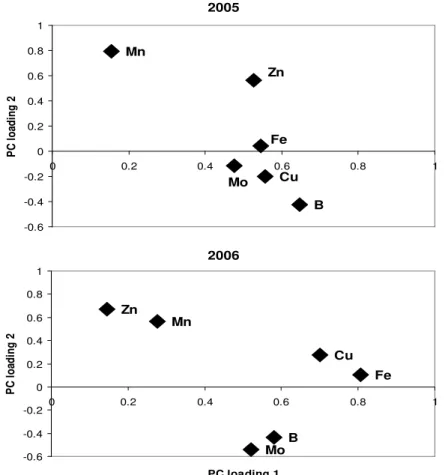
Figure 1. Principal component loadings (similarities of compositional traits), loading 1 (PC1) versus loading 2 (PC2) for concentrations of six micronutrients computed separately for 2005 and 2006
Slika 1. Koordinate glavnih komponenata (sličnosti između svojstava); os 1 (PC1) prema osi 2 (PC2) za koncentracije šest mikroelemenata izračunatih odvojeno za 2005. i 2006. godinu
Quantities of micronutrients in grain are influenced by numerous complex factors including genotypes, soil properties, environmental conditions and nutrient interactions (House, 1999). As a consequence, results reported in literature about micronutrient concentrations in maize grain varied substantially. Brkić et al. (2004) reported somewhat higher concentration values for majority of the micronutrients determined at the same location as in our study, but with other genotypes in different years.
Our results demonstrate that environmental conditions can play also an important role for micronutrient density in grain, since there were weak associations for Fe, Mo and Zn concentrations between the two years when the same genotypes and very similar soil properties were considered (Table 2). It is certainly connected with different multivariate relations of these elements across the two years revealed by PCA. Further analysis of genotype by environment interaction seems to be necessary in order to explain relations between genotype and environment for micronutrient density. Our previous study in the same material and at the same environments (Šimić et al., 2009) demonstrates that genotypes should be evaluated over a number of environments to obtain accurate estimates of heritability and genotype by environment interaction for iron and zinc concentrations. However, if there were no adverse soil chemical properties such as mineral deficiency (Cakmak, 2008 for review) or extreme weather conditions like in our study, it was expected that the relations among six micronutrients should be constant at the same location.
(2007) found also tight positive relations in wheat among Cu, Mn and Zn according to both correlations and PCA analysis.
CONCLUSION
Generally positive correlations between micronutrient concentrations in maize grain suggest that it is possible to improve various micronutrients in maize grain simultaneously. Further work should be done to elucidate underlying physiological mechanisms of the relation among the micronutrients, particularly in cases when the relations are not obscured by deficiency of any element as an additional complicating factor.
REFERENCES
1. Bänziger, M., Long J. (2000): The potential for increasing the iron and zinc density of maize through plant breeding. Food and Nutrition Bulletin 20:397-400.
2. Brkić, I., Šimić, D., Zdunić, Z., Jambrović, A., Ledenčan, T., Kovačević V., Kadar I. (2003): Combining abilities of Corn-Belt inbred lines of maize for mineral content in grain. Maydica 48: 293-297.
3. Brkić, I., Šimić, D., Zdunić, Z., Jambrović, A., Ledenčan, T., Kovačević V., Kadar I. (2004): Genotypic variability of micronutrient element concentrations in maize kernels.
4. Cakmak, I. (2008): Enrichment of cereal grains with zinc: Agronomic or genetic biofortification?
Plant and Soil 302:1-17.
Cereal Research Communication 32:107-112.
5. Comrey, A.L., Lee, H.B. (1992):
6. FAO/UNESCO. (1990): Soil map of the world, revised legend, World Soil Resources Report 60. A first course in factor analysis (2nd ed.). Lawrence Erlbaum Associates, Hillsdale, NJ
7. Fisher, G.E.J. (2008): Micronutrients and animal nutrition and the link between the application of micronutrients to crops and animal health. Turkish Journal of Agriculture and Forestry 32: 221-233.
8. Graham,
9. House, W. (1999): Trace element bioavailability as exemplified by iron and zinc. Field Crops Research 60:115-141.
R.D., Senadhira, D., Beebe, S., Iglesias C., Monasterio I. (1999): Breeding for micronutrient density in edible portions of staple food crops: conventional approaches. Field Crops Research 60:57-80.
10. Kaiser H.F., Rice J. (1974): Little jiffy, mark IV. Educational and Psychological Measurement 34: 111-117.
11. Liu, K., Goodman, M.M., Muse, S., Smith, J.S.C., Buckler E.S., Doebley J. (2003): Genetic structure and diversity among maize inbred lines as inferred from DNA microsatellites. Genetics 165: 2117-2128.
12. Mason, S.C., D’Croz-Mason N.E. (2002): Agronomic practices influence maize grain quality. Journal of Crop Production. Vol. 5: 75-91.
13. Ortiz-Monasterio, J.J., Palacios-Rojas, N., Meng, E., Pixley, K., Trethowan, R., Pena, R.J. (2007): Ehnancing the mineral and vitamin content of wheat and maize through plant breeding. Journal of Cereal Science 46:293-307.
14. Otto, M. (1999): Chemometrics statistics and computer application in analytical chemistry. Wiley, Weinheim, Germany.
15. Patterson, H.N., Williams, E.R. (1976): A new class of resolvable incomplete block designs. Biometrika 63:83-92.
16. Piepho, H.P., Büchse A., Truberg B. (2006): On the use of multiple lattice designs and alpha designs in plant breeding trials. Plant Breeding 125:523-528.
17. Salt, D.E., Baxter I., Lahner B. (2008): Ionomics and the study of the plant ionome. Annual Review of Plant Biology 59:709-733.
19. Šimić, D., Sudar, R., Jambrović, A., Ledenčan, T., Zdunić, Z., Kovačević, V., Brkić, I. (2009): Genetic variation of bioavailable iron and zinc in grain of a maize population. Journal of Cereal Science (in press).
20.
21.
Škrbić, B , Onjia, A. (2007): Multivariate analyses of microelement contents in wheat cultivated in Serbia. Food Control 18:338-345.
Sorić, R., Lončarić, Z., Kovačević, V., Brkić, I., Šimić, D. (2009): A major gene for leaf cadmium accumulation in maize (Zea mays L.). The Proceedings of the International Plant Nutrition
Colloquium XVI. UC Davis, USA. Retrieved from:
22. Welch, R.M., Graham R.D. (2002): Breeding crops for enhanced mineral content. Plant and Soil 245: 205-214.
ODNOSI MEĐU ŠEST MIKR
OELEMENATA U ZRNU PROCIJENJENIH U
POPULACIJI KUKURUZA
SAŽETAK
Iako mikroelementi imaju važnu fiziološku ulogu kod životinja i ljudi, malo je objavljenih radova o odnosima
među njima u zrnu žitarica. Cilj ovoga rada je bio odrediti odnose među koncentracijama bora (B), bakra
(Cu), željeza (Fe), mangana (Mn), molibdena (Mo) i cinka (Zn) izmjerenih induktivno spregnutom plazmom
– optičkom emisijskom spektrometrijom (ICP-OES) u suhom zrnu 297 genotipova jedne populacije kukuruza
tijekom dvije vegetacijske godine. Korelacijski koeficijenti su ukazali na slabu, ali pozitivnu povezanost pojedinih koncentracija mikrohraniva u obje godine. Analiza glavnih komponenata je otkrila da odnosi među
mikrohranivima nisu isti kroz godine, ukazujući važnost okoline. Međutim, uočena je bliska povezanost između Cu i Fe, i u nešto manjoj mjeri između B i Mo. Mn je dosljedno najslabije povezano mikrohranivo s
drugima. Naši rezultati ukazuju na mogućnost istovremenog poboljšanja koncentracije nekoliko
mikrohraniva u zrnu kukuruza, iako bi napredak bio dosta spor.
Ključne riječi: zrno, kukuruz, mikrohraniva, analiza glavnih komponenata