F O O T B A L L S P O N S O R S H I P S
Master in Marketing
Frederik Bastian SchoopFootball Sponsorship Market: Danish perspective.
Supervisor:
Daniela Langaro ISCTE Business School, Phd Departamento de Marketing, Operações e Gestão Geral
Acknowledgements
I want to thank Amanda for her unconditional support. Furthermore, I appreciate the support given from family and friends, and especially I want to thank Daniela Langaro, and all who took time for interviews and surveys, I couldn’t have done it without you!
Abstract
The purpose of this project was to investigate and analyse the Danish football sponsorship market. In doing so, existing theory was explored regarding motives associated to sponsorship in sports, criteria for sponsorship evaluation and measurement and the influence of fans regarding sponsorships. In the following phase, data were collected among sponsors, football clubs and football related external companies. The findings were analysed in order to examine how the Danish football sponsorship market relates to the explored theory. Envisioning to obtain a solid data collection, in-depth interviews were conducted with 7 persons from 6 football clubs and with 2 football related external companies and an online survey was sent to 39 companies located in Denmark (27 valid responses were obtained). The results obtained support the literature in various aspects, However, some important discrepancy is identified concerning two topics, namely: Sponsorships motives, where football clubs and football related external companies describe the importance of networking with other companies, as a key motive for driving sponsorship decisions and the limited evaluation and measurement approaches used in sponsorships, with individuals´ gut feeling being the method most commonly adopted to evaluate results. In contrast, the companies investigated disagree and state brand awareness as a key motive for the establishment of football sponsorships. Furthermore, they also point out brand awareness, internal and external feedback as the essential methods used to measure and evaluate sponsorships, despite acknowledging difficulties on implementing those criteria in their managerial practices. Finally, both targets agree on the influence of fans` support for the decision towards a sponsorship agreement, particularly concerning fans´ attendance to games. Future studies are recommended.
Resumo
O objetivo deste projeto foi o de investigar e analisar o mercado de patrocínio de futebol dinamarquês. Ao fazê-lo, a teoria existente foi explorada quanto motivos associados ao patrocínio de esportes, critérios de avaliação de patrocínio e medição ea influência dos fãs sobre patrocínios. Na fase seguinte, os dados foram coletados entre os patrocinadores, clubes de futebol e futebol empresas externas relacionadas. Os resultados foram analisados a fim de analisar a forma como o mercado de patrocínio futebol dinamarquês refere-se à teoria explorado. Prevendo a obter uma recolha de dados sólida, entrevistas em profundidade foram conduzidas com 7 pessoas a partir de 6 clubes de futebol e com 2 empresas externas relacionadas com o futebol e uma pesquisa online foi enviado a 39 empresas localizadas na Dinamarca (foram obtidas 27 respostas válidas). Os resultados obtidos suportam a literatura em vários aspectos, no entanto, alguma discrepância importante é identificado relativamente a dois temas, a saber: motivos patrocínios, onde os clubes de futebol e as empresas relacionadas externos descrevem a importância do trabalho em rede com outras empresas, como um motivo fundamental para a condução de patrocínio decisões e as abordagens de avaliação e de medição limitados utilizados em patrocínios, com individuals' intuição sendo o método mais comumente adotado para avaliar os resultados. Em contraste, as empresas investigadas discordar e consciência de marca estado como um motivo chave para o estabelecimento de patrocínios de futebol. Além disso, eles também apontam a notoriedade da marca, feedback interno e externo como os métodos essenciais utilizados para medir e avaliar patrocínios, apesar de reconhecer dificuldades na implementação desses critérios em suas práticas de gestão. Finalmente, ambos os alvos acordo sobre a influência do apoio fans` para a decisão no sentido de um acordo de patrocínio, nomeadamente no que respeita fans' atendimento aos jogos. Futuros estudos são recomendados.
Executive Summary
The current project intended to research if the managerial practices put in place in the Danish football market are aligned with the existing theory, regarding the motives for establishing sponsorship agreements, with specific interest on the influence of the football clubs´ fans, and methods for measurement and evaluation of agreements.
In-depth interviews were conducted with 7 persons from 6 football clubs and 2 football related external companies and an online survey was sent to 39 companies located in Denmark (27 valid responses were obtained), to acquire a solid data foundation.
According to the obtained results, networking with companies is one the most important elements for the establishment of a football sponsorship in Denmark, and is the main motive for companies when deciding on a sponsorship agreement according to football clubs and football related external companies. All the football clubs and the external companies highlighted networking with companies as the key motive. The companies have a different viewpoint and states brand awareness as the main motive, which is represented in previous studies emphasised as a motive for deciding upon sponsorship. This is a very important discrepancy to acknowledge (Andersen et al., 2015; Serra et al., 2009; Fuller, Turner and Karg, 2010; Britcher, 2004; Serra et al., 2009; Meenaghan, 2001).
Regarding the methods used for evaluating and measuring the results of sponsorship agreements reveals a discrepancy between how companies evaluate and measure their sponsorship. The companies express brand awareness, internal feedback and external feedback as the most common used methods, which emphasised with previous studies, and additional states sponsorships are difficult to measure and evaluate. The football clubs and the football related external companies, expresses that companies don’t measure and evaluate sponsorships, and base their measurement and evaluation on gut feeling as their main approach. Justifying sponsorships by this method as a generally accepted approach towards measurement and evaluation of sponsorships does not appear to be a trustworthy and credible method. The discrepancy between companies and football clubs and football related external companies, is an important discovery (Meenaghan, 2001; Wolfe, 2016).
Regarding the influence of the football clubs´ fans on sponsorship, results reveal that the companies argue against being influenced by fans, and states that fan attendance at the football games is an important contribution in the establishment of
sponsorships. The football clubs and the football related external companies agrees on these statements, and describes the influence by fans as minimal.
In conclusion, fans´ influence is the only subject investigated where all involved parties, companies, football clubs and football related external companies, agree on the question on how fans influence sponsorships (Fullerton, 2010; Britcher, 2004; Shannon, 1999; Bee and Kahle, 2006).
Finally, the results of current project need to acknowledge the limitations associated with the method of data collection, which was limited to Denmark. Within the scope of companies, I suggest that future studies involve additional influencers in companies, enriching the results. In addition, future studies possibly will profit from one to one interviews with sponsors and uncovering and exploring new facets, of the discrepancy in football sponsorship motives, and measurement and evaluation methods of football sponsorships.
Keywords: Sponsorship in sports; Football clubs; Motives for sponsorship agreements; Evaluation and Measurement of sponsorships; Fans´ influence on sponsorships.
Table of contents
Acknowledgements i
Abstract iii
Resume iv
Executive summary vi
List of figures and tables viii
Chapter 1 - Introduction 1
1.1Research context 1
1.2 Research context - Danish football market 4
1.3 Research questions 6
1.3.1 Research question 1 6
1.3.2 Research question 2 7
1.3.3 Research question 3 7
Chapter 2 - Literature review 8
2.1Literature review of sponsorships 8 2.2 Summary of previous studies in view of the Research Questions 18 2.2.1. Summary of previous studies regarding Research Question 1 Fejl! Bogmærke er
ikke defineret.
2.2.2. Summary of previous studies regarding Research Question 2 20 2.2.3. Summary of previous studies regarding Research Question 3 Fejl! Bogmærke er
ikke defineret.
Chapter 3 - Methodology 22
3.1 Data collection – In-dept interviews 22
3.2 Data collection – Survey 24
Chapter 4 - Results 26
4.1 Data analysis 26
4.1.1 Research question 1 – Sponsorship motives 26
4.1.3 Research question 3 – Fans´ influence 46
Chapter 5 - Conclusion, limitations and future studies 54
5.1 Conclusion 54
5.2 Limitations and future studies 57
Chapter 6 - References 58
Appendix A 64
A.1. Interview guide 64
Appendix B 68
B.1. List of respondents that integrated in the interviews 68
Appendix C 70
C.1 Transcription of Interviews 70
Appendix D 86
D1. Questionaire used with ccompanies 86
Appendix E 90
E1. List of respondents that integrated in the questionnaire 90
Appendix F 92
List of figures and tables
Figures: Page:
Figure 1: Elements in Football Sponsorships v.1 3 Figure 2: Profile of clubs 27 Figure 3: Evaluation and measurement statement 40 Figure 4: Evaluation and measurement methods 41 Figure 5: Elements in Football Sponsorships v.2 55
Tables:
Table 1: Summary of motives associated to sponsorships 19 Table 2: Measurement and evaluation criteria 20 Table 3: Influence of fans` on sponsorships 21 Table 4: Sponsorship importance 29 Table 5: Sponsorship statements 30 Table 6: Sponsorship motives 32
Table 7: Evaluation and measurement elements 38
Table 8: Fan relationship 47 Table 9: Fans` influence 49
1. Chapter 1
Introduction
1.1 Research context
Football is a sport that has been practised for centuries, but football is also a multi-million dollar industry, an industry that each year becomes more powerful, significant and loved across countries. The sums of money spent on sponsorships in football increases along with the interest in football every year, and now clubs, on average, earn more than 200 million dollars a year on sponsorships (Andrews, 2015; Smith, 2015).
Today, it is almost impossible to find a club that is not sponsored in some way, whether local, national or international, because sponsorships increase awareness of the company, develop a relationship to a certain club and the clubs themselves receive financial support. These are some factors why a company enters into sponsorship, and it can also lead to goodwill towards fans but, more importantly, brand awareness to a specific target group. Companies are likely to become a sponsor because of the emotional connection that consumers have with their football clubs. The emotional connection is very strong, and companies see this marketing approach as an influential marketing tool (Andersen et al. 2015)
Andersen et al. (2015) and Fullerton (2010) describe sponsorships as just one of many methods that companies today use as a marketing tool. Previously, sponsorship was more a way of supporting a local club, but now sponsorship is used together with other marketing tools to maximise exposure and revenue. Therefore, is it also important to
the level and form of sponsorship. However, first the company has to be aware of whether the football club’s brand can be associated with their own brand, and understand the relationship and commitment between consumers, fans and the football club (Fullerton, 2010). Companies are able to reach out to a significant audience, as fans around the world watch football every week, and the exposure to football is only on the increase throughout the whole world, which contributes to fans being an important part of sponsorships. Andrew (2015), states that sponsorship is a traditional way of using marketing as a communication tool, but nowadays sponsorships also reach other marketing channels, such as events and social media. These channels can facilitate the marketing strategy and, by using all potential communication parameters and channels, the company can optimise their integrated marketing approach towards reaching business objectives (Andersen et al. 2015; Andrew, 2015; Fullerton).
Sponsorships, according to Fullerton (2008), are also a way of strengthening the brand image and equity of a company, but particularly the awareness. When a company sponsors a football club it will lead to increasing knowledge of the company’s image, products and brand. In addition, Dees, Bennett and Villegas (2008), Hinson (2011), Joseph (2012), Richelieu, Pawlowski and Breuer (2011) and Urbach (2008) notes that strong fan loyalty towards their football clubs would have a positive effect on the company, since fans are expected to buy products or services from a company that supports and sponsors their favourite clubs. Companies use football clubs to communicate a statement or to increase the awareness of the brand, which is being achieved through exposure in the media and other communication channels.It means that the company can reach out to their segment, but also target potential new customers, because of the attention to football worldwide. When a company incorporates sponsorships into their strategy, they interact with the club on various marketing channels and co-operate towards long-term visions for both company and football club. Current and potential customers will link the brand and club together, which enhances brand identity (Dees, Bennett and Villegas, 2008; Fullerton; Hinson, 2011; Joseph, 2012; 2010 Richelieu, Pawlowski and Breuer, 2011; Urbach, 2008).
Figure 1. Elements in Football Sponsorships v.1
(Self-made illustration of elements in football sponsorships according to Kivirauma, 2015) • The company which sponsors the football club, wants to use sponsorship as a
marketing tool towards fans and in order to reach their target they must connect with the club (Kivirauma, 2015)
• The fans are spectators, receivers of the marketing communication message, and follow the football club (Kivirauma, 2015).
• The football clubs receive sponsorships, and co-operate with companies (Kivirauma, 2015).
Sponsorships are used differently, and obviously sponsorships can be considered too expensive to be feasible, which makes the evaluation of the sponsorship very important; therefore, companies have to carefully select partners where a potential profit will be made. As this trend continues to grow and develop, new research studies on sponsorship motives are required in order to provide an improved understanding of what it takes to achieve a successful sponsorship, and additionally, how companies measure and evaluate the sponsorship outcome. Furthermore is it also important to understand how third parties, such as fans, can influence the decision making process of a sponsorship. All these factors will be linked together in order to better understand sponsorships (Fullerton, 2010; Kivirauma, 2015).
1.2 Research context - Danish football market
According to DBU (2013), Denmark had no domestic professional league until 1978 and it was forbidden for Danish football clubs to have professional players. However, as a result of requests from several highly respected personalities, Denmark finally introduced professional football in late 1978. Not introducing it before had proved challenging for Danish football and also influenced the general standard in all Danish football clubs. However, Carlsberg became the first sponsor of the first Danish league and developed the Danish football league standard and reputation, to become a serious European contender (DBU, 2013)
The Danish sponsorship market has been going through a tough period that started back in 2007 with the global crisis. Customers were not spending at the same level as before the crisis, resulting in hard times for companies nationally and globally. Consequently, companies needed to reign themselves in and eliminate unnecessary expenses, such as sponsorships. Currently, there is an economic recovery, which is expected to pave the way for new and more sustainable sponsorships (Ohmsen, 2013).
Fyns Stiftiende (2016) states that all the sponsors of F.C. København pay a total of 12.6 eur million each year for sponsorships, while the second largest income from sponsorship comes from another Copenhagen-based football club, Brøndby I.F., with an income on 5,1 eur million. SønderjyskeE, in contrast, generated an income of 2,2(eur) million, making their sponsorship income the lowest in the Danish Superliga (Fyns Stiftiende, 2016).
This indicates a huge gap between sponsorship income in Denmark, and F.C. København is certainly the biggest club calculated on economy, which gives them an advantage in the market. On the other hand, is it an unwritten rule that most Danish football clubs have financial problems. Both historically and today, Danish football clubs are fighting to survive, even though there has been some level of stability for some football clubs; it is still rare to be financially secure as a football club in Denmark (Business, 2014).
According to Business (2014), Danish football has had some difficult years, not only because of decreasing results in terms of decreasing rank list points but also decreasing interest in both the national team and in the Danish football league and also because of the financial crisis. Both the fans and economic development have had an impact on the Danish football clubs, and the clubs are suffering. Business (2014) furthermore states that the development of marketing sees an increase in television advertising and Internet were the big winners in the advertising market in 2011, while the market for sports sponsorships remained stable with a turnover of 160 mil eur.
”Overall, we have been through a financial crisis, and the fact is that the media market has declined. It negatively affects the sum of money that companies spend on marketing as a whole and thus sponsorships specifically. It is both declining demand and lower prices. At the same time the sponsors ask for higher requirements for clubs in documenting the effect of sponsorship” (Business, 2014, p.1).
Business (2014) and Christensen (2013) describes football in Denmark as a declining product for companies to become involved in, and additionally are sponsorships difficult to measure and quantify. Storm (2016), also highlights it as an economically unstable industry ”Danish football hasn’t seen its last rescue, or capital injection - Challenges related to sponsorship-income are a detailed measurement of the sponsor's return on investment - sports and sponsorship is great marketing and football is the best product in Denmark" (Christensen, 2013, p.15)
In the last 20 years, annually, there has been at least one capital raise in the best football league in Denmark, and the Danish football clubs have had a very difficult time attracting new sponsors, and have thereby damaged the foundation of the football clubs (Storm and Hayman, 2016).“The Danish clubs survive because there are a number of external stakeholders, creditors, sponsors and patrons who help and support when the crisis began – There has also been given extraordinary sponsorship which helps to support the industry.” This is an explicit comment from Storm (2016,p.1) which is responsible for research and analysis in IDAN, analyses of elite sport and economics in professional sports, and which states how important sponsorships are to the continuation of football clubs’ existence (Storm, 2016).
Danish football clubs are still in their early days of development, and a considerable part of the Danish football clubs have fluctuating economical problems. The financial crisis and the decreasing interest for Danish football contributes to an unstable industry. Therefore, will this dissertation be an important contribution in order to understand how does the football sponsorship market in Denmark stand in view of recommendations and theory from previous studies.
1.3 Research questions
Despite the increasing relevance and importance of sponsorships in the Danish football market, due to economical challenges for Danish football clubs, there are questions that are still poorly addressed in the sports-related literature concerning aspects like the motives for sponsoring, the criteria for evaluating and measuring the results and the influence of the emotional connection between fans and clubs on sponsorship agreements. Therefore, the current dissertation will investigate each of the abovementioned objectives. While doing that, the focus will be placed on the Danish football market which will be used in order to deepen the current understanding available in the sports-related literature and to critically understand up to what point the current literature reflects the managerial reality. It is important to understand the motives behind sponsorships and why companies are likely to invest in co-operation with football clubs. By strengthening the pre-analysis stage, companies could take more advantage of their sponsorship. Furthermore, this study can help both parties to understand the results of sponsoring football clubs, along with the importance of fans having an emotional connection with their team. (Andersen, et al. 2015).
In view of these aspects, the current dissertation intends to address the following research questions:
1.3.1 Research question 1
• What are the main motives present when companies decide to sponsor a football club?
I wish to understand how the motives behind the establishment of sponsorships form the companies’ perspective, in relation to the investigated objectives in the literature review. In
understanding the current market situation for companies, this question will be analysed from a Danish market perspective to understand the motives the companies.
1.3.2 Research question 2
• How can companies measure and evaluate the outcomes of a football club’s sponsorship?
Through having clear practices, strategies and motives for the sponsorships, companies are able to attain successful sponsorships, and thereby secure financial profits, but it does not necessarily equate to a simple way of analysing the sponsorship. This question will be analysed, from a Danish market perspective and will attempt to give an answer on which evaluation and measurement approaches are being used to gather valid information in order to secure and justify this marketing tool.
1.3.3 Research question 3
• How important are fans’ interaction and relationship with the club, when a company has to engage with a football club?
By understanding sponsorship motives and companies’ measurement and evaluation methods, this question will focus on how fans influence sponsors and how important they are for the establishment of a sponsorships, and analyse the importance of fans and their relationship to the club, before and during the sponsorship.
2. Chapter 2
Literature review
2.1 Literature review of sponsorships
Given the current project’s research problems, the project has focused the literature review on studies that investigate the subject of sponsorships within this specific area. The project’s primary focus will be on international literature concerning the research questions, due to a limited range of studies on the Danish football sponsorship market.
Sports sponsorships provide the image of being healthy, young, energetic, fast and vibrant (Jobber, 2007). By collaborating with sports clubs, the company interacts with a brand that symbolises certain attributes. The audience, customers, clients or the users, will find the sponsor’s logo and other symbols embedded within the event, game, player, etc., and learn to associate the sponsor with the activity. The connection creates symbioses, and further generates stable conditions for cooperation, which will lead to improved revenue (Jobber, 2007).
According to Jobber (2007) companies need to satisfy their customers by creatively managing their marketing mix in order to have a competitive advantage over others (Jobber, 2007).
Sponsoring events is a great way for companies to promote their brands, logos and products. Products can conveniently incorporate logos that associate the company with the sponsored object, and a wider audience will retain and recognise the logo (Jobber, 2007)
• Improving community relations:
Social responsibility is a key element of why companies become involved in sponsorship. Sponsorship can improve the reputation of a company in its given community (Jobber 2007).
• Fostering favorable brand and company associations:
The intention is for a company to associate itself with an event and hopefully, the positive elements of the event can be transposed to their products as well (Jobber, 2007,).
• Creating entertainment opportunities:
Jobber also argues that companies not only sponsor events for publicity, but also to reach out to customers that are highly placed in various fields. Employees can benefit from sponsorships by getting tickets to events, meeting sports idols or participating in other ways (Jobber, 2007)
• Gaining publicity:
Sponsorship provides a useful platform to reach millions of spectators, whereby some of them are likely to become customers due to the publicity provided by the various media coverage. Jobber believes that sponsorship of certain major events such as football assist in producing awareness for products (Jobber, 2007)
Additional external motives described by Meenaghan (2001). • Corporate Social Responsibility (CSR):
CSR is understood as a company’s responsibility to act in an ethical way as they aim to reach the needs of their society as well as the demands from their stakeholders (Meenaghan, 2001 p.95).
• Local community involvement:
Social objectives in sports sponsorship have become increasingly common for companies in terms of community involvement and cause-related marketing with the purpose of improving their brand image (Meenaghan, 2001)
• Market penetration:
From a marketer’s point of view, an important motive for sponsorships is to penetrate new markets and reach new audiences (Meenaghan, 2001).
Meenaghan (2001) and Jobber (2007) have the same opinion of how sponsorships can be used in a marketing campaign, but adopt different ways of expression and define the aforementioned aspects of sponsorship as a marketing tool, and additional Koluperas, Morrow and Sparks (2015), describes improving local community relations and corporate social responsibility as an very important factor of sponsorships motives with future development potential (Jobber, 2007; Koluperas, Morrow and Sparks, 2015;Meenaghan, 2001).
Previous studies by Britcher (2004) and Serra et al. (2009) states that it is important to observe and understand why a company would wish to spend millions of dollars to sponsor a football team. The outcomes of the sponsorships are not always equal to the budget used on them, and the negative ramifications of being a part of a business which, has over the years, become more corrupt than ever, can also be damaging to the brand. This has become a central issue in sponsoring a football team, and a concern when taking part in this communication strategy (Britcher, 2004; Serra et al. 2009). Nevertheless, according to Andersen et al. (2015), sponsorships lead to various goals for the company; increasing sales, awareness, brand value, reputation and image, as a result of the commercial alliance between the two parties (Andersen et al., 2015)
Therefore, companies use sponsorships as a communication channel to reach their general business objective, which is increasing profits within target groups and potential customers. As Fuller, Turner and Karg (2010) continue to state, sponsorship is a marketing tool towards achieving familiarity in a given target audience. This is in contrast to Britcher (2004), who states, together with Jobber, that it opens up opportunities to reach new target groups and new customers (Britcher, 2004; Fuller, Turner and Karg, 2010; Jobber 2007). However, Fuller, Turner and Karg (2010) merely focus on the established segment and overlook the opportunity to use sponsorship to enter into new markets. (Fuller, Turner and Karg, 2010). Burnett, Menon and Smart (1993), Cornwell and Maignan (1998), Fuller, Turner and Karg (2010) and Hinson (2011) analyse the impact of sponsorships in
With an appropriate match between sponsor and sport organisation, the sponsor can influence their target group on a global basis, due to the similar vision and mission. This marketing platform is able to effectively penetrate the marketing and promotional mix, and is also an effective method used by companies to achieve their marketing strategies (Burnett, Menon and Smart, 1993; Cornwell and Maignan, 1998; Fuller, Turner and Karg, 2010; Hinson, 2011).
Therefore, considering that a partnership will only be successful if both parties have identical ideas and a general understanding of how they both should reach their objectives, it is important, according to Richelieu, Pawlowski and Breuer (2014), Burnett, Menon and Smart, 1993 and Britcher (2004) to clarify how the overall goal should be accomplished in order to achieve increased brand value for the organisation and the sports club (Britcher, 2004; Burnett, Menon and Smart, 1993; Richelieu, Pawlowski and Breuer, 2014).
According to Richelieu, Pawlowski and Breuer, (2014), Serra et al. (2009) and Dees, Bennett and Villegas (2008) there is an emotional connection between football clubs and fans, where fans can feel a deep kinship to a specific club, the culture and group of people. Football clubs all have something in common, feelings and emotions, which is unique. It is unbroken and intact relation, and defines the long-term cooperation between football clubs and companies - and companies are likely to become a part of this strong connection between fans and team. Overall, the customer loyalty to the brand will be increased when the company is sponsoring a sports organisation, and the brand will obtain important benefits in terms of awareness (Dees, Bennett and Villegas, 2008; Richelieu, Pawlowski and Breuer, 2014; Serra et al. 2009).
Many fans will purchase souvenirs that can be used as a keepsake of their attendance at a game, or as visual means of demonstrating support for a specific team, player or event. Some of these products, however, may serve a purpose beyond simply being a souvenir. The meaning of such mementos is deeply entwined with the feelings towards the club, and can be displayed at any time. Serra et al. (Serra et al. 2009) and Richelieu, Pawlowski and Breuer, (2014) agree in general terms, but Richeliue Richelieu, Pawlowski and Breuer (2014), Bee and Kahle (2006) and Dees, Bennett and Villegas (2008), are more detailed regarding the influence from fans. The influence can be major, and the loyalty
between club, fans and company can affect all of the objectives both positively and negatively for a long time. Therefore, according to Serra et al. (2009), brand awareness is the main purpose for companies choosing sponsorships as a marketing channel (Bee and Kahle, 2006; Dees, Bennett and Villegas, 2008; Richelieu, Pawlowski and Breuer, 2014; Serra et al. 2009).
A sponsorship is a great way of conducting businesses on a more personal basis in order to create a certain level of goodwill, as Fuller, Turner and Karg (2010) state. This is similar to the reasoning of Serra et al (2009): gaining awareness by sponsoring football teams. Richelieu, Pawlowski and Breuer (2014) and Cornwell and Maignan (1998) are more focused on the commitment between fans, club and companies - with the intention of a long-term cooperation that will gain profit over the long term. (Cornwell and Maignan, 1998; Fuller, Turner and Karg, 2010; Richelieu, Pawlowski and Breuer, 2014; Serra et al., 2009).
In contrast, Urbach (2008) and Burnett, Manon and Smart (1993) describes the importance of establishing strong relationships based on similarly accepted objectives. In order to illustrate that, Urbach (2008) mentions the example, involving MasterCard and FIFA. MasterCard claimed it had the right to future sponsorship, but instead FIFA settled an agreement with VISA, the company’s rival. Because of external problems, which often lead to challenges for the companies and sports organisations, this example almost went to court, but eventually both parties agreed on financial compensation for MasterCard. Urbach (2008) further highlights that the overall objectives for MasterCard were to increase awareness during the FIFA World Cup, one of the biggest sports event worldwide (Burnett, Manon and Smart, 1993; Urbach, 2008).
Richelieu, Pawlowski and Breuer (2014) and Crimmins and Horn (1996) states that it is very important that the emotional connection and long-term association are well connected to achieve overall objectives, with positive effects and outcomes. As MasterCard lost the opportunity to engage in a long-term contract with FIFA, Visa had to build up emotional connection, and a clear strategy towards their target audience (Crimmins and Horn, 1996; Richelieu, Pawlowski and Breuer, 2014).
Sponsorships can also be an over-represented environment and are under increasing pressure to respond to public disapproval, and furthermore cannot guarantee wider brand awareness or a positive outcome. Britcher (2004) and Kleiman (2003), concur that sponsoring a sports club will not inevitably result in a positive brand effect and have not yet become convinced that it will lead to positive effects, even with the establishment of a long-term connection and emotional ties with a sports club (Britcher, 2004; Kleinmann, 2003). Because of different viewpoints on how a sponsorship influences a company, it is difficult to measure tangible outcome of the sponsorship in terms of specific numbers and increased profit, as it is notoriously difficult to measure the outcome of a sponsorship and indeed measure long-term results (Britcher, 2004; Kleinmann, 2003). Furthermore Fullerton (2010) and Crimmins and Horn (1996), states that football sponsorship will not always contribute to brand awareness among the target group and increased added value for their clients and potential customers, although companies tend to look for football clubs that have strong ties to fans and can effectively reach the target audience, and additional Cahill and Meenaghan (2013) explains how well-established brands made a policy of using sponsorships as a market penetration tool (Cahill and Meenaghan, 2013; Crimmins and Horn, 1996; Fullerton, 2010).
Companies can also suffer from sponsorships. Red Bull bought the local football club in Leipzig, and renamed the club to RB Leipzig, which has made German fans furious and caused them to boycott their stadium. Germans clubs have to be majority-owned by the fans, and, since Red Bull became interested in managing the club, it “arbitrarily rejects membership applications: whereas Bayern Munich has 270,000 members, RB Leipzig has only 636” (Economist, 2016, p. 1). Additional Backhaus, David & Haselhoff (2014) elaborates on the topic and states sponsorships can have strong negative emotional effects on fans, and establish resistance to sponsors. (Backhaus, David & Haselhoff, 2014; Economist, 2016).
As mentioned, sponsorship does not guarantee positive brand awareness, resulting in sponsorships affecting the brand image negatively, which also direct change consumer behaviour and attitude. David Ornstein (2014) states that the episode with Nicolas Anelka - his anti-Semitic ‘aquelle’ salute at his former football club West Bromwich Albion – has affected the sponsorship in a negative way, and also led to increased negative attention
paid to his football club. This resulted in the main sponsor, Zoopla, deciding to resign from their sponsorship. Furthermore, Ornstein (2014) and Shannon (1999) explains how the negative evaluation of the brand can made it difficult for clubs to collaborate with a new sponsor (Ornstein, 2014; Shannon, 1999).
Ornstein (2014) also concludes that it has been a turbulent time for West Bromwich Albion, and its brand image and value. Although Zoopla has managed to get some positive PR and turned the situation into positive reviews, it has also affected their brand image, because consumers associate their brand with the episode (Ornstein, 2014).
Zoopla thus did not achieve success in their marketing strategy; not only was their target audience affected by the accident, but potential new customers were also affected. The only positive outcome for Zoopla was they reached a wider target audience in mass media, but the audience were not able to disassociate the brand and the episode, as Ornstein (2014) highlights concerning the incident (Ornstein, 2014).
A former study by Joseph (2012) shows that trustworthiness can be hindered if a brand decides to sponsor a rival, as Joseph (2012) Dees, Bennett and Villegas (2008) explains because of the very high loyalty to football teams by fans. It can have negative effects for big companies and become a significant problem if a company is sponsoring two teams with a long history of rivalry, such as Liverpool FC and Manchester Utd. FC (Dees, Bennett and Villegas 2008; Joseph, 2012).
Chevrolet ultimately decided to end their sponsorship with Liverpool, because of the unconstructive and negative reviews in the media, which have resulted in a lost brand value for Chevrolet, and also caused a lack of trust from both clubs’ fans, as Grohs, Heribert and Woesetschläger (2015) and Joseph (2012 clarify that fans have negative perception of rival teams and its sponsors (Grohs, Heribert and Woesetschläger, 2015; Joseph, 2012).
<<
Fans are also an important factor for companies when they establish a sponsorship. Bricther (2004), Fullerton (2010), Bee and Kahle (2006) and Shannon (1999) highlights; attendance, number of sponsors and media coverage as some of the important factors that impact on the sponsorship ( Bee and Kahle, 2006; Britcher 2004; Fullerton,
both parties to agree on a strategic vision to reach targets and objectives. They will have to agree on a common vision through mutual co-operation, if the partnership has to give a positive outcome for both the organisation and the sports club, which is also an essential condition according to Ornstein (2014) and Catterway (2012).
Chevrolet, MasterCard and Zoopla all experienced negative reviews and had to end their sponsorships, although the termination also attracted positive attention. Companies can take advantage of a negative occurrence and transform it to a more agreeable situation and gain profit, PR and awareness. Joseph (2012) also emphasises the importance of knowing the market well, and understanding cultural perspectives in order to prepare a considered and clear marketing strategy (Catterway, 2012; Ornstein, 2014; Hinson 2011; Jobber, 2007; Joseph, 2012)
Nevertheless, Yueh (2014) explains why Asian tycoons, Russian oligarchs, Arab sheikhs and American businessmen have the same motive for getting involved with football clubs worldwide: many of them spend billions of euros and these investors are not focused on the profit but are more interested in the game and enthralled by the sport. In today’s football, while it is commonly known that owners compete to acquire the best football players in the world to generate a profit, some investors genuinely support their club, and may have strong ties to the local community and thereby invest through goodwill. Furthermore does Crimmins and Horn (1996), Olkkonen and Tuominen (2006) and Yueh (2014) explain how businessmen can have distinct motives where the head rules the heart, and the financial outcome is more important than the sporting results, because the sponsorship motives is based on personal motivation. In addition, investments in football clubs can also give you celebrity status, access to important people and football clubs are also used a as a “toy.” (Crimmins and Horn 1996; Olkkonen and Tuominen, 2006; Yueh, 2014).
According to Jacobs, Jain, and Surana (2011), to manage sponsorship spending effectively companies should implement a complete marketing programme based on five metrics to measure the performance of sponsorship outcome:
Marketing directors in the company should evaluate the cost per reach: the number of people exposed to the sponsorship through traditional and upcoming media (Jacobs, Jain, and Surana, 2011).
• Unaided awareness per reach:
Companies often spend a lot of money acquiring sponsorship rights but very little on activation, such as merchandise to promote the sponsorship in cooperation with the club. If companies increased activation, it will result in greater unaided awareness and higher brand recall (Jacobs, Jain, and Surana, 2011).
• Sales/margin per dollar spent:
Linking sales directly to sponsorships is challenging, but there are two approaches that can help to quantify and understand it (Jacobs, Jain, and Surana, 2011).
The first is a two-step approach that connects spending on sponsorships to marketing measurements such as unaided awareness, tendency to buy, and willingness to consider.
It tracks the influence of each variable on short- and long-term sales.
The second approach, built on econometrics, uses data on spending and over a period of time, establishes links between sponsorships and sales, and then isolates the impact of sponsorships from other activities (Jacobs, Jain, and Surana, 2011).
• Long-term brand attributes:
Sponsorships have the potential to reach beyond short-term sales and develop a brand’s identity.
A survey helps companies to understand and identify the brand attributes that the sponsorship supports. It gives marketers the opportunity to determine the importance of their sponsorships, and clarify if any of the sponsorships are misaligned (Jacobs, Jain, and Surana, 2011).
Sponsorship will potentially stimulate indirect sales; when sponsors gather together at a football event, it can affect long-term business partners and assist its market potential. Marketers often neglect this business attribute and it is difficult to measure and evaluate it (Jacobs, Jain, and Surana, 2011).
In addition to abovementioned variables, Wolfe (2016) describes evaluation and measurement, and what attributes the companies need to understand the uncertainty regarding sponsorships (Wolfe, 2016).
It is difficult to provide tangible evidence in terms of economic numbers, because sponsorships involve that the measuring of “passion” that fans feel toward a sport or event, can be differentiated from sports results. Given the nature of the enormous industry, Clart, Cornwell and Pruitt (2009), Jacobs, Jain, and Surana (2011) and Wolfe (2016) highlights, it is hard to precisely identify the exact measurement of a sponsorship, although companies use this marketing approach in their marketing mix, and that it tends to only increase every year by nearly 5%, the Return on Investment (ROI) of a sponsorship is impeded (Clart, Cornwell and Pruitt, 2009; Jacobs, Jain, and Surana, 2011; Wolfe, 2016). While large investments would seem to require accountability and financial ROI, this has not been the case. In fact, the perfect standard method for measuring ROI, has unfortunately fallen to measuring the ROI to these activities (Wofle, 2016; Jacobs, Jain, and Surana, 2011). Meenaghan (2001) agrees, stating that research imprecision in measuring the benefits of sponsorship, especially ROI, has made many companies to consider sponsorship as ‘soft spending.’ (Meenaghan, 2001)
However, Meenaghan (Meenaghan, 2001) and Heerden (2001) suggest some metrics to analyse sponsorships:
• Sales activity • Lead generation
• Lower customer acquisition cost • Attitudes toward the brand • Internal feedback
• Media relations • Dealer/trade response
• Primary consumer reach • Print media analysis • TV exposure analysis (Meenaghan, 2001) • General in sales • Media audits
• Image and attitude (Heerden, 2001)
Furthermore, Bee and Kahle (2006) and Wolfe (2016) state that sponsorship marketing’s objectives are to connect company brands to the passion and engagement that fans feel towards football. It has therefore been this emotional component that has made sponsorship ROI measurement so difficult to evaluate and measure (Bee and Kahle, 2006; Wolfe, 2016).
2.2 Summary of previous studies in view of the Research Questions
This section will present an analysis of the collected empirical data, primarily data and secondary data from official associates.
In order to give an understanding of the findings, a cross-case analysis will be used. The literature review will be utilised in the framework, to better understand what kind of similarities and differences we can compare from the data collected.
2.2.1. Summary of previous studies regarding Research Question 1
• Research Question 1
What are the main motives when companies decide to sponsor a football club?
Table 1: Summary of motives associated to sponsorships
Author, year Motives
Jobber, 2007;
Andersen et al., 2015; Serra et al., 2009; ; Fuller, Turner and Karg, 2010; Britcher, 2004; ; Serra et al., 2009; Meenaghan, 2001
Brand awareness
Jobber, 2007;
Andersen et al., 2015 Creating entertainment opportunities Andersen et al., 2015; Yueh, 2014; Hinson,
2011; ; Fuller, Turner and Karg, 2010; Jacobs, Jain, and Surana, 2011
Increasing sales
Andersen et al., 2015; Richelieu, Pawlowski and Breuer, 2011; Fuller et al. 2010; Burnett, Menon and Smart,1993; Cornwell and Maignan, 1998
Increasing brand value
Meenaghan, 2001; Jobber 2007; Koluperas, Morrow and Sparks, 2015
Corporate Social Responsibility Meenaghan, 2001; Jobber 2007; Koluperas,
Morrow and Sparks, 2015 Local community involvement Meenaghan, 2001; Britcher, 2004; Jobber
2007; Cahill and Meenaghan, 2013 Market penetration Yueh, 2014; Crimmins and Horn, 1996;
Olkkonen and Tuominen, 2006
Personal incentive Elaborated by the author based on former studies
2.2.2. Summary of previous studies regarding Research Question 2
• Research Question 2
How can companies measure and evaluate the outcomes of a football club’s sponsorship?
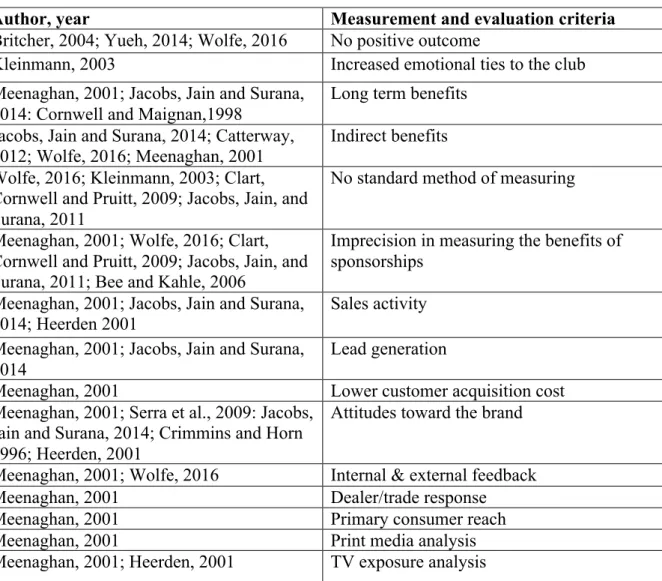
Table 2: Measurement and evaluation criteria
Author, year Measurement and evaluation criteria
Britcher, 2004; Yueh, 2014; Wolfe, 2016 No positive outcome
Kleinmann, 2003 Increased emotional ties to the club Meenaghan, 2001; Jacobs, Jain and Surana,
2014: Cornwell and Maignan,1998
Long term benefits Jacobs, Jain and Surana, 2014; Catterway,
2012; Wolfe, 2016; Meenaghan, 2001 Indirect benefits Wolfe, 2016; Kleinmann, 2003; Clart,
Cornwell and Pruitt, 2009; Jacobs, Jain, and Surana, 2011
No standard method of measuring
Meenaghan, 2001; Wolfe, 2016; Clart, Cornwell and Pruitt, 2009; Jacobs, Jain, and Surana, 2011; Bee and Kahle, 2006
Imprecision in measuring the benefits of sponsorships
Meenaghan, 2001; Jacobs, Jain and Surana, 2014; Heerden 2001
Sales activity Meenaghan, 2001; Jacobs, Jain and Surana,
2014
Lead generation
Meenaghan, 2001 Lower customer acquisition cost
Meenaghan, 2001; Serra et al., 2009: Jacobs, Jain and Surana, 2014; Crimmins and Horn 1996; Heerden, 2001
Attitudes toward the brand
Meenaghan, 2001; Wolfe, 2016 Internal & external feedback
Meenaghan, 2001 Dealer/trade response
Meenaghan, 2001 Primary consumer reach
Meenaghan, 2001 Print media analysis
Meenaghan, 2001; Heerden, 2001 TV exposure analysis Elaborated by the author based on former studies
2.2.3. Summary of previous studies regarding Research Question 3
• Research Question 3
How important are fans’ interaction and relationship with the club, when a company has to engage with it?
Table 3: Influence of fans` on sponsorships
Author, year Influence of fans` on sponsorships
Fullerton, 2010; Britcher, 2004; Shannon, 1999, Bee and Kahle, 2006
Fans attendance can affect sponsorships Richelieu, Pawlowski and Breuer, 2011;
Urbach, 2008
Companies’ decision-making is influenced by fans
Economist, 2016; Britcher, 2004; Backhaus, David & Haselhoff, 2014; Grohs, Heribert and Woesetschläger, 2015; Joseph, 2012
Fans boycott sponsors
Richelieu, Pawlowski and Breuer, 2011; Hinson, 2011; Joseph, 2012; Dees, Bennett and Villegas, 2008; Urbach, 2008
Fan loyalty effect company objectives
Richelieu, Pawlowski and Breuer, 2011; Crimmins and Horn, 2016; Burnett, Manon and Smart, 1993
Fans influence the selection of sponsors
Richelieu, Pawlowski and Breuer, 2011; Joseph, 2012; Dees, Bennett and Villegas, 2008; Shannon, 1999; Bee and Kahle, 2006; Wolfe, 2016
Long-term cooperation will increase fans’ commitment
Elaborated by the author based on former studies
3. Chapter 3
Methodology
This section will identify the selected methodologies used for addressing the research questions. This project will primarily focus on the literature review, which will be used to frame the data collection. Primary data will be collected from companies and football clubs. For that, quantitative and qualitative methods will be used to answer the research questions proposed. By using both methods, a deeper and wider analysis will be available. Furthermore, the Danish football market is used for the data collection, based on its convenience and language (Andersen et al., 2015).
3.1 Data collection – In-dept interviews
Individual interviews will be conducted with football clubs. The objective of this approach is to enrich the answer to the research questions with insights from those that are actively involved in the sponsorship agreements and understand how companies behave with respect to that subject. Interviews will be done with clubs´ marketing departments. A semi-structured research guide will be used in order to conduct the interviews (Appendix A).
The individuals interviewed have a broad understanding of sponsorships, and are primarily working with sponsorships across all aspects, namely: activation, exposure, sales, development, customer contact, etc.
One-on-one interviews are some of the most effective procedures used in sport management research. They entail three types of interviews; structured, semi-structured and unstructured. Structured interviews are often inflexible and to not reflect the interviewees’ true feelings about the issue, while semi-structured interviews allow the respondents to be subjective and describe the situation in detail, as it is meaningful to them and the subject. Finally, unstructured interviews are dependent on social interaction and are vulnerable to interpretations and subjective insights. A semi-structured interview guide will be used, because they are often based on the knowledge of the respondent, and give a subjective and wider understanding of the topic, with details and feelings dominating the interview. By audio taping the interviews it allows the researcher to concentrate more fully on the interviewee and communication process, and the attention is thereby directed solely at the content of the interview, providing quality to the outcome (Andersen et al. 2015).
The main goal of this section will be to undergo audio taped semi-structured interviews with at least 50% of the clubs in the Superliga (SP), the best football league in Denmark. This will allow the analysis to be more accurate and trustworthy. As the SP consists of 14 clubs instead, a minimum of seven interviews will be aimed (DBU, 2015).
In order to gain a broader understanding and a more valid approach to the data analysis, this project will, in addition, undertake two interviews with external companies, which work with sponsorships, as the middleman. They mediate sponsorships, evaluate sponsorships and analyse the Danish football sponsorship market in order to do business (Andersen et al. 2015).
A digital recorder was used throughout all the interviews. This made it easier to be focused and present throughout the interview and to concentrate on the subject and questions: i.e., the interviewed person and the interview, instead of transcription. All of the interviews were transcribed afterwards, for the purpose of analysis. The transcribed interviews are not the foundation of the data, but instead the recordings are the foundation, since all the interviews are translated from audio, to Danish text and yet again to English. I will not attempt to influence the transcription in a personal way, and will transcribe in an objective approach, which increase the validation of the interviews and the project (Andersen et al. 2015).
3.2 Data collection – Survey
Surveys are ideal for scientific research studies because they provide all the participants with a standardised stimulus. With such high reliability obtained, the researchers own biases are eliminated and provide credibility towards the results, and surveys are relatively easy to compare. In order to collect valid data from influenced companies, and make it easier to analyse the outcome, a survey was developed aiming at companies (Andersen et al. 2015).
As questions in the survey should undergo a careful search and standardisation, they provide uniform definitions to all the subjects answering the questionnaires. This will allow me to more easily analyse the outcome and compare results within the survey. A non-comparative scaling technique, with an itemised rating scale, the Liker Scale, will be used to elicit answers in the best possible way from a scale from 1-7. The Liker Scale indicates a degree of agreement of disagreement for each of a series of statements. It is important to use a consistent scoring procedure so that high or low scores consistently reflect a favourable response. This is because it is easy to construct and respondents readily understand how to use the scale, making it suitable for surveys on Internet surveys, mail or personal interviews (Birks and Malhotra, 2007).
Advantages of written surveys:
• Large numbers of people can give their input • Low cost
• People can respond at their convenience • Avoids interviewer bias
• Provides a written record
• Easy to list or tabulate responses • Wide range of respondents
• No training needed as with interviewing • Easy to compare
Disadvantages of written surveys:
• Often has low return rate
• Limited alternative expression of respondent's reaction • Depends on the selected sample
• May not truly represent of the whole group • Respondents may skip sections
(Birks and Malhotra, 2007).
It is important to be aware of who you are inviting to participate in your survey when you have to identify the company's basic sponsorship strategy. The recruitment will focus on companies´ CEO or alternatively someone in a position of responsibility who have knowledge of both the sponsorship considerations and the nuances of the sponsorships within company’s marketing strategy. By getting a response from these individuals, I should be aware of the emotional connection the person has towards the sponsorship: the sponsorship can often be seen as positive, and the person behind the establishment could easily be blinded by his/her decision and tendency to defend the sponsorships (Andersen et al. 2015; Birks and Malhotra, 2007).
The research will contact four to eight companies from each club. This will allow the project to obtain a broader understanding of how the companies see themselves and their sponsorship motives, and to obtain trustworthy and valid information for the foundation of data analysis and, since the participants do not work with football sponsorships on a daily basis, it justifies a broader survey, which is understandable to analyse. Moreover, it is difficult to undergo an in-depth interview with employees, which have less knowledge of the subject (Andersen et al. 2015).
A range from 20 to 40 companies would allow a valid foundation for the data. The project will contact approximately 100 companies, and expects to obtain answers from 30-40% in order to obtain valid information. The participants were given a link to an online survey, on Survey Monkey (www.surveymonkey.com); the questionnaire used is presented in appendix D.
4. Chapter 4
Results
4.1 Data analysis
The analysis will focus on the collected data, interviews and survey with the results for each research question being presented separately.
In total, 27 valid responses were obtained from the survey with companies and 9 interviews were obtained from football clubs and football related external companies
In investigating the acquired data from surveys and interviews, this part will be divided up in three smaller sections, in order to better answer the applied research questions. After having identified the different aspects of sponsorships, and considered the theory behind sponsorships, this part will focus on the relevant operators in the field of sponsorship. The focus on this project has so far involved companies that sponsor the football clubs and the fans.
4.1.1 Research question 1 – Sponsorship motives
To obtain a greater insight into the motivations for companies to establish a sponsorship and understand the ideas behind them, this part will first analyse the collected data from the companies. In addition to this part, data from football clubs and external companies which work with football sponsorships in Denmark, will be compared with the
To conclude this section, the project will determine the investigated theory and compare it to the findings.
Results of the survey with Companies
• Question 2 (Appendix D)
Most of the companies, which participated in the survey, indicate that they sponsor a big club – a total of 56% state that their club, on a national basis, is extensive. Considering that a ‘big’ club could be one in the highest league or a club that can compete to be champions, we should be aware of the companies’ subjective understanding (Figure 2: Profile of clubs).
A total of 28% of the respondents would describe the sponsored club as medium size on a national basis, which is the second biggest proportion. Five companies, or 13%, would describe the sponsored club as small and one company states other, company X states that they are sponsoring “more clubs – medium and big clubs.” (Figure 2: Profile of clubs).
Figure 2: Profile of clubs
Source: Survey with companies, 2016 (Appendix F)
56,4% 28,2%
12,8% 2,6%
Based on a national market perception, please indicate the sponsored club`s position/status from your point of view
Big club Medium club Small club Other
• Question 3 (Appendix D)
In order to understand the companies’ motives from an economical perspective, the participating companies were asked how important the sponsorship is in relation to their marketing budget and their business strategy. This aspect will lead the project to get a better understanding of the companies’ involvement in the sponsorship, and the importance of the sponsorship related to the company. The results indicate that 46% of the companies agree that the sponsorship is an important part of their marketing budget. The companies consider their sponsorship as important. A total of 20% slightly agree and 9% strongly agree, which helps to confirm how important the sponsorship is in relation to the overall marketing budget. Only 6% strongly disagree, 11% disagree and 8% slightly disagree. The responses that the sponsorship is not important in the marketing budget only confirms that a small number of the companies rely on the sponsorship for their overall marketing approach. A current picture of the companies’ tactics could illustrate the trend, because of the perspective of sponsorship contracts is considered to have a short-term perspective in Danish football. Nevertheless, more than 50% agree or strongly agree that the sponsorship is an important factor of the marketing budget. The same trend is reflected in the importance of sponsorships related to the company’s business strategy. The responses are almost the same, with little deviation. The respondents see sponsorships as having an important role in their company’s business strategy. However, 8% strongly disagree, 8% disagree and 8% slightly disagree that sponsorships are an important part of the business strategies. On the other hand, most companies believe that sponsorships play an important role in the company’s business strategy, this reflects the self-understanding of the company and also on how they feel attached to the football club, as it has an important role of the identity of the company, which lead to an acceptance of the sponsorship motives. The motives of the sponsorships can be understood and accepted if the company has strong ties to the area of the club, the local community and culture (Table 4: Sponsorship importance).
More than 50% agree that the sponsorship is an important part of their business strategy, which indicated that marketing and particular sponsorships are a key figure in the participating companies’ strategy. The weighted average is extremely close, thereby confirming a synergy between business strategy and marketing budget (Table 4: Sponsorship
Table 4: Sponsorship importance Answer Options Strongly disagree Disagree Slightly disagree Neither disagree or agree Slightly agree Agree Strongly agree Weighted average Marketing budget 2 4 3 5 7 16 3 4,70 Business strategy 3 3 3 4 7 17 2 4,69
Source: Survey with companies, 2016 (Appendix F) • Question 4 (Appendix D)
Looking at the how the companies have answered the questions regarding the clubs’ image, they answered this question with highest weighted average, 6.06. Even though the difference is tiny in comparison to the other questions, this indicated that the perception of the football clubs’ image is the most important, compared to geographic position, local community relationship and the size of the club, regarding motives for establishing a sponsorship. The companies strongly agree that the geographic position is important with 36%, a higher percentage of strongly agree than any other answers. By looking at how important the local community relationships are in regard to the establishment of a sponsorship and the geographic position regarding establishment of a sponsorship, this could indicate the significance and value of support a local club (Table 5: Sponsorship statements).
While the companies believe they are sponsoring a big club, they also state that the size of the club is least important of all aforementioned factors, with a weighted average of 5.59. Overall, the answers are similar and provide a general understanding that the clubs’ characteristics are important for the establishment of a sponsorship, which indicates a thoroughness and consciousness about which club they should sponsor, with the right motives (Table 5: Sponsorship statements).
Table 5: Sponsorship statements Answer Options Strongly disagree Disagree Slightly disagree Neither disagree or agree Slightly agree Agree Strongly agree Weighted average The image of the football club is important for the establishment of the sponsorship 0 0 1 2 5 17 10 5,94 The geographic position of the football club is important for the establishment of the sponsorship 1 2 0 2 4 14 12 5,74 The football club`s relation to the local community is important for the establishment of the sponsorship 1 0 0 4 5 15 10 5,77 The size of the football club is important for the establishment of the sponsorship 0 0 2 6 12 9 6 5,31
Source: Survey with companies, 2016 (Appendix F) • Question 5 (Appendix D)
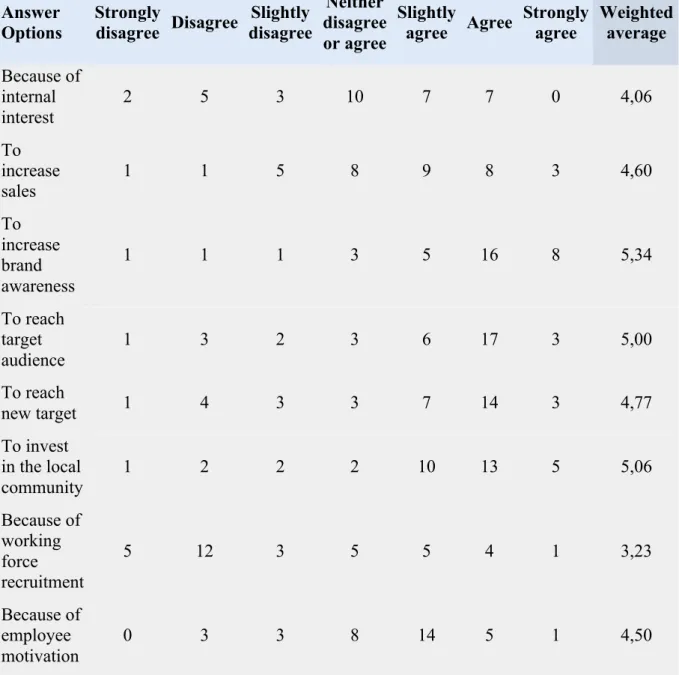
In order to understand companies’ motives, they were asked, based on their former experience, what the main reason is behind sponsoring a football club. The most important factor for the companies is to increase “brand awareness,” 23% strongly agree and 46% agree on this factor, making it undoubtedly the primary focus. Brand awareness had the lowest factor in disagreement, with only three companies stating either strongly disagree, disagree or slightly disagree (Table 6: Sponsorship motives)
By looking at the second most important factor, “to invest in the local community,” we know that the local community is important to interact with from a company’s point of view. The biggest disagreement between companies, is “working force recruitment,” with a relatively high standard deviation on 1.75. This factor divides the respondents, and is the only one with such a high deviation. This is also supported by the weighted average of 3.23, which is certainly the lowest of all. The companies do not have the intention of employing a working force, in relation to a sponsorship, regardless if it is small or big-name sponsorship (Table 6: Sponsorship motives)
Internal interest has the second lowest score on weighted average, with 29% stating either disagree or agree, furthermore it is the only factor where no one strongly agrees on internal interest as a main reason to sponsor a football club. “To increase sales,” “because of employment motivation” and “to reach new target” all have a relatively high score, and similar responses. “To increase sales” has 4.60, “because of employment motivation” has 4.50 and “to reach new target” has 4.77 in weighed average. As the score is relatively similar, the answers differentiate considerably, 41% slightly agree on employment motivation, while 40% agree on reaching targets. This can indicate that the companies are likely to have the same opinion, but sponsorships are a marketing tool to promote and sell products, and a small part of working force recruitment. Sponsorships are used as to invest in local areas, and, more importantly, to increase brand awareness either in the local area, regional or national (Table 6: Sponsorship motives).