Performance and carcass characteristics of Nellore young bulls fed different
sources of oils, protected or not from rumen degradation
1Bruna Laurindo Rosa2, Alexandre Amstalden Moraes Sampaio3, Wignez Henrique4, Emanuel
Almeida de Oliveira2, Thiago Martins Pivaro2, Antonio Tadeu de Andrade2, Alexandre Rodrigo
Mendes Fernandes5
1 Project supported by Fundação de Amparo à Pesquisa do Estado de São Paulo (FAPESP), Conselho Nacional de Desenvolvimento Científico e Tecnológico (CNPq) and Bellman Nutrição Animal/Nutreco Company.
2 UNESP/FCAV, Jaboticabal, SP, Brazil.
3 UNESP/FCAV, Jaboticabal, SP, Brazil. Fellowship granted by CNPq. Member of INCT-CA. 4 UPD/Agência Paulista de Tecnologia dos Agronegócios, São José do Rio Preto, SP, Brazil. 5 Faculdade de Ciências Agrárias/UFGD, Dourados, MS, Brazil.
ABSTRACT - The objective was to evaluate the addition of vegetable oils protected or not from rumen degradation in the diet of feedlot-finished young bulls and their effects on performance and carcass characteristics. Thirty-five Nellore males of 402.69±14.90 kg initial weight and 18±2 months of age were utilized. The animals were confined for 96 days, after 28 days of adaptation, and slaughtered at 532.17±30.25 kg. Experimental diets were: control (715 g total digestible nutrients - TDN/kg of dry matter - DM), with addition of soybean oil or fresh linseed oil, and with the addition of the same oils protected from rumen degradation (765 g TDN/kg DM). All diets were formulated with the same amount of protein and with a roughage:concentrate ratio of 40:60, with sugarcane as the only roughage. The addition of oil, regardless of the type and processing, resulted in greater body weight gain (1.17 and 1.41 kg/animal/day), better feed (0.11 and 0.14 kg weight gain/kg DM ingested) and protein efficiency (0.86 and 1.09 kg weight gain/kg crude protein ingested), heavier carcasses (280.3 and 298.0 kg), with better yield (54.5 and 55.5%) and thicker subcutaneous fat (5.1 and 7.5 mm backfat thickness) and with heavier prime cuts, for control diet and the other treatments, respectively. The use of soybean or linseed oil protected or not from rumen degradation only changed the intake of a few nutrients and carcass yield and depth. Thus the addition of energy sources in the diet is beneficial for finishing feedlot bulls. For this addition, either soybean or linseed oils can be used, and the processing of these oils is only useful to facilitate the mixing with the other ingredients of the diet.
Key Words: feedlot, linseed oil, Megalac-E®, soybean oil, sugarcane
Introduction
In Brazil, the utilization of feedlot for finishing cattle has grown in the last few years. In 2008, approximately 36 million animals were slaughtered (IBGE, 2008) and based on the research conducted by Millen et al. (2009), approximately 8.7% of these animals were finished in feedlot.
Cervieri et al. (2009) stated that one of the main aspects to propel the growth of Brazilian feedlots was the demand for meat of better quality by external markets. This is a determinant factor, since the intensive finishing is aimed at improving and standardizing the carcass subcutaneous fat and the weights of the commercial cuts, as well as promoting constant supply throughout the year.
The inclusion of lipid sources in diets for cattle has been used in the fattening of animals of high genetic potential so as to increase the energy density of the diet, improve its feeding efficiency and generate meat products with better
nutritional quality. According to Palmquist & Mattos (2006), these feedstuffs improve the capacity of absorption of liposoluble vitamins, provide essential fatty acids important for the membranes of tissues and act as precursors of the regulation of the metabolism, increasing the efficiency of the animals that deposit fat in their products.
The lipid supplementation in the form of protected fat, obtained from the complexion of unsaturated fatty acids with calcium, has been recommended for ruminants (Wu & Palmquist, 1991; Harvatine & Allen, 2006) because, although the calcium salts are dissociated in the rumen, there is no increase in the concentration of non-esterified fatty acids at a level high enough to damage the microbial metabolism (Palmquist & Mattos, 2006).
In Brazil, the soybean oil protected from rumen degradation is commercially found under the name
Megalac-E®. Fresh linseed oil has been used for feeding
cattle, mainly because of its better composition of omega-3 ISSN 1806-9290
www.sbz.org.br R. Bras. Zootec., v.42, n.2, p.109-116, 2013
polyunsaturated fatty acids than soybean oil, but it is still not found commercially in the protected form.
Given the above, the objective was to evaluate the addition of soybean or linseed oil protected or not from rumen degradation on the efficiency during the fattening phase and the carcass characteristics of feedlot Nellore young bulls fed high energy diets.
Material and Methods
Thirty-five Nellore young bulls belonging to the same contemporary group, with 402.69±14.90 kg initial weight and 18±2 months of age were used. The facilities of the feedlot
consisted of individual 12 m2 pens with concrete floor and
partially covered. Prior to adaptation, animals were identified with earrings, tickicide-bathed and wormed. After this, animals were separated in seven blocks by body weight and adapted to the facilities and management for 28 days.
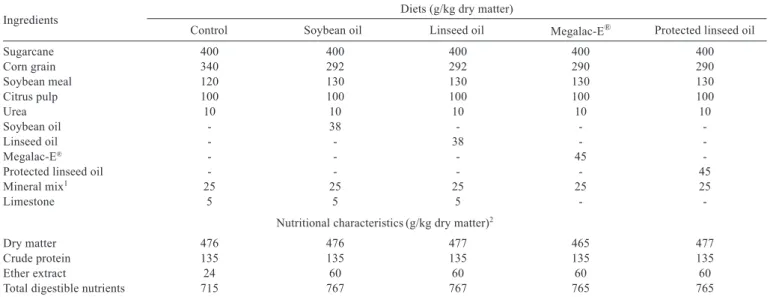
The experimental period lasted 96 days. Five diets were formulated for maximum weight gain, and sugarcane variety IAC 86-2480 (Landell et al., 2002) was used as exclusive roughage. All the experimental diets (Table 1) had a roughage:concentrate ratio of 40:60 in the dry matter
and were formulated through software RLM®/Esalq/USP
(1999), with nutritional requirements estimated by system CNCPS (Fox et al., 1992). The location of blocks within the facilities, as well as the distribution of animals in the diets within each block, were random. Feed was supplied in two daily meals, at 08h00 and 14h00, as a complete diet. Feed was offered allowing leftovers of 10% of dry matter consumed in the previous day.
Megalac-E® is a commercial product that contains
protected fat, rich in omega-3 and omega-6, and it is obtained from soybean oil, which goes through a saponification process with calcium salts for the protection of long-chain polyunsaturated fatty acids. The laboratory analysis of this product resulted in the following nutritional composition: 98.8% dry matter, 190.0% total digestible nutrients, 85.0% ether extract and 8.2% calcium.
Because protected linseed oil does not exist as a commercial product, a methodology was developed for its obtainment from the commercial linseed oil. The methodology used to obtain the protected linseed oil was adapted from Oser (1965). The method consisted essentially of the saponification (hydrolysis) of linseed oil with sodium hydroxide in 65% ethanol, on average, in a plastic drum; the mixture was agitated until glycerol and soap were produced (saponification process). Once this reaction occurred, a saturated solution of calcium chloride was added to precipitate the soap. The mixture of water and glycerol was removed and the calcium soap produced was dried in room temperature, resulting in a product highly stable in water and at room temperature, which could be digested in the animal organism only in an acid medium. Through the laboratory analysis, the nutritional composition of this product was of 100.0% dry matter, 190.0% total digestible nutrients, 85% ether extract (obtained by the methodology of acid ether extract; AOAC, 1995) and 6.68% calcium.
During the experimental period, leftovers were collected at every two days and weighed for readjusting the roughage:concentrate ratio in the diets. In addition, they were sampled once weekly and, along with samples of the
Table 1 - Feed composition and estimated nutritional characteristics of experimental diets
Ingredients Diets (g/kg dry matter)
Control Soybean oil Linseed oil Megalac-E® Protected linseed oil
Sugarcane 400 400 400 400 400
Corn grain 340 292 292 290 290
Soybean meal 120 130 130 130 130
Citrus pulp 100 100 100 100 100
Urea 10 10 10 10 10
Soybean oil - 38 - -
-Linseed oil - - 38 -
-Megalac-E® - - - 45
-Protected linseed oil - - - - 45
Mineral mix1 25 25 25 25 25
Limestone 5 5 5 -
-Nutritional characteristics(g/kg dry matter)2
Dry matter 476 476 477 465 477
Crude protein 135 135 135 135 135
Ether extract 24 60 60 60 60
Total digestible nutrients 715 767 767 765 765
1 Composition per kg of product: P - 40 g; Ca - 146 g; Na - 56 g; S - 40 g; Mg - 20 g; Cu - 350 mg; Zn - 1.300 mg; Mn - 900 mg; Fe - 1.050 mg; Co - 10 mg; I - 24 mg; Se - 10 mg; F - 400 mg;
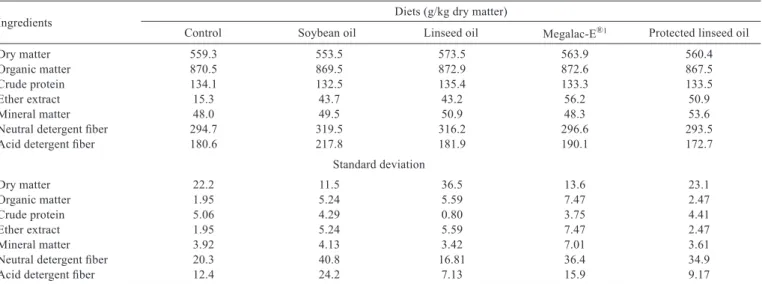
diets, were dried in forced-ventilation oven at 65 ºC and subsequently analyzed for the contents of dry matter, crude protein, ether extract, mineral matter, neutral detergent fiber and acid detergent fiber (Table 2), according to procedures described by the AOAC (1995), so the nutrient intake, feed and protein efficiency could be estimated. Analyses of ether extract of leftovers and diets with oil sources protected
from rumen degradation (Megalac-E® and protected linseed
oil - PLO) were conducted through acid hydrolysis, also according to procedures from the AOAC (1995).
Animals were weighed at the beginning and end of the experimental period, after fasting for 15 hours, to determinate the daily weigh gain; and they were also monitored at the final weighing by ultrasound images taken by a non-certified technician, utilizing a Pie Medical scanner device, equipped with an “Animal Science” transducer of 18 × 30 cm linear array, aiming at the estimation of the deposition of muscle and fat tissues, utilizing software E-view. For the ultrasound evaluation of the loin-eye area and subcutaneous fat, animals were contained in a three-point torso restraint system, by guillotines. The measuring site was covered by a thin layer of vegetable oil, immediately before taking images in the region between the 12th and 13th ribs, so as to ensure the acoustic contact of the probe standoff with the animal skin, allowing maximal resolution of the images obtained.
Animals were then transported for a commercial slaughterhouse freezer and after a fasting period of 24 hours, they were slaughtered according to the standard procedures of the establishment. At slaughter, the hot carcass weight and carcass yield were obtained; the dressing was calculated by dividing the hot carcass weight by the slaughter weight. Kidneys, liver and kidney-pelvic-inguinal fat were weighed.
The total length was also measured on the carcass, by taking the maximum distance from the cranial edge of the first rib at its midpoint to the front edge of the ischiopubic symphysis, and the internal depth, whose measure has been taken away by the distance from the front edge of the outer cartilage to the lower edge of the spinal canal between the 5th and the 6th dorsal vertebra.
After cooling for 24 hours in a cold storage chamber at 4 ºC, half-carcasses were separated into hindquarter and forequarter, by the cut between the fifth and sixth ribs. The hindquarter was separated into beef round and short ribs; the latter were removed at a distance of 20 cm from the backbone and were comprised of the muscle masses that cover the last eight ribs, the last sternebrae, the xiphoid process and the empty space. Prime cuts (beef round, forequarter and short ribs) were weighed for the calculation of the yield in relation to the cooled left half-carcass,
without the hump. A section of the longissimus muscle of
each carcass was also collected, comprised between the 10th and the 13th ribs, aiming at the measurement of the loin eye area and subcutaneous fat thickness. To measure the loin eye area, a transverse cut was made between the 12th and the 13th ribs, so as to expose the muscle; next, the part was traced in vegetable paper and the area was measured through software AutoCAD R14 (Auto Computer Aided Design. AutoDesk, Inc.). Subcutaneous fat thickness was measured at the final third of the muscle, from the
backbone, perpendicularly to the muscle longissimus,
with the aid of a precision rule.
The results were subjected to variance analysis through procedure GLM of software SAS (Statistical Analysis System, version 9.0), with α = 0.05 of probability as significance level, considering seven blocks and five
Table 2 - Nutritional characteristics analyzed and standard deviation of experimental diets, in g/kg dry matter
Ingredients Diets (g/kg dry matter)
Control Soybean oil Linseed oil Megalac-E®1 Protected linseed oil
Dry matter 559.3 553.5 573.5 563.9 560.4
Organic matter 870.5 869.5 872.9 872.6 867.5
Crude protein 134.1 132.5 135.4 133.3 133.5
Ether extract 15.3 43.7 43.2 56.2 50.9
Mineral matter 48.0 49.5 50.9 48.3 53.6
Neutral detergent fiber 294.7 319.5 316.2 296.6 293.5
Acid detergent fiber 180.6 217.8 181.9 190.1 172.7
Standard deviation
Dry matter 22.2 11.5 36.5 13.6 23.1
Organic matter 1.95 5.24 5.59 7.47 2.47
Crude protein 5.06 4.29 0.80 3.75 4.41
Ether extract 1.95 5.24 5.59 7.47 2.47
Mineral matter 3.92 4.13 3.42 7.01 3.61
Neutral detergent fiber 20.3 40.8 16.81 36.4 34.9
Acid detergent fiber 12.4 24.2 7.13 15.9 9.17
treatments, and assessed by orthogonal contrasts for comparison between treatments.
Results and Discussion
The addition of oil to the diet, protected or not from rumen degradation, did not alter the ingestion of dry matter, crude protein and neutral detergent fiber (Table 3), in comparison with the control diet. On the other hand, the intake of ether extract and mineral matter was affected by this addition (P<0.05); the animals which received the treatments with addition of oil, regardless of the protection, ingested higher amounts of these nutrients, both in kg/day and g/kg of body weight. The greater intake of ether extract in the diets with addition of oil occurred because of the greater energy concentration of these diets in relation to the control diet (765 and 715 g/kg dry matter of total digestible nutrients, respectively), once there was no difference in dry matter intake.
As to the greater mineral intake, in relation to the diets with the fresh oil, there could have been formation of small granules, along with the mineral core, during the mixing of ingredients in the mixer, which ended up overestimating the amount of minerals in the leftovers analyzed, since the quantity of minerals supplied to the animals was the same for all treatments. For the protected oils, calcium salts are formed during their obtainment, but they were accounted in the formulation of the diets, which may explain the greater mineral intake by the animals in this experiment.
The processing of oils for protection of rumen degradation caused a reduction (P<0.05) in the ingestion of neutral detergent fiber, both in kg/day and g/kg body weight (Table 3). This difference might have occurred because of a variation in the neutral detergent fiber values of the concentrates, which were of 177.6 and 191.8 g/kg dry matter for the fresh oils of soybean and linseed, respectively, and of 170.8 and 163.1 g/kg dry matter for the concentrates with protected oil from soybean and linseed, respectively, in the experimental period.
According to Coelho da Silva (2006), for adult animals, the intake is limited by their energy requirement, rather than by the filling effect of the feed, when the neutral detergent fiber content is below 500-600 g/kg dry matter. Thus a sugarcane variety that presents an elevated fiber content will limit the digestion at a certain level and consequently the energy intake will be insufficient to meet the nutritional requirements of the animal, affecting its performance. In the present study, because the sugarcane presented a low fiber content (481 g/kg dry matter, on average, during the
whole experimental period) and was supplied at a low Trea
ratio (40%) in the complete diet, there was no limitation in the ingestion of the nutrients necessary to the animal, considering this factor.
The ingestion of ether extract, in kg/day and in g/kg body weight, had a different result (P<0.05) according to the oils added to the diet and the processing or not for protection of rumen degradation, once the interaction between these factors (Table 3), as well as all their deployments, were significant. The processing of soybean oil caused increase in the ingestion of this nutrient, while for the linseed oil, the protection from rumen degradation reduced its intake. Thus, at the provision of fresh oils, linseed oil increases the ingestion of ether extract compared with soybean oil, while when these oils are processed, the effect is the opposite.
The addition of vegetable oils, protected or not from rumen degradation, was beneficial (P<0.05) for slaughter weight, daily weight gain, feed efficiency and protein efficiency ratio (Table 4). The weight gains of the treatments with addition of oil were superior (0.25 kg/day, on average), promoting better feed efficiency to these treatments, in relation to the control diet, once there was no difference in the dry matter intake between all treatments (Table 3). According to Paulino et al. (2003), diets with addition of oil can affect the growth efficiency of animals in two basic characteristics: weight gain rate, for which, the higher it is, the greater the feed efficiency for the same ingestion of dry matter; and the chemical composition of the tissues deposited. Besides, according to these authors, the use of lipids in diets for ruminants provides essential fatty acids important for the metabolism, increases the capacity of absorption of liposoluble vitamins and improves the use efficiency of the diet.
Other results in the literature have also demonstrated the same effect, like those of Clinquart et al. (1995) and Jaeger & Oliveira (2007). Aiming to evaluate the performance of uncastrated male cattle of different breed groups, among them Nellore, subjected to a diet without or with addition of 50 g fat protected from rumen degradation/
kg of dry matter of the diet (LAC 100 – Yakult®, based on
soybean oil complexed with calcium), Jaeger & Oliveira (2007) observed weight gains of 1.47 kg/day for the animals receiving the addition of protected fat and 1.38 kg/day for those receiving the diet without the addition of this fat. Furthermore, the results demonstrated that the use of protected fat promoted less dry matter intake and greater digestibility of the ether extract. Thus there was a benefit in the animal performance with the addition of fat, so animals reached a greater slaughter weight.
In spite of the differences found between the ingestions of nutrients (Table 3) mentioned before, comparing the types of oil and the protection or non-protection from rumen degradation, these effects did not reflect on the performance of animals during confinement as to weight gain, feed efficiency, protein efficiency and final weight (Table 4).
On the other hand, the processing of vegetable oils can be important for the industries of animal ration, since it facilitates the mixing with other dietary components, once there is difficulty in utilizing the fresh oils in the factory. For this incorporation to take place, specific equipment must be acquired and attached to the mixer, which means a raise in the costs, and even though, the homogeneity of the diet might not be satisfactory for the standards required. On the other hand, the protection would necessarily increase the cost of the product.
Table 4 - Initial and slaughter weights, average daily gain and feed and protein efficiency of feedlot-finished Nellore young bulls fed different oil sources protected or not from rumen degradation
Treatments Initial weight Slaughter weight Daily gain Feed efficiency1 Protein efficiency2
kg kg/day
Control 401.57 513.71 1.17 0.11 0.86
Soybean oil 402.86 537.71 1.41 0.14 1.02
Megalac-E® 401.57 537.57 1.42 0.14 1.01
Linseed oil 400.00 534.29 1.40 0.14 1.08
Protected linseed oil 407.43 537.57 1.41 0.14 1.09
Contrasts Probability
Control vs. diets with oil 0.696 0.016 0.010 0.0002 <.0001
Soybean oil vs. linseed oil 0.663 0.833 0.925 0.312 0.123
Protected oils vs. unprotected oils 0.377 0.847 0.895 1.000 0.998
Interaction (oil*protection) 0.215 0.833 0.985 0.798 0.858
Protected or not for soybean oil 0.791 0.990 0.915 0.856 0.901
Protected or not for linseed oil 0.138 0.775 0.937 0.856 0.898
Type of protected oil 0.237 1.000 0.937 0.370 0.220
Type of unprotected oil 0.558 0.765 0.958 0.588 0.323
Coefficient of variation (%) 2.07 3.97 15.07 10.01 9.04
Concerning the carcass characteristics (Table 5), the animals fed diets containing the oils from linseed or soybean, protected or not from rumen degradation, achieved heavier slaughter weight and carcass yields, in addition to higher values of kidney-pelvic-inguinal fat, when compared with the animals fed the control diet (P<0.05). These results reflected the greater energy uptake offered to the animals fed the diets containing oil, promoting higher amounts of nutrients, thus resulting in more growth. Jaeger et al. (2004), in turn, working with four distinct breed groups fed diets with or without protected fat, did not find any differences for slaughter weight and hot carcass weight, but in this case, all diets evaluated had the same amount of energy (720 g/kg of dry matter from total digestible nutrients).
Carcass depth was greater for the animals receiving the oil from soybean in relation to linseed, and also for those
that received Megalac-E® in comparison with protected
linseed oil (P<0.05). The carcass length was greater for the animals that received the diets with oil, in relation to the control treatment (P<0.05). For the weights of kidneys and liver, no differences were observed between treatments (P>0.05).
The animals from the treatment with Megalac-E® had
superior carcass yield by 1.63 kg/100 kg body weight, in relation to the animals from the treatment with this fresh oil (Table 5). Moreover, among the protected oils, the carcass
yield was greater for Megalac-E® than for protected linseed
oil. These differences between treatments for the carcass yield did not follow the differences of slaughter weight (Table 4) or carcass weight (Table 5) between treatments. The evaluations of loin eye area and backfat thickness measured by ultrasound, as well as the values measured on
the carcass, did not differ (P>0.05) between the treatments (Table 6). Both the loin eye area and the backfat thickness were superior to those obtained by Donicht et al. (2011) also evaluating feedlot-finished Nellore young bulls receiving
Megalac-E® (3.0 or 6.0% in dry matter) in the diet (average
of 66.5 cm2 and 4.51 mm, respectively). On the other hand,
the values found by Jaeger et al. (2004) were higher, and these authors also evaluated diets with and without addition of protected fat for the same animal category and breed, but slaughtered the animals at 19 months of age, approximately 530.75 kg slaughter weight and 296.94 kg carcass weight.
In the present study, there was a high correlation
between the values obtained in the animals in vivo and on
the carcass, with an R2 of 0.79 and 0.89 for loin eye area
and backfat thickness, respectively. Obtained by ultrasound examination, the loin eye area and the subcutaneous fat thickness have presented good repeatability when measured by experienced technicians, as well as their correlations with the measures corresponding to those obtained on the carcass after the slaughter (Hassen et al., 1998). The
evaluation of the carcass by in vivo predictions can offer
an economy of the productive process, once it allows for the determination of the subcutaneous fat degree and of the muscle development of the animals, avoiding punishment of the producers by the slaughterhouses.
From the results of this study, one can affirm that non-castrated young animals (20 to 24 months) of the Nellore breed present a uniform subcutaneous fat which is distributed all over the carcass and satisfactory for a good preservation (6.0 mm), when finished in feedlot under favorable nutritional conditions. According to Silva et al.
Table 5 - Weights of hot carcass, liver, kidneys and kidney-pelvic-inguinal fat (KPIF) and dressing, length and depth of the carcass of feedlot-finished Nellore young bulls fed different oil sources protected or not from rumen degradation
Treatments Hot carcass weight Yield Liver Kidneys KPIF Carcass length Carcass depth
kg kg/100 kg of BW kg cm
Control 280.29 54.53 6.66 0.84 4.06 128.29 41.00
Soybean oil 295.21 54.93 7.21 0.90 5.23 130.00 42.57
Megalac-E® 303.64 56.56 7.47 0.86 5.24 128.86 41.86
Linseed oil 296.29 55.45 7.51 0.83 5.27 129.14 41.86
Protected linseed oil 296.79 55.17 6.97 0.84 5.29 128.29 40.43
Contrasts Probability
Control vs. diets with oil 0.0001 0.082 0.150 0.540 0.058 0.046 0.502
Soybean oil vs. linseed oil 0.001 0.036 0.083 0.726 0.006 0.841 0.243
Protected oils vs. unprotected oils 0.508 0.286 0.753 0.246 0.921 0.456 0.045
Interaction (oil*protection) 0.310 0.103 0.654 0.696 0.953 0.299 0.045
Protected or not for soybean oil 0.366 0.026 0.216 0.436 0.984 0.881 0.488
Protected or not for linseed oil 0.148 0.013 0.587 0.450 0.979 0.441 0.340
Type of protected oil 0.929 0.648 0.258 0.800 0.957 0.561 0.071
Type of unprotected oil 0.234 0.030 0.296 0.800 0.957 0.698 0.071
Coefficient of variation (%) 3.86 11.61 11.18 18.81 1.93 3.23 2.68
(2002), Zebu animals, especially the non-castrated ones, have always been considered as having carcasses of inferior quality, especially because of the deficiency of subcutaneous fat, which was not found in the present study. With the absence of fat during cooling, which is a minimum of 4 mm (Luchiari Filho, 2000), the carcass of animals may present some darkening on the external part of the muscles, undermining its commercialization.
According to Luchiari Filho (2000), the loin eye area (LEA)/100 kg of carcass weight and subcutaneous fat thickness measures, obtained approximately at the 12th rib, are essential for the determination of muscularity and the subcutaneous fat degree of the carcass, and a LEA
of 29 cm²/100 kg carcass weight would be adequate. However, this value was not reached by the animals from this experiment, regardless of the diets.
The yields of the primary cuts of the carcass are influenced by numberless factors, such as breed group, diet and maturity of the animal. The weights of the primary cuts (Table 7) differed between the treatments; the diets containing oil, regardless of the source or processing, resulted in greater weights of forequarter, beef round and short ribs in relation to the control diet (P<0.05). These values were a consequence of the heavier weights at slaughter and the hot carcass weight of the animals that received the addition of oil in their diet (Table 5).
Table 6 - Loin eye area and subcutaneous fat thickness, measured by ultrasound and on the animal, of feedlot-finished Nellore young bulls fed different oil sources, protected or not from rumen degradation
Treatments LEAu LEA SFTu SFT LEA
cm2 mm cm²/100 kg of carcass
Control 72.44 75.53 6.04 5.14 26.91
Soybean oil 71.61 74.79 7.21 7.29 25.32
Megalac-E® 72.01 77.25 7.94 7.43 25.43
Linseed oil 73.47 82.84 6.81 7.29 27.96
Protected linseed oil 70.31 77.07 7.86 7.86 25.94
Contrasts Probability
Control vs. diets with oil 0.870 0.468 0.191 0.064 0.465
Soybean oil vs. linseed oil 0.981 0.199 0.798 0.843 0.126
Protected oils vs. unprotected oils 0.670 0.584 0.355 0.741 0.344
Interaction (oil*protection) 0.583 0.181 0.869 0.843 0.292
Protected or not for soybean oil 0.933 0.585 0.656 0.932 0.936
Protected or not for linseed oil 0.510 0.208 0.487 0.735 0.163
Type of protected oil 0.721 0.969 0.954 0.800 0.719
Type of unprotected oil 0.697 0.085 0.789 1.000 0.073
Coefficient of variation (%) 11.75 10.18 34.66 40.44 9.04
LEAu - loin eye area measured by ultrasound; LEA - loin eye area measured on the carcass; SFTu - subcutaneous fat thickness measured by ultrasound; SFT - subcutaneous fat thickness measured on the carcass.
Table 7 - Weights and yields of forequarter, hindquarter and short ribs of the cooled left half-carcass of feedlot-finished Nellore young bulls fed different oil sources protected or not from rumen degradation
Treatments Weigths (kg) Yields (kg/100 kg of cold carcass)
Cold carcass Forequarter Hindquarter Short ribs Forequarter Hindquarter Short ribs
Control 137.73 52.97 64.87 19.89 38.47 47.11 14.42
Soybean oil 144.09 55.31 65.16 21.61 38.36 46.64 15.00
Megalac-E® 149.01 57.26 69.57 22.19 38.41 46.70 14.89
Linseed oil 146.31 56.91 68.36 21.04 38.89 46.73 14.38
Protected linseed oil 147.03 56.97 68.43 21.63 38.72 46.56 15.72
Contrasts Probability
Control vs. diets with oil 0.001 0.002 0.006 0.002 0.292 0.709 0.252
Soybean oil vs. linseed oil 0.945 0.483 0.978 0.213 0.951 0.172 0.122
Protected oils vs. unprotected oils 0.124 0.289 0.242 0.202 0.892 0.835 0.648
Interaction (oil*protection) 0.244 0.317 0.269 0.987 0.760 0.725 0.379
Protected or not for soybean oil 0.062 0.118 0.087 0.361 0.627 0.900 0.783
Protected or not for linseed oil 0.776 0.962 0.958 0.373 0.901 0.744 0.394
Type of protected oil 0.433 0.812 0.402 0.373 0.370 0.786 0.655
Type of unprotected oil 0.380 0.193 0.380 0.385 0.141 0.857 0.125
Conclusions
The inclusion of vegetable oils, either protected or not protected from rumen degradation, in diets for cattle, improves performance and carcass characteristics, regardless of the type of oil.
Acknowledgments
To Fundação de Amparo à Pesquisa do Estado de São Paulo - FAPESP, for the financial support and for the fellowship granted to the first author; to Conselho Nacional de Desenvolvimento Científico e Tecnológico - CNPq, for the financial aid; and to the company Bellman Nutrição Animal Ltda. - A Nutreco Company, for the financial aid and concession of animals for the experiment.
References
ASSOCIATION OF OFFICIAL ANALYTICAL CHEMISTRY – AOAC. Official methods of analysis. 16.ed. Arlington: AOAC International, 1995.
CERVIERI, R.C.; CARVALHO, J.C.F.; MARTINS, C.L. Evolução do manejo nutricional nos confinamentos brasileiros: importância da utilização de subprodutos da agroindústria em dietas de maior inclusão de concentrado. In: SIMPÓSIO DE NUTRIÇÃO DE RUMINANTES, 4.; BRAZILIAN RUMINANT NUTRITION CONFERENCE, 2., 2009, Botucatu. Anais... Botucatu: FMVZ/ Unesp, 2009. p.2-22.
CLINQUART A.; MICOL, D.; BRUNDSEAUX, C. et al. Utilisation des matières grasses chez les bovins léngraissement (Utilization of fat concentrates for fattening cattle). INRA Productions Animales, v.8, p.29-42, 1995.
COELHO DA SILVA, J.F. Mecanismos reguladores de consumo. In: BERCHIELLI, T.T.; PIRES, A.V.; OLIVEIRA, S.G. (Eds.) Nutrição de ruminantes. Jaboticabal: Funep, 2006. p.57-78. DONICHT, P.A.M.M.; RESTLE, J.; FREITAS, L.S. et al. Fat sources
in diets for feedlot-finished steers - carcass and meat characteristics. Ciência Animal Brasileira, v.12, p.487-496, 2011.
FOX, D.G.; SNIFFEN, C.J.; O’CONNOR, J.D. et al. A net carbohydrate and protein system for evaluating cattle diets: III.
Cattle requirements and diet adequacy. Journal of Animal Science, v.70, p.3578-3596, 1992.
HARVATINE, K.J.; ALLEN, M.S. Fat Supplements affect fractional rates of ruminal fatty acid biohydrogenation and passage in dairy cows. Journal of Nutrition, v.136, p.677-685, 2006.
HASSEN, A.; WILSON, D.E.; WILLHAN, R.L. et al. Evaluation of ultrasound measurement of fat thickness and Longissimus muscle area in feedlot cattle: Assessment of accuracy and repeatability. Canadian Journal of Animal Science, v.78, p.277-285, 1998. INSTITUTO BRASILEIRO DE GEOGRAFIA E ESTATÍSTICA -
IBGE. [2008]. Abate bovino fecha o ano com queda de 6.6%. Available at: <http://www.ibge.gov.br/home/presidencia/noticias/ noticia_visualiza>. Accessed on: Jan. 11, 2010.
JAEGER, S.M.P.; DUTRA, A.R.; PEREIRA, J.C. et al. Características da carcaça de bovinos de quatro grupos genéticos submetidos a dietas com ou sem adição de gordura protegida. Revista Brasileira de Zootecnia, v.33, p.1876-1887, 2004. (supl.1).
JAEGER, S.M.P.L.; OLIVEIRA, R.L. Uso de gordura protegida sobre o desempenho e a digestibilidade para diferentes grupos genéticos de bovinos em confinamento.Magistra, v.19, p.135-142, 2007. LANDELL, M.G.A.; CAMPANA, M.P.; RODRIGUES, A.A. et al.
A variedade IAC86-2480 como nova opção de cana-de-açúcar para fins forrageiros: manejo de produção e uso na alimentação animal. Campinas: Instituto Agronômico, 2002. 39p. (Boletim Técnico IAC, 193).
LUCHIARI FILHO, A. Pecuária da carne bovina. São Paulo: LinBife, 2000. 134p.
MILLEN, D.D.; PACHECO, R.D.L.; ARRIGONI, M.D.B. et al. A snapshot of management practices and nutritional recommendations used by feedlot nutritionists in Brazil. Journal of Animal Science, v.87, p.3427-3439, 2009.
OSER, B.L. Hawk’s physiological chemistry. 14.ed. New York: McGraw Hill Book, 1965. 1472p.
PALMQUIST, D.L.; MATTOS, W.R.S. Metabolismo de lipídeos. In: BERCHIELLI, T.T.; PIRES, A.V.; OLIVEIRA, S.G. (Eds.) Nutrição de ruminantes. 1.ed. Jaboticabal: Funep, 2006. p.287-310.
PAULINO, M.F.; FIGUEIREDO, D.M.; MORAES, E.H.B.K. et al. [2003]. Suplementação de bovinos em pastagens: uma visão sistêmica. Available at:<http://www.simcorte.com/index/Palestras/ q_simcorte/simcorte3.PDF>. Accessed on: Oct. 18, 2011. SILVA, F.F.; VALADARES FILHO, S.C.; ÍTAVO, L.C.V. et al.
Consumo, desempenho, características de carcaça e biometria do trato gastrintestinal e dos órgãos internos de novilhos nelore recebendo dietas com diferentes níveis de concentrado e proteína. Revista Brasileira de Zootecnia, v.31, p.1849-1864, 2002. WU, Z.; PALMQUIST, D.L. Synthesis and biohydrogenation of