Pesq. agropec. bras., Brasília, v.49, n.7, p.540-545, jul. 2014 DOI: 10.1590/S0100-204X2014000700006
Chemical characteristics of grape juices from different cultivar
and rootstock combinations
Rita de Cássia Mirela Resende Nassur(1), Giuliano Elias Pereira(2), Juliana Alvarenga Alves(1) and Luiz Carlos de Oliveira Lima(1)
(1)Universidade Federal de Lavras, Departamento de Ciência dos Alimentos, Caixa Postal 3037, CEP 37200‑000 Lavras, MG, Brazil. E‑mail: [email protected], [email protected], [email protected] (2)Embrapa Uva e Vinho, Rodovia BR 428, Km 152, Caixa Postal 23, CEP 56302‑970 Petrolina, PE, Brazil. E‑mail: [email protected]
Abstract – The objective of this work was to evaluate the influence of different combinations of grape cultivars and rootstocks on chemical characteristics of grape juices. Six treatments were evaluated, consisting of combinations between the Isabel Precoce and BRS Cora grape cultivars and the 'IAC 766', 'IAC 313', and 'IAC 572' rootstocks. Approximately 10 L of juice were obtained per treatment. Analyses of color, total soluble solids content, pH, anthocyanins, total phenolics, total sugars, and quantification and identification of biogenic amines by HPLC were performed. Biogenic amines, such as putrescine, cadaverine, spermidine, and spermine, were found in all evaluated cultivars. By principal component analysis (PCA), treatments can be divided into two groups, according to the cultivar. Juices obtained from 'Isabel Precoce' are characterized by higher levels of total sugar content and soluble solids; however, juices from 'BRS Cora' are positively correlated with phenolic content, anthocyanins, and color and acidity parameters. The differences found by PCA for juices from the Isabel Precoce and BRS Cora cultivars indicate that, regardless of the rootstock used, the most important factor in the chemical characterization of juices is the grape cultivar.
Index terms: Vitis labrusca, anthocyanins, biogenic amines, phenolics, principal component analysis.
Características químicas de sucos de uva obtidos de diferentes
combinações de cultivares e porta‑enxertos
Resumo – O objetivo deste trabalho foi avaliar a influência de diferentes combinações de cultivares de uva e porta‑enxertos nas características químicas de sucos de uva. Foram avaliados seis tratamentos, que consistiram de combinações entre as cultivares de uva Isabel Precoce e BRS Cora com os porta‑enxertos 'IAC 766', 'IAC 313' e 'IAC 572'. Aproximadamente 10 L de suco foram obtidos por tratamento. Foram realizadas análises de coloração, teor de sólidos solúveis totais, pH, antocianinas, compostos fenólicos totais, açúcares totais, e quantificação e identificação de aminas biogênicas por HPLC. Aminas biogênicas, tais como putrescina, cadaverina, espermidina e espermina, foram encontradas em todas as cultivares avaliadas. Por meio da análise de componentes principais (PCA), os tratamentos podem ser divididos em dois grupos, de acordo com a cultivar. Sucos obtidos de 'Isabel Precoce' são caracterizados pelos maiores teores de açúcares totais e sólidos solúveis; no entanto, sucos de 'BRS Cora' correlacionam‑se positivamente com conteúdo fenólico, antocianinas, e parâmetros de coloração e acidez. As diferenças encontradas por meio da PCA, para sucos das cultivares Isabel Precoce e BRS Cora, indicam que, independentemente do porta‑enxerto utilizado, o fator mais importante na caracterização química dos sucos é a cultivar de uva.
Termos para indexação: Vitis labrusca, antocianinas, aminas biogênicas, fenólicos, análise de componentes
principais.
Introduction
Grape (Vitis labrusca L.) juices are consumed
worldwide and are considered an important source of phytochemicals, such as anthocyanins, biogenic amines, and polyphenolic compounds (Dani et al., 2007; Burin et al., 2010).
histamine and tryptamine; or aromatic, comprising tyramine and henylethylamine. The most important biogenic amines that can occur in foods and beverages are histamine, beta‑phenylethylamine, tyramine, tryptamine, putrescine, cadaverine, spermine, and spermidine (Naila et al., 2010).
However, the presence of biogenic amines in food products can cause health risks to sensitive individuals. Consumption of food containing high amounts of this substance may cause headaches, nausea, hot flushes, cold sweat, red rash, high or low blood pressure, and digestive problems (Kalac & Krausova, 2005). The analytical determination of biogenic amines in wines and grape juices is important to provide useful information about these products.
Genetic material is a key factor to determine grape juice quality. In this context, studies have characterized grape genotypes that have potential to produce high quality juice with higher content of phenolic compounds, anthocyanins, total sugars, and reduced presence of biogenic amines.
The objective of this work was to evaluate the
influence of different combinations of grape cultivars and rootstocks on chemical characteristics of grape juices.
Materials and Methods
The grape cultivars assessed were BRS Cora and Isabel Precoce, located in the experimental area of the Bebedouro irrigation project of Embrapa Semiárido, in the municipality of Petrolina, in the state of Pernambuco, Brazil (9°21'S, 40º40'W, at approximately 350 m of altitude).
The experimental design was a randomized complete block. The cultivars were grafted onto the 'IAC 766', 'IAC 313', and 'IAC 572' rootstocks. Six treatments were evaluated, consisting of the combination between the Isabel Precoce and BRS Cora cultivars and the 'IAC 766', 'IAC 313', and 'IAC 572' rootstocks.
The plants were installed five years before, grown on a drip‑irrigated trellis system, spaced at 3.5x2.0 m. The total cycle, between prune and harvest, was of 105 days for 'Isabel Precoce' and of 111 days for 'BRS Cora'. Fifteen kg of grapes were harvested per block in the morning at optimal maturity, based on total soluble sugars and total acidity, and were taken to the Laboratório de Enologia of Embrapa Semiárido,
where they were placed in cold chambers at 10°C, for 12 hours, before being processed. The grapes, 15 kg for each block, were then hand stripped and placed in an experiment container. Juice extraction was accomplished with water vapor during 60 min, at 75–80ºC, obtaining approximately 10 L of juice per treatment. The juice was sulphited (25 mg L‑1 potassium metabisulfite) and pasteurized after bottling in 500 mL containers with plastic lids with a lock screw.
Total soluble solids were determined in a filtered homogenate using a digital refractometer, model PR‑100 (Atago, Tokyo, Japan), with automatic temperature compensation to 25°C (Horwitz, 2002). Total sugar determinations, which provide the percentage of glucose, were extracted with 70% ethanol and determined by the Antrona method (Dische, 1962).
Juice color was measured using a colorimeter, model CR‑400 (Konica Minolta Business Solutions U.S.A., Ramsey, NY, USA), with an 8 mm light path aperture. The instrument was calibrated with a CR‑400 standard tile (Y=93.5, x=0.3114, y=0.3190) (Konica Minolta Business Solutions U.S.A., Ramsey, NY, USA) . Juice color results were characterized by: lightness (L*), which ranges from black (0) to white (100); and chromaticity (C*), which represents color purity. Juice pH was determined with a pH meter, model Tec‑3MP (Tecnal Equipamentos para Laboratórios, Piracicaba, SP, Brazil).
Analysis of total anthocyanins was performed following the method of differential pH (Giusti & Wrolstad, 2001). A solution with acidified methanol was centrifuged at 2,000 g for 15 min, at 4°C, for sample
preparation. An aliquot of the supernatant was diluted with buffers of pH 1.0 and 4.5, and determinations were taken at wavelengths of 510 and 700 nm on a Varian Cary 50 probe spectrophotometer (Varian Medical Systems, Belrose, Australia). The total content of anthocyanins was calculated as cyanidin‑3‑glucoside.
Pesq. agropec. bras., Brasília, v.49, n.7, p.540‑545, jul. 2014 DOI: 10.1590/S0100‑204X2014000700006
Biogenic amines were determined in the Departmento de Farmácia of Universidade Federal de Minas Gerais, in the state of Minas Gerais, Brazil, where the juices were homogenized, degassed in an ultrasound, centrifuged at 10,000 g, at 4ºC, for 20 min,
and filtered through a cellulose hydrophilic membrane filter (HAWP, Millipore, Bedford, MA, USA). The amines were then separated by ion‑pair reverse‑phase high‑performance liquid chromatography (HPLC) (Shimadzu Corporation, Kyoto, Japan) and quantified fluorimetrically after post‑column derivatization with o‑phthalaldehyde. Liquid chromatography was performed on a LC‑10AD system connected to a RF‑551 spectrofluorimetric detector at 340 and 445 nm of excitation and emission, respectively, and to a CBM‑10AD controller (Shimadzu Corporation, Kyoto, Japan). A reversed‑phase µBondapak C18 column, 300x3.9 mm i.d., 10 µm, was used with a µBondapak C18 Guard‑Pak Insert (Waters, Milford, MA, USA). The mobile phases were: solution of 0.2 mol L‑1 sodium acetate and 10 mmol L‑1 1‑octanesulfonic acid sodium salt adjusted to pH 5.0 with acetic acid; and acetonitrile. The flow rate was set at 0.8 mL min‑1, and the gradient was: 13 min at 11% acetonitrile, 19 min at 30% acetonitrile, 24 min at 11% acetonitrile, and 45 min at 11% acetonitrile. The post‑column derivatization reagent was delivered at 0.4 mL min‑1 and consisted of 1.5 mL Brij‑35, 1.5 mL mercaptoethanol, and 0.2 g o‑phthalaldehyde dissolved in a 500 mL solution of 25 g boric acid and 22 g KOH (pH adjusted to 10.5 with 3% KOH). The column and the post‑column reaction apparatus were kept at room temperature (22±1ºC). The identification of amines was performed by comparison of retention times of amines in samples to standard solutions and also by the
addition of the suspected amine to the sample. Amine levels were calculated by direct interpolation in the standard curve. No replicates and no statistical analysis were made for quantification of biogenic amines, only quantification by HPLC and assessment with standards were performed.
The study of chemical characteristics of juice was carried out in a completely randomized design, with six treatments and four replicates. Means were compared by Tukey’s test, at 5% probability, except for biogenic amines, in which the values obtained by HPLC were compared to the standard peak. Principal component analysis (PCA) was performed on data of the grape juices. The dataset was autoscaled before analysis. Calculations were performed in the Chemoface software, version 1.4 (Nunes et al., 2012).
Results and Discussion
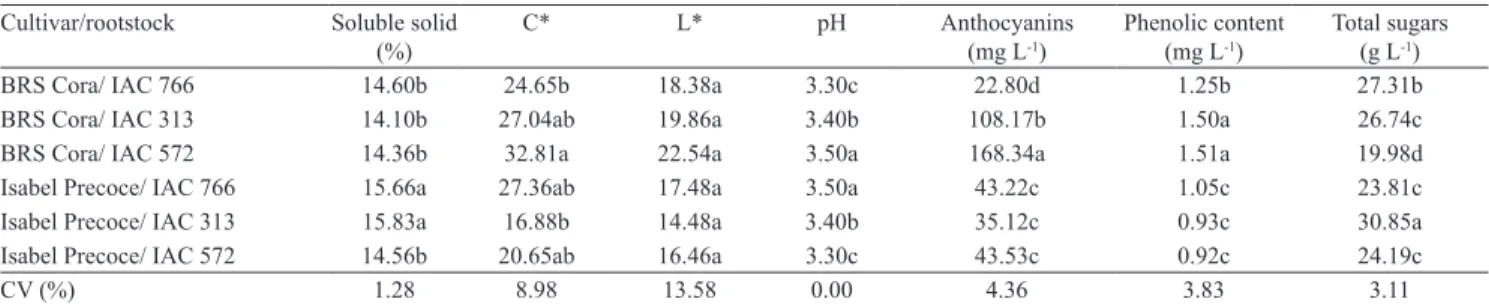
The content of soluble solids was significantly greater for the Isabel Precoce cultivar combined with the 'IAC 766' and 'IAC 313' rootstocks (Table 1). Juices made from the combination between 'BRS Cora' and 'IAC 572' showed the highest values of anthocyanin content. For total sugars, 'Isabel Precoce' combined with 'IAC 313' presented higher contents than the other combinations. 'Isabel Precoce' is originally from a spontaneous somatic mutation of the variety Isabel and it offers good productivity, anticipated maturation, and the same characteristics as the original cultivar (Camargo, 2004).
For color measurements, the lightness (L*) of the juices did not differ significantly between the evaluated materials, indicating that it was not affected by the cultivar effect. Chromaticity (C*) was higher
Table 1. Quality characteristics of grape (Vitis labrusca)juices obtained from the cultivars BRS Cora and Isabel Precoce
grown on the 'IAC 766', 'IAC 313', and 'IAC 572' rootstocks(1).
Cultivar/rootstock Soluble solid
(%) C* L* pH Anthocyanins (mg L‑1) Phenolic content (mg L‑1) Total sugars(g L‑1)
BRS Cora/ IAC 766 14.60b 24.65b 18.38a 3.30c 22.80d 1.25b 27.31b
BRS Cora/ IAC 313 14.10b 27.04ab 19.86a 3.40b 108.17b 1.50a 26.74c
BRS Cora/ IAC 572 14.36b 32.81a 22.54a 3.50a 168.34a 1.51a 19.98d
Isabel Precoce/ IAC 766 15.66a 27.36ab 17.48a 3.50a 43.22c 1.05c 23.81c
Isabel Precoce/ IAC 313 15.83a 16.88b 14.48a 3.40b 35.12c 0.93c 30.85a
Isabel Precoce/ IAC 572 14.56b 20.65ab 16.46a 3.30c 43.53c 0.92c 24.19c
CV (%) 1.28 8.98 13.58 0.00 4.36 3.83 3.11
for juice from: 'BRS Cora' with 'IAC 572', 'Isabel Precoce' with 'IAC 766' and 'IAC 572', and 'BRS Cora' with 'IAC 313'; this value indicates higher color intensity. The 'BRS Cora' hybrid variety is used to improve the color of juices when required, and the use of a proportion of 15–20% in the juice formulation is recommended (Camargo et al., 2005).
Juices from 'Isabel Precoce' combined with 'IAC 572' and from 'BRS Cora' with 'IAC 766' were the ones with the lowest pH, and those from 'BRS Cora' combined with 'IAC 572' and 'IAC 313' presented the highest phenolic content and were the first material to show a higher anthocyanin content.
The anthocyanins present in the juice varied greatly depending on the used cultivar and rootstock. Verdana et al. (2008) observed contents of 100.5 mg L‑1 for juices obtained from the Isabel Precoce cultivar. According to Malacrida & Mota (2005), anthocyanins concentration in grape juices range from 11.70 to 668 mg L‑1. The Isabel Precoce cultivar, regardless of the used rootstock, produced juices with no differences for anthocyanin content.
Rootstock strength can strongly influence the phenolic composition and the levels of phenolic compounds of grapes, and, consequently, of grape juices too (Reynier, 2007). The contents of phenolic compounds in the present work varied from 0.92 to 1.51 g L‑1. Malacrida & Mota (2005) found content of total phenolic compounds on grape juices of 1.43 g L‑1, whereas Verdana et al. (2008) reported 1.88 g L‑1 of phenolics on grape juices from the Isabel Precoce cultivar. The combination between the 'IAC 572' rootstock and the BRS Cora cultivar presented, on average, one of the highest concentrations
of phenolic compounds, anthocyanins, chromaticity, pH, and juice lightness (Table 1).
Four biogenic amines – putrescine, cadaverine, spermidine, and spermine – were detected in all evaluated grape juices (Table 2). The highest levels of biogenic amines were observed when putrescine and spermidine were assessed, varying from 0.97 to 2.67 µg mL‑1 and from 1.66 to 2.69, respectively. Cunha et al. (2011) observed the presence of biogenic amines in grape juice samples. According to these authors, putrescine was the most abundant, ranging from 1.06 to 7.25 mg L‑1, with an average level of 3.02 mg L‑1, usually accounting for around 50% of the total amine content. It was followed by ethylamine, methylamine, 2‑phenylethylamine, histamine, and tyramine.
The presence of putrescine in grape juices, as well as cadaverine, spermine, and spermidine, was also reported by Bauza et al. (1995) and Sass‑Kiss et al. (2000). Bover‑Cid et al. (2006) found the presence of putrescine and cadaverine in 16 samples of Cabernet Sauvignon grape juices, with an average of 6.81 and 1.16 mg kg‑1, respectively. Del Prete et al. (2009) obtained an average level of 11.23 mg L‑1 of putrescine for 14 grape juices, representative of seven different
cultivars from the 2004 and 2005 vintages.
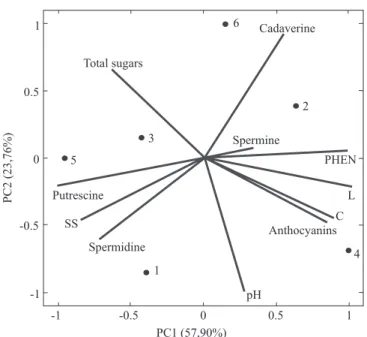
A distinction among the juices was observed according to PCA scores: principal component 1 (PC1) explained close to 60% of the variance and distributed juices from 'Isabel Precoce' grapes to the left and from 'BRS Cora' to the right of the score plot (Figure 1). Juices from 'BRS Cora' grapes presented elevated content of cadaverine, spermine, phenolics, and anthocyanins, in addition to high values for color (L* and C*). Juices from 'Isabel Precoce' grapes had a tendency of showing higher values for putrescine, spermidine, and
Table 2. Biogenic amines of grape (Vitis labrusca) juices obtained from the cultivars BRS Cora and Isabel Precoce grown on
the 'IAC 766', 'IAC 313', and 'IAC 572' rootstocks(1).
Juice Putrescine Cadaverine Spermidine Spermine
‑‑‑‑‑‑‑‑‑‑‑‑‑‑‑‑‑‑‑‑‑‑‑‑‑‑‑‑‑‑‑‑‑‑‑‑‑‑‑‑‑‑‑‑‑‑‑‑‑‑‑‑‑(µg mL‑1)‑‑‑‑‑‑‑‑‑‑‑‑‑‑‑‑‑‑‑‑‑‑‑‑‑‑‑‑‑‑‑‑‑‑‑‑‑‑‑‑‑‑‑‑‑‑‑‑‑
'Isabel Precoce' + 'IAC 766' 2.25 0.13 2.76 0.58
'Isabel Precoce' + 'IAC 313' 2.67 0.16 2.69 0.85
'Isabel Precoce' + 'IAC 572' 1.79 0.18 2.57 0.39
'BRS Cora' + 'IAC 766' 1.22 0.38 1.66 0.55
'BRS Cora' + 'IAC 313' 0.97 0.30 1.84 1.10
'BRS Cora' + 'IAC 572' 0.61 0.22 1.98 0.71
(1)No replicates and no statistical analysis were made for quantification of biogenic amines, only quantification by HPLC and assessment with standards
Pesq. agropec. bras., Brasília, v.49, n.7, p.540‑545, jul. 2014 DOI: 10.1590/S0100‑204X2014000700006
soluble solids. The characteristics pH and total sugars had lower relevance to the discrimination of the juices by PCA. Regardless of the used rootstock, the most important factor to characterize the juices was the grape cultivar.
The juice from 'BRS Cora' combined with 'IAC 572' presented desirable quality characteristics and a positive correlation for chroma value and anthocyanin content. A high chroma value indicates a highly saturated and intense color of the juice, whereas a low value, such as the one observed in juices from 'Isabel Precoce' and 'IAC 313', has a negative correlation with these color characteristics. However, the juice from 'BRS Cora' combined with 'IAC 572' showed a lower content of total sugars, which is a disadvantage for grape juices. The elevated content of anthocyanin in juices from 'BRS Cora' combined with 'IAC 313' and 'IAC 572' can explain the high contribution to total phenolic content.
Conclusions
1. Cultivars influence the chemical characteristics of grape (Vitis labrusca) juices, regardless of the rootstock
combined to them.
2. Grapes from 'BRS Cora' present elevated content of cadaverine, spermine, phenolics, and anthocyanins, in addition to high values for color.
3. 'BRS Cora' combined with the 'IAC 313' and 'IAC 572' rootstocks produces juices with the highest phenolic content, and 'BRS Cora' combined with 'IAC 572', juices with the highest levels of anthocyanins and the lowest levels of total sugars.
4. Four biogenic amines are present in all juices: putrescine, spermidine, cadaverine, and spermine.
Acknowledgement
To Coordenação de Aperfeiçoamento de Pessoal de Nível Superior (Capes), to Conselho Nacional de Desenvolvimento Científico e Tecnológico (CNPq), to Fundação de Amparo à Pesquisa do Estado de Minas Gerais (Fapemig), to Empresa Brasileira de Pesquisa Agropecuária (Embrapa), and to Empresa de Pesquisa Agropecuária de Minas Gerais (Epamig), for financial support.
References
BAUzA, T.; BLAISE, A.; MESTRES, J.P.; TEISSEDRE, P.L.; DAUMAS, F.; CABANIS, J.C. Teneurs en amines biogènes et facteurs de leurs variations dans les vins des côtes du Rhône, de la vallée du Rhone et de Provence. Sciences des Aliments, v.15,
p.367‑380, 1995.
BOVER‑CID, S.; IQUIERDO‑PULIDO, M.; MARINÉ‑FONT, A.; VIDAL‑CAROU, M.C. Biogenic mono‑, di‑ and polyamine contents in Spanish wines and influence of a limited irrigation.
Food Chemistry, v.96, p.43‑47, 2006. DOI: 10.1016/j.
foodchem.2005.01.054.
BURIN, V.M.; FALCãO, L.D.; GONzAGA, L.V.; FETT, R.; ROSIER, J.P.; BORDIGNON‑LUIz, M.T. Colour, phenolic content and antioxidant activity of grape juice. Ciência e
Tecnologia de Alimentos, v.30, p.1027‑1032, 2010. DOI: 10.1590/
S0101‑20612010000400030.
CAMARGO, U.A. 'Isabel Precoce': alternativa para a
vitivinicultura brasileira. Bento Gonçalves: Embrapa Uva e Vinho, 2004. 4p. (Embrapa Uva e Vinho. Comunicado técnico, 54). CAMARGO, U.A.; MAIA, J.D.G.; NACHTIGAL, J.C. BRS
Violeta: nova cultivar de uva para suco e vinho de mesa. Bento
Gonçalves: Embrapa Uva e Vinho, 2005. 8p. (Embrapa Uva e Vinho. Comunicado técnico, 63).
Figure 1. Principal component analysis of grape (Vitis
labrusca) juices and their characteristics. PHEN, phenolic
CUNHA, S.C.; FARIA, M.A.; FERNANDES, J.O. Gas chromatography‑mass spectrometry assessment of amines in Port wine and grape juice after fast chloroformate extraction/ derivatization. Journal of Agricultural and Food Chemistry,
v.59, p.8742‑8753, 2011. DOI: 10.1021/jf201379x.
DANI, C.; OLIBONI, L.S.; VANDERLINDE, R.; BONATTO, D.; SALVADOR, M.; HENRIQUES, J.A.P. Phenolic content and antioxidant activities of white and purple juices manufactured with organically‑ or conventionally‑produced grapes. Food and
Chemical Toxicology, v.45, p.2574‑2580, 2007. DOI: 10.1016/j.
fct.2007.06.022.
DEL PRETE, V.; COSTANTINI, A.; CECCHINI, F.; MORASSUT, M.; GARCIA‑MORUNOA, E. Occurrence of biogenic amines in wine: the role of grapes. Food Chemistry, v.112, p.474‑481, 2009.
DOI: 10.1016/j.foodchem.2008.05.102.
DISCHE, z. General color reactions. In: WHISTLER, R.L.; WOLFRAM, M.L. (Ed.). Carbohydrate chemistry. New York:
Academic Press, 1962. v.1, p.477‑512.
GIUSTII, M.M.; WROLSTAD, R.E. Characterization and measurement of Anthocyanins by UV‑visible spectroscopy. In: WROLSTAD, R.E. (Ed.). Current protocols in food analytical
chemistry. New York: Wiley, 2001. DOI: 10.1002/0471142913.
faf0102s00.
HORWITz, W. Official methods of analysis of the Association of Official Analytical Chemists. 17th ed. Washington: AOAC International, 2002. 1115p.
KALAC, P.; KRAUSOVA, P. A review of dietary polyamines: formation, implications for growth and health and occurrence in foods. Food Chemistry, v.90, p.219‑230, 2005. DOI: 10.1016/j.
foodchem.2004.03.044.
LIANG, z.; WU, B.; FAN, P.; YANG, C.; DUAN, W.; zHENG, X.; LIU, C.; LI, S. Anthocyanin composition and content in grape berry skin in Vitis germplasm. Food Chemistry, v.111, p.837‑844,
2008. DOI: 10.1016/j.foodchem.2008.04.069.
MALACRIDA, C.R.; MOTTA, S. da. Compostos fenólicos totais e antocianinas em sucos de uva. Ciência e Tecnologia
de Alimentos, v.25, p.659‑664, 2005. DOI: 10.1590/
S0101‑20612005000400006.
NAILA, A.; FLINT, S.; FLETCHER, G.; BREMER, P.; MEERDINK, G. Control of biogenic amines in food – existing and emerging approaches. Journal of Food Science, v.75, p.139‑150,
2010. DOI: 10.1111/j.1750‑3841.2010.01774.x.
NUNES, C.A.; FREITAS, M.P.; PINHEIRO, A.C.M.; BASTOS, S.C. Chemoface: a novel free user‑friendly interface for chemometrics. Journal of the Brazilian Chemical Society, v.23,
p.2003‑2010, 2012. DOI: 10.1590/S0103‑50532012005000073. REYNIER, A. Manuel de viticulture. 10th ed. Paris: Lavoisier, 2007. 532p.
SASS‑KISS, A.; SzERDAHELYI, E.; HAJóS, G. Study of biologically active amines in grapes and wines by HPLC.
Chromatographia, v.51, p.316‑320, 2000. DOI: 10.1007/
BF02492826.
SINGLETON, V.L.; ROSSI JUNIOR, J.A. Colorimetry of total phenolics with phosphomolybdic‑phosphotungstic acid reagents.
American Journal of Enology and Viticulture, v.16, p.144‑158,
1965.
VEDANA, M.I.S.; zIEMER, C.; MIGUEL, O.G.; PORTELLA, A.C.; CANDIDO, L.M.B. Efeito do processamento na atividade antioxidante de uva. Alimentos e Nutrição, v.19, p.159‑165, 2008.