High-volume hemoiltration and prone ventilation
in subarachnoid hemorrhage complicated by
severe acute respiratory distress syndrome and
refractory septic shock
INTRODUCTION
Keeping adequate oxygenation and blood pressure are milestones of neuroprotective care in patients with acute brain insults, such as aneurismal subarachnoid hemorrhage (SAH). Pulmonary and other medical complications after SAH may increase the length of stay, worsening mortality and the neurological outcomes.(1) Sepsis/septic shock, transfusions and the severity of the SAH are independent risk factors for acute respiratory distress syndrome (ARDS).(2) Some strategies for severe ARDS patients, such as permissive hypercapnia, higher levels of positive end-expiratory pressure (PEEP) and restrictive luid therapy are diicult to apply to neurocritical patients. Prone position ventilation (PPV) is one of these strategies, which is rarely used in patients with SAH because of the possible efects on the intracranial pressure (ICP) and cerebral perfusion pressure (CPP). In the few reports addressing the use of PPV for critical neurologic patients, PPV was well tolerated, and Rodrigo Cornejo1, Carlos Romero1, Diego Ugalde1,
Patricio Bustos2, Gonzalo Diaz1, Ricardo Galvez1,
Osvaldo Llanos1, Eduardo Tobar1
1. Intensive Care Unit, Department of Medicine, Hospital Clínico Universidad de Chile - Santiago, Chile.
2. Department of Neurology and Neurosurgery, Hospital Clínico Universidad de Chile -
Santiago, Chile. of two patients with aneurismal We report the successful treatment
subarachnoid hemorrhage complicated by severe respiratory failure and refractory septic shock using simultaneous prone position ventilation and high-volume hemoiltration. hese rescue therapies allowed the patients to overcome the critical situation without associated complications and with no detrimental efects on the intracranial and cerebral perfusion pressures. Prone position ventilation is now an accepted therapy for severe acute respiratory distress syndrome, and high-volume hemoiltration is a non-conventional hemodynamic support
Conflicts of interest: None. Submitted on December 13, 2013 Accepted on April 21, 2014
Corresponding author:
Carlos Romero Intensive Care Unit Department of Medicine
Hospital Clínico Universidad de Chile Santos Dumont 999, Santiago, Región Metropolitana 8380430
Chile
E-mail: [email protected]
Hemoiltração de alto volume e ventilação em posição prona em
hemorragia subaracnóidea complicada por grave síndrome do
desconforto respiratório agudo e choque séptico refratário
ABSTRACT
Keywords: Subarachnoid hemorrhage/ therapy; Respiration, artiicial; Prone position; Hemoiltration/methods; Acute respiratory distress syndrome; Septic shock; Case reports
that has several potential mechanisms for improving septic shock. In this manuscript, we briely review these therapies and the related evidence. When other conventional treatments are insuicient for providing safe limits of oxygenation and perfusion as part of basic neuroprotective care in subarachnoid hemorrhage patients, these rescue therapies should be considered on a case-by-case basis by an experienced critical care team.
its beneits for improving oxygenation outweighed the increased ICP, even in reduced cerebral compliance conditions.(3,4)
Septic shock and multi-organ dysfunction syndrome (MODS) are the main non-neurological causes of death in aneurismal SAH.(5) Early mortality in septic shock is attributed to refractory hypotension; in this scenario, high-volume hemoiltration (HVHF) has been used as a rescue therapy to revert the shock status and to eventually remove inlammatory mediators.(6)
To the best of our knowledge, there is no data on the use of HVHF in neurocritical patients with severe shock or on the simultaneous use of PPV and HVHF. Here, we describe two patients with aneurismal SAH that evolved to severe ARDS and refractory septic shock; the patients were simultaneously treated with these therapies.
CASE PRESENTATION
Case 1
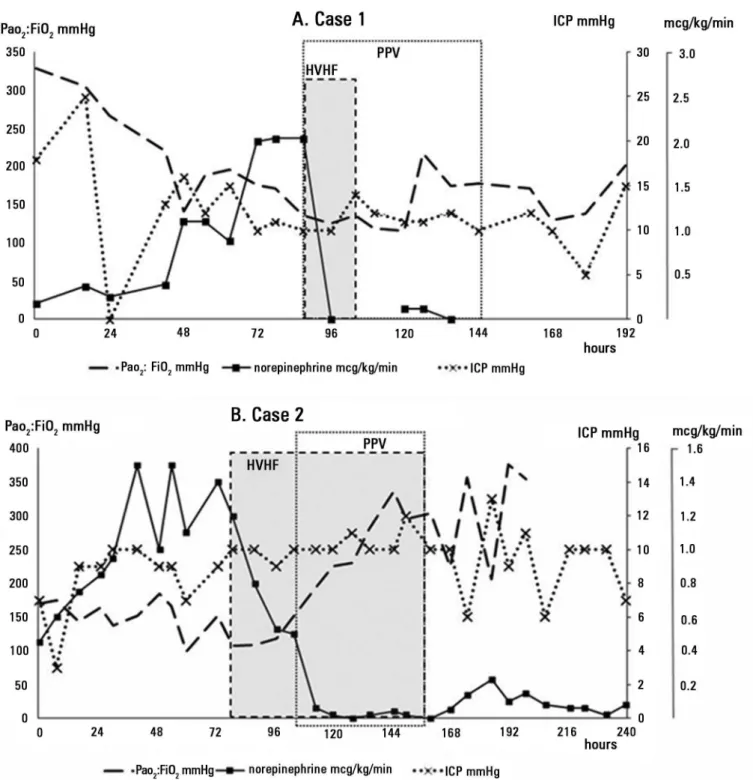
A 36-year-old, previously healthy woman was admitted to the intensive care unit (ICU) with SAH Fisher IV, Hunt-Hess II, and World Federation of Neurosurgeons (WFNS) 1. Angiography detected an aneurysm in the right pericallous artery, and surgical resolution was deemed necessary. he aneurysm was ruptured during surgery, and the patient sufered blood loss of approximately 3L. In the ICU, she presented signs of intracranial hypertension (ICP up to 25mmHg) and developed an enlarging frontal hematoma with secondary hydrocephalus that required an external ventricular drainage and reintervention. She was managed according to the established guidelines for the brain-injured patient;(7) sedation was maintained with propofol, fentanyl and midazolam. he patient developed catastrophic respiratory failure due to massive transfusion, aspiration pneumonia, coagulopathy, and refractory septic shock, requiring norepinephrine (up to 2mcg/kg/min) and epinephrine (0.48mcg/kg/min) to maintain mean arterial pressure (MAP) at approximately 70mmHg, while the ICP was 11mmHg and CPP 62mmHg; the Sequential Organ Failure Assessment (SOFA) score was 12.
he main therapeutic goal was to optimize cerebral oxygenation, aiming for a CPP >60mmHg, adequate arterial oxygenation and carbon dioxide elimination (PCO2 35 to 40mmHg), but these goals were extremely diicult to achieve. Despite the administration of 100% oxygen, volume control ventilation using high inspiratory pressures (up to 40cmH2O), a PEEP of 20cmH2O, and neuromuscular blockade with rocuronium, the partial
pressure of oxygen (PaO2) ranged from 40.5 to 66.7mmHg with a pressure arterial oxygen:fraction of inspired oxygen (PaO2:FiO2) of 135.7 and oxygenation index (OI) of 13.3. On her 3rd day in the ICU, we simultaneously applied PPV (60 straight hours) and HVHF. he HVHF dose was 100mL/kg/h in pulse for 6 hours and then 35mL/kg/hour, for 18 hours. he patient evolved with improved gas exchange and reversion of the shock status; tapering pressors began 12 hours after the combination therapy, with PaO2:FiO2 of 174 and OI of 8.6. he ICP remained unchanged.
Two days after returning to the supine position, the patient’s OI was 7, PaO2:FiO2 200mmHg, and MAP 100mmHg without vasopressor support (Figure 1). Her hemodynamic and respiratory parameters improved; she remained intubated due to her neurological condition. She had partial recovery and was responsive to contact, but she could not follow orders. Transcranial Doppler showed moderate right and mild left vasospasm, indicating that she was responsive to medical treatment. No signiicant complications were observed during the ICU stay. he patient was transferred to the neurosurgical intermediate unit with a total ICU stay of 21 days. She achieved comprehensible language and walker-assisted mobility 44 days after admission. She achieved a modiied Rankin scale of 3; Barthel index of 55; functional independence measure (FIM) of 73/126 (58%); and Glasgow outcome scale (GOS) of 4. he ethics committee granted approval for including her case in this report.
Case 2
Figure 1 - Time course of oxygenation (PaO2:FiO2), vasopressor requirement (norepinephrine dose), and intracranial pressure during the rescue therapies in both patients
(cases 1 and 2). The dotted line demarks the prone position ventilation period, and the gray area with interrupted line borders marks the high-volume hemofiltration period.
PaO2:FiO2 - pressure arterial oxygen: fraction of inspired oxygen; ICP - intracranial pressure; PPV - prone position ventilation; HVHF - high-volume hemofiltration.
measures were started, which included head positioning and strict management of body temperature as well as glycemia, hemodynamic, oxygenation and internal homeostasis. he patient evolved with an ICP of <20mmHg and a CPP of >60mmHg.
Later, he developed progressive respiratory failure and hemodynamic instability with a SOFA score of 11. His vasopressor requirements increased to norepinephrine >1mcg/kg/min, and PaO2:FiO2 decreased approximately 100mmHg. he HVHF session was started (a pulse of 100mL/kg/h for 6 hours followed by a maintenance dose of 35mL/kg/h for 18 hours to complete a total of 24 consecutive hours), decreasing the norepinephrine requirements, but severe respiratory failure remained unchanged (PaO2:FiO2 of 107mmHg and OI of 17.8); therefore, PPV was applied. With the combined use of PPV and HVHF, vasopressor reduction (norepinephrine dose of 0.06mcg/kg/min) and respiratory improvement were achieved (PaO2:FiO2 of 226mmHg and OI of 8.7). During HVHF and PPV, his brain tissue oxygen tension (PtiO2), ICP and CPP were maintained within adequate margins. After 72 hours of PPV without complications, which achieved our goals of reduced pressors and gas exchange, the patient was returned to the supine position, and hemoiltration was suspended (Figure 1). Later, vasopressor therapy and neuromonitorization were suspended. Weaning of mechanical ventilation was successfully performed; the ICU stay lasted for 36 days, and the patient required 11 days of intermediate care. he patient was transferred to the neurology general care room for continued rehabilitation. He was discharged 2 months after admission with minimal left hemiparesia, independence in basic activities, modiied Rankin Scale of 2, Barthel index of 90, FIM of 102 and GOS of 5. he ethics committee granted approval for including his case in this report.
DISCUSSION
To the best of our knowledge, these are the irst patients treated simultaneously with PPV and HVHF in the context of SAH complicated by catastrophic respiratory failure and refractory septic shock. hese therapies were clinically efective and improved the patients’ oxygenation and hemodynamic properties without detrimental efects on ICP and CPP.
PPV and HVHF are non-conventional, salvage therapies applied to severe ARDS and refractory septic shock, respectively. heir application is usually limited to SAH patients because of the general contraindications for PPV and HVHF in cases of intracranial hypertension and coagulopathy. PPV has been contraindicated in severe shock, and HVHF is often not feasible in patients with severe respiratory failure who require high levels of PEEP.
herefore, the synergistic efect of these two treatment approaches when used is combination is interesting.
At the time that these cases were treated, there was no robust data demonstrating the survival beneits of PPV and HVHF. We used as these treatments in these patients because they were in critical clinical situations.
Prone position ventilation
Acute respiratory dysfunction is the most frequent medical complication in SAH patients who survive the initial bleeding, and it is an important cause of non-neurological mortality and cerebral hypoxia.(1,5,8) Diferent therapeutic strategies used in the management of severe ARDS patients, such as permissive hypercapnia, higher PEEP,(9) luid restriction and PPV, are diicult to apply in neurocritical patients. PPV is a feasible, safe and inexpensive therapy, which in addition to improving gas exchange in over two thirds of patients with respiratory failure, can be a life-saving therapy in cases of severe ARDS. Remarkably, in patients with a PaO2:FiO2 <100mmHg, PPV increases survival; although initial trials did not show a beneit,(2,10-12) recent evidence has shown a beneit of this therapy.(13,14) PPV has been proposed as a lung-protective ventilation strategy because the ARDS lung can be more uniformly recruited and stress and strain can be better distributed.(15-17)
In recent years, we have implemented a management strategy for severe ARDS with PPV, the cornerstone of treatment. As others authors, we have obtained good results using these methods in diferent settings, such as for pandemic H1N1 associated ARDS.(18-20)
However, when patients return to the supine position, oxygenation improvements may be partially lost, and higher levels of PEEP are typically required. However, this behavior seems to be related to the time on PPV because better results have been obtained after prolonged periods of PPV.(18-21)
PPV does not signiicantly modify the systemic hemodynamics, but it may contribute to reducing the afterload of the right ventricle. Intraabdominal pressure, splenic low and the energetic balance of the gastric mucosa are usually not altered.(22,23)
hypoxemia directly afects neurologic outcomes and survival.(1,5) Experimental data show that partial prone positioning in traumatic brain injury patients may increase the ICP. However, in the majority of SAH patients, the procedure has been well tolerated, causing minimal or no increase in ICP, while there are signiicant efects on oxygenation; only a very small fraction of cases have increased ICP with PPV.(3,4) Accordingly, if ICP is appropriately monitored, PPV may be an adequate treatment option for severe ARDS in SAH patients.
High volume hemofiltration
Sepsis and septic shock are relevant causes of death, and current management considers goal-directed reanimation and evidence-based interventions as paramount.(24) However, septic shock refractory to standard therapy with unresponsive hypotension remains a concern for ICU patients, such as in these cases. Non-conventional salvage therapies, such as HVHF, have emerged as treatment options in this scenario.(6)
HVHF is deined by consensus as the continuous application of a iltration dose of over 50mL/kg/h, or a pulse (for 4 to 12 hours) application of 100 to 120mL/kg/h.(25)
In recent years, HVHF has evolved from experimental studies to adjuvant therapy for septic shock, but its eicacy has yet to be thoroughly established. Early trials have shown a reduction on the vasopressor requirements and complement mediators when HVHF is used.(26,27) Meanwhile, hemodynamic improvement, cytokine reduction and clinical improvement have been documented in pulse modality, even for as short as a single session, which is more practical and associated with lower costs.(28) HVHF has been associated with improvements in blood pressure and sublingual microcirculatory blood low with increasing systemic vascular resistance, suggesting a systemic macrohemodynamic beneit without detrimental efects in microcirculation.(29) Moreover, HVHF responsiveness seems to be a mortality predictor on its own in severe hyperdynamic septic shock.(7) In contrast, low volume hemoiltration has not been shown to be beneicial in septic patients.(30)
However, no clear overall beneicial efect from HVHF could be demonstrated in a recent trial (IVOIRE).(31) However, the dose (70mL/kg/h) and the HVHF treatment time (96-hour period) employed in this study may not have
been the most appropriate parameters for this therapeutic method. It remains controversial whether HVHF has a role in septic shock.
HVHF was applied in both cases without established renal failure due to septic and hemodynamic objectives. However, it is important to consider that the use of HVHF as continuous renal replacement therapy (CRRT) provides an efective method of solute clearance with cardiovascular and intracranial stability in patients with acute brain injury.(32,33) Additionally, there is anecdotal evidence that CRRT may have beneicial efects in patients with refractory intracranial hypertension.(34) he disadvantage of any CRRT is the use of anticoagulation, wherein there are risks of intracerebral hemorrhage. However, we did not employ anticoagulants in the presented cases. In our experience, we rarely use anticoagulants during HVHF due to common coagulopathy in severely septic patients without signiicant thrombotic complications.
he theoretical beneits of HVHF in controlling inlammation in addition to the better oxygenation and more protective ventilation obtained with PPV make the simultaneous use of HVHF and PPV a possible synergistic combination.
CONCLUSIONS
In these two subarachnoid hemorrhage patients, the simultaneous use of high-volume hemoiltration and prone position ventilation had positive efects, improving oxygenation and hemodynamics without exerting detrimental consequences on the intracranial pressure.In both cases, these therapies allowed the patients to overcome the critical situation and eventually be discharged from the intensive care unit with no associated complications.
Relatamos o tratamento bem-sucedido de dois pacientes com hemorragia subaracnóidea complicada com grave falência respiratória e choque séptico refratário, utilizando, simultaneamente, ventilação em posição prona e hemoiltração de alto volume. Esses tratamentos de resgate permitiram que os pacientes superassem a grave situação sem complicações associadas ou efeitos deletérios na pressão intracraniana e de perfusão cerebral. A ventilação em posição prona é, hoje, um tratamento aceito para síndrome de desconforto respiratório agudo grave, e a hemoiltração de alto volume é um suporte hemodinâmico não convencional, que tem diversos
mecanismos potenciais para melhorar o choque séptico. Neste artigo revisamos brevemente esses tratamentos e as evidências relacionadas. Quando outras terapias convencionais são insuicientes para proporcionar oxigenação e perfusão como parte do cuidado neuroprotetor básico dentro de limites seguros em pacientes com hemorragia subaracnóidea, esses tratamentos de resgate podem ser considerados caso a caso por uma equipe com experiência em cuidados críticos.
RESUMO
Descritores: Hemorragia subaracnóidea/terapia; Respiração artiicial; Decúbito ventral; Hemoiltração/métodos; Síndrome do desconforto respiratório do adulto; Choque séptico; Relatos de casos
REFERENCES
1. Wartenberg KE, Schmidt JM, Claassen J, Temes RE, Frontera JA, Ostapkovich N, et al. Impact of medical complications on outcome after subarachnoid hemorrhage. Crit Care Med. 2006;34(3):617-23; quiz 624. 2. Wheeler AP, Bernard GR. Acute lung injury and the acute respiratory
distress syndrome: a clinical review. Lancet. 2007;369(9572):1553-64. 3. Thelandersson A, Cider A, Nellgård B. Prone position in mechanically
ventilated patients with reduced intracranial compliance. Acta Anaesthesiol Scand. 2006;50(8):937-41.
4. Reinprecht A, Greher M, Wolfsberger S, Dietrich W, Illievich UM, Gruber A. Prone position in subarachnoid hemorrhage patients with acute respiratory distress syndrome: effects on cerebral tissue oxygenation and intracranial pressure. Crit Care Med. 2003;31(6):1831-8.
5. Gruber A, Reinprecht A, Illievich UM, Fitzgerald R, Dietrich W, Czech T, et al. Extracerebral organ dysfunction and neurologic outcome after aneurysmal subarachnoid hemorrhage. Crit Care Med. 1999;27(3):505-14. 6. Romero CM, Downey P, Hernandez G. Hemofiltración de alto volumen en
shock séptico. Med Intensiva. 2010;34(5):345-52.
7. Diringer MN, Bleck TP, Claude Hemphill J 3rd, Menon D, Shutter L, Vespa P,
Bruder N, Connolly ES Jr, Citerio G, Gress D, Hänggi D, Hoh BL, Lanzino G, Le Roux P, Rabinstein A, Schmutzhard E, Stocchetti N, Suarez JI, Treggiari M, Tseng MY, Vergouwen MD, Wolf S, Zipfel G; Neurocritical Care Society. Critical care management of patients following aneurysmal subarachnoid hemorrhage: recommendations from the Neurocritical Care Society’s Multidisciplinary Consensus Conference. Neurocrit Care. 2011;15(2):211-40. 8. Kahn JM, Caldwell EC, Deem S, Newell DW, Heckbert SR, Rubenfeld GD.
Acute lung injury in patients with subarachnoid hemorrhage: incidence, risk factors, and outcome. Crit Care Med. 2006;34(1):196-202.
9. Bugedo G, Bruhn A, Regueira T, Romero C, Retamal J, Hernández G. Positive end-expiratory pressure increases strain in patients with ALI/ARDS. Res Bras Ter Intensiva. 2012;24(1):43-51.
10. Charron C, Bouferrache K, Caille V, Castro S, Aegerter P, Page B, et al. Routine prone positioning in patients with severe ARDS: feasibility and impact on prognosis. Intensive Care Med. 2011;37(5):785-90.
11. Guerin C, Gaillard S, Lemasson S, Ayzac L, Girard R, Beuret P, et al. Effects of systematic prone positioning in hypoxemic acute respiratory failure: a randomized controlled trial. JAMA. 2004;292(19):2379-87.
12. Taccone P, Pesenti A, Latini R, Polli F, Vagginelli F, Mietto C, Caspani L, Raimondi F, Bordone G, Iapichino G, Mancebo J, Guérin C, Ayzac L, Blanch L, Fumagalli R, Tognoni G, Gattinoni L; Prone-Supine II Study Group. Prone positioning in patients with moderate and severe acute respiratory distress syndrome: a randomized controlled trial. JAMA. 2009;302(18):1977-84.
13. Sud S, Friedrich JO, Taccone P, Polli F, Adhikari NK, Latini R, et al. Prone ventilation reduces mortality in patients with acute respiratory failure and severe hypoxemia: systematic review and meta-analysis. Intensive Care Med. 2010;36(4):585-99.
14. Guérin C, Reignier J, Richard JC, Beuret P, Gacouin A, Boulain T, Mercier E, Badet M, Mercat A, Baudin O, Clavel M, Chatellier D, Jaber S, Rosselli S, Mancebo J, Sirodot M, Hilbert G, Bengler C, Richecoeur J, Gainnier M, Bayle F, Bourdin G, Leray V, Girard R, Baboi L, Ayzac L; PROSEVA Study Group. Prone positioning in severe acute respiratory distress syndrome. N Engl J Med. 2013;368(23):2159-68.
15. Vieillard-Baron A, Rabiller A, Chergui K, Peyrouset O, Page B, Beauchet A, et al. Prone position improves mechanics and alveolar ventilation in acute respiratory distress syndrome. Intensive Care Med. 2005;31(2):220-6. 16. Rival G, Patry C, Floret N, Navellou JC, Belle E, Capellier G. Prone position
and recruitment manoeuvre: the combined effect improves oxygenation. Crit Care. 2011;15(3):R125.
17. Cornejo RA, Díaz JC, Tobar EA, Bruhn AR, Ramos CA, González RA, et al. Effects of prone positioning on lung protection in patients with acute respiratory distress syndrome. Am J Respir Crit Care Med. 2013; 188(4):440-8.
18. Romero CM, Cornejo RA, Gálvez LR, Llanos OP, Tobar EA, Berasaín MA, et al. Extended prone position ventilation in severe acute respiratory distress syndrome: a pilot feasibility study. J Crit Care. 2009;24(1):81-8. 19. Cornejo R, Tobar E, Díaz G, Romero C, Llanos O, Gálvez LR, et al. Systematic
approach for severe respiratory failure due to novel A (H1N1) influenza. Minerva Anestesiol. 2011;77(5):510-21.
20. Cornejo R, Ugalde D, Muñoz M, Romero C, Tobar E, Llanos O, et al. Efectos de la ventilación en posición prono extendida en SDRA secundario a influenza A(H1N1). Rev Chil Med Intensiv. 2011;26(1):17-26.
21. McAuley DF, Giles S, Fichter H, Perkins GD, Gao F. What is the optimal duration of ventilation in the prone position in acute lung injury and acute respiratory distress syndrome? Intensive Care Med. 2002;28(4):414-8. 22. Vieillard-Baron A, Charron C, Caille V, Belliard G, Page B, Jardín F. Prone
positioning unloads the right ventricle in severe ARDS. Chest. 2007; 132(5):1440-6.
23. Matejovic M, Rokyta R Jr, Radermacher P, Krouzecky A, Sramek V, Novak I. Effect of prone position on hepato-splanchnic hemodynamics in acute lung injury. Intensive Care Med. 2002;28(12):1750-5.
25. Honoré PM, Joannes-Boyau O, Kotulak T. Report of the working party on high volume hemofiltration including definitions and classification. Proc 2nd Czech
Conference on Critical Care Nephrology, Pardubice, Czech Republic, 2007. 26. Cole L, Bellomo R, Journois D, Davenport P, Baldwin I, Tipping P.
High-volume haemofiltration in human septic shock. Intensive Care Med. 2001;27(6):978-86.
27. Joannes-Boyau O, Rapaport S, Bazin R, Fleureau C, Janvier G. Impact of high volume hemofiltration on hemodynamic disturbance and outcome during septic shock. ASAIO J. 2004;50(1):102-9.
28. Ratanarat R, Brendolan A, Piccinni P, Dan M, Salvatori G, Ricci Z, Ronco C. Pulse high-volume haemofiltration for treatment of severe sepsis: effects on hemodynamics and survival. Crit Care. 2005;9(4):R294-302.
29. Ruiz C, Hernandez G, Godoy C, Downey P, Andresen M, Bruhn A. Sublingual microcirculatory changes during high-volume hemofiltration in hyperdynamic septic shock patients. Crit Care. 2010;14(5):R170.
30. Payen D, Mateo J, Cavaillon JM, Fraisse F, Floriot C, Vicaut E; Hemofiltration and Sepsis Group of the Collège National de Réanimation et de Médecine d’Urgence des Hôpitaux extra-Universitaires. Impact of continuous venovenous hemofiltration on organ failure during the early phase of severe sepsis: a randomized controlled trial. Crit Care Med. 2009;37(3):803-10. 31. Joannes-Boyau O, Honoré PM, Perez P, Bagshaw SM, Grand H, Canivet
JL, et al. High-volume versus standard-volume haemofiltration for septic shock patients with acute kidney injury (IVOIRE study): a multicentre randomized controlled trial. Intensive Care Med. 2013;39(9):1535-46. 32. Davenport A. Renal replacement therapy in the patient with acute brain
injury. Am J Kidney Dis. 2001;37(3):457-66.
33. Davenport A. Continuous renal replacement therapies in patients with acute neurological injury. Semin Dial. 2009;22(2):165-8.