Inlammatory and perfusion markers as risk factors
and predictors of critically ill patient readmission
INTRODUCTION
Mortality rates in intensive care units (ICU) have decreased signiicantly in recent years. However, the rates of readmission to the ICU have remained relatively constant.(1,2) Readmission rates may vary from 0.89 to 19%, depending on the inclusion criteria of the study, study design, and the proile of the ICU studied.(3-9) Invariably, all previous studies have indicated a correlation between readmission rates, increased mortality rates, and/or hospital stay.(3-12) A recent American retrospective cohort study reported that readmitted patients had a 2.5-fold greater hospitalization time and a 4-fold higher probability of death compared to non-readmitted patients.(3)
Other studies comparing readmitted and non-readmitted patients have indicated that the former are more critically ill, are older, experience a longer stay in the ICU, and have more chronic comorbidities.(3-12) Several studies have identiied risk factors associated with readmission, whereas other studies Moreno Calcagnotto dos Santos1, Márcio Manozzo
Boniatti1,2, Carla Silva Lincho1, José Augusto Santos Pellegrini1,2, Josi Vidart2, Edison Moraes Rodrigues Filho1,2, Silvia Regina Rios Vieira2
1. Department of Intensive Care, Hospital Nossa Senhora da Conceição - Porto Alegre (RS), Brazil. 2. Department of Intensive Care, Hospital de Clínicas de Porto Alegre, Universidade Federal do Rio Grande do Sul - Porto Alegre (RS), Brazil.
Objective: To assess the performance of central venous oxygen saturation, lactate, base deicit, and C-reactive protein levels and SOFA and SWIFT scores on the day of discharge from the intensive care unit as predictors of patient readmission to the intensive care unit.
Methods: his prospective and
observational study collected data from 1,360 patients who were admitted consecutively to a clinical-surgical intensive care unit from August 2011 to August 2012. he clinical characteristics and laboratory data of readmitted and non-readmitted patients after discharge from the intensive care unit were compared. Using a multivariate analysis, the risk factors independently associated with readmission were identiied.
Conflicts of Interest: None.
Submitted on November 8, 2013 Accepted on April 2, 2014
Corresponding author:
Moreno Calcagnotto dos Santos
Unidade de Terapia Intensiva do Hospital Nossa Senhora da Conceição
Rua Frascisco Trein, 596 - Cristo Redentor Zip code: 91350-200 - Porto Alegre (RS), Brazil E-mail: [email protected]
Marcadores inlamatórios e perfusionais como preditores e fatores
de risco para readmissão de pacientes gravemente enfermos
ABSTRACT
Keywords: Patient readmission;
Patient readmission/economics; Risk factors; C-reactive protein; Lactate; Patient safety
Results: he C-reactive protein,
central venous oxygen saturation, base deicit, and lactate levels and the SWIFT and SOFA scores did not correlate with the readmission of critically ill patients. Increased age and contact isolation because of multidrug-resistant organisms were identiied as risk factors that were independently associated with readmission in this study group.
Conclusion: Inlammatory and
perfusion parameters were not associated with patient readmission. Increased age and contact isolation because of multidrug-resistant organisms were identiied as predictors of readmission to the intensive care unit.
have developed scores to identify patients at risk for
readmission.(13-16) he irst score developed was the
Stability and Workload Index for Transfer (SWIFT), which was designed in an American ICU and validated in a population of critically ill patients in Europe. A more recently adopted score is the Minimizing ICU
Readmission (MIR).(13-16) Unfortunately, these scores
indicate, at best, a moderate ability to discriminate which patient will be readmitted.
Some retrospective studies have identiied inlammatory markers, such as C-reactive protein (CRP), as readmission predictors of critically ill patients to the ICU.(17,18) However, the data on this issue are conlicting. A prospective study reported the absence of a signiicant relationship between readmission and CRP levels.(19) he reasons for these results are unknown. CRP is an acute phase reagent, and its levels are associated with multiple organ dysfunctions in critically ill patients. Possibly, CRP is a marker of an unknown or incipient organ dysfunction in this patient group.
Recently, several studies have reported that elevated central venous oxygen saturation (ScvO2) is an indicator of inadequate oxygen utilization and is associated with increased mortality in critically ill patients.(20-22) Currently, we are unaware of studies on the use of perfusion markers as risk factors or predictors of patient readmission to the ICU.
he aim of this study was to identify whether some perfusion markers, including ScvO2, base deicit (BD), lactate levels, and inlammatory markers, such as CRP, could be useful to identify unknown organ dysfunctions associated with the readmission of critically ill patients.
METHODS
his prospective study collected data from patients
admitted to the ICU at the Hospital Nossa Senhora da
Conceição between August 2011 and August 2012. he study was approved by the Research Ethics Committee
of this hospital under Protocol Nº 11-125, and the
requirement for informed consent was waived because of the observational nature of the study.
All clinical and demographic data were collected on the initial day of ICU admission. Both SWIFT and SOFA scores were calculated when the patients were discharged from the ICU. CRP and perfusion markers were collected according to patient availability at ICU discharge. Some variables were scored to deine more precise criteria to identify patients that were at risk for readmission. CRP was scored based on previous studies that used a CRP level
>100mg/L as the cutof value.(17,18) A ScvO
2 level >80% was deined as the cutof value because of increasing evidence that central venous hyperoxia is associated with worse ICU outcomes.(20-22) A lactate level >2mmol/L was deined as the cutof to discriminate patients at risk of readmission because this level has been classically used to deine hyperlactatemia and/or hypoperfusion states.(23-26)
Patients who died in the ICU, those who were discharged from the ICU to receive palliative care, those with non-resuscitation orders, and those with planned readmissions were excluded from the present study.
he outcome was deined as readmission when the patients were hospitalized up to 96 hours after discharge from the ICU. he readmission time was restricted because of the kinetics of the inlammatory and perfusion markers and also because readmissions after a long period of discharge cannot be attributed to patient care or events associated with prior patient admittance to the ICU.(13)
Risk factor analysis for readmission
Continuous variables are expressed as the means ± standard deviations or medians (interquartile range) according to the distribution assessed by normality tests. Data normality was conirmed using the Shapiro-Wilk test. he qualitative variables are expressed as percentages and were compared using Fisher’s exact test. A multivariate analysis was performed considering readmission as the dependent variable. Variables with a signiicant p value in the univariate analysis were included in the multivariate analysis. A value of p<0.05 was considered signiicant in the inal models. Statistical tests were performed using the Statistical Package for Social Sciences (SPSS) version 18.0.
RESULTS
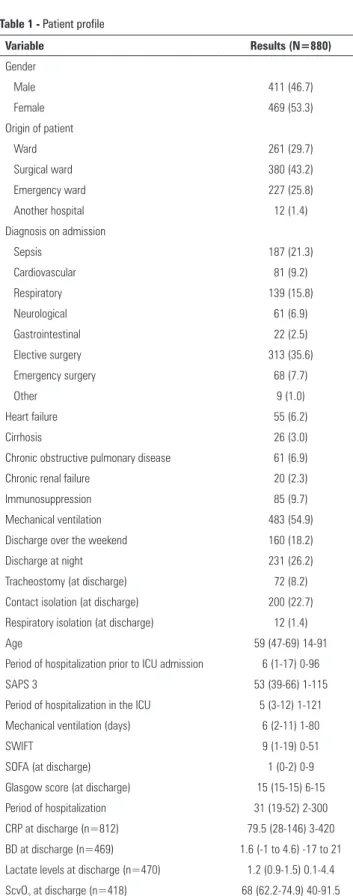
Between August 2011 and August 2012, 1,360 admissions were computed. Among these admissions, 461 patients (33.9%) who died in the ICU and 19 (2.1%) who did not it the criteria for readmission (including those with non-resuscitation orders and those discharged from the ICU to receive palliative care) were excluded. herefore, 880 patients were evaluated (Figure 1). Among these patients, 66 (7.5%) were readmitted. Table 1 shows the demographic and clinical proile of the patients at risk of readmission.
Figure 1 - Flowchart of the study group.
of multidrug-resistant bacteria, and those discharged in the evening and on weekends were more likely to be readmitted. Patients in the postoperative period of elective surgery were less likely to be readmitted. CRP levels, lactate levels, ScvO2, and BD were not associated with readmission. hese data are shown in table 1S of the electronic supplementary material.
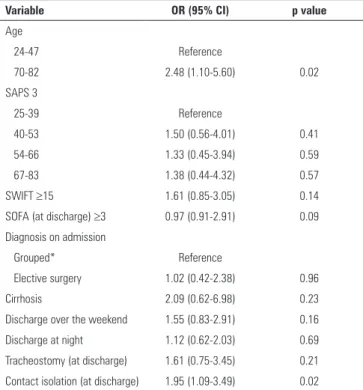
Table 2 shows the multivariate analysis of factors associated with readmission. he only variables associated with an increased probability of readmission to the ICU were an age of >70 (odds ratio (OR)=2.48; conidence interval at 95% (95%CI)=1.10-5.60, p=0.02) and contact isolation because of multidrug-resistant bacteria (OR=1.95, 95%CI=1.09-3.49, p=0.02). In this model, elective surgery, as the primary reason for ICU admission, did not lead to a decreased probability of readmission (OR=0.93, 95%CI=0.51-1.71, p=0.81). Considering the possible collinearity between statistically signiicant variables in the univariate analysis, another multivariate analysis model was prepared, excluding the SOFA score, patients with cirrhosis, and those who underwent tracheostomy (Table 3). In this second model, patients who were >70 years old or required contact isolation because of multidrug-resistant bacteria remained statistically signiicant as risk factors associated with readmission (OR=2.49, 95%CI=1.11-5.58, p=0.02 and OR=2.02, 95%CI=1.14-3.57, p=0.01, respectively).
Table 1 - Patient profile
Variable Results (N=880)
Gender
Male 411 (46.7)
Female 469 (53.3)
Origin of patient
Ward 261 (29.7)
Surgical ward 380 (43.2)
Emergency ward 227 (25.8)
Another hospital 12 (1.4)
Diagnosis on admission
Sepsis 187 (21.3)
Cardiovascular 81 (9.2)
Respiratory 139 (15.8)
Neurological 61 (6.9)
Gastrointestinal 22 (2.5)
Elective surgery 313 (35.6)
Emergency surgery 68 (7.7)
Other 9 (1.0)
Heart failure 55 (6.2)
Cirrhosis 26 (3.0)
Chronic obstructive pulmonary disease 61 (6.9)
Chronic renal failure 20 (2.3)
Immunosuppression 85 (9.7)
Mechanical ventilation 483 (54.9)
Discharge over the weekend 160 (18.2)
Discharge at night 231 (26.2)
Tracheostomy (at discharge) 72 (8.2)
Contact isolation (at discharge) 200 (22.7)
Respiratory isolation (at discharge) 12 (1.4)
Age 59 (47-69) 14-91
Period of hospitalization prior to ICU admission 6 (1-17) 0-96
SAPS 3 53 (39-66) 1-115
Period of hospitalization in the ICU 5 (3-12) 1-121
Mechanical ventilation (days) 6 (2-11) 1-80
SWIFT 9 (1-19) 0-51
SOFA (at discharge) 1 (0-2) 0-9
Glasgow score (at discharge) 15 (15-15) 6-15
Period of hospitalization 31 (19-52) 2-300
CRP at discharge (n=812) 79.5 (28-146) 3-420
BD at discharge (n=469) 1.6 (-1 to 4.6) -17 to 21
Lactate levels at discharge (n=470) 1.2 (0.9-1.5) 0.1-4.4
ScvO2 at discharge (n=418) 68 (62.2-74.9) 40-91.5
ICU - intensive care unit; SWIFT - Stability and Workload Index for Transfer; SOFA - Sequential Organ Failure Assessment; CRP - C-reactive protein; BD - base deficit; ScvO2 - central venous oxygen saturation. The results are expressed as numbers (percentages) or medians (interval 25 to 75%) min-max. SAPS 3, Simplified Acute Physiology Score 3. Differences in the number of laboratory data available on CRP, ScvO2, lactate, and BD levels are a result
Table 2 - Multivariate analysis of the risk factors associated with patient readmission - model 1
Variable OR (95% CI) p value
Age
24-47 Reference
70-82 2.48 (1.10-5.60) 0.02
SAPS 3
25-39 Reference
40-53 1.50 (0.56-4.01) 0.41
54-66 1.33 (0.45-3.94) 0.59
67-83 1.38 (0.44-4.32) 0.57
SWIFT ≥15 1.61 (0.85-3.05) 0.14
SOFA (at discharge) ≥3 0.97 (0.91-2.91) 0.09
Diagnosis on admission
Grouped* Reference
Elective surgery 1.02 (0.42-2.38) 0.96
Cirrhosis 2.09 (0.62-6.98) 0.23
Discharge over the weekend 1.55 (0.83-2.91) 0.16
Discharge at night 1.12 (0.62-2.03) 0.69
Tracheostomy (at discharge) 1.61 (0.75-3.45) 0.21
Contact isolation (at discharge) 1.95 (1.09-3.49) 0.02
* All diagnoses at admission (sepsis, cardiovascular, respiratory, neurological, gastrointestinal, and emergency surgery) were grouped except for elective surgery. SWIFT - Stability and Workload Index for Transfer; SOFA - Sequential Organ Failure Assessment; SAPS 3 - Simplified Acute Physiology Score 3.
Table 3 - A multivariate analysis of the risk factors associated with patient readmission to the ICU - Model 2
Variable OR (95% CI) p value
Age
24-47 Reference
69-82 2.49 (1.11-5.58) 0.02
SAPS 3
25-39 Reference
40-53 1.50 (0.56-4.00) 0.40
54-66 1.42 (0.48-4.17) 0.52
67-83 1.72 (0.56-5.24) 0.33
SWIFT ≥15 1.75 (0.94-3.26) 0.07
Diagnosis on admission
Grouped* Reference
Elective surgery 0.99 (0.42-2.31) 0.99
Discharge over the weekend 1.61 (0.87-2.99) 0.12
Discharge at night 1.13 (0.63-2.01) 0.68
Contact isolation (at discharge) 2.02 (1.14-3.57) 0.01 * All diagnoses at admission (sepsis, cardiovascular, respiratory, neurological, gastrointestinal, and emergency surgery) were grouped except elective surgery. SWIFT - Stability and Workload Index for Transfer; SOFA - Sequential Organ Failure Assessment; SAPS 3 - Simplified Acute Physiology Score 3.
he areas under the ROC curve for the CRP,
lactate, ScvO2, and BD levels corresponded to 0.48
(95%CI=0.38-0.59), 0.57 (95%CI=0.48-0.66), 0.45 (95%CI=0.35-0.56), and 0.55 (95%CI=0.44 to -0.66), respectively. he areas under the ROC curve for the SOFA and SWIFT scores were 0.61 (95% CI=0.52−-0.71) and 0.69 (95% CI=0.61−-0.79), respectively.
he analysis of the patient subgroup in the postoperative period of elective surgeries (313 patients) indicated a readmission rate of 4.8% (15 patients). Similarly, in this subgroup, the CRP (OR=1.42, 95% CI=0.44-4.59, p=0.55), lactate (OR=1.07, 95%CI=0.12-8.96, p=0.94),
ScvO2 (OR=0.77, 95%CI=0.09-6.54, p=0.81), and BD
levels (OR=0.76, 95%CI=0.07-7.74, p=0.82) were not correlated with readmission in the univariate analysis.
Hospital mortality rates were 53.0 and 11.1% among the readmitted and non-readmitted patients, respectively. he relative risk of death for patients readmitted to the ICU was 7 (p<0.01).
DISCUSSION
Altogether, 7.5% of patients discharged from the clinical-surgical ICU were readmitted. he CRP, lactate, ScvO2, and BD levels of patients at discharge from the ICU were not associated with an increased risk of readmission in the univariate analysis, and therefore, these variables were not included in the multivariate analysis. he SOFA and SWIFT scores were not associated with readmission in either of the multivariate analysis models.
Our results corroborate the results of a prospective study by Al-Subaie et al.,(19) wherein the authors observed that CRP levels on the day of ICU discharge were not associated with readmission or unexpected death. By contrast, other retrospective studies have observed that CRP is an independent risk factor associated with readmission. In this respect, Ho et al. conducted a control-case study that included 12 patients readmitted to the ICU and observed a signiicant association between CRP levels and readmission. However, the small sample size might have favored false-positive results.(17) An important limitation of using CRP as a biomarker is its half-life of 19 hours,(27) which may limit its usefulness as a predictor of a worse prognosis after ICU discharge.(19)
Other parameters, including hypoperfusion or the inadequate consumption of oxygen, are clearly associated
with worse outcomes in the ICU.(23-26) High levels of
indicate the inability of SWIFT to identify at-risk patients in the population group studied.
It is unclear whether patient readmission to the ICU is dependent on the decision to discharge, the level of care provided outside the ICU, or a combination of these 2 factors. In the present study, the contact isolation required because of the presence of multidrug-resistant bacteria has been identiied as a risk factor for readmission. his result may indicate that the colonization and/or infection with multidrug-resistant organisms and contact isolation through restricted wards and/or separate rooms may emphasize the factors associated with readmission that should be considered in future studies. Recently, Ranzani et al. evaluated the efect of an intermediate care unit on the rate of readmission to the ICU and the mortality rate in a tertiary hospital in Brazil.(36) hese authors observed no diference in the readmission and mortality rates among patients discharged from the ICU to an intermediate care unit (ratio of 11 patients per nurse) compared to patients discharged to a unit that provided less intensive care (regular ward with a ratio of 20-25 patients per nurse). hese data reinforce the need to study the efect of patient care in hospital care units that ofer diferent intensity levels of treatment on readmission rates.
he present study contained some limitations. First, 10 variables were included in the irst multivariate analysis model and only 66 outcomes were computed. his approach may have led to a diferent classiication of variables. However, 7 variables for 66 outcomes were included in the second model, and consequently, this model might have been less susceptible to diferences in the classiication system. Second, considering the observational nature of the study, the laboratory data were collected according to patient availability. herefore, there was a large amount of missing data related to lactate, ScvO2, and BD levels. For this reason, the missing data were excluded from the analysis, which resulted in a loss of statistical power. However, because these variables were not included in the multivariate analysis, they possibly did not afect the results. hird, our results may not be widely applicable because of the proile of the hospital investigated (a tertiary care teaching hospital) and the ICU proile (predominantly clinical). Finally, the small sample size may have afected the statistical signiicance of those variables that indicated minimal diferences between the readmitted and non-readmitted patients. Notwithstanding these limitations, our results helped elucidate important risk factors associated with ICU readmission.
consumption and are associated with increased patient mortality in the ICU.(25,26,28-31) However, in the present study, these parameters were not good indicators of potentially unidentiied organ dysfunctions associated with the readmission of critically ill patients. In addition, low levels of ScvO2 may relect inadequate cardiac output, which is characterized by excessive oxygen consumption, low hemoglobin concentration, and/or low blood oxygen
saturation. Moreover, high levels of ScvO2 indicate
increased oxygen delivery - exceeding tissue requirements - a decrease in cellular oxygen consumption (mitochondrial dysfunction), and/or a large arteriovenous shunt.(20) A possible explanation for the negative correlation between perfusion markers and patient readmission is the distinctive characteristics of this marker as an indicator of serious outcomes, in which the supply and/or consumption of oxygen is impaired. Considering that patients who are discharged from the ICU do not typically present with hypoperfusion, ScvO2, lactate, and BD levels may not be adequately adopted as biomarkers of organ dysfunction associated with readmission.
he SOFA score analyzes the degree of organ dysfunction in critically ill patients and can indicate varying degrees of pulmonary, hematologic, hepatic, cardiovascular, neurological, and kidney dysfunctions. Previous studies have indicated that patients with critical health conditions and cumulative organ dysfunctions exhibit an increased risk of readmission.(1,3,4,8-10,32,33) Nonetheless, in the present study, this increased risk was not conirmed by a high SOFA score at ICU discharge.
he SWIFT score is a tool speciically designed to predict ICU readmission. SWIFT scores the origin of patients before ICU admission, length of stay in
the ICU, correlation between O2 partial pressure and
fraction of inhaled O2 (PaO2/FiO2) - both determined in the ICU - Glasgow score at ICU discharge, and the last evaluation of the partial pressure of carbon dioxide (PCO2). In the original tool developed in an American ICU, the SWIFT’s ability to identify patients at risk for readmission was moderate (AUC: 0.75) with a speciicity of 87% using a cutof value of 15.(13) However, in the present study, SWIFT’s accuracy was lower (AUC: 0.69) but similar to that observed in a study conducted in another hospital by our group (AUC: 0.67).(34) In a study conducted in France,
SWIFT’s performance was even worse (AUC: 0.61).(15)
CONCLUSION
Readmitted critically ill patients exhibited worse outcomes during hospitalization. Parameters, including C-reactive protein, central venous oxygen saturation, lactate, and base deicit levels and SWIFT and SOFA
scores were not correlated with patient readmission. Increased age and contact isolation for infection from multidrug-resistant organisms were identiied as risk factors that were independently associated with hospital readmission in this study group.
Objetivo: Avaliar o desempenho da saturação venosa central, lactato, déice de bases, níveis de proteína C-reativa, escore SOFA e SWIFT do dia da alta da unidade de terapia intensiva como preditores para readmissão de pacientes na unidade de terapia intensiva.
Métodos: Estudo prospectivo observacional com dados
coletados de 1.360 pacientes internados consecutivamente no período de agosto de 2011 a agosto de 2012 em uma unidade de terapia intensiva clínico-cirúrgica. Foram comparadas as características clínicas e os dados laboratoriais dos pacientes readmitidos e dos pacientes não readmitidos após a alta da unidade de terapia intensiva. Por meio de análise multivariada, foram identiicados os fatores de risco independentemente associados à readmissão.
Resultados: A proteína C-reativa, a saturação venosa central, o déice de bases, o lactato, os escores SOFA e o SWIFT não foram associados à readmissão de pacientes graves. Pacientes mais idosos e a necessidade de isolamento de contato devido a germes multirresistentes foram identiicados como fatores de risco inde-pendentemente associados à readmissão na população estudada.
Conclusão: Os parâmetros inlamatórios e perfusionais
não foram associados à readmissão. Idade e necessidade de isolamento de contato devido a germes multirresistentes foram identiicados como preditores para readmissão na unidade de terapia intensiva.
RESUMO
Descritores: Readmissão do paciente; Readmissão do
pa-ciente/economia; Fatores de risco; Proteína C-reativa; Lactato; Segurança do paciente
REFERENCES
1. Renton J, Pilcher DV, Santamaria JD, Stow P, Bailey M, Hart G, et al. Factors associated with increased risk of readmission to intensive care in Australia. Intensive Care Med. 2011;37(11):1800-8.
2. Kramer AA, Higgins TL, Zimmerman JE. The association between ICU readmission rate and patient outcomes. Crit Care Med. 2013;41(1):24-33. 3. Kramer AA, Higgins TL, Zimmerman JE. Intensive care unit readmissions
in U.S. hospitals: patient characteristics, risk factors, and outcomes. Crit Care Med. 2012;40(1):3-10.
4. Rosenberg AL, Watts C. Patients readmitted to ICUs: a systematic review of risk factors and outcomes. Chest. 2000;118(2):492-502.
5. Frost SA, Alexandrou E, Bogdanovski T, Salamonson Y, Davidson PM, Parr MJ, et al. Severity of illness and risk of readmission to intensive care: a meta-analysis. Resuscitation. 2009;80(5):505-10.
6. Metnitz PG, Fieux F, Jordan B, Lang T, Moreno R, Le Gall JR. Critically ill patients readmitted to intensive care units-lessons to learn? Intensive Care Med. 2003;29(2):241-8.
7. Rosenberg AL, Hofer TP, Hayward RA, Strachan C, Watts CM. Who bounces back? Physiologic and other predictors of intensive care unit readmission. Crit Care Med. 2001;29(3):511-8.
8. Brown SE, Ratcliffe SJ, Kahn JM, Halpern SD. The epidemiology of intensive care unit readmissions in the United States. Am J Respir Crit Care Med. 2012;185(9):955-64.
9. Lai JI, Lin HY, Lai YC, Lin PC, Chang SC, Tang GJ. Readmission to the intensive care unit: a population-based approach. J Formos Med Assoc. 2012;111(9):504-9.
10. Ho KM, Dobb GJ, Lee KY, Finn J, Knuiman M, Webb SA. The effect of comorbidities on risk of intensive care readmission during the same hospitalization: a linked data cohort study. J Crit Care. 2009;24(1):101-7.
11. Lee JY, Park SK, Kim HJ, Hong SB, Lim CM, Koh Y. Outcome of early intensive care unit patients readmitted in the same hospitalization. J Crit Care. 2009;24(2):267-72.
12. Chan KS, Tan CK, Fang CS, Tsai CL, Hou CC, Cheng KC, et al. Readmission to the intensive care unit: an indicator that reflects the potential risks of morbidity and mortality of surgical patients in the intensive care unit. Surg Today. 2009;39(4):295-9.
13. Gajic O, Malinchoc M, Comfere TB, Harris MR, Achouiti A, Yilmaz M, et al. The Stability and Workload Index for Transfer score predicts unplanned intensive care unit patient readmission: initial development and validation. Crit Care Med. 2008;36(3):676-82.
14. Badawi O, Breslow MJ. Readmissions and death after ICU discharge: develop-ment and validation of two predictive models. PLoS One. 2012;7(11):e48758. 15. Ouanes I, Schwebel C, Français A, Bruel C, Philippart F, Vesin A, Soufir
L, Adrie C, Garrouste-Orgeas M, Timsit JF, Misset B; Outcomerea Study Group. A model to predict short-term death or readmission after intensive care unit discharge. J Crit Care. 2012;27(4):422.e1-9.
16. Frost SA, Tam V, Alexandrou E, Hunt L, Salamonson Y, Davidson PM, et al. Readmission to intensive care: development of a nomogram for individualising risk. Crit Care Resusc. 2010;12(2):83-9.
17. Ho KM, Dobb GJ, Lee KY, Towler SC, Webb SA. C-reactive protein concentration as a predictor of intensive care unit readmission: a nested case-control study. J Crit Care. 2006;21(3):259-65.
18. Kaben A, Corrêa F, Reinhart K, Settmacher U, Gummert J, Kalff R, et al. Readmission to a surgical intensive care unit: incidence, outcome and risk factors. Crit Care. 2008;12(5):R123.
20. Textoris J, Fouché L, Wiramus S, Antonini F, Tho S, Martin C, et al. High central venous oxygen saturation in the latter stages of septic shock is associated with increased mortality. Crit Care. 2011;15(4):R176. 21. Perz S, Uhlig T, Kohl M, Bredle DL, Reinhart K, Bauer M, et al. Low and
“supranormal” central venous oxygen saturation and markers of tissue hypoxia in cardiac surgery patients: a prospective observational study. Intensive Care Med. 2011;37(1):52-9.
22. Pope JV, Jones AE, Gaieski DF, Arnold RC, Trzeciak S, Shapiro NI; Emergency Medicine Shock Research Network (EMShockNet) Investigators. Multicen-ter study of central venous oxygen saturation (ScvO(2)) as a predictor of mortality in patients with sepsis. Ann Emerg Med. 2010;55(1):40-6.e1. 23. Husain FA, Martin MJ, Mullenix PS, Steele SR, Elliott DC. Serum lactate
and base deficit as predictors of mortality and morbidity. Am J Surg. 2003;185(5):485-91.
24. Thom O, Taylor DM, Wolfe RE, Myles P, Krum H, Wolfe R. Pilot study of the prevalence, outcomes and detection of occult hypoperfusion in trauma patients. Emerg Med J. 2010;27(6):470-2.
25. Kruse O, Grunnet N, Barfod C. Blood lactate as a predictor for in-hospital mortality in patients admitted acutely to hospital: a systematic review. Scand J Trauma Resusc Emerg Med. 2011;19:74.
26. Nguyen HB. Lactate in the critically ill patients: an outcome marker with the times. Crit Care. 2011;15(6):1016.
27. Kao PC, Shiesh SC, Wu TJ. Serum C-reactive protein as a marker for wellness assessment. Ann Clin Lab Sci. 2006;36(2):163-9.
28. Treger R, Pirouz S, Kamangar N, Corry D. Agreement between central venous and arterial blood gas measurements in the intensive care unit. Clin J Am Soc Nephrol. 2010;5(3):390-4.
29. Middleton P, Kelly AM, Brown J, Robertson M. Agreement between arterial and central venous values for pH, bicarbonate, base excess, and lactate. Emerg Med J. 2006;23(8):622-4.
30. Hajjar LA, Nakamura RE, de Almeida JP, Fukushima JT, Hoff PM, Vincent JL, et al. Lactate and base deficit are predictors of mortality in critically ill patients with cancer. Clinics (São Paulo). 2011;66(12):2037-42. 31. Hobbs TR, O’Malley JP, Khouangsathiene S, Dubay CJ. Comparison of lactate,
base excess, bicarbonate, and ph as predictors of mortality after severe trau-ma in rhesus trau-macaques (Macaca mulatta). Comp Med. 2010;60(3):233-9. 32. Nishi GK, Suh RH, Wilson MT, Cunneen SA, Margulies DR, Shabot
MM. Analysis of causes and prevention of early readmission to surgical intensive care. Am Surg. 2003;69(10):913-7.
33. Timmers TK, Verhofstad MH, Moons KG, Leenen LP. Patients’ characteristics associated with readmission to a surgical intensive care unit. Am J Crit Care. 2012;21(6):e120-8.
34. Araujo TG, Rieder MM, Kutchak FM, Franco Filho JW. Readmissões e óbitos após a alta da UTI - um desafio da terapia intensiva. Rev Bras Ter Intensiva. 2013;25(1):32-8
35. Kastrup M, Powollik R, Balzer F, Röber S, Ahlborn R, von Dossow-Hanfstingl V, et al. Predictive ability of the stability and workload index for transfer score to predict unplanned readmissions after ICU discharge. Crit Care Med. 2013;41(7):1608-15.