SOCIEDADE BRASILEIRA DE ORTOPEDIA E TRAUMATOLOGIA
w w w . r b o . o r g . b r
Original
Article
Anterior
cruciate
ligament
and
meniscal
injuries
in
sports:
incidence,
time
of
practice
until
injury,
and
limitations
caused
after
trauma
夽
Diego
Costa
Astur
∗,
Marcos
Xerez,
João
Rozas,
Pedro
Vargas
Debieux,
Carlos
Eduardo
Franciozi,
Moises
Cohen
UniversidadeFederaldeSãoPaulo(UNIFESP),SãoPaulo,SP,Brazil
a
r
t
i
c
l
e
i
n
f
o
Articlehistory:
Received25February2016 Accepted4April2016 Availableonline20July2016
Keywords:
Anteriorcruciateligament Meniscus
Sportsmedicine Soccer/injuries
a
b
s
t
r
a
c
t
Objective:ToanalyzetheincidenceofACLandmeniscalinjuriesinapopulationof recre-ationalandeliteathletesfromBrazilandtherelationoftheseinjurieswiththeirsports activities.
Methods:Thiswasaprospectiveobservationalstudyof240patientswithACLand/or menis-calinjuriessubmittedtosurgicaltreatment.Dataofpatientsandsportmodality,aswellas Tegnerscorewereregisteredinthefirstclinicalevaluation.Thepatientsweredividedinto threegroups:(1)isolatedruptureoftheACL;(2)ACLinjuryassociatedwithmeniscalinjury; (3)isolatedmenisciinjury.
Results:Themajorityofthepatientsbelongedtogroup1(44.58%),followedbygroup2(30.2%) and3(25%).Mostpatientsweresoccerplayers.Themeantimefromsportpracticetoinjury ingroup1was17.81years.Ingroup2,itwas17.3years,andingroup3,26.91years.Soccer athletespresentedACLinjuryin0.523/1000hofpracticeandmeniscalinjuryin0.448/1000h ofpractice.Beforetheinjury,themeanTegnerscoreobtainedforgroups1,2,and3were 7.18,7.34,and6.53,respectively.Afterkneeinjury,thosevalueswere3.07,3.18,and2.87, respectively.
Conclusion:Soccerwasthesportthatcausedthemajorityoflesions,regardlessthegroup. Furthermore,patientsfromgroups1and2hadlesstimeofpracticepriortotheinjury(17.81 and17.3years)thanthepatientsofgroup3(26.91years).Womenpresentedahigherrisk todevelopACLandmeniscalinjuriesin1000hofgame/practice.Running,volleyball,and weightliftingareinascendingorderofriskforACLand/ormeniscalinjury.Regardingthe returntosportpractice,theefficiencyofallathleteswasimpairedbecauseoftheinjury.
©2016SociedadeBrasileiradeOrtopediaeTraumatologia.PublishedbyElsevierEditora Ltda.ThisisanopenaccessarticleundertheCCBY-NC-NDlicense(http:// creativecommons.org/licenses/by-nc-nd/4.0/).
夽
StudyconductedattheCentrodeTraumatologiadoEsporte,DepartamentodeOrtopediaeTraumatologia,UniversidadeFederalde SãoPaulo(UNIFESP),SãoPaulo,SP,Brazil.
∗ Correspondingauthor.
E-mail:[email protected](D.C.Astur). http://dx.doi.org/10.1016/j.rboe.2016.04.008
Lesões
do
ligamento
cruzado
anterior
e
do
menisco
no
esporte:
incidência,
tempo
de
prática
até
a
lesão
e
limitac¸ões
causadas
pelo
trauma
Palavras-chave:
Ligamentocruzadoanterior Menisco
Medicinaesportiva Futebol/lesão
r
e
s
u
m
o
Objetivo: AvaliaraincidênciadalesãodoLCAedosmeniscosnumapopulac¸ãodeatletas amadoreseprofissionaisnoBrasilearelac¸ãodestaslesõescomoesportepraticado.
Métodos: Estudoprospectivoobservacionalde240pacientescomlesãomeniscoligamentar dojoelhodesencadeadapordiversasatividadesesportivas.Dadosdospacientes,doesporte praticadoedoquestionáriodeTegnerforamregistradosnaprimeiraavaliac¸ãoclínica.Os pacientesforamdivididosemgrupos:1)lesãoisoladadoLCA;2)lesãodoLCAassociadaa lesãomeniscal;3)lesãomeniscalisolada.
Resultados: Amaioriadospacientespertenciaaogrupo1(44,58%),seguidopelosgrupos2 (30,2%)e3(25%).Otempomédiodepráticaesportivaparagerarlesãofoide17,81anosno grupo1,17,3nogrupo2e26,91nogrupo3.AtletasdefutebolapresentaramlesãodeLCAem 0,523/1000horasdejogoedelesõesmeniscaisem0,448/1000horasdejogo.Antesdalesão,a médiadepontosobtidosnoquestionáriodeTegnerparaospacientesdogrupo1,2e3foram de7,18,7,34,e6,53.Apósalesão,estevalorcaiupara3,07,3,18,e2,87respectivamente.
Conclusões: Amodalidadeesportivamaispraticadafoiofutebolecausouomaiornúmero delesões,independentedogrupo.Alémdisso,pacientesdogrupo1e2levarammenos tempodepráticadoqueosdogrupo3parasofreremlesões.Asmulheresapresentaram maiorriscodelesõesdeLCAemeniscospor1000horasdetreino/jogo.Corrida,voleibol eacademiaestãoemordemcrescentederiscosdelesõesmeniscoligamentares.Quando avaliadooretornoaoesporte,orendimentodetodososatletasfoiprejudicadopelalesão.
©2016SociedadeBrasileiradeOrtopediaeTraumatologia.PublicadoporElsevier EditoraLtda.Este ´eumartigoOpenAccesssobumalicenc¸aCCBY-NC-ND(http:// creativecommons.org/licenses/by-nc-nd/4.0/).
Introduction
Orthopedic injuries affecting the knee are common and oftenresultinwithdrawaloftheathlete fromtraining and competitions.1–3 Injuries to the anterior cruciate ligament (ACL)arecommoninsportsinwhichthekneeperforms rota-tionasinsoccer,basketball,andskiing,4totalingmorethan 250,000casesperyear.5–8
In the USA, the most common intra-articular lesion of thekneeoccursinthemeniscus,9,10beingthemostfrequent surgicalindicationamongtheorthopedicprocedures.9,11The menisci play an importantrole inknee homeostasis, load transmission,shockabsorption,lubrication,jointstabilityand proprioception.Injuriesinthemeniscicancausepain, disabil-ity,aswellasacceleratetheprogressionofosteoarthritisofthe knee.12
The sport can favor the type of athlete’s knee injury. Somesports have ahigher prevalenceof ACL injuriesand others have prevalence of meniscal injuries. Few stud-ies correlate ligament and meniscus injury to the sport practiced.11–14
TheaimofthestudywastoevaluatetheprevalenceofACL andmeniscalinjuryinapopulationofamateurand profes-sionalathletesinBrazil,aswellastherelationshipofthese lesionswiththesportpracticedandcharacteristicsofthe ath-letes.
Material
and
methods
Thisisaprospectiveobservationalstudy,conveyedandduly approvedbytheResearchandEthicsCommitteeofour institu-tion,whichisconsistentwiththerequiredstandards.Patients includedinthestudysignedafreeandinformedconsent.
240patientswithligamentandmeniscusinjuriesinthe kneetriggeredbysportingpracticeswereselected,whichwere evaluatedandfollowedupindividually.Dataofthepatientand relatedtosports practicewererecorded inthefirst clinical evaluation.Inaddition,theTegnerquestionnairewasapplied toassesstheimpactoftheinjuryinsportingpracticesbetween 2011and2014.PatientsweredividedintoGroup1:isolatedACL injury;Group2:ACLinjuryassociatedwithmeniscalinjury; andGroup3:isolatedmeniscalinjuries.
Inclusion criteria were: ACL injury alone or associated with meniscalinjury or isolatedmeniscal injuries; skeletal maturity(>18years); nosignsofosteoarthritis.Thecriteria for non-inclusion were: presence of other musculoskeletal injuries;option formeniscalsuturing;systemicdiseases or associatedsyndromes.
protocolestablishedbythemedicalandphysiotherapystaff, withpatientsreturningtosportsaftersixmonthsforligament injuriesandthreemonthsformeniscalinjuries.
Results
240patientsunderwentkneearthroscopy:107(44.58%) under-wentACLreconstruction(group1);73(30.2%)underwentACL reconstructionand partialmeniscectomy (group2);and 60 (25%)underwentisolatedpartialmeniscectomy.
196patientsweremaleand44werefemale.Theaverage agewas33yearsamongallpatients.Patientsofgroup1had anaverageageof31yearsold,mostlybetween20and40years (69.15%).Thegroup2patientsalsohad31yearsoldonaverage, andmostlybetween20and40years(67.13%).Patientsingroup 3hadameanof39yearsoldandthemajoritywasover40years old(45%)(Fig.1).
Sports
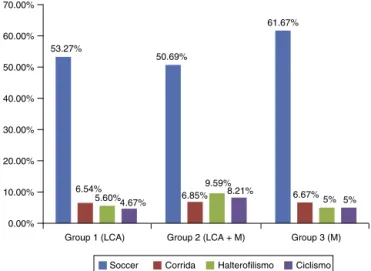
Group1 patientshad anincidence ofinjuryin the follow-ingsports:53.27%insoccer,6.54%inracingactivities,5.6%in gymactivities,4.67%involleyball,cyclingandsurfing.Other lesscommonsportswerejiu-jitsu,capoeira,swimming, hik-ing,triathlonanddance.80.37%ofisolatedACLinjuriesinthe sportwereinmen;insoccer,theincidencerises to87.72%. Femalesaccountedfor100%ofthelesionsinhandball,57.14% intherace,40%involleyballand16.67%inthegym.
Group 2patients had incidence ofinjury inthe follow-ing sports:50.69%insoccer, 9.59%in gymactivities, 8.21% incycling,6.85%inracingandvolleyballactivities.Otherless commonformswerehandball,triathlon,dance, hikingand jiu-jitsu.76.71%oftheinjurieswereinmales,withincidencein footballof83.79%.Femalesaccountedfor100%ofthelesions inhandball,42.86%ingym,40%inracing,and20%in volley-ball.
0.00%
Group 1
20 20 to 29 30 to 39 40 11.21%
35.51% 33.64%
19.63%
12.33% 39.73%
27.40%
20.55%
3.33% 28.33%
23% 45%
Group 2 Group 3 5.00%
10.00% 15.00% 20.00% 25.00% 30.00% 35.00% 40.00% 45.00% 50.00%
Fig.1–Agedistributionamongthethreeevaluatedgroups. Itwasobservedthatpatientsingroup1and2areyounger thanthoseingroup3.
0.00% 53.27%
6.54% 5.60%
4.67% 50.69%
6.85% 9.59%
8.21% 61.67%
Soccer Corrida Halterofilismo Ciclismo 6.67%
5% 5%
Group 1 (LCA) Group 2 (LCA + M) Group 3 (M) 10.00%
20.00% 30.00% 40.00% 50.00% 60.00% 70.00%
Fig.2–Distributionofmainsportsamongathletestreated ofligamentandmeniscusinjuries,notingthedominance ofsoccerpracticeinthispopulation.
Thethirdgroupofpatientshadincidenceofinjuryinthe followingsports:61.67%insoccer,6.67%inracingactivities,5% incycling,gymandjit-jitsu.Otherlesscommonsportswere: boxing,golf,triathlon,dancing,hiking,capoeira,surfingand tennis.Malepatientswereaffectedin90%ofisolatedmeniscal injuriesinsports.Insoccer,theincidencewas94.59%.Female patientsaccountedfor100%ofboxinginjuries,50%ongolf andjujitsuand20%inracing(Fig.2).
Practicetime
Themeantimeofsportpracticeforinjuryoccurrenceingroup 1was17.81years(22.14yearsforrunning,18.2forcycling,17 forsoccer,and9.87forgym).Ingroup2,themeantimewas 17.3yearsofsportactivities(20.8yearsforrunning,20.11for soccer,17forcyclingand8.14forgym).Ingroup3,themean timewas26.91yearsofsportsactivities(34.67yearsforcycling, 33forracing,25.59forsoccerand19.33forgym).
Insoccer,thesportwiththehighestnumberofreported cases,theincidenceofACLinjurywas0.523/1000hof play-ing,with0.507/1000hformenand 0.871/1000hforwomen. The incidence of meniscal injuries in these athletes was 0.448/1000h of playing, with 0.435/1000h for men and 0.596/1000hforwomen.
Ingymactivities,theincidencewas0.69/1000hoftraining forACLinjuryand0.55/1000hformeniscalinjury.In volley-ball,theincidencewas0.33/1000hofplayingforACLinjury and 0.47/1000hformeniscalinjury. Inracingactivities, the occurrencewas0.24/1000hofactivityforACLinjuryaswellas formeniscalinjury.Incycling,theoccurrencewas0.31/1000 and0.28/1000hofactivityforACLandmeniscalinjury, respec-tively.
Tegnerquestionnaire
9
8
7
6
5
4
3
2
1
0
Tegner pre group 1
Tegner pos group 1
Tegner pre group 2
Tegner pos group 2
Academia Corrida Soccer Ciclismo Geral Tegner pre group 3
Tegner pos group 3
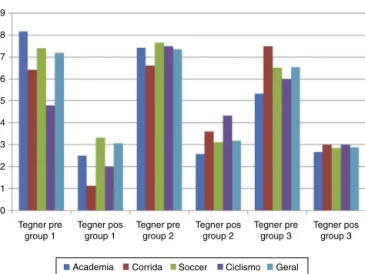
Fig.3–CorrelationbetweenmajorsportsandTegner questionnairepreandpostinjury.Thebestresultswere cycling(Group1),racing(Group2)andgym(Group3).The worstresultsweregym(Group1and2)andracing.
theinjuryforpatientsingroup2were7.34and3.18, respec-tively.Ingroup3,theaveragescorewas6.53beforetheinjury. Aftertheinjury,thisaveragedecreasedto2.87(Fig.3).
Discussion
InafirstreportofathletepopulationinBrazil,itwasobserved thatthecharacteristicsofkneeinjuriesaredifferentaccording toage,sport andtimeofactivity.Thesportinvolvedatthe timeofinjuryreflectstheinvolvementofculturalcharacterin theprevalenceofresults.Wenoticedthattheaverageageof patientswithmeniscalinjuryishigherthanthatofpatients withligamentinjury,oncethefirstinjuryhasadegenerative characterandsecondinjuryhasatraumaticcharacter.
Inallgroups,themostharmfulsportwassoccer,followed byracingintheisolatedligamentandmeniscusinjuriesgroup andgymactivitiesintheassociatedinjuries.Theperformance ofallathletesdecreasedaftertheinjury.IntheTegnerscale, groupslostanaverageof40–55%ofitssportperformance.In aten-year studyconductedinSwitzerland,Majewski etal. foundconflictingresults: soccerpredominatesasthe main sport(35%),howeverskiingonsnowcomesasasecondsport (26%), which is normal since in that country this type of practiceisverycommon.15
Analyzingtheresults,itisnotedthatanimportantrisk fac-toristheperiodofsportpractice.Socceris,byfar,themain causeofinjuryasitis,invariably,themostpopularsportinthe studiedcountries.Sportswithimpactaregreatcausesofknee injuriesanddifferaccordingtothecountrybytheirown geo-culturalcharacteristicsofthedifferentstudiedpopulations. Thepresenceofsportswithimpact, trauma,androtational movementsofthekneeareinnatecharacteristicsto menis-cusand ligamentinjuries.16 In groups1and 2theaverage yearsofsportpracticeweresimilar.Racingwasthesportwith morepracticetimetoonsetoftheinjury,whichwasexpected sinceit promotes the emergence of injury with degenera-tivecharacter.Inrecentyears,amateurracing practicehas
graduallyincreasedinBrazilandhasseveralcardiovascular benefits forthe population. But the practicewithout guid-anceofanadequateprofessional canincreasethechances ofdegenerative kneeinjuries.These numbersare expected toincreaseasthissporthasbecomeincreasinglycommonin Braziliancities.Ingroup3,injuriesemergedwithmoretime ofsportpractice:26.9years,withcyclingthesportthattook moretimetocauseinjury,34yearsonaverage,showingthe degenerativecharacteristicofmeniscalinjuries.Inallgroups, socceremergedasthesportwithlesspracticetimecompared tolesionsappearance:17yearsforgroup1and2and25years forgroup3.StewinandCamargoreportedanaveragepractice timeforprofessionalsoccerplayersof154monthsformen and113monthsforwomen,17slightlylowervaluescompared toourcontrolgroupofligamentinjuries.Thepracticetimeis anaturalpredictivefordegenerativelesionsforobvious rea-sons,eventakingintoaccountthetypeofexercisepracticed andvariationsofimpactandrotarymovement.However,the intensityofpracticeisanotherfactorthatmustbetakeninto accountforbothacuteanddegenerativeinjuries.Inourstudy, theincidenceofkneeinjuriesperhoursofpracticeissimilar tothatfoundintheliteratureforsoccerplayers,bothmenand women.8Inrunners,boththeincidenceandtheintensityof theselesionswererelatedtotheintensityoftraining,being directlyproportionaltothelevelofpractice.18Cyclingshowed approximatelyhalftheriskofinjuryevery1000hoftraining whencomparedtosoccerandgymactivitiesandsimilar val-ueswhencomparedtorunners.Thisisthefirstreportshowing thisdata.
ThevarianceoftheTegnerscorewaspresentinallgroups, withsignificantlossofperformanceofallathletes.The reduc-ing of thesporting performanceafterwards the injury had alreadybeendescribedbyotherauthors.Bobbifounda vari-anceof1.6ontheTegnerscoreinamixedgroupofathletes fromvarioussports.19Andersson-Molinaetal.founda vari-anceof2pointsintheTegnerscoreinnon-athletepatients who haveundergone partialand full meniscectomy.20 The return tothe same level ofpractice isdiminished for sev-eral reasons which maybe questionable.First,it is known that, especiallyinprofessionalathletes,the returntosport isorchestratedasearlyaspossible.Studiesindicatethatthe strength of quadriceps and flexor muscle is reduced even a year after surgery.21 Other factors can contribute to the decreaseinsportperformance,eveninpatientsshowing nor-malpostoperativefunctions.Manyathletesfeelthatligament kneeinjuriesareagoodreasontostopthecompetitivelevel andfocustheirtimeonsocialandfamilylife.Otherathletes have apsychological obstacle whichlimits the functionin exchangeforprotectionagainstapossiblereinjury.8
This study has some limitations initially once it is an assessmentofathletesfromdifferentsports,whichoftenhave subgroupswithsmallamountsofsubjects.Inaddition, the follow-upperiodoftheseathletes,aswellasfunctional eval-uation,couldbeperformedafteralongerperiod.
Conclusion
2had less timeofpractice (17.81and 17.3 years)than the patients of group 3 (26.91 years) until suffer the injuries. Womendisplayed higher risk to develop ACL and menisci injuryby1000hofgame/practice.Running,volleyballandgym areinascendingorderofriskforACLand/ormeniscalinjury. Whenevaluatedthereturntosportpractice,theefficiencyof allathleteswasimpairedbecauseoftheinjury.
Conflicts
of
interest
Theauthorsdeclarenoconflictsofinterest.
r
e
f
e
r
e
n
c
e
s
1. AsturDC,AleluiaV,VeroneseC,AsturN,OliveiraSG,Arliani GG,etal.Aprospectivedoubleblindedrandomizedstudyof anteriorcruciateligamentreconstructionwithhamstrings tendonandspinalanesthesiawithorwithoutfemoralnerve block.Knee.2014;21(5):911–5.
2. PapaliaR,TorreG,VastaS,ZampognaB,PedersenDR,Denaro V,etal.Bonebruisesinanteriorcruciateligamentinjured kneeandlong-termoutcomes.Areviewoftheevidence. OpenAccessJSportsMed.2015;6:37–48.
3. BritoJ,SoaresJ,RebeloA.PreventionofInjuriesofthe anteriorcruciateligamentinsoccerplayers.RevBrasMed Esporte.2009;15(1):62–9.
4. AsturDC,BatistaRF,GustavoA,CohenM.Trendsin
treatmentofanteriorcruciateligamentinjuriesofthekneein thepublicandprivatehealthcaresystemsofBrazil.Sao PauloMedJ.2013;131(4):257–63.
5. FerrettiA,PapandreaP,ConteducaF,MarianiPP.Knee ligamentinjuriesinvolleyballplayers.AmJSportsMed. 1992;20(2):203–7.
6. ArlianiGG,AsturDC,MoraesER,KalekaCC,JalikjianW, GolanoP,etal.Threedimensionalanatomyoftheanterior cruciateligament:anewapproachinanatomicalorthopedic studiesandaliteraturereview.OpenAccessJSportsMed. 2012;3:183–8.
7. ArlianiGG,AsturDC,KanasM,KalekaCC,CohenM.Anterior cruciateligamentinjury:treatmentandrehabilitation. Currentperspectivesandtrends.RevBrasOrtop. 2012;48(2):191–6.
8. BjordalJM,ArnlyF,HannestadB,StrandT.Epidemiologyof anteriorcruciateligamentinjuriesinsoccer.AmJSports Med.1997;25(3):341–5.
9. AkatsuY,YamaguchiS,MukoyamaS,MorikawaT,Yamaguchi T,TsuchiyaK,etal.Accuracyofhigh-resolutionultrasoundin
thedetectionofmeniscaltearsanddeterminationofthe visibleareaofmenisci.JBoneJtSurgAm.2015;97(10): 799–806.
10.NordenvallR,BahmanyarS,AdamiJ,MattilaVM,
Felländer-TsaiL.Cruciateligamentreconstructionandriskof kneeosteoarthritis:theassociationbetweencruciate ligamentinjuryandpost-traumaticosteoarthritis.A populationbasednationwidestudyinSweden,1987–2009. PLOSONE.2014;9(8):e104681.
11.LealMF,AsturDC,DebieuxP,ArlianiGG,SilveiraFrancioziCE, LoyolaLC,etal.Identificationofsuitablereferencegenesfor investigatinggeneexpressioninanteriorcruciateligament injurybyusingreversetranscription-quantitativePCR.PLOS ONE.2015;10(7):e0133323.
12.MakrisEA,HadidiP,AthanasiouKA.Thekneemeniscus: structure-function,pathophysiology,currentrepair techniques,andprospectsforregeneration.Biomaterials. 2011;32(30):7411–31.
13.Wong-OnM,Til-PérezL,BaliusR.EvaluationofMRI-USfusion technologyinsports-relatedmusculoskeletalinjuries.Adv Ther.2015;32(6):580–94.
14.BranchEA,MilchteimC,AspeyBS,LiuW,SalimanJD,AnzAW. Biomechanicalcomparisonofarthroscopicrepairconstructs forradialtearsofthemeniscus.AmJSportsMed.
2015;43(9):2270–6.
15.MajewskiM,SusanneH,KlausS.Epidemiologyofathletic kneeinjuries:a10-yearstudy.Knee.2006;13(3):184–8. 16.NordenvallR,BahmanyarS,AdamiJ,StenrosC,WredmarkT,
Felländer-TsaiL.Apopulationbasednationwidestudyof cruciateligamentinjuryinSweden,2001–2009:incidence, treatment,andsexdifferences.AmJSportsMed. 2012;40(8):1808–13.
17.StewienE,CamargoO.Ocorrênciadeentorseelesõesdo joelhoemjogadoresdefuteboldacidadedeManaus, Amazonas.ActaOrtoBras.2005;13(3):141–6.
18.Schueller-WeidekammC,SchuellerG,UffmannM,BaderT. Incidenceofchronickneelesionsinlong-distancerunners basedontraininglevel:findingsatMRI.EurJRadiol. 2006;58(2):286–93.
19.GobbiA,FranciscoR.Factorsaffectingreturntosportsafter anteriorcruciateligamentreconstructionwithpatellar tendonandhamstringgraft:aprospectiveclinical investigation.KneeSurgSportsTraumatolArthrosc. 2006;14(10):1021–8.
20.Andersson-MolinaH,KarlssonH,RockbornP.Arthroscopic partialandtotalmeniscectomy:along-termfollow-upstudy withmatchedcontrols.Arthroscopy.2002;18(2):183–9. 21.KvistJ.Rehabilitationfollowinganteriorcruciateligament