DEFINING CHARACTERISTICS, VALIDATED BY SPECIALISTS AND MANIFESTED BY
PATIENTS - A STUDY OF THE SEXUAL DYSFUNCTION AND INEFFECTIVE SEXUALITY
PATTERN DIAGNOSES
Alexandra de Souza Melo1 Emilia Campos de Carvalho2 Vanderlei José Haas3
Melo AS, Carvalho EC, Haas VJ. Defining characteristics, validated by specialists and manifested by patients: a study of the sexual dysfunction and ineffective sexuality pattern diagnoses. Rev Latino-am Enfermagem 2008 novembro-dezembro; 16(6):951-8.
This observational and descriptive study was carried out to validate the nursing diagnoses Sexual Dysfunction and Ineffective Sexuality Pattern and relate the relevance of the defining characteristics validated by experts with their incidence in patients. Validation by experts involved 32 specialists and 20 patients to verify clinical evidence. For the diagnosis Sexual Dysfunction, the experts attributed scores higher than 0.80 to seven defining characteristics; for Ineffective Sexuality Pattern, four characteristics received scores between 0.50 and 0.80. The clinical occurrence of these characteristics for the Sexual Dysfunction diagnosis ranged between 55% and 90% of the sample and, for Ineffective Sexuality Pattern, between 30% and 85% of the sample. The study contributed to the improvement of these diagnoses and to careful consideration on their defining characteristics according to experts and as observed in a given clientele.
DESCRIPTORS: nursing diagnosis; sexuality; validation studies
CARACTERÍSTICAS DEFINIDORAS VALIDADAS POR ESPECIALISTAS Y LAS
MANIFESTADAS POR PACIENTES: ESTUDIO DE LOS DIAGNÓSTICOS DISFUNCIÓN Y
ESTÁNDARES DE SEXUALIDAD INEFICACES
Con los objetivos de realizar la validación de los diagnósticos de enfermería Disfunción Sexual y Estándares de Sexualidad Ineficaces y relacionar la pertinencia de las características definidoras validadas por peritos en la incidencia de las mismas en pacientes, se realizó este estudio de observación y descriptivo. Para la validación por especialistas, se contó con 32 peritos y, para la verificación de las evidencias clínicas con 20 pacientes. Para el Diagnóstico Disfunción Sexual, los peritos atribuyeron puntajes mayores que 0,80 para 7 características definidoras y, para Estándares de Sexualidad Ineficaces, 4 de las características recibieron puntajes entre 0,50 y 0,80. La ocurrencia clínica de esas características para el diagnóstico Disfunción Sexual fue de 55 el 90% de la muestra y para Estándares de Sexualidad Ineficaces fue de 30 el 85% de la muestra. El estudio contribuyó para el perfeccionamiento de esos diagnósticos y reflexionar sobre las características definidoras de los mismos en la opinión de los especialistas y observadas en una clientela dada.
DESCRIPTORES: diagnóstico de enfermería; sexualidad; estudios de validación
CARACTERÍSTICAS DEFINIDORAS VALIDADAS POR ESPECIALISTAS E AS
MANIFESTADAS POR PACIENTES: ESTUDO DOS DIAGNÓSTICOS DISFUNÇÃO SEXUAL E
PADRÕES DE SEXUALIDADE INEFICAZES
Com os objetivos de realizar a validação dos diagnósticos de enfermagem Disfunção Sexual e Padrões de Sexualidade Ineficazes e relacionar a pertinência das características definidoras validadas por peritos à incidência das mesmas em pacientes, realizou-se este estudo observacional, descritivo. Para a validação por especialistas, contou-se com 32 peritos e, para a verificação das evidências clínicas, 20 pacientes. Para o Diagnóstico Disfunção Sexual, os peritos atribuíram escores maiores que 0,80 para 7 características definidoras e, para Padrões de Sexualidade Ineficazes, 4 das características receberam escores entre 0,50 e 0,80. A ocorrência clínica dessas características para o diagnóstico Disfunção Sexual foi de 55 a 90% da amostra e para Padrões de Sexualidade Ineficazes foi de 30 a 85% da amostra. O estudo contribuiu para o aprimoramento desses diagnósticos e reflexão sobre as características definidoras dos mesmos na opinião dos especialistas e observadas em uma dada clientela.
DESCRITORES: diagnóstico de enfermagem; sexualidade; estudos de validação
1 RN, Ph.D. in Nursing; 2 RN, Full Professor, University of Sao Paulo at Ribeirao Preto College of Nursing, WHO Collaborating Centre for Nursing Research
Development, Brazil; 3 Physicist, Ph.D. in Sciences, Faculty, University of Sao Paulo at Ribeirao Preto College of Nursing, WHO Collaborating Centre for Nursing
Research Development, Brazil.
INTRODUCTION
N
ursing diagnoses are an essential tool for nursing practice. For them to be considered valid,however, they need to correspond to the true state of
phenomena being measured. If they present the same
results at different moments, they will be considered
reliable and, if they are equally identified in several
similar observations, they will be considered stable.
Under these conditions, nursing diagnoses can
contribute to the development of knowledge in clinical
practice(1-2).
Different validation models are used in
studies on this topic. They sometimes validate a
diagnosis, other times its components, or yet
diagnoses prevalent in a certain clientele(3). Among
several methodological designs, one of the most
comprehensive is that of Hoskins(4), which proposes
three phases: analysis of concept – to identify
attributes and characteristics of a construct; validation
by experts – to verify the representativeness of these
characteristics in the studied concept(5-6); and clinical
validation – to verify whether the defining
characteristics determined in the previous phase are
present in a certain population.
Although the set of diagnoses employed in
practice is broad, just a few have been considered in
clinical validation studies, especially if we think about
the different types of patients and scenarios in which
these diagnoses can occur(7). Further research is
necessary to reduce uncertainties in research on this
topic, like the selection of experts and types of
validation adopted, which this study looks at.
Different aspects are considered when
assessing professional qualification with a view to
expert status(7-10), which are: number of years of
clinical experience; time of bachelor’s degree;
experience with research; place of work; areas or
sectors of work; experience and type of rationale
used. Contradictions have been observed in literature
regarding the relation between these variables and
accuracy in establishing nursing diagnoses(7-10).
This study was motivated by the possibility
of verifying the potential influence of the expert’s area
of work on the validation of diagnoses, as well as by
the correspondence between clinical evidence
appointed by specialists and the evidence presented
by patients with a certain diagnosis.
It is worth highlighting that the diagnoses that
describe sexuality(13) have undergone few changes in
their essential elements since their elaboration in 1980
(sexual dysfunction) and 1986 (ineffective sexuality
pattern) despite studies carried out in our field,
including two master’s theses. One of them(14) presents
clinical validation of these diagnoses proposed in the
taxonomy and the other presents a study of the Sexual
Dysfunction diagnosis. The conclusion is that changes
are needed due to disagreement with what had been
proposed in the taxonomy and in the literature for
this diagnosis(15). In addition to these studies, another
research extracted from a doctoral dissertation,
involving patients with onco-hematological disorders,
looks at the incidence of defining characteristics of
the two diagnoses mentioned above(16). The authors
also carried out a conceptual validation of these
diagnoses(17), based on findings in the literature and
the NANDA(13) 2005/2006 version. Suggestions made
in that publication(17), which were adopted by NANDA
in its 2007/2008(18) version, were also considered by
the present study. They are: review of definitions,
separation of defining characteristics, inclusion of new
defining characteristics and review of existent defining
characteristics. It is important to keep in mind though
that the defining characteristics “perceived limitations
imposed by the disease and/or therapy” and “actual
limitations imposed by the disease/therapy” of the
Sexual Dysfunction diagnosis as well as the defining
characteristic “reported difficulties, limitations, or
changes in sexual behaviors or activities” of the
ineffective sexuality pattern diagnosis are separated
in the current taxonomy(18), published after this report.
This study contributes to strengthen changes
in the NANDA(18) taxonomy because it presents clinical
validation and expert validation of defining
characteristics related to these two diagnoses and
encourages careful consideration of such validation
processes, taking into account the background of
participant experts.
The study objectives were: carry out an
expert validation of the Sexual Dysfunction and
Ineffective Sexuality Pattern nursing diagnoses;
evaluate the presence of variation in the scores
attributed to defining characteristics of the studied
diagnoses, by two groups of experts with different
educational backgrounds, and relate the relevance
of defining characteristics validated by experts and
METHOD
This is a methodological study where the
second and third steps of Hoskins’(4) validation
approach are highlighted. The concepts and elements
of two diagnoses were used according to literature,
departing from the conceptual(17) evaluation carried
out in the previous phase; operational definitions of
each defining characteristic were elaborated.
Thirty-two professionals, selected by snowball sampling,
participated in the expert validation, according to
criteria proposed in the literature(19). The experts
evaluated the relevance of each diagnostic category
for the corresponding diagnosis, based on their label
and operational definition, using a five-point Likert
scale. An instrument was developed to collect clinical
evidence in patients. Its face and content validation
were carried out containing all proposed defining
characteristics. This phase was developed at a medical
clinic unit – hematology sector of a hospital in the
interior of São Paulo, Brazil. Besides the author, two
clinical nurses with experience in the Nursing Process
and Hematological Nursing participated in data
collection. After data collection, the nurses
independently performed analysis and synthesis of
data and identified whether the nursing diagnoses
under study were present or not.
All ethical procedures for research in human
beings were complied with for the different research
phases (Process No. 0270/2002 EERP/USP).
Sample
Referees, all with a master’s and 68.8% with
a doctoral degree, participated in the expert validation.
Two groups were composed: Group 1, 17 nurses with
experience in NANDA Nursing Diagnoses and human
sexuality, with scores varying from 7 to 12 points
(maximum score: 14 points) and a predominant score
of nine points; Group 2, 15 nurses with experience in
Nursing diagnoses and less experience in Human
Sexuality, with scores varying from 6 to 18 points
and a predominant score of six points. Fehring’s(19)
requirements were adopted for the score.
The difference in scores between groups
occurred because the adopted methodology(6,19) values
the professional with scientific experience and clinical
practice in the nursing diagnosis under study, although,
in general, it does not disregard those with work
experience in nursing diagnoses.
Aiming to identify whether the expert groups
presented divergences in the evaluation of relevance
of each studied defining characteristic, central
tendency (median and mean rank) and variability
(interquartile distance) measures were used for each
diagnosis; Mann-Whitney’s(20) test was employed for
inter-rater analysis.
Defining characteristics with scores inferior
to 0.50 were considered non-validated. The studied
diagnoses were determined from scores attributed
by experts to each validated defining characteristic
according to literature(4,6,19) recommendations, i.e. the
total score of validation (DCV total).
Twenty patients participated in the verification
of clinical evidence, 11 males and nine females, single,
with a predominant age between 18 and 27 years,
and with diagnosed leukemia or lymphoma. Two
properly trained nurse observers collected data.
There was agreement between observers in
the identification of diagnostic characteristics (presence
of diagnosis) in the studied clientele, in all analyses,
including for patients who did not comply with the
study inclusion criteria.
Regarding the identification of clinical
expressions (defining characteristics) of the studied
diagnoses, there was a 98% agreement between
observers regarding the Sexual Dysfunction diagnosis
and 97% for the Ineffective Sexuality Pattern
diagnosis. The agreement ratios presented for both
nursing diagnoses were considered satisfactory in
studies of this nature(4).
RESULTS
First the results of the expert validation are
presented for each studied diagnosis.
Variation in the scores experts attributed to
defining characteristics.
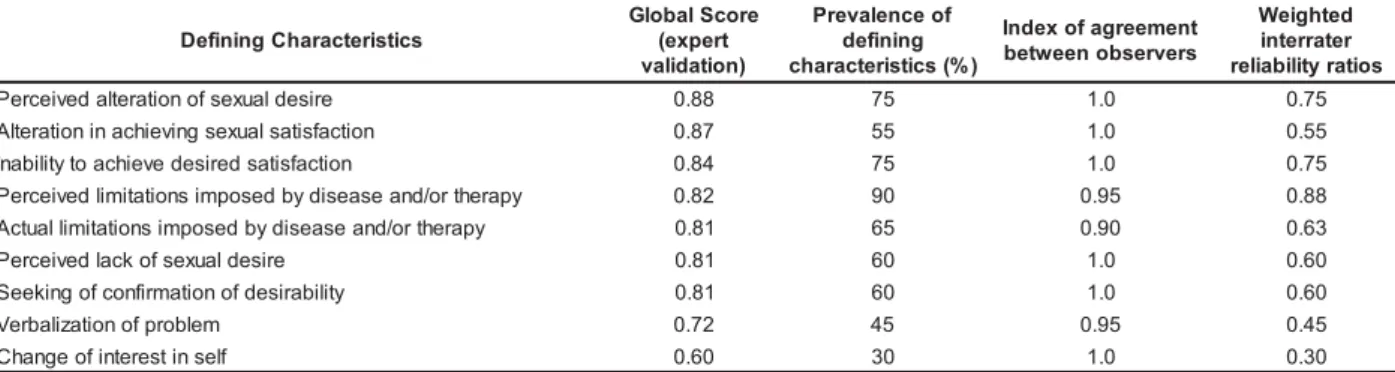
It is observed (Table 1) that there was no
significant statistical difference between the two
groups of experts for the defining characteristics of
the Sexual Dysfunction diagnosis (p>α=0.05),
although the mean ranks were different in the majority
of defining characteristics. Thus, they can be
Table 1 – Distribution of 10 defining characteristics of the Sexual Dysfunction nursing diagnosis, according to
scores, p-value, median, mean rank and interquartile distance obtained by two groups of nurse specialists in
expert validation. Ribeirão Preto, 2003
It is observed that the scores attributed to
defining characteristics of this diagnosis were
h i g h e r o r e q u a l t o 0 . 8 0 i n s e v e n d e f i n i n g
characteristics, five of which were already part of
the Sexual Dysfunction diagnosis(13). The other two
are characteristics that emerged from literature.
Thus, we can affirm that nurse experts agree that
these are clinical manifestations that characterize
the Sexual Dysfunction nursing diagnosis. In fact,
one of these characteristics (“perceived alteration
insexual excitation”) received the highest score,
0.88.
The defining characteristic that obtained the
lowest score (0.50) is a characteristic that was
fragmented(17-18) in “change of interest in self” and
“change of interest in others”, which in the
taxonomy(13) was originally “change of interest in self
and others”. Therefore, this characteristic should
undergo another validation process.
The two groups attributed similar scores to
the seven defining characteristics. According to the
experts’ median values, the defining characteristics
that coincided (70%) for the two groups were: “change
of interest in self, change of interest in others,
perceived limitations imposed by the disease and/or
therapy, actual limitations imposed by the disease and/
or therapy, alteration in achieving sexual satisfaction,
perceived alteration in sexual excitation and perceived
lack of sexual desire”.
Equal interquartile distances occurred in the
groups of nurse experts in six of the seven
characteristics with the same median values in both
groups.
Scores attributed by the two groups were
different for three defining characteristics. In the
characteristics in which the median values differed,
the first and third quartiles show that the characteristics
“seeking of confirmation of desirability” and
“verbalization of problem” received the highest scores
by Group 1 and Group 2, respectively. For the
characteristic “inability to achieve desired satisfaction”,
according to the mean value, the highest scores were
attributed by Group 2.
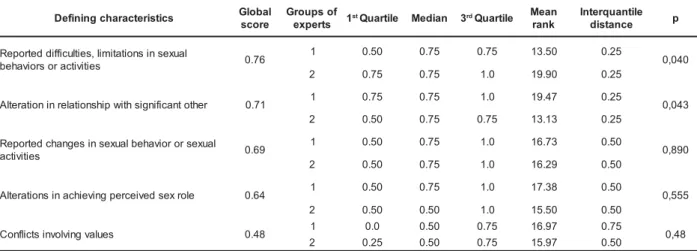
Regarding the Ineffective Sexuality Pattern
diagnosis, there was statistical difference in two
defining characteristics: “reported difficulties,
limitations or changes in sexual behaviors or
activities” and “alteration in relationship with significant
other” (p < than α=0.05); their mean ranks also
differed. Thus, we perceive that both groups of
experts are statistically homogeneous for the three
defining characteristics (Table 2).
s c i t s i r e t c a r a h C g n i n i f e D e r o c S l a b o l G t r e p x e ( ) n o i t a d i l a v f o e c n e l a v e r P g n i n i f e d ) % ( s c i t s i r e t c a r a h c t n e m e e r g a f o x e d n I s r e v r e s b o n e e w t e b d e t h g i e W r e t a r r e t n i s o i t a r y t i l i b a i l e r e r i s e d l a u x e s f o n o i t a r e t l a d e v i e c r e
P 0.88 75 1.0 0.75
n o i t c a f s i t a s l a u x e s g n i v e i h c a n i n o i t a r e t l
A 0.87 55 1.0 0.55
n o i t c a f s i t a s d e r i s e d e v e i h c a o t y t il i b a n
I 0.84 75 1.0 0.75
y p a r e h t r o / d n a e s a e s i d y b d e s o p m i s n o i t a t i m il d e v i e c r e
P 0.82 90 0.95 0.88
y p a r e h t r o / d n a e s a e s i d y b d e s o p m i s n o i t a t i m il l a u t c
A 0.81 65 0.90 0.63
e r i s e d l a u x e s f o k c a l d e v i e c r e
P 0.81 60 1.0 0.60
y t il i b a r i s e d f o n o i t a m r i f n o c f o g n i k e e
S 0.81 60 1.0 0.60
m e l b o r p f o n o i t a z il a b r e
V 0.72 45 0.95 0.45
f l e s n i t s e r e t n i f o e g n a h
C 0.60 30 1.0 0.30
s r e h t o n i t s e r e t n i f o e g n a h
Table 2 – Distribution of five defining characteristics of the nursing diagnosis Ineffective Sexuality Pattern,
according to scores, p-value, median, mean rank and interquantile distance obtained by the two groups of
nurse experts in the expert validation. Ribeirão Preto, 2003
s c i t s i r e t c a r a h c g n i n i f e
D Global
e r o c s
f o s p u o r G
s t r e p x
e 1stQuartile Median 3rdQuartile n a e M
k n a r
e l i t n a u q r e t n I
e c n a t s i
d p
l a u x e s n i s n o i t a t i m il , s e i tl u c i f f i d d e t r o p e R
s e i t i v i t c a r o s r o i v a h e
b 0.76
1 0.50 0.75 0.75 13.50 0.25
0 4 0 , 0 2 0.75 0.75 1.0 19.90 0.25
r e h t o t n a c i f i n g i s h t i w p i h s n o i t a l e r n i n o i t a r e tl
A 0.71 1 0.75 0.75 1.0 19.47 0.25 0,043
2 0.50 0.75 0.75 13.13 0.25
l a u x e s r o r o i v a h e b l a u x e s n i s e g n a h c d e t r o p e R
s e i t i v i t c
a 0.69
1 0.50 0.75 1.0 16.73 0.50
0 9 8 , 0 2 0.50 0.75 1.0 16.29 0.50
e l o r x e s d e v i e c r e p g n i v e i h c a n i s n o i t a r e tl
A 0.64 1 0.50 0.75 1.0 17.38 0.50 0,555
2 0.50 0.50 1.0 15.50 0.50
s e u l a v g n i v l o v n i s t c il f n o
C 0.48 1 0.0 0.50 0.75 16.97 0.75 0,48
2 0.25 0.50 0.75 15.97 0.50
It is observed that four characteristics received scores higher than 0.50 and lower than 0.80 and none presented scores higher than or equal to 0.80. These scores showed that nurse experts agree that the characteristic “reported difficulties, limitations, or changes in sexual behaviors or activities” should be kept in this diagnosis, as it is already part of the taxonomy(13). Difficulties, limitations or changes, as well as sexual behaviors or activities were fragmented in distinct defining characteristics in NANDA’s(18) new version. These data also evidence that subjects agree with the presence, in this diagnosis, of the defining characteristics “alteration in relationship with significant other” and “alterations in achieving perceived sex role”, which are characteristics transferred from Sexual Dysfunction.
On the other hand, the characteristic “conflicts involving values”, also transferred from the Sexual Dysfunction diagnosis, was not accepted by the experts in this diagnosis because it obtained score 0.48. Therefore, this characteristic should undergo another expert validation process.
It is observed, through the mean ranks, that members with less experience in the Sexuality area (Group 2) attributed a higher score to the defining characteristic “reported difficulties, limitations, or changes in sexual behaviors or activities”. This might have happened because it is a defining characteristic that was already part of the taxonomy(13).
However, it is observed that the highest scores for the characteristic “alteration in relationship with significant other” came from the group with more experience in the sexuality area (Group 1). This fact might be related to their deeper knowledge of subjective psychosocial aspects involved in sexuality.
The only defining characteristic in which
median values were not the same was “alterations in achieving perceived sex role”. In this case, although the variability of answers was equal between the
groups, as shown by the quartiles, Group 1 attributed a higher score than Group 2, illustrated by the
medians.
In the defining characteristic “conflicts involving values”, which obtained a score lower than
0.50, despite equal medians between groups, there was different variability of answers; lower scores were
attributed by Group 2.
Therefore, it is verified that the two groups of experts equally identified clinical manifestations that
characterize the Ineffective Sexuality Pattern nursing diagnosis in four characteristics.
The total validation score (DCV Total) was 0.80 for the Sexual Dysfunction diagnosis and 0.70 for the Ineffective Sexuality Pattern diagnosis. Thus,
there were four characteristics that received scores higher than 0.50 and lower than 0.80 and none higher
than or equal to 0.80 in this diagnosis.
Considering the two studied nursing diagnoses, experts of both groups were homogeneous
in their answers in 86.7% of the defining characteristics.
Relation between validation by experts and clinical validation
It is important to stress that some variables
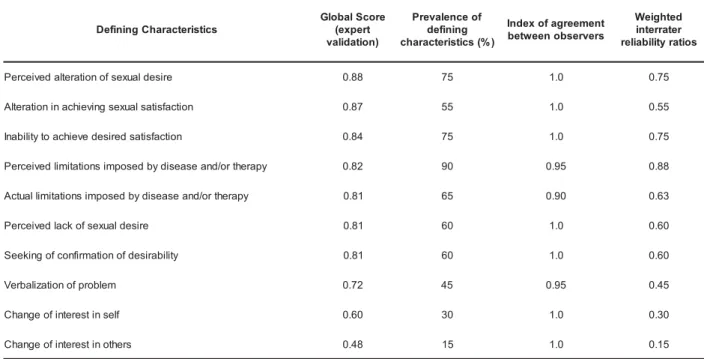
patients. According to Table 3, the defining characteristic “change of interest in others” received score 0.48 by nurse experts and presented score 0.15
related to prevalence. It means that the nurse experts believe this characteristic is not very frequent in
s c i t s i r e t c a r a h C g n i n i f e D e r o c S l a b o l G t r e p x e ( ) n o i t a d i l a v f o e c n e l a v e r P g n i n i f e d ) % ( s c i t s i r e t c a r a h c t n e m e e r g a f o x e d n I s r e v r e s b o n e e w t e b d e t h g i e W r e t a r r e t n i s o i t a r y t i l i b a i l e r e r i s e d l a u x e s f o n o i t a r e tl a d e v i e c r e
P 0.88 75 1.0 0.75
n o i t c a f s i t a s l a u x e s g n i v e i h c a n i n o i t a r e tl
A 0.87 55 1.0 0.55
n o i t c a f s i t a s d e r i s e d e v e i h c a o t y t il i b a n
I 0.84 75 1.0 0.75
y p a r e h t r o / d n a e s a e s i d y b d e s o p m i s n o i t a t i m il d e v i e c r e
P 0.82 90 0.95 0.88
y p a r e h t r o / d n a e s a e s i d y b d e s o p m i s n o i t a t i m il l a u t c
A 0.81 65 0.90 0.63
e r i s e d l a u x e s f o k c a l d e v i e c r e
P 0.81 60 1.0 0.60
y t il i b a r i s e d f o n o i t a m r i f n o c f o g n i k e e
S 0.81 60 1.0 0.60
m e l b o r p f o n o i t a z il a b r e
V 0.72 45 0.95 0.45
fl e s n i t s e r e t n i f o e g n a h
C 0.60 30 1.0 0.30
patients for the Sexual Dysfunction diagnosis, which was verified in the studied clinical context (15%). However, despite its low frequency, we stress that
this is a relevant characteristic because lack of sexual desire can be described as “change of interest in others”.
Table 3 – Distribution of the 10 defining characteristics of the Sexual Dysfunction nursing diagnosis, according
to scores assigned by specialists in the expert validation and prevalence of incidence in patients with
onco-hematological diseases, agreement ratio and Weighted interrater reliability ratios. Ribeirão Preto, 2003
The characteristics “change of interest in self”
and “verbalization of problem” were considered less
frequent characteristics in the validation by experts.
This type of characteristic provides evidence of
support to the diagnosis, though patients may not
present it. Through the reliability coefficient, we
observe that the first of these characteristics
appeared in only 30% of the sample and the second
in 45%. These data reinforce findings from the
previous phase.
In this study, defining characteristics nurse
experts believe to be present in patients with the
Sexual Dysfunction diagnosis were observed in
between 55 and 90% of the sample. Regarding
agreement ratios for this diagnosis, it is observed
(Table 3) that nurses making the diagnosis do not
agree in only three characteristics.
For the diagnosis Ineffective Sexuality
Pattern, it is observed that (Table 4), from five observed defining characteristics, the nurses making
the diagnosis presented disagreement about the
incidence in three cases among. This might have occurred because these are diagnoses that present
characteristics focused on psychosocial aspects involved in sexuality. Thus, they are related to
information difficult to express by interviewees and also to be analyzed.
In the characteristic “conflicts involving values”, it is observed that nurse experts attributed
scores below 0.50 and in fact, this characteristic
appeared in only 10% of the sample with a reliability coefficient of 0.10. Nonetheless, this defining
characteristic should undergo a new process of investigation with another group of subjects with
questions directed to sexual beliefs and superstitions.
Table 4 – Distribution of the five defining characteristics of the nursing diagnosis Ineffective Sexuality Pattern
according to scores assigned by specialists in the validation by experts and prevalence in patients with
onco-hematological diseases, agreement ratio and weighted interrater reliability ratios. Ribeirão Preto, 2003
s c i t s i r e t c a r a h c g n i n i f e D e r o c s l a b o l G y b n o i t a d i l a v ( ) s t r e p x e f o e c n e l a v e r P g n i n i f e d ) % ( s c i t s i r e t c a r a h c o i t a r t n e m e e r g A s r e v r e s b o g n o m a r e t a r r e t n i d e t h g i e W s o i t a r y t i l i b a i l e r r o s r o i v a h e b l a u x e s n i s n o i t a t i m il , s e i tl u c i f f i d d e t r o p e R s e i t i v i t c
a 0,76 85 0,95 0,83
r e h t o t n a c i f i n g i s h t i w p i h s n o i t a l e r n i n o i t a r e tl
A 0,71 30 1,0 0,30
s e i t i v i t c a r o s r o i v a h e b l a u x e s n i s e g n a h c d e t r o p e
R 0,69 75 0,95 0,69
e l o r x e s d e v i e c r e p g n i v e i h c a n i n o i t a r e tl
A 0,64 45 0,95 0,40
s e u l a v g n i v l o v n i s t c il f n o
The nurse experts classified the characteristics “alteration in perceived sex role” and “alteration in relationship with significant other” as
less frequent characteristics. In this clientele, frequency levels were 40 and 30%, respectively, that is, they are characteristics that should be better investigated, using a specific approach in a larger
sample and looking at other diseases.
On the other hand, the score obtained in the validation by experts and the weighted interrater reliability ratios were identical for the defining
characteristic “reported changes in sexual behaviors or activities”. It means that the prevalence of this characteristic in patients with onco-hematological diseases was the same as the frequency expected by
nurse experts.
Finally, the only characteristic that presented a higher prevalence level than expected by nurse experts (85%) in the studied clientele was “reported
difficulties or limitations in sexual behaviors or activities”.
Thus, the total prevalence score of clinical evidence was 0.68 for the Sexual Dysfunction
diagnosis and 0.76 for Ineffective Sexuality Pattern.
DISCUSSION
Scholars have attempted to identify the potential influence of experts’ experience on the diagnostic validation process(7-10). This influence, if
present, can be perceived in the variation of scores experts attribute during validation(11-12). This study included two groups of experts, one of them with more expertise in the sexuality area, to participate in the
validation process of the studied nursing diagnoses. The similar medians found for defining characteristics between the two groups of nurse experts (70% for Sexual Dysfunction and 80% for
Ineffective Sexuality Pattern) show that, even if the nurses do not directly work in the Human Sexuality area, they pay attention to these aspects. It is worth noting that, considering both studied diagnoses,
experts from the two groups were homogeneous in their responses in 86.7% of the defining characteristics. The small difference between groups might be associated to the fact that the area of Human
Sexuality is a complex subject when compared to other human basic needs and is seen as an attribution of medical competence, that is, it is an area only partially incorporated into nursing professionals’(16)
practice.
The total DCV scores of 0.80 for Sexual
Dysfunction and 0.70 for Ineffective Sexuality Pattern
are sufficient to accept both diagnoses as validated by experts, according to the adopted model(4,6,19).
Another aspect of interest in validation studies
is related to the observation of the presence, in a certain clientele, of those defining characteristics
experts appoint as relevant for a diagnosis.
In this perspective, the prevalence in patients of defining characteristics experts consider of high
frequency deserves consideration. According to
literature, these characteristics generally appear in the diagnosis, which did not always occur in the studied
sample. On the other hand, there was large variation
in the prevalence scores of defining characteristics experts considered less frequent. We highlight, for
instance, the high occurrence of the defining
characteristics “reported difficulties, limitations in sexual behaviors or activities”, stressing that this fact
might have occurred due to the marked presence of
fear of acquiring an infectious disease, as a result of frequent cases of neutropenia in this type of clientele.
The results of the remaining defining characteristics
can be subject to the sample size or to the nature and complexity of the studied diagnoses.
Even if some variables behaved differently in the two evaluations, considering the total scores
obtained in the verification of prevalence of clinical
evidence – 0.68% for the Sexual Dysfunction and 0.76 for Ineffective Sexuality Pattern – it can be concluded
that the diagnoses reached the scores (4-6,19)
recommended in clinical validation studies.
Although satisfactory results were achieved
in the two validations, it is worth to expand the sample
size in future clinical validation studies, so that generalizations can be made.
CONCLUSIONS
Two groups of specialists participated in the
validation by experts to analyze defining
characteristics of the Sexual Dysfunction and
Ineffective Sexuality Pattern diagnoses. For the first
diagnosis, the groups were statistically homogeneous
and agreement was reached in 70% of the defining
characteristics when medians were considered, and
attributed scores were higher or equal to 0.80 in seven
defining characteristics. For the Ineffective Sexuality
three characteristics, where there was agreement in
80% of the defining characteristics when medians were considered, while the highest scores attributed to four
characteristics were higher than 0.50 and lower than 0.80.
The comparative analysis between validation
by experts and the verification of prevalence of clinical evidence in 20 patients showed that the defining
characteristics the experts believed to be present in patients with the Sexual Dysfunction diagnosis were
observed in between 55 and 90% of the sample of patients with onco-hematological diseases. For the
Ineffective Sexuality Pattern diagnosis, defining characteristics were observed in between 30 and 85%
of the sample.
The study limitations are related to the size
of samples, experts and patients, as well as to the
complexity of the studied diagnoses of sexuality. It is
relevant to point out that there was difficulty in finding
experts with clinical and scientific practice regarding
the studied nursing diagnoses. In terms of patients, a
larger and more diversified sample is necessary.
Further studies with these two nursing diagnoses in
other specific populations are essential to verify the
incidence of defining characteristics found in this study,
in terms of patients with cancer and other pathologies
that affect sexuality.
The contribution of this study to clinical
practice consists in providing more precision in the
identification of these two nursing diagnoses and
reiterating that human sexuality should be part of the
nursing care process. This study also encourages
careful consideration of reliability in data collection
and the use of experts in research on the area of
nursing diagnosis validation.
REFERENCIAS
1. Grant J, Kenney M, Guzzeta C. A methodology for validating nursing diagnoses. Adv Nurs Science 1990; 12(3):65-74. 2. Gordon M, Sweeney MA. Methodological problems and issues in identifying and standardizing nursing diagnoses. Adv Nurs Science 1979; 2(1):1-15.
3. Creason NS. Clinical Validation of nursing diagnoses. Int J Nurs Terminol Classifications 2004; 15(4):123-32. 4. Hoskins LM. Clinical Validation, Methodologies for Nursing Diagnoses Research. In: Carrol Johnson RM, editors. Classification of Nursing Diagnoses: Proceedings of the Eighth Conference; 1989. Philadelphia: Lippincott; 1989. p. 126-31.
5. Fehring RJ. Validation Diagnostic Labels: Standardized Methodology. In: Hurley ME, editor. Classification of Nursing Diagnoses: Proceedings of the Sixth Conference of North American Nursing Diagnosis Association. 1986. St. Louis; Mosby C; 1986. p. 183-90.
6. Ferhing RJ. Methods to validate nursing diagnoses. Heart & Lung. 1987; 16(6):625-9.
7. Whitley GG. Process and methodologies for research validation of nursing diagnoses. Nurs Diagn 1999 January-March; 10(1):5-14.
8. Benner P. From novice to expert. Excellence and power in clinical nursing practice. Menlo Park: Addison-Wesley; 1984. 9. Simmons B, Lanusa D, Fonteyn M, Hicks F, Holm K. Clinical reasoning in experienced nurses. Western J Nurs Res. 2003; 25(6): 701-19.
10. Wall BM, Philips JP, Howard JC. Validation of encreased intracranial pressure and high risk for encreased intracranial pressure. Nurs Diagn 1994 5(2):74-81.
11. O´Connell B. Diagnostic Reliability. A study of the process. Nurs Diagno. 1995 July-September; 6(3):99-107.
12. Carvalho EC, Bachion MM, Jesus CAC, Canini SRMS, Napoleão AA, Dalri MCB. Análise da produção da Pós-Graduação Brasileira sobre validação de Diagnóstico de Enfermagem. Simpósio Nacional sobre Diagnóstico de Enfermagem – SINADEN, 8. João Pessoa – PB: ABEn; 2006. 13. North American Nursing Diagnosis Association – NANDA Nursing Diagnoses: definitions and classification, 2005-2006. 6th ed Philadelphia: NANDA International; 2005. 14. Vieira ES. Identificação e Validação dos diagnósticos de enfermagem Padrão de sexualidade alterados e Disfunção Sexual. [Dissertação]. São Paulo (SP): Departamento de Enfermagem/ UNIFESP; 2001.
15. Silva EV. Disfunção sexual como diagnóstico de enfermagem em pacientes coronariopatas. [Dissertação]. São Paulo (SP) Departamento de Enfermagem/UNIFESP; 2003. 16. Melo AS, Carvalho EC, Pelá NTR. The sexuality of patients with onco-hematological diseases. Revista Latino-am Enfermagem 2006; 14(2): 227-32.
17. Melo AS, Carvalho EC, Pelá NTR. Proposed Revisions for the Nursing Diagnoses Sexual Dysfunction and Ineffective Sexuality Patterns. Int J Nurs Terminol Classifications. October./December 2007; 18(4):150-5.
18. North American Nursing Diagnosis Association – NANDA. Nursing Diagnoses: definitions and classification. 2007-2008. 7th ed. Philadelphia: NANDA International; 2 0 0 7 .
19. Fehring RJ. Symposium of Validation models: the Fehring Model. In: Carrol-Johnson RM, Paquette M, editors. Classification of Nursing Diagnoses: Proceedings of the Tenth Conference Conference of North American Nursing Diagnosis Association. Philadelphia: Lippincott; 1994. p. 55-62. 20. Sheskin D. Handbook of parametric and nonparametric statistical procedures. 3ª. ed. Boca Raton (FL): Chapman ? Hall/CRC; 2004.