Revista Gaúcha
de Enfermagem
How to cite this article: Roso CC, Kruse MHL. Life on Facebook: self-care in renal transplantation patients. Rev Gaúcha Enferm. 2017;38(2):e67430. doi: http://dx.doi.org/10.1590/1983-1447.2017.02.67430.
doi: http://dx.doi.org/10.1590/1983-1447.2017.02.67430
Life on Facebook: self-care in
renal transplantation patients
a Universidade Federal do Rio Grande do Sul (UFRGS),
Escola de Enfermagem, Programa de Pós-Graduação em Enfermagem, Porto Alegre, Rio Grande do Sul, Brasil.
A vida no Facebook: o cuidado de si de transplantados renais Vida en Facebook: el cuidado de sí de trasplantados de riñón
Camila Castro Rosoa Maria Henriqueta Luce Krusea
ABSTRACT
Objective: To analyze self-care in renal transplantation patients.
Methods: Qualitative research, inspired in the post-structuralism. The empirical material was composed by the posts of a Facebook group of Renal Transplantation Patients, collected from February to May of 2016, totaling 53 posts from 35 participants. The research data were analyzed under the perspective of cultural analysis, using theories derived from Foucault.
Results: Self-care in renal transplantation patients was identified by the preoccupation with themselves and others, habits and lifestyles, restrictions and limitations that the disease imposes, such as lessons, ways of living and lifestyles after the procedure. Conclusions: This experience forces people that have been submitted to renal transplantation to reflect on the lifestyle they follow. The group also stimulates adhesion to treatment.
Keywords: Kidney transplantation. Culture. Internet. Nursing. Self-care. Patient compliance.
RESUMO
Objetivo: Analisar as estratégias de cuidado de si de transplantados renais.
Métodos:Pesquisa qualitativa, inspirada na vertente pós-estruturalista. O material empírico foi composto pelas postagens de um grupo de Transplantados Renais do Facebook, coletados de fevereiro a maio de 2016, totalizando 53 postagens, de 35 participantes. Os dados da pesquisa foram analisados sob a perspectiva da análise cultural, utilizando teorizações foucaultianas.
Resultados: O cuidado de si de transplantados renais pode ser identificado por meio da preocupação consigo e com os outros, dos hábitos e estilos de vida, das restrições e limitações que a doença impõe, como ensinamentos, modos de viver e estilos de vida após o procedimento.
Conclusões: Essa experiência faz com que as pessoas que se submeteram ao transplante renal reflitam sobre o modo de vida que seguem. O grupo também estimula a adesão ao tratamento.
Palavras-chave:Transplante renal. Cultura. Internet. Enfermagem. Autocuidado. Cooperação do paciente.
RESUMEN
Objetivo: El análisis de las estrategias de atención propias de trasplante de riñón.
Método: La investigación cualitativa, inspirada en la vertiente posestructuralista. El material empírico se compone de publicación de un grupo de trasplantados de riñón en Facebook, recogido de febrero a mayo de 2016, con un total de 53 publicaciones de 35 participantes. Los datos de la encuesta fueron analizados desde la perspectiva del análisis cultural, utilizando las teorías de Foucault. Resultados: El cuidado de sí de trasplantados renales puede ser identificado por la preocupación consigo y con los otros, por los hábitos y estilos de vida, las restricciones y limitaciones que les impone la enfermedad, como enseñanzas, formas de vivir y estilos de vida después del procedimiento.
Conclusión: Esta experiencia hace que las personas que se sometieron a trasplante renal piensen acerca de la forma de vida que siguen. El grupo también fomenta la adherencia al tratamiento.
INTRODUCTION
The treatment of kidney disease depends on its evolu-tion. Conservative treatment is indicated at the beginning of the disease and is implemented mainly through medi-cation, restrictive diets, consults and periodical evaluations. As the disease advances, kidney replacement therapies are indicated, such as hemodialysis, peritoneal dialysis and kid-ney transplant. Renal transplant is recognized as the best therapeutic option for people with advanced chronic renal disease. This treatment became possible with the scien-tific and technological development in the health and life fields, especially in the last 30 years, which produced new investigative methods, techniques that were until then un-known, more effective medications and control over dis-eases considered uncontrollable until then.
Although organ transplantation can be considered the result of the evolution of surgical techniques, it is more than that, for it requires a relation between donors and receptors, implying in new possibilities of reflecting on life, the body and the right to cure. Transplants can be understood as hy-brid agents of knowledge, instruments, people, making it possible to think about human beings in another way(4).
We live in a time where the body is the ideal place for all biotechnology experiments. Implants, transplants and new medications allow the survival of patients who would be destined to death in a short amount of time. Technology reveals itself as omnipresent in all moments of everyday life, as a hybrid, colonizing our bodies, in an intimate rela-tion between what is organic and artificial. These technolo-gies to not intend only to cure diseases or improve health, they propose changes for a better health, but also chang-ing what is understood as a biologic organism, hopchang-ing to recalculate vital processes with the intention of improving its functioning and results(4).
Science, technology an specializations tend to segre-gate experience, which makes direct contact with events and situations that connect individuals to broad issues of finiteness to be rare, for many. Means of communication, such as Facebook, make is possible for people to access new fields of experience, even though by distance, allow-ing the experiences of each person, meanallow-ing, their own experiences, to be established with themselves and others, intertwining relations of knowledge and power.
Recent studies on life after renal transplantation have shown that eating habits, vices, level of education and age are crucial factors in the survival of the person and the or-gan after the surgical procedure. Quality of life is one of the most discussed themes in scientific publications, which show that people who undergo renal transplants suffer
less pain and uncomfortable symptoms when compares to renal patients who undergo dialysis.
The success of renal transplant is related to the num-ber of years one can live with the organ and with the bet-ter quality of life and well-being of the patient and his or her family(5). Care after renal transplantation is very
im-portant and depends on the knowledge and lifestyle of the patient, since it is necessary for the receptors to take care of themselves, take immunosuppressive drugs for the rest of their lives to avoid rejection, and adhere to the treatment specified for chronic diseases, such as diabetes mellitus cardiovascular disease and to have control over the risk of infections.
If one thinks as Michel Foucault, that the subject is built by the surrounding and affecting discourses and by the true effects that such discourses produce, one can con-sider the importance of the relationships between these people with themselves and others that have received an organ from another person, especially regarding the way they organize their life and deal with the effects of this ther-apeutic modality.
Thus, this study seeks to research the self-care of trans-planted patients in a unique way, as a possibility to narrate the ways in which the lives of these people and their rela-tionships with themselves have been affected. In this sense, it is understood that being on a social network, for health professionals and nursing professionals, can be a way to monitor the life of those with chronic diseases, in addition to being a way to support and encourage these people to continue treatment.With this in mind and inspiration in the ideas of philosopher Michel Foucault(6), namely his concept
of self-care, understood as knowledge of one’s self – which requires a certain number of rules of conduct and princi-ples that should be known for the subject to find his or her singularity – this study has the objective of analyzing the self-care strategies of renal transplant patients, based on the following question: How do people who underwent renal transplantation take care of themselves?
METHOD
This study, based on a qualitative approach, was based on a doctoral thesis(7). This research is inspired in
post-struc-turalism, which considers the “production of discourse as simultaneously controlled, selected, organized and redis-tributed by several procedures that have the role of con-juring their powers and dangers, dominating the random occurrence”(8,9). In this reference, the subject is constituted
through which a certain consensus about the world one lives in is construed, interfering in the relations between people and economic and political systems, as well as the way the contemporary world is organized. Culture involved the systems of meaning that human beings use to define and regulate their conduct in relation to each other(9).
The empirical material was composed by the posts of a Facebook group of Renal Transplantation Patients, with al-most six thousand members from all regions of Brazil. Face-book is one of the most widely used social networks in the world. This network allows for social interactions, through comments, participation in groups, games. It is a space for encounters, sharing and discussion of ideas. With this, it is shown that the subjects of social networks increasing-ly speak of themselves and others, constituting the main agents of subjectivity on the Internet(10).
After reading the posts, those considered significant in answering the research question were selected. After monitoring the group, posts that related to the way people narrated their experience with renal transplantation, how they organized their life and how they deal with the effects of this therapeutic modality were selected. The posts were collected from February to May of 2016. The inclusion cri-teria for study subjects were as follows: having undergone renal transplantations, with those under the age of 18 be-ing excluded.
The project, included in Plataforma Brasil, was approved by the Comitê de Ética em Pesquisa (Committee for Ethics in Research) of UFRGS, CAAE No. 44529715.2.0000.5347, under opinion No. 1.072.320 and obeyed the Normas Reg-ulamentadoras para Pesquisa em Saúde (Regulating Rules of Research in Health), of the Conselho Nacional de Saúde (National Health Counsel)(11). After approval, contact was
established with the authors of the selected posts, inform-ing them of the research. Facebook messenger, an instant communication service provided by Facebook itself, was used to explain that participation was based on the au-thors’ authorization to use certain posts they have made to the group. Thus, each subject signed the Free and In-formed Consent Form, in which the objective of the study and the means of participation of the research subject was explained, assuring the right to withdraw at any time. The material collected was saved to a computer, in image format, under the surveillance and responsibility of the researcher, for five years. Fifty-three posts from thirty-five participants were selected for analysis.
Research data were analyzed under the perspective of cultural analysis, using a few theories derived from Fou-cault. Cultural analysis allowed to describe and question the discourses of renal transplantation patients on
Face-book, analyzing the ways through which they expressed themselves. Under this perspective, an attempt was made to understand how those who underwent renal transplan-tation lived with this experience, how it affects and inter-feres in their lives.
RESULTS AND DISCUSSION
To analyze the life of people who underwent renal transplantation, social networks were used as a space to diffuse knowledge and practice for self-care. The group is a place that promotes the encounter of people who have experienced renal transplantation, talking about their lives, how they face the daily challenges that the transplant im-poses upon them, at any time of day or night. Participants are renal patients who approach different themes, such as exams, symptoms, pains, spiritual beliefs, fear of losing the organ and, especially, their doubts related to life with this new organ and ways of not losing it.
The posts are answered as examples of life after trans-plantation, many times encouraging those who are wait-ing for their own procedure or who are gowait-ing through tough times. People who are members post the names of medication that they no longer use and wish to donate, praise those who have donated their kidneys, state their problems, in sum, speak of their lives.
The concepts of “self-practices”, “self-techniques” and “self-care”, extracted from Greek ancient times, are used to analyze the way through which the subject has been formed in modern times. The need to take care of one’s self is linked to the exercise of power. “Occupying one’s self with themselves” is implied in the will of individuals to exercise political power over others, thus, it is impossible to govern others without occupying one’s self with themselves. The emergence of self-care is in the privilege of political action to exercise power. It is necessary to provide a definition of one’s self and one’s care, from which the knowledge neces-sary to govern others can be derived(6).
The treatment of chronic kidney disease is permanent and, therefore, it is necessary for the patient to maintain habits and attitudes that promote self-care. Adhesion to treatment refers to the situation in which patient behavior corresponds to medical recommendations, being present at consults, obeying prescriptions and changes in lifestyle, in addition to behavior factors such as perception of the disease and ways of coping with adversity, external factors and support network(12-13).
mean-ing that, by developmean-ing these practices, each person con-stitutes themselves, becomes a subject, understanding that the notion of subjectivity takes place in the relations established in the body of each subject(14). The experience
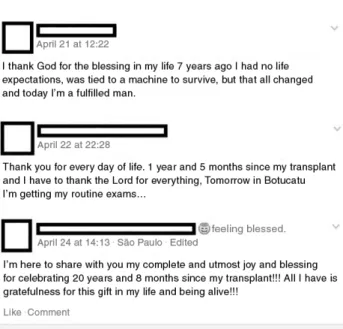
of undergoing renal transplantation makes people that were submitted to this procedure reflect on their way of life through self-techniques, as verified in the publications of Figure 1.
These posts show how much people thank God for the possibility of having a better life. The religious discourse operates as an exercise of bipower over patients, a power to regulate life, making them subjects that are more easi-ly manipulated and susceptible to the rules. As such, they tend to remain alive and healthy, overcoming the disease. The posts show how much the renal transplantation has made life better when compared to life even before the
dis-ease. These people speak of their habits, having a healthy life, improving as individuals. The years of renal transplanta-tion mark a new life, a new beginning. They speak of their lives and their lives after the transplant as a victory that should be shared with virtual friends. Aside from that, the social network seems to work as encouragement to not infringe the “rules” imposed after transplantation, such as not smoking.
At the same time, when someone demonstrates diffi-culty in following such conduct, posts are made to help and provide strength for those who have succumbed to follow the recommendations, with messages that speak of how harmful smoking is, promoting a certain life style to maintain the transplanted organ. Respecting obeying and following a certain life style and prescriptions after renal transplantation becomes a condition to maintain a new, functioning organ. The group “Transplantados Renais” (Renal Transplantation Patients) on Facebook incites its fol-lowers to maintain the purpose of adherence to treatment, helping avoid alcoholic beverages, certain foods and the habit of smoking.
The subject should conduct his or herself in a way to constitute themselves, acting in reference to prescriptive elements that constitute a certain moral code. Following the prescriptions to achieve a healthy life frees the subject from the machine, brings the moral subject, meaning, the individual’s behavior in relation to the rules and values that are proposed and constitute a game of elements that com-bine, compensate and cross out one another, allowing for commitment and escape. The constitution of a subject as the effect of a self-practice, will provide the possibility to reflect on a practice of freedom. Self-practices are an ex-ercise of the individual over the individual, through which the subject seeks to elaborate, transform and achieve a cer-tain way of living(14). Through “self-practices” and “self-care”,
men and women become subjects in an active way, relat-ed to the “games of truth”, meaning they assume a position of exercise over themselves, transforming themselves and creating a way of being, before the disease. In the posts of Figure 2, we can observe how the people submitted to renal transplantation are constituted.
Such people establish a way of living for themselves, act upon themselves, know themselves, control them-selves, test themthem-selves, perfect themselves and transform themselves. These posts speak of having a normal life after the transplant, however, the transplant patients state that they will “never be 100% normal”. But, after all, what does normal mean? Is anyone normal? For Michel Foucault, the rule allows for the comparison of individuals. Normal peo-ple are considered those capable of fitting in the model
Figure 1 – Way of life in renal transplantation patients
and those considered abnormal are those who do not fit in the model, an “individual to be corrected” (15). Thus, the rule
works as a common measurement, referring to a certain group that related to itself, in this case, the kidney trans-plant patients, who determine a certain way of living after renal transplantation.
The practice of physical exercise is discussed in these posts, where to be healthy, one must exercise, with the practice of sports being an integral part of the behav-iors and habits necessary for life. It is understood that the skinny, appealing, self-regulated, physically fit, young and healthy person is the one considered as the rule. In the re-nal transplant patient group, normal is having had a kid-ney transplant, being the bearer of an organ that was not originally theirs, depending on immunosuppressive drugs, going to periodic consults, having a certain life style.
The discourse about the importance of health makes in-dividuals feel responsible for maintaining their own health, and guilty for their loss. There is a need for self-control and self-government as criteria that value, condition and direct actions. Taking care of one’s body is a synonym for increas-ing prognostics, (re)configurincreas-ing, havincreas-ing a healthy life.
The subject is constituted supported on ways of sub-jectification and self-practices. When organizing their re-lationships with themselves and others, they choose be-tween the different narratives to which they were exposed. Considering that subjectification is considered around the relations of humans among themselves, vocabulary has a key role in the composition and recomposition of these relationships. Self-care would no longer be a solitary activ-ity, since it presumes monitoring by another person and is distributed according to social activities, such as conversa-tions, letter exchanges, teaching and learning(14). Thus, it is
present in social networks, where several linguistic resourc-es are used (words, explanations, storiresourc-es and attribution), that build messages and transmit intentions that affect and convince the subjects, as verified in the posts of Figure 3.
The survival time after renal transplant can be found in many posts, as a way of sustaining/authorizing the dis-course. Having many years as a renal transplantee and not having lost the organ reveals the amount of self-care the patient has, authorizing him or her to give advice on life-style, ways of following restrictions and use of drugs, con-sidering that the descriptions surrounding the body are intimately connected to the constitution of the subject. This way, the human being is the agent built as an I and provides to its own life the coherence of a narrative(16).
The Facebook group shows the need to thank the peo-ple for donating their kidneys to save others, mothers who donated to their children, brothers and sisters, fathers and
Figure 2 – Life after the transplant
Source: Facebook print screen, 2016
Figure 3 – Renal transplant time
sons, spouses, friends and relatives. The received organ, be it from a dead donor, or a relative, should be valued. Some-one who lost their life gave another person the chance to live. The receptor should then take care of this organ and control their lives and the chronic renal disease, meaning they should govern their body to maintain the transplant-ed kidney. To achieve this, they should exercise the practic-es and diets learned on the social network.
The concept of self-tracking began to emerge in several discussions surrounding the best way to improve one’s own life. This concept refers to the practice of analyzing habits, behaviors and feeling through digital technologies to help promote health through motivation, encouragement to practice self-reflection or feelings of guilt, fear and shame(17).
This way, it is possible to observe that social networks have been used to promote a change in behavior regard-ing health, promotregard-ing a reflection on “what is best for one’s self” through the sharing of personal information to learn with others. Self-practices and self-care can be productive in understanding self-tracking as a certain way of governing one’s self. This concept seems to show a way of reinventing the I and the body, to improve health and wellbeing(17).
Self-care requires the subject to recognize a certain number of rules of conduct and principles that are, at the same time, true and prescribed. Taking care of one’s self is to arm one’s self with these truths. In the Facebook group, when someone takes care of themselves, they also take care of the others, considering that feeling good with one’s self is intimately related to the wellbeing of others, a fact that can be seen through the posts found in Figure 4.
In the group, when a person questions the possibility of stopping to take medication, the others position them-selves against it, stating how good it is to live “free from the machine”, and how the person can lose the kidney and that they should be thankful for the new chance at life. The care with the body of people who have undergone renal trans-plants becomes a central element, since that state that “living on the machine” was bad and that taking the medi-cation as recommended should be considered simple. The life of these people depends on following treatment and staying away from the machine or abandoning medication and returning the machine, in this case, dialysis.
The imperative fact is that the connection allows spa-cial barriers to be overturned, through the information technology available, in which the global communication networks offer access to virtual experiences, dismissing the “organicity of the body, the materiality of space and lineari-ty of time”(18:8), which increases the possibilities of micro life
practices. Currently, the subjectivities and bodies are deep-ly affected by connectivity. Social media, such as Facebook,
YouTube, Twitter and blogs have been potent tools in promoting treatment adhesion for patients with chronic diseases, daily encouraging the correct drug administra-tion, the practice of physical exercises, avoiding tobacco, excessive alcohol consumption and eating healthy food. Promoting health, in this perspective, uses messages and posts that are accessed in real time to share good health status’ and discourage habits that promote poor lifestyles.
New subjectivities, proposed and suggested by the cul-ture of social networks allows the group members to help each other in the choice of treatment, doctors, drugs and alternative therapies. This is evident in the posts and com-ments of Figure 5.
In the group, people are encouraged to share their practices, if they undergo psychiatric treatment, if they use drugs that have adverse effects, in addition to the medica-tion and the possibility of having a new life. Currently, it is possible to observe that people with chronic diseases and their relatives search for “virtual communities” on the inter-net that can provide information on certain diseases. Thus, the members of these virtual communities are mobilized to convert into experts on themselves, to establish a relation-ship of autonomy and take responsibility for their choices. In this perspective, it is understood that adaptations made
Figure 4 – Continuity of treatment
by them in terms of health are established in the relations made with others. The expert patient is that who seeks in-formation on diagnostics, diseases, symptoms, medication, hospitalization and treatment costs. It is the individual who is not only informed, but feels that he or she is an expert in a certain subject(20).
The discourses seen on the social network regulate the conduct of transplanted individuals, establishing truths, building identities, defining ways to act in certain situa-tions. The group members who have experienced renal transplantation longer ago are authorized to speak and encourage the others. They reverberate the speech of doc-tors, speaking of specific and privileged places that reaffirm their authority. The qualification and place of where they speak confers legitimacy and true status to their discourses, since discourses of authority seduce the subjects.
The discourses about health promotion have brought meaning to the diseases and moral codes. Accepting the predominance of the discourse involving a healthy life seems difficult for people with chronic disease, who need to relinquish certain pleasures in favor of their health. Many times, certain practices are used to escape this intense management over the body(19). These subjects go through
intense learning and loss of these lessons, fears and inse-curities, both in life and on the social network. Self-care in renal transplantees is usually centers on adhesion to diet, medication and treatment. Thus, their decisions influence the way each person experiences and understands the de-mands and restrictions related to being a chronic kidney disease patient.
CONCLUSIONS
The context of renal transplant is marked by people who carry chronic renal insufficiency, depend on machines, many of them in a situation of social vulnerability, with co-morbidities that aggravate the disease and interfere in the quality of life. This research shows that the people who have experienced renal transplantation, participants of a Facebook group, share their stories and life circumstanc-es over the internet, considering everything they read and post, in a way that they constitute themselves, producing identifications that are naturalized over time, as if they came from themselves. Such experiences constitute a cer-tain life culture, as if life were lived on Facebook.
Self-care in the group for renal transplantation patients, can be identified by the preoccupation with themselves and others, habits and lifestyles, restrictions and limitations that the disease imposes. The individuals post about their happiness in living with a new organ as a way of propagat-ing self-care. On this social network, posts are like lessons, ways of living, lifestyles after renal transplantation.
In that space, they learn what it means to be a renal transplantee, what life is after the procedure, being pre-sented with ways and possibilities of living after this event. For this purpose, several linguistic resources are used. Words, explanations, stories, messages that transmit the in-tention the effect and persuade. The reference of a new life that supposedly occurs after the transplant with recurrent religious allusions, especially thanking God, is frequent, when they give thanks for the opportunity to receive a new kidney that they must take care of.
Taking care of themselves and others in the group Transplantados Renais, also seems like a way to adhere to treatment, in which the social network is relevant in mon-itoring life, treatment changes, consults and exams, form-ing a sort of surveillance over maintainform-ing healthy habits. In the group, people are encouraged to comment about how they live, so that they know the stories of one anoth-er, share experiences, how much weight they’ve gained, if they are depressed after the transplant, which medications they use, which treatments they undergo, who donated the organ, how long it has been since the transplant, di-verse ways of sustaining and authorizing the discourses.
As for the possibilities of this research in the health and nursing field, one of the modern characteristics of life should be emphasized: the knowledge that transplantees have of their health status. In the imperative of knowledge over health, the group members invest meaning, building and rebuilding meaning for the impacts of this technolo-gy, anchored on the statement that an identity, united in
Figure 5 – Other treatment
groups based on the characteristics of their bodies, with the objective of making their body features as individual and unique beings, showing how much they are affected by such connectivity.
Being on social networks can be a strategy to monitor the life of transplantees, understanding ways of life and their influence in adherence to the treatment of chron-ic diseases. Such professionals can be engaged in these groups as a form of support, to monitor the life of their pa-tients, or even a teaching method for future health profes-sionals. With this, the potential of this material as a research body and the possibility of analyzing such material from the post-structuralist referential is once again states. And, at the same time, the stimulus for other researchers to re-flect on this research for other applications in the health and nursing fields.
REFERENCES
1. Ribeiro MPA, Sandes-Freitas TV, Sato KH, Ribeiro Junior MA, Silva-Junior HT, Medina-Pestana JO. Efeito da terapia de indução em pacientes sensibilizados: análise dos riscos e benefícios. J Bras Nefrol. 2016;38(1):82-9.
2. Glassock R, Denic A, Rule AD. Quando os rins envelhecem: um ensaio em nefro-geriatria. J Bras Nefrol. 2017;39(1):59-64.
3. Silva RAR, Souza VL, Oliveira GFN, Silva BCO, Rocha CCT, Holanda JRR. Estraté-gias de enfrentamento utilizadas por pacientes renais crônicos em tratamento hemodialítico. Esc Anna Nery. 2016;20(1):147-54.
4. Rose N. A política da própria vida: biomedicina, poder e subjetividade no século XXI. São Paulo: Paulus; 2013.
5. Sallenave MP, Françoso MM, Gusukuma LW, Pestana JOM. Transplantar ou não transplantar. In: Pestana JOM, Freitas TVS, Silva Junior HT. Transplante renal: manual prático. São Paulo: Livraria Balieiro; 2014. p. 3-15.
6. Foucault M. O governo de si e dos outros: curso no Collège de France (1982-1983). Brandão E, tradutor. São Paulo: WMF Martins Fontes; 2010.
7. Roso CC. A vida no Facebook: modos de subjetivação de transplantados renais [tese]. Porto Alegre (RS): Escola de Enfermagem, Universidade Federal do Rio Grande do Sul; 2016.
8. Foucault M. A ordem do discurso. 21. ed. São Paulo: Edições Loyola; 2011. 9. Hall S. A identidade cultural da pós-modernidade. 10. ed. Rio de Janeiro: DP&A;
2005.
10. Assunção ABM, Jorge TM. As mídias sociais como tecnologias de si. Rev Esferas. 2014;3(5):151-60.
11. Ministério da Saúde (BR), Conselho Nacional de Saúde. Resolução nº 466, de 12 de dezembro de 2012. Diretrizes e normas regulamentadoras de pesquisas envolvendo seres humanos. Diário Oficial da União [da] República Federativa do Brasil. 2013 jun 13;150(112 Seção 1):59-62.
12. Freitas JGA, Nielson SEO, Porto CC. Adesão ao tratamento farmacológico em idosos hipertensos: uma revisão integrativa da literatura. Rev Soc Bras Clin Med. 2015 jan/mar;13(1):75-84.
13. Souza AM, Filipini CB, Rosado SR, Dázio EMR, Fava SMCL, Lima RS. Transplante renal: vivência de homens em hemodiálise inscritos na lista de espera. Rev Rene. 2015 jan/fev;16(1):11-20.
14. Foucault M. História da sexualidade III: o cuidado de si. Rio de Janeiro: Graal; 1985. 15. Foucault M. Os anormais. São Paulo: Martins Fontes; 2001.
16. Rose N. Inventando nossos eus. In: Silva TT. Nunca fomos humanos: nos rastros do sujeito. Belo Horizonte: Autêntica; 2001. p. 169-97.
17. Lupton D. Self-tracking cultures: towards a sociology of personal informatics. In: OzCHI’14: Proceedings of the 26th Australian Computer-Human Interaction Conference on Designing Futures: the Future of Design; 2014 Dec 02-05; Sydney NSW, Australia. New York: ACM; 2014. p. 77-86.
18. Sibilia P. O homem pós-orgânico: corpo, subjetividade e tecnologias digitais. Rio de Janeiro: Relume Dumará; 2002.
19. Lupton D. M-health and health promotion: the digital cyborg and surveillance society. Soc Theory Health. 2012;10(3):229-44.
20. Jacopetti A. Práticas sociais e de comunicação de pacientes renais no Facebook da Fundação Pró-Rim. Rev Estud Comun. 2011 jan/abr;12(27):81-9.
Corresponding author: Camila Castro Roso
E-mail: [email protected]