Quality assessment of randomized clinical trial in
intensive care
Avaliação da qualidade dos ensaios clínicos aleatórios em
terapia intensiva
INTRODUCTION
he randomized clinical trial is a type of prospective study that compares the efect and value of interventions in human beings, involving one or more groups of intervention and at least one control group, with randomized allo-cation of participants and using control measures.(1,2) In the majority of cases
Intervention under consideration is compared to the most common and more adequate procedure to date. Should there be no such procedure; the experi-mental group is compared to a placebo group.(1) Randomized clinical trials are
viewed as studies that form the basis for the advance of science, because they have less possibility of biases during the investigation of the phenomenon of interest.(3)
Methodological quality assessment enables the reader to analyze a survey’s performance and verify the applicability of these indings in his daily clinical practice. Some authors already published their results related to methodologi-cal quality assessment in other areas in or outside of medicine, with variable results, as there are few articles with good methodological quality.(4-7)
he objective of this survey was to assess the quality of original articles of the randomized clinical trials in the ield of intensive care in Brazil.
Giulliano Peixoto Gonçalves1,
Fabiano Timbó Barbosa2, Luciano
Timbó Barbosa3, José Lira Duarte4
1. Medical Student at the Universidade Estadual de Ciências da Saúde de Alagoas; Member of the Anesthesiology, Pain and Intensive Care League of Alagoas – Maceió (AL), Brazil.
2. Physician of the Clínica Santa Juliana - Maceió (AL), Brazil; Tutor of the Anesthesiology, Pain and Intensive Care League of Alagoas - Maceió (AL), Brazil.
3. Physician of the Hospital da Agroindústria do Açúcar e do Álcool do Estado de Alagoas - Maceió (AL), Brazil.
4. Physician of the Emergency Unit, Doutor Armando Lages - Maceió (AL), Brazil.
ABSTRACT
Objective: A randomized clinical trial is a prospective study that compares the efect and value of interventions in human beings, of one or more groups vs. a control group. he objective of this study was to evaluate the quality of published randomized clinical trials in Intensive care in Brazil.
Methods: All randomized clini-cal trials in intensive care found by manual search in Revista Brasileira de Terapia Intensiva from January 2001 to March 2008 were assessed to evalu-ate their description by the quality scale. Descriptive statistics and a 95 % conidence interval were used for the primary outcome. Our primary
out-come was the randomized clinical trial quality.
Results: Our search found 185 orig-inal articles, of which 14 were random-ized clinical trials. Only one original ar-ticle (7.1%) showed good quality. here was no statistical signiicance between the collected data and the data shown in the hypothesis of this search.
Conclusion: It can be concluded that in the sample of assessed articles 7% of the randomized clinical trials in in-tensive care published in a single inten-sive care journal in Brazil, present good methodological quality.
Keywords: Health evaluation; Ran-domized controlled trials as topic; Publi-cations; Intensive care units
Received from the Anesthesiology, Pain and Intensive Care League of Alagoas – Maceió (AL), Brazil.
Submitted on July 28, 2008 Accepted on February 10, 2009
Author for correspondence: Fabiano Timbó Barbosa
METHODS
This survey was submitted to the Committee on Ethics in Research of the Universidade de Ciências da Saúde of Alagoas (protocol 861). A term of informed consent is not applicable in this type of survey. The authors were in charge of the expenses inherent to this survey. The hypothesis tested in this survey was that 5% of the original articles of randomized clinical tri-als published on intensive care in Brazil were of good methodological quality.
This was a descriptive study for assessment of the quality of randomized clinical trials. Inclusion cri-terion was: original article of a randomized clinical trial published on intensive care in Brazil. Exclusion criteria were: articles regarding research with animals, articles with incomplete descriptions and original ar-ticles involving the pediatric age bracket.
The primary variable analyzed was quality of ran-domized clinical trials, defined as the probability that a clinical trial will generate unbiased outcomes.(8)
Sec-ondary variables were: forwarding of the survey to a Committee of Ethics in Research, use of the informed consent, description of the funding source, sample size calculation, site of origin, statistical test utilized and classification of the type of study.
Original articles from the “Revista Brasileira de Terapia Intensiva” published from January 2001 to March 2008, were analyzed by a manual search for the words random, randomized, double blind, placebo or any other words suggesting that the article was about a randomized clinical trial. Titles, summaries and key words were initially reviewed to separate randomized clinical trials.
Randomized clinical trials were separated, read in their entirety and submitted to quality assessment us-ing the quality scale that can be seen in chart 1.
The quality scale assessment criteria used in the survey were:(8) randomizing, double blind masking
and the set of losses and exclusions. These items may be described as follows:
a) For randomization: the method of generating the randomized sequence was considered appropriated when it permitted that each participant had the same chance of receiving each intervention and when the researcher was unable to foresee which would be the next treatment.
b) For double blind masking: a study was consid-ered double blind when the term double blind was used. The method was considered appropriate when neither the patient nor the person in charge of data collection were able to identify the type of treatment given to each one, or in absence of this statement, if the use of an identical placebo or imitations were mentioned.
c) For the losses and exclusions: participants who entered the study but did not fulfill the observation period or were not included in the analysis and who were described by the authors of original articles. Number and reasons for losses in each group must be stated. When there are no losses, this must also be stated in the article. When there was no description of loss, the item was ascribed a zero.
A maximum of five points could be achieved by this scale: one point for each yes, an additional point for an adequate randomization method and another additional point for an adequate masking method.
When the term double blind was not mentioned,
Chart 1 –Items of the quality scale *Quality scale
1.a he study was described as randomized (use of words as “random”, “randomized” “randomization”)?
1.b Was the method adequate?
2.a Was the study described as double blind?
2.b Was the method adequate?
3. Was there a description of losses and exclusions?
Source Translated: Greenield ML, Rosenberg AL, O’Reilly M, Shanks AM, Sliwinski MJ, Nauss MD. he quality of randomized controlled trials in major anesthesiology journals. Anesth Analg. 2005;100(6):1759-64.(4)
however there was a description of the patient’s and researcher’s masking of the variables, this item was scored in the quality scale. A study was considered to be of poor quality when it had only two points or less on the quality scale.(8)
Original articles of randomized clinical trials were analyzed and classified for concealment of allocation as follows:
A – Concealment of allocation properly performed and described;(2)
B – Study was described as randomized, but there is no description of randomization nor of conceal-ment of allocation;
C – The study was described as randomized, but the survey method was inadequate, such as: use of the number on medical charts; birth date; alternation of the week days or any other form that had not been considered transparent for the authors of this survey;
D – The study was not a randomized clinical trial. Articles that were not about a randomized clinical trial were analyzed to confirm their exclusion from the quality assessment and in the search for secondary variables. Secondary variables were also analyzed in the original articles of randomized clinical trials.
Descriptive statistics were used in addition to cal-culation of the 95% confidence intervals (CI 95%) for results of the methodological quality analysis. Survey data were compared with those of the hypothesis using the Chi-square, considering a 5% significance level.
RESULTS
One hundred and eighty five original articles on intensive care, published in Brazil were found and analyzed. Of these 185, 15 were initially classified as randomized clinical trials.(9-23) These 15 original
ar-ticles were analyzed regarding concealment of alloca-tion, and six articles(17,19-23) (40%) ranked as A, other
six articles(10,13-16,18) (40%) ranked as B, two articles(11,12)
(13.3%) as C and one article(9) (6.7%) that was not a
randomized clinical trial was ranked as D.
Quality analysis could only be performed in 14 original articles of randomized clinical trials because one article(9) was excluded from this analysis. Results
of the quality assessment disclosed that 7% (1/13) of the articles were of good quality(22) (Table 1). Score
dis-tribution on the quality scale was: zero for 8 (57.2%) original articles(10-16,18) 2 points for 5 (35.7%)(17,19-21,23)
and 4 points for one (7.1%) original article that pre-sented good methodological quality.(22)
Table 1 – Quality of the original articles of randomized cli-nical trials in intensive care in Brazil
Quality N % CI 95% (%)
Good 01 7.1 0 to 20.5
Bad 13 92.9 79.5 to 100
CI – Conidence interval; N – number of original articles
The assessment of the secondary variables of all original articles showed that: 110 (59.5%) original articles described submitting the project to a Com-mittee of Ethics in Research, 53 (28.6%) described use of informed consent, 19 (10.3%) described sample size calculation, 146 (78.9%) described the variables analyzed, 118 (63.8%) described inclusion criteria, 90 (48.6%) described exclusion criteria and in only 3 (1.6%) was there a description of the fund-ing source.
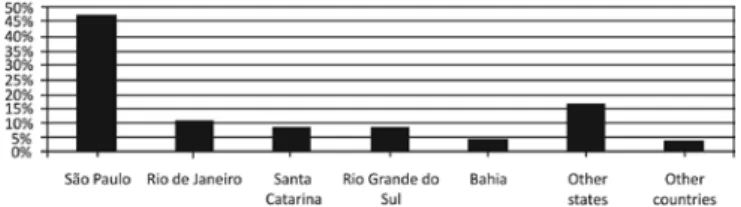
Regarding origin of the original articles, it was noted that the largest contribution came from the state of São Paulo with 88 (47.3%) original articles (Graph 1).
Graph 1 – Origin of the original articles on intensive care published in Brazil
Classiication of the original articles by type of study is presented in table 2, and the cohort study was the most common, described in 106 (57.3%) of original articles.
Table 2 – Classification of the studies of original articles pu-blished on intensive care
Type of study N %
Coohort 106 57.3
Cross-sectional 42 22.7
Randomized clinical trial 15 8.1
Case-control 8 4.3
Meta-analysis/Systematic Review 8 4.3
Others 6 3.2
N – number of original articles.
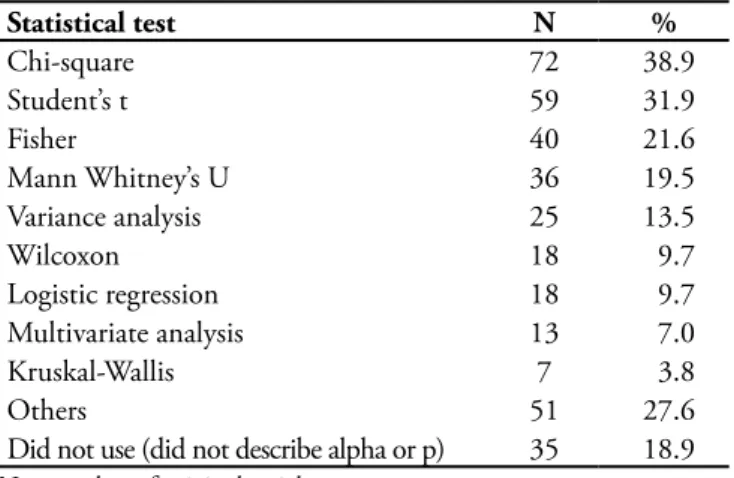
Table 3 – Statistical tests used in the original articles on in-tensive care in Brazil
Statistical test N %
Chi-square 72 38.9
Student’s t 59 31.9
Fisher 40 21.6
Mann Whitney’s U 36 19.5
Variance analysis 25 13.5
Wilcoxon 18 9.7
Logistic regression 18 9.7
Multivariate analysis 13 7.0
Kruskal-Wallis 7 3.8
Others 51 27.6
Did not use (did not describe alpha or p) 35 18.9
N – number of original articles.
Results of the quality analysis of the original articles on randomized clinical trials of this survey were com-pared with data of the hypothesis and there was no sta-tistical signiicance (p=0.71).
DISCUSSION
Currently, randomized clinical trials are being de-scribed as the gold standard for the assessment of thera-peutic issues in health.(24) his type of study reduced
the probability of obtaining biased data in a survey.(25)
Occurrence of systematic error may be avoided by us-ing randomization maskus-ing principles and analysis of all the recruited subjects.(26)
In this survey 14 original articles of randomized clinical trials were found, however only one presented good methodological quality according to the quality scale.(8) he fact that the authors state that the study
was randomized does not warrant to the reader or those assessing the article, that it truly was a clinical trial. he randomization principle in this type of study means that the allocation of the surveyed subjects to these study groups must be randomized,(1) participants must
have the same probability of receiving interventions as well as being tested regarding their control.(27) If this
principle is respected and adequately preformed, ran-domization reduces risk of systematic errors balancing the risk factors that could inluence the clinical out-come to be measured.(28) Some of the authors analyzed
did not describe the randomization method and there-fore lost the point for this item on the scale.
When assessing masking it was perceived that most authors, directly or indirectly mentioned that there was masking, but did not describe it adequately. he
masking principle states that, whenever possible it must be guaranteed that individuals involved as subjects of survey as well as those obtaining the data, do not know which group is receiving intervention or belongs to the control, thus being characterized as double-blind.(29)
Masking helps to avoid occurrence of biases due to sub-jectivity of the researcher as well as of the patients.
A joint description of losses and exclusions that took place after randomization of patients was not found in any of the 14 original articles, therefore no article scored in this item. It is important that the reader has access to the rates and reasons of these losses and exclu-sions to enable him to assess the feasibility of perform-ing the intervention in his daily practice.
In this survey it was observed that 100 (59.5%) original articles mentioned contact with the Research Ethics Committee, 53 (28.6%) mentioned use of the informed consent and, 3 (1.6%) articles described a funding source. hese items were also analyzed by other scales and lists as integral part of the methodological quality assessment and the description gives quality and credibility to the publication.(30,31) Such items should be
described in all publications regarding research with human beings.
In this survey it was observed that 19 (10.3%) origi-nal articles described sample size calculation. Sample size has an inverse inluence on the p value, that is why, very large samples tend to present low p values and lead to er-rors in decision making concerning the diferences found in the survey.(32) Failure to present sample size calculation
jeopardizes the validity of outcomes in any survey. In this survey 146 (78.9%) original articles de-scribed the analyzed variables, 118 (63.8%) dede-scribed inclusion criteria and 90 (48.6%) the exclusion criteria. Description of these items leads to a better understand-ing of eligibility criteria used. his permits the reader of original articles to judge if it is possible to extrapolate results found in a survey to patients attended in daily practice.(33)
he state of São Paulo had the largest contribution of original articles 88 (47.3%) published. hese results can be explained by the larger number of universities, researchers, training centers and scientiic events in that city.
he statistical test most often used is the Chi-square (38.9%). Tests of the hypothesis are expressed in p values that represent the probability of an event taking place in a sample, even if this event is null in the populations that originated the sample.(32) he Chi-square serves to
analyze the proportions of the categorical variables and together with the Student’s t test may be considered as one of the most often used in health surveys.(33)
Comparison between data of this survey and the formulated hypothesis disclosed that there was no sta-tistical signiicance (p=0.7). When results are negative and there is no mention of sample size calculation, some authors state that the publication regarding the survey does not deserve any credit by the readers.(33) For
this reason we calculated sample size after concluding the survey considering a hypothesis of 5%, an absolute precision of 4% and a signiicance level of 5% and ob-tained as an outcome 114 original articles. his number of original articles needed to conirm our hypothesis was lower than the number of articles assessed in this survey, conirming our results that the number of good quality original articles is as low as 5%.
Limitations of this survey were: use of only one scale for quality assessment, assessment of only one of the Brazilian journal that publishes intensive care in Brazil and quality assessment by only one reviewer of the arti-cles. he quality scale used in this survey(8) assesses only
the items of internal validity, neglecting those of exter-nal validity and the statistical method utilized. Other forms of the methodological quality assessment could also have been used such as individual items and lists.(31)
Assessment of only one journal prevented the authors from observing the clinical trials carried out in Brazil but published in other journals, besides Brazilian works published in international journals. It is recommended
that more than one reviewer assesses the articles and that discrepancies be resolved by consensus meetings, as such conduct would help to reduce biases.(8)
CONCLUSION
It can be concluded that in the sample of articles as-sessed, 7% of the randomized clinical trials on intensive care published in one of the Brazilian journals, are of good methodological quality.
RESUMO
Objetivo: O ensaio clínico aleatório é um estudo prospec-tivo que compara o efeito e o valor das intervenções em seres humanos, utilizando um ou mais grupos contra o grupo con-trole. O objetivo deste estudo foi avaliar a qualidade dos ensaios clínicos aleatórios publicados em terapia intensiva no Brasil.
Métodos: Todos os ensaios clínicos aleatórios encontrados através da busca manual na Revista Brasileira de Terapia Inten-siva de janeiro de 2001 a março de 2008 foram analisados para avaliar sua descrição através da escala de qualidade. Foi utilizada uma estatística descritiva e intervalo de coniança de 95% para a variável primária. A variável primária foi a qualidade dos ensaios clínicos aleatórios.
Resultados: Foram encontrados 185 artigos originais, sendo 14 de ensaios clínicos aleatórios. Apenas um artigo original ana-lisado (7,1%) mostrou-se de boa qualidade. Não houve signii-cância estatística entre os dados coletados e os dados mostrados na hipótese desta pesquisa.
Conclusão: Pode-se concluir que na amostra de artigos avaliada 7% dos ensaios clínicos aleatórios em terapia intensiva publicados em uma revista no Brasil são de boa qualidade me-todológica.
Descritores: Avaliação em saúde; Ensaios clínicos contro-lados aleatórios como assunto; Publicações; Unidade de terapia intensiva
REFERENCES
1. Castelo Filho A, Sesso RCC, Atallah NA. Epidemiologia clínica: uma ciência básica para o clínico. J Pneumol. 1989;15(2):89-98. 2. Higgins JPT, Green S, editors. Cochrane Handbook for Sys-tematic Reviews of Interventions. Version 4.2.5 [updated May 2005]. Chichester, England: John Wiley & Sons Ltd; Appen-dix 8a:215-229. [cietd 2006 Apr 24]. Available from: http:// www.cochrane.org/resources/handbook/hbook.htm.
3. Schulz KF. Unbiased research and the human spirit: the challen-ges of randomized controlled trials. CMAJ. 1995;153(6):783-6. Comment in: CMAJ. 1995;153(12):1708-10. Comment on: CMAJ. 1995;153(6):769-79.
4. Greenield ML, Rosenberg AL, O’Reilly M, Shanks AM, Sliwinski MJ, Nauss MD. he quality of randomized con-trolled trials in major anesthesiology journals. Anesth Analg. 2005;100(6):1759-64.
5. Bauer DC. Randomized trial reporting in general endocrine journals: the good, the bad, and the ugly. J Clin Endocrinol Metab. 2008;93(10):3733-4. Comment on: J Clin Endocrinol Metab. 2008 Oct;93(10):3810-6.
6. Harrison JE. Clinical trials in orthodontics II: assessment of the quality of reporting of clinical trials published in three orthodontics journal between 1989 and 1998. J Orthod. 2003;30(4):309-15; discussion 297-8.
care: Assessing the quality of controlled clinical trials. BMJ. 2001;323(7303):42-6.
8. Jadad AR, Moore RA, Carroll D, Jenkinson C, Reynolds DJ, Gavaghan DJ, McQuay HJ. Assessing the quality of reports of randomized clinical trials: is blinding necessary? Control Clin Trials. 1996;17(1):1-12.
9. Rodrigues Júnior GR, Amaral JLG. Impacto psicológico da internação na Unidade de Terapia Intensiva. Rev Bras Ter In-tensiva. 2001;13(4):92-8.
10. Oliveira LRC, José A, Dias EC, Santos VLA, Chiavone PA. Protocolo de desmame da ventilação mecânica: efeitos da sua utilização em uma Unidade de Terapia Intensiva. Um estudo controlado, prospectivo e randomizado. Rev Bras Ter Intensiva. 2002;14(1):22-32.
11. Piras C. A gasometria arterial na relação tempo entre a coleta e realização do exame. Rev Bras Ter Intensiva. 2002;14(3):95-8. 12. Figueirêdo LC de, Araújo S, Kosour C, Veloso CA, Petrucci Jú-nior O. Comparação entre dois métodos de retirada do suporte ventilatório mecânico no pós-operatório de cirurgia cardíaca. Rev Bras Ter Intensiva. 2003;15(3):114-20.
13. Vieira SRR, Lu Q, Rouby JJ. A scanographic assessment of alveolar recruitment and overinlation during high frequency ventilation - preliminary results in three patients. Rev Bras Ter Intensiva. 2004;16(3):138-41.
14. Yamaguti WPS, Alves LA, Kauss IAM, Galvan CCR, Brunetto AF. Comparação entre a pressão inspiratória máxima medida pelo método da válvula unidirecional e pelo convencional em pacientes submetidos ao processo de desmame da ventilação mecânica invasiva. Rev Bras Ter Intensiva. 2004;16(3):142-5. 15. Fiore Júnior JF, Oliveira ACS, Pinho E, Benassule E,
Francis-chini J, Chiavagato LD. O uso de baixos níveis de pressão su-porte inluencia a avaliação de parâmetros de desmame? Rev Bras Ter Intensiva. 2004;16(3):146-9.
16. Ferreira JC, Valiatti J, Schettino GPP, Bonassa J, Iwata L, Carva-lho CCR. Comparação do modo VAPS com os modos volume controlado e pressão controlada em pacientes com insuiciência respiratória aguda. Rev Bras Ter Intensiva. 2005;17(2):89-93 17. Viana JM, Martins MA, Campos AD, Basile-Filho A. Análise
comparativa entre os pesos corpóreos estimados e os medidos obtidos de pacientes em estado crítico. Rev Bras Ter Intensiva. 2005;17(4):238-45.
18. Moritz RD, Souza RL, Machado FO. Avaliação de um algorit-mo para a adequação da sedoanalgesia de pacientes internados em UTI e submetidos à ventilação mecânica. Rev Bras Ter In-tensiva. 2005;17(4):265-9.
19. Arantes AS, Christiano Júnior AC, Abreu SP, Moraes JMNF, Gandoli JV, Leite LG, Lobo SM. Doses baixas de dobutamina e luidos no pós-operatório de pacientes de alto risco: efeitos sobre a oxigenação tecidual, resposta inlamatória e morbidade. Rev Bras Ter Intensiva. 2007;19(1):5-13.
20. Lage SG, Carvalho RT, Kopel L, Bastos JF, Ribeiro MA, Fa-gundes Júnior AAP, et al. Estudo de segurança e eicácia da
eno-xaparina sódica na proilaxia e terapêutica antitrombótica. Rev Bras Ter Intensiva. 2007;19(1):67-73.
21. Rosa FK da, Roese CA, Savi A, Dias AS, Monteiro MB. Com-portamento da mecânica pulmonar após a aplicação de proto-colo de isioterapia respiratória e aspiração traqueal em pacien-tes com ventilação mecânica invasiva. Rev Bras Ter Intensiva. 2007;19(2):170-5.
22. Molon M, Piva J, Karcher P, Baldissera T. Clonidina associada à morina e midazolam em crianças submetidas à ventilação mecânica: estudo aleatório, duplamente encoberto e placebo controlado. Rev Bras Ter Intensiva. 2007;19(3):284-91. 23. Azevedo JRA, Azevedo RP, Cossetti RJD, Lima ERM, Sousa GB.
Insuiciência adrenal relativa no choque séptico: comparação da resposta ao tratamento com hidrocortisona em pacientes diagnos-ticados através de dosagem única do cortisol plasmático versus teste da corticotropina. Rev Bras Ter Intensiva. 2008;20(1):18-23. 24. Council for International Organizations of Medical
Sciences(CIOMS). World Health Organization (WHO). In-ternational ethical guidelines for biomedical research involving human subjects. Washington: OPAS; 1996.
25. Atallah AN, Castro AA. Medicina baseada em evidências: funda-mentos da pesquisa clínica. São Paulo: Lemos Editorial; 1998. 26. Schulz KF, Chalmers I, Grimes DA, Altman DG.
Asses-sing the quality of randomization from reports of controlled trials published in obstetrics and gynecology journals. JAMA. 1994;272(2):125-8. Comment in: JAMA. 1995;274(23):1835-6. JAMA. 2001;286(20):2546-7. JAMA. 2001;286(20):2546; author reply 2547.
27. Yusuf S, Collins R, Peto R. Why do we need some large, simple randomized trials? Stat Med. 1984;3(4): 409-22.
28. Collins R, Peto R, Gray R, Parish S. Large-scale randomized evidence: trials and overviews. In: Weatherall DJ, Ledingham JGG, Warrell DA. Oxford Textbook of Medicine, 3a. ed. Oxford: Oxford University Press; 1996. P. 21-32.
29. Newell DJ. Intention-to-treat analysis: implications for quanti-tative and qualiquanti-tative research. Int J Epidemiol. 1992;21(5):837-41. Comment in: Int J Epidemiol. 1993;22(3):566.
30. Schulz KF, Chalmers I, Hayes RJ, Altman DG. Empirical evidence of bias. Dimensions of methodological quality as-sociated with estimates of treatment efects in controlled trials. JAMA. 1995;273(5):408-12. Comment in: JAMA. 2001;286(20):2546-7.
31. Verhagen AP, de Vet HC, de Bie RA, Kessels AG, Boers M, Bouter LM, Knipschild PG. he Delphi list: a criteria list for quality assessment of randomized clinical trials conducting sys-tematic reviews developed by Delphi consensus. J Clin Epide-miol.1998;51(12):1235-41.
32. Cavalcanti AB, Akamine N, Sousa JMA. Avaliação crítica da literatura. In: Knobel E. Condutas no paciente grave. 3a. ed. São Paulo: Atheneu; 2006. P. 2635-47.