BRAZILIAN DOCTORS IN SPEECH-LANGUAGE
PATHOLOGY AND AUDIOLOGY CERTIFICATED
IN THE PERIOD 2009-2013: PROFILE OF TRAINING
Fonoaudiólogos brasileiros titulados doutores
no período de 2009 a 2013: peril da formação
Andréa Paz-Oliveira(1), Michele Picanço do Carmo(1), Léslie Piccolotto Ferreira(1)
(1) Programa de Estudos Pós-Graduados em Fonoaudiologia,
Pontifícia Universidade Católica de São Paulo – PUC – São Paulo (SP), Brasil.
Study conducted at the Graduate Studies Program in
Speech--Language Pathology and Audiology, Pontiical Catholic Univer -sity of São Paulo– PUC – São Paulo (SP), Brazil.
Conlict of interest: non-existent
the number of Doctors accredited by universities in several countries members of the Organization for Economic Co-operation and Development (OECD), where there was a 38% increase in doctors consid-ering that a total of 154.000 doctors accredited in the year 2000 and 213.000 in 20091. In Brazil, there is also an increase in the number of Doctors and of Graduate Studies Programs, since in the year 2002 there were 32 Ph.D. programs and 891 programs offering Masters’ Degrees and Ph.D.s, with a total of 37.728 Doctoral students and, in 2012 there were 53 Ph.D. programs and 1.664 programs offering Masters’ Degrees and Ph.Ds, with a total of 79.478 Doctoral students2.
INTRODUCTION
Doctors (Ph.D. holders) have a strategic role in the process of producing and transmitting knowledge and technology, in spite of representing a relatively small portion of the overall population. A recent record recognizes the gradual increase in
ABSTRACT
Purpose: to analyze the formation of Brazilian speech-language pathologists (SLP) PhDs in the period 2009-2013. Methods: data collection was done through consultation with the Lattes Platform
from the National Council for Scientiic and Technological Development (CNPq) with the descriptors
“Language and Hearing Sciences and “PhDs” and considered as inclusion criteria to be
speech-language pathologist and have earned a PhD degree in the determined period The data were
categorized according to the variables: gender, year of submission of the thesis, School, insertion of
program by area of expertise of the CNPq and theme developed in the thesis according to the areas
set out in the Language and Hearing Sciences and recognized by the Brazilian Society Speech, Language and Hearing Sciences. Data were analyzed descriptively and statistically. We applied the
test of association using the chi-square for trend analysis to second-order polynomial regression was
applied and and it was taken a signiicance level of 5%. Results: the reporting period totaled 271
PhDs degrees and the largest number of theses was achieved by women (266- 98.2%), in 2012 (72- 26.6%), in public universities (216- 79.7%), located in the Southeast region (188 -69.4%), belonging to the Health Sciences Programs (174- 64.2%), and written on language-related topics (95- 35.1%).
Conclusions: the survey, coupled with previous research, showing a total of 775 doctors with similar
proile to the previously researches but differing in the SLP insertion in graduate programs not only linked to the health areas, relecting the expansion of the various performance of this professional ields.
KEYWORDS: Speech, Language and Hearing Sciences; Scientiic Publication Indicators; Teaching;
presented by Speech-Language Pathologists and
Audiologists with a Ph.D. This survey was updated
in 201020 comprising the period between 1976 (the
year the irst thesis was presented) up to the end of 2008 and found a total of 504 presented Theses. On the three precious surveys most of the Theses were
presented by female Speech-Language Pathologists and Audiologists in the areas of Hearing/Balance and oral Language and its disorders.
Knowledge about the path of scientiic production of a certain ield is imperative in order to improve research quality, to achieve scientiic
progress and, mainly, to diagnose the impact of this production in the social environment where it
is created. The search for explanations about the
paths taken by research enables the evidencing of advances, indicating gaps and, at the same time, drive attention to new investigation alternatives21. In the present moment, the update proposed here is also a tribute in recognition to the work developed by Dr. Ieda Chaves Pacheco Russo, a partner in
the irst surveys conducted. The purpose of this
study was to analyze the education of Brazilian Speech-Language Pathologists and Audiologists who earned their Ph.D. degrees between the years
of 2009 and 2013, according to sex, year of Thesis
presentation, type of Education institution, insertion
of the Program where the Thesis was developed and Thesis theme.
METHODS
Data survey was conducted through search on the 25th and 30th of October, 2013, on the Lattes
platform on the National Counsel of Technological and Scientiic Development (CNPq) website, using
the following descriptors: “Speech Language and Hearing Science” and “Doctors”. At this moment, the curriculums for 2177 researchers were found. When reading the curriculums, there were other professional who performed activities related to the
ield of Speech-Language Pathology and Audiology who were a part of this listing. Thus, each curriculum
was accessed and the inclusion criteria was being a Speech-Language Pathologist and Audiologist and having obtained a Ph.D. degree between years
2009 and 2013. Since search was inalized in the
month of October, titles were considered up to this moment.
Then, the data, in addition to name and Thesis
title, were categorized according to the variables:
sex, year of thesis presentation, educational insti
-tution (Federal, State, Private and International); insertion of the Graduate Studies Program where
the thesis was developed according to the ield of
knowledge established by the National Counsel of
This increase in the number of Doctors relects in greater number and better quality of Brazilian
studies, resulting from factors such as the creation
and expansion of Masters’ Degree and Ph.D.
programs, especially after the second half of the 20th Century3,4. This aspect has also been especially
registered in the ield of Speech-Language
Pathology and Audiology that has an ever increasing
number of scientiic productions, certainly due to greater recognition of the ield and to the increase
in the number of Speech-Language Pathologists and Audiologists who are part of Graduate Studies Programs, for both Master’s and Ph.D. degrees5.
Scientiic production analysis has been valued in
surveys conducted in recent years6-15. Knowing the
educational proile of the professionals in the ield, their scientiic production and their ability to educate
future researchers help to build a picture of their current identity, and also to plan future scenarios.
A consolidated profession in the ield of Health
sciences may succeed in preparing its members to attend the population’s therapeutic needs, as well as to predict future clinical and prevention demands11.
This fact has also been observed in other ields
such as Education9, Nursing10, Physical Therapy6,11, Nutrition12,13 and Physical Education14,15.
A current survey on the Doctors of a speciic ield
may turn into an important indicator to analyze the
growth and maturity of the ield and consequently to predict the scientiic production potential to be
recognized by funding agencies16. This fact will result in the improvement of professional practices
in all work ield possibilities17.
The increase and the quality of scientiic
production has put Brazil in a highlight spot in the international scenery, and Graduate Studies Programs have contributed in the education of professors and researchers who are committed to academic and social development4. Continued studies have been increasingly necessary since
experience and knowledge gained from university
benches are far from enough in ensuring that professionals achieve a good placement in the work market18.
The proposal presented in this study is an update of previously conducted surveys. A irst
survey was completed in 1998, aiming to know the Speech-Language Pathologists and Audiologists
and ield of the Graduate studies program where the Thesis was presented, analyzed the period between
1976 and the beginning of 199819. Results found
91 Theses presented during this period, with a signiicant increase (83.5% increase) in the 1990’s.
Afterwards20 the period between the beginning of 1998 and the end of 2003 was analyzed and
When analyzing the presented theses according
to the ields of Speech-Language Pathology and
Audiology that are recognized by the Federal Council of Speech-Language Pathology and Audiology and by the Brazilian Society of Speech-Language Pathology and Audiology, it was observed that the
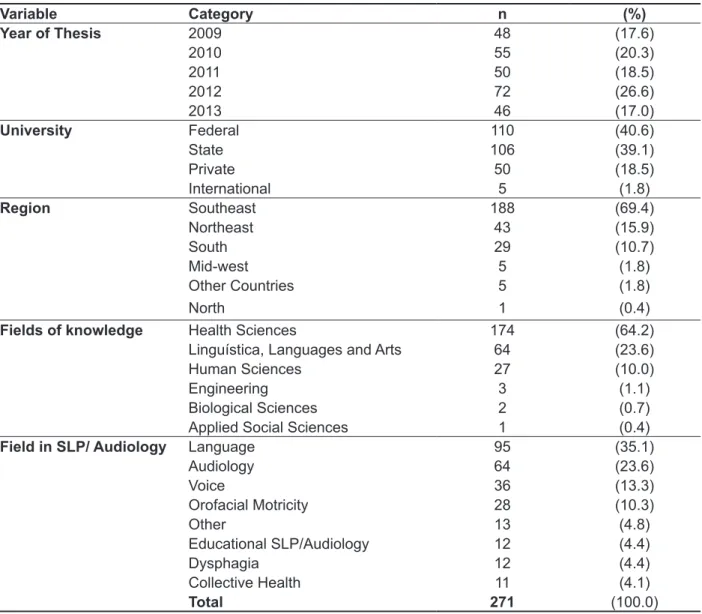
ield of Language prevails in comparison to the other ields (35.1%), followed by Audiology (23.6%). As expected, ields that have emerged more recently
(Collective Health, Dysphagia and Educational Speech-Language Pathology and Audiology, respectively) registered a small percentage of titled Doctors. On the item named “others” there
were Theses concerning anatomy and physiology,
genetics, neurosciences and the placement of the Speech-Language Pathologist and Audiologist in
the Work ield. There was no statistically signiicant differences between the ields for a same analyzed year (p=0.372) (Tables 2 and 3). The category “Others” was created in order to group Theses that
were related to themes that were not contemplated before, such as anatomy and physiology, education of Speech-Language Pathologists and Audiologists and placement of Speech-Language Pathologists
and Audiologists in the work ield.
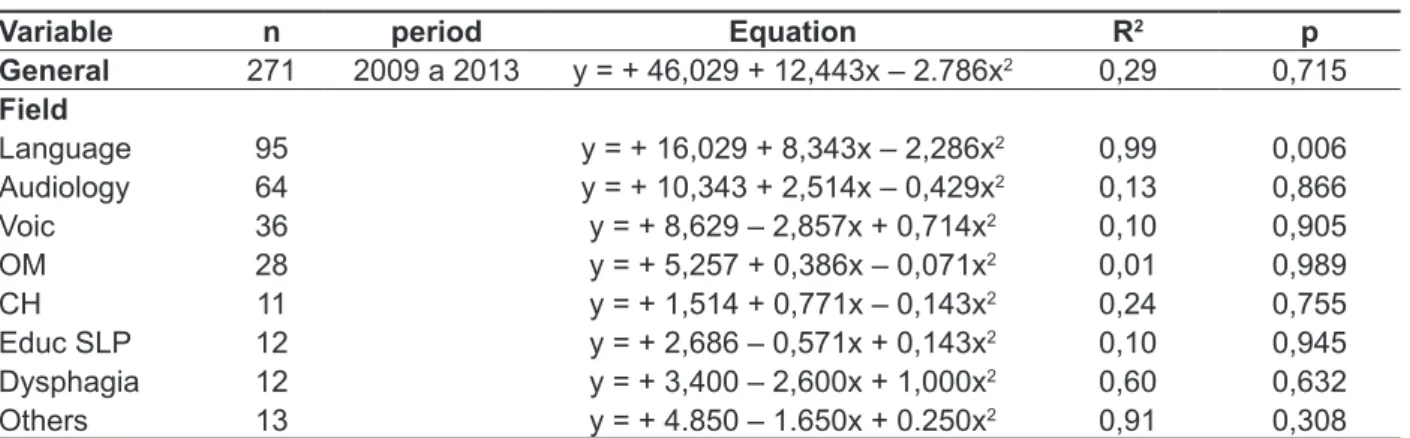
In order to evaluate whether there were
statisti-cally signiicant changes in the increase of Doctoral Theses productions, Polynomial Regression models
were used. In the general analysis of theses (Figure
1), there were no veriied changes throughout the
analyzed years (R2 = 0.29; p = 0.715). However,
the ield of Language has a growth tendency until
the year 2012 with a decrease in 2013 (R2 = 0.99;
p=0.006) (Table 3). All other areas did not have statistically signiicant changes in the number of
theses throughout the years (p>0.05) (Figure 1).
DISCUSSION
This study has shown a gradual increase in
the number of presented theses during the years, a characteristic that has been observed since the
irst survey was conducted19 that reported 91 theses
presented between 1976 and 1998, with an increase
of 83.5% from the 1990’s onward. The following
survey20 counted 203 theses presented by Ph.D. Speech-Language Pathologists and Audiologists between 1976 and 2003, and when the period between 1976 and 2008 was considered16 there was a total of 504 presented theses. When added to the number found in the present study (271), a total of 775 Speech-Language Pathologists with a Ph.D. title may be considered until the present moment.
This study found a greater number of female
Speech-Language Pathologists and Audiologists, which was also reported in the previous surveys, a
Technological and Scientiic Development (CNPq)
which are: Health Sciences; Human Sciences; Applied Social Sciences; Biological Sciences;
Linguistics; Arts and Literature; Engineering; Exact
and Earth Sciences; Agricultural Sciences and Education); and theme developed in the thesis,
according to the established ields in
Speech-Language Pathology and Audiology, as recognized by the Brazilian Society of Speech-Language Pathology and Audiology (Language, Hearing and Balance, Orofacial Functions and Mobility, Voice, Collective Health, Dysphagia and Educational Speech-Language Pathology and Audiology).
The descriptive analysis of the data considered the absolute and relative frequency of the variables and in order to compare the ields within
Speech-Language Pathology and Audiology and year of
publication the chi-square test was used. In order
to analyze the tendency of the Doctoral theses
quadratic regression analysis was used, in second
order polynomial function, y = a + bx + cx2- in order to
observe change throughout time, considering values
of p<0.05 as signiicant. The number of theses was
considered a dependent variable (y) and the year an
independent variable (x). Year standardization was conducted by subtracting the irstanalyzed year.
Statistical signiicance was determined by a descriptive value assumed at 5%. The analyses
were conducted using the SPSS software version 17.0 for Windows, annd graphs were completed
using Excel software, 2007 version.
RESULTS
In the analyzed ive-year period (2009 to 2013)
271 Doctoral theses were presented. Of these, a greater number was presented by women (266-98.2%), in the year 2012 (72- 26.6%), in public universities (216-79.7%), of the Southeast
region (188-69.4%), inserted in the ield of Health
Sciences (174-64.2%), developing different themes
concerning Language (95-35.1%) (Table 1).
A few of the data stood out: about the university where the thesis was developed, the Federal University of São Paulo (UNIFESP) was respon-sible for 10% of the Doctoral degrees and, among
the private institutions the Pontiical Catholic
Universities (PUCs) were responsible for 11.4%; when analyzing geographical regions, the state of São Paulo alone, situated in the Southeast region was responsible for conceding 57.6% of Ph.D. degrees; there are Speech-Language Pathologists and Audiologists who attained their titles in programs
that used to be speciic for the Medical ield, such as
Table 1 – Number and percent distribution of Speech-Language Pathologists and Audiologists,
according to year of thesis presentation, place (type of university and geographical region) and ield (of knowledge according to the National Counsel for Scientiic and Technological Development and specialty ield according to the Federal Council of Speech-Language Pathology and Audiology and
Brazilian Society of Speech-Language Pathology and Audiology)
Variable Category n (%)
Year of Thesis 2009 48 (17.6)
2010 55 (20.3)
2011 50 (18.5)
2012 72 (26.6)
2013 46 (17.0)
University Federal 110 (40.6)
State 106 (39.1)
Private 50 (18.5)
International 5 (1.8)
Region Southeast 188 (69.4)
Northeast 43 (15.9)
South 29 (10.7)
Mid-west 5 (1.8)
Other Countries 5 (1.8)
North 1 (0.4)
Fields of knowledge Health Sciences 174 (64.2)
Linguística, Languages and Arts 64 (23.6)
Human Sciences 27 (10.0)
Engineering 3 (1.1)
Biological Sciences 2 (0.7)
Applied Social Sciences 1 (0.4)
Field in SLP/ Audiology Language 95 (35.1)
Audiology 64 (23.6)
Voice 36 (13.3)
Orofacial Motricity 28 (10.3)
Other 13 (4.8)
Educational SLP/Audiology 12 (4.4)
Dysphagia 12 (4.4)
Collective Health 11 (4.1)
Total 271 (100.0)
Key: SLP - Speech-Language Pathology
fact that relects the formation of this ield that has
been traditionally constituted, since its beginnings,
mainly by women. This fact is also seen in other occupations. The number of women enrolling in
human and biological sciences at the main Brazilian College Entrance System (University Foundation
of Admittance Exams – FUVEST) is signiicantly greater than men and, especially for the ield of
Speech-Language Pathology and Audiology, there were 91.51% of female applications22. Data from
the CNPq from the year 2013 also show a gradual
increase in the number of female researchers, who today represent half of Brazilian researchers, while in 1995, they were 39% of the total number
of researchers23. Speciically in the ield of Speech-Language Pathology and Audiology, most of the theses presented during the analyzed period regards
Language (35.51%), a inding that is different from
those in the irst surveys20,23, where Hearing and
Balance accounted for most of the theses (37-40.6%
and 82-40.3%, respectively), but that conirms the
fact announced by the third survey16, that reported
a close record between the ields of Language
(34.52%) and Hearing and Balance (32.34%).
Scientiic production in other countries also
shows prevalence of the rehabilitation model and
in it, the ield of Language has greater number of
Figure 1 – Tendency Analysis using polynomial regression model
n
u
mb
e
r
o
f
th
e
si
s
total studies Poly. (total studies)
Table 3 – Models of polynomial regression, according to ield for years between 2009 and 2013
Variable n period Equation R2 p
General 271 2009 a 2013 y = + 46,029 + 12,443x – 2.786x2 0,29 0,715
Field
Language 95 y = + 16,029 + 8,343x – 2,286x2 0,99 0,006 Audiology 64 y = + 10,343 + 2,514x – 0,429x2 0,13 0,866
Voic 36 y = + 8,629 – 2,857x + 0,714x2 0,10 0,905
OM 28 y = + 5,257 + 0,386x – 0,071x2 0,01 0,989
CH 11 y = + 1,514 + 0,771x – 0,143x2 0,24 0,755
Educ SLP 12 y = + 2,686 – 0,571x + 0,143x2 0,10 0,945 Dysphagia 12 y = + 3,400 – 2,600x + 1,000x2 0,60 0,632 Others 13 y = + 4.850 – 1.650x + 0.250x2 0,91 0,308
SLP – Speech-Language Pathology, OM- Orofacial Motricity, CH- Collective Health, Educ SLP- Educational Speech-Language Patho-logy and AudioPatho-logy
Quadratic regression analysis – second order polynomial function, considering values of p<0.05 signiicant.
Table 2 – Analysis of chi-square association between the variables year of thesis presentation and
ield in Speech-Language Pathology and Audiology
Field SLP/Audiology
year
2009 2010 2011 2012 2013
n (%) n (%) n (%) n (%) n (%)
Language 16 (16.8) 22 (23.2) 24 (25.3) 20 (21.1) 13 (13.7) Audiology 12 (18.8) 10 (15.6) 11 (17.2) 20 (31.2) 11 (17.2) Voice 10 (27.8) 5 (13.9) 2 (5.6) 13 (36.1) 6 (16.7) Orofacial Mot 5 (17.9) 7 (25.0) 3 (10.7) 8 (28.6) 5 (17.9) CH 2 (18.2) 1 (9.1) 3 (27.3) 3 (27.3) 2 (18.2) Educ SLP 3 (25.0) 2 (16.7) 1 (8.3) 4 (33.3) 2 (16.7) Dysphagia 0 (0.0) 3 (25.0) 3 (25.0) 1 (8.3) 5 (41.7) Others 0 (0.0) 5 (38.5) 3 (23.1) 3 (23.1) 2 (15.4)
Total 48 (17.7) 55 (20.3) 50 (18.5) 72 (26.6) 46 (17.0)
p=0.372 Polynomial Regression
Analysis of quadratic regression – second order polynomial function, considering values of p<0.05 signiicant
have been accepting the enrollment of Speech-Language Pathologists and Audiologists, fact that
may be conirmed among those who have received
their titles from Programs such as General Bases of Surgery, Surgical Clinic, and Gastroenterology
Sciences. Finally, a inding that also accounts for
the increase in Doctors is the growing number of new undergraduate schools of Speech-Language Pathology and Audiology in federal universities, mainly in the Northeast region, and these institu-tions prioritize Ph.D. titles in the composition of their
faculty. Teaching is a practice that demands speciic education in addition to knowledge of speciic
content; this is a fact that encourages those who are involved in teaching to search for constant updating, such as found in a Ph.D. 29.
It may be said that there is still a movement in search of higher titles, registered in Brazil in
different ields. In the year 2000, there were 304,795
Brazilians who were enrolled in Graduate Studies Programs in order to obtain a Masters’ or Ph.D. Degree, corresponding to only 0.18% of the total population of Brazil28. In updating this data, it may be seen that Brazilian population is over 190 million citizens and there are currently 594 Graduate
Studies Programs in the ield of Health, where 132
offer only Masters’ Degrees, 17 only Ph.D. degrees, 105 professional Masters’ and 340 that offer Masters’ Degrees and Ph.D. Degrees. At CAPES, Speech-Language Pathology and Audiology is inserted in Area 21 that also involves programs in
the ields of Physical Education, Physical Therapy and Occupational Therapy. While the ield of
Physical Education has 31 Programs (14 Masters’, 1 professional Masters’ and 16 Masters’/Ph.D.),
Physical Therapy and Occupational Therapy have
12 programs (6 Masters’ and 6 Masters’/Ph.D.), Speech-Language Pathology and Audiology has 11 Graduate Studies Programs (9 academic Masters’, 2 Professional Masters’ and 7 Ph.D. programs).
In comparing this inding with that of the precious three-year period, it may be said that the ield has
had a 71% increase in Graduate Studies Program between the years of 2010-201230,31.
When analyzing the data regarding the different Brazilian regions, there was more search for education of Ph.D. Speech-Language Pathologists and Audiologists in the Southeast region, mainly in
the state of São Paulo. This is due to the fact that
the Southeast is the most highly populated region in Brazil and thus concentrates the greatest number of Speech-Language Pathologists and Audiologists. Of all Brazilian Speech-Language Pathologists and Audiologists, 30.9% are located in São Paulo. On the opposite end, the north region was chosen by only one Ph.D. Speech-Language Pathologist and Audiologist (0.4%)32.
As expected, the more recent ields (Collective
Health, Dysphagia and Educational Speech-Language Pathology and Audiology) have lower percentage of titled professional when compared to the others. However, it is evident that these areas begin to stand out, such as Collective Health, for
example, that accounted for 2.98 of the theses
presented in the past survey16 and, in the present research is responsible for 4.1% of the presented theses.
It should be noted that the growth regarding the
ield of Orofacial Motricity and Functions that was
announced in some studies16 was not conirmed in the present survey.
The creation of new specialty ields relects different professional placements, in ields where speciic knowledge should be obtained in order to perform. The curriculum needs to coincide with the
population’s new and growing needs25. In addition to Speech-Language Pathology and Audiology,
the ield of Physical Therapy has also registered changes when analyzing its scientiic production. Although there were no new specialty ields, the ield of orthopedics, the irst, still prevails in comparison
to all others6 .
In this study, regarding the education of these Doctors, there was a preference for choosing federal institutions, especially the Federal University
of São Paulo (UNIFESP), a inding that coincides
with those in the irst surveys19,20, and that differs
from those of the third survey16 that shows a greater search for State universities, particularly the State University of São Paulo (USP). According to the
Government Ofice for Education and Culture (MEC)
26 there was a signiicant increase in the number of
Federal Universities and also in the number of grants conceded by funding agencies, a fact that enables a greater number of interested individuals to conduct their Graduate studies in these institutions. In 2008 there were around 40 thousand scholarship holders
in the country. As an example, the Coordination for
the Improvement of Higher Education Personnel (CAPES) conceded 72.071 Graduate studies grants in 2011 and more than 127 thousand grants of all
kinds in 2012, while the CNPq, in the same period,
increased the offer of all types of grants from 63 thousand to about 81 thousand in the same period27.
There was an increase in the number of Graduate
Studies programs in Speech-Language Pathology and Audiology28, as in the beginning of the ield there were only two, one of which was responsible for a greater number of Masters’ Degrees (PUC-SP) and another one of Ph.D. degrees (UNIFESP-EPM). In addition to this fact being responsible for the greater
scientiic production, according to the ISI-Thomson
Reuters-Web of Science (WS) data-base, and the health sciences occupied the 3rd global position in 2008, according to the WS base, surpassed only by the USA and England40.
A study conducted about the proile of the Physical Therapy Researcher regarding aspects of his education, ield of work, scientiic production
and education of new researchers, as well as funding and grants in the country according to the
CNPq area concluded that the ield itself, as well
as research funding agencies need to recognize the high academic efforts of these researchers. With recognition and support, these efforts may be
encouraged and reverted in beneit of the devel
-opment of knowledge in the ield, professional
strengthening and improvement of the health and
quality of life of the population11.
CONCLUSIONS
The survey showed 271 Speech-Language
Pathologists and Audiologists with Ph.D. Degrees in the analyzed periods (which added to the data of precious studies yield a total of 775), with greater number of titled women who seek mainly federal
institutions in the Southeast region, in Health ield
programs in order to develop themes related to Language.
Among the programs selected by Speech-Language Pathologists and Audiologists to obtain their Ph.D., the Linguistics program stands out, followed by Human Communication Disorders
and Rehabilitation Science. This data is different
from precious studies where the Communication Disorders Program accounted for the greatest number of presented theses16,23. Certainly, the fact of a greater search for Linguistics Programs
explains the greater number of theses in the ield of
Language.
Knowing the Education proile of the ield has
proven necessary in order for better knowledge
about the ield, a fact that has also proven true in
other ields. Among these are Education 9, Physical
Therapy6,11, Nutrition12,13, Physical Education14,15 and
Nursing10. Especially in the latter, an increase in the number of Graduate Studies Program has also
been found. The analysis of the scientiic production
on stuttering33, cerebral palsy 34 Speech-Language Pathology and Audiology and Education35, written Language36, general Speech-Language Pathology and Audiology37, evidences the continuing growth
of publication throughout the years. The interest in surveying the education of professional, scientiic
productions and advances are also observed in
other ields such as in collective health38, nursing39,
nutrition12,13, physical education14,15. These data
conirm the privileged place of Brazilian scientiic
production. Brazil holds the 13th place in global
RESUMO
Objetivo: analisar a formação defonoaudiólogos brasileiros titulados doutores no período de 2009 a 2013. Métodos: o levantamento dos dados foi realizado por meio de consulta à Plataforma Lattes do
Conselho Nacional de Desenvolvimento Cientíico e Tecnológico a partir dos termos “Fonoaudiologia”
e “doutores”, e considerado como critério de inclusão ser fonoaudiólogo e ter-se titulado doutor no
período determinado. Os dados foram categorizados segundo as variáveis: sexo, ano de defesa da tese, instituição de ensino, inserção do programa em que a tese foi desenvolvida, segundo área de conhecimento do Conselho Nacional de Desenvolvimento Cientíico e Tecnológico e temática
desenvolvida na tese, de acordo com as áreas estabelecidas na Fonoaudiologia e reconhecidas pela Sociedade Brasileira de Fonoaudiologia. Os dados foram analisados de forma descritiva e
estatís-tica. Aplicou-se o teste de associação pelo qui-quadrado e para a análise de tendência foi aplicada
a regressão polinomial de segunda ordem. Assumiu-se um nível descritivo de 5%. Resultados: o período avaliado totalizou 271 doutorados defendidos. Desses, maior número de teses foi realizada por mulheres (266-98,2%), no ano de 2012 (72-26,6%), em universidades públicas (216-79,7%),
situ-adas na região Sudeste (188-69,4%), em programas pertencentes à área de Ciências da Saúde
(174-64,2%) e de temática relacionada à linguagem (95-35,1%). Conclusões: o levantamento, somado
a pesquisas anteriores, evidencia um total de 775 doutores, com peril semelhante ao levantado anteriormente, mas diferindo quanto à inserção de fonoaudiólogos em programas de pós-graduação não relacionados apenas à área de saúde, reletindo a ampliação dos diversos campos de atuação desse proissional.
13. Canella DS; Silva ACF; Jaime PC. Produção
cientíica sobre nutrição no âmbito da Atenção
Primária à Saúde no Brasil: uma revisão de literatura.
Ciênc. saúde coletiva. 2013;18(2):297-308.
14. Leite BD, Oliveira EA, Queiroz IN, Martelli
DR, Oliveira MC, Martelli Júnior H. Proile of
the Researchers with Productivity Grants in the
Brazilian National Research Council (CNPq) of
the Physical Education Area. Motri. [periódico na Internet]. 2012 Jul [citado 2014 Ago 07]; 8(3): 90-8. Disponível em: http://www.scielo.gpeari.
mctes.pt/scielo.php?script=sci_arttext&pid=S1646-107X2012000300010&lng=pt. http://dx.doi.
org/10.6063/motricidade.8(3).1160.
15. Lazzarotti Filho A, Silva AM, Nascimento JV, Mascarenhas F. Modus operandi da produção
cientíica da educação física: uma análise das revistas e suas veiculações. Rev. educ. is. UEM.
2012;22(1):1-14.
16. Ferreira LP, Russo ICP, Adami F. Fonoaudiólogos
doutores no Brasil: peril da formação no período
de 1976 a 2008. Pró-Fono R Atual Cient. 2010;22(2):89-94.
17. Coutinho RX, Soares MC, Folmer V, Puntel RL. Análise da produção de conhecimento da Educação Física brasileira sobre o cotidiano escolar. RBPG. 2012;9(17):491-516.
18. Freitas E. A importância de uma pós-graduação na vida proissional. http://www.administradores.
com.br/entrevistas/academico/a-importancia-de-uma-pos-graduacao-na-vida-profissional/88/. Visualizado em 26.12.2013
19. Ferreira LP, Russo ICP. O peril das teses de
doutorado defendidas por fonoaudiólogos brasileiros. Pró-Fono R Atual Cient. 1998;10(2):64-70.
20. Russo ICP, Ferreira LP. Fonoaudiólogos doutores no Brasil: análise das teses segundo área de atuação e programas. Pró-Fono R Atual Cient. 2004;(1):119-30.
21. Martins NR, Silva RVS. Pesquisas brasileiras em Educação Física e Esportes: tendências das
teses e dissertações. Disponível em: <http:// www. nuteses.ufu.br/trabalho_2.pdf>. Acesso em: 22 fev. 2014.
22. Guilherme P, Moreno AC. Mulheres são maioria na disputa em biológicas e humanas na Fuvest 2013. http://g1.globo.com/educacao/noticia/2012/11/ mulheres-sao-maioria-na-disputa-em-biologicas-e-humanas-na-fuvest-2013.html. Visualizado em 11.12.2013.
23. Conselho Nacional de Desenvolvimento
Cientíico e Tecnológico-CNPq. Número de
mulheres cientistas já se iguala aos homens. [acesso em 2013 Nov 25]. Disponível em: http://
www.cnpq.br/web/guest/noticiasviews/-/journal_ content/56_INSTANCE_a6MO/10157/905361.
REFERENCES
1. Organisation for Economic Co-operation and Development- OECD Innovation Strategy, OECD 2010. [acesso em 2013 Nov 10]. Disponível em: http://www.oecd.org/sti/45326349.pdf.
2. GEOCAPES. Distribuição de bolsa de pós-graduação no Brasil por Estado. 2013 [acesso em 2013 Nov 10]. Disponível em: http://geocapes.
capes.gov.br/geocapesds/#app=c501&da7a- selectedIndex=0&5317-selectedIndex=0&dbcb-selectedIndex=0.
3. Guimarães R. Desaios da pós-graduação em
saúde humana no Brasil. Rev Saúde Pública. 2011;45(1):1-13.
4. Schaurich D, Crossetti MGO, Padoin SMM..
Filosoia Buberiana e a produção da pós-graduação
stricto sensu brasileira: revisão integrativa. Rev Bras Enferm. 2011;64(6):1132-40.
5. Borges LBN. A escrita que a fonoaudiologia
vem escrevendo. [Dissertação]. São Paulo (SP): Departamento de Fonoaudiologia da Pontifícia Universidade Católica São Paulo; 2003.
6. Virtuoso JF, Haupenthal A, Pereira ND, Martins CP, Knabben RJ, Andrade A. A produção
de conhecimento em isioterapia: análise de
periódicos nacionais (1996 a 2009). Fisioter Mov. 2011;24(1):173-80.
7. Ferreira, LL. Variabilidade da frequência cardíaca como recurso em isioterapia: análise de periódicos
nacionais. Fisioter. mov. 2013;26(1):25-36.
8. Pinto ICM, Esperidiao MA, Silva IV, Soares
CM, Santos L, Fagundes TLQ et al. Trabalho e educacao em saude no Brasil: tendências da producao cientiica entre 1990-2010. Ciencia &
Saude Coletiva. 2013;18(6):1525-34.
9. Ramos MY; Lea Velho L. Formação de doutores
no Brasil: O esgotamento do modelo vigente
frente aos desaios colocados pela emergência do sistema global de ciência. Avaliação : Rev Avaliação
da Educação Superior. 2013;18(1):219-46.
10. Erdmann AL, Andrade SR, Santos JLG,
Oliveira RJT. Peril dos egressos de gerenciamento
de enfermagem dos Programas da área de Enfermagem da Região Sul. Rev Esc Enferm USP. 2011;45(Esp):1551-7.
11. Coury HJCG, Vilella I. Peril do pesquisador isioterapeuta brasileiro. Rev Bras Fisioter.
2009;13(4):356-63.
12. Olinto MTA, Lira PIC, Marchini JS, Kac G. Formação humana, pesquisa e produção cientíica na subárea de avaliação “nutrição” da
em: http://www.capes.gov.br/sobre-a-capes/ plano-nacional-de-pos-graduacao.
31. Instituto Brasileiro de Geograia e Estatística.
http://www.ibge.gov.br/home/estatistica/populacao/ censo2010/calendario.shtm
32. Conselho Federal de Fonoaudiologia. CNPq
[acesso em 2013 Nov 25]. Disponível em: http://
www.fonoaudiologia.org.br/cffa/index.php/
numero-por-regiao/.
33 . Damasceno WAPL, Friedman S. Análise da
produção cientíica fonoaudiológica nacional sobre
gagueira. Rev CEFAC. 2011;13(1):41-7.
34. Silva MCF, Friedman S. Análise da produção
cientíica fonoaudiológica brasileira sobre
paralisia cerebral. Rev Soc Bras Fonoaudiol. 2010;15(4):589-93.
35. Trenche MCB, Biserra MP, Ferreira LP. Interface
entre fonoaudiologia e educação: análise da
produção em periódicos cientíicos. Distúrb Comum.
2011;23(2):357-63.
36. Munhoz, CMA, Massi G, Berberian AP, Giroto
CRM, Guarinello AC. Análise da produção cientíica
nacional fonoaudiológica acerca da linguagem escrita. Pró-Fono R Atual Cient. 2007;19(3):249-58. 37. Berberian AP, Ferreira LP, Corteletti LCBJ,
Azevedo JBM, Marques JM. A produção do
conhecimento em distúrbios da comunicação: análise de periódicos (2000-2005). Rev Soc Bras Fonoaudiol. 2009;14(2):153-9.
38. Minayo MCS. A produção de conhecimentos
na interface entre as ciências sociais e humanas
e a saúde coletiva. Saúde Soc São Paulo. 2013;22(11):21-31.
39. Schaurich D, Crossetti MGO. Produção do
Conhecimento sobre Teorias de Enfermagem. Esc
Anna Nery Rev Enferm. 2010;14(1):182-8.
40. Meneghini R. Visibilidade internacional da produção brasileira em saúde coletiva. Cad. Saúde Pública. 2010;26(6):1058-9.
24. Pava-Ripoll NA, Villamizar CMP, Torres AR.
Aportes desde la investigación formativa a la producción en Fonoaudiología: el caso de una universidad colombiana. Rev Soc Bras Fonoaudiol. 2011;16(4):377-83.
25. Busari JO. The discourse of generational
segmentation and the implications for postgraduate medical education. Perspect Med Educ. 2013;2:340-8.
26. MEC. Análise da expansão das Universidades
Federais 2003 – 2012. Disponível em:http://
www.google.com.br/url?sa=t&rct=j&q=&esr c=s&source=web&cd=1&cad=rja&ved=0CC 0QFjAA&url=http%3A%2F%2Fportal.mec. gov.br%2Findex.php%3Foption%3Dcom_
docman%26task%3Ddoc_download%26gid%3D
12386%26Itemid%3D&ei=UxapUo_IEJPnoASF4 IC4Ag&usg=AFQjCNGklNn43M3IX03P2SOmjm N1oOci0A&sig2=S158jERQaE9c6lB-WF9mNg.
Visualizado em 12.12.2013.
27. MEC. Notícias. Governo vai reajustar em abril as bolsas de pós-graduação. Disponível em:
http://portal.mec.gov.br/index.php?option=com_ content&view=article&id=1854. Visualizado em
12.12.2013.
28. Centro de Gestão e Estudos Estratégicos.
Doutores 2010: estudos da demograia da base técnico-cientíica brasileira - Brasília, DF:, 2010.
[acesso em 2013 Nov 25]. Disponível em: http:// www.capes.gov.br/servicos/sala-de-imprensa/36- noticias/3884-estudo-do-cgee-indica-crescimento-no-numero-de-doutor.
29. Correa GT, Ribeiro VMB. Formação pedagógica
na pós-graduação stricto sensu em saúde coletiva.
Ciência & Saúde Coletiva. 2013;18(6):1647-56.
30. IV Plano Nacional de Pós-graduação. Ministério da Educação. Coordenação de Aperfeiçoamento de Pessoal de Nível Superior. Plano Nacional de Pós-graduação – PNPG 2005/2010. Brasília; 2010[citado 2013 Dez 6]. Disponível
Received on: July 03, 2014 Accepted on: August 24, 2014
Mailing address: Andréa Paz-Oliveira
Rua Pio XI, 587 – Alto da Lapa São Paulo – SP – Brasil CEP: 05060-000