(1) Departamento de Fonoaudiologia da Faculdade de Odontologia de Bauru, FOB-USP, Bauru, SP, Brasil. (2) Faculdade de Medicina de Botucatu,
FMB-UNESP, Botucatu, SP, Brasil. (3) Faculdade de Medicina, FM-USP, São
Paulo, SP, Brasil.
Conlict of interest: non-existent
Development and application of an administrative
instrument to guide research on Telehealth in Speech
and Language Pathology
Desenvolvimento e aplicação de instrumento administrativo
para orientação das pesquisas em Telefonoaudiologia
Paulo Marcos Zanferrari(1) Camila de Castro Corrêa(2) Chao Lung Wen(3) Giédre Berretin-Felix(1)
Received on: November 10, 2015 Accepted on: January 17, 2016
Mailing address:
Giédre Berretin-Felix
Al. Octávio Pinheiro Brisola, 9-75 Bauru - SP - Brasil
CEP: 17012-901 E-mail: [email protected]
ABSTRACT
Purpose: to develop and apply a tool to guide research on Telehealth in Speech and Language Pathology and to identify the strong and weak aspects of these projects.
Methods: a questionnaire addressing administrative, technological, inancial and sustainable points was developed. Eleven teachers who had been working on projects on Telehealth in Speech and Language Pathology answered the questionnaire. These data were analyzed using descriptive statistics and the SWOT Matrix was applied, enabling the identiication of the strong and weak points, and the Ishikawa Diagram used to identify the effects and causes.
Results: the questionnaires were applied and 32 projects in which the purpose of the project, the qua -lity of the information, the communication channels and the beneits to users were identiied as strong points, were analyzed, having as the main causes the use of speciic multimedia, continued education, the amount of available information and the commitment of the team. Weak aspects such as the absence of qualiied personnel in certain stages of the project, the lack of hardware and software updating, the digital exclusion of users and the obsolescence of the project were seen, the main causes owing to the dificulty in technical support, professionals for marketing and training strategies and the maintenance of the developed projects.
Conclusion: the questionnaire was developed and applied, so as to identify the strong and weak points related to training. Maximizing of the time and updating of digital resources were identiied as important inputs to extend the beneits of telehealth projects, towards organizational competitive advantage. Keywords: Telemedicine; Speech, Language and Hearing Sciences; Planning
RESUMO
Objetivo: desenvolver e aplicar um instrumento para orientação das pesquisas em Telefonoaudiologia e identiicar os pontos fortes e fracos destes projetos.
Métodos: foi desenvolvido um questionário, abordando quatro competências distintas: administrativa, tecnológica, inanceira e de sustentabilidade. Realizou-se a aplicação com 11 docentes que desenvolviam projetos na área de Telefonoaudiologia. Tais dados foram analisados por meio de estatística descritiva e aplicada a Matriz SWOT, que possibilitou identiicar os pontos fortes e fracos, bem como o Diagrama de Ishikawa, para identiicar os efeitos e causas.
Resultados: foram aplicados os questionários e analisados 32 projetos em que os pontos fortes foram: a missão do projeto, a qualidade das informações, os canais de comunicação e os benefícios proporciona -dos aos usuários, tendo como principais causas a utilização de multimeios especíicos, a educação con -tinuada, a quantidade de informações disponibilizadas e o comprometimento do capital humano. Quanto aos pontos fracos, constatou-se a ausência de especialização da mão de obra em determinadas etapas do projeto, a falta de atualização de hardware e software, a exclusão digital de usuários e a obsolescência do projeto, sendo as principais causas concentradas na diiculdade de suporte técnico, proissionais para divulgação e treinamento, estratégias de marketing e a manutenção dos projetos desenvolvidos. Conclusão: foi desenvolvido e aplicado o questionário, sendo identiicados os pontos fortes e pontos fracos, estando associados a especialização do capital humano. A maximização do tempo e a atualização dos recursos digitais foram identiicados como insumos importantes para ampliar os benefícios dos pro -jetos de Telessaúde, rumo à vantagem competitiva organizacional.
INTRODUCTION
Instruments available in the area of Business Administration are used to analyze if products or services are keeping their functionality within what was planned during their design and the chances of being adopted by consumers in the current market 1.
Thus, SWOT analysis 2, an instrument which assesses the status of the organization and its products in relation to the market, aiming at eradicating the constant failures of corporate planning, was created. The analysis consists of four distinct variables, i.e., the strengths, weaknesses, opportunities and threats 2.
The SWOT analysis is not a privilege of the Business Administration area, though, for it is also present in other segments where objective and reliable interpre-tation of a particular institution and its operational mode is needed. For instance, the analysis of palliative care in Latin America, helping to identify common aspects among countries and key elements in their devel-opment 3.
Another important instrument in this context is the Ishikawa diagram which serves to identify the potential causes for the recurrence of a defect or failure in the product or services, as well as a critical analysis of the operational process which is being developed 4. Its importance extends to the analyses of medical cases to improve the clinical reasoning skills and enhance the knowledge of medical students and physicians being trained, thus, facilitating the teaching-learning process 5. Aided by these instruments, the strategic planning of an organization will be founded on solid bases and visible to everyone involved 1.
To ensure the effectiveness of the application of such instruments, it is necessary to maintain an adequate communication, so that such analyses achieve their goals6.
Communication can be established by diverse means, including digital information, which when added to health, gives rise to tele-health, tele-education and tele-care 7. These resources should be considered from educational models, using technological instruments, combined with the goal of enhancing patient care 8,9, owing to their proven eficacy 10.
A wider nomenclature, tele-health involves the exchange of health information among distant sites, encompassing activities that go beyond patient care, the concern with health promotion, patients and profes-sionals education, disease prevention, epidemiological surveillance, health service management and environ-mental protection, among others 11.
Different strategies have been used by telemedicine, allowing the training of health professionals in medicine, dentistry, nursing, speech therapy, physical therapy, mental health and social care, the most known areas. The interface among specialties, provides custom-ization with productive and economic characteristics.
In terms of telehealth in the area of Speech Therapy and Audiology, a prevalence of publications in the area of Audiology, with greater focus on assessment or intervention, has been observed, and the number of papers on this subject has risen, mainly in the last ive years 12. Correlating telehealth in speech and language pathology and audiology, inserted into the contem-porary marketing and compared to the condition of product or service, it can be made available to users, provided that studies examining its quality and facili-tating the sustainability of such actions with optimi-zation strategies for its operation, be carried out 13.
Thus, this study aimed at developing and imple-menting a instrument to guide research in telehealth in speech and language pathology and audiology, and identify the strengths and weaknesses of these projects.
METHODS
Ethical aspects
The study was approved by the Ethics Committee on Human Research of the Bauru Dentistry School, University of São Paulo, under process No. 133/2011. All participants were informed about the procedures involved in the research, by reading and signing the Informed Consent.
Sample
Eleven professors working on telehealth research along with the Speech Therapy Department of the above mentioned educational institution participated in this study.
Procedures
The works produced by the professors, related to the research line deined in this study, were identiied and cataloged by the Curriculum Lattes analysis, as well as the access to Scielo, PubMed, Dedalus and Bireme databases.
Professor: Date: I – Indicators of the Administrative Competence
a) Current condition of the project
Name of the Project In progress
Accomplished
Within time limit Out of time Within time
limit Out of time
b) The accomplished project meets the objectives proposed in the telehealth area with a performance
Name of the Project Excellent (5) Good (4) Reasonable (3) Bad (2) Very bad (1)
c) The level of use of the Project by the target public can be considered:
Name of the Project Excellent (5) Good (4) Reasonable (3) Bad (2) Very bad (1)
d)The divulging degree of the Project can be considered:
Name of the Project Excellent (5) Good (4) Reasonable (3) Bad (2) Very bad (1)
e) The communication multimedia used for the development of the project can be considered
Name of the Project Excellent (5) Good (4) Reasonable (3) Bad (2) Very bad (1)
f) The accessibility of the target public to the material developed can be rated as
Name of the Project Excellent (5) Good (4) Reasonable (3) Bad (2) Very bad (1)
g) The amount of information offered by the project to the target audience was
Name of the Project Excellent (5) Good (4) Reasonable (3) Bad (2) Very bad (1)
h)Taking the beneits of the project into account, it can be stated that the result was
Name of the Project Excellent (5) Good (4) Reasonable (3) Bad (2) Very bad (1)
II – Indicators of Technological Competence
a) The level of technology used in the development of the project can be considered
Name of the Project Excellent (5) Good (4) Reasonable (3) Bad (2) Very bad (1)
b) The ease of the user in operating the content of the project can be assessed as
Name of the Project Excellent (5) Good (4) Reasonable (3) Bad (2) Very Bad (1)
c) The level of project content updating can be considered
Name of the Project Excellent (5) Good (4) Reasonable (3) Bad (2) Very Bad (1)
d) The technological potential of the project in hardware can be considered:
Name of the Project Excellent (5) Good (4) Reasonable (3) Bad (2) Very Bad (1)
e) The technological potential of the project in software can be considered:
Name of the Project Excellent (5) Good (4) Reasonable (3) Bad (2) Very Bad (1)
III - Indicators of Financial Competence
a) Did the project receive inancial resources for its development and execution?
Name of the Project Yes No
In case the answer is negative, justify the reason (s)
b) The time for the inancial resource to be released for the development of the project can be regarded as
Name of the Project Excellent (5) Good (4) Reasonable (3) Bad (2) Very bad (1)
c)The inancial incentive the Project was given to be performed can be considered
d)The legal procedures for the inancial resources to be approved, for the Project to be developed, can be considered
Name of the Project Excellent (5) Good (4) Reasonable (3) Bad (2) Very Bad (1)
e)The cost-beneit relation of the project can be considered
Name of the Project Very low (5) Low (4) Mean (3) High (2) Very high (1)
IV - Indicators of Sustainability Competence
a) The sustainability of the project, in relation to technological and digital changes, can be considered
Name of the Project Excellent (5) Good (4) Reasonable (3) Bad (2) Very bad (1)
b) The adaptation of the Project, in relation to future digital changes, can be considered
Name of the Project Excellent (5) Good (4) Reasonable (3) Bad (2) Very bad (1)
c) The project´s sofware obsolescence, over time, can be considered
Name of the Project Very low (5) Low (4) Mean (3) High (2) Very high (1)
d) The project´s hardware obsolescence, over time, can be considered
Name of the Project Very low (5) low (4) Mean (3) High (2) Very high (1)
e)The ideal number of professionals involved, for the Project to keep on going, can be considered
Name of the Project Very low (5) Low (4) Mean (3) High (2) Very high (1)
Comments
Figure 1. Survey questionnaire of project productivity in telehealth in speech and language pathology and audiology
This questionnaire consisted of 23 questions, divided into four distinct areas: administrative, technical, inancial and sustainability. The scoring criteria of the questionnaire used were: excellent / very low - 5; good / low - 4; reasonable / mean - 3; bad / high - 2; bad / very high - 1; yes - 2; no - 1. Thus, the questionnaire allowed the decreasing classiication of the main points highlighted by the professors interviewed, viewing, hence, the positive and negative aspects, converting into percentage and identifying the factors of higher and lower impact, in relation to the projects (SWOT analysis).
Following the collection of these data, the possible causes of the performance achieved by the compe-tences identiied as strengths and weaknesses, were calculated.
After identifying the positive and negative effects of the research object, the Ishikawa diagrams were drawn up, aiming at discovering the causes which triggered the strengths and weaknesses of each project. Such a diagram allowed analyzing, individually, the strengths and weaknesses found, by allocating each one of them at the ends of the diagram spine, and from this
moment on, the relevant causes which contributed to the performance of the work in telehealth (Figure 2), were assigned to each positive or negative factor of the project.
Data analysis
The data were tabulated in a spreadsheet in Excel, interpreted by the use of quantitative descriptive analysis, using descriptive measures (minimum, maximum values, median and percentage), shown in Table, graphs and igures.
RESULTS
Figure 2. Adaptation of the Ishikawa Diagram applied to the academic scenario of this research
Tabela 1. Apresentação do número de projetos desenvolvidos (concluídos e em andamento) por cada docente do Departamento de
Fonoaudiologia da Faculdade de Odontologia de Bauru, na área de Telessaúde
Professor Nº of projects underway Nº of projects completed Total of projects
1 1 11 12
2 4 2 6
3 3 5 8
4 2 2 2
5 0 2 2
6 0 2 2
7 1 2 3
8 3 1 4
9 2 3 5
10 0 1 1
11 0 3 3
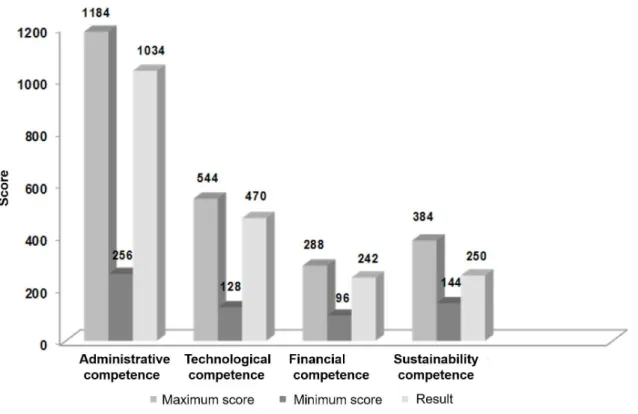
From the interpretation of the data achieved through the questionnaires directed to the professors in charge of projects, followed by the interpretation of the scores for each speciied competence, it was found that the administrative competence showed a greater usefulness and assertiveness degree, as compared to the other pillars analyzed, with a maximum score of 1.034 points (87.33%).
The questions inserted in this variable showed
that the projects have a high degree of administrative managing, seeking the goals set when elaborating the guidelines that guided the research. On the other hand, sustainability was the competence that showed the lowest degree of productivity, with 250 points (65.10%). The remaining competences showed the following results: technological competence with 470 points (86.39%) and inancial competence with 242 points (84.00%), as shown in Figure 3.
Figure 3. Minimum and maximum score achieved in the competences considered in assessing productivity
This graph was built, taking into account the maximum and minimum limits corresponding to the sum of the scores related to the different issues assigned to each of the competences analyzed, by comparing them with the results.
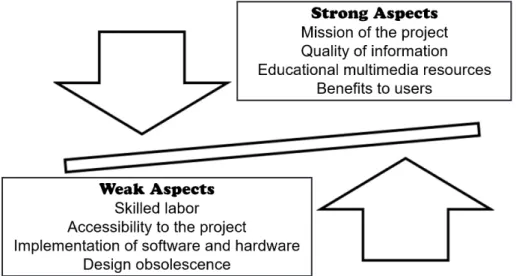
The application of SWOT analysis allowed visual-izing the factors which contributed, positively and negatively, to the performance of the projects, from the planning to moment of making them available to users, as shown in Figure 4.
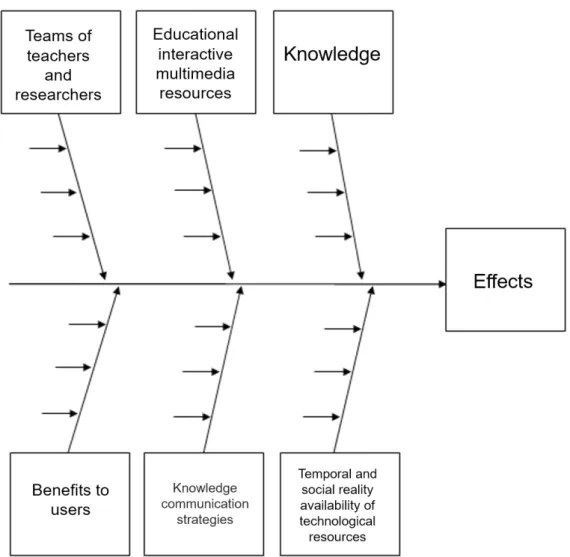
Figure 5. Strengths in relation to administrative competence, through the Ishikawa Diagram
The information obtained through the questionnaire showed that the structural eficiency is concentrated in the categories: temporal and social reality, teams of teachers and researchers, knowledge, educational interactive multimedia resources and beneits to users. These aspects allowed reaching a positive result in relation to this variable. It should be emphasized that the constant specialization of human capital, the availability of technological resources, supported by dynamic and lexible strategies, contribute for results of this nature to be repeated.
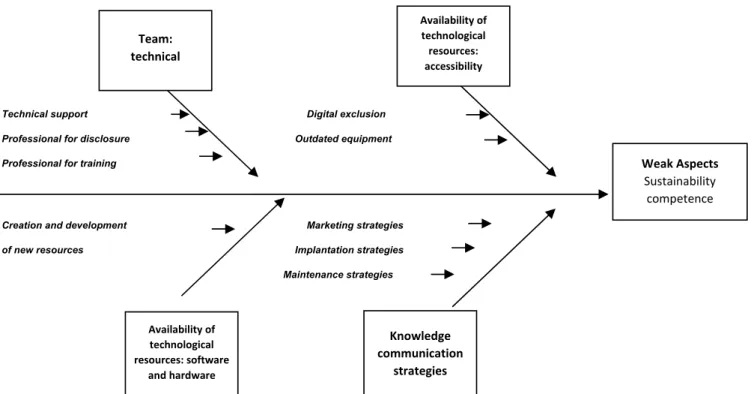
The weaknesses pointed out in the research are directed to the competence of sustainability, using the
same devices that were applied on the strengths, seen before. After surveying and identifying the area which negatively contributes to the project, it is time to seek the root causes that led to this result (Figure 6).
The survey showed a structural deiciency in relation to the technical staff, availability of technology and accessibility, technology availability in software and hardware and knowledge communication strategies. The delay in approving such resources, as well as the choice of partners for process development, hinders the productivity of this variable.
The same unsatisfactory impact is seen with the downgrade of software and hardware. Obsolescence is
Figure 4. Summary of the results obtained from the application of SWOT analysis
Efficient solution to problem Multidisciplinary project
Maximizing resources Auto didactic content Education continued to distance Support of multidisciplinary areas
Using CD-ROM Service agility
Creation of specific multimedia Amount of information Education continued to distance Optimization time
Positive cost-benefit relation
Benefits to users
Strong Aspects
Administrative Competence
Educational interactive multimedia resources Temporal/social
reality
Teams of teachers /
implicit from the moment new technologies are imple-mented and the instrument does not have access to them. Another factor worth mentioning is the obsoles-cence of hardware equipment located in the areas of community outreach, hindering the implementation of the projects.
DISCUSSION
The application of Business Administration Area instruments together with telehealth in speech and language pathology and audiology had as the main challenge the interaction and synergy between these areas, apparently distinct regarding deinition and implementation, but similar when it comes to their goals. This concept becomes more evident when general aspects are compared between these areas, such as the management of the administration, inancial management, technology and sustainability. It repre-sents the alignment and development of the team’s ability to create the results its members truly desire14.
Through this survey, it was possible to identify the projects developed by each professor, in the ield of telehealth, with more than a third of professors linked to the aforementioned Department, showing that produc-tivity in the development of this type of project has increasingly grown. Among the professors surveyed, one has developed twelve projects in telehealth in
Figure 6. Weaknesses in relation to administrative competence, through the Ishikawa Diagram
speech and language pathology and audiology, so far, and the others have coordinated the execution of one or more projects in this segment, corroborating literature indings 12.
The creation of the questionnaire and the appli-cation of the so-called SWOT matrix instrument allowed the identiication of the strengths and weaknesses of the projects studied. It should be noted that these methods provide within the corporate setting, the analysis of practicality, as well as propitiate visibility of the external and internal environment of the company, the research of opportunities and threats, the planning of new scenarios, through the analysis of strengths and weaknesses 15.
In this sense, the administrative competence showed a higher degree of productivity in relation to the others, demonstrating that the projects have a high degree of productivity in terms of administrative management, achieving the proposed objectives from its elaboration to its conclusion.
Technological and inancial competences demon-strated performances similar to that of the administrative competence. Conversely, the competence sustain-ability corresponded to weakness, demonstrating the need to develop speciic strategies to enhance the productivity and eficiency of projects during their use.
No research was found in this area, however, it should be emphasized that the sustainability Technical support Digital exclusion
Professional for disclosure Outdated equipment
Professional for training
Creation and development Marketing strategies
of new resources Implantation strategies
Maintenance strategies
Availability of technological resources: accessibility
Availability of technological resources: software
and hardware
Knowledge communication
strategies
Weak Aspects Sustainability
competence Team:
competence analysis can be operated by institutions which have interdisciplinary areas, focusing on the basic principles of sustainability: social, economic and environmental ones 13. The analysis of administrative competence through the SWOT matrix, allowed identi-fying, in the telehealth projects, that the strengths are comprised by the mission of the project, the quality of information, ease of access to information and the beneits they provide to their users. Regarding the sustainability competence, the SWOT analysis helped to conirm that the weaknesses are expressed by the dificulty of skilled labor, accessibility to the project, implementation of software and hardware and design obsolescence.
The analysis of strengths and weaknesses is paramount in all areas, as in the analysis of the health systems of different countries, showing integration and increase in the number of professionals trained in palliative care, but also noting the lack of programs on palliative care and limited connection between politicians and health professionals 3. The application of the Ishikawa diagram in telehealth projects allowed assessing the main causes that contributed for the administrative competence to be regarded as strength and the sustainability one, as weakness.
Accordingly, the Ishikawa diagram was used to help memory and recovery of important cases from the medical literature in a university, resulting in more eficient studies to improve clinical reasoning skills, thus, expanding professional knowledge 5.
Thus, it was veriied that the project’s strengths had as main causes the use of speciic multimedia, continuing education, the amount of information provided and the commitment of human capital. The weaknesses are pointed out, as well, and the main causes were centered in the dificulties of technical support, professionals for divulging and training, digital exclusion, lack of marketing strategies and the dificulty to maintain the projects studied. Regarding the weaknesses, speciically, the need to deine and validate a stable model in telehealth with organizational change, providing care in the implementation and assessment of such projects16, is noted.
The development and application of the question-naire follow a strategic line for the standardization of a procedure aimed at guiding telehealth in speech and language pathology and audiology projects, enhancing the quality of responses and interpreting them in a rational and contextualized way, from the view of business administration, with positive results
in an organization. Thus, the importance of evalu-ating projects inserted into a Department of Research Institutions, as well as their assessment by the subjects directly involved in the initiative, is emphasized 17-20.
The constant analysis of the strengths and weaknesses of projects in telehealth, provide perfect functioning and the required quality at the time of making them available to users. Non-observance of this strategy can cause the project to have a life cycle shorter than the one expected, making it obsolete. Thus, given the technological and market develop-ments, institutions are required to keep a positioning and differentiation strategy, so as to ensure their success through the management of the volume of investment in new technologies, specialization of human capital, innovation and renewal in each stage of the project.
The assessment of telehealth use is still observed in a non-systematic way, without the establishment of standard questionnaires, in other researches 17,19,21.
Finally, the limitations of the study, which considered just one center of research on telehealth in speech and language pathology and audiology in its sample, should be taken into account, as well as the need to validate the proposal developed in the current research, allowing the analysis of productivity, by accurately determining the strengths and weaknesses of each project, in the ield of telehealth.
CONCLUSION
This research resulted in the development of an administrative instrument to guide research on telehealth in speech and language pathology and audiology, allowing identifying the strengths concen-trated in the administrative competence and the weaknesses in the sustainability competence.
REFERENCES
1. Martins PG, Laugeni FP. Administração da produção. 2. ed. São Paulo: Saraiva, 2005.
2. Tarapanoff, K. Inteligência organizacional e competitiva. Brasília: UnB, 2001.
3. Pastrana T, Centeno C, De Lima L. Palliative care in latin america from the professional perspective: a SWOT analysis. J Palliat Med. 2015;18(5):429-37. 4. Davis MM, Aquilano NJ, Chase R. Fundamentos da
levels of proof, implementation rules. Therapie. 2014;69(4):339-54.
17. Conceição HV, Barreira-Nielsen C. Health hearing training: assessment tool in the Brazilian National Telemedicine Program. Rev CEFAC. 2014;16(5):1426-33.
18. Blasca WQ, Correa CC, Picolini MM, Campos K, Silva ASC, Berretin-Felix G et al. Una estrategia de teleducación sobre la salud auditivay vocal en Brasil. Rev Logop Foniatr Audiol. 2015;35(1):2-7. 19. Corrêa CC, Freire T, Zabeu JS, Martins A, Ferreira
R, Francisconi PAS et al. Teleducation about Cleft Lip and Palate: an interdisciplinary approach in the promotion of health. Int Arch Otorhinolaryngol. 2015;19(2):106-11.
20. Maximino LP, Picolini-Pereira MM, Carvalho JLB. Telegenetics: application of a tele-education program in genetic syndromes for Brazilian students. J Appl Oral Sci. 2014;22(6):477-83.
21. Penna GC, Mendes HG, Dias MAS, Melo MCB, Santos AF, Resende MC et al. Evaluation of the use of videoconferencing for distance training of doctors in the family health teams within the national telehealth project. Rev Med Minas Gerais. 2015;25(1):108-14.
5. Wong KC. Using an Ishikawa diagram as a tool to assist memory and retrieval of relevant medical cases from the medical literature. J Med Case Rep. 2011;29(5):120.
6. Grifin RW, Moorhead G. Fundamentos do comportamento organizacional. Tradução Fernando Moreira Leal e André Siqueira Ferreira. São Paulo: Ática, 2006.
7. Silva AS, Rizzante FA, Picolini MM, Campos KD, Corrêa CC, Franco EC et al. Bauru School of Dentistry Tele-Health League: an educational strategy applied to research, teaching and extension among applications in tele-health. J Appl Oral Sci. 2011;19(6):599-603.
8. Bastos BG, Ferrari, DV. Internet and education for the patient. Arq Int Otorrinolaringol. 2011;15(4):515-22.
9. Ferrari DV. Therapeutic patient education via tele-audiology brazilian experiences. The hearting review. 2012;19(11):40-3.
10. Haney ML, Silvestri S, Van Dillen C, Ralls G, Cohen E, Papa L. A comparison of tele-education versus conventional lectures in wound care knowledge and skill acquisition.J Telemed Telecare. 2012;18(2):79-81.
11. Costa CA, Petrucio WS, Rodrigues PMA, Lages RO, Wen CL. Effectiveness of practices for Web Conferencing Teleducation to combat dengue in the State of Amazonas, Brazil. J health inform. 2014;6(1):15-8.
12. Regina Molini-Avejonas D, Rondon-Melo S, de La Higuera Amato CA, Samelli AG. A systematic review of the use of telehealth in speech, language and hearing sciences. J Telemed Telecare. 2015;21(7):367-76.
13. Gudim RS. Gestão dos fatores determinantes para sustentabilidade de centros de Telemedicina [tese]. São Paulo (SP): Faculdade de Medicina. Universidade de São Paulo; 2009.
14. Senge PM. A quinta disciplina: arte, teoria e prática da organização de aprendizagem. São Paulo: Best Seller, 1990.
15. Brasil - Tribunal de Contas da União. Análise SWOT e Diagrama de Veriicação de Risco aplicados em Auditoria. Tribunal de Contas da União. Brasília: TCU, Secretaria de Fiscalização e Avaliação de Programas de Governo (Seprog), 2010.