Note
INDUCTION OF SYMMETRICAL NUCLEUS
DIVISION AND MULTI-NUCLEATE STRUCTURES IN
MICROSPORES OF EGGPLANT (
Solanum melongena
L.)
CULTURED
IN VITRO
Ugur Bal1*; Sebnem Ellialtioglu2; Kazim Abak3
1Namik Kemal University, Faculty of Agriculture, Department of Horticulture - 59 030 - Tekirdag - Turkey. 2Ankara University, Faculty of Agriculture, Department of Horticulture - 06 110 - Diskapi - Ankara - Turkey. 3Cukurova University, Faculty of Agriculture, Department of Horticulture - 01 330 - Balcali - Adana - Turkey. *Corresponding author <[email protected]>
ABSTRACT: A modification of a protocol used to induce tobacco microspore embryogenesis was tested in
eggplant (Solanum melongena L.). In tobacco, uninucleate microspores are subjected to stress treatment by
culturing in mannitol containing “B” medium at 33°C for six days. The microspores are then transferred to maltose containing AT3 medium for further development. In the experiment presented here late uninucleate and bi-nucleate microspores of the eggplant cultivar Bambino were pre-cultured in B medium and then incubated at +4°C, 25°C and 33°C, respectively, for two days. After the pre-treatments, microspore cultures were transferred to AT3 medium containing 0.25 M maltose and maintained at 25°C in the dark. Presence of symmetrical division and multinucleate structures was checked with DAPI staining of the nucleus after one and two weeks. Symmetrical division of the nucleus and multinucleate structures were observed only in uni-nucleate microspores pre-treated at 33°C for two days. The frequency of multinucleate structures was 19.4% under these conditions. We demonstrated that eggplant is responsive to the modified tobacco protocol in the production of symmetrically division and multinucleate structures. These results may be used as a basis for adaptation fully of the tobacco system in eggplant.
Key words: haploid, microspore culture, symmetrical division, mannitol starvation
INDUÇÃO DE DIVISÃO NUCLEAR SIMÉTRICA E ESTRUTURAS
MULTINUCLEADAS EM MICRÓSPOROS DE BERINJELA
(
Solanum melongena
L.) CULTIVADOS
IN VITRO
RESUMO: Uma modificação de um protocolo utilizado para induzir embriogênese a partir de micrósporos
de tabaco foi testada em berinjela (Solanum melongena L.). Em tabaco, micrósporos uninucleados são
submetidos a um tratamento de estresse em meio “B” contendo manitol a 33°C por seis dias. Os micrósporos são então transferidos para um meio AT3 contendo maltose para as fases posteriores de desenvolvimento. Neste estudo, micrósporos uninucleados e binucleados tardios do cultivar de berinjela Bambino foram cultivados em meio “B” e, posteriormente, incubados a 4°C, 25°C e 33°C por dois dias. Após os pré-tratamentos, as culturas de micrósporos foram transferidas para o meio AT3 contendo maltose 0,25 M e mantidas a 25°C no escuro. A presença de divisão simétrica e estruturas multinucleadas foram verificadas com coloração DAPI do núcleo após uma e duas semanas. Foram observadas divisões simétricas dos núcleos e estruturas multinucleadas somente em micrósporos uninucleados, pré-tratados a 33ºC por dois dias. A frequência de estruturas multinucleadas foi de 19,4% sob essas condições. Nós demonstramos que a berinjela responde ao protocolo modificado de tabaco para produção de divisões simétricas e estruturas multinucleadas. Esses resultados podem ser utilizados como base para uma completa adaptação do sistema
de tabaco em berinjela.
Palavras chave: haplóide, cultura de micrósporos, divisão simétrica, estresse com manitol
INTRODUCTION
Improvement of eggplant (Solanum melongena L.)
is carried out via hybridization and biotechnological approaches (Kalloo, 1993; Kashyap et al., 2003; Ma
-gioli & Mansur, 2005). Haploidy achieved through mi
in vitro and after a stress pretreatment microspores
de-velop sporophytically (Shariatpanahi et al., 2006). Anther culture (AC) is the mainstream approach in ME in eggplants (Raina & Iyer, 1973; Chinese Research Group of Haploid Breeding, 1978; Chambonnet & Du
-mas De Vaulx, 1983; Rotino et al., 1987; Tuberosa et al., 1987; Karakullukcu & Abak, 1992, 1993a, 1993b). Isolated microspore culture (IMC) in eggplants was first reported by Gu (1979), and later, Miyoshi (1996)
induced callus and plantlets from isolated microspores.
Since then, to the best of our knowledge, no other report appeared on IMC in eggplant. Although the technique is more complicated than AC, IMC offers various advan
-tages (Kasha et al., 2001). Most importantly, IMC guar -antees gametic origin of regenerants, because somatic
anther tissues are discarded before culture.
Despite the above advantages the technique has not been fully explored in eggplant. Gu (1979) and Mi
-yoshi (1996) utilized growth regulators, and a callus interphase was observed before regeneration. However, microspore callus induced by culture factors, especially by the use of growth regulators, may result in variations and therefore should be avoided if possible. As in the case of tobacco, microspores can regenerate directly into embryos and plants. A direct regeneration protocol for microspore embryogenesis in eggplant would be de
-sirable for both molecular manipulations and haploidy supported breeding of the crop. As part of our efforts to establish a reliable and efficient direct regeneration protocol in eggplant we tested a modified version of the tobacco protocol and present the results in this report.
MATERIAL AND METHODS
A basic experimental setup was adapted from the microspore culture protocol of tobacco to determine the effects of cold and heat shocks in combination with the starvation treatment in eggplant. The so-called starva -tion treatment consists of exposing microspores to a
culture medium without metabolizable sugars. Mannitol is the main compound with non-metabolizable proper
-ties in such a medium, and the microspores, lacking external sources, turn to internal reserves for energy subsequently becoming embryogenic. This phenomenon is routinely exploited in tobacco and barley (Shariatpa
-nahi et al., 2006). To check if the above phenomenon is applicable in the eggplant a modified version of the tobacco protocol was tested by changing the duration of the incubation time of microspores in the mannitol-starvation medium. In addition, cold shock in combina
-tion with starva-tion treatment was tested.
Cultures in the B-starvation medium were incubated at 4°C, 33°C and 25°C, respectively, for two days, in place of six days in the tobacco protocol. Flower buds
containing uni-nucleate and bi-nucleate microspores
were collected from the eggplant cultivar Bambino grown in a greenhouse. Previous examination of the microspores using DAPI stain under UV light showed that buds of 3-4 mm and 4-5 mm diameter represented uni-nucleate and bi-nucleate microspores, respectively. The buds that contained uni-nucleate microspores were green at the bottom and dark brown to black at the tip with light green anthers. The buds with bi-nucleate mi
-crospores were slightly larger with the same coloring on the buds whereas the anther color was green to light cream (Figure 1). Following sterilization using 15% H2O2 (with 2-3 drops of Tween 20) for 15 minutes, buds
were washed with sterile distilled water for four times. Anthers were gently dissected from the buds and
released into 17 mL glass vials containing B medium
(Touraev et al., 1996). The anthers were stirred with a magnetic bar for 2-3 min at 600-800 rpm (Heidolph, MR3001, Germany) until microspores were visible in the medium. This resulting suspension was filtered through a 40 µm nylon mesh in order to remove anther wall debris. Following washing in the same isolation medium twice, microspores were cultured in 2.5 mL B-medium in petri dishes of 3 cm diameter (Nunc, Den
-mark) at a density of 2 105 grains mL–1 (Benito Moreno
et al., 1988; Touraev et al., 1995).
The media employed here were those used in the to
-bacco protocol where the B medium consisted of KCl,
1.49 g L–1; MgSO
4.7H2O, 0.25 g L –1; CaCl
2, 0.11 g L –1
and Mannitol (0.3 M) 54.63 g L–1 and 1 mM phosphate
buffer of pH 7 (Kyo & Harada, 1986). The AT3 me -dium consisted of 13 mM KNO3,, 8.6 mM (NH4)2SO4,
2.9 mM KH2PO4, 1.1 mM CaCl2.2H2O, 0.7 mM
MgSO4.7H2O, 10 mM MES Buffer, 8.6 mM glutamine,
0.25 M maltose and Fe-EDTA, vitamins and microele
-ments according to Murashige & Skoog (1962). The pH of the medium was adjusted to 6.5. All media were filter sterilized before use. In order to determine the ef -fect of temperature during the starvation pretreatment
the cultures were incubated separately at 4°C and 33°C for two days, respectively. Also a control culture was maintained at 25°C. After the combined treatments of starvation and cold, starvation and heat, and starvation
and control-temperature microspores from all cultures
were transferred separately to the AT3 medium contain
-ing 0.25 M maltose (Touraev & Heberle-Bors, 1999). Following the transfer the cultures were maintained at
25°C.
The stage of microspore development in relation to morphological characteristics of buds and anthers, sym
at 150 g for two min, stained in DAPI (4’, 6-diamidino-2-phenylindole, Partec, Germany) and observed under the fluorescent microscope. The percentage of multi
-nucleate structures was determined by counting at least 300 microspores for each treatment.
RESULTS AND DISCUSSION
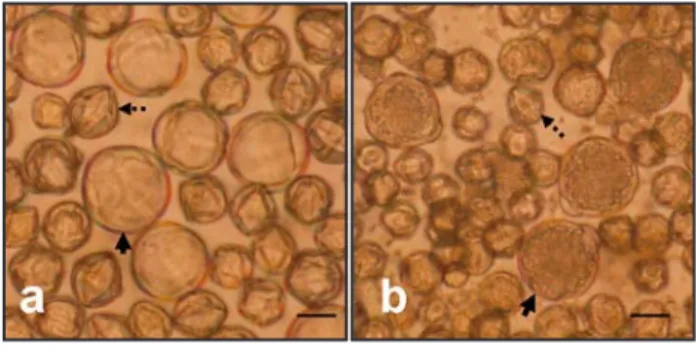
The microspores exposed to 33°C heat shock swelled, a possible sign of the presence of symmetrically divided nuclei or multinucleate structures. The state of swelling was maintained throughout the culture period (Figure 2a; arrow). The rest of the microspores lost viability, appearing shrunken and small (Figure 2a, dotted arrow). Although at a low frequency, the microspores swelled in the control culture at 25°C during the pretreatment in B medium (data not given). In the initial cold shock at 4°C, although size increased in few of the microspores, the appearance was not similar to those swelled after the heat shock (Figure 2b, arrow). The swelled microspores appeared to have a fine and thin surface (Figure 2a, ar
-row) whereas others, although large in size, appeared to have lost surface integrity and seemingly contained starch grains, a sign of non-sporophytic development (Figure 2b, arrow) (Rihova & Tupy, 1999).
Generally, the cold treated microspores lost viability soon after transfer to AT3 medium (Figure 2b; dotted ar
-row; data not shown). Symmetrical nucleus divisions and multinucleate structures were obtained at a low frequency following transfer of the microspores from the heat shock and starvation pre-treatment to AT3 medium containing 0.25 M maltose. The frequency of multinucleate struc
-tures was 17.3% and 19.4% after one and two weeks in AT3 medium, respectively (Figure 3).
We determined that the combined effect of heat and starvation is in agreement with the results of Miyoshi
(1996) who cultured microspores in a mannitol starva
-tion medium exposing the cultures to 35°C for 3 days during the pre-treatment. However, Miyoshi (1996) transferred the microspores to NLN medium (Lichter, 1982) containing 2% sucrose. A concentration of 2% sucrose corresponds to ca. 0.6 M in contrast to 0.25 M (i.e., 90 g L–1 and 9%) maltose, we tested. Miyoshi
(1996) did not test the effect of maltose which suc
-cessfully induced the development of multinucleate
structures in our experiment. In fact, no androgenesis
protocol using maltose as the sole carbon source is available in eggplant.
From the earlier reports both on anther and mi
-Figure 3 - Stages and development of microspores in cultures of
eggplant. Late uninucleate (a) and binucleate, i.e.,
asymmetrically divided (b; v: vegetative nucleus, g: generative nucleus) microspores were cultured separately. Symmetrical nucleus division (c) and multinucleate structures (d-f) were obtained in AT3 medium containing 0.25 M maltose following
pretreatment of uninucleate microspores in mannitol
starvation medium at 33oC for two days. Binucleate pollen was not responsive under the same conditions (Bar = 10 µm)
Figure 2 - Microspores in culture during and after the pre-treatment. Microspores in B medium at 33°C swelled and a similar appearance was maintained after transfer to the maltose-containing AT3 medium (a, arrow). Microspores transferred from the cold pretreatment also swelled but degenerated rapidly (b, arrow); In both cultures inviable microspores appeared shrunken (dotted arrows; Bar = 10 µm).
Figure 1 - Sizing of eggplant buds, cv. Bambino, for microspore developmental stages. Green anthers containing meiotic (1), light-green anthers containing uninucleate (2; diameter = 3-4mm) and green light-cream anthers
containing binucleate stages (3; diameter = 4-5mm,
crospore cultures of eggplant (Chambonnet & Dumas De Vaulx, 1983; Rotino et al., 1987; Tuberosa et al., 1987; Karakullukcu & Abak, 1992; Karakullukcu & Abak 1993a, 1993b; Gu, 1979; Miyoshi, 1996) and our results presented here, it can be concluded that heat shock can be used successfully as the stress factor for microspore embryogenesis in eggplant. However, star
-vation pre-treatment in combination with heat shock, i.e. the tobacco microspore embryogenesis protocol, may be even more effective.
In the presence of low sucrose levels, heat treatment during starvation triggers callus development from microspores (Miyoshi, 1996). However, the effect of the tobacco protocol on further development of multi
-nucleate structures into doubled haploids remains to be seen. Goralski et al. (2002) demonstrated that while osmotic pressure increased dramatically in sucrose me
-dia, changes in the osmotic pressure in maltose media were insignificant, and maltose is metabolized relatively slowly. It can be speculated that maltose, by providing a more stable culture medium, may be more conducive to direct embryogenesis. Hence it may be suggested that previously published tobacco protocols can be effective in microspore embryogenesis in eggplant and sucrose may be replaced successfully with maltose. The phe
-nomenon of induction of microspore embryogenesis via carbon starvation with or without heat treatment works well in tobacco and barley (Touraev & Heberle-Bors,
1999; Wei et al., 1986; Cistué et al., 1994), and a de
-tailed study on the effects of starvation on eggplant may prove useful. With regards to genetic manipulations, availability of a direct regeneration protocol in eggplant might bring the crop up to the level of tobacco, one of the most studied model plants (Hosp et al., 2007).
In conclusion, we confirmed that the heat shock and mannitol starvation pre-treatment triggers the develop -ment of multinucleate structures in eggplant. In addition
to sucrose (Miyoshi, 1996), here we demonstrated that maltose allows development of multinucleate structures in eggplant. AT3 medium containing 0.25 M maltose is conducive to the formation of symmetrical divisions
and multinucleate structures from eggplant microspores
via a modified tobacco protocol. Refinement of the ap
-proach we tested may lead to production of haploid/ doubled haploid plants via direct embryogenesis in
eggplant.
REFERENCES
BENITO MORENO, R.M.; MACKE, F.; ALWEN, A.; HEBERLE-BORS, E. In situ seed production after pollination with in vitro matured, isolated pollen. Planta, v.176, p.145-148, 1988.
CHAMBONNET, D.; DUMAS DE VAULX, R. A new anther culture medium performant on various eggplant (Solanum melongena L.)
genotypes. In: MEETING OF THE CAPSICUM AND EGGPLANT WORKING GROUP, 5., Plovdiv, 1983. Proceedings. Plovdiv: S.
Daskalov, 1983. p.38-41.
CHINESE RESEARCH GROUP OF HAPLOID BREEDING. Induction of haploid plants of Solanum melongena L. In: SYMPOSIUM ON
PLANT TISSUE CULTURE, Peking, 1978. Proceedings. Peking: Science Press, 1978. p.227–232.
CISTUÉ, L.; RAMOS, A.; CASTILLO, A.M.; ROMAGOSA I. Production of large number of doubled haploid plants from barley anthers pretreated with high concentrations of mannitol. Plant Cell Reports,
v.13, p.709–712, 1994.
COLLONNIER, C.; FOCK, I.; KASHYAP, V.; ROTINO, G.L.; DAUNAY, M.C.; LIAN, Y.; MARISKA, I.K.; RAJAM, M.V.; SERVAES, A.; DUCREUX, G.; SIHACHAKR, D. Applications of Biotechnology
in eggplant. Plant Cell, Tissue and Organ Culture, v.65, p.91–107,
2001.
GORALSKI, G.; LAFITTE, C. BOUAZZA, L.; MATTHYS-ROCHON, E.; PRZYWARA, L. Influence of sugars on isolated microspore development in maize (Zea mays L.). Acta Biologica Cracoviensia Series Botanica, v.44, p.203-212, 2002.
GU, S.R. Plantlets from isolated pollen culture of eggplant (Solanum melongena L.). Acta Botanica Sinica,v.21, p.30–368, 1979.
HOSP, J.; MARASCHIN, S.F.; TOURAEV, A.; BOUTILIER K. Functional genomics of microspore embryogenesis. Euphytica, v.158, p.275-285, 2007.
KALLOO, G. Eggplant. In: KALLOO, G.; BERGH, B.O. (Ed.) Genetic improvement of vegetable crops. Oxford: Pergamon Press, 1993. p.587-604.
KARAKULLUKCU, S.; ABAK, K. Reactions of some eggplant cultivars to anther culture. Ziraat Fakültesi Yilligi, v.42, p.7-12, 1992.
KARAKULLUKCU, S.; ABAK, K. Studies on anther culture of eggplant.
I.. Determination of the suitable bud stage. Turkish Journal of Agriculture and Forestry, v.17, p.801-810, 1993a.
KARAKULLUKCU, S.; ABAK, K. Studies on anther culture of eggplant. II.. Effects of sugars and growth regulators. Turkish Journal of Agriculture and Forestry, v.17, p.811-820, 1993b.
KASHA, K.J.; SIMION, E.; ORO, R.; YAO, Q.A.; HU, T.C.; CARLSON, A.R. An improved in vitro technique for isolated microspore culture of barley. Euphytica, 120, p.379-385, 2001.
KASHYAP, V.; KUMAR, S.V.; COLLONNIER, C.; FUSARI, F.; HAICOUR, R.; ROTINO, G.L.; SIHACHAKR, D.; RAJAM, M. Biotechnologyofeggplant, Scientia Horticulturae, v.97, p.1-25,
2003.
KYO, M., HARADA, H. Control of the developmental pathway of tobacco pollen in vitro. Planta, v.168, 427–432, 1986.
LICHTER, B. Induction of haploid plants from isolated pollen of Brassica napus. Zeitschrift Fur Pflanzenzuchtung, v.105, p.427-434, 1982. MAGIOLI, C.; MANSUR, E. Eggplant (Solanum melongena L.): tissue
culture, genetic transformation and use as an alternative model plant.
Acta Botanica Brasilica, v.19, p.139-148, 2005.
MASAHISA, O.; TATEMI, Y.; MASUO, N.; MITSUO, M. A new rootstock variety for eggplant, ‘Daijirou’. Bulletin of the Kochi Agricultural Research Center, v.11, p.53-61, 2002.
MIYOSHI, K. Callus induction and plantlet formation through culture of
isolated microspores of eggplant (Solanum melongena L.). Plant Cell Reports, v.15, p.391-395, 1996.
MURASHIGE, T., SKOOG, F. A revised medium for rapid growth and bioassays with tobacco tissue cultures. Physiologia Plantarum, v.15, 473-497, 1962.
RAINA, S.K.; IYER, R.D. Differentiation of diploid plants from pollen callus in anther cultures of Solanum melongena L. Zeitschrift Fur
Pflanzenzuchtung, v.70, p.275-280, 1973.
RIHOVA, L.; TUPY, J. Manipulation of division symmetry and developmental fate in cultures of potato microspores. Plant Cell, Tissue and Organ Culture, v.59, p.135-145, 1999.
ROTINO, G.L.; FALAVIGNA, A.; RESTAINO, F. Production of anther-derived plantlets of eggplant. Capsicum Newsletter, v.6, p.89-90, 1987.
SHARIATPANAHI, M.E.; BAL, U.; HEBERLE-BORS, E.; TOURAEV, A. Stresses applied for the re-programming of plant microspores towards in vitro embryogenesis. Physiologia Plantarum, v.127,
TOURAEV, A.; ILHAM, A.; VICENTE, O.; HEBERLE-BORS, E. Stress induced microspore embryogenesis from tobacco microspores: an optimized system for molecular studies. Plant Cell Reports, v.15, p.561-565, 1996.
TOURAEV, A.; HEBERLE-BORS, E. Microspore embryogenesis and in vitro pollen maturation in tobacco. In: HALL, R.D. (Ed.) Methods in molecular biology, Totowa: Humana Press, 1999, p.281-291. TOURAEV, A.; LEZIN, F.; HEBERLE-BORS, E.; VICENTE, O.
Maintenance of gametophytic development after symmetrical division
in tobacco microspore culture. Sexual Plant Reproduction, v.8,
p.70-76, 1995.
TUBEROSA, R.; SANGUINETI, M.C.; CONTI, S. Anther culture
of eggplant (Solanum melongena L.) lines and hybrids. Genetica Agraria, v.41, p.267-274, 1987.
WEI, Z.M.; KYO, M.; HARADA, H. Callus formation and plant regeneration through direct culture of isolated pollen of Hordeum vulgare cv. ‘Sabarlis’. Theoretical and Applied Genetics, v.72,
p.252-255, 1986.