The terrestrial Gastropoda
Megalobulimus
abbreviatus
as a useful
model for nociceptive experiments.
Effects of morphine and naloxone on
thermal avoidance behavior
1Laboratório de Histofisiologia Comparada, Departamento de Ciências Morfológicas,
and 2Laboratório de Neurobiologia, Departamento de Fisiologia,
Instituto de Ciências Básicas da Saúde, Universidade Federal do Rio Grande do Sul, Porto Alegre, RS, Brasil
M. Achaval1, M.A.P. Penha1,
A. Swarowsky1, P. Rigon1,
L.L. Xavier1, G.G. Viola1 and
D.M. Zancan2
Abstract
We describe the behavior of the snail Megalobulimus abbreviatus
upon receiving thermal stimuli and the effects of pretreatment with morphine and naloxone on behavior after a thermal stimulus, in order to establish a useful model for nociceptive experiments. Snails sub-mitted to non-functional (22ºC) and non-thermal hot-plate stress (30ºC) only displayed exploratory behavior. However, the animals submitted to a thermal stimulus (50ºC) displayed biphasic avoidance behavior. Latency was measured from the time the animal was placed on the hot plate to the time when the animal lifted the head-foot complex 1 cm from the substrate, indicating aversive thermal behav-ior. Other animals were pretreated with morphine (5, 10, 20 mg/kg) or naloxone (2.5, 5.0, 7.5 mg/kg) 15 min prior to receiving a thermal stimulus (50ºC; N = 9 in each group). The results (means ± SD) showed an extremely significant difference in response latency be-tween the group treated with 20 mg/kg morphine (63.18 ± 14.47 s) and the other experimental groups (P < 0.001). With 2.5 mg/kg (16.26 ± 3.19 s), 5.0 mg/kg (11.53 ± 1.64 s) and 7.5 mg/kg naloxone (7.38 ± 1.6 s), there was a significant, not dose-dependent decrease in latency compared to the control (33.44 ± 8.53 s) and saline groups (29.1 ± 9.91 s). No statistically significant difference was found between the naloxone-treated groups. With naloxone plus morphine, there was a significant decrease in latency when compared to all other groups (minimum 64% in the saline group and maximum 83.2% decrease in the morphine group). These results provide evidence of the involve-ment of endogenous opioid peptides in the control of thermal with-drawal behavior in this snail, and reveal a stereotyped and reproduc-ible avoidance behavior for this snail species, which could be studied in other pharmacological and neurophysiological studies.
Correspondence
M. Achaval
Laboratório de Histofisiologia Comparada
Departamento de Ciências Morfológicas, ICBS, UFRGS R. Sarmento Leite, 500 90050-070 Porto Alegre, RS Brasil
Fax: +55-51-3316-3092 E-mail: [email protected]
Research supported by
UFRGS/FINEP (No. 66.91.0509.00) and CNPq.
Received January 30, 2004 Accepted October 13, 2004
Key words
•Snail
Introduction
According to Sherrington, the capacity of animals to detect and react to stimuli that may compromise their integrity is embodied in the term “nociception” cited in Ref. 1. The ability to respond to aversive environmental stimuli is a basic characteristic of animals and this adaptive animal behavior implies the presence of nociceptors to detect the aversive nature of the stimuli and effectors which respond to the sensory input with reflex and/or non-reflex behavior. Descrip-tions of postures and movements associated with nociception and avoidance behavior can be quantitative and objective if we re-frain from interpreting them with connota-tions of human experience. The avoidance
behavior of snails, such as Cepaea nemoralis,
Megalobulimus sanctipauli and Aplysia californica has been described (1-4). In avoid-ance behavior, the snails presented a with-drawal reaction accompanied by mucus se-cretion to all kinds of noxious stimuli. In response to moderately intense tactile
stimu-lation (15-40 g/mm2) the snail remained
out-side the shell, locomotion ceased, and the animal showed pneumostome closure, ten-tacle contraction, head withdrawal, and a latency of about 0.2 s. In response to a strong noxious stimulus, the snails showed all the aforementioned reactions and retraction of the whole body into the shell (5). In response
to thermal stimuli, within a few seconds C.
nemoralis (40ºC) and M. sanctipauli (52ºC) showed aversive behavior characterized by lifting the anterior regions of the head-foot (H-F) complex. This behavior is not detected in snails at room temperature or at lower temperatures such as 30-33ºC (4,6).
Moreover, the administration of morphine sulfate, methionine-enkephalin or ß-endor-phin resulted in a significant increase in the latency of thermal avoidance behavior (4,6). Also, the increased latency resulting from
morphine administration to C. nemoralis,
Limax maximus and M. sanctipauli after a
thermal stimulus can be suppressed by the opiate antagonist, naloxone (3,4,7). Thus, in these gastropods the ability of the nonselec-tive opiate antagonist naloxone to produce a complete blockade of morphine analgesia indicates that a µ receptor is related to this behavior (4,8). Naloxone alone decreases the latency of the thermal stress (2). It was also demonstrated that thermal
stimulus-in-duced analgesia was blocked by a δ
antago-nist (9). In addition, enkephalin immunore-activity was identified in the central nervous
system of different snails such as A.
califor-nica, Lymnaea stagnalis, Helix pomatia,and
M. abbreviatus (10,11).
The present study reports the avoidance
behavior of M. abbreviatus, as well as the
effects of morphine and its antagonist nalox-one on this snail after a thermal stimulus. This study represents a contribution as a starting point for the functional detection of the nociceptive circuit (12,13) present in this snail.
Material and Methods
Animals
Adult land snails, Megalobulimus
abbre-viatus (Becquaert, 1948), previously called
M. oblongus (Müller, 1774), with shell lengths of 65-80 mm and weighing 50-79 g were collected in Charqueadas county, State of Rio Grande do Sul, Brazil. The animals were kept in a screened terrarium, subjected to normal annual light and temperature
var-iations, and fed lettuce and water ad libitum.
once. Additionally, to avoid the probable effect of the lack of humidity on the sub-strate during exposure of the snails to the hot plate, a plastic film covered with 10 ml of distilled water was placed over the plate. It was then necessary to wait for the plate to reacquire the predetermined temperature. All the experimental procedures were carried out during the mid-light period (14-17 h).
Experimental procedures
The nociceptive thresholds of individual snails were determined by measuring the latency of their avoidance or withdrawal behaviors (15) in response to the thermal stimulus. The measurement of latency started at the time when the snail was placed on the hot plate and ended as soon as the animal lifted the H-F complex to a minimum of 1 cm (4). Individual hydrated snails were placed on a hot plate (model-DS37, Socrel, Comerio, VA, Italy) at 22ºC ambient temperature (non-functional hot plate), at a non-stressful mal condition of 30ºC or at a stressful ther-mal condition of 50ºC (N = 9 in each group) and the response latency of their avoidance behavior was determined.
In order to determine the variation of the thermal stress (50ºC) response latency to morphine and naloxone, individual hydrated snails were injected with pharmacological drugs, as described below, 15 min prior to thermal stimuli. After their response laten-cies were determined, the snails were quickly removed from the hot plate.
Four groups of hydrated snails (N = 9 in each) were injected with morphine sulfate
(Cristália do Brasil S/A, São Paulo, SP,
Bra-zil) at concentrations of 5.0, 10.0, and 20.0 mg/kg body weight or saline (1.0 ml) before being placed on a heated surface (50ºC). Another group (control; N = 9) of untreated hydrated snails was also placed on a heated surface (16).
Latencies were also determined for ani-mals treated with the morphine antagonist
naloxone. Four groups (N = 9 in each) were injected with naloxone hydrochloride (Cris-tália) at concentrations of 2.5, 5.0 or 7.5 mg/ kg body weight, or with saline (1.0 ml) be-fore being placed on a heated surface (50ºC). Another group of untreated hydrated snails (control, N = 9) was also placed on a heated surface.
To reverse the action of morphine 9 snails were pretreated with naloxone hydrochlo-ride (5.0 mg/kg body weight) and after 5 min were injected with morphine sulfate (20.0 mg/kg body weight); after another 15 min, the snails were placed on a heated surface (50ºC). Another group was injected with 1.0 ml saline (N = 9).
Statistical analysis
Data were analyzed statistically by anal-ysis of variance (ANOVA) followed by the Tukey test, with the level of significance set at P < 0.05. The analyses were carried out using the SPSS 7.0 software.
Results
Nociceptive response
tion and searching movements in the second (17).
First phase. When placed on the hot
plate, M. abbreviatus exhibited an extended
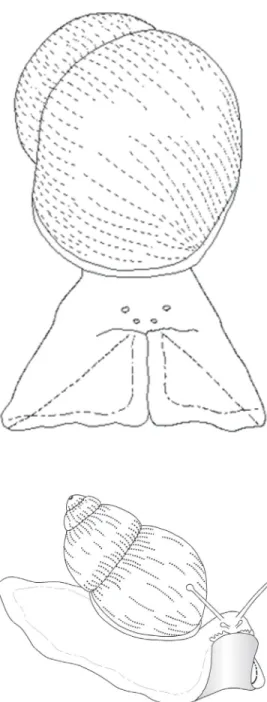
foot which was immediately retracted later-ally. At the same time, the oral tentacles and labial palps retracted and this movement was followed by a medial-ventral retraction of the H-F complex, beginning at the rostral region and extending to the caudal region. Thus, only the lateral portion of the foot remained in contact with the substrate, with the occurrence of a partial retraction of the body into the shell. When the snail was ob-served from the anterior region, the H-F com-plex showed a triangular aspect (Figure 1).
Second phase. After 25 s, on average, the retracted oral tentacles and labial palps be-gan to protract and the snail displayed search-ing movements followed by lateral parapo-dial waves characterizing exploratory be-havior. Subsequently, the animals exhibited anterior lifting of the H-F complex 1 cm or more from the substrate. The average la-tency of the avoidance behavior response or of the H-F complex elevation to a height of 1 cm was 33 s. After the lifting of the H-F complex, the rostral portion of the head turned (Figure 2). All the animals in this group exhibited foot swelling and intense secretion of yellowish mucus.
Nociceptive responses after morphine and naloxone administration
Administration of different concentra-tions of morphine before the thermal stress (50ºC) promoted an increased latency of withdrawal behavior in the snails, with the oral tentacles and optic tentacles remaining partially retracted and flaccid.
The animals treated with 5.0, 10.0 or 20.0 mg/kg body weight morphine displayed a partial retraction of the H-F complex, less intense than that observed in control snails. In the second phase of avoidance behavior, the snails showed a partial protraction of Figure 1. Schematic
representa-tion of the snail Megalobulimus abbreviatus in the first phase of aversive behavior. Note the re-tracted oral tentacles and labial palps and the triangular aspect of the head-foot complex when the snail was placed on the hot plate.
Figure 2. Schematic representa-tion of the second phase of the aversive behavior of the snail
Megalobulimus abbreviatus. Note that, after protraction, the snail exhibited anterior lifting of the head-foot complex 1 cm from the substrate, characteriz-ing aversive behavior.
foot lifting behavior nor locomotion. No modification was detected in mucus secre-tion. The snails were observed for 300 s on the hot plate, always displaying the same behavior, which was also observed in snails submitted to a non-thermal stress of 30ºC.
protrac-flaccid palps and oral tentacles.
The snails injected with a higher dose of morphine (20.0 mg/kg body weight) showed pedal muscle rigidity before being placed on the hot plate. The optic and oral tentacles of these snails remained protracted and flaccid throughout all phases of the test. All animals in this group that received morphine before the thermal aversive stimulus presented a thick yellowish mucus secretion. With this higher morphine dose the response latency was significantly longer (means ± SD, 63.18 ± 14.47 s) than those recorded with 5.0 mg/ kg (34.22 ± 12.7 s) or 10.0 mg/kg (34.8 ± 7.78 s) of morphine. Nevertheless, there was no significant difference in the response la-tency between snails that received 5.0 or 10.0 mg/kg body weight morphine (Figure 3). The snails only injected with saline dis-played an response latency of 29.1 ± 9.91 s and exhibited a similar behavior to the con-trol group (33.44 ± 8.53 s). Furthermore, there was no significant difference between the groups receiving saline or 5.0 or 10.0 mg/ kg body weight morphine in terms of re-sponse latency.
The snails that received naloxone (2.5, 5.0, 7.5 mg/kg body weight) exhibited biphasic behavior, faster than that observed in control animals. However, lifting of the H-F complex 1 cm above the substrate oc-curred at 16.26 ± 3.19, 11.5 ± 1.64 and 7.38 ± 1.6 s, respectively, for each of the above doses. The latency of the response obtained with these naloxone doses was significantly shorter than that of the control (33.44 ± 8.53 s; P < 0.01 for dose of 2.5 mg and P < 0.001 for doses of 5.0 and 7.5 mg/kg) and saline groups (29.1 ± 9.91 s; P < 0.05 for dose of 2.5 mg/kg, P < 0.01 for dose of 5.0 mg/kg and P < 0.001 for dose of 7.5 mg/kg), but there were no significant differences between the three naloxone-treated groups (Figure 4). These naloxone doses did not interfere with motor behavior. The snails exhibited retracted and flaccid oral and optic tentacles, similar to those of the animals treated with
Response latency (s)
90
Control Saline Morphine
5 mg/kg Morphine10 mg/kg Morphine20 mg/kg 5 mg/kg +Naloxone morphine 20 mg/kg
*
*
80
70 60
50 40
30 20
10 0
Figure 3. Effect of treatment with morphine, naloxone plus morphine, and saline (1.0 ml) on the response latency after thermal aversive stimuli (50ºC) 15 min after injection. Data are reported as means ± SEM for N = 9 animals in all groups. Note the significant difference between the group treated with 20.0 mg/kg body weight morphine and all other groups (P < 0.001), and the significant difference between the naloxone plus morphine-treated group and all other groups (P < 0.01). The vertical axis shows the response latency. *P < 0.01 (ANOVA followed by the Tukey test).
Response latency (s)
90
Control Saline Naloxone
2.5 mg/kg Naloxone5 mg/kg 7.5 mg/kgNaloxone 5 mg/kg +Naloxone morphine 20 mg/kg 80
70
60
50
40
30
20
10
0
*
*
* *
Figure 4. Effect of naloxone, naloxone plus morphine, and saline (1.0 ml) on the response latency after thermal aversive stimuli (50ºC) 15 min after injection. Data are reported as means ± SEM for N = 9 animals in all groups. *P < 0.05 compared to control and saline-treated groups (ANOVA followed by the Tukey test). No significant difference was ob-served between the groups treated with different naloxone doses.
morphine.
differed significantly (P < 0.001) from that of the animals treated with morphine or sa-line and control, but not among the groups injected with naloxone (Figure 3).
The snails injected with saline alone dis-played an average response latency of 29.1 s and a behavior similar to that of the control group. Also, there was no significant differ-ence between the groups treated with saline or 5.0 and 10.0 mg/kg body weight morphine in terms of response latency.
Discussion
In the present study, we examined the
behavior of the snail M. abbreviatus after the
application of thermal stimuli and the effects of morphine and the antagonist naloxone on thermal avoidance behavior. The snails showed exploratory behavior at ambient tem-perature (22ºC) or non-thermal stress (30ºC), but a stereotyped behavior at 50ºC. These results were similar to those obtained with other species of gastropods (4,7).
M. abbreviatus displayed exploratory behavior without locomotion when placed on the nonfunctional hot plate (22ºC) in relation to the animals in their habitat (cages). The exploratory behavior consisted of move-ments of the H-F complex as well as of the oral tentacles and labial palps. The latter structures showed retraction at first contact with the substrate and were immediately protracted, subsequently exhibiting a ten-tacular palpation of the substrate. This ex-ploratory behavior was also described in the
Helix species, with satiated animals usually showing no locomotion (5). Also, the avoid-ance behavior was not observed at similar hot plate, (nonfunctional) temperatures in
C. nemoralis, M. sanctipauli, H. aspersa or L. maximus (2,4,7,9,18).
The pulmonate snail M. abbreviatus,
when exposed to thermal stress (50ºC), pre-sented withdrawal behavior characterized by lifting of the H-F complex, with an average response latency of 33 s. This behavior was
quite different from that observed at 22º and 30ºC. This withdrawal or avoidance behav-ior has also been identified in other
gastro-pods, such as C. nemoralis, M. sanctipauli,
H. aspersa, and L. maximus (2,4,7,17,18), although some differences were noted. Of particular note were the latency times for
snails to display the H-F lifting response (C.
nemoralis, 5-6 s; M. sanctipauli, 6-8 s, and
M. abbreviatus, 33 s). An explanation of the difference in response latency between the
two species of Megalobulimus may be the
time of day when the snails were stimulated.
In the nociception of C. nemoralis, a
light-dark rhythm of thermal response latency was found, with latency being longer during the mid-dark period than during the mid-light period (19). Nevertheless, the experiments
on the two Megalobulimus specieswere
car-ried out during the same mid-light period (4,20).
During thermal stress, M. abbreviatus
developed a complex behavior similar to
that described for C. nemoralis (17). These
snails displayed biphasic avoidance behav-ior including protraction and retraction of the body. In the first phase of this behavior,
C. nemoralis displayed complete
withdraw-al of the body into the shell, while M.
abbreviatus displayed partial withdrawal consisting of elevation of the ventral-medial region of the anterior aspect of the body, supported only by the lateral parapodium. These movements involve the columellar, tentacular retractor and pedal muscles (21), which are controlled by neurons located in the pedal and cerebral ganglia (22,23). Thus,
we can conclude that M. abbreviatus showed
a sequence of escape behaviors similar to
that shown by C. nemoralis (17).
The color and consistency of the mucus secretion varied according to the thermal
stimulus. In M. abbreviatus stimulated at 22º
prob-able inflammatory process in the foot. Our findings showed that morphine elic-ited an increase in the latency of the aversive behavior and that naloxone blocked this
be-havior causing an antiaversive effect in M.
abbreviatus, as has been described in verte-brates and other inverteverte-brates (1,2,4,7,9,18, 20,24-27). The fact that naloxone suppressed the analgesic response of morphine and re-duced the nociceptive response of the en-dogenous peptides suggests the existence of
an opiate mechanism in M. abbreviatus.
In addition, it is well known that mor-phine produces behavioral inactivity and muscular rigidity in both humans and ani-mals (26,28). At low doses it enhances loco-motion, while at higher doses it produces a biphasic effect. In the first phase, spontane-ous activity is reduced and in the second phase, locomotion increases. At the highest doses, morphine produces a state character-ized by muscular rigidity and lack of sponta-neous activity (29,30).
Both morphine and naloxone affected
the thermal avoidance behavior of M.
abbre-viatus. These results, together with the de-tection of Met-enkephalin-like immunore-activity in the central nervous system of this snail (11), provide evidence of the involve-ment of an endogenous opioid system in the control of thermal withdrawal behavior and nociception. On other hand, it is well known that one of the most difficult problems in neurobiology is functional identification of neurons involved in a network underlying certain behaviors (31). Thus, this experi-mental model can be used for subsequent investigations about nociception to be con-ducted in our laboratory, such as the detec-tion of the nociceptive pathway and of the neurotransmitters and peptides involved in this circuit.
Acknowledgments
We are grateful to Dr. Alberto A. Rasia-Filho (Fundação Faculdade Federal de Ciên-cias Médicas de Porto Alegre) for valuable comments on the manuscript and to Anto-nio. G. Severino for technical assistance.
References
1. Kavaliers M (1988). Evolutionary and comparative aspects of noci-ception. Brain Research Bulletin, 21: 923-932.
2. Kavaliers M, Hirst M & Teskey GC (1983). A functional role for an opiate system in snail thermal behavior. Science, 220: 99-101. 3. Walters ET (1987). Multiple sensory neuronal correlates of
site-specific sensitization in Aplysia. Journal of Neuroscience, 7: 408-417.
4. Romero SMB, Hoffmann A & Menescal de Oliveira L (1994). Is there an opiate receptor in the snail Megalobulimus sanctipauli? Action of morphine and naloxone. Comparative Biochemistry and Physiology, 107C: 37-40.
5. Balaban PM (1993). Behavioral neurobiology of learning in terrestrial snails. Progress in Neurobiology, 41: 1-19.
6. Hirst M & Kavaliers M (1987). Levorphanol but not dextrorphan suppresses the foot-lifting response to an aversive thermal stimu-lus in the terrestrial snail, Cepaea nemoralis.Neuropharmacology, 26: 121-123.
7. Kavaliers M & Hirst M (1986). Naloxone-reversible stress-induced feeding and analgesia in the slug Limax maximus. Life Sciences, 38: 203-209.
8. Nestler EJ, Hyman SE & Malenka RS (2001). Molecular
Neurophar-macology. A Foundation for Clinical Neuroscience. McGraw-Hill Companies, Inc., New York.
9. Kavaliers M (1987). Evidence for opioid and non-opioid forms of stress-induced analgesia in the snail, Cepaea nemoralis. Brain Re-search, 410: 111-115.
10. Elekes K, Stefano GB & Carpenter DO (1993). Enkephalin-like im-munoreactive neurons in the central nervous system of gastropods (Helix pomatia, Lymnaea stagnalis, Aplysia californica): a compara-tive immunohistochemical study. Cell and Tissue Research, 272: 257-272.
11. Zancan DM (1996). Localização de mediadores químicos nos gân-glios nervosos centrais e tentaculares e inervação da glândula corpo dorsal do caracol pulmonado Megalobulimus oblongus. Doctoral thesis, Programa de Pós-graduação em Ciências Biológicas: Fisiologia, Universidade Federal do Rio Grande do Sul, Porto Alegre, RS, Brazil.
12. Naranjo RM, Mellstrom B, Achaval M & Sassone-Corsi P (1991). Molecular pathways of pain: Fos/jun-mediated activation of a noncanonical AP-1 site in the prodynorphin gene. Neuron, 6: 607-617.
spinal cord and thalamus of the rat following peripheral stimulation.
Brain Research, 493: 391-397.
14. Kavaliers M, Perrot-Sinal TS, Desjardins DC, Cross-Mellor SK & Wiebe JP (2000). Antinociceptive effects of the neuroactive steroid 3alpha-hydroxy-5alpha-pregnan-20-one and progesterone in the land snail, Cepaea nemoralis. Neuroscience, 95: 807-812.
15. Kavaliers M & Perrot-Sinal TS (1996). Pronociceptive effects of the neuropeptide, nociceptin, in the land snail Cepaea nemoralis. Pep-tides,17: 763-768.
16. Penha MA (2001). Um modelo de comportamento aversivo térmico em Megalobulimus oblongus e a ação de fármacos nos sistemas opióide e serotoninérgico. Master’s thesis, Programa de Pós-graduação em Neurociências, Universidade Federal do Rio Grande do Sul, Porto Alegre, RS, Brazil.
17. Dyakonova VE, Elofsson R, Calberg M & Sakharov DA (1995). Com-plex avoidance behavior and its neurochemical regulation in the land snail Cepaea nemoralis. General Pharmacology, 26: 773-777. 18. Gutiérrez R (1992). Effects of naloxone on membrane potential of
identified neurons of Helix aspersa. Comparative Biochemistry and Physiology, 101C: 425-431.
19. Yu N & Kavaliers M (1991). Pertussis toxin reduces the day-night rhythm of nociception and mu and kappa opioid peptide-mediated antinociception in the snail Cepaea nemoralis. Peptides, 12: 877-881.
20. Kavaliers M (1992). Opioid systems, behavioral thermoregulation and shell polymorphism in the land snail Cepaea nemoralis. Journal of Comparative Physiology,162B: 172-178.
21. Faccioni-Heuser MC, Zancan DM, Lopes C & Achaval M (1999). The pedal muscle of the land snail Megalobulimus oblongus (Gastropo-da, Pulmonata): an ultrastructure approach. Acta Zoologica, 80: 325-337.
22. Faccioni-Heuser MC, Puperi C, Malysz T, Zancan DM & Achaval M (2001). Neurônios do gânglio pedal envolvidos na inervação da musculatura pediosa do caracol terrestre Megalobulimus oblongus.
Proceedings of the XVI Annual Meeting of FESBE, Caxambu, MG, Brazil, August 29-September 1, 273.
23. Malysz T, Faccioni-Heuser MC, Puperi C, Achaval M & Zancan DM (2001). Identificação de neurônios envolvidos na inervação da região posterior do pé do caracol Megalobulimus oblongus. Proceedings of the XVI Annual Meeting of FESBE, Caxambu, MG, Brazil, August 29-September 1, 273.
24. O’Callagan JF & Holtzman SG (1975). Quantification of the analge-sic activity of narcotic antagonists by a modified hot-plate proce-dure. Journal of Pharmacology and Experimental Therapeutics, 192: 497-505.
25. Warizi R (1976). Morphine effects on cholinergic synaptic transmis-sion in Aplysia: evidence for receptor blockage. Comparative Bio-chemistry and Physiology, 55C: 95-102.
26. Martin WR (1984). Pharmacology of opioids. Pharmacological Re-views, 35: 284-323.
27. Kavaliers M & Ossenkopp KP (1993). Repeated naloxone treat-ments and exposures to weak 60-Hz magnetic fields have “analge-sic” effects in snails. Brain Research, 620: 159-162.
28. Tzsenchtke TM & Schmidt WJ (1996). Morphine-induced catalepsy is augmented by NMDA receptor antagonists but is partially attenu-ated by an AMPA receptor antagonist. European Journal of Pharma-cology, 295: 137-146.
29. Turski L, Havemann U & Kuschinsky K (1982). Evidence for func-tional interaction of morphine in substantia nigra and striatum in relation to muscular rigidity in rats. Neuroscience Letters, 28: 291-296.
30. Burrowes WR, Assanah P & Stefano GB (1983). Behavioral effects of opiates on the land snail Helix aspersa. Life Sciences, 33 (Suppl 1): 381-384.