Ferulic acid lowers body weight and visceral fat
accumulation via modulation of enzymatic, hormonal
and in
fl
ammatory changes in a mouse model of
high-fat diet-induced obesity
T.S. de Melo
1, P.R. Lima
2, K.M.M.B. Carvalho
2, T.M. Fontenele
1, F.R.N. Solon
1, A.R. Tomé
3,
T.L.G. de Lemos
4, S.G. da Cruz Fonseca
1, F.A. Santos
2, V.S. Rao
2and M.G.R. de Queiroz
11Faculdade de Farmácia, Universidade Federal do Ceará, Fortaleza, CE, Brasil 2
Laboratório de Produtos Naturais, Departamento de Fisiologia e Farmacologia, Faculdade de Medicina, Universidade Federal do Ceará, Fortaleza, CE, Brasil 3
Faculdade de Medicina Veterinária, Universidade Estadual do Ceará, Fortaleza, CE, Brasil 4
Departamento de Química Orgânica e Inorgânica, Universidade Federal do Ceará, Fortaleza, CE, Brasil
Abstract
Previous studies have reported on the glucose and lipid-lowering effects of ferulic acid (FA) but its anti-obesity potential has not yet beenfirmly established. This study investigated the possible anti-obesitogenic effects of FA in mice fed a high-fat diet (HFD) for 15 weeks. To assess the antiobesity potential of FA, 32 male Swiss mice, weighing 20–25 g (n=6–8 per group) were fed a
normal diet (ND) or HFD, treated orally or not with either FA (10 mg/kg) or sibutramine (10 mg/kg) for 15 weeks and at the end of this period, the body weights of animals, visceral fat accumulation, plasma levels of glucose and insulin hormone, amylase and lipase activities, the satiety hormones ghrelin and leptin, and tumor necrosis factor-a(TNF-a) and monocyte chemoattractant protein-1 (MCH-1) were analyzed. Results revealed that FA could effectively suppress the HFD-associated increase in visceral fat accumulation, adipocyte size and body weight gain, similar to sibutramine, the positive control. FA also significantly (Po0.05) decreased the HFD-induced elevations in serum lipid profiles, amylase and lipase activities, and the levels of blood
glucose and insulin hormone. The markedly elevated leptin and decreased ghrelin levels seen in HFD-fed control mice were significantly (Po0.05) reversed by FA treatment, almost reaching the values seen in ND-fed mice. Furthermore, FA
demon-strated significant (Po0.05) inhibition of serum levels of inflammatory mediators TNF-a, and MCH-1. These results suggest that
FA could be beneficial in lowering the risk of HFD-induced obesity via modulation of enzymatic, hormonal and inflammatory responses.
Key words: Ferulic acid; Anti-obesity; High-fat diet; Leptin; Lipase; Tumor necrosis factor-a
Introduction
The increasing trend in the prevalence of obesity has become a global concern, causing severe burden on health care systems (1). Characterized by the accumulation of excess adipose tissue, obesity is related to cardiovascular disease, insulin resistance, and metabolic syndrome (2). The available anti-obesity drugs such as orlistat and sibutramine (SIB) have modest clinical efficacy, but safety and tolerability concerns may limit their use (3,4). Therefore, there is a need for the discovery and development of novel, safe, and effective drugs for the control and treatment of obesity.
Due to the increasing consumer knowledge of the link between diet and health, there is an increased awareness
and demand for functional food ingredients and nutraceu-ticals. This leads to a mindset directed to self-medication to avoid the undesirable side effects associated with con-sumption of synthesized drugs and also to avoid the increasing cost of drug therapy. Several studies have focused on prevention and treatment of obesity and its associated health risks using plant-derived phenolic compounds. The nutritional effects of phenolic compounds have been well established in their role in modulating specific physiologi-cal functions in rodents and human beings (5,6). Ferulic acid (FA) (Figure 1) belongs to the family of phenolic acids and is very abundant in fruits, vegetables and grains, such
Correspondence: T.S. de Melo:<[email protected]>
as rice bran, oats, wheat, barley, roasted coffee, tomatoes, asparagus, berries, vegetables, citrus fruits and leaves of most plants. FA has shown to exhibit hypocholesterol-emic, hypoglychypocholesterol-emic, atherogenic, anticancer, anti-oxidant, antidiabetic and anti-inflammatory properties in experimental studies (7–12). Moreover, FA is a phenolic acid of low toxicity and it can be absorbed, easily metab-olized in the human body (13). Recently, FA has also shown to improve the glucose and lipid homeostasis in high-fat diet (HFD)-fed mice probably via modulating the expression of lipogenic and gluconeogenic genes in liver tissues (14).
The consumption of fat-rich foods may activate an inflammatory response in the hypothalamus, thereby dis-turbing the anorexigenic and thermogenic signals gener-ated by the hormones, ghrelin, leptin and insulin, leading to anomalous body mass control (15). Since FA exhibits anti-oxidant (9) and anti-inflammatory properties (16), and modulatory effects on glucose and lipid metabolism (14,17), it is likely that FA modulates adipogenesis. Therefore, the present study was aimed to demonstrate the anti-obesity effect of FA (10 mg/kg) compared to sibutramine (10 mg/kg), a well-known weight loss agent, using the mouse model of HFD-induced obesity.
Material and Methods
Chemicals and drugs
Ferulic acid was purchased from Sigma Aldrichs (USA), 98% pure. Sibutramine was purchased from Achés (Brazil). All other chemicals and reagents used were of analytical grade and obtained from standard commercial suppliers.
Animals
Male Swiss mice (32 total, weighing 20–25 g) obtained from the Central Animal House of Universidade Federal do Ceará were used. They were kept in propylene cages, at a room temperature (24±2°C) on a 12-h light/dark cycle with food (chow) and water provided ad libitum. Experimental protocols (#34/2011) were approved by the Universidade Federal do Ceará Institutional Commit-tee on Care and Use of Animals for Experimentation, in accordance with the guidelines of the National Institutes of Health, USA.
Diet composition
The normal diet (ND) used was the pelleted chow obtained from a commercial source (Nuvilab, Brazil). It con-sisted of 19.0% protein, 56% carbohydrate, 3.5% lipids, 4.5% cellulose, 5.0% vitamins and minerals, and 12% humidity with a total energy content of 17.03 kJ/g. The standardized HFD used for the study (18) comprised the following hypercaloric constituents: 15 g of laboratory animal chow, 10 g of roasted ground nut, 10 g of milk chocolate, and 5 g of maizen cookies. These ingredients were ground and prepared in the form of pellets that con-tained, by weight, 20% protein, 48% carbohydrate, 20% lipids, 4% cellulose, 5% vitamins and minerals and 3% humidity. The net energy content of this diet was 21.40 kJ/g. Thus, the HFD, compared with ND, was hypercaloric, and it contained less carbohydrate but more lipids with a net energy difference of 4.37 kJ/g. To avoid auto-oxidation of the fat components, food was stored at approximately 24°C.
Anti-obesity activity
Mice were randomly divided into four groups (n=8) matched for body weight after 1 week being fed laboratory pellet chow. The control group (ND) continued to be fed laboratory pellet chow ad libitum. The remaining mice consumed HFD (HFD control), HFD+FA (0.05% in drinking water, which is equivalent to 10 mg/kg of body weight based on water consumption), or HFD+SIB (0.05% in drinking water, which amounts to 10 mg/kg of body weight) for 15 weeks. FA and SIB concentrations were based on our previous experiments (8,19). FA was suspended initially in 3% (v/v) Tween 80 and then further diluted in water. HFD-fed controls received the same vehicle. As SIB is water-soluble, no vehicle was used. FA- or vehicle-containing water was changed twice a week, and weekly consumption of water (mL/week) was recorded. The body weight of each mouse was measured once a week, the total amount of food consumption was recorded every day for 15 weeks, and weekly consumption of food (g/week) was calculated. At the end of this period, animals were fast for 6 h, blood was taken by venous puncture and then they were killed by cervical dislocation. The plasma was prepared and either used within a few hours or frozen at –70°C until analysis. The liver and visceral adipose tissues (epididymal and parametrial) were dissected, weighed, and expressed in mg/10 g of body weight.
Biochemical analysis
Plasma amylase and lipase activities were deter-mined by a kinetic method using commercial kits for amy-lase (Labtests, Brazil) and lipase (Bioclins, Brazil). The assays were performed according to the manufacturer’s instructions, and their levels are reported in U/L. Plasma glucose, triglycerides, and total cholesterol were analyzed using commercial kits (Labtests), and the levels are reported as mg/dL. Plasma alanine aminotransferase (ALT) and aspartate aminotransferase (AST), reported Figure 1.Chemical structure of ferulic acid
in U/L, were analyzed by a kinetic method using com-mercial kits (Labtests). Plasma TNF-a, MCP-1, insulin, leptin, and ghrelin levels were measured by enzyme linked immunosorbent assays (Crystal Chem, USA) per-formed in duplicate and reported in ng/mL or pg/mL.
Non-protein sulfhydryls (NP-SH)
NP-SH (non-protein sulfhydrils, GSH) in hepatic tissues were determined by Ellman’s reaction using 5’5’-dithio-bis-2-nitrobenzoic acid (DTNB) (20). Aliquots of 4 mL of the homogenates in ice-cold ethylenediamine-tetraacetic acid (EDTA; 0.02 mol/L, pH 8.9) were mixed with 3.2 mL of distilled water and 0.8 mL of 50% trichloroacetic acid (TCA). The tubes were centrifuged at 800 g for 15 min at 4°C. The supernatant (2 mL) was mixed with 4 mL Tris buffer (0.4 mol/L, pH 8.9) and 0.1 mL of DTNB (0.01 mol/L). The absorbance was measured within 5 min after addition of DTNB at 412 nm. The absorbance values were extrapolated from a glutathione standard curve and reported asmg/g of hepatic tissue.
Malondialdehyde assay
The concentration of hepatic lipid peroxidation was determined by estimating malondialdehyde (MDA) using the thiobarbituric acid test (21). The hepatic tissue was homogenized in 0.15 KCl, pH 7.4. The homogenate was maintained in a water bath for 60 min at 37°C. Perchloric acid (35%) was added to the homogenate and centrifuged at 17,500gfor 10 min at 4°C. The supernatant was mixed with 1.2% thiobarbituric acid, and the mixture was heated at 98°C for 30 min. After cooling to room temperature, the absorbance was measured at 532 nm. The standard curve was obtained using 1,1,3,3-tetramethoxypropane. The results were reported as nmol of MDA/g hepatic tissue.
Histological analysis
The epididymal fat pads were excised, fixed in 10% formalin, and processed routinely for paraffin embedding. Tissue sections of 5-mm thick were cut, processed for hematoxylin and eosin (H&E) staining, and examined under a light microscope for histological changes.
Statistical analyses
The results are reported as means±SE for 8 animals in each group. Data were analyzed by one-way analysis of variance (ANOVA) followed by Student-Newman-Keuls test, using the GraphPad (USA) Prism program (version 5.0). Differences were considered to be significant at Po0.05.
Results
Antiobesity effect of ferulic acid and sibutramine in mice fed HFD
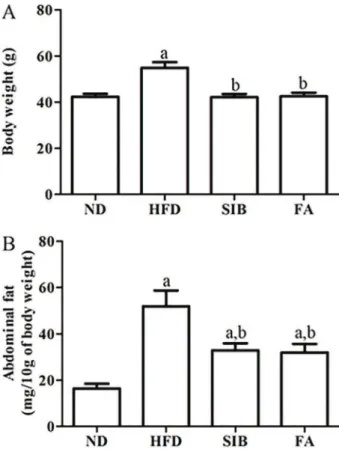
The body weight of mice in the four groups was similar at baseline and constantly increased over time. As shown
in Figure 2A, at the end of the 15-week experimental period, the high calorie diet induced a significant (Po0.05) increase of 29% in body weight of the HFD group compared to the ND group (54.88±2 vs 42.36±1.27 g, respectively). Abdominal fat weight, which includes the epididymal and parametrial pads, was significantly (Po0.05) higher in HFD controls compared to ND controls (Figure 2B). FA supplementation in drinking water (50 mg/L) significantly (Po0.05) reduced the final body weight (g) and abdominal fat deposition (mg/10 g) to 42.56±1.54 and 31.95±3.73, respectively, when compared to the HFD group, representing reductions of 22 and 38% in these parameters. The FA had an effect similar to sibutramine in reducing body weight and abdominal fat accumulation (23 and 36%, respectively). While treat-ment with FA and SIB slightly but significantly (Po0.05) reduced water consumption compared to ND and HFD controls, both treatments effectively decreased the net energy intake almost to the level seen in ND fed mice when compared to values observed in HFD controls (Table 1).
Effects of ferulic acid and sibutramine on plasma parameters
As shown in Table 2, plasma levels of glucose and insulin were significantly (Po0.05) higher (78% and 3.2-fold, respectively) in the HFD group compared to ND group. FA treatment for 15 weeks led to a significant (Po0.05) 33% reduction in plasma glucose levels and 58% reduction in plasma insulin levels compared to HFD group. Treatment with SIB showed no significant influence on plasma glucose, but it effectively decreased insulin level (48%). Compared to the ND group, the HFD group significantly (Po0.05) decreased plasma ghrelin (orexi-genic hormone), while it elevated the leptin (anorexi(orexi-genic hormone) level (Table 1). These changes induced by the HFD were effectively reversed by FA treatment. SIB treatment, however, caused no significant change in the level of ghrelin hormone.
The amylase and lipase activities were significantly (Po0.05) higher in the HFD group (65 and 37%, respec-tively), compared to ND group. FA treatment caused sig-nificant (Po0.05) reductions in the activities of both amylase and lipase by 42 and 27%, respectively. SIB, used as a reference standard, reduced significantly (Po0.05) the amylase activity (38%), while it had no influence on lipase activity (Table 2).
The HFD raised total cholesterol (70%) and trigly-cerides (66%) significantly (Po0.05) compared with the ND.
These increased levels of the HFD group were signifi-cantly (Po0.05) lowered by FA and SIB treatments (Table 2).
Effects of ferulic acid and sibutramine on plasma levels of inflammation and lipid peroxidation-related parameters
Table 3 shows the effects of FA and SIB treatments on plasma levels of monocyte chemotactic protein 1 (MCP-1) and tumor necrosis factor (TNF-a), and hepatic levels of NP-SH, and MDA, in mice fed experimental diets for 15 weeks. The levels of MCP-1 showed an increase of 55% in the HFD relative to ND group, which was significantly (Po0.05) decreased in groups treated with FA and SIB (44 and 34%, respectively). Similarly, the increase in TNF-a promoted by the HFD was also greatly decreased in groups treated with FA and SIB. The hepatic tissue levels of NP-SH, and MDA were significantly (Po0.05) elevated by the HFD, whereas in mice treated with FA or SIB these changes were partially reversed, but not significantly.
Effects of ferulic acid and sibutramine on satiety parameters
There were no significant changes in serum urea and creatinine levels among all tested groups. However, animals subjected to the hypercaloric diet showed an increase in the activity of ALT and AST (41 and 46%, respectively), Table 1.Effects of ferulic acid (FA) and sibutramine (SIB) treatments on net water, food, and energy intakes and the levels of satiety hormones ghrelin and leptin, in mice fed experimental diets for 15 weeks.
Parameter ND HFD HFD+FA HFD+SIB
Net water intake (mL/week) 52.51±1.5 48.70±1.3 44.79±1.4a,b 41.89±1.3a,b Net food intake (g/week) 33.15±1.6 47.50±2.8a 28.47±1.1b 31.96±1.3b Net energy intake (kJ/week) 564.54±27.2 1016.50±59.9a 609.26±23.5b 683.94±27.8b Ghrelin (ng/mL) 0.695±0.1 0.294±0.1a 1.032±0.2b 0.288±0.1a Leptin (ng/mL) 43.57±5.7 370.00±79.8a 126.70±37.2b 66.62±17.1b
Data are reported as means±SE (n=8). ND: normal diet; HFD: high-fat diet.aP
o0.05vsND;bPo0.05vsHFD (ANOVA and Student-Newman-Keuls test).
Table 2.Effects of ferulic acid (FA) and sibutramine (SIB) treatments on blood parameters related to carbohydrate and lipid metabolism, in mice fed experimental diets for 15 weeks.
Parameter ND HFD HFD+FA HFD+SIB
Glucose (mg/dL) 117.9±8.51 209.8±16.51a 140.0±8.90b 178.6±18.31a Insulin (ng/mL) 0.112±0.02 0.467±0.09a 0.192±0.03b 0.258±0.05b Amylase (U/L) 847.70±35.18 1396.55±97.41a 804.86±33.17b 858.50±74.22b Lipase (U/L) 234.46±10.81 322.03±28.77a 234.15±10.60b 281.19±19.42b Triglycerides (mg/dL) 99.18±9.99 165.06±12.40a 111.15±13.50b 95.85±6.19b Total cholesterol (mg/dL) 109.62±3.42 185.94±11.97a 126.90±6.03b 154.26±5.67a,b
Data are reported as means±SE (n=8). ND: normal diet; HFD: high-fat diet.aP
indicating a possible liver damage (Table 4). Serum ALT and AST decreased significantly (Po0.05) in groups treated with FA compared to HFD control group, repre-senting a decrease of 33 and 74% in the activity of the respective enzymes. Sibutramine, used as positive con-trol, also significantly (Po0.05) reduced the activity of ALT and AST by 36 to 59% compared to HFD fed animals.
Effects of ferulic acid and sibutramine on epididymal adipocytes size in mice fed HFD
Mice fed HFD for 15 weeks apparently presented greater number of epididymal fat cells with an increased size of adipocyte (Figure 3) compared to the group that received normal diet. In the groups treated with FA or SIB, the adipocyte size almost resembled those of the ND-fed mice.
Discussion
Past studies have addressed the hypoglycemic, hypo-lipidemic, and antioxidant properties of FA in HFD fed animals (8,9), but its influence in lowering the visceral adiposity has not been analyzed and reported. The results obtained in this study clearly showed that a HFD for 15 weeks promoted visceral adiposity and weight gain in Swiss mice, and treatments with the FA, or a known anorectic agent, such as SIB (22) in drinking water (50 mg/L) prevented this adiposity and weight gain.
Ghrelin from the stomach and leptin from adipose tissue regulate appetite and energy homeostasis in humans
and rodents. It has been observed that the long-term intake of a HFD can induce hyperleptinemia and hypo-ghrelinemia and a significant positive correlation between plasma leptin levels and epididymal fat mass (23). Consistent with these earlier findings, the present study with mice on HFD for 15 weeks demonstrated hyperlepti-nemia and hypoghrelihyperlepti-nemia and an increased abdominal fat deposition, which could be counteracted by FA sup-plementation. The hypothalamus is considered the major site of anorexigenic and orexigenic signaling integration through activation of respective receptors for ghrelin (orexigenic) and leptin (anorexigenic). Obesity is asso-ciated with elevated leptin and resistance to leptin effects on energy homeostasis (24). Our current study demon-strated that FA supplementation significantly lowers cir-culating leptin level. Since FA supplementation could reduce the food and energy intakes, we assume that the HFD-induced changes in ghrelin and leptin plasma levels may, in part, account for the observed body weight loss and reduced abdominal fat. However, the underlying molecular mechanism of FA in its antiobese effect remains to be established.
Several studies demonstrated that adipose tissue dysregulation and aberrant adipokine secretion contribute to low-grade chronic proinflammatory state and insulin resistance (25–27). Obesity has been considered a disease in which there is a predominance of proinflam-matory cytokines. Recentfindings suggest that the size of adipocytes is a major modulator of their endocrine func-tion. Hypertrophic adipocytes secrete greater amounts of Table 3.Effects of ferulic acid (FA) sibutramine (SIB) treatments on blood levels of monocyte chemotactic protein-1 (MCP-1), TNF-a, and the hepatic tissue levels of non-protein sulfhydrils (NP-SH), and malondialdehyde (MDA), in mice fed experimental diets for 15 weeks.
Parameter ND HFD HFD+FA HFD+SIB
MCP-1 (ng/mL) 45.70±6.50 70.78±8.80a 39.82±5.50b 46.78±4.90b TNF-a(pg/mL) 35.32±4.30 80.78±15.82a 39.98±9.00b 46.01±5.80b NP-SH (mg/g tissue) 60.68±7.60 34.03±2.30a 47.32±7.50 44.49±4.10 MDA (nmol/g tissue) 8.87±1.60 26.92±0.40a 23.63±1.50a 25.12±0.80a
Data are reported as means±SE (n=8). ND: normal diet; HFD: high-fat diet.aP
o0.05vsND;bPo0.05vsHFD (ANOVA and Student-Newman-Keuls test).
Table 4.Effects of ferulic acid (FA) and sibutramine (SIB) treatments on serum levels of urea, creatinine, alanine aminotransferase (ALT) and aspartate aminotransferase (AST), in mice fed experimental diets for 15 weeks.
Parameter ND HFD HFD+FA HFD+SIB
Urea 32.13±2.63 41.88±4.74 33.14±1.80 30.75±2.00
Creatinine 0.34±0.02 0.31±0.05 0.35±0.02 0.31±0.03
ALT (U/L) 41.75±3.07 70.50±10.79a 47.14±5.23b 44.71±4.71b
AST (U/L) 94.38±23.51 176.3±15.53a 45.50±3.95b 71.50±8.19b
Data are reported as means±SE (n=8). ND: normal diet; HFD: high-fat diet.aP
TNF-a and MCH-1 than normal adipocytes, and this excess secretion has been hypothesized to cause insulin resistance (28–30). In our studies, circulating levels of MCP-1 and TNF-a, as well as insulin were greatly elevated in mice fed on HFD for 15 weeks, indicating a proinflammatory state and insulin resistance seen in type-2 diabetes. Both FA and SIB reduced the adipocyte size, as well as the circulating levels of adipokines, TNF-aand MCH-1, which would explain its ameliorating effect on abdominal adiposity and insulin resistance.
In addition, there was a significant improvement in biochemical parameters such as plasma glucose, choles-terol and triglycerides, as well as the lipase and amylase activities, when mice were treated with the combination of FA plus HFD. Inhibition of pancreatic lipase and the associated reduction of lipid absorption is an attrac-tive approach for the discovery of potent agents (31). Currently, the only clinically approved pharmacological agent for pancreatic lipase inhibitor is orlistat. However, its usage is compromised by unpleasant gastrointestinal adverse reactions (oily stools and flatulence). An impor-tant target for the treatment of obesity includes the develop-ment of inhibitors of nutrient digestion and absorption. FA is therefore capable of modulating glucose and lipid metabolism, consistent with earlier reports (8,16,32).
rates of urea and creatinine, which confirms no poten-tial kidney or hepatic damage. Moreover, it prevented HFD-induced fatty liver in the present study and offered protection against diosbulbin-induced hepatotoxicity (37) and glycerol-induced nephrotoxicity (38) in other studies. This study has its strength in the evaluation of various parameters that are closely related to metabolic syndrome and obesity, which were improved with FA treatment. Adipose tissue and liver are the two main organs involved in lipid metabolism, and transcriptional control of gene expression is a common mechanism by which lipids and other nutrients affect metabolism. The limitation of this study is the absence of analysis of possible genetic changes related to obesity promoted by FA treatment. Therefore, further studies are required to elucidate the antiobesity FA action.
In summary, ferulic acid effectively prevented high fat diet-induced visceral adiposity and body weight gain via mechanisms involving the modulation of food regulatory peptide hormones (insulin, ghrelin and leptin), inhibition of serum amylase and lipase activity, and sup-pression of adipocyte-derived pro-inflammatory cyto-kines MCP-1 and TNF-a. These effects of ferulic acid may be beneficial and therefore it might be a promising adjuvant therapy for the treatment of obesity and its complications.
Acknowledgments
The authors would like to thank Aguinéa Rocha de Morais for technical support. This research was supported by the grants and fellowships from CNPq and FUNCAP.
References
1. Caveney E, Caveney BJ, Somaratne R, Turner JR, Gourgiotis L. Pharmaceutical interventions for obesity: a public health perspective. Diabetes Obes Metab 2011; 13: 490–497, doi: 10.1111/j.1463-1326.2010.01353.x.
2. Ohman MK, Wright AP, Wickenheiser KJ, Luo W, Eitzman DT. Visceral adipose tissue and atherosclerosis.Curr Vasc Phar-macol2009; 7: 169–179, doi: 10.2174/157016109787455680.
3. Ling H, Lenz TL, Burns TL, Hilleman DE. Reducing the risk of obesity: defining the role of weight loss drugs. Pharma-cotherapy2013; 33: 1308–1321, doi: 10.1002/phar.1277.
4. Sumithran P, Proietto J. Benefit-risk assessment of orlistat in the treatment of obesity.Drug Saf2014; 37: 597–608, doi:
10.1007/s40264-014-0210-7.
5. Cheng DM, Pogrebnyak N, Kuhn P, Poulev A, Waterman C, Rojas-Silva P, et al. Polyphenol-rich Rutgers Scarlet Lettuce improves glucose metabolism and liver lipid accumulation in diet-induced obese C57BL/6 mice. Nutrition 2014; 30: S52–S58, doi: 10.1016/j.nut.2014.02.022.
6. Alam MA, Subhan N, Hossain H, Hossain M, Reza HM, Rahman MM, et al. Hydroxycinnamic acid derivatives: a potential class of natural compounds for the management of lipid metabolism and obesity.Nutr Metab2016; 13: 27, doi: 10.1186/s12986-016-0080-3.
7. Zhao Z, Moghadasian MH. Chemistry, natural sources, dietary intake and pharmacokinetic properties of ferulic acid: A review.Food Chem 2008; 109: 691–702, doi: 10.1016/
j.foodchem.2008.02.039.
8. Ardiansyah, Ohsaki Y, Shirakawa H, Koseki T, Komai M. Novel effects of a single administration of ferulic acid on the regulation of blood pressure and the hepatic lipid metabolic profile in stroke-prone spontaneously hypertensive rats. J Agric Food Chem2008; 56: 2825–2830, doi: 10.1021/ jf072896y.
9. Srinivasan M, Sudheer AR, Menon VP. Ferulic acid: ther-apeutic potential through its antioxidant property. J Clin Biochem Nutr2007; 40: 92–100, doi: 10.3164/jcbn.40.92.
10. Jung EH, Kim SR, Hwang IK, Ha TY. Hypoglycemic effects of a phenolic acid fraction of rice bran and ferulic acid in C57BL/KsJ-db/db mice. J Agric Food Chem 2007; 55: 9800–9804, doi: 10.1021/jf0714463.
11. Jin Son M, W Rico C, Hyun Nam S, Young Kang M. Influence of oryzanol and ferulic Acid on the lipid metabolism and antioxidative status in high fat-fed mice.J Clin Biochem Nutr2010; 46: 150–156, doi: 10.3164/jcbn.09-98.
12. Ramar M, Manikandan B, Raman T, Priyadarsini A, Palanisamy S, Velayudam M, et al. Protective effect of ferulic acid and resveratrol against alloxan-induced diabetes in mice.Eur J Pharmacol2012; 690: 226–235, doi: 10.1016/
j.ejphar.2012.05.019.
13. Zhao Z, Egashira Y, Sanada H. Ferulic acid is quickly absorbed from rat stomach as the free form and then conjugated mainly in liver.J Nutr2004; 134: 3083–3088.
14. Naowaboot J, Piyabhan P, Munkong N, Parklak W, Pannangpetch P. Ferulic acid improves lipid and glucose homeostasis in high-fat diet-induced obese mice. Clin Exp Pharmacol Physiol2016; 43: 242–250, doi: 10.1111/ 1440-1681.12514.
15. Velloso LA, Araujo EP, de Souza CT. Diet-induced infl am-mation of the hypothalamus in obesity. Neuroimmunomodu-lation2008; 15: 189–193, doi: 10.1159/000153423.
16. Das U, Manna K, Sinha M, Datta S, Das DK, Chakraborty A, et al. Role of ferulic acid in the amelioration of ionizing radiation induced inflammation: a murine model.PLoS One 2014; 9: e97599, doi: 10.1371/journal.pone.0097599. 17. Mancuso C, Santangelo R. Ferulic acid: pharmacological
and toxicological aspects. Food Chem Toxicol 2014; 65: 185–195, doi: 10.1016/j.fct.2013.12.024.
18. Estadella D, Oyama LM, Damaso AR, Ribeiro EB, Oller Do Nascimento CM. Effect of palatable hyperlipidic diet on lipid metabolism of sedentary and exercised rats.Nutrition2004; 20: 218–224, doi: 10.1016/j.nut.2003.10.008.
19. Carvalho KM, Marinho Filho JD, de Melo TS, Araujo AJ, Quetz JS, da Cunha MP, et al. The resin from protium heptaphyl-lum prevents high-fat diet-induced obesity in mice: scientific evidence and potential mechanisms.Evid Based Complement Alternat Med2015; 2015: 106157, doi: 10.1155/2015/106157. 20. Sedlak J, Lindsay RH. Estimation of total, protein-bound, and nonprotein sulfhydryl groups in tissue with Ellman’s reagent. Anal Biochem1968; 25: 192–205, doi: 10.1016/
21. Ohkawa H, Ohishi N, Yagi K. Assay for lipid peroxides in animal tissues by thiobarbituric acid reaction.Anal Biochem 1979; 95: 351–358, doi: 10.1016/0003-2697(79)90738-3.
22. Araujo JR, Martel F. Sibutramine effects on central mech-anisms regulating energy homeostasis.Curr Neuropharma-col2012; 10: 49–52, doi: 10.2174/157015912799362788.
23. Handjieva-Darlenska T, Boyadjieva N. The effect of high-fat diet on plasma ghrelin and leptin levels in rats.J Physiol Biochem2009; 65: 157–164, doi: 10.1007/BF03179066. 24. Pan H, Guo J, Su Z. Advances in understanding the
interrelations between leptin resistance and obesity.Physiol Behav2014; 130: 157–169, doi: 10.1016/j.physbeh.2014.
04.003.
25. Samaras K, Botelho NK, Chisholm DJ, Lord RV. Sub-cutaneous and visceral adipose tissue gene expression of serum adipokines that predict type 2 diabetes.Obesity2010; 18: 884–889, doi: 10.1038/oby.2009.443.
26. Bremer AA, Jialal I. Adipose tissue dysfunction in nascent metabolic syndrome. J Obes 2013; 2013: 393192, doi: 10.1155/2013/393192.
27. Fisman EZ, Tenenbaum A. Adiponectin: a manifold ther-apeutic target for metabolic syndrome, diabetes, and coronary disease?Cardiovasc Diabetol2014; 13: 103, doi: 10.1186/1475-2840-13-103.
28. Liang H, Yin B, Zhang H, Zhang S, Zeng Q, Wang J, et al. Blockade of tumor necrosis factor (TNF) receptor type 1-mediated TNF-alpha signaling protected Wistar rats from diet-induced obesity and insulin resistance.Endocrinology 2008; 149: 2943–2951, doi: 10.1210/en.2007-0978.
29. Baranowski M, Enns J, Blewett H, Yakandawala U, Zahradka P, Taylor CG. Dietary flaxseed oil reduces adipocyte size, adipose monocyte chemoattractant protein-1 levels and T-cell infiltration in obese, insulin-resistant rats.Cytokine2012; 59: 382–391, doi: 10.1016/j.cyto.2012.04.004.
30. Bastard JP, Maachi M, Lagathu C, Kim MJ, Caron M, Vidal H, et al. Recent advances in the relationship between
obesity, inflammation, and insulin resistance.Eur Cytokine Netw2006; 17: 4–12.
31. Buchholz T, Melzig MF. Polyphenolic compounds as pan-creatic lipase inhibitors.Planta Med2015; 81: 771–783, doi:
10.1055/s-0035-1565716.
32. Kesh SB, Sikder K, Manna K, Das DK, Khan A, Das N, et al. Promising role of ferulic acid, atorvastatin and their combina-tion in ameliorating high fat diet-induced stress in mice.Life Sci 2013; 92: 938–949, doi: 10.1016/j.lfs.2013.03.015.
33. Kim YJ, Choi MS, Park YB, Kim SR, Lee MK, Jung UJ. Garcinia Cambogia attenuates diet-induced adiposity but exacerbates hepatic collagen accumulation and infl amma-tion.World J Gastroenterol2013; 19: 4689–4701.
34. Oberholzer HM, Van Der Schoor C, Bester MJ. Sibutramine, a serotonin-norepinephrine reuptake inhibitor, causesfi bro-sis in rats.Environ Toxicol Pharmacol2015; 40: 71–76. doi:
10.1016/j.etap.2015.05.011, doi: 10.1016/j.etap.2015.05.011. 35. Senaphan K, Kukongviriyapan U, Sangartit W, Pakdeechote
P, Pannangpetch P, Prachaney P, et al. Ferulic acid alleviates changes in a rat model of metabolic syndrome induced by high-carbohydrate, high-fat diet.Nutrients2015; 7: 6446–6464, doi: 10.3390/nu7085283.
36. Kamei T, Asano K, Nakamura S. Determination of serum glutamate oxaloacetate transaminase and glutamate pyr-uvate transaminase by using L-glutamate oxidase. Chem Pharm Bull1986; 34: 409–412, doi: 10.1248/cpb.34.409. 37. Wang JM, Sheng YC, Ji LL, Wang ZT. Ferulic acid prevents
liver injury and increases the anti-tumor effect of diosbulbin Bin vivo.J Zhejiang Univ Sci B 2014; 15: 540–547, doi:
10.1631/jzus.B1300250.
38. Manikandan R, Beulaja M, Thiagarajan R, Pandi M, Arulvasu C, Prabhu NM, et al. Ameliorative effect of ferulic acid against renal injuries mediated by nuclear factor-kappaB during glycerol-induced nephrotoxicity in Wistar rats. Ren Fail 2014; 36: 154–165, doi: 10.3109/08860