Profile of the Brazilian scientific
production in multiple sclerosis
Centro de Investigação em Esclerose Múltipla de Minas Gerais, Departamento de Oftalmologia, Faculdade de Medicina,
Universidade Federal de Minas Gerais, Belo Horizonte, MG, Brasil C.R. Araujo,
M.A. Moreira and M.A. Lana-Peixoto
Abstract
This paper analyzes the profile of the Brazilian output in the field of multiple sclerosis from 1981 to 2004. The search was conducted through the MEDLINE and LILACS databases, selecting papers in which the term “multiple sclerosis” was defined as the main topic and “Brazil” or “Brasil” as others. The data were analyzed regarding the themes, the state in Brazil and institution where the papers were produced, the journals where the papers were published, journal’s impact factor, and language. The search disclosed 141 documents (91 from MEDLINE and LILACS, and 50 from LILACS only) published in 44 different journals (23 of them MEDLINE-indexed). A total of 111 documents were produced by 17 public universities, 29 by 3 private medical schools and 1 by a non-governmental organization. There were 65 original contributions, 37 case reports, 20 reviews, 6 PhD dissertations, 5 guidelines, 2 validation studies, 2 clinical trials, 2 chapters in textbooks, 1 Master of Science thesis, and 1 patient education handout. The journal impact factor ranged from 0.0217 to 6.039 (median 3.03). Of 91 papers from MEDLINE, 65 were pub-lished by Arquivos de Neuro-Psiquiatria. More than 90% of the papers were written in Portuguese. São Paulo was the most productive state in the country, followed by Rio de Janeiro, Minas Gerais and Paraná. Eighty-two percent of the Brazilian output came from the Southeastern region.
Correspondence M.A. Lana-Peixoto
Rua Padre Rolim, 769, Sala 1301 31130-090 Belo Horizonte, MG Brasil
E-mail: [email protected]
Received December 12, 2005 Accepted May 29, 2006
Key words
•Multiple sclerosis •Scientific production •Brazil
Introduction
Multiple sclerosis (MS) is a chronic im-muno-mediated inflammatory and demyeli-nating disease of the central nervous system, characterized by a progressive clinical course leading to physical disability. Despite inten-sive efforts to determine the nature of the disease, no etiologic agent has been identified. In the last two decades, investigators have taken advantage of the sophisticated techno-logical advances in genetics, molecular medi-cine, pathology, and imaging of the central
nervous system to promote a tremendous change in the understanding of the nature, pathogenesis, clinical features, diagnosis, and treatment of the disease. Clinical and basic research journals have published a vast amount of papers by researchers from all continents, showing that the search for better knowledge of the disease has become a world concern.
observed in most countries and on all conti-nents. The largest number of papers in this field came from the United States, Italy, United Kingdom, and Germany. Canada, Brazil and Mexico followed the US on the American continent. Although most papers have been produced by affluent countries with high gross domestic product per capita (GDPpc), we observed that a high GDPpc is not always a positive predictive factor for the highest ranking positions (2). Brazil is an example of this observation since it has one of the lowest GDPpc among all the countries studied but still had a better performance than countries with four times as high a GDPpc such as Switzerland, Norway, Bel-gium, and Australia (2).
In the present paper, we describe the profile of the scientific output in MS in Brazil, assessing the type of document, its theme, journal impact factor, and the loca-tion and nature of the instituloca-tions - whether public or private - where MS research was carried out and published. The results of this study may shed some light on factors that influence scientific output on MS in Brazil. Additionally they may suggest ways to turn the Brazilian scientific production more dif-fuse and visible.
Methods
The search was conducted on the Internet using the MEDLINE and the Latin Ameri-can and Caribbean Health Science Litera-ture Database (LILACS) databases. The LI-LACS database was included in order to add papers from Latin America and Caribbean countries which might not be present in the MEDLINE database.
In order to avoid duplication, the docu-ments indexed in both databases were iden-tified and counted only once.
MEDLINE database
MEDLINE was accessed through the
National Library of Medicine website (http:// www.ncbi.nlm.nih.gov/PubMed/medline. html). The search was performed in the ad-vanced-search option. In the search strategy we entered the term “multiple sclerosis” in the field “MeSH Major Topic” to select pa-pers in which multiple sclerosis was the main topic discussed. Both ‘Brazil’ and ‘Brasil’, separated by the preposition “OR”, were typed in the field “affiliation” to select Brazilian papers. This field reflects the insti-tutional affiliation of the first author of the article.
LILACS database
The LILACS database was accessed through the BIREME website (http:/www. bireme.org). The search strategy was the same as described for the MEDLINE data-base. We considered all kinds of documents indexed in the LILACS database (theses, books, chapters in books, abstracts of meet-ings or conferences, technical-scientific re-ports, original papers, short communications, and case reports).
The data were analyzed in relation to the indexing database (MEDLINE and LILACS), the state in which the Institution is located, type of publication, journal title, impact fac-tor of the journal, language of publication, and the type of the institution the first author was affiliated with (whether public or pri-vate).
The impact factor of the journal was obtained from the Journal of Citation Report published by the Institute for Scientific In-formation (ISI) (3) for the year 2003 and from the Latin American and Caribbean Cen-ter on Health Science Information (http:// www.bireme.org) for the year 2004.
Results
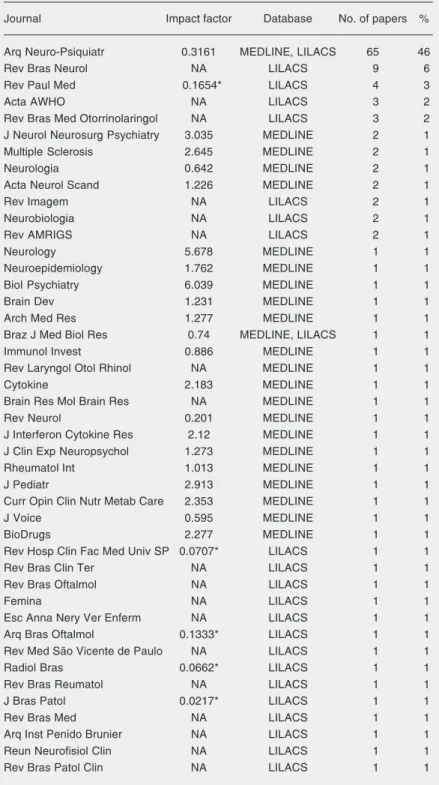
MEDLINE published in 23 different jour-nals and 117 documents in the LILACS database published in 23 journals (Table 1). Sixty-seven papers appeared in both data-bases and 50 documents appeared in LI-LACS but not in MEDLINE. The earliest paper found in MEDLINE was published in 1982 and the earliest found in LILACS was published in 1981.
The Brazilian documents published dur-ing the period comprised 65 original publi-cations, 37 case reports, 20 reviews, 6 PhD dissertations, 5 guidelines, 2 validation stud-ies, 2 clinical trials, 2 chapters in textbooks, 1 Master of Science thesis, and 1 patient education handout. The mean publication rate was 5.9 per year. In spite of some yearly oscillations, there was an increase in publi-cations with timeas shown in Figure 1. From 1981 to 1985 Brazilian investigators pro-duced 10 papers on MS, whereas from 2000 to 2004 the output was 53. The publication growth in the field of MS is similar to that of Brazilian scientific output in medical sci-ences which increased from 1889 papers in 1981 to 10,555 in 2001 (4).
Brazilian investigators published their papers in 44 different journals - 22 Brazilian and 22 foreign journals - with an impact factor (IF) ranging from 0.0217 to 6.039. Only 2 of the Brazilian journals - Arquivos de Neuro-Psiquiatria, IF 0.3161, and Bra-zilian Journal of Medical and Biological Research, IF 0.74 - are indexed in the MEDLINE database. Sixty-five papers were published in the Arquivos de Neuro-Psi-quiatria and only 1 in the Brazilian Journal of Medical and Biological Research. The remaining 25 papers in MEDLINE were pub-lished in foreign journals.
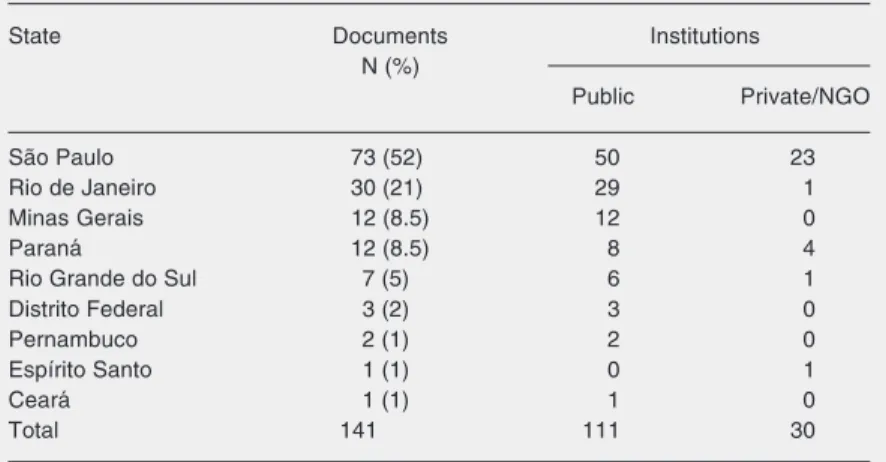
The State of São Paulo was the most productive state in the country, accounting for 73 papers (52%), followed by the States of Rio de Janeiro (30 papers, 21%), Minas Gerais and Paraná (12 papers, 8.5% each), Rio Grande do Sul (7 papers, 5%) and Fed-eral District with 3 papers, Pernambuco with
Table 1. Journals in which Brazilian papers on multiple sclerosis were published during the period from 1981 to 2004.
Journal Impact factor Database No. of papers %
Arq Neuro-Psiquiatr 0.3161 MEDLINE, LILACS 65 46
Rev Bras Neurol NA LILACS 9 6
Rev Paul Med 0.1654* LILACS 4 3
Acta AWHO NA LILACS 3 2
Rev Bras Med Otorrinolaringol NA LILACS 3 2
J Neurol Neurosurg Psychiatry 3.035 MEDLINE 2 1
Multiple Sclerosis 2.645 MEDLINE 2 1
Neurologia 0.642 MEDLINE 2 1
Acta Neurol Scand 1.226 MEDLINE 2 1
Rev Imagem NA LILACS 2 1
Neurobiologia NA LILACS 2 1
Rev AMRIGS NA LILACS 2 1
Neurology 5.678 MEDLINE 1 1
Neuroepidemiology 1.762 MEDLINE 1 1
Biol Psychiatry 6.039 MEDLINE 1 1
Brain Dev 1.231 MEDLINE 1 1
Arch Med Res 1.277 MEDLINE 1 1
Braz J Med Biol Res 0.74 MEDLINE, LILACS 1 1
Immunol Invest 0.886 MEDLINE 1 1
Rev Laryngol Otol Rhinol NA MEDLINE 1 1
Cytokine 2.183 MEDLINE 1 1
Brain Res Mol Brain Res NA MEDLINE 1 1
Rev Neurol 0.201 MEDLINE 1 1
J Interferon Cytokine Res 2.12 MEDLINE 1 1
J Clin Exp Neuropsychol 1.273 MEDLINE 1 1
Rheumatol Int 1.013 MEDLINE 1 1
J Pediatr 2.913 MEDLINE 1 1
Curr Opin Clin Nutr Metab Care 2.353 MEDLINE 1 1
J Voice 0.595 MEDLINE 1 1
BioDrugs 2.277 MEDLINE 1 1
Rev Hosp Clin Fac Med Univ SP 0.0707* LILACS 1 1
Rev Bras Clin Ter NA LILACS 1 1
Rev Bras Oftalmol NA LILACS 1 1
Femina NA LILACS 1 1
Esc Anna Nery Ver Enferm NA LILACS 1 1
Arq Bras Oftalmol 0.1333* LILACS 1 1
Rev Med São Vicente de Paulo NA LILACS 1 1
Radiol Bras 0.0662* LILACS 1 1
Rev Bras Reumatol NA LILACS 1 1
J Bras Patol 0.0217* LILACS 1 1
Rev Bras Med NA LILACS 1 1
Arq Inst Penido Brunier NA LILACS 1 1
Reun Neurofisiol Clin NA LILACS 1 1
Rev Bras Patol Clin NA LILACS 1 1
Figure 1. Growth of papers published on multiple sclerosis in Brazil. The line indicates the trend of growth.
2, whereas the State of Espírito Santo and Ceará contributed with 1 paper each. Re-garding the geographical regions of the coun-try, 82.5% of the papers were produced in the Southeast, 13.5% in the South, 2% in the Northeast, and 2% in the West.
Of the 141 documents, 111 were pro-duced in 17 public universities (5 State Uni-versities and 12 Federal UniUni-versities), 29 in 3 private medical schools, and 1 in a non-governmental organization, as shown in Table 2.
Ninety-one documents (65%) were writ-ten in Portuguese, 48 (34%) in English, 1 in French, and 1 in Spanish. Of the 91 papers from MEDLINE, 48 were written in En-glish, 41 in Portuguese, 1 in French, and 1 in Spanish. On the other hand, all of the 50 documents exclusively found in the LILACS database were written in Portuguese. Portu-guese was also the language of 40 (65%) of 65 papers published by the Arquivos de Neuro-Psiquiatria. Of the remaining 25 pa-pers published by this journal, 24 (37%) were written in English and 1 (1%) in French. The single paper published by the Brazilian Journal of Medical and Biological Research was written in English.
Brazilian documents addressed a diver-sity of themes in the field of MS, the vast majority of them dealing with clinical and immunological aspects of the disease, as shown in Table 3.
Table 2. Origin of the Brazilian output on multiple sclerosis during the period from 1982 to 2004.
State Documents Institutions
N (%)
Public Private/NGO
São Paulo 73 (52) 50 23
Rio de Janeiro 30 (21) 29 1
Minas Gerais 12 (8.5) 12 0
Paraná 12 (8.5) 8 4
Rio Grande do Sul 7 (5) 6 1
Distrito Federal 3 (2) 3 0
Pernambuco 2 (1) 2 0
Espírito Santo 1 (1) 0 1
Ceará 1 (1) 1 0
Total 141 111 30
Source: CNPq, Plataforma Lattes. NGO = non-governmental organization.
Table 3. Themes addressed by Brazilian multiple sclerosis documents.
Theme N %
Clinical aspects 47 33
Immunology 24 17
Neurobiology/Neurophysiology 16 11
Neuropsychology 13 9
Epidemiology 12 9
Treatment 12 9
Diagnosis review 6 4
Experimental autoimmune encephalomyelitis 4 3
Genetics 2 1
Imaging 2 1
Symptomatic management 1 1
History 1 1
Discussion
Scientific publishing is an intrinsic and important part of the process of disseminat-ing scientific knowledge and innovation. The use of the scientific literature as a measure of research activity has acquired great impor-tance in the assessment of the production and utilization of scientific information. The MEDLINE database was chosen because it is a biomedical website often accessed by the international scientific community and a frequently used tool for studies of scientific production (5-9).
However, due to some inherent limita-tions of the available databases, the accu-racy of the data cannot be fully relied on (10,11). The present paper illustrates some of these shortcomings very clearly. In the search strategy, for example, the field “af-filiation” has not been designed necessarily as an indication of the place where the re-search was conducted, though, in most cases, it could indicate it. This field of the search inquiry indicates the geographical location of only the first author when this informa-tion has been supplied in the document.
It has been observed that investigators have not been indicating their academic af-filiation in a standardized and informative way and an inappropriate indication of these data not only makes it difficult for the author to be reached by those interested in the re-search, but also prevents adequate registra-tion of the paper in the database and other information systems (12). In an attempt to reduce the impact of bias regarding the coun-try of origin of the first author and to avoid missing papers due to non-standardized in-formation in this field, we used both the “Brasil” and “Brazil” spellings. We took into account only the first author’s institu-tion and address, even in documents co-authored by investigators in different states. As a result, if Brazilian researchers were not the first authors in international co-authored papers, the work might not be considered.
Another methodological limitation concerns the field “MeSH Major Topic” in the search strategy of the MEDLINE database. By the use of this strategy papers on MS were cited only if the term “multiple sclerosis” was clearly defined by their authors as their main topic. The search mechanisms of the LI-LACS database contain similar limitations.
Our previous study on the geographical distribution of MS papers in the world (1) showed a marked disparity across different countries. Likewise, the present paper dem-onstrates huge disparities in different geo-graphical areas of Brazil. Most Brazilian papers come from São Paulo, Rio de Janeiro and Minas Gerais in Southeastern Brazil. Investigators in Southeastern and Southern Brazil have produced over 90% of the total scientific output in the field of MS. This finding may be explained by the fact that over 80% of the research groups in Brazil are located in these areas of the country (13). The present study also showed that the vast majority of the documents in the field of MS in Brazil have been produced by inves-tigators working at public medical schools. Only 3 private medical schools and 1 non-governmental organization have contributed to the Brazilian output in this field.
fluid acceptance criteria.
Of the 27 LILACS-indexed journals con-taining papers and other communications on MS, only 7 have available IF with values ranging from 0.0217 to 0.74 (median 0.38). It has been pointed out that the IF has clear limitations as a measure of a journal’s scien-tific value and that factors such as language, degree of specialization, regional location, and visibility of journals influence the accu-mulation of citations (14,15). The IF, there-fore, may rather reflect the impactof a jour-nal in which a paper is published than its intrinsic scientific quality. In spite of these limitations, it remains a practical measure of the penetration with which a paper reaches the scientific community, therefore having a chance to modify concepts and behaviors.
The present study shows that the interest in the study of MS has increased over the years in Brazil as reflected by the increased
number of papers. This growth in the field of MS is part of the increased scientific output by Brazilian investigators in other areas (4). However, most of the papers on MS have been written in Portuguese and have ap-peared in predominantly local medical jour-nals with a low IF. Since MS is a disease with a much higher prevalence in the United States and Europe than in Brazil, Brazilian investigators in this field should aim at mak-ing their observations reach a broader scien-tific audience. We believe that adherence to stricter criteria of quality for carrying out and reporting research, attention to interna-tional editorial conventions and the use of the English language to communicate the findings should contribute to making Brazil-ian papers appear in journals with higher IF, and become more visible to the international scientific community.
References
1. Lana-Peixoto M, Araujo C, Macedo R, Haase VG. Studies on mul-tiple sclerosis: the geographical distribution. Mult Scler 2002; 8 (Suppl 1): S39 (Abstract).
2. Lana-Peixoto M, Araujo C, Macedo R, Haase V, Monteiro LP. Stud-ies on multiple sclerosis: the gross domestic product as an index of scientific productivity. Mult Scler 2004; 10 (Suppl 2): S138 (Ab-stract).
3. ISI - Institute for Scientific Information. Journal citation report. Phila-delphia: Thomson ISI; 2003.
4. Coura JR, Willcox LC. Impact factor, scientific production and qual-ity of Brazilian medical journals. Mem Inst Oswaldo Cruz 2003; 98: 293-297.
5. Frame JD, Narin F. The international distribution of biomedical pub-lications. Fed Proc 1977; 36: 1790-1795.
6. Weisinger JR, Bellorin-Font E. Latin American nephrology: scientific production and impact of the publications. Kidney Int 1999; 56: 1584-1590.
7. Kremer JA, Braat DD, Evers JL. Geographical distribution of publi-cations in human reproduction and fertility and sterility in the 1990s.
Hum Reprod 2000; 15: 1653-1656.
8. Garcia-Rio F, Serrano S, Dorgham A, Alarez-Sala R, Ruiz PA, Pino
JM, et al. A bibliometric evaluation of European Union research of the respiratory system from 1987-1998. Eur Respir J 2001; 17: 1175-1180.
9. Grossi F, Belvedere O, Rosso R. Geography of clinical cancer research publications from 1995 to 1999. Eur J Cancer 2003; 39: 106-111.
10. Spinak E. Quantitative analyses of scientific literature and their validity for judging Latin American production. Bull Pan Am Health Organ 1995; 29: 352-359.
11. King J. A review of bibliometric and other science indicators and their role in research evaluation. J Inf Sci 1987; 13: 261-276. 12. Meneghini R. Systematization of academic and scientific affiliation,
or how to prevent data on your publications from being lost in the national and international data base. Braz J Med Biol Res 1995; 28: 617-619.
13. Coimbra CE Jr. Challenges for scientific output and communica-tions in health in Brazil. Cad Saude Publica 2003; 19: 4-5. 14. Seglen PO. Why the impact factor of journals should not be used for
evaluating research. BMJ 1997; 314: 498-502.
15. Luukkonen T. Bibliometrics and evaluation of research performance.