Shyness in consumer behavior
Issued on 26.05.2017
Supervisor: Irene Consiglio
Course of studies: International Management
Nova School of Business and Economics, Lisbon, Portugal
from
Sandra Kusterer
Alemannenstr. 4, 89426 Wittislingen
Abstract
Title: Shyness in consumer behavior
Shyness is widespread among the population and affects a large group of consumers.
Companies, however, have barely knowledge about this kind of consumers and their behavior.
Particularly in the field of complaint management the barriers which prevent consumers of
voicing a complaint are largely unknown and quite often companies are not aware of the
dissatisfaction among their customers. Thus, this paper aims to analyze the impact of shyness
on consumer complaint behavior. A survey-based approach was performed and it was
detected that shy consumers have a slight preference for online over offline channels when
complaining directly to the company. Further, shy consumers call less likely the customer
service than non-shy consumers to voice their dissatisfaction.
Table of Contents
Abstract ... 2
Table of Contents ... 3
List of figures ... 3
1. Introduction ... 4
2.Theoretical Foundation... 4
2.1. Consumer Complaint Behavior ... 4
2.2. Shyness and Complaining ... 8
2.2.1. Shyness as a psychological construct ... 8
2.2.2.The role of shyness in complaining behavior ... 10
3.Methodological Approach ... 13
3.1. Approach ... 13
3.2. Sample Group ... 15
4.Data Analysis ... 16
4.1. Data Analysis of consumer complaint survey ... 16
4.2.Data Analysis of follow-up survey ... 21
5.General Discussion ... 21
5.1. Discussion of results ... 21
5.2. Critical Reflection and Limitations ... 22
5.3. Recommendations ... 24
6. Conclusion and suggestions for further research ... 25
7. References ... 26
List of figures Figure 1: Adapted Complaining Behavior Framework ... 7
Figure 2: Restaurant Scenario ... 15
Figure 3: Shyness and its impact on direct complaints ... 17
Figure 4: Complaint towards company vs. friends and family members ... 18
Figure 5: Complaint through online vs. offline channels ... 20
1. Introduction
4% of unhappy customers voice their complaint directly to the company (1st Financial
Training Services 2009). In other words, for every direct customer complaint, there are about
25 other unsatisfied customers, who remain silent (Shaw 2013). Voiced complaints are only
the tip of the iceberg. Thus, the absence of negative feedback does not automatically mean
overall customer satisfaction is high. Often the intentions of dissatisfied customers are
unclear. So far the behavior of so called non-complainers did not yet receive much attention
in literature discussing consumer complaining behavior. Little research has been done about
consumers’ reactions on critical incidents and their decisions on voicing a complaint or
remaining silent. (Cho, Im, Hiltz et. al. 2002)
Nearly every second person in the world claims to be shy. Scientists furthermore were able to
demonstrate that this prevalence of self-reported shyness is increasing (Carducci 2000;
Henderson, Gilbert, and Zimbardo 2014). Considering that shyness is a widespread
phenomenon and affects a large proportion of the population it is of great importance to shed
light on the impact shyness has on consumer behavior. Further, companies barely know about
the preferences of shy consumers as those engage less in social situations and try to avoid
interacting with strangers. When dealing with consumer complaining behavior shyness might
prevent customers from complaining as this requires a certain degree of interaction with the
company (strangers). The following paper thus focuses on the role of shyness in complaint
management. (Whitten 2001)
2. Theoretical Foundation
2.1. Consumer Complaint Behavior
A complaint is defined as “an expression of dissatisfaction on a consumer’s behalf to a
post-purchase evaluation and might not always lead to a behavioral response towards the
responsible party. To analyze the different response patterns of customer dissatisfaction,
Hirschmann developed the first consumer complaining behavior framework in 1974. This
framework classifies the complaining patterns in “exit”, “voice” and “loyalty”. Moreover,
complaining response patterns have been categorized into: Passives, Voicers, Irates and
Activists (Singh 1988). Day and Landon (1977), on the contrary, developed a two-level
complaining behavior framework.
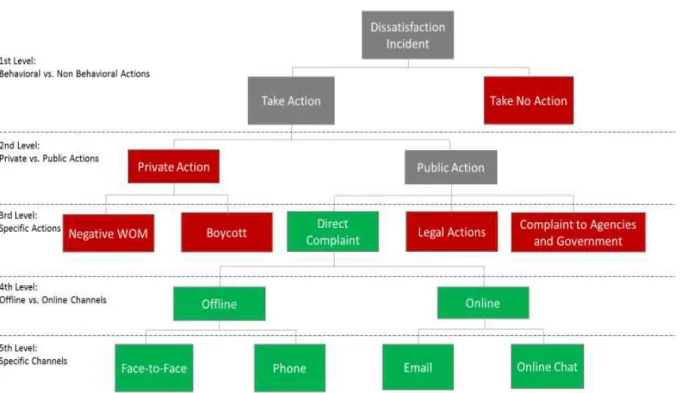
At the beginning of the framework stands a dissatisfaction incident, which failed to meet the
customers’ expectations. Such incidents are unavoidable and affect every company regardless
its size or industry (Zaugg 2006). Dissatisfaction can be caused by employees (20%), the
customer itself (40%) or by the product or the process (40%). In case the employee fails to
deliver the required service, customers are four times more likely to switch to the competitor
instead of when the dissatisfaction is caused by a product or process related failure. The
degree of customer dissatisfaction differs strongly among individuals as customers have
disparate expectations towards the company (Goodman and Newman 2003). Thus, not every
customer dissatisfaction leads automatically to a complaint. The decision to voice a complaint
or not is influenced by several factors. For example, consumer complaint behavior might be
triggered by the importance of the product for the individual, the likelihood of success of the
complaint, the product importance and the individual’s ability and willingness to voice such a
complaint. Lee and Cude (2012) identified three types of factors influencing customer
complaint propensity:
- Product-specific factors: product importance, involvement, price-performance ratio
- Environmental factors: complaint situation, seriousness of the problem, cost of
complaining, convenience of complaint channels, firm’s responsiveness, industry and
- Consumer-related factors: personal characteristics and values, loyalty, demographics,
emotions, degree of dissatisfaction, attitudes towards complaining and the company
While several factors play an important role in the decision of voicing a complaint or not, Day
and Landon distinguish on the first level of their framework between behavioral (“Take
Action”) and non-behavioral responses (“Take No Action”). Non-behavioral responses are
considered as “forget about the incident and do nothing.”
On the second level of the framework the behavioral category is divided into “Private Action”
and “Public Action”. Private actions are largely invisible for companies and imply negative
word-of-mouth as well as personal boycott of the brand, which can be equated with the end of
the relationship. Public actions, contrariwise, are visible for the company and can be
“complaints towards agencies or governments”, “legal actions” or “direct complaints”
towards the company. Consumers might engage in several of those options to express their
dissatisfaction. Those options represent the third level of the framework. In this context a
voiced complaint is understood as a public action directed towards the company as the
responsible party. A silent complaint, on the contrary, is not voiced to the company directly.
Nonetheless, a silent complaint can be voiced towards third parties. (Ro and Mattila 2015)
To shed further light on the channel choice when voicing direct complaints, Mattila and Wirtz
(2006) extended the framework from Day and Landon by two other levels: the tendency
towards interactive and remote channels and the channel of communication. As online
channels increasingly gain importance in the communication, the framework was adapted
accordingly (Figure 1). Thus, on the fourth level of the framework it is distinguished between
“offline” and “online” channels. Offline channels might be face-to-face interactions as well as
phone calls, which allow an immediate interaction with the company, but require high
psychological costs. Online channels, on the contrary, allow for a high degree of anonymity
Figure 1: Adapted Complaining Behavior Framework
Source: Adapted from Day and Landon (1977)
From a company’s perspective, the desired consumer complaining pattern (marked in green)
consists of a dissatisfied customer “taking action” after a critical incident and addressing its
complaint to the company directly without any further public or private action. In addition,
companies should see complaints as opportunities to improve their services and products.
Implemented changes and realized improvements might not only lead to higher customer
satisfaction, but also improve brand loyalty and therefore even profitability. There is rarely
any other so easily accessible source of customer insights. Thus, complaints are highly
valuable information, which can be used for product improvements, quality insurance and
market studies without any high investments. (Barlow and Müller 1996; Zaugg 2006)
The worst-case scenario (marked in red) from an organizational perspective is that the
customer voices his complaint to third parties (e.g. friends, family members, agencies,
governments or legal institutions) and additionally boycotts the brand. In this case the
respective improvements. Customers not directly addressing the company with their
complaint is disastrous for the success of every company as negative word-of-mouth might
lead to revenue losses and a bad market image (Zaugg 2006). A dissatisfied customer tells on
average 9-15 people about his negative experience, while a customer who gets his issue
resolved tells between 4-6 people (Shaw 2013). Those numbers emphasize that customers
penalize organizations disproportionally for poor customer service. It takes 12 positive
experiences to compensate for one unresolved negative experience (Goodman and Newman
2003). Apart from the negative word-of-mouth it is furthermore crucial for companies to not
lose an existing customer. Studies show that the costs of acquiring a new customer are six
times higher than retaining an existing one. The purchase intention of an existing customer is
between 60–70%, while the probability that a new customer buys a product or service is only
between 5–20%. Also, a 2% increase of the retention rate has the same effect on company
profitability as a 10% decrease in costs. Those findings demonstrate impressively that it is
essential for a company’s success to retain its customers and to establish a strong customer
relationship, which prevents the termination of this relationship after a critical incident. (Shaw
2013)
2.2. Shyness and Complaining
2.2.1. Shyness as a psychological construct
Zimbardo (2014 p.98) defines shyness as “a heighted state of individuation characterized by
excessive egocentric preoccupation and overconcern with social evaluation, …, with the
consequence that the shy inhibits, withdraws, avoids and escapes social interactions.” In other
words, shyness is understood as a discomfort and inhibition in the presence of other
Shyness has three characteristics: little self-confidence, excessive negative self-evaluation and
excessive negative self-preoccupation. Shyness implies embarrassment, timidity, fear of
rejection or a reluctance to be exposed to inconvenient situations. Shy people engage less in
social situations, demonstrate fewer facial expressions, maintain a greater physical distance
than non-shy people and exhibit nervousness sometimes. The biggest challenge for shy people
is to deal with strangers, people from the opposite sex and people with authority. Shyness can
range from a simple occasionally feeling to inhibiting social phobia. (Saunders and Chester
2008; Whitten 2001)
As introversion is often used synonymously with shyness the two terms will be delimitated in
the following. Overall, shyness and introversion show some overlaps but are not
interchangeable. Introverts prefer solitary, but they do not fear social gatherings as shy people
do. What makes distinction difficult is that many shy people are introverted. However, there
exist also shy extroverts who function best in situations with assigned roles. Carducci (1995
p.38) says: “If you see two people standing by a wall at a party, the introvert is there because
he wants to be and the shy person is there because he feels like he has to be there.” (Thiessen
2008, Henderson, Gilbert, and Zimbardo 2014)
In one of the largest clinical studies, a questionnaire was developed to detect the level of
shyness among the population (Zimbardo and Carducci 1995). Overall, 5000 respondents
completed the Stanford Shyness Survey. Not very surprising, the study revealed that 80% of
the respondents reported that they felt shy at some point of their life. However, 40%
mentioned that they feel currently shy and 91% out of the currently shy admitted that they
actively make an effort to overcome their shyness (Saunders and Chester 2008). 65% of the
respondents perceive shyness as an intrapersonal problem, while other research suggests that
shyness is not exclusively such an intrapersonal problem. External factors like the social
restrict them in their abilities. For example, the performance of shy pupils might be
constrained by an extroverted teacher, who values active involvement in lectures more than
written exercises (Carducci 2000). Moreover, the negative stereotyping of shyness in Western
countries might even lead to social avoidance and it makes it difficult for shy people to
improve their social skills (Henderson, Gilbert, and Zimbardo 2014). Similar observations can
be made regarding technical advances. Zimbardo (1995) mentioned that under the strong
influence of digital technologies shyness was becoming an epidemic. Digital technologies like
the internet, Emails and social media channels force people to avoid personal contact and do
not provide shy people with sufficient social interactions to improve their social skills.
Zimbardo (1995) figured that by 2000 it would be possible to live a whole day without
communication to another living person. The way of communication becomes increasingly
faceless and leads easier to mistreatment and disrespect. Technological advances change the
culture at an increasing pace. These circumstances lead to less patience and less tolerance
towards people who need their time to get familiar with the respective circumstances.
Therefore, it can be derived that technological advances disadvantage shy people in training
their social skills. Not surprisingly, surveys show that the level of shyness among the
population increased from 40% to 48% over the last decade and a half. (Carducci 2000)
2.2.2.The role of shyness in complaining behavior
As stated previously, the complaint intentions of consumers depend on several factors and
only a few of them have been analyzed in the literature. As shyness was never analyzed, some
Shyness and direct complaints
Stephens and Gwinner (1998) find that customers who fear external blame and shame will
more likely project the service failure on themselves than on the company. Thus, they will
more likely remain silent than voicing their dissatisfaction towards the company. Another
study on individual and situational influences on consumer complaint behavior in 2010
detected that highly impulsive customers react more likely to critical incidents than low
impulsive ones. It is assumed that highly impulsive customers are spending less time
analyzing a critical incident. Low impulsive customers, on the contrary, think very carefully
about complaining and consider several options before taking an action (Sharma, Marshall,
Reday, et al. 2010). Further, a significant correlation between power balance and the
likelihood to voice a direct complaint was detected by Stephens and Gwinner (1998). As a
matter of course, people who feel powerless towards the company are less likely to voice a
direct complaint. Powerlessness was explained by belonging to a certain disadvantaged group
in the society. The findings of external blame, impulsive behavior and power balance between
the consumer and company might be affiliated with shyness and might conclude in a lower
amount of voiced complaints.
As stated earlier, shyness affects a large group of consumers and is constantly increasing
among the population. Voicing a direct complaint requires social interaction and engagement
with an unknown third party. As shy people try to avoid interactions with strangers, shyness
might prevent such consumers from voicing a direct complaint to the company (Saunders and
Chester 2008). Therefore, the question rises whether shyness plays a role in consumer
complaining behavior and if yes to which extent. The following hypothesis will test those
circumstances.
Shyness and negative word-of-mouth
“It is not difficult to imagine a consumer seeking help and reassurance from family and
friends when faced with a marketplace problem” (Stephens and Gwinner 1998 p.184).
Particularly, customers with a high self-confidence prefer negative word-of-mouth instead of
voicing a direct complaint (Balaji, Jha, and Royne 2015). Thus, the question arises whether
shy customers act accordingly:
Hypothesis 2: Shy consumersaremore likelyto complain tothird parties than
directly to the company
Shyness and channel choice
Shame proneness correlates with customer’s complaint channel choice (Mattila and Wirtz
2006). Consumers with a higher level of shame were more likely to avoid interactive channels
like face-to-face or phone calls. Internet interaction requires less effort than face-to-face
interaction and the anonymity makes it easier for shy people to communicate (Carducci
2000). Similar consumer behavior patterns were reported by Fletcher H. (2009) while
analyzing consumer reactions towards the purchase of adult bedroom accessories. A
manufacturer and direct marketer of adult bedroom accessories, increased its sales by a third
after implementing an online chat. Potential customers felt safer reaching out with their
questions about the products through an online chat rather than calling the customer center.
Furthermore, studies from Hertel et al. (2008) detected that introverts are more likely to
choose online communication over face-to-face interactions in comparison to extroverts. The
physical distance through online channels allows for more solitary. As shy people in
comparison to introverts fear physical closeness and lack in social engagement, it is of great
importance to study not only the impact of introversion on channel choice in consumer
whether shy people have a preference for online channels voicing their complaint rather than
offline channels.
Hypothesis 3: Shy consumers are more likely to choose online channels rather than
offline channels to voice their complaint
In the following section the proposed hypotheses will be tested and the respective
methodological approach to achieve these results is demonstrated.
3. Methodological Approach
3.1. Approach
To analyze the proposed hypotheses a survey-based research design was used. Participants
were exposed to an imaginary customer dissatisfaction scenario and were subsequently
questioned about their behavioral intentions to voice their dissatisfaction. The usage of a
scenario ensures control over some confounding influential factors like brand loyalty, product
category, price or other situational factors. This control over influential factors is not
guaranteed applying the critical incident technique, which is based on a recall of a dissatisfied
incident and is a frequently applied methodological approach in the field of consumer
behavior. (Sharma, Marshall, Reday, et al. 2010)
As the Better Business Bureau’s Top Complaints Statistic 2015 ranked the telecommunication
industry as the highest complaining industry and as receiving an incorrect bill was one of the
most common reasons for complaints, the survey scenario was chosen accordingly. Further,
as mobile phone services are used by a large majority of people, respondents can easily relate
to a situation of an overcharge (Better Business Bureau 2015). Thus, it can be ensured that
more accurate information is revealed about the respondents’ behavioral intentions. In the
phone service provider and were subsequently asked about their intentions to take actions.
Specifically, all participants read the following:
“Imagine, you just changed your mobile phone provider. After one month, you check your
bank account and see that you have been charged additionally 5,00€ for international calls from your mobile phone provider. You know that you did not do any international calls within
the last month. How likely would you be to take the following actions?”
The likelihood of taking any of the given actions was measured using a 7-item Likert scale1.
Thereby, the following options were given: call the customer service, write an Email to the
company, use the online chat of the company, tell a friend or family members about the
overcharge, say something negative about the company to friends and family members and
take no action at all. The provided answer options were chosen based on the framework of
consumer complaining behavior from Day and Landon. The interviewees had either the
choice to “take no action” or to “take action”, which could be private actions (negative
word-of-mouth by telling friends or family members about the overcharge or saying something
negative about the company to friends and family members) or public actions. The public
actions were exclusively options to complain directly to the company. Thereby, three different
channels were given. The channel choice was based on a study from PricewaterhouseCoopers
(PwC) demonstrating that “speaking over the phone” (81%), followed by “Email” (43%) and
“Online Chat” (39%) are the most common customer service channels. Similar results were
detected by PwC with regards to customer preference (84% calling, 55% Email, 41% online
chat). (Bothun et al. 2015; Day and Landon 1977)
To assess whether shyness influences consumer complaining behavior, the level of shyness
was measured by the 13-item revised Cheek and Buss Shyness Scale (RCBS).2 The RCBS is
1 Respondents was offered a choice of 7 pre-coded responses ranging from extremely unlikely to extremely
likely. Thus, the Likert Scale allows the individual to express his likelihood of taking an action or not.
2 One of the items to measure the level of shyness is “I feel tense when I’m with people I don’t know well”
the most commonly used measurement for shyness and has been applied in several empirical
studies. (Cheek et al. 2004)
Based on the results of the first survey a follow-up study was conducted. This follow-up study
was designed to identify whether the results of the first study can also be applied to other
fields in consumer behavior. A scenario in the pre-purchase phase was given, while the
respondents were asked to make a reservation at a restaurant. As it can be seen in Figure 2,
two restaurants in the same area, with the same price range, type of cuisine, opening hours,
rating and amount of reviews were provided to the interviewees. The only difference between
the two restaurants was the way to get in contact with the establishments: calling or booking a
table through the online calendar
Figure 2: Restaurant Scenario
Thereby, participants were asked the following: “Imagine, you would like to make a
reservation at one of those two restaurants. Which restaurant would you prefer?” The results
of the follow-up study are explained in a later section.
3.2. Sample Group
94 participants (mean age = 26) took part in the survey testing the impact of shyness on
consumer complaint behavior. Respondents were told that the purpose of the survey is to
employees (37%). The country of origin from the participants was quite diversified: German
(36%), American (12%), Egyptian (12%), Portuguese (7%) and other nationalities (33%).
4. Data Analysis
4.1. Data Analysis of consumer complaint survey
The following data analysis refers to the consumer complaint survey. Measuring the level of
shyness among the participants showed that about 38% are considered as particularly shy.
This proportion is similar to the overall estimated level of shyness (40%) among the
population. Furthermore, the vast majority of 83% stated that they consider the given scenario
as realistic and see it as necessary to take either public or private actions (88%) to voice their
dissatisfaction. This behavior reflects the belief that their complaint will make a change (70%)
and that they are concerned about the overcharge (70%). Most of the respondents stated that
complaining would not make them feel uncomfortable (69%) and is not too much of an effort
(54%). Among all the given possible actions participants stated with the highest likelihood
that they would tell friends or family members about the overcharge followed by saying
something negative about the company to friends and family members. On average, they
would tell about 6 friends and family members about the critical incident. This shows that
negative word-of-mouth is very common among consumers and critical for every company.
Considering the given possible direct complaining channels, the majority would call the
customer service, followed by writing an Email and using the online chat of the company.
Only 12% of the respondents stated that they would take no behavioral action and remain
Shyness and direct complaints
In the following section Hypothesis 1 - Shyness has a negative impact on voicing direct
complaints - is analyzed. The likelihood of voicing a direct complaint was determined through
the mean value of the three given channels (Call, Email and Online Chat). The impact of
shyness on direct consumer complaint behavior was analyzed by a regression analysis. Figure
3 displays the level of shyness on the x-axis and the likelihood of voicing a direct complaint
on the y-axis. This analysis revealed no effect of shyness (B = 0.03, t(x) = 0.30, p = .77).
Figure 3: Shyness and its impact on direct complaints
Shyness and negative word-of-mouth
To analyze whether shy consumers are more likely to complain to third parties than directly to
the company (Hypothesis 2) a mixed ANOVA was performed. Thereby, the interaction
between shyness and the likelihood of complaining towards friends and family members or
the company was tested. The likelihood to complain to the company directly was determined
by the average value of the three given channels. However, no significant difference between
the complaining behavior of shy and non-shy consumers was determined (p = .47). Indeed,
Figure 4 confirms that in general consumers have a higher tendency towards negative
on the y-axis. While the mean likelihood of complaining towards friends and family members
is about 5.80 for shy and non-shy consumers, the mean likelihood of complaining directly to
the company is with 4.88 by far lower. Having a closer look on the impact of shyness on
telling friends and family members about their dissatisfaction, no significant difference
between shy and non-shy consumers was noticed. In regards of voicing a direct complaint, the
figure demonstrates that shy consumers (5.08) voice slightly more likely a direct complaint
than non-shy consumers (4.76). Nonetheless, this slight difference between shy and non-shy
consumers can be left out of consideration as the impact of shyness on direct complaints was
already analyzed through the performed regression analysis in the previous section and no
significant correlation between the two indicators was detected.
Shyness and channel choice
In the next step, it is detected whether shy consumers are more likely using online channels to
complaint to the company than offline channels (Hypothesis 3). The likelihood to voice a
complaint through an online channel was determined by the mean value of writing an Email
and using the online chat. The likelihood of using an offline channel was determined by the
likelihood of calling the customer service. To test the interaction between shyness and
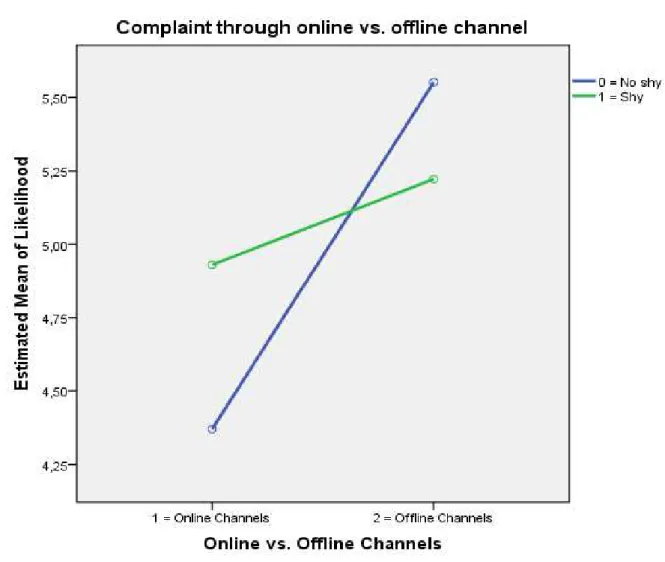
channel choice a mixed ANOVA analysis was performed. The results showed a marginal
significant interaction (p = .07). Thus, it can be said that shy consumers have a slight
preference for online channels in comparison to non-shy consumers. Figure 5 demonstrates on
the y-axis the likelihood to use a channel. The x-axis distinguishes between online vs. offline
channels. The blue line represents the behavior of the non-shy consumers and the green line
the behavior of the shy consumers. In general consumers have a preference for offline (5.43)
over online channels (4.58). Having a closer look on the behavior of shy and non-shy
consumers, it can be seen that shy consumers are more in favor of utilizing online channels
Figure 5: Complaint through online vs. offline channels
Taking a closer look at each of the respective channels, a significant correlation was
determinanted between calling the customer service and the level of shyness. Shy consumers
are less likely to call the customer service than non-shy ones (B = 0.21, t(x) = -2.09, p = .04).
Analyzing whether the level of shyness has an influence on writting an Email (B = 0.14, t(x)
= 1.37, p = .17) or using an online chat (B= 0.12, t(x) = 1.16, p = .25) to voice a complaint the
performed regression analysis did not show any significant correlations. The results of the
performed analyses are gathered in Figure 6. The indicators, which showed a (marginal)
significant correlation towards the examined level of shyness are highlighted in green. No
H1: Shyness has a negative impact on direct complaints
H2: Shy consumers complain more likely to friends and family members than to the company
H3: Shy consumers choose online over offline channels to voice their complaints
Shy consumers call less likely the customer service to complain than non-shy ones
Shy consumers write more likely an Email to voice their complaint than non-shy ones
Shy consumers use more likely the online chat to complain than non-shy ones
Figure 6: Overview of the analyzed hypotheses
4.2.Data Analysis of follow-up survey
In the follow-up survey, 47 people participated. The average age of the participants was 27
and the majority was employed (45%) followed by being a student (43%). Most of the
participants were Brazilians (38%), followed by Germans (32%), Americans (6%) and other
nationalities (24%). The proportion of shy participants (36%) is similar to the estimated level
of shyness among the population (40%). Analyzing whether shy people prefer to use an
online calendar to make a reservation at a restaurant rather than calling, showed a significant
correlation (B = 0.06, p = .04).
5. General Discussion
5.1. Discussion of results
Given the analyzed indicators it can be said that shy consumers are not less likely to voice
direct complaints than non-shy consumers. However, regardless their level of shyness
consumers have a higher tendency to voice their dissatisfaction towards friends and family
members instead of voicing it directly towards the company. The only marginal significant
interaction between shyness and consumer complaining behavior was determined with
regards to channel choice. Shy consumers are less likely to call the customer service and they
The study revealed that shy consumers do not behave differently on the first three levels of
Landon and Day’s consumer complaint framework. Shyness had only a minor influence on
the fourth level of the extended framework. This means, that shy consumers tend to select the
channel to voice their direct complaint differently than non-shy consumers. Similar results
have been seen in the follow-up survey when shy consumers had a preference to make a
reservation over online calendar versus calling the restaurant directly to make the reservation.
5.2. Critical Reflection and Limitations
It is necessary to be careful in drawing final conclusions about the impact of shyness on the
consumer complaint behavior as the self-assessment on shyness through the RCBS requires a
high ability of self-reflection. This ability is also of great importance to give accurate
information on the potential behavioral intentions. 72% of the participants indicated to voice
their dissatisfaction directly to the company. As statistics from the Financial Training
Services (2009) revealed that only about 4% of dissatisfied consumers complain directly to
the company, it can be anticipated that some of the interviewees would act differently in
reality than they stated in the questionnaire. The chosen scenario based approach does not
allow a deeper insight into the actions consumers would take in reality. Therefore, it is limited
in the extend to draw an accurate image on the consumer complaining behavior. Thus, it is
recommended to use another methodological approach (e.g. experiment) in further research to
draw a more realistic picture on the consumer intentions (Sharma, Marshall, Alan Reday, et al.
2010).
Consumer complaint behavior is influenced by several different factors as mentioned
previously. In the effort to draw a conclusion on shyness in consumer complaint behavior as
many influential factors as possible have been eliminated. Nonetheless, determinants like the
an impact on the decision to make a direct complaint. The survey-based research design does
not allow to eliminate and control all those factors. Further, the chosen critical incident itself
influences the choices of the respondents and might vary by selecting another scenario.
It is also critical that the sample group is small in size and not homogeneous in its origin. It
needs to be considered that the different cultural backgrounds of the respondents have an
impact on shyness and the likelihood to voice a complaint. Studies showed that shyness is not
only intrapersonal, but also influenced by environmental factors like culture. While shyness
exists among all cultures, the prevalence rate of shyness, however, varies from culture to
culture. Analyzing the effect of culture on shyness and complaining behavior would have
gone beyond the scope of this paper. (Saunders and Chester 2008)
Further, it should also be mentioned that the study lacks in a proportional distribution of age
and employment status. The average age of the respondents was 26 and the majority stated to
be student. This disproportional distribution and the scenario choice makes it difficult to draw
conclusions on the general consumer behavior and the respective behavioral attitudes of shy
individuals on other products/services and industries. In this context, it should also be
mentioned that the relatively young sample group is in general more familiar with online
channels and uses those more frequent than older generations.
Only a limited selection of channel choice was given in the questionnaire. Thus, it is critical
to conclude that there is a slight preference for online channels among shy consumers when
only one alternative as an offline channel was given. Offline channels can also be face-to-face
interactions or written letters. Moreover, the choice of online channels is not exclusively
based on writing an Email or using the online chat. Adding other channels to the survey might
have an impact on the results and the behavioral intentions of the participants. Nevertheless,
the given channels are the ones which are most likely used among the population according to
5.3. Recommendations
Regardless of the findings on shy consumers, companies in general should aim to receive as
many complaints as possible, resolve them fast and to the utmost satisfaction. Such an
exemplary reaction would consumer most likely prevent from boycotting the company or
spreading negative word to friends, family members or third parties.
As almost half of the population describes itself to be shy, companies and especially
employees need to be aware of this social insecurity when dealing with customers. On the one
hand, employees should be sensitive in communicating with shy consumers. Especially when
shy consumers voice their complaint through the phone, it is of great importance that
employees show comprehension and resolve the critical incident to the utmost customer
satisfaction. This positive experience leads to a higher possibility that the shy consumer will
reuse the respective channel to communicate with the company. Further, it provides shy
clients with the opportunity to train their social skills and to lose their social insecurity in the
long run.
On the other hand, to capture the group of shy consumers, it is also important to offer
sufficient online channels which have lower psychological costs and ensure a degree of
anonymity. In this context Aberdeen Group Inc. claims that companies with a strong customer
engagement strategy on omni-channels retain about 89% of their clients (Kulbyte 2016). It is
recommended to offer online complaining channels, which guarantee anonymity but also
allow a fast interaction with the customer to resolve the issue and to avoid negative
word-of-mouth. To ensure anonymity and fast interaction, the implementation of live chats on
companies’ homepages could be a suitable solution to capture the shy consumers as well.
Despite the fact that the conducted survey did not show a higher likelihood for online chats
among shy consumers, it should be considered, that online chats are still in its infancy and
6. Conclusion and suggestions for further research
As a conclusion, it can be said that shyness does not have a significant impact on the high
percentage of non-complainers. Non-shy and shy consumers do voice direct complaints and
complaints towards friends and family members equally. Further, there is no significant
difference in behavioral and behavioral actions to voice a complaint among shy and
non-shy consumers. The only marginal significant differences among those consumers are that
they have a higher preference for online versus offline complaining channels and that shy
consumers call the customer service less likely than non-shy consumers. As shy people are a
large consumer group and very little is known about their complaining behavior, further
research on shyness and its impact on consumer intentions should be initiated. It is suggested
to investigate on the behavior of shy consumers especially in face-to-face interactions and
how shyness can be neutralized in such situations. In addition, it would be of importance to
analyze the impact of culture on shyness and complaining attitudes. As the follow-up study
gave already an indication about the impact of shyness on pre-purchase decisions, it is
recommended to conduct a more comprehensive study and to investigate on other fields
among the purchase process as well. Further research on shyness and its impact on consumer
behavior would allow companies to get a deeper insight in the behavioral intentions of many
customers. Additionally, this know-how would enable companies to initiate respective
7. References
1st Financial Training Services. 2009. “Don’t Lose Customers Because of Poor Customer
Service.” (800): 2–3.
Balaji, Makam; Subhash, Jha and Royne, Marla. 2015. “Customer E-Complaining
Behaviours Using Social Media.” The Service Industries Journal 35: 633–54.
Barlow, Janelle and Müller, Claus.1996. “The Complaint as Gift.” In , 9–69.
Better Business Bureau. 2015. BBB’s Top Complaints.
Bothun, Deborah; Lieberman, Matthew; McElfresh, Todd and Feeney, Laura. 2015.
Customer Care Evolution. United States of America.
Carducci, Bernardo.2000. “Shyness: The New Solution.” Psychology Today: 39–45.
Cheek, Jonathan et al. 2004. “Psychometric Properties of the Revised Cheek and Buss
Shyness Scale.” Journal of Personality Assessment 84(2): 186–93.
Cho, Yooncheong; Il Im, Hiltz, Roxanne and Fjermestad, Jerry. 2002. “The Effects of
Post-Purchase Evaluation Factors on Online vs. Offline Customer Complaining
Behavior: Implications for Customer Loyalty.” Advances in Consumer Research 29(1):
318–26.
Day, Ralph and Landon, Laird. 1977. “Toward a Theory of Consumer Complaining
Behavior.” Consumer and industrial buying behavior: 425–37.
Goodman, John and Newman, Steve. 2003. “Understand Customer Behavior And
Complaints.” Quality Progress (January): 51–55.
Henderson, Lynne; Gilbert, Paul and Zimbardo, Philip. 2014. Social Anxiety Shyness,
Social Anxiety and Social Phobia. Third Edit. Berkley: Elsevier Inc.
Hertel, Guido; Schroer, Joachim; Batinic, Bernard and Naumann, Sonja.2008. “Do Shy
People Prefer to Send Email?” Social Psychology 39(4): 231–43.
2017: 1–6. http://www.superoffice.com/blog/customer-experience-statistics/.
Landon, Laird. 1980. “The Direction of Consumer Complaint Research.” Advances in
Consumer 7: 335–38.
Lee, Seul and Cude, Brenda. 2012. “Consumer Complaint Channel Choice in Online and
Offline Purchases.” International Journal of Consumer Studies 36(1): 90–96.
Mattila, Anna, and Wirtz, Jochen. 2006. “Consumer Complaining to Firms: The
Determinants of Channel Choice.” Journal of Services Marketing 18(2): 147–55.
Ro, Heejung and Mattila, Anna. 2015. “Silent Voices: Nonbehavioral Reactions to Service
Failures.” Services Marketing Quarterly 36(2): 95–111.
Saunders, Peter Lee and Chester, Andrea. 2008. “Shyness and the Internet : Social
Problem or Panacea ?” Computers in Human Behavior 24: 2649–58.
Sharma, Piyush; Marshall, Roger; Reday, Peter Alan and Woonbong Na. 2010.
“Complainers versus Non-Complainers: A Multi-National Investigation of Individual
and Situational Influences on Customer Complaint Behaviour.” Journal of Marketing
Management 26(1–2): 163–80.
Shaw, Colin. 2013. “15 Statistics That Should Change The Business World – But Haven’t.”
Linked in: 5–7.
https://www.linkedin.com/pulse/20130604134550-284615-15-statistics-that-should-change-the-business-world-but-haven-t.
Singh, Jagdip. 1988. “Consumer Complaint Intentions and Behavior: Definitional and
Taxonomical Issues.” Journal of Marketing: 93–106.
Stephens, Nancy and Gwinner, Kevin. 1998. “Why Don’t Some People Complain? A
Cognitive-Emotive Process Model of Consumer Complaint Behavior.” Journal of the
Academy of Marketing Science 26(3): 172–89.
Whitten, Meredith. 2001. “All About Shyness.” PsychCentral: 1–4.
Zaugg, Alexandra Daniela. 2006. Channelspecific Consumer Complaint Behaviour : The
Case of Online Complaining. Bern, Switzerland.
Zimbardo, Philip and Carducci, Bernardo. 1995. “The Cost of Shyness.” Psychology