A Work Project, presented as part of the requirements for the Award of a Master Degree in Management from the NOVA – School of Business and Economics.
Neutralizing shyness in consumer behavior
Agata Julia Moruszewicz 3117
A Project carried out on the Master in Management Program, under the
supervision of Professor Irene Consiglio
2
Neutralizing shyness in consumer behavior
ABSTRACT
Shyness is a widespread phenomenon which is present in the lives of majority of people. Although it is important, it barely has been studied in business context. This thesis explores the way of neutralizing shyness by the psychological concept called misattribution of arousal, meaning the process of people making a wrong assumption of what cause them to feel aroused. The mechanism is studied in the business context, on the example of language course. Taking care of the shy customers may be useful for business owners who, by treating them differently, can attract new customers and therefore, earn money from that.
Keywords
Shyness
3
TABLE OF CONTENTS
INTRODUCTION ... 4
LITERATURE REVIEW ... 5
2.1. Shyness ... 5
2.2. Shyness and consumer behavior ... 6
2.3. Misattribution of arousal ... 9
PILOT STUDY ... 12
3.1. Procedure ... 12
3.2. Results ... 13
STUDY 1 ... 14
4.1. Procedure ... 14
4.2. Results ... 15
STUDY 2 ... 16
5.1. Procedure ... 17
5.2. Results ... 19
CONCLUSIONS AND DISCUSSION ... 21
FUTURE RESEARCH ... 22
REFERENCE LIST ... 24
4
INTRODUCTION
Surprisingly, shyness in reference to consumer behavior has been barely described in the literature. Nevertheless, it is very interesting and important issue from both theoretical and practical sides. Shyness is a widespread and universal phenomenon (Carducci and Golant 2000) – almost half of the society labels themselves as the shy (Zimbardo 1996). Those people have difficulties with meeting new people and making friends (Carducci 1995), but also giving a speech or in general being in new situations (Zimbardo 1996). Shy people act differently in their everyday lives (Zimbardo 1996), thus it is reasonable to assume that they also act differently as consumers, especially in some kinds of businesses where interacting with others is bigger, such as going to a club or participating in dance classes. Because shyness can somehow control people and make them ineffective in social and business situations (Carducci 2000), it seems useful to know how to neutralize shyness in consumer behavior and then, increase comfort of the shy and fight some of their inhibiting behaviors, such as avoidance of social situations. As a result, we may expect shy to be more likely to start using services they never used before or use them more often. Then, number of customers increases and therefore sales are bigger, what is above all, the main goal of every business.
5
LITERATURE REVIEW
2.1. Shyness
In the topic literature shyness has no single definition. Majority of researchers associate shyness with feelings such as uneasiness and discomfort (J. M. Cheek and Buss 1981), anxiety (Schmidt 1999), tense, worry, awkwardness (J. M. Cheek and Briggs 1990) or fear (Jones and Briggs 1986), which one can face in the company of other people (J. M. Cheek and Buss 1981; Schmidt 1999; Jones and Briggs 1986; Henderson, Zimbardo, and Carducci 1999). The simplest definition of shyness can be conceptualized as “discomfort and inhibition in the presence of other individuals” (Jones and Briggs 1986) and this state derives from the interpersonal nature of the situation rather than the external sources of threat and discomfort (Jones and Briggs 1986).
Researchers point out that the shy believe everyone is watching and judging them all the time (Carducci 2000) and they are too much focused on themselves and how they are perceived by others (Zimbardo 1996; Saunders and Chester 2008). Henderson, Zimbardo and Carducci mention also that shyness interferes with “pursuing one’s interpersonal or professional goals” (1999) because shy person wants to do a particular thing and know how to do it but in the same time is held back from doing it (Zimbardo 1996). He or she “feels imprisoned by their shyness” (Carducci 2000). Shyness makes people require extra time to adjust to every new situation (Carducci 2000), lower their self-esteem and make them more fearful (J. M. Cheek and Buss 1981). All in all, definitions differ but what glue them together is that all shy people think about themselves as shy (J. Cheek and Watson 1989; J. M. Cheek and Krasnoperova 1999).
6 cognitive levels of shyness which include: anxiety, feeling of embarrassment, sadness, shame or guilt, negative thoughts, excessive self-conscious and self-pity. All of those feelings may result in changes in behavior of the shy person: avoiding social situations, being more reserved and reluctant to public speaking and having problems with keeping a good eye contact (Kiran 2016; Henderson, Zimbardo, and Carducci 1999; Henderson, Gilbert, and Zimbardo 2014).
2.2. Shyness and consumer behavior
A lot was already written about shyness, but why should we, business people, bother about it? There is very little information in the literature about shyness and its influence on consumer behavior. However, there are some clues that may make us conclude that it is an important issue in a business world. First of all, shyness is a wide spread phenomenon. In Zimbardo’s research in 1977, it turned out that more than 80% of surveyed people stated they were shy at some point in their lives and over 40% were shy in the moment of the experiment (Zimbardo 1996). In later studies, the number of the shy were similar – 40% in long-lasting studies (Henderson, Zimbardo, and Carducci 1999), 48% in Carducci experiment (2000) and almost 50% in nine-year comparison (Carducci and Stein 1988). Ayesha Kiran states that shyness is experienced by everyone to some extent. Moreover, it is predicted that due to changes in culture, role of technology, increasing isolation, competitiveness and loneliness, the problem of shyness will be growing in the next decades (Zimbardo 1996; Carducci 2000; Carducci and Golant, 2000). Taking this into consideration, one can notice that almost every second consumer is shy and this number is growing. Therefore, the knowledge of how to deal with it is getting more and more significance.
7 the concept of Marketing 3.0 where the company is supposed to be concentrated on the higher values and needs of its customers. Looking from this perspective and taking into consideration that it is getting more and more difficult to get the customer and make him/her loyal, the importance of going outside the scheme is getting significance importance. The solution for that may be marketing more connected with psychological concepts.
Third, it seems reasonable to expect that because shyness affects all areas of lives, it may affect consumer behavior as well. There might be a lot of business situations in which the shy do not feel comfortable and simply avoid them. One of them is interacting with strangers or opposite sex (Zimbardo 1996). Talking to the sales people, shop assistant or waiters is present in any store or restaurant. Dhaundiyal and Coughlan tested that some shy people are often irritated by shop assistants who continually ask them how they can help. This behavior of sales people force leaving those particular stores or simply avoiding them on the shy (Dhaundiyal and Coughlan 2016). “Expectations of what people desire and expect from the service depends on level of shyness and sociability” (Dhaundiyal and Coughlan 2016). Dhaundiyal and Coughlan stated also that shyness has a positive effect on cognitive impulse buying tendencies, meaning those where buying refers to lack of planning and deliberation on the part of the consumer (2016).
8 The worst situation for the shy was found to be speaking in public to a big group of people who have high status and evaluate the person (Zimbardo 1996). Speaking in public is connected with speech anxiety which, as in every form of anxiety, is about people fearing “that they will fail
to make the desired impression on their audiences. They believe that as a consequence of this failure the audience will devalue their relationship with them” (Vertue 2003). It was proven that shy participants were more anxious while giving a speech than not shy participants (Pilkonis 1996). Moreover, shy people think their output is unworthy because they are afraid that others will think they are stupid. It is connected with the fact that the shy think they are constantly evaluated by others (Carducci and Golant 2000). As speaking in public is required in some business activities, such as language courses or any kind of workshops, it seems important to focus on this specific context.
9
H1: The shy are less likely participate in some kind of business activities (e.g. a language course) than not shy.
2.3. Misattribution of arousal
If shyness indeed affects the likelihood of attending some business situations, the question is what business can do about it, how to neutralize shyness in consumer behavior. Social psychology gives a possible answer for that – misattribution of arousal, a psychological concept that assumes people can experience emotional states without knowing their causes or attributing them to something different.
10 Going further, when it is not possible for a brain to find an immediate explanation of the emotion, it describes its feelings based on the cognitions available (Schachter and Singer 1962). Because a lot of stimuli have the same symptoms they can be mislabeled and then it is called misattribution of arousal. Arousal can be defined here as “a state of excitement or energy expenditure linked to a strong emotion” (Nugent 2013) and is accompanied by the faster heart rate, rapid breathing, dry mouth, trembling, etc. Misattribution of arousal suggests that we experience some emotions without knowing the reason of them, even though we think we know their sources. “According to Schachter’s theory, if one attributes the arousal from an emotional source (e.g. fear) to a non-emotional source (i.e. drug) the perception of the emotion is diminished.” (Cotton 1981). To illustrate better the concept of misattribution of arousal one can give an example of testing the link emotion – sexual attraction tested by Dutton and Aron (1974). They performed an experiment in a natural environment of participants. In the first one a group of men were asked to walk through one of the bridges – either scary suspension bridge or a “control” one – a solid bridge which did not cause any fear. After crossing the bridge and attractive woman interviewed them. The results were that the men who walked through the scary bridge had stronger sexual imagery and were more likely to pick the woman up. It shown that men who had symptoms like they were afraid, for instance faster hearts beating, they were misattributing this arousal to feeling of attraction in the presence of an attractive woman, when the real source of their feelings (faster heart beating) was fear caused by going through the scary bridge.
11 exciting music), shy people might be induced to think that the source of their felt arousal is not shyness (the real source), but the external source (e.g. music). As a result they may behave as less shy. This mechanism has been proven by Zimbardo and Brodt in their experiment (1981). The participants consisted of shy and not-shy women and were divided in two groups (misattributed and control). There were told that a high-frequency noise present during the experiment caused arousal. In fact, it was a neutral sound which aim was to attribute the feeling of increased heartbeat to the sound instead of shyness. During the experiment the participants also interacted with a male confederate who they thought was another participants. The results shown that shy women acted as if they were not shy in a presence of the male confederate after their shyness was misattributed. It has supported that the theory of misattribution can work in the case of shyness.
Besides shyness, the mechanism of misattribution has been applied in several arousing behaviors: to decrease insomnia (Storms and Nisbett 1970), to reduce inhibiting emotions in cheating (Dienstbier 1972), to diminish the irritation of smoking cessation (Cotton 1981, as cited in Barefoot and Girodo 1972), to show love-is-blind phenomenon (McClanahan et al. 1990), to eliminate attitude change (Tedeschi et al. 1986), and others.
There has been also other methods of misattribution, such as: placebo pills (Storms and Nisbett 1970), threat of electric shocks (Ross, Rodin, and Zimbardo 1969), physical exercise (Cotton 1981, as cited in Cantor et al. 1975), pictures (Drachman and Worchel 1976) or caffeine (Cotton 1981, as cited in Borkovec et al., 1974).
12 In this thesis I would like to test if it is possible to neutralize shyness in the business context, in particular while signing up for a language course. In order to check if neutralizing shyness in consumer behavior is doable, three studies were conducted. The exploratory pilot study was designed to determine which business activities the shy consumers are less likely to perform. The first study examined the specific context of language courses, and tested if the shy are less likely to sign up for a language course than not shy. If the hypothesis is supported, one can state that shy people are less likely to participate in some business activities. The second study was conducted to check the misattribution theory on shyness, in the specific context of language courses. Two following hypotheses are tested in the given studies:
H1: The shy are less likely to sign up for a language course than not shy.
H2: Shyness can be neutralized through the misattribution of arousal while signing up for a language course.
PILOT STUDY
Prior to two studies, I run a pilot test to assess which activities the shy consumers are less likely to engage in. The assumption was that the ones which are the least likely to happen are also the most disturbing and least comfortable, and therefore, it is the field where I should explore more with the further research and try to neutralize shyness in the context of one of those behaviors. As those situations may be worse for the shy consumers, it might be also a field to improve by business owners.
3.1. Procedure
13 described behaviors (e.g. “You want to order food with delivery. How likely are you to order by phone?” 1 = Extremely unlikely, 7 = Extremely likely; questions in appendix A). Next, respondents completed the 14-item McCroskey Shyness Scale (e.g. “Most people are more shy than I am.” 1 = Strongly disagree, 5 = Strongly agree; alpha reliability estimate > 0,9; Appendix B) (McCroskey and Richmond 1982).
3.2. Results
As expected, the respondents varied in terms of level of shyness (𝑀𝑠ℎ𝑦𝑛𝑒𝑠𝑠 =42,28, SD = 10,9). Because no significant correlation was found between level of shyness and gender (p>0,05), it will not be discussed further.
To determine which of the tested behaviors are the most related with the level of shyness, the correlation analysis was applied. Correlation coefficient Pearson r was computed (Table 1).
Table 1: Correlation between level of shyness and general behaviors (only significant results).
Level of shyness Likelihood of demanding a new dish in a restaurant after receiving a cold one -0,35* Likelihood of complaining to a manager after receiving a cold dish -0,436** Likelihood of calling a company and ask for help when having a problem with a
product -0,37*
Likelihood of asking an assistant for help when looking for a product in a store -0,375* Likelihood of asking people on the street for directions -0,328*
Likelihood of going to crowded places -0,382*
* = p < 0,05 ** = p < 0,01 *** = p < 0,001
14 study suggests that there are some social situations that shy people avoid and are less likely to perform.
In this study shy participants seemed to have the resistance in complaining directly to a manager after receiving a cold dish. However, there are other forms of complaining from which managers can leverage from, so lower likelihood of going to crowded places seems to be more relevant for further studies.
STUDY 1
As the pilot study distinguished crowded places as the ones less favorable for the shy, the first study concentrated on the behaviors which can be labeled as “crowded places”. One of those behaviors is a language course. It may be a difficult activity for shy people also from the theoretical point of view. Participating in a language course requires several situations that the shy do not feel comfortable in. The aim of this study was to test the first hypothesis, which is: The shy are less likely to sign up for a language course than not shy. After answering this question, I could move forward to the step of neutralizing shyness with the concept of misattribution.
4.1. Procedure
15
4.2. Results
On the basis of the Shyness Scale, the level of shyness differed among respondents (𝑀𝑠ℎ𝑦𝑛𝑒𝑠𝑠= 41,3; SD = 11,5). To determine which of the tested behavior is the most related with the level of shyness, the correlation analysis was applied. Correlation coefficient Pearson r was computed (Table 2).
Table 2: Correlation between level of shyness and given behaviors.
Level of shyness
Likelihood of gym attendance -0,019
Likelihood of taking part in the language course -0,29*
Likelihood of attending big music events 0,017*
Likelihood of taking part in dance classes -0,048
Likelihood of taking part in big sport events, as a spectator -0,037
Likelihood of going to the club -0,294*
* = p < 0,05 ** = p < 0,01 *** = p < 0,001
The significant results were obtained only in three cases. Unsurprisingly, the highest significant correlation was found between level of shyness and likelihood of going to the club. One can state that there is a medium negative correlation between those variables, meaning that the higher level of shyness, the lower likelihood of going to a club. The similar, significant medium negative correlation can be found between level of shyness and likelihood of taking part in a language course.
16 While the pilot test shown that likelihood of performing some behaviors as a consumer may be dependent on the level of shyness, this study supported that shyness is indeed correlated with certain consumer behaviors and that the shy are less likely to participate in language courses (H1).
STUDY 2
The previous studies resulted in knowledge of what behaviors can have the biggest importance in the business context and that shyness is correlated with likelihood of performing some of them. As it can be concluded from the second pilot study, going to the club and taking part in the language courses are the activities amongst studied ones which are the least likely to happen for the shy. Because of its significance, relevance and feasibility to improve, attracting shy people to the language schools was chosen as the behavior which was tried to be neutralized through the misattribution of arousal in the second study.
As written in the literature review, misattribution or arousal is possible in any state of anxiety. In the case of this study, this anxiety is shyness and the misattributing stimuli is exciting music. Based on the theory, I assumed that the chosen type of music (external source) aroused the participants and that the shy ones might assign their arousal feelings to the music (the external source) rather than to shyness (the real source). Consequently, they might behave as less shy and therefore, be as likely to sign up for the language course as the not shy participants.
17
5.1. Procedure
89 respondents from an international convenience sample took part in the experiment and completed an online questionnaire (appendix D). 47 of them were randomly assigned into the shy misattribution condition (40% male, Mage = 27,83, SD = 10,08 years) and the rest 42 was in the control group without misattribution (38% male, Mage = 27,64, SD = 10,71 years). All participants were unaware of the shyness-related base of the research.
First, respondents listened to a piece of music – as an arousing one in the misattribution group “Warriors” by Imagine Dragons was chosen, and as a relaxing one in the control group - “Gymnopédie no. 1” by Erik Satie. Those pieces of music were chosen because of their suitable
emotional character (arousing or relaxing). The arousing music is the misattribution part of the questionnaire. The aim is that shy participants in the misattribution group were expected to feel aroused by the music and attribute their symptoms (e.g. faster heart beating) to the exciting music. In the control group, the chosen piece was relaxing and quite neutral so no stronger emotions were awakened and eventual symptoms of shyness were attributed to shyness.
After listening to the music, a print screen of the International House language school was shown. The website’s language is English and the school offers a big variety of languages. Participants were asked how likely were they to take part in the language course (0 = “Extremely
18 for specific information spend more time on the specific website, so the music can be played in the background.
To eliminate possibility that low likelihood of taking part in the language course is caused by no interest in foreign language, an additional question was asked (“Are you interested in
speaking fluently another language?”, Yes/No).
Afterwards, the respondent chose the language she/he would like to know and was directed to the print screen of the specific language’s website with the same question of likelihood of signing up for the specific course (0 = “Extremely unlikely” , 11 = “Extremely likely”). If respondent chose the “other” option, he was asked to imagine he wanted to learn Spanish and asked the same question. To better check if participants were likely indeed to sing up for the course they were asked if they were willing (Yes/No) to get an email with the test checking their language knowledge and be contacted by the school. They were also promised a special discount. Later on, they were explained, it was not true.
Afterwards, manipulation check questions are shown. Participants were asked how much they liked the music (rating 10-item scale) and it was also tested which feelings were produced while listening to the music (multiple choice with up to 3 answers within options: relaxed, happy, bored, afraid, tense, anxious, excited, sad, awakened, neutral and other).
19
Independent and dependent variables
To test the hypothesis, the dependent variable was set as a likelihood to take part in the language course. It was measured in three ways: general likelihood to take part in any language course (called later general likelihood), likelihood in taking part in a particular course of a chosen language (called later specific likelihood), and willingness to do a language test and be contacted by language school to discuss details (called later behavioral likelihood). Three independent variables were manipulated: level of shyness, stimuli: arousing (1) vs relaxing (0), as dummy variables, and interaction which was computed by multiplying those two variables. To control variables, interest in knowing foreign language and likeliness of the stimuli were measured.
5.2. Results
The participants differed according to the reported level of shyness (𝑀𝑠ℎ𝑦𝑛𝑒𝑠𝑠 = 41,27, SD = 10,21 in the misattributed group; and 𝑀𝑠ℎ𝑦𝑛𝑒𝑠𝑠= 42,88; SD = 11,6 in the control group).
Almost all respondents (98,9%) would like to speak fluently another foreign language. Thanks to this, we can exclude the lack of desire to participate in a language course from possible extraneous variables. As a manipulation check, participants were asked to rate the played music (misattributed group: 𝑀𝑙𝑖𝑘𝑒𝑙𝑖𝑛𝑒𝑠𝑠 = 6,55/10, SD = 2,36 ; control group: 𝑀𝑙𝑖𝑘𝑒𝑙𝑖𝑛𝑒𝑠𝑠 = 6,92/10; SD =2,41). It was also checked that both stimuli produced projected feelings. Arousing music were described mainly as the exciting and awakening one (70%), while the relaxing music created neutral and relaxing feelings (81%). It indicates that played music fulfilled its role and introduced participants in the desired mood.
Shyness in the context of language courses
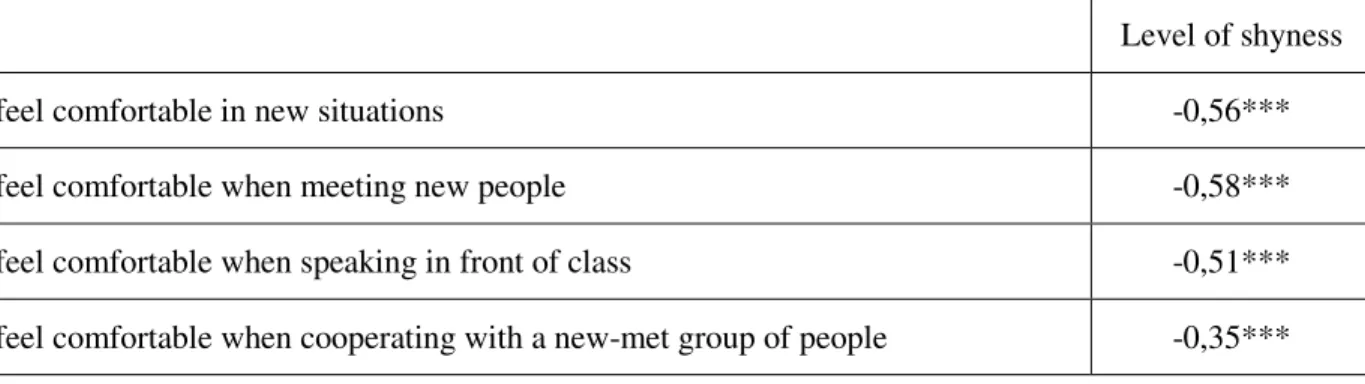
20 was performed. Quite strong significant negative correlation was found between level of shyness and four additional statements common while participating in the language courses (Table 3).
Table 3: Correlation between the level of shyness and comfort in situations present during language courses
Level of shyness
I feel comfortable in new situations -0,56***
I feel comfortable when meeting new people -0,58***
I feel comfortable when speaking in front of class -0,51*** I feel comfortable when cooperating with a new-met group of people -0,35***
* = p < 0,05 ** = p < 0,01 *** = p < 0,001
Hypothesis testing
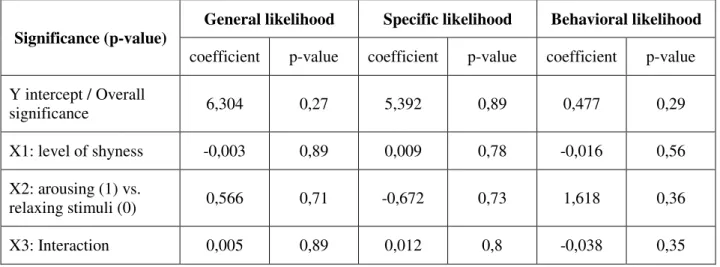
To test the hypothesis and determine if people with higher level of shyness are more likely to sign up for the language course after listening to the arousing music, than without this stimulus, I run regression analysis. The analysis was performed for three dependent variables: general likelihood, specific likelihood and behavioral likelihood. In the cases of general likelihood and specific likelihood the multiple linear regression was performed. But because the dependent variable in the third issue – behavioral variable is dichotomous, it was analyzed by the logistic regression.
21
Table 4: Coefficients and p-values of the regression analysis models.
Significance (p-value)
General likelihood Specific likelihood Behavioral likelihood
coefficient p-value coefficient p-value coefficient p-value Y intercept / Overall
significance 6,304 0,27 5,392 0,89 0,477 0,29
X1: level of shyness -0,003 0,89 0,009 0,78 -0,016 0,56 X2: arousing (1) vs.
relaxing stimuli (0) 0,566 0,71 -0,672 0,73 1,618 0,36
X3: Interaction 0,005 0,89 0,012 0,8 -0,038 0,35
CONCLUSIONS AND DISCUSSION
The obtained results supported the hypothesis that the shy are less likely to sign up for the language course, and that implies that there are some business activities which are less likely to happen for the shy. However, no statistically significant difference between likelihood of taking part in the language course by shy in the misattributed group and the control group was found. Therefore, the second hypothesis cannot be supported. Although this research was carefully prepared, there are some possible explanations why the results defied expectations.
First of all, there may be a better form of the research, instead of questionnaire. Placing participants in the more realistic situation, not in front of the computers, may cause more stress and arousal among the shy ones and misattribution may work better in that situation. It could be better to conduct a survey through the phone, face-to-face, or basically do an experiment in the language school imitating a real situation of singing up for the course.
22 website. It should be checked if misattribution works better when done simultaneously with the decision-making process.
Third, it was not guarded if the music (arousing stimuli) was actually played. The only thing I did to exclude this error was writing a request for listening music till the end. However, I cannot be sure, if respondents actually did it. Consequently, I suggest using a technique which displays arousing stimuli without the engagement of the participant.
Another thing may be that participants may have not liked the particular website of the language school that was presented. They may have had wrong associations with the school or basically the look of the website did not convince them. Maybe they would be willing to take part in the course when another website is shown.
In addition, since the research was done by the student, the sampling method was based on the network of friends. That is why it may have caused respondents selection error. The results may change when using a different sampling method.
Finally, it may be the case that the music stimuli is not the right choice in terms of the shy. It is possible that the shy feel even more shy and less comfortable while listening to the energetic and tense music. That would explain why they are less likely to go to a club where the music is rather arousing. If it is true, it means that the misattribution theory does not work under every condition and with every stimulus.
FUTURE RESEARCH
23 especially in the contemporary world, where there is a strong customization. As the pilot study and study 1 shown, there is indeed a relationship between level of shyness and likelihood of taking part in some business activities. It just needs to be studied more.
One of the idea is to check whether the people who are more shy can be misattributed in the same way as the less shy subjects. It is possible that the shy are so strongly closed in themselves that, energetic music causes the exactly opposite result from the wanted one – it makes them feel worse and, as in the case of shop assistants who continuously wanted to help them (Dhaundiyal and Coughlan 2016), they just want to leave the store. It is possible that for the shy it is basically too much and their only desire is to leave the room, or, as in this study, finish the questionnaire. On the other hand, it is possible that, misattribution of arousal without instructions does not work the same in the shy’ example because they basically do not believe in what they feel.
24
REFERENCE LIST
Brodt, Susan E., and Philip G. Zimbardo. 1981. “Modifying Shyness-Related Social Behavior through Symptom Misattribution.” Journal of Personality and Social Psychology 41 (3): 437–49.
Carducci, Bernardo J., and Nikki D. Stein.1988. “The Personal an Situational Pervasiveness of
Shyness in College Students : A Nine-Year Comparison.” paper presented at the Annual Meeting of the Southeastern Psychological Association, 31 March - 2 April. New Orleans.
Carducci, Bernardo J. 1995. “Are You Shy?” Psychology Today November/December: 34–40, 64, 66, 68, 70, 78, 82.
Carducci, Bernardo J.2000. “Shyness: The New Solution.” Psychology Today January/February: 39–45, 78.
Carducci, Bernardo J., and Susan K. Golant. 2000. Shyness: A Bold New Approach. New York: Harper Collins.
Cheek, Jonathan M., and Arnold H. Buss. 1981. “Shyness and Sociability.” Journal of Personality and Social Psychology 41 (2): 330–39.
Cheek, Jonathan, and Arden Watson. 1989. “The Definition of Shyness: Psychological
Imperialism or Construct Validity?” Journal of Social Behavior and Personality 4 (January): 85– 95.
Cheek, Jonathan M., and Stephen R. Briggs.1990. “Shyness as a Personality Trait.” In Shyness and Embarrassment: Perspectives from Social Psychology, edited by Ray W. Crozier, 315–37. Cambridge University Press.
Cheek, Jonathan M., and Elena N. Krasnoperova. 1999. “Varieties of Shyness in Adolescence
and Adulthood.” In Extreme Fear, Shyness, and Social Phobia: Origins, Biological Mechanisms, and Clinical Outcomes, 224–50. New York: Oxford Univeristy Press.
Chu, Hsiang-Ning Rebecca. 2008. “Shyness and EFL Learning in Taiwan: A Study of Shy and
Non-Shy College Students’ Use of Strategies, Foreign Language Anxiety, Motivation, and Willingness to Communicate.” Phd Dissertation, The University of Texas at Austin.
Cotton, John L. 1981. “A Review of Research on Shcachter’s Theory of Emotion and the
25
Dhaundiyal, Mayank, and Joseph Coughlan. 2016. “Investigating the Effects of Shyness and
Sociability on Customer Impulse Buying Tendencies: The Moderating Effect of Age and Gender.” International Journal of Retail & Distribution Management 44 (9): 923–39.
Dienstbier, Richard A.1972. “The Role of Anxiety and Arousal Attribution in Cheating.” Journal of Experimental Social Psychology 8 (2): 168–79.
Drachman, David, and Stephen Worchel. 1976. “Misattribution of Arousal as a Means of Dissonance Reduction.” Sociometry 39 (1): 53–59.
Dutton, Donald G., and Arthur P. Aron. 1974. “Some Evidence for Heightened Sexual
Attraction under Conditions of High Anxiety.” Journal of Personality and Social Psychology 30 (4): 510–17.
Henderson, Lynne, Paul Gilbert, and Philip Zimbardo. 2014. “Shyness, Social Anxiety and
Social Phobia.” In Social Anxiety: Clinical, Developmental, and Social Perspectives, edited by Stefan G. Hofmann and Patricia M. DiBartolo, 95–115. Elsevier.
Henderson, Lynne, Philip G. Zimbardo, and Bernardo J. Carducci. 1999. “Shyness - An Article for the Encyclopedia of Psychology.” Encyclopedia of Psychology.
Jones, Warren H., and Stephen R. Briggs. 1986. “Shyness: Conceptualization and
Measurement.” Jorunal of Personality and Social Psychology 51 (3): 629–39.
Kiran, Ayesha Manzoor. 2016. “Level of Shyness among the Public and Private Schools
Adolescents (13-18 Years): A Comparative Study.” Procedia - Social and Behavioral Sciences 217. Elsevier B.V.: 858–66.
McClanahan, Kimberly K., Joel A. Gold, Ellen Lenney, Richard M. Ryckman, and Gorden E. Kulberg. 1990. “Infatuation and Attraction to a Dissimilar Other: Why Is Love Blind?” Journal of Social Psychology 130 (4): 433–45.
McCroskey, James C., and Virginia P. Richmond. 1982. “Communication Apprehension and Shyness: Conceptual and Operational Distinctions.” Central States Speech Journal 33 (3): 458– 68.
Mohammadian, Tannaz. 2013. “The Effect of Shyness on Iranian EFL Learners. Language
26 3 (11): 2036–45.
Nugent, Pam M. 2013. "Arousal." PsychologyDictionary.org. https://psychologydictionary.org/arousal/ (accessed August 29, 2017).
Ordulj, Antonia, and Ivana Grabar. 2014. “Shyness and Foreign Language Anxiety.” In 2nd
International Conference on Foreign Language Teaching and Applied Linguistics “Linguistics, Culture and Identity in Foreign Language Education,” 215–22. Sarajevo.
Pilkonis, Paul A. 1996. “The Behavioral Consequences of Shyness.” Journal of Personality 60 (April): 31–46.
Ross, Lee, Judith Rodin, and Philip G. Zimbardo.1969. “Toward an Attribution Therapy: The
Reduction of Fear through Induced Cognitive-Emotional Misattribution.” Journal of Personality & Social Psychology 12 (4): 279–88.
Saunders, Peter Lee, and Andrea Chester.2008. “Shyness and the Internet: Social Problem or
Panacea?” Computers in Human Behavior 24 (6): 2649–58.
Schachter, S, and J E Singer. 1962. “Cognitive, Social, and Physiological Determinants of
Emotional State.” Psychological Review.
Schmidt, Louis A. 1999. “Frontal Brain Electrical Activity in Shyness and Sociability.” Psychological Science 10 (4): 316–20.
Sinclair, Robert C., Curt Hoffman, Melvin M. Mark, Leonard L. Martin, Tracie L. Pickering,1994. “Construct Accessibility and the Misattribution of Arousal : Schachter and Singer Revisited.” Psychological Science 5 (1): 15–19.
Storms, Michael D., and Richard E. Nisbett. 1970. “Insomnia and the Attribution Process.” Journal of Personality and Social Psychology 16 (2): 319–28.
Tedeschi, James T., Gerald G Gaes, Nancy Norman, and Valerie Melburg. 1986. “Pills and
Attitude Change: Misattribution of Arousal or Excuses for Negative Actions?” The Journal of General Psychology 113 (4): 309–28.
27
Vertue, Frances M.2003. “From Adaptive Emotion to Dysfunction: An Attachment Perspective
on Social Anxiety Disorder.” Personality and Social Psychology Review 7 (2): 170–91.
28
APPENDICES
Appendix 1: Pilot test – questionnaire
1. Please imagine yourself in the situations described below and answer the questions marking the right number.
(7-point Likert scale: 1 – Extremely unlikely, 2 - Unlikely, 3 – Somewhat unlikely, 4 – Undecided, 5 – Somewhat Likely, 6 – Likely, 7 – Extremely Likely)
a) You want to order food with delivery. How likely are you to: Order online / Order by phone b) You want to book a table in a restaurant you don’t know. How likely are you to: Book it online
/ Book it by phone
c) You find the service in the hotel you are staying very bad. How likely are you to: Complain in a place where you experienced it / Complain by phone / Make a complaint online
d) You are in the restaurant and the food you get is cold. How likely are you to: Demand a new dish / Ask for a chat with manager and complain to him/her / Eat food and after give the restaurant bad review in social media / Eat the food, do not complain in the social media and never go to this restaurant again
e) You want to return a product because you don’t like it. You still have 15 days to do it. How likely are you to: Return it online / Return it in the physical store
f) You want to exchange the product because the one you bought is too big. How likely are you to: Do it in a physical store / Do it online
g) The product you had bought broke after 2 days of using it. How likely are you to: Demand a refund in the store / Keep the product but never buy in this store again
h) You have a problem with a new bought product (e.g. computer). How likely are you to: Call the company and ask for help / Write an email or chat with the assistant online asking for help i) You are in the supermarket. There is no crowd and cashiers are available. How likely are you
to: Use self-cashier / Go to the normal cashier
29 k) You are alone in the crowded shopping center. You are hungry. How likely are you to: Order food and seat with someone you don’t know / Order food and seat aloof / Do not order and eat at home
l) You are in a restaurant with your friends. How likely are you going to: Order the same what your friends / Order something different
m) You are in the fast food restaurant. There is no crowd. How likely are you to: Order food at the self-ordering machine / Order food at the counter
n) You are in the crowded store. You cannot find the product you’re looking for. How likely are you going to: Find an assistant and ask for help / Go through the store avenues till you find it / Walk around and give up after a few minutes
o) You are in a Cafe. There are a lot of people around you so the place is loud. There is only one salesman and he has his hands full of work. How likely are you going to: Shout to the salesman to get his attention and then order / Wait for a while till he sees you and if it’s not happening leave Café
p) You are looking for a small hairdresser somewhere in Lisbon. You got lost. How likely are you going to: Ask for help people on the street / Google it and find directions through Internet q) [only for women] You are in the store with underwear. You’re choosing bras. How likely are
you going to: / Accept bra fitter’s help / Ask for a specific size if sales person is a man / Ask for a specific size if sales person is a woman (additional option Not applicable)
r) You have to buy condoms. How likely are you going to: Choose the store or pharmacy where you don’t have to ask for them and just pick the pack up from the shelf / Go to the pharmacy and ask for a pack
s) You have an intimate problem (e.g. hemorrhoids or fungal). You are in the pharmacy. How likely are you going to ask for medicine: If the pharmacist is the same gender you are / If the pharmacist is another gender
30 3. Please answer the question below: (7-point Likert scale: 1 – Extremely unlikely, 2 - Unlikely, 3 – Somewhat unlikely, 4 – Undecided, 5 – Somewhat Likely, 6 – Likely, 7 – Extremely Likely)
How likely are you to: Go to a crowded place (e.g. club), Use dating platforms, Share content in social media, Buy condoms, Ask the salesperson for help, Complain about the service you don’t like
4. Metrics:
a) Gender (dichotomous question: Male / Female) b) Age: (open-ended question)
c) Nationality: (open-ended question)
Appendix B: McCroskey Shyness Scale
Below are fourteen statements that people sometimes make about themselves. Please indicate whether or not you believe each statement applies to you by marking whether you:
Strongly Disagree = 1; Disagree = 2; Neutral = 3; Agree = 4; Strongly Agree = 5 (5-point Likert scale)
1. I am a shy person.
2. Other people think I talk a lot. 3. I am a very talkative person. 4. Other people think I am shy. 5. I talk a lot.
6. I tend to be very quiet in class. 7. I don't talk much.
31 9. I am a quiet person.
10. I talk more in a small group (3-6) than others do. 11. Most people talk more than I do.
12. Other people think I am very quiet. 13. I talk more in class than most people do. 14. Most people are more shy than I am.
Appendix C: Study 1 – questionnaire
1. Please answer the following questions by marking the right number on the given scale: 1 – Extremely unlikely, 2 - Unlikely, 3 – Somewhat unlikely, 4 – Undecided, 5 – Somewhat Likely, 6 – Likely, 7 – Extremely Likely (7-point Likert scale)
a) How likely are you to attend the gym?
b) How likely are you to take part in a language course in groups (outside the school)? c) How likely are you to attend big music events, such as festivals?
d) How likely are you to take part in dance classes?
e) How likely are you to take part in big sport events, such as football match (as a spectator)? f) How likely are you to go to a club?
2. Metrics:
a) Gender (dichotomous question: Male / Female) b) Age: (open-ended question)
32
Appendix D: Study 2 – questionnaire
1. Imagine you have to decide whether or whether not to take part in a language course (any language you want in any place you want). How likely are you to sign up for the course?
(11-item Likert scale: 0 – Not at all likely, 5 – Undecided, 10 – Extremely likely)
2. Would you like to speak fluently another foreign language? (Dichotomous question: Yes/No)
3. Choose the language you would like to know: (multiple choice with one answer possible: Portuguese, French, Italian, Japanese, Mandarin, Spanish, Other)
4. On a scale from 0 – 10, how likely are you to sign up for the course shown above? (11-item Likert scale: 0 – Not at all likely, 5 – Undecided, 10 – Extremely likely)
5. Do you agree to get on your email a test from the language school to find out which level of chosen above language would be appropriate for you to study? After filling out the test, you will be contacted by the local branch of the school to tell you more about the school and the course. You will also have a possibility to sign up for the course with a special discount. (Dichotomous question: Yes/No)
6. Sorry for that but what was written on the previous page was not true - you will not receive any test and be contacted by any school. I asked this question to check whether signing up for the course is something you would really consider. Please proceed to the next part of the questionnaire. (Note)
7. How did you like the music played at the beginning of the questionnaire? (1-10 rating item, where 1 means “did not like at all” and 10 means “loved it”)
8. What did you feel while listening to the music? (Multiple choice with up to 3 answers: relaxed, happy, afraid, tense, anxious, excited, sad, depressed, bored, awaken, other (open-ended question))
9. Below are four statements that people sometimes make about themselves. Please indicate whether or not you believe each statement applies to you by marking whether you:
Strongly Disagree = 1; Disagree = 2; Neutral = 3; Agree = 4; Strongly Agree = 5 (5-point Likert scale)
a) I feel comfortable in new situations.
33 c) I feel comfortable when speaking in front of the class
d) I feel comfortable when cooperating with a newly-met group of people.
10. Metrics:
Gender (Dichotomous question: Male / Female) Age: open-ended question
34 Appendix E: Print screen of the language school’s website