*e-mail: [email protected]
1. Introduction
It is well known that the presence of short randomly dispersed ibers in a cementitious matrix can result in an appreciable improvement in the mechanical behavior of the produced composite. This improvement is clearly manifested by the signiicant superiority of the composite’s toughness in comparison with that of the plain matrix. The increase in toughness, due to the incorporation of ibers, can be attributed, largely, to the iber bridging mechanism, whereby the ibers take an active part in supporting tensile loading, in controlling matrix microcracking and in reducing the rate of crack propagation. The iber reinforced concrete will, therefore, exhibit a pseudoductile behavior, maintaining considerable load carrying capacity after cracking of the matrix.
Different types of ibers, both metallic and nonmetallic, have been used as reinforced elements in cementitious matrices. More speciically, a number of investigations1-4
were conducted using randomly dispersed short steel ibers, polymeric ibers and hybrid combinations of both. One could verify that the presence of ibers in, for example, high strength concrete resulted in enhancing both its lexural strength and toughness. This was attributed to energy absorbing mechanism (bridging action) and to delay in microcrack formation1.
Environmental awareness and an increasing concern with greenhouse effect have stimulated several industries to look for sustainable substitutes that can replace conventional synthetic ibers. In this respect, natural ibers seem to be a
good alternative to steel and polymeric ibers since they are readily available in ibrous form and can be easily extracted from their proper plants at very low cost5. Further, their adoption as reinforcing elements is also associated with overall reduction in CO2 emissions as well as reduced amounts of energy needs5.
Starting early seventies, a number of studies6-10 have
been made regarding the use of natural ibers, such as sisal and bamboo, as reinforcing elements in cement mortars and in concretes. The focus in these works has been on the evaluation of the mechanical properties of the resulting composites as a function of the characteristics of their constituents, and the results obtained have indicated the viability of using natural ibers as reinforcing agents. Cement composite laminates reinforced with long sisal fibers, manufactured using a cast hand lay up technique, were found to exhibit high energy absorbing capacity relected in high toughness values under tension and bending loads11. Ultimate strength, on the other hand, achieved average levels of 12 and 25 MPa for tensile and bend loading, respectively11.
It can thus be stated that, despite a tolerable degradation in their compressive strength, lexural strength and fracture toughness of the reinforced composites were signiicantly enhanced due to the presence of natural ibers, consistent with experimental data reported by Abu-Lebdeh and co-authors3. It is to be noted, though, that the susceptibility of natural fibers to degradation, due to ambient and biological factors, requires appropriate surface treatment in order to improve their durability. For example, long
On the Strengthening of Cement Mortar by Natural Fibers
Marcos Venicius Pereiraa*, Roberto Fujiyamab, Fathi Darwishc, Gilvania Terto Alvesa
aDepartment of Materials Engineering, Catholic University of Rio de Janeiro – PUC-Rio,
Rua Marquês de São Vicente, 225, CEP 22453-900, Rio de Janeiro, RJ, Brazil
bDepartment of Mechanical Engineering, Pará Federal University – UFPA, Rua Augusto Corrêa, 1,
CEP 66075-110, Belém, PA, Brazil
cDepartment of Civil Engineering, Fluminense Federal University – UFF, Rua Passo da Pátria, 156,
CEP 24210-240, Niterói, RJ, Brazil
Received: June 26, 2014; Revised: January 7, 2015
The purpose of this work is to evaluate mechanical behavior of sisal iber reinforced cement mortar. The composite material was produced from a mixture of sand, cement and water. Sisal ibers were added to the mixture in two different lengths. Mechanical characterization of the composite and the plain mortar was carried out using three point bend, compression and impact tests. Specimens containing parallel sided notches of different root radii were loaded in three point bending in order to determine the effect of the ibers on the material fracture toughness in the presence of discontinuities. According to the results, while iber reinforcement leads to a decrease in compressive strength, J-integral calculations at maximum load for the different notch root radii have indicated, particularly for the case of long ibers, a signiicant superiority of the reinforced material in comparison with the plain cement mortar, in consistence with the impact test data.
term embrittlement can be markedly reduced by immersing sisal and coconut ibers in a silica fume slurry prior to their incorporation by the cementitious matrix12. Long term properties of the treated specimens were thus found to be very proximate to those of 28 days untreated apecimens12.
In view of their numerous advantages, natural iber reinforced composites have been considered as potential candidates for structural applications, such as low cost residential compounds in developing countries. Structural components are expected to support the applied loads without suffering critical or subcritical fracture during their projected lifetime, and since the presence of discontinuities (notches and cracks) can lead to premature failure, the cement base composite should be tolerant to such defects. The notch sensitivity exhibited by a given material depends on its toughness level and this in turn can be expressed by appropriate parameters such as the value of the J-integral at physically signiicant events (for example, fracture initiation and maximum load attainment). Higher toughness signiies lower notch sensitivity; however, one should point out that toughness level depends on the notch geometry, particularly the notch root radius.
The present work was initiated with the purpose of evaluating the effect of sisal ibers on the compressive strength and fracture resistance of hardened cement mortar. As the presence of natural ibers is generally detrimental to the compressive strength, it is imperative to strike a good balance of properties, so as to guarantee adequate toughness level together with acceptable compressive strength. For evaluating the fracture toughness, the J-integral approach was adopted and specimens containing deep notches of different root radii were cast in appropriate molds, cured and then loaded in three point bending. The J-integral values at maximum load were determined and correlated with the notch root radius, for both plain and reinforced mortars. Finally, the J-integral results are also correlated with the impact energy of unnotched prismatic bars having the Charpy dimensions.
2. Material and Methods
The mortar mixture used in the present study was composed of Portland cement PC 32, washed dry sand and tap water, in the proportions of 1:1: 0.4, respectively. The sand had ineness modulus of about 3.33, a maximum particle size of 2 mm and an apparent density of 1.6 g/cm3.
As to the production of the reinforced mortars, 25 and 45 mm long sisal ibers, amounting to 3% of the combined weight of cement and sand, were thoroughly dispersed throughout the dry mixture before water was gradually added. The fibers had an average specific weight of 9.1 kN/m3 and average mechanical properties of 400 MPa
tensile strength, 4% elongation and 18 GPa elastic modulus5. The mixing process resulted in a homogeneous pulp which was cast in appropriate molds for compression and bend test specimens. Twenty four hours later, the specimens were taken off the molds and then immersed in water for 35 days. The hardened specimens of the reinforced mortars had a iber volume fraction of about 0.081, corresponding to the quantity of ibers incorporated by the matrix.
Compressive strength of the mortars in question was determined using cylindrical specimens (50 mm in diameter and 100 mm in length) which were loaded at room temperature (23 °C) in a universal testing machine with a cross-head speed of 10–5 m/s.
The fracture resistance of the mortars was evaluated making use of notched prismatic specimens (50×50×300 mm) which were submitted to three point bending, with 270 mm loading span. The bend test was carried out at room temperature at a cross head speed of 2x10⁻⁵ m/s and load-displacement (P-δ) curves were obtained for both plain and reinforced mortars. The bend specimens contained a 25 mm deep parallel sided notch with 0.5, 1, 1.5, 2 and 2.4 mm root radius. Unnotched specimens with a geometry identical to that of the notched bars were also tested in three point bending.
Impact testing was carried out on unnotched prismatic specimens (10×10×50 mm), using a low capacity Charpy type impact machine appropriate for low toughness brittle materials.
3. Results and Discussion
3.1. Compressive strength
Plain mortar specimens loaded in compression suffered a highly unstable mode of failure, whereas the iber-reinforced mortars exhibited a more stable behavior, characterized by larger deformations with a gradual drop in the applied load. This increased capacity for deformation can be attributed to the interfacial bond between the sisal ibers and the cement mortar matrix.
The values of the compressive strength were calculated from the ultimate load and are presented in Table 1, for the three mortars in question.
From this table it can be veriied that the presence of sisal ibers has a deleterious inluence on the strength level. Moreover, this inluence turns out to be more signiicant for the long ibers in comparison with the shorter ones. This can be attributed to a decrease in the mortar’s density, associated with an increase in its porosity10-13
. However, it should be mentioned that the specimen integrity was preserved over a wider deformation range in the presence of longer ibers.
To a irst approximation, the ultimate compressive strength of the composite can be estimated from the relation
σC = VMσM (1)
where σC and σM are respectively the composite and matrix
strength and VM the matrix volume fraction given by
Vm = (1-Vf) (2)
where VF is the iber volume fraction.
Table 1. Compressive strength of the plain and reinforced mortars.
Mortar Compressive Strength (MPa)
plain 28 ± 1
reinforced with 25 mm sisal ibers 25 ± 1
The validity of Equation 1 is derived from the hypothesis that the ibers do not play an active role in supporting compressive loads applied to the composite. Accordingly, for the sisal iber volume fraction of 0.081, σC is estimated
to be about 25.7 MPa, which is close to the compressive strength level of 25 MPa experimentally determined for the mortar containing the 25 mm ibers. However, for the long ibers (45 mm), the lower compressive strength of 22 MPa listed in Table 1 does not agree well with the strength level estimated by Equation 1, indicating that higher porosity can be associated with the incorporation of such ibers.
3.2. Flexural strength
As expected, the use of sisal fibers as reinforcing element resulted in a signiicant increase in the load carrying capacity of the unnotched bend specimens. The ultimate load values, corresponding to the average of three bend tests, amounted to 1.5, 2.2 and 2.5 kN, for the plain, 25 mm and 45 mm iber reinforced mortar, respectively. Considering the specimen geometry and dimensions, the maximum lexural stress σ, within the linear elastic loading regime, can be related to applied load P as
σ = 3.24 P (3)
where P is in kN and σ in MPa.
Equation 3, which is based on the theory of beams, can be applied to the plain mortar, as it behaves essentially in an elastic manner, yielding a lexural strength level of about 5 MPa. To a irst approximation, the same equation may also be applied to the iber reinforced mortars, resulting in strength levels of about 7 and 8 MPa, for the 25 and 45 mm iber reinforcement, respectively. These values are considered to be rough estimates, in virtue of the nonlinear behavior that precedes the ultimate load achieved by the iber reinforced bend specimens. Accordingly, one may be able to conclude that the reinforced mortar can achieve a lexural strength level, representing a 60% improvement over the plain matrix of similar formulation. A common theme in the literature14-15 refers to the notion that ibers serve as bridging elements when crack traverses the cement matrix, thus maintaining the specimen integrity and allowing the ultimate load and deformation capacity to increase.
The strengthening effect due to iber presence is also related to the interfacial bond between the ibers and cement matrix, which allows the former to take an active part in supporting the applied load. Sisal ibers present irregular cross section with different shapes that may be beneicial for the bond strength. Three different cross sectional geometries were reported in the literature16: horse-shoe, arched and twisted arch shape, with the highest bond stress related to the twisted arch iber type. Average adhesional bond for all three cross sectional geometries is reported to be in the range of 0.59 to 0.67 MPa16.
Macro and micro fracture aspects of iber reinforced bend specimens are presented in Figures 1 and 2. As depicted in Figure 1, fracture mode of the iber reinforced bend specimens is characterized by a pull-out failure mechanism. This igure refers to the proile of a 45 mm iber reinforced specimen, showing the sisal ibers as exposed due to iber pull-out. Figure 2, on the other hand, presents the fracture
surface features of a 25 mm iber reinforced bend specimen, also attesting to the pull-out phenomenon as a dominant mode of failure. At this point, it is important to mention that the pull-out force increases as the embedded iber length increases16, which is seen to be consistent with the fact that
long (45 mm) ibers are more effective in promoting lexural strength than the 25 mm ibers.
3.3. Fracture resistance
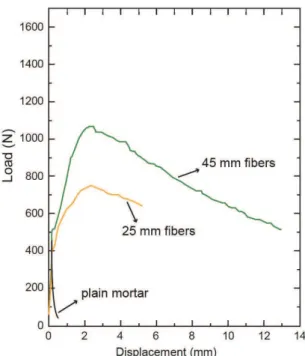
Examples of the load-displacement curves obtained in three point bending of the composite mortar are presented in Figure 3, for the different notch root radii. The load-displacement curves corresponding to the plain and reinforced mortars are depicted in Figures 4, 5 and 6, for the 0.5, 1.5 and 2.4 mm root radii, respectively, indicating the marked inluence of the presence of sisal ibers on both load carrying capacity and deformability of the notched specimens.
The variation of the maximum load, PU, with the notch root radius, ρ, is presented in Figure 7, for the mortars in question. Compared to their respective unnotched counterparts, the notched specimens had a much lower load
Figure 1. Fracture proile of a 45 mm iber reinforced specimen.
Figure 2. Fracture surface of a 25 mm iber reinforced bend
carrying capacity, as a result of the signiicant reduction of the specimen cross section in the notch plane. As to the inluence of the notch root radius, Figure 7 indicates that PU decreases as the notch becomes sharper and that, for a given root radius, the incorporation of the sisal ibers is associated with an appreciable increase in the load carrying capacity, with the long ibers being more effective in that respect. This is seen to be consistent with the results obtained on the lexural strength of unnotched beams, as sisal ibers contribute signiicantly to the tensile strength and more effectively so for longer ibers in virtue of the increase in the interfacial force, between ibers and matrix, with the increase in iber length.
3.3.1. Toughness estimation
The J-integral values at maximum load (JM) were calculated from the integrated energy (U) under the load-displacement curve, using the Rice estimation formula17.
2
( )
U J
B W a
=
− (4)
where B and W are the specimen cross sectional dimensions (50 x 50 mm), a the notch depth (25 mm) and U the integrated energy under the P-δ curve up to P = PU.
At this point, it is important to mention that toughness evaluation of concrete using fracture mechanics is considered to be applicable to large scale initially cracked structures18-19, where structural aspects, such as the size of coarse aggregates, are to be small compared to the concrete size. Thus, the effect of specimen size should be considered in determining the fracture toughness of concrete. For the mortars considered in the present study, the relevant microstructural scale, which is related to the
sand used as aggregate, is in fact very small in comparison to the bend specimen dimensions. Accordingly, Equation 4 is considered to be applicable to toughness determination of cement mortar.
The variation of JM with the root radius is shown in Figure 8, for the plain mortar. One can observe that such a variation is in agreement with the effect normally detected
Figure 3. Load-displacement curves of the 45 mm iber composite
mortar.
Figure 4. Mortars’ load-displacement curves in three point bending
for 0.5 mm root radius.
Figure 5. Mortars’ load-displacement curves in three point bending
for metallic and nonmetallic materials, where the J-integral value at fracture initiation varies linearly with the root radius. As fracture initiation in the plain mortar occurs essentially at the maximum load, JM can, therefore, be considered a good estimate of the J-integral value corresponding to the event of failure initiation in the mortar. For small root radii (ρ ≤ 1.5 mm), though, JM becomes independent of ρ, remaining at a constant level discriminated as JIC and
considered as a material characteristic. The limiting root radius, which is equivalent approximately to 1.5 mm, is also considered a material constant of microstructural signiicance, apparently compatible with the fact that the sand, used as a constituent of the mortar mixture, had a maximum particle size of 2 mm.
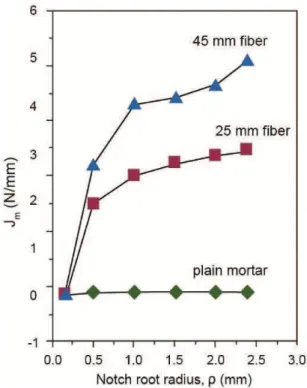
As to the reinforced mortars, the variation of JM with the notch root radius is presented in Figure 9, for both the 25 and
Figure 6. Mortars’ load-displacement curves in three point bending
for 2.4 mm root radius.
Figure 7. Inluence of the notch root radius on the maximum load
for the different mortars.
Figure 8. Variation of JM with the notch root radius for the plain
mortar.
Figure 9. Variation of JM with the notch root radius for the plain and reinforced mortars.
ibers. The beneicial effect on toughness is the result of an improvement in both strength and ductility of the mortar due to sisal iber presence and as can be veriied from the P-δ curves, this effect is more pronounced for the longer ibers.
The impact energy results are presented in Table 2, for the three mortars in question. The individual energy levels shown in the table correspond to the average of ive tests with a standard deviation of about 12%.
The analysis of Table 2 leads to conclude that the use of sisal ibers as a reinforcing element in mortar results in a considerable increase in the impact resistance and that such an increase is considerably more signiicant for the longer ibers. Results obtained by Ramakrishna and Sundararajan20
have shown that the addition of natural ibers to cement mortar slab can increase its impact resistance by a factor ranging between 3 and 18. This beneicial inluence is attributed to the fact that, even as the matrix cracks, the load carrying capacity is replenished by invoking iber loading. This maintains the specimens’ integrity as they continue to deform and hence to absorb more energy. The superiority of long ibers in promoting impact resistance is related to the higher load carrying capacity, as well as deformability, of the mortars reinforced with such ibers.
The correlation between the impact energy levels and J-integral results is presented in Figure 10, whereby an essentially linear relationship is seen to exist between the two parameters.
4. Conclusions
Regarding the study described herein, the following conclusions can be drawn:
• The use of sisal fibers decreases the mortar’s compressive strength. However, the iber reinforced mortars exhibit retardation of the failure process, characterized by larger deformations and gradual drop in the applied load, when compared with the plain mortar.
• The deleterious influence of sisal fibers on the compressive strength of reinforced mortar seems to be more signiicant for long ibers than for shorter ones.
• The presence of sisal fibers in cement mortar considerably improves its fracture resistance. This improvement is manifested by an increase in the J-Integral values determined at maximum load in the presence of deep notches with different root radii. • Results of impact tests on unnotched specimens
indicate a pronounced improvement in impact energy levels due to sisal ibers incorporated to cement mortar.
• Longer sisal ibers are seen to be more effective than shorter ones in promoting fracture resistance of reinforced mortars.
Table 2. Impact energy of the plain and reinforced mortars.
Mortar Impact energy (J)
plain 0.45 ± 0.05
reinforced 25 2.04 ± 0.22
reinforced 45 3.28 ± 0.35
Figure 10. Correlation between JM and impact energy for the
reinforced mortars with notch root radius of 0.5 and 2.4 mm.
References
1. Sivakumar A and Santhanam M. Mechanical properties of high strength concrete reinforced with metallic and non-metallic fibers. Cement and Concrete Composites. 2007; 29(8):603-608. http://dx.doi.org/10.1016/j.cemconcomp.2007.03.006.
2. Qian CX and Stroeven P. Development of hybrid polypropylene-steel-fiber-reinforced concrete. Cement and Concrete Research. 2000; 30(1):63-69. http://dx.doi.org/10.1016/S0008-8846(99)00202-1.
3. Abu-Lebdeh TM, Fini E and Lumpkin M. Flexural and tensile characteristics of microfiber-reinforced very high strength concrete thin panels. American Journal of Engineering
and Applied Science. 2012; 5(2):184-197. http://dx.doi. org/10.3844/ajeassp.2012.184.197.
4. Kitamura S. Experimental study of the inluence of iber content
and specimen dimensions on the split tensile strength and its relationship with the lexural strength. [Dissertation]. Rio de Janeiro: Fluminense Federal University; 2006. Portuguese.
5. Silva FA, Chawla N and Toledo Filho RD. Tensile behavior of high performance natural (sisal) fibers. Composites Science and Technology. 2008; 68(15-16):3438-3443. http://dx.doi. org/10.1016/j.compscitech.2008.10.001.
6. Fujiyama RT. Sisal iber reinforced cement mortar-mechanical
de Janeiro: Catholic University of Rio de Janeiro; 1997. Portuguese.
7. Brescansin J. Fracture behavior of bamboo pulp reinforced cementitious matrix. [Dissertation]. Rio de Janeiro: Catholic University of Rio de Janeiro; 2003. Portuguese.
8. Toledo Filho RD. Natural iber reinforced mortar composites:
experimental characterization. [Thesis]. Rio de Janeiro: Catholic University of Rio de Janeiro; 1997.
9. Campello EF. Fatigue behavior of bamboo pulp reinforced cementitious composites. [Dissertation]. Rio de Janeiro: Catholic University of Rio de Janeiro; 2006. Portuguese.
10. Okafor FO, Eze-Uzomaka OJ and Egbuniwe N. The structural properties and optimum mix proportions of palmnut fibre-reinforced mortar composite. Cement and Concrete Research. 1996; 26(7):1045-1055. http://dx.doi.org/10.1016/0008-8846(96)00087-7.
11. Silva FA, Mobasher B and Toledo Filho RD. Cracking mechanisms in durable sisal fiber reinforced cement composites.
Cement and Concrete Composites. 2009; 31(10):721-730. http://dx.doi.org/10.1016/j.cemconcomp.2009.07.004.
12. Toledo Filho RD, Ghavami K, England GL and Scrivener K.
Development of vegetable fibre-mortar composites of improved durability. Cement and Concrete Composites. 2003; 25(2):185-196. http://dx.doi.org/10.1016/S0958-9465(02)00018-5.
13. Hughes BP and Fattuhi NI. Stress-strain curves for fibre reinforced concrete in compression. Cement and Concrete Research. 1977; 7(2):173-183. http://dx.doi.org/10.1016/0008-8846(77)90028-X.
14. Li VC. J-integral applications to characterization and tailoring of cementitious materials. In: Chuang T-J, Rudnicki JW, editors. Multiscale deformation and fracture in materials and structures. Springer; 2002. p. 385-406.. http://dx.doi. org/10.1007/0-306-46952-9_21.
15. Savastano Jr. H, Turner A, Mercer C and Soboyejo WO. Mechanical behavior of cement-based materials reinforced with sisal fibers. Journal of Materials Science. 2006; 41(21):6938-6948. http://dx.doi.org/10.1007/s10853-006-0218-1.
16. Silva FA, Mobasher B, Soranokom C and Toledo Filho RD. Effect of fiber shape and morphology on interfacial bond and cracking behaviors of sisal fiber cement based composites.
Cement and Concrete Composites. 2011; 33(8):814-823. http:// dx.doi.org/10.1016/j.cemconcomp.2011.05.003.
17. Rice JR. A path independent integral and the approximate analysis of strain concentrations by notches and cracks. Journal of Applied Mechanics. 1968; 35(2):379-386. http://dx.doi. org/10.1115/1.3601206.
18. Choi S-H, Kye H-J and Kim W-J. J-integral evaluation of concrete fracture characteristics. International Journal of Concrete Structures and Materials. 2006; 18(3E):183-189. http://dx.doi.org/10.4334/IJCSM.2006.18.3E.183.
19. Jun Z and Qian L. Determination of concrete fracture parameters from a three-point bending test. Tsinghua Science and Technology. 2003; 8(6):726-733.
20. Ramakrishna G and Sundararajan T. Impact strength of a few