ISSN 1 5 1 7 - 7 0 7 6
Revista Matéria, v. 15, n. 2, pp. 218–224, 2010. http://www.materia.coppe.ufrj.br/sarra/artigos/artigo11219
Dynamic behavior of gamma-irradiated polycarbonate
Ricardo Pondé WeberI, Keneth S. VecchioII, João Carlos Miguez SuarezI
I
Departamento de Engenharia Mecânica e de Materiais, Instituto Militar de Engenharia, Rio de Janeiro, RJ, Brazil.
e-mail: [email protected] ; [email protected] II
Department of Mechanical and Aerospace Engineering, University of California, San Diego, CA, USA. e-mail: [email protected]
ABSTRACT
The aim of the present work was to establish the relationship between dynamic behavior of Bisphenol A polycarbonate (BAPC) and degradation by gamma irradiation. The BAPC was exposed to 340 kGy dose and the molecular weight was evaluated by Size Exclusion Chromatography (SEC). A modified split Hopkinson pressure bar was used to measure stress-strain dynamic relations. The results showed little change in the dynamic behavior of irradiated BAPC in the highest strain rate used in this work, in spite of the high decrease in the molecular weight of irradiated BAPC. The lowest strain rate used in this work produced the highest change in the dynamic behavior of irradiated BAPC.
Keywords: Polycarbonate, gamma irradiation, degradation, dynamic behavior, split Hopkinson pressure bar.
1 INTRODUCTION
Polycarbonate (PC), an engineering thermoplastic, has found many applications in several industrial fields due to its high toughness, good ductility, high glass transition temperature, excellent optical clarity and dimensional stability. Aircraft and automobile parts as well safety glass are just some of the current applications [1-4].
The PC, in these applications, is exposed to outdoor agents like sunlight, temperature, moisture, radiation etc. In general, the exposure to these environmental agents lead to structural changes in linear polymers, like Bisphenol A polycarbonate (BAPC), that may reduce the material properties such us the molecular weight [5-7].
Additionally, the mechanical response of materials is sensitive to the rate at which they are loaded and in the literature there are some studies dedicated to the dynamic behavior of polymeric materials. However there is not enough information about the influence of the environmental degradation in the high strain rate behavior of these materials [8].
2 EXPERIMENTAL
2.1 Material
In this work we studied a PCLIGHT commercial grade of Bisphenol A polycarbonate (Policarbonatos do Brasil S.A., São Paulo, Brazil). The PCLIGHT was received as 6 mm thickness extruded sheets and Table 1 presents typical commercial characteristics of studied material [9].
Table 1: Typical commercial properties of PCLIGHT polycarbonate [9].
Property ASTM standard Data
Yield stress
D 638 type I
62 MPa
Elongation at yield 5.99%
Rupture strength 58 Mpa
Flexural stress D 790 93 Mpa
Rockwell hardness D 785 71.2
2.2 Degree of Crosslinking
The gel fraction of the samples, before and after gamma irradiation, was determined according to ASTM D2765 standard [11], using chloroform PA (CHCl3) as solvent. The specimens were immersed in the solvent at room temperature for 48 hours, weighed after extraction dried for at least 72 hours at room temperature until the sample attained constant weight. The degree of crosslinking was considered to be equal to the gel content expressed as the extraction residue.
2.3 Size Exclusion Chromatography (SEC)
The molecular weight, before and after gamma irradiation, was determined by size exclusion chromatography (SEC) using a model 600E Waters HPLC apparatus equipped with a Waters 510 pump, a Waters 410 differential refraction detector and three model SEC HFIP Shodex columns (800P, 805 and 803), using tetrahidrofuran PA as solvent. Polystyrene monodisperse was used as a standard for calibration. The number-average molecular weight ( ), the weight-average molecular weight ( ) and the polydispersity ( / ) were calculated.
2.4 X-ray Diffraction (XRD)
Wide-angle X-ray diffraction (WAXD) analyzes, before and after gamma irradiation, was performed at room temperature in an XPert-Pro diffractomer (PANalytical), using Cu Kα radiation at 45kV
and 40mV, in steps of 0.0098° from 5° to 80°. The possibility of occurrence of structural changes and crystallinity (Xc) due to gamma irradiation of PCLIGHT polycarbonate was verified by the analysis of
WAXD profiles.
2.5 Differential Scanning Calorimetry (DSC)
The thermal behavior of BAPC, before and after gamma irradiation, was determined according to ASTM D3417 [12] standard in a model DSC-60 Shimatzu apparatus equipped with TA-60WS software and a computer. Samples of about 10mg, sealed in aluminum pans, were submitted to a heating/cooling cycle from -100ºC to -23ºC at a heating rate of 3ºC/min under nitrogen atmosphere. The β relaxation temperature of PCLIGHT polycarbonate, before and after gamma irradiation, was determined.
2.6 Dynamic Test
3 RESULTS AND DISCUSSION
3.1 Degree of Crosslinking
The amount (percentage) of extracted material and the degree of crosslinking of polycarbonate samples, “as received” (non-irradiated) and irradiated with 340kGy dose, are shown in Table 2.
Table 2: Degree of crosslinking of PCLIGHT polycarbonate, before and after irradiation.
Condition Extracted material (%) Degree of crosslinking (%)
“As received” 100 0
Irradiated 100 0
It is verified that the exposition to gamma radiation doesn´t produce crosslinking in PCLIGHT polycarbonate as indicated by the no reduction in the amount of extracted material [13].
3.2 Size Exclusion Chromatography (SEC)
Figure 1 presents the SEC chromatograms of PCLIGHT polycarbonate, before and after gamma irradiation.
(a) (b)
Figure 1: SEC chromatograms of PCLIGHT polycarbonate: (a) “as received”; (b) gamma irradiated with 340kGy.
The number-average molecular weight ( ), the weight-average molecular weight ( ) and the polydispersity ( / ), calculated from SEC curves of PCLIGHT polycarbonate samples, in both conditions, are presented in Table 3.
Table 3: Weight and number average molecular weights and polydispersity of PCLIGHT polycarbonate, before and after gamma irradiation.
Condition Average molecular weight (g/mol)
Polydispersity Number Weight
“As received” 27715 51601 1.86
Irradiated 16739 33918 2.02
3.3 X-ray Diffraction (XRD)
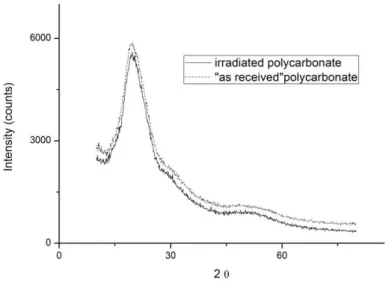
Figure 2 shows the wide-angle X-ray diffraction (WAXD) spectra of PCLIGHT polycarbonate, before and after gamma irradiation.
Figure 2: Wide-angle X-ray diffraction (WAXD) spectra of PCLIGHT polycarbonate, before (“as received”) and after gamma irradiation (irradiated).
It is observed that the both diffractograms are very similar and that no new peaks appear in the WAXD profile after irradiation indicating that the material does not undergo any transformation [15].
3.4 Differential Scanning Calorimetry (DSC)
Figure 3 shows the DSC curves of PCLIGHT polycarbonate, before and after gamma irradiation. The β transition temperature of polycarbonate, in both conditions, is presented on the Table 4.
Temperature (oC)
-120 -110 -100 -90 -80 -70 -60 -50 -40 -30 -3,40
-3,35 -3,30 -3,25 -3,20 -3,15 -3,10 -3,05 -3,00 -2,95 -2,90
0,25 0,30 0,35 0,40 0,45 0,50
PC "as received" (non irradiated)
PC irradiated 340kGy
Hea
t fl
u
x
(m
W)
It is verified that the irradiated polycarbonate presents, in relation to “as received material, an increase in the β transition temperature from -96°C to -74°C. It is known to exist a correlation between yielding and localized molecular motions; the segmental mobility associated to the β relaxation processes has been considered as responsible to the polycarbonate toughness [16, 17]. This observed increase in the β transition temperature of irradiated PC indicates that the lateral groups of PCLIGHT polycarbonate herein studied need less energy to move. In consequence, due to the occurrence of this secondary transition in a higher temperature, the PCLIGHT polycarbonate deforms more easily and the irradiated polymer can present a ductile behavior.
Table 4:β transition temperature of PCLIGHT polycarbonate, before (“as received”) and after gamma irradiation (irradiated).
Condition β transition temperature
“as received” 096
Irradiated 074
3.5 Dynamic Test
Figure 4 presents experimental uniaxial compression stress-strain curves of PCLIGHT polycarbonate, before (“as received”) and after gamma irradiation (irradiated), at 2 (two) strain rates, 1100s-1 and 2300s-1. The mechanical dynamic properties, yield strength, Young modulus and ultimate true strain of polycarbonate, in both conditions, determined in the tests are shown in Table 5.
Figure 4: Experimental uniaxial compression stress-strain curves of PCLIGHT polycarbonate, before (“as received”) and after gamma irradiation (irradiated), at 2 (two) strain rates.
Table 5: Results of dynamic properties of PCLIGHT polycarbonate, before (“as received”) and after gamma irradiation (irradiated), at 2 (two) strain rates.
Strain rate (s-1)
Yield strength (MPa) Young’s modulus (GPa) Ultimate true strain (mm/mm)
“as received” irradiated “as received” irradiated “as received” irradiated
1100 118 120 2.6 3.4 0.23 0.27
2300 127 127 2.8 3.5 0.35 0.34
The increase in the strain rate from 1100s-1 to 2300s-1, as expected, results in a higher mechanical dynamic strength of PCLIGHT polycarbonate, “as received” (non irradiated) and irradiated [18, 19].
expected brittle behavior as indicated by the decrease in the molecular weight. However, this behavior, as suggested by the DSC results, can be related to the observed increase in the β transition temperature, since this a higher temperature value implies in an increase of toughness of PCLIGHT polycarbonate due to the reduction of activation energy of the lateral groups [20].
4 CONCLUSIONS
The influence of gamma irradiation on the dynamic behavior of PCLIGHT polycarbonate, a commercial Brazilian material, was investigated. The experimental data lead to the following conclusions:
- The exposure of polycarbonate to a 340 kGy gamma dose does not change the degree of crosslinking neither the crystallinity, but produces backbone scission of polymeric chains.
- The 340kGy gamma dose irradiation increases the β transition temperature and, in consequence,
reduces the activation energy of the lateral groups of studied PC.
- The polycabonate irradiated with a 340kGy gamma dose, under different strain rates, presents, as compared with the “as received” material, a similar dynamic behavior.
- The gamma irradiation of studied polycarbonate does not modify significantly its dynamic strength, probably due to an increase in the β transition temperature.
5 ACKNOWLEDGEMENTS
Authors thank the Department of Mechanical and Aerospace Engineering at the University of California, San Diego, USA, for autorization to use the Hopkinson bar, the Empresa Brasileira de Radiações (EMBRARAD) by the gamma irradiation of the polycarbonate and the Brazilian agencies, CAPES, CNPq, FAPERJ and FINEP, for financial support. RPW has special thanks to Professor Marc Andre Meyers by support the research at the University of California, San Diego, USA.
6 REFERENCES
[1] HILL, A.J., HEATER, K.J., AGRAWAL, C.M., “The effect of physical aging in polycarbonate”, Journal
of Polymer Science: Part B, Polymer Physics, v. 28, pp. 387-405, 1990.
[2] PAKULL, R., GRIGO, U., FREITAS, D., Rapra Review Reports, Current Developments in Materials Technology and Engineering, Report 42, Polycarbonates, Pergamon Press. Oxford, New York, p.3-110, 1991.
[3] ARAUJO, E.S., KITOURY, H.J., SILVEIRA, S.V., “Effects of gamma irradiation on some properties of durolon polycarbonate”, Radiation Physics and Chemistry, v. 53, pp. 79-84, 1998.
[4] SCHAFER, J., WOOLEY, K.L., POLIKS, B., BYERS, J.A., GAN, D., GOETZ, J.M., BOLTON, D., “Chain dynamics in linear and hyperbranched phenol – polycarbonates”, Macromolecules, v. 36, pp. 2368-2373, 2003.
[5] SHARIFF, G., SATHYANARAYANA, P.M., THIMMEGAWDE, M.C., ASHALATHA, M.B., RAMANI, R., AVASTHI, D.K., RANGANATHAIAH, C., “Influence of ion-irradiation on the free volume controlled diffusion process in polycarbonate – a positron lifetime study”, Polymer, v. 43, pp. 2819-2826, 2002.
[6] RAMANI, R, SHARIFF, G., THIMMEGOWDA, M.C., SATHYANARAYANA, P.M., ASHALATHA, M.B., BALRAJ, A., RANGANATHAIAH, G., “Influence of gamma irradiation on the formation of methanol induced micro-cracks in polycarbonate”, Journal of Materials Science, v. 38, pp. 1431-1438, 2003.
[7] KALSI, P.C., RAMASWAMI, A., “Study of effects of gamma-irradiation on tuffak polycarbonate track detector by T.G”, Journal of Thermal Analysis and Calorimetry, v. 78, pp. 793-797, 2004.
[8] NAIK, N.K., PERLA, Y., “Mechanical behavior of acrylic under high strain rate tensile loading”,
Polymer Testing, v. 27, pp. 504-512, 2008.
[10] WEBER, R.P., SUAREZ, J.C.M., “Behavior of polycarbonate armor: influence of gamma irradiation”,
Journal de Physique, v. 134, pp. 941-947, 2006.
[11] American Society for Testing and Materials, ASTM D2765, Determination of Gel Content and Swell Ratio, Standard Test Method for, USA, 2001.
[12] American Society for Testing and Materials, ASTM D3417, Enthalpies of fusion and crystallization of polymers by Differential Scanning Calorimetry, Standard Test Method for, USA, 1999.
[13] CLAUDE, B., GONON, L., DUCHER, J., VERNEY, V., GARDETTE, J.L., “Surface cross-linking of polycarbonate under irradiation at long wavelengths”, Polymer Degradation and Stability, v. 83, pp. 237-240, 2004.
[14] SEGUCHI, T., YAGI, T., ISHIKAWA, S., SANO, Y., “New material synthesis by radiation processing at high temperature – polymer modification with improved irradiation technology”, Radiation
Physics and Chemistry, v. 63, pp. 35-40, 2002.
[15] JI, G., GI, X., MA, J., DONG, C., GU, X., “Concentration dependencd of cristallinity of polycarbonate by shock-cooling and subsequent freeze-drying of its various solutions”, Polymer, v. 37, n. 15, pp. 3255-3258, 1996.
[16] RICHETON, J., AHZI, S., “Influence of temperature and strain rate on the mechanical behavior of three amorphous polymers: Characterization and modeling of the compressive yield stress”, International
Journal of Solids and Structures, v. 43, pp. 2318-2335, 2006.
[17] MULIKEN, A.D., BOYCE, M.C., “Polycarbonate and a polycarbonate-POSS nanocomposite at high rates of deformation”, Journal of Engineering Materials and Technology, v. 128, p. 543-550, 2006. [18] SAWAS, O., BRAR, N.S., BROCKMAN, R.A., “Dynamic characterization of compliant materials
using an all-polymeric split Hopkinson bar”, Experimental Mechanics, v. 38, n. 3, pp. 204-210, 1998.
[19] NAIK, N.K., PERLA, Y., “Mechanical behavior of acrylic under high strain rate tensile loading”,
Polymer Testing, v. 27, pp. 504-512, 2008.
![Table 1: Typical commercial properties of PCLIGHT polycarbonate [9].](https://thumb-eu.123doks.com/thumbv2/123dok_br/18872672.420531/2.892.118.767.132.297/table-typical-commercial-properties-pclight-polycarbonate.webp)