Health care to immigrant and Portuguese
pregnant women in Portugal
O
riginal
a
r
ticle
Emília de Carvalho Coutinho1, Alcione Leite da Silva2, Carlos Manuel Figueiredo Pereira3, Alexandra Isabel
Almeida4, Paula Alexandra Batista Nelas5, Vitória Barros Castro Parreira6, Maria Odete Amaral7
Cuidados de saúde a gestantes imigrantes e portuguesas em portugal
Cuidado de la salud a mujeres embarazadas imigrantes y portuguesas en portugal
1 phd in nursing sciences, school of Health of Viseu ipV/Cidets, Viseu, portugal. 2 phd in philosophy and nursing, department of Health sciences/
university of aveiro, aveiro, portugal. 3 phd in Human biology school of Health of Viseu ipV/Cidets, Viseu, portugal. 4 Nurse, currently unailliated, Viseu,
portugal. 5 phd in education sciences, school of Health of Viseu ipV/Cidets, Viseu, portugal. 6 master in nursing sciences, school of nursing of porto,
porto, portugal. 7 phd in public Health, school of Health of Viseu ipV/Cidets, Viseu, portugal. doi: 10.1590/s0080-623420140000800003
rESuMO
Este estudo teve como objeivo conhecer
os cuidados de saúde recebidos e as bar
-reiras enfrentadas por gestantes imigran
-tes e portuguesas, em Portugal. Trata-se de um estudo de natureza qualitaiva, do ipo exploratório, com aplicação de en
-trevista semiestruturada a 60 mulheres imigrantes e 22 portuguesas. Foi uilizada a análise de conteúdo apoiada pelo pro
-grama QSR Nvivo10. O estudo foi aprovado por uma Comissão de Éica. Os resultados apontaram quatro categorias relacionadas às dimensões afeivo-relacional, cogniiva, técnico-instrumental e políica do cuidado de saúde à gestante. Já as barreiras nos cuidados de saúde foram mencionadas por algumas gestantes, com destaque para as imigrantes. Na sua grande maioria, tanto as gestantes imigrantes quanto as portu
-guesas, encontravam-se saisfeitas com os cuidados de saúde.
dESCrItOrES
Gestação Cuidados de saúde Sistema de saúde português
ABStrACt
This study aimed to assess the care re
-ceived and the barriers faced by immi
-grants and Portuguese pregnant women in Portugal. This is an exploratory qualitaive study, resoring to applying semi-struc
-tured interviews to 60 immigrant and 22
Portuguese women. Content analysis sup
-ported by QSR Nvivo10 program was used.
The study was approved by an Ethics Com
-mitee. The results showed four categories related to afecive dimensions-relaional, cogniive, technical-instrumental and health care policy for pregnant women. As for the barriers in health care, these were menioned by some of the expectant
mothers, especially immigrant women. Al
-most all, both immigrant and Portuguese, pregnant women were saisied with the health care.
dESCrIPtOrS
Pregnancy Health care
Portuguese health system
rESuMEN
Este estudio tuvo como objeivo evaluar la asistencia sanitaria recibida y las barre
-ras que enfrentan las madres inmigrantes y portuguesas en Portugal. Se trata de un estudio cualitaivo, exploratorio, con en
-trevista semiestructurada que se aplicó a 60 mujeres inmigrantes y 22 portuguesas. Se uilizó el análisis de contenido apoyado por el programa QSR Nvivo10. El estudio fue aprobado por un Comité de Éica. Los resultados mostraron cuatro categorías: las relacionadas con las dimensiones afecivas y relacionales, con la políica, la técnica ins
-trumental y el cuidado de la salud cogniiva de las embarazadas. Se han mencionado las barreras en el cuidado de la salud por algunas embarazadas, sobre todo inmi
-grantes. La gran mayoría de las mujeres
embarazadas tanto inmigrantes como por
-tuguesas, se encontraban saisfechas con la atención de la salud.
dESCrIPtOrES
INtrOduCtION
Becoming a mother is a phenomenon experienced by women, from any part of the world, characterized by a mix of emoions, new challenges and physical and psycho
-logical changes, among others, assuming both posiive and negaive meanings(1).
Motherhood is considered a transiion, deined as “the shit from one stage of life, condiion, or status to
another”(2,3). Immigraion is also another transiion phe
-nomenon experienced by foreign women. This occurrence is more and more frequently moivated by the search for beter living condiions or emoional reasons (to go live with the spouse). Portugal is a country where immigraion occurs(4), thus jusifying the importance of cultural care,
which combines cultural diversity and universality to nur
-sing care, resuling in a culturally congruent care(5).
Currently, due to social changes, the knowledge that once was generaional and culturally transmited, is now sought ater, by resoring increasingly to the care of health professionals, especially nurses as facilitators of the tran
-siion to motherhood(6). Nursing encompasses the art and
science of facilitaing the transiion to health and well
--being of the populaion and has as its central “mission” to facilitate the transiion processes across the life cycle(3).
The Portuguese health care services, ofered to preg
-nant women, are established by the Naional Health Po
-licy, and include the promoion and restoraion of health and prevenion of disease, during pregnancy, which begin in the preconcepion period(7).
In this sense, it is expected that nurses assume, increa
-singly, their frontline role in antenatal surveillance, so that the parturient and the newborn are healthy(8), thereby re
-ducing maternal and perinatal mortality(9). Prenatal care,
focusing on pregnant women and their life context, may inluence the experience of motherhood with greater au
-tonomy and health(10).
Therefore, it is necessary to be aware of barriers that may hinder access of this woman to health care. These barriers may be related to factors connected to pregnancy or health insituions, as for example the resources, the quality of care and the health policies adopted(9).In this
sense, health protecion is perceived not only as a right but as a joint responsibility of ciizens, society and state, with the freedom in the search and delivery of care(11). In
this sense, the Consituion of the Portuguese Republic is a facilitator of access to maternal health care, since it de
-termines the gratuity of the health system during this pe
-riod, among others rights directed to the woman/couple, the parturient, puerpera, and new born(12).
Given the above, this study aims to idenify the heal
-th care received and -the barriers faced by immigrant and Portuguese pregnant women in Portugal.
MEtHOdS
This is a qualitaive, exploratory, descripive study. A total of 82 women, 60 immigrant and 22 Portuguese (Ta
-ble 1), belonging to two groupings of health centres of two districts of the Central Region of Portugal, paricipa
-ted in the study. The naionaliies of the mothers were: Portuguese (n=22), Brazilian (n=14), Ukrainian (n=11), Chinese (n=8), Moldova (n=4), African (n=4), and French and Russian (n=3 each), and thirteen other naionaliies (Congolese, Dutch, Cape Verdean, Guineans, Argeninian, Byelorussian, Polish, Romanian, Ethiopian, Canadian, Se
-negalese and Switzerland) (n=1 for each). Inclusion crite
-ria were; to be Portuguese or Immigrant; to have been a mother for less than a year; to understand the Portuguese language, to agree to paricipate in the study.
Table 1 – Socio-demographic characterization of the sample
Portuguese N=22
Immigrant N=60
Total N=82 Age Group
<21 0 1 11
21-35 18 43 61
>35 4 16 20
Marital Status
Married/de facto union 20 49 69
Single/divorced/widow 2 11 13
Academic Qualiications
≤ 9º grade 6 13 19
10-12 grades 3 17 20
Higher Education 13 30 43
Professional Status
Employed 19 44 63
Unemployed 3 16 19
Pregnancy Monitoring
Monitored 20 41 61
Not monitored 2 19 21
No. of births
1 birth 13 22 35
2 births 8 21 29
3 or more births 1 17 18
No.-deliveries
1 delivery 13 29 42
2 deliveries 8 20 28
3 or more deliveries 1 11 12
Data collecion was conducted between February 2011 and February 2012, through semi-structured inter
-views, a weekly average of 1.5 interviews. The guiding ins
-trument consisted of socio-demographic characterizaion and of seven or eight open quesions (depending on the paricipant be Portuguese or immigrant, respecively), in order to get the data in the speech of the informants the
-mselves. The interviews took place at the Health Centres involved, with varied duraion 45-125 minutes with a me
Data analysis was based on the Technique of Catego
-rical Content Analysis(13), with the support of the program
Qualitaive Analyses Sotware Ceriied Partner (QSR NVi
-vo version 10). Similar ideas were systemaized, procee
-ding to the co-ding of the registraion units (RU) and res
-pecive categorizaion.
This study was approved by the ethics commitees of the Health Centres involved in the study. The script of the interview was previously submited to and appro
-ved by the Naional Commission for Data Protecion (Ca
-se 85/2011, No. 191/2011). The data conideniality and anonymity of paricipants were guaranteed. The informed consent for the interview and recording of verbaim was obtained ater full informaion about the study. To main
-tain anonymity, each paricipant was ideniied by two let
-ters of the alphabet, followed by their naionality (e.g. DC Ukraine).
rESuLtS
The results of the analysis and coding of the verbaim of Portuguese and immigrant pregnant women corres
-pond to health care during pregnancy and the barriers fa
-ced during this phase of their lives.
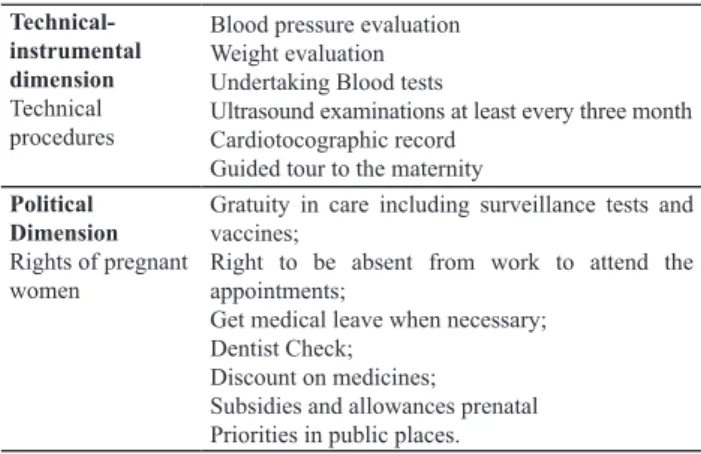
Health care during pregnancy encompassed, from the perspecive of immigrant and Portuguese paricipants, four categories on the afecive-relaional, cogniive, tech
-nical-instrumental and care policy dimensions, as can be seen in Table 2.
Table 2 - Dimensions of health care during pregnancy
Affective-relational dimension
Trust relation Support Attention Interest
To know they could rely on health professionals Cognitive
dimension Health education sessions
Nutrition Weight Physical Activity Rest
Risk behaviour Travels Blood pressure Sexuality
How to access information Delivery preparation Care of the baby Breast feeding preparation
Self-care Nutrition
Stretch Marks Prevention Physical Activity Safe environment Avoid efforts Dialog with the baby
To keep informed about the pregnancy To attend to prenatal consultations
Technical-instrumental dimension Technical procedures
Blood pressure evaluation Weight evaluation Undertaking Blood tests
Ultrasound examinations at least every three month Cardiotocographic record
Guided tour to the maternity Political
Dimension Rights of pregnant women
Gratuity in care including surveillance tests and vaccines;
Right to be absent from work to attend the appointments;
Get medical leave when necessary; Dentist Check;
Discount on medicines;
Subsidies and allowances prenatal Priorities in public places.
The afecive-relaional dimension was related to the relaionship of trust established between health profes
-sionals from the areas of medicine and nursing and preg
-nant women, to open dialog, the support, interest and atenion received from these professionals during preg
-nancy, and to know that they could count on them in any situaion. All were unanimous in poining out that this di
-mension of care was very signiicant for them, mainly be
-cause they feel vulnerable and insecure with this new con
-diion. For immigrants, this dimension was vital for being away from their home country and their support network. The tesimonials below exemplify this dimension of care.
“I felt a lot of support [by professionals] and this gives us
the will to repeat the experience. It meant a lot and is effec-tive at a time when we are vulnerable; it really is important
care and support” (an France).
“As I had already lost two children, I had more support
from them (...) from the health centre ... They explained
calmly, I felt safe “(bu ukraine).
“Were very friendly, from pregnancy to childbirth,
bo-th medical and nurse were very nice and bo-thoughtful in
everything” (bp brazil).
“A support, at the time I had no father and mother, and now
she [the nurse] replaces them a bit ... Then the nurse re-places them those important moments ... I could talk to her
about everything, it was important for me”(aQ portugal).
In the cogniive dimension were included the educaion sessions for health related guidelines received during preg
-nancy and the methods used. The themes highlighted by pregnant women were nutriion and weight, physical aci
-vity and rest, risk behaviors, travel, blood pressure, sexu
-al acivity, how to access the informaion, preparaion for childbirth and baby care (weight, growth, clothing , prepa
-raion for breasfeeding. guidelines received helped them feel more informed, calm, conident and beter prepared.
“I think it’s very good, they use very good methods to
pro-vide the information; I took lyers home in every consulta -tion, they explained everything, if I did not realize they [the
Continued...
nurse and the doctor] explained. I could call out of hours at home ... Alcohol, tobacco, sexual activity, weight, growth of the baby, clothing, preparation for breastfeeding, the nurse was all, and all consultations we would-be talking about
some topics that are there” (bC brazil).
“The nurse spoke of nutritional care” (aa portugal).
“With preparation for childbirth, I was very restful in
child-birth” (bX belarus).
“Yes the nurse was present in consultations, I love the nurse. There was a stage when I got here, I was already desperate, did not sleep and she calmed me down and ex-plained to me what to do ... I felt safer, more prepared, I had
forgotten many things as how to treat a child” (uz ukraine).
Based on the guidance received, and Portuguese im
-migrant pregnant women reported having applied the knowledge gained in caring for themselves and the baby, taking care of nutriion, hydraion and prevenion of stre
-tch marks, physical exercises, frequening safe environ
-ments, avoiding eforts, talking to baby, trying to keep the
-mselves informed about pregnancy and atend prenatal consultaions.
“Yes, all they [doctors and nurses] said and advised I put
everything into practice” (bu ukraine).
“Had care with nutrition” (ar brazil).
“I took care in hydrating the body because of subsequent
stretch marks” (Cg portugal).
“I exercised, which I already had a habit of doing” (bQ
mol-dova).
“Avoid smoky environments, nights out” (ap switzerland).
“I had been informed by professionals that talking to the
baby, soothed the child and so I did that” (bK portugal).
The technical-instrumental dimension of care included the evaluaion of blood pressure and weight, blood tests, ultrasounds at least every three months, cardiotocogra
-phic record and visit to maternity ward, as can be seen from the statements below:
“I also did blood tests” (al China).
“I did the morphological ultrasound” (aW brazil).
“I weighed myself in all consultations” (am China).
“I did cardiotocographic registration” (by poland).
“It was late in pregnancy that I went to the maternity
hospi-tal” (bH portugal).).
The poliical dimension was related to the rights of pregnant women, during pregnancy, according to the Por
-tuguese Consituion. The tesimonies of the women, this dimension integrated the gratuity of the monitoring care including tests and vaccines; the right to be absent from work to atend the appointments; obtain medical leave
when necessary; denist check; discount on medicines; subsidies and prenatal allowance; and prioriies in public places. Some immigrants valued the gratuity of the Portu
-guese health care, during pregnancy, and wove compari
-sons with their countries of origin.
“Here in Portugal I received, free of charge, the dentist checks, medical and nursing consultations, tests, at the
health centre” (dC ukraine).
“I had beneits in terms of exemption in terms of medica -tion” (Cb ethiopia).
“[I had the right to] receive from Social Security an allo-wance for high risk pregnancy ... I had the right to pre-natal
allowance” (Co France).
“Concerning the rights, I booked the consultations outside of working hours and when I could not book off schedule I
used that time” (bl portugal).
“In Ukrainian law it is written that to health everyone has access to, and it is free, but in fact that is not so; Here truly
if it is being said it is free, it really is” (dC ukraine).
Health care, described above, occurred mostly in the public health system. However a minority of pregnant women, mostly Portuguese, had some experience in the private health sector. The reasons given for the choice of the public system were: gratuity; beter pregnancy sur
-veillance; specialized care; surveillance shared between health centre and hospital.
“I was being followed in the private system but ... but for
inancial reasons I opted for the public” (Co France).
“I was followed at the health centre and at the hospital be-cause I had high blood pressure during pregnancy and so I
had consultations with a cardiologist” (bg portugal).
It was very important [to have the monitoring of health professionals] because everything needed I cleared my doubts, I came here more quickly [Health Centre], I felt
as-surance (bu ukraine).
“I was going to have the child in the hospital, I had to have consultations from the six months, had to have three con-sultations and these appointments were there, for them to have knowledge of the case and then follow it, along with
the health centre (bH portugal).
The reasons that lead the minority of pregnant women to opt for private health system, were the result of dislike or be unable to secure a family doctor in the public heal
-th system; receive personalized and coninuous care; and feel safe.
“I was without a family doctor; they were taking a long time
to arrange appointments so I changed to a private” (ap
switzerland).
“I trusted the doctor and thus my reason to go to C. for
“People do not bind to patients, doctors, and if we want this service, more personalized, maybe we have to opt for other
options, paying for it in the private sector” (Cm portugal).
The majority of Portuguese and immigrant pregnant women were saisied with health care; this saisfacion resulted, largely, of the care of health professionals. Ho
-wever, a minority of pregnant women, paricularly immi
-grant, reported barriers in health care.
Barriers in health care during pregnancy
Emerging barriers were reported by 22 pregnant wo
-men (18 immigrant and 4 Portuguese) and were related to the long waiing ime to be atended to (6 immigrants and 1 Portuguese); lack of pregnancy supervision at home (3 immigrants and 1 Portuguese); the lack of monitoring by a specialist (3 immigrants and 1 Portuguese); long wait to access consultaions at the health centre (2 immigrants and 1 Portuguese); the lack of monitoring by the same physician (3 immigrants); the lack of organizaion in the health centre and hospital (1 immigrant). When they refer these barriers, many immigrants wove comparisons with their countries of origin.
“It took a long time waiting for appointments and I did not
expect that to happen” (bm portugal).
“It would be nice to have in Portugal monitoring at home by
the physician, as we have in Ukraine (ukraine aC).
“I expected to have a midwife. In Canada, the midwife
does everything, they accompany a lot and there is a re-lationship between them and the mother before and after
delivery (ay Canada).
“It took me six weeks to get an appointment at the health
centre” (Cd netherlands).
“There should be a little more support, such as the visit of a doctor or nurse to the house to see how a person is,
I am not talking only of pregnancy, but postpartum” (aQ
portugal).
“When I was in the health centre the doctor was never the
same, changing from one to another” (ab France).
“In terms of organization of the health service, it could
gre-atly improve” (bs russia).
dISCuSSION
From the data analysis four categories, afecive and relaional, cogniive, technical-instrumental and policies emerged, the irst three being adopted from a referen
-ial(14), which was used in another study(15). In this sense,
the afecive-relaional dimension refers to Being, resul
-ing from the interacions that allow humans involved in the care, to express their subjeciviies related to their
experiences. The cogniive dimension relates to the Kno
-wing, ie professional competence, which in this study was shared with the pregnant women, insigaing the care of themselves and the baby. The technical-instrumental
di-mension consists in Doing with quality and competence
through specialized technical intervenions, permeated by know-how”(14,15). The policies dimension refers to social
and health rights enjoyed by people, in this paricular ca
-se, the pregnant women, due to social and health adopted policies in a given country. All dimensions were important for the pregnant women. Studies with pregnant women based on this framework were not found in the literature. For pregnant women, in general, the afecive-relaio
-nal dimension was considered important at this stage of their lives. This dimension of health care helped them feel welcomed, supported, feeling welcome to open dialogue, and ulimately to the establishment of a trust. It was di
-rectly linked to the way of Being of the health professio
-nals, especially for the nurses, with whom they had most contact. Thus, they expressed saisfacion with the health professionals and therefore to the quality of health care. The results obtained in this dimension are consistent wi
-th -those presented by a study in which women presen
-ted themselves saisied with the quality of care, claiming atenion, respect and punctuality in assistance from the professionals(16). “The experiences of people with the care
provided to them are determined primarily by how they are treated when they are experiencing a problem and
seek help from health services”(16). They wish to be seen
by someone they can “trust and that will receive them promptly in an appropriate environment, with respect and
conideniality”(17). Establishing a relaionship of trust wi
-th -the heal-th professionals is -therefore one of -the factors that contributes to the tranquility of women during preg
-nancy, preparing them for childbirth. To provide a good recepion is an essenial factor for a higher quality of ca
-re and consequent saisfacion(16,17). To provide comfort is
also to respect the privacy of the pregnant woman, who thus feels safe and respected by the health professionals.
The cogniive dimension has proved vital in health care. The pregnant woman, by virtue of her condiion, is more suscepible to the need for the care that is essen
-ially based on learning what is pregnancy, its implicaions and condiions(10). The role of the nurse starts in the pre
-natal period, through consultaions and health educaion sessions, addressing the needs and condiion of the preg
-nancy, in which are included, among others, screening for complicaions, guidance about the period that she is going through, concerning the discomforts typical of pregnancy and relief techniques, the care about nutriion, weight gain, sexuality, the emoional aspects, the risk associated with the use of drugs and not prescribed medicaion(8).
“In the permanent search for excellence in professional
pracice, the nurse helps customers achieve maximum
heal-th potenial” through the “use of opportuniies to promote
cog-niive learning and new skills by the customer”(12). In ma
-ternal health, this learning is done in the consultaions and sessions of health educaion. For the pregnant women in this study, the educaion sessions focused on several key issues, which are expressed in the self-care and the baby’s care. This knowledge acquired by the woman about the gestaional process and preparaion for childbirth contri
-bute to reduce anxiety, fear and pain, so characterisic of childbirth(8,18). The preparaion facilitates interacion with
the pregnant woman and the family(8), thus relecing its
importance. The value atributed by pregnant woman, of this study, to the childbirth preparaion was evident in their statements, of feeling more informed and therefore more peaceful and conident, because they are beter prepared.
The technical-instrumental dimension encompassed specialized technical intervenions, which ranged from hi
-gh blood pressure and wei-ghing unil the conducing exa
-ms needed to assess the health of pregnant women. This assessment enables early diagnosis in case of problems and therefore an appropriate intervenion, creaing tran
-quility in the pregnant women, family and health profes
-sionals, with posiive outcomes for the mother-baby pair. The policies dimension focused on the rights of preg
-nant women living in Portugal. According to the Consi
-tuion of the Portuguese Republic, pregnant woman and new mothers are exempt from user fees and in the Portu
-guese public health system, all care underlying this state can be use free of charge(19). In addiion, rights include
dispensaion of night work, maternity leave and paternity leave for consultaions and breasfeeding, the allocaion of subsidies among others rights(20). Pregnant women re
-ported having enjoyed a set of rights, which favored them in this stage of life.
The consultaions of the paricipants were carried out in the public system. However, a small number of pregnant women, with a predominance of Portuguese naionality, used temporarily the private health sector. The reasons sta
-ted for the consultaions in the public health system were: a gratuity in exams, beter surveillance of pregnancy, ofering specialized care and shared surveillance between health centre and hospital. In turn, the fact that they did not get a family doctor in the public health system, received mo
-re personalized ca-re and felt g-reater security, we-re aspects that led some pregnant women to seek the private health system. Pregnant women who opted for the public health system, were saisied with the health care received.
The vast majority of Portuguese and immigrant preg
-nant women, were saisied with health care. The saisfac
-ion of pregnant women is important as these are more likely to demonstrate beter self-care and have beter ou -tcomes(21). The saisfacion is directly related to the quality
of services that a paricular insituion provides; conse
-quently health services must move towards the preferen
-ces and values of their consumers, since their view is a quality indicator(8).
However, several pregnant women showed them
-selves dissaisied with some aspects of health care re
-ceived, paricularly for immigrants. These aspects, while barriers to health care, encompassed the diicult access to appointments, problems in professional monitoring at the health centre and the lack of pregnancy monitoring at home. The literature shows that dissaisfacion is usually related to the delay ime of an appointment or admission, the waiing results of clinical tests, poor and inadequate informaion, especially those relaing to maters of inte
-rest to the client(23).
CONCLuSION
This study aimed to assess the health care received and the barriers faced by immigrant and Portuguese pregnant women in Portugal. The results indicated four dimensions of health care on the afecive-relaional, cog
-niive, technical-instrumental and policy dimensions. The afecive-relaional dimension involved the relaionship of trust between health professionals and pregnant women, open dialogue, support, interest, comfort, good hospitali
-ty and atenion received from these professionals during pregnancy, and know that they could rely on them in any situaion. The cogniive dimension resulted from educa
-ion sess-ions for health-related diet and weight, physical acivity and rest, risk behaviors, travel, blood pressure, sexual acivity, how to access the informaion, prepara
-ion for childbirth and baby care. This cogniive learning was present in caring for themselves and the baby, by the pregnant woman. In technical-instrumental dimen
-sion emerged to assess blood pressure and weight, blood tests, ultrasounds, cardiotocographic record and visit to maternity hospital/ward. The policy dimension integrated in the gratuity of monitoring care including examinaions and vaccinaions; the right to be absent from work to at
-tend the appointments; obtain medical leave when neces
-sary; denist check; discount on medicines; subsidies and prenatal allowance; and prioriies in public places.
The saisfacion displayed by most paricipants, both by Portuguese and immigrant women, resulted from the health care responding to their health needs. For many immigrants, this care exceeded their expectaions,by comparing them with those of their own countries, with emphasis on the gratuity of such care.
However, several pregnant women pointed barriers in healthcare, with a predominance of immigrants. These barriers were: the long waiing ime to be consulted; lack of pregnancy monitoring at home; the lack of monitoring by a specialist; long waiing ime to access consultaions at the health centre; the lack of monitoring by the same physician; and the lack of organizaion in the health centre and hospital.
in the public system, which prevented a comparison be
-tween them and the private system; the fact that no stu
-dies were found in the literature focused on the dimen
-sions of health care during pregnancy, prevening further discussion on the same, can be signaled as limitaions of this study.
Based on this study, we suggest that others on this subject can be developed with immigrant and Portuguese pregnant women of both public and private systems of ca
-re as well as families and health professionals.
We hope that this study may contribute to improving health care for immigrant and Portuguese pregnant wo
-men in Portugal.
ACkNOwLEdgMENt
Portug
uese Foundaion for Science and Technology, through project PEst-OE/CED/UI4016/2014, and Centro de Estudos em Educação Tecnologia e Saúde (CI&DETS).rEFErENCES
1. Shimizu H, Lima M. As dimensões do cuidado pré-natal na consul
-ta de enfermagem [The dimensions of the prena-tal care in nursing consultaion]. Revista brasileira de enfermagem. 2009;62:387-92.
2. Chick N, Meleis AI. Transiions: a nursing concern. In: Chinn PL, publishers. Nursing research methodology. Boulder, CO: Aspen Publicaion; 1986. p. 237-57.
3. Meleis AI. Transiions Theory. Middle range and situaion speciic theories in nursing research and pracice. New York: Springer Publishing Company; 2010.
4. Insituto Nacional de Estaisica, SP. (Producer). Esimaivas anuais de imigração de 2012 [Annual esimates of immi
-graion of 2012]. Anual-INE. (consultado em 10 de outu
-bro de 2013). Disponível em: htp://www.ine.pt/xportal/ xmain?xpid=INE&xpgid=ine_indicadores&indOcorrCod=0006 058&contexto=bd&selTab=tab2.
5. Lopes JR, Santos MC, Matos MSD, Ribeiro OP. Muliculturali
-dade: perspecivas da enfermagem - contributos para melhor cuidar [Muliculturalism: perspecives of nursing – contribu
-ions to beter care]. Loures: Lusociência; 2009.
6. Graça LCC, Figueiredo MCB, Carreira MTC. Contributos da in
-tervenção de enfermagem de cuidados de saúde primários para a transição para a maternidade [Contribuions from the nursing intervenion of primary health care for the transiion to motherhood]. Rev Enferm Referência 2011; (3): 27-35.
7. Akkerman D, Cleland L, Crot G, Eskuchen K, Heim C, Levine A, et al. Rouine prenatal care. Bloomington, MN: Insitute for Clinical Systems Improvement; 2012. Available from: ht
-tps://www.icsi.org/_asset/13n9y4/Prenatal.pdf
8. Marque FC, Dias LMV, Azevedo L. A percepção da equipe de enfermagem [The percepion of nursing staf ]. Esc Anna Nery R Enferm. 2006;10(3): 439 - 47.
9. Couinho EC, Parreira MVBC. Outra forma de olhar de olhar a mãe imigrante numa situação de transição [Another way to look at the immigrant mother in a transiion situaion]. Mille
-nium 2011; 40: 83-97.
10. Sercekus P, Mete S. Efects of antenatal educaion on mater
-nal prenatal and postpartum adaptaion. J Adv Nurs. 2010; 66(5): 999-1010.
11. Portugal. História do Serviço Nacional de Saúde. Saiba como nasceu o Serviço Nacional de Saúde e quais os desenvolvi
-mentos dos úlimos 30 anos [History of the naional health service. Learn how the Naional Health Service was born and which developments of the last 30 years]. Portal do Ci
-dadão: Ministério da Saúde; 2010. (consultado em Agosto de 2012). Disponível em: htp://www.portugal.gov.pt/pt/os
--ministerios/ministerio-da-saude/quero-saber-mais/quero
--aprender/historia-sns.aspx
12. Ordem Enfermeiros. Regulamento dos padrões de qualida
-de dos cuidados especializados em enfermagem -de saú-de materna, obstétrica e ginecológica [Regulaion of quality standards of specialized care in nursing of maternal heal
-th, gynecologic and obstetric care]. Lisboa: OE; 2011. 1-16. (consultado em agosto 2013). Disponível em: htp://www. ordemenfermeiros.pt/colegios/Documents/PQCEESaude
-MaternaObstetricaGinecologica.pdf.
13. Bardin L. Análise de Conteúdo [Content analysis]. Lisboa: Edições 70; 2013.
14. Silva AL. O cuidado no encontro de quem cuida e de quem é cuidado [The care in the meeing of who cares and who is careful]. In: Mercado FJ, Gastaldo D, Calderón C. Paradigmas y diseños de la invesigación cualitaiva en salud: una an
-tologia iberoamericana [Paradigm and qualitaive research designs in health: an ibero-American anthology]. Mexico: Universidad de Guadalajara; 2002. p. 285-318.
15. Sousa CSO, Silva AL. HIV/AIDS care according to the pers
-pecive of healthcare providers. Rev Esc Enferm USP. 2013; 47(4): 907-14.
16. Queiroz MVO, Jorge MSB, Marques JF, Cavalcante AM, Mo
-reira KAP. Indicators of quality of care at birth based on sa
17. World Health Organizaion. The world health report 2008: primary health care now more than ever. Geneva, Swit
-zerland; 2008. (cited 2009 Nov 30). Available from: htp:// www.who.int/whr/2008/whr08_en.pdf
18. Yenal K, Sevil Ü. The efects of web-based childbirth educa
-ion program on aciviies of daily living of pregnant women. HealthMed. 2012; 6 (7):930-8.
19. Portugal. Decreto-lei n.173 de 1 de agosto de 2003. Dispõe sobre o regime das taxas moderadoras no acesso à presta
-ção de cuidados de saúde no âmbito do Sistema Nacional de Saúde [Rules on the system of charges in access to health care under the Naional Health System]. Diário da Repúbli
-ca, Lisboa, 1 de agosto de 2003. Série I-A, p. 4537.
20. Portugal. Direito dos pais [Right of parents]. Portal do ci
-dadão (Producer), 6 de janeiro de 2014 (citado em 6 de janeiro de 2014). Disponivel em: htps://www.portaldoci
-dadao.pt/PORTAL/pt/Dossiers/DOS_5+++direitos+dos+pais. htm?passo=3
21. Peterson WE, Charles C, DiCenso A, Sword W. The Newcastle Saisfacion with Nursing Scales: a valid measure of mater