Pregnancy and childbirth: What changes in the
lifestyle of women who become mothers?
O
riginal
a
r
ticle
Emília de Carvalho Coutinho1, Cristina Bastos da Silva2, Cláudia Margarida Balula Chaves3, Paula Alexandra
Batista Nelas4, Vitória Barros Castro Parreira5, Maria Odete Amaral 6, João Carvalho Duarte7
Gravidez e parto: o que muda no estilo de vida das mulheres que se tornam mães?
el embarazo y el parto: ¿qué cambios en el estilo de vida de las mujeres que son madres?
1 phd in nursing sciences, school of health of viseu ipv/cidets, viseu, portugal. 2 Nurse, currently unafiliated, Viseu, Portugal. 3 PhD in Education Sciences, school of health of viseu ipv/cidets, viseu, portugal. 4 PhD in Education Sciences, School of Health of Viseu IPV/CIDETS, Viseu, Portugal. 5 master in nursing sciences, school of nursing of porto, portugal. 6 phd in public health, school of health of viseu ipv/cidets. viseu, portugal. 7 phd in mental health, school of health of viseu ipv/cidets, viseu, portugal.
DOI: 10.1590/S0080-623420140000800004
rESuMO
O decurso da gravidez é determinado pela interação de diversos fatores, pelo que este estudo teve como objeivo conhecer as mudanças nos esilos de vida provocadas pela gravidez e pelo parto em mulheres imigrantes e portuguesas. Estudo de natu-reza qualitaiva, exploratório, que recorreu à entrevista semiestruturada, em oitenta e duas mulheres imigrantes e portuguesas. Foi uilizada a análise de conteúdo com a categorização do verbaim suportada pelo Nvivo 10. O estudo foi autorizado por uma Comissão de Éica. Os resultados apontaram como principais mudanças ocorridas nos es-ilos de vida, provocadas pela gravidez, as relacionadas com a alimentação, aividade diária, exposição a perigos, sono e repouso, relações sociais e familiares, saídas, cuidado consigo própria, trabalho, vestuário e calça -do, viagens, vigilância de saúde, vivências da sexualidade, e consumos. A principal mudança, após o parto, manifestada por es -tas mulheres, foi que a sua vida passou a ser gerida em função do bebé.
DESCritOrES Gravidez
Esilo de vida Mudança Parto ABStrACt
Pregnancy is a period inluenced by the interacion of several factors, therefore this study aimed to idenify changes in lifestyles due to pregnancy and childbirth in Portuguese and immigrant women in Portugal. This is a qualitaive study, using the semi-structured interview, with eighty-two Portuguese and immigrant women. Content analysis was used, with verbaim classiicaion supported by Nvivo 10. It was authorized by an Ethics Commission. Re -sults revealed that the primary changes in lifestyles due to pregnancy were in eaing habits (nutriion), daily acivity, exposure to danger, sleep and rest paterns, social and family relaionships, going out, self-care, work, clothing and footwear, travel, health monitoring and sexual acivity and substances consumpion. The main change ater the birth, manifested by these wom -en, was that their lives began to revolve around their baby.
DESCriPtOrS Pregnancy Lifestyle Change Childbirth
rESuMEN
El desarrollo del embarazo está determina -do por la interacción entre varios factores. En este estudio fueron evaluados los cam-bios en el esilo de vida causadas por el embarazo y el parto en mujeres inmigran-tes y portuguesas. El estudio posee un ca-rácter cualitaivo y exploratorio recurrió a entrevistas semiestructuradas, en ochenta y dos mujeres inmigrantes e portuguesas. Se uilizó el análisis de contenido apoyado por el programa QSR Nvivo10El estudio fue aprobado por un Comité de Éica. Los re -sultados mostraron cómo grandes cambios en los esilos de vida causados por el em -barazo, relacionados con la alimentación, la acividad diaria, la exposición a riesgos, el sueño, el descanso, las relaciones socia-les y familiares, salidas, cuidar de sí misma, el trabajo, la ropa y el calzado, viajes, vigi-lancia de la salud, las experiencias de la se -xualidad y el consumo. El principal cambio, después de la entrega, que se maniiesta por estas mujeres, era que su vida iene que ser manejado de acuerdo a la bebé.
DESCriPtOrES Embarazo
iNtrODuCtiON
Pregnancy is a requirement for the survival of human
life, being essenial to the generaional renewal, and rep
-resents the period of formaion of a new being. This starts with the concepion, extends over a period of about 40
weeks, and ends with the delivery(1). It is a period of pro
-found changes, concerning lifestyle, not only in the per
-sonal life, but also in the lives of the couple and the whole
family. This is a stage of physical and psychological prepa
-raion for birth and parening(2).
Studies reveal that physiological changes occurring during pregnancy result in increased nutriional needs of the pregnant women, which, although similar to those of non-pregnant women have some pariculariies regarding
the need for energy, protein, certain vitamins such as thia
-mine, folic acid, vitamin C, and minerals such as iron, zinc,
copper and magnesium(3).
It is also common knowledge that although physical exercise is an increasingly present pracice in everyday life, due to the growing worldwide awareness of healthy
lifestyles, and although pregnancy is not illness, it is, how
-ever, a period that involves several changes in the mater
-nal body, so that physical exercise should be balanced and
take into account the woman’s habits before the pregnan
-cy. On one hand, the pracice of physical acivity can lead to the risk of hypoglycaemia, hyperthermia, decreased blood low to the placenta, and musculoskeletal injuries, on the other, it also has health beneits such as improving body fat control, promote psychosocial interacions, and
the eventual facilitaion of labour(4). Hence physical exer
-cise should be of low intensity and the average duraion should be forty minutes not to cause complicaions for
the mother and the foetus(4).
Studies also relate that consumpion of harmful sub
-stances such as tobacco and alcohol, and exposure to pol
-luted environments is detrimental to the general popu
-laion and pregnant women, due to the phase they are going through, are no excepion.
Since pregnancy is a ime of intense physical and psy
-chological changes in women’s lives, it can and should be
an opportunity to adopt healthier life styles(5).
Literature denotes that sexuality is one of the most
natural characterisics of being human(6); it is a biological,
physiological reality and one of the engines of human ex
-istence.
In this framework, considering the changes in lifestyles presented, the birth of a child marks the lives of women and the family as a period illed with changes and with enormous impact on their individual and family lives. The
pregnant woman, in addiion to having to adapt to physi
-cal changes caused by childbirth, is now faced with a new being that depends on her.
Considering the context presented, this study
aimed to identify changes in lifestyles due to pregnan
-cy and childbirth in Portuguese and immigrant women
in Portugal.
MEthOD
This is qualitative research study, using semi-struc
-tured interviews for data collection. Content analysis of
verbatim interviews was done resorting to the Qualita
-tive Analyses Software Certified Partner (NVivo version 10). The study abided by the ethical principles with the
study participants, the institutions involved and the Na
-tional Commission for Data Protection (Case 85/2011, No. 191/2011). The interviews took place in the period between February 2011 and February 2012, with the use of the recording and subsequent transcription of
verbatim.
The study population consists of Portuguese and immigrant women in Portugal, recent (less than a year) mothers, from two districts of the Central Region of Portugal. The sample comprises of 82 women, 22 of which are Portuguese and 60 are immigrants. In this sample 22 nationalities are represented, with 28.05%
Portuguese women, 17.07% Brazilian, 13.41% Ukrai
-nian, 9.76% Chinese, 4.88% Moldovan, 3.66% French, 3.66% Russian, 2.44%, Spanish, 2.44% Indian, and
1.22% of each of the other nationalities. Inclusion crite
-ria were: to be Portuguese or Immigrant in Portugal, to be a recent mother (less than a year); knowledge of the
Portuguese language, and acceptance to participate in
the study.
Table 1 – Socio-demographic characterization of the sample
N=82
Age Group
<21 1
21-35 61
>35 20
Marital status
married/de facto union 69
Single/divorced/widow 13
Academic Qualiications
≤ 9º grade 19
10-12º grades 20
Higher Education 43
Professional status
Employed 63
Unemployed 19
Figure 1 represents the sample in terms of number of
Figure 1 – Number of pregnancies
rESultS
To achieve the goal deined in the introducion, the study was developed in order to bring out the changes in lifestyles due to pregnancy and childbirth in Portuguese
and immigrant women.
In this sense, the emerging results of the analysis and
the coding of verbaim provided by the paricipants’ in
-terviews are presented below; these relect what the par
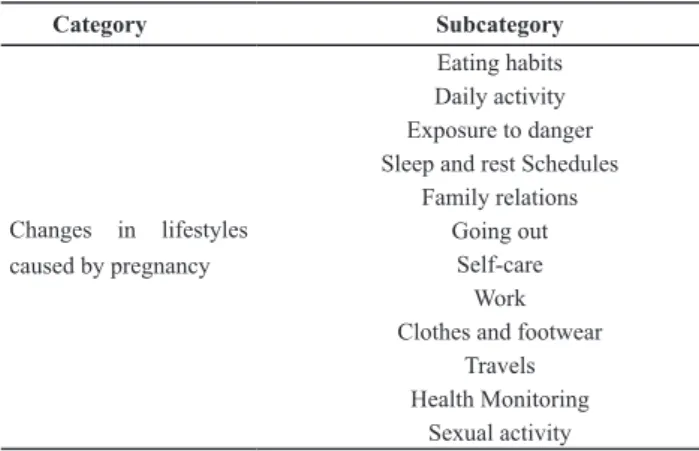
-icipants believe are changes in their lifestyles caused by pregnancy and childbirth. One can observe, from Table 2, that pregnancy caused some changes in several domains “Changes due to the pregnancy were many, I was used to
being very independent and to do whatever I felt like do
-ing... now normal day-to-day acivity is all changed, from going on holidays, concerts and even walking. I wasn’t able to stand up for long periods of ime, everything I did had to be done with the limitaions I had “(AN France).
The key domains evidenced by exposure of some of the paricipants’ speech are presented in table 2.
Table 2 - Changes in lifestyles caused by pregnancy
Category Subcategory
Changes in lifestyles caused by pregnancy
Eating habits Daily activity Exposure to danger Sleep and rest Schedules
Family relations Going out
Self-care Work Clothes and footwear
Travels Health Monitoring
Sexual activity
Therefore, as for the eaing habits, this change is re
-vealed, on the one hand, in the wishes of the pregnant woman and on the other hand, the concern with healthy eaing for both mother and child
“... I had an addiction to drinking coke during pregnancy”
(cp brazil);
“…during pregnancy I was careful to eat everything well washed, and have a healthy diet” (AO Congo);
“I ate more ish during pregnancy” (AE Brazil);
“With the pregnancy I ate more fruit” (CN Moldova);
“I started eating more vegetables in pregnancy” (AC Ukraine);
“I never drank milk and started drinking it after becoming pregnant; I started to eat more yogurt” (DA Ukraine);
“I cut a lot in fats and fried food” (AE Brazil);
“I began drinking plenty of water during pregnancy” (BT
romania).
There were also changes in daily acivity which be
-came more moderate, as evidenced by the paricipants’ speech.
“I was unable to make great exertions during pregnancy, I used to go hiking but not for long, I used to do it for ap-proximately 30 minutes per day” (BG Portugal);
“With the pregnancy I stopped doing a number of things: stopped doing impact sports, stopped doing a lot of things ... I stopped doing sports ...” (CH Portugal).
The exposure to hazards was safeguarded during preg
-nancy, either with regard to the consumpion of tobacco and alcohol, as well as contact with polluted environments.
“I used to smoke before, I no longer smoke, and did not smoke during pregnancy”, (CI Brazil);
“…with the pregnancy I stopped drinking alcohol, I really had to do it, because it could harm the baby” (DA Ukraine);
“During pregnancy even though I wanted to go out at night … not to the places where I used to go: there could be smoke… (CE Portugal).
The women also felt a need to regulate the sleep and rest paterns, due to the new condiion.
“I slept much, much more during pregnancy” (BY Poland);
“With pregnancy I changed in terms of rest, basically when I was pregnant I was very sleepy, I slept a lot…”(CQ China).
Social and family relaionships became diferent with pregnancy, there is a greater marital closeness.
“… me and my husband, we’ve become much better friends. Our relationship became much closer than when I was not pregnant”(CZ Brazil);
“We became closer to the family with the pregnancy”(CU India).
“With the pregnancy one has to give up going out” (CQ
china);
“When I was pregnant I did not go out” (BI Portugal).
With the pregnancy the woman started to be more careful with herself, adoping healthier habits for her and the baby.
“…pregnancy was what led me to... a healthier life for me and for her “(AT Argentina);
“I had more care with me during pregnancy” (BQ Moldova).
The condiion of pregnancy, and inherent discomforts, also condiioned work performance.
“he put it like this, well if you already feel a lot of pain in the back and belly, talk to the person in charge and she will arrange a person for the section, to do your work “(CL
portugal);
“I stopped working… once I was at work, and started to bleed... I could not stand anymore, although my boss said that I still had a small belly, and I could work “(BJ Portugal);
“I stopped working because I was pregnant” (AC Ukraine).
Likewise, there was a need to adjust the clothing and footwear to the new condiion of pregnancy and new body as demonstrated in the paricipants’ speech.
“I started using more comfortable and larger clothes during pregnancy” (AC Ukraine);
“…at the end of pregnancy I was wearing slippers, be-cause I could no longer wear the rest” (BH Portugal).
Furthermore pregnancy limited the travels by the
partici-pants.
“With the pregnancy I could not do long trips” (AV Portugal).
It is evident, in the paricipants’ speech, the change that occurred in the frequency of health monitoring, which use to be yearly, and changed into monthly, at the
very least.
“Before getting pregnant I only went to the doctor once
a year … but after the pregnancy i always went, every
month”(Cape Verde DD).
During pregnancy, sexual acivity assumed diferent
forms, either by sexual absinence, adopion of new strat
-egies due to the size of the belly, or even changed the li
-bidinal impulses and exacerbaion of sexual desires.
“My husband was a little scared of the belly ... and forgot it”(CJ Portugal);
“In sexual relations … sought more appropriate positions”
(bc portugal);
“... near the end ... there began an appetite out of the ordi-nary … I woke up in the night and just felt like waking him ...”(CL Portugal).
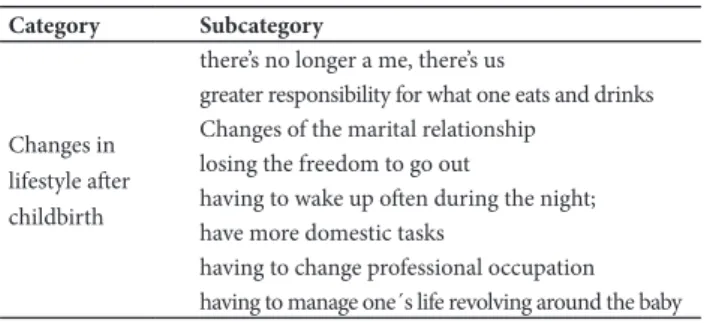
As demonstrated in Table 3, there were several chang
-es in lif-estyl-es ater giving birth reported by the women
interviewed.
Table 3 - Changes in lifestyle after childbirth
Category Subcategory
Changes in lifestyle ater childbirth
there’s no longer a me, there’s us
greater responsibility for what one eats and drinks Changes of the marital relationship
losing the freedom to go out
having to wake up oten during the night; have more domestic tasks
having to change professional occupation having to manage one´s life revolving around the baby
Among these changes, the igure of “me” is replaced by “us”, as highlighted by the speech of some paricipants.
“With the birth of the baby…there is no longer a “me”, there is “us”. (CH Portugal).
It also emerged a greater responsibility for what one eats and drinks and with the quality of their milk.
“I’m trying to eat some foods that I did not eat before, be-cause of the baby, … so that the breast milk has the nec-essary nutrients for the baby I try to eat more and I think of what foods I should eat “(CB Ethiopia).
Ater the birth, changes occur in the marital relaionship.
“With the pregnancy and also now the relationship be-tween the couple changed. Now it’s different!” (AT
Argen-tina).
The feeling of losing the freedom to go out is also re
-ported;
“When I didn´t have a baby I could go out, I could go for a walk, now I have to be closer to the baby. (AK Russia)”;
And the need of having to wake up oten during the night is also expressed, as a change of lifestyle.
“Now I have to wake up at night to care for the baby” (CB
ethiopia);
“We had to feed every two hours at night ... more than two weeks every two hours ... it was hard!” (CD Netherlands).
The increase of domesic aciviies is also expressed.
“With pregnancy and childbirth more housework accumu-lated, a little more work, I have to divide myself in another part, because we are already three at home” (BZ Moldova).
Again there is a need of having to change the profession
-al acivity, with the family being the main centre of interest.
“With the birth of baby I stopped working [to be with the baby] because I don’t feel right sending a 4 to 6 months child to daycare” (AZ Ukraine).
In the last subcategory paricipants are confronted with the necessity of having to manage life depending on the baby
“After birth, (of the baby) it is completely different” (CH
Por-tugal)
“Now with the birth of the baby everything is different, ev-erything is in function of her” (AV Portugal).
DiSCuSSiON
From the data analysis emerged changes in lifestyle caused by pregnancy and childbirth caused by
As regards the changes in lifestyles caused by preg
-nancy, although 11 (13.41%) women stated that there were no changes in his style of life during pregnancy, 15 (18.29%) reported that the changes were many, 50 (60.98%) reported changes in their eaing habits, 14
(17.07%) reported having felt diferences in daily aciv
-ity , 12 (14.63%) reported avoiding dangers during preg
-nancy, 6 (7.32%) showed diferences in the sleep and rest paterns, 5 (6.09%) reported changes in social and family relaionships, 3 (3, 66%) had stressed more restricions on going out, 7 (8.54%) reported having more self-care, 14 (17.07%) reported changes in relaion to work, 21 (25.61%) have referred changes in clothing and footwear, 12 (14.63%) reported changes in health monitoring and 28 (31.15%) menion changes in sexual acivity. Several authors highlight pregnancy as a period of transiion and
change(7), corroboraing the present results.
It is important to stress the importance of having a bal
-anced, complete and varied diet to meet nutriional needs. Although 3 (3.66%) of respondents said they eat less well, 24 (29.27%) paricipants reported paying more atenion their eaing habits. The responses of 23 (28.05%) women were grouped according to the New Food Wheel since they were in accordance with the recommendaions given by
the Portuguese Directorate General of Health. One can ob
-serve an increased consumpion of meat, ish and seafood
reported by 9 (10.97%) women; with an increased con
-sumpion of fruit were 3 (3.66%) women and of vegetables
and dairy. Also 5 (6.09%) women reported lower consump
-ion of fats and oils, and some people referred increased water consumpion. Physiological changes occurring during pregnancy determine an increase in the nutriional needs of the pregnant women, which, although similar to those
of non-pregnant women have some pariculariies regard
-ing the need for energy, protein, certain vitamins such as thiamine, folic acid, vitamin C, and minerals such as iron,
zinc, copper and magnesium(3), as referred insome studies.
The results obtained reveal that most women who de
-scribed changes in daily aciviies, reduced the exercise,
but few stopped it enirely, with none reporing doing intense physical exercise during the pregnancy and the ones who did before, stopped it. There is also literature on this subject as there are growing numbers of women who pracice physical exercise during pregnancy. Although
pregnancy is not a disease nor a disability, it is a period
that involves many changes in the maternal body and
physical acivity can lead to risks as hypoglycaemia, hy
-perthermia, and musculoskeletal injuries, decrease blood
low to the placenta, as well as hypoglycaemia and hyper
-thermia in the foetus, but also has beneits such as beter control of body fat, psychosocial interacions and possible
facilitaion of labour, due to an improved blood circula
-ion, enhancement of muscle balance; reduced swelling,
relief of bowel discomfort, decrease leg cramps, strength
-ening abdominal muscles and ease the postpartum recov
-ery. Therefore, authors recommend low intensity exercise and of an average duraion forty minutes not to cause
complicaions for the mother and the foetus(4). Women
who get fater during the irst half of pregnancy are more
likely to give birth to an obese baby(8). More recent studies
have conirmed that the pracice of about twenty minutes
of moderate and regular exercise during pregnancy im
-proves brain development in new-borns(9).
The consumpion of harmful substances such as tobacco
and alcohol, and exposure to polluted environments is det
-rimental to the general populaion and pregnant women, due to phase they are going through are no excepion. In our study, 11 (13.41%) paricipants avoided exposure to hazards, including smoking cessaion, stop consuming alcohol and avoid polluted environments. For these women, the change occurred in their lifestyle was due to the fact that they were pregnant and the objecive was the wish to reduce the risk
to the baby. This adopion of healthier life styles is also pres
-ent in the speech of 7 (8.54%) women who reported that during pregnancy had more care about themselves. These results are corroborated by other studies, in that tobacco use is sill considered the main cause of preventable morbidity
and mortality in developed countries, as well as a major
pub-lic health problem globally, with efects on the reproducive
funcion and development of a healthy pregnancy(8). Authors
also refer that the consumpion of alcohol during the irst tri
-mester of pregnancy has been associated with increased risk
of foetal malformaions(10). In agreement with the results of
the present study, other studies conirm that, since pregnan
-cy is a ime of profound physical and psychological changes in women’s lives, it can and should also be an opportunity to adopt healthier life styles(5).
According to the results obtained, 12 (14.63%) women
conveyed having ampliied health monitoring during preg
-nancy. As menioned in a previous study(11), pregnancy
involves risks for the mother and the new-born, but vigi
-lance and adequate provision of antenatal care, allows for
a favourable clinical outcome. The decrease in maternal and foetal morbidity depends, among other things, on a
Traveling is not inadvisable for low risk pregnant
wom-en, however results in this study reveal that 4 (4.88%)
women reported avoiding travels. As stated in the litera
-ture, pregnant women who plan to make long trips should organise periods of acivity and rest; if they are driving
they should stop every hour and wear a seat belt(12).
Sleep and rest, being basic human needs, are essenial to life, and these needs during pregnancy are ampliied. In
this study, 6 (7.32%) paricipants reported changes of sleep
-ing habits, namely that they slept more dur-ing pregnancy. A
pregnant woman is advised to plan regular rest periods,
es-pecially as the pregnancy progresses, because she is more easily ired, ending up to restricing her ouings.
As for changes in the family relaionships, these are
documented by 5 (6.10%) paricipants in the study, in har
-mony with the stated by other authors who refer that preg
-nancy is an important event in the experiences of all family
members, relected in the family structure and in the cre
-aion of emoional bonds among its members, and despite the intense changes in the structure and organizaion of the
family; this remains a unit that takes care of its members(13).
In this context, the job of the companion changes, as during
pregnancy, his main role is to accept and respond to feel
-ings of vulnerability of the pregnant woman(14).
As for work related changes, some authors consider that the work done on the job does not normally cause adverse efects on gestaion outcomes, and suspension
of the labour acivity is usually due excessive faigue (15).
In this study 5 (6.10%) women referred other causes to decrease or abandon work, as obstetric complicaions and medical advice; 2 (2.24%) women reduced work by choice and 2 (2.24%) stopped working due to being pregnant.
The physical changes inherent to pregnancy lead the women to adapt their clothing. It should be noted that most women who conveyed having felt changes on clothing and footwear choices, tesiied to have changed to more comfortable and loose clothing, and wider and
low heel footwear. As conirmed by other authors, com
-fortable and loose clothing is the most suitable for preg
-nant women, to prevent some complicaions and provide greater comfort; it is advisable to use comfortable shoes
with good stability and fostering good body posture(16).
As for sexuality, this is one of the most natural character
-isics of being human(6). In this study there was one woman
who reported having increased sexual acivity towards the end of pregnancy; compaible to the acknowledged sexual desire due to increased libido in late pregnancy. Sexuality is a biological, physiological reality and one of the engines of
our existence. Addressing sexual intercourse during preg
-nancy is essenial, and if once it was prohibited during preg
-nancy, nowadays it is encouraged in view of the wellbeing of the couple. In the early period of pregnancy it is frequent
the occurrence of emoional vulnerability along with physi
-cal changes such as nausea, vomiing, drowsiness, ired
-ness making the woman feel less sexual appeite; however
demonstraions of afecion and care from the father(17) are
welcome. In late pregnancy, if some couples increase their sexual acivity, other couples are more reluctant to seek it, some even abstain since the discomfort is increased due to
iredness, faigue, and awkwardness because of the bel
-ly(18). Despite the knowledge evoluion in this area there are
sill myths, beliefs, moral and cultural values of the sexual
-ity experiences in the context of pregnancy(18).
As for changes in lifestyle ater childbirth, 14 (17.07%) women described that ater the birth of the baby, everything is managed around the child. This is validated by some authors, in the sense that The birth of a baby is a period marked by many changes and has huge impact on personal and family
life of individuals; women as well as having to adapt to physi
-cal changes caused by childbirth, are faced with a new being which depends on them. The birth of a child consitutes a
change in the exising inter-relaional structure in a family(19).
In a country where the birth rate is so low, it is worth noing that for three-iths of the sample it was not their
irst experience of motherhood which to some extent re
-sults in diferences in awareness for each woman, in how they face and live these changes.
CONCluSiON
This study aimed to know the changes in lifestyles due to pregnancy and childbirth in Portuguese and immigrant
women in Portugal. Most women adopted healthier life
-styles during pregnancy, considering both themselves and the baby, and used this period to put aside some less
healthy habits, as is the case of tobacco, alcohol and expo
-sure to polluted environments.
The results showed that major changes in lifestyles due to pregnancy were in eaing habits, they became more careful, in daily acivity, which became more moderate; in exposure to hazards, which was avoided; sleep and rest sought by the women; in social and family relaionships,
that became closer; going out paterns, which were re
-duced or even avoided; self-care, which increased; at work, where there was a need to slow down or someimes stop;
in clothing and footwear, adjusted, for comfort to the con
-diion of pregnancy; on journeys, which were diminished or even avoided; Health surveillance, which was signiicantly increased; and the experiences of sexuality, where new strategies were sought to adapt to the circumstances.
The main changes experienced by these women, ater childbirth, were that they lives came to be managed in the light of the baby, in this sense, ouings, domesic acivity, work, sleep and rest, are condiioned by the baby’s schedule, since the baby always comes irst and is the centre of atenion.
Limitaions of this study, one has to point out the larg
-est number of immigrant pregnant women in relaion to
-ies were found that focused on this subject of the Portu
-guese and immigrant populaion in Portugal, precluding further discussion on it.
Considering our results, no signiicant diferences were found in lifestyles between Portuguese and immigrants who experience the process of motherhood, taking into account
their culture, but only with regard to their condiion of be
-coming a mother; however one suggests the development of other studies with Portuguese immigrants and pregnant around this issue, due to lack of exising literature.
We hope that this study may contribute to under
-standing the Portuguese and immigrant women who experience the process of motherhood, in regard to the changes occurring in their lifestyles.
ACKNOWlEDGEMENtS
Portuguese Foundaion for Science and Technology, through project PEst-OE/CED/UI4016/2014, and Centro de Estudos em Educação Tecnologia e Saúde (CI&DETS).
rEFErENCES
1. Council AHMA. Clinical Pracice Guidelines: Antenatal Care -
Module I. Canberra: Australian Government Department of Health and Ageing; 2012.
2. Mendes IM. Ajustamento materno e paterno: experiências viven
-ciadas pelos pais no pós parto. Coimbra: Mar da Palavra; 2009.
3. Blumield ML, Hure AJ, Macdonald-Wicks L, Smith R, Collins CE. A systemaic review and meta-analysis of micronutrient intakes during pregnancy in developed countries. Nutriion Reviews. 2013;71(2):118-32. PubMed PMID: 23356639.
4. Petrov Fieril K, Fagevik Olsén M, Glantz A, Larsson M. Expe
-riences of Exercise During Pregnancy Among Women Who Perform Regular Resistance Training: A Qualitaive Stu
-dy. Physical Therapy. 2014;94(8):1135-43. PubMed PMID: 2012669650. Language: English. Entry Date: 20140815. Revi
-sion Date: 20140829. Publicaion Type: journal aricle.
5. Lin YH, Tsai EM, Chan TF, Chou FH, Lin YL. Health promoing lifestyles and related factors in pregnant women. Chang Gung medical journal. 2009 Nov-Dec;32(6):650-61. PubMed PMID: 20035645. Epub 2009/12/29. eng.
6. Pauleta JR, Pereira NM, Graça LM. Sexuality During Pregnancy. The Journal of Sexual Medicine. 2010;7(1pt1):136-42.
7. Couinho EC, Parreira MVBC. (2011). Outra forma de olhar de
olhar a mãe imigrante numa situação de transição [Another way to look at the immigrant mother in a transiion situaion]. Millenium 2011; 40: 83-97.
8. Koletzko B, Bauer CP, Bung P, Cremer M, Flothkoter M, Hellmers C, et al. German naional consensus recommendaions on nutri
-ion and lifestyle in pregnancy by the ‘Healthy Start - Young Fami
-ly Network’. Annals of nutriion & metabolism. 2013;63(4):311-22. PubMed PMID: 24514069. Epub 2014/02/12. eng.
9. Geddes L. Exercise during pregnancy boosts baby brain deve
-lopment. New Scienist. 2013 11/16/;220(2943):10
10. Briggs GG, Freeman RK, Yafe SJ. Drugs in Pregnancy and
Lactaion: A Reference Guide to Fetal and Neonatal Risk. 9th ed. Philadelphia: Lippincot Williams & Wilkins; 2011.
11. Couinho T, Monteiro MFG, Sayd JD, Teixeira MTB, Couinho
CM, Couinho LM. Monitoramento do processo de assistên
-cia pré-natal entre as usuárias do Sistema Único de Saúde em município do Sudeste brasileiro. Revista Brasileira de Gi
-necologia e Obstetrícia. 2010;32:563-9.
12. Motozawa Y, Hitosugi M, Abe T, Tokudome S. Efects of se -at belts worn by pregnant drivers during low-impact
colli-sions. American Journal of Obstetrics and Gynecology. 2010 7//;203(1):62.e1-.e8.
13. Silva, L. J., & Silva, L. R. Mudanças na Vida e no Corpo: Vi
-vências Diante da Gravidez na Perspeciva Afeiva dos Pais. Revista de Enfermagem Esc Anna Nery, 2009, Abril-Junho. htp://www.scielo.br/pdf/ean/v13n2/v13n2a22.pdf
14. Akincigil A, Munch S, Niemczyk KC. Predictors of Maternal Depression in the First Year Postpartum: Marital Status and Mediaing Role of Relaionship Quality. Social Work in Heal
-th Care. 2010 2010/03/15;49(3):227-44.
15. Palmer K, Bonzini M, Ellekilde P. Pregnancy: Occupaional Aspects Of Management: Concise Guidance. Royal College Of Physicians Clinical Medicine. 2013;13(1):75-9.
16. Bogaerts AFL, Devlieger R, Nuyts E, Witers I, Gyselaers W, Van den Bergh BRH. Efects of lifestyle intervenion in obese pregnant women on gestaional weight gain and mental health: a rando
-mized controlled trial. Int J Obes. 2013 06//print;37(6):814-21.
17. Magalhães, L., Soares, R., Oliveira, S., & Ribeiro, S. Sexualida
-de na gravi-dez. Revista Ecos da Enfermagem, 2007, Nº262.
18. Barbosa, B. N., Gondim, A. N. C., Pacheco, J. S., Pitombeira, H. C. S., Gomes, L. F., Vieira, L. F., & BDamasceno, A. K. C. Sexualidade vivenciada na gestação: conhecendo essa reali
-dade. Revista Eletrônica de Enfermagem, 2011. htp://www. fen.ufg.br/revista/v13/n3/pdf/v13n3a12.pdf
19. Shapiro AF, Gotman JM, Carrére S. The baby and the mar
-riage: Idenifying factors that bufer against decline in mari