RESUmEn
Objeivo: Analizar la concordancia y la discordancia entre las evaluaciones rea-lizadas mediante la aplicación o no de un instrumento de clasiicación de pacientes e invesigar la asociación entre la concor-dancia y las caracterísicas personales y profesionales de los evaluadores. Méto-do: Estudio descripivo exploratorio. Se invesigaron a 105 pacientes internados en hospital universitario del interior del Esta-do de São Paulo uilizánEsta-dose la estadísica kappa (ponderado) y el método Bootstrap. Resultados: La concordancia entre las eva-luaciones reveló: kw 0,87 (instrumento x evaluador interno), kw 0,78 (instrumento x evaluador externo) y kw 0,76 (entre los evaluadores) y la inluencia de algunas caracterísicas personales y profesionales. Las evaluaciones conducidas mediante el empleo de instrumento contemplaron mayor número de áreas de cuidado en comparación a cuando no se aplicó el ins-trumento. Conclusión: Se recomienda el uso de este instrumento a in de lograr una ideniicación más efeciva de las necesida-des de cuidados a los pacientes.
dEScRIPtoRES
Evaluación en enfermería Pacientes
Clasiicación
Evaluación de necesidades
RESUmo
Objeivo: Analisar a concordância e a dis-cordância entre as avaliações realizadas mediante a aplicação ou não de instru-mento de classiicação de pacientes, e in-vesigar a associação entre a concordância e as caracterísicas pessoais e proissionais dos avaliadores. Método: Trata-se de um estudo descriivo exploratório. Foram in-vesigados 105 pacientes internados em hospital de ensino do interior do Estado de São Paulo uilizando-se a estaísica kappa (ponderado) e o método Bootstrap. Resul-tados: A concordância entre as avaliações apontou: kw 0,87 (instrumento x avaliador interno), kw 0,78 (instrumento x avaliador externo) e kw 0,76 (entre os avaliadores) e a inluência de algumas caracterísicas pessoais e proissionais. As avaliações con-duzidas mediante o uso de instrumento contemplaram maior número de áreas de cuidado em relação a quando o instrumen-to não foi aplicado. Conclusão: Recomen-da-se o uso deste instrumento a im de se obter ideniicação mais efeiva das neces-sidades cuidaivas dos pacientes.
dEScRItoRES
Avaliação em enfermagem Pacientes
Classiicação
Determinação de necessidades de cuidados de saúde
AbStRAct
Objecive: To analyze the agreement and disagreement between the assessments by applying or not a paient classiicaion instrument, and to invesigate the asso-ciaion between the agreement and per-sonal and professional characterisics of the evaluators. Method: This is a descrip-ive exploratory study. 105 paients were hospitalized in a teaching hospital in the state of Sao Paulo, using the kappa stais-ic (weighted) and the Bootstrap method. Results: The agreement between the as-sessments were: kw 0.87 (instrument x
internal evaluator), kw 0.78 (instrument x external evaluator) and kw 0.76 (between
evaluators) and the inluence of some personal and professional characteris-ics. The assessments conducted through the use of an instrument contemplated a greater number of areas of care in relaion to when the instrument was not applied. Conclusion: The use of this instrument is recommended in order to more efecively idenify care needs of paients.
dEScRIPtoRS
Nursing assessment Paients
Classiicaion Needsassessment
Identification of care needs of patients
with and without the use of a classification
instrument
marcia Galan Perroca1, marli de carvalho Jericó1, Josi Vaz de Lima Paschoal2
IDENTIFICAÇÃO DE NECESSIDADES DE CUIDADOS DOS PACIENTES COM E SEM USO DE INSTRUMENTO DE CLASSIFICAÇÃO
IDENTIFICACIÓN DE LAS NECESIDADES DE CUIDADOS A LOS PACIENTES CON Y SIN EL EMPLEO DE INSTRUMENTO DE CLASIFICACIÓN
1 PhD Professor. Department of Specialized Nursing, Faculty of Medicine of Sao Jose do Rio Preto, Sao Jose do Rio Preto, SP, Brazil. 2 MSc in Health Sciences,
Faculty of Medicine of Sao Jose do Rio Preto, Sao Jose do Rio Preto, SP, Brazil.
DOI: 10.1590/S0080-623420140000400008
O
r
ig
in
a
l
a
r
ti
c
IntRodUctIon
The nursing assessment aims to idenify care needs of the paient/family in their various dimensions, providing the scieniic basis for targeing behaviors and implement-ing care intervenions(1). The importance of the criical
appraisal as a component of assessment in the decision-making process in nursing pracice has been highlighted in the literature. Criical appraisal covers a process in which diferent types of clinical informaion about the paient are used to conduct an assessment of the current situa-ion of their state of health(2).
The accuracy of this criical appraisal afects the qual-ity of the decision. Thus, inaccurate or improperly com-bined criical appraisals produce poor decisions(3). The use
of informaion that has no use for the judgment in ques-ion and assigning excessive importance to certain infor-maion have been ideniied(4) as causes of inaccuracy. On
the other hand, the misinterpretaion of data can lead to loss of ime and energy, dissaisfacion and harm to pa-ients and also reduce the favorable outcomes of the care provided(5). It is important to note that professional criical
appraisal is founded on clinical experience, which is the precursor of experise(2).
Clinical reasoning has been found in the literature as synonymous with clinical criical appraisal and decision making(2,6) and deined as the representaion of
intellectu-al processes involved in paient care, incorporaing knowl-edge standards (empirical, ethical, personal and aestheic) and criical appraisal(7). Fluency, lexibility and elaboraion
are considered capabiliies involved in the process. Fluen-cy is the muliple thoughts of human beings; lexibility, the ability to switch from one thought to another allocated in another category; and the elaboraion is the ideniicaion of the implicaions from an informaion(8).
In recent decades, measurement scales have been increasingly used by nurses in the assessment process to provide greater asseriveness to decision making in man-aging care(9). Among them, the Paient Classiicaion
In-strument (PCI), built with the purpose of idenifying the demand for paient care in relaion to nursing, so that categories could be grouped later (minimum, intermedi-ary, semi intensive, intensive)(9). Its applicaion enables
the provision of data relaing to paients, so that decision making may be made based on care planning, staf adjust-ments,producivity and costs of nursing services(10-11).
A Paient Classiicaion Instrument (PCI), developed in Brazil in the late 1990s, has been subjected, over the years, to several tests to evaluate its psychometric proper-ies(9,12-13). Although the results have shown evidence of
reli-ability and validity of the scale and that it can be used to guide management pracice in determining the workload of the nursing staf(13), it becomes important to further
invesi-gate this instrument, even though the demand for nursing care for the paient is ideniied by the percepion of nurses.
Although one can find in the literature approaches to the development and validation of instruments for classification, it has not been possible to identify in-vestigations comparing the care demand of patients identified by applying PCI with the nurses perceptions of patient’s care demand. We highlight research con-ducted in Finland(14), where areas of care contained the
classification instrument which were contrasted with the patient’s perception of their own care needs. It is still unknown whether factors such as being allocated in patient unit or having experience in caring for pa-tients of critical units, such as an ICU, interfere with the agreement of the nurse when they use different forms of assessments for patient’s needs. With a patient in a critical condition, for instance, nurses require more fre-quent assessments than patients in other categories of care, allowing greater opportunity for the development of expertise.
Thus, this study aims to: analyze the agreement and disagreement between the assessments by applying or not a paient classiicaion instrument and to invesigate the associaion between the agreement and the personal and professional characterisics of the evaluators.
mEtHod
This is a quanitaive research approach, with cross-secional design, for the assessment of a diagnosic method using a validated PCI as a gold standard, which was conducted in a private teaching hospital for extra capacity, located in the State of Sao Paulo. We propose to answer the following quesions: what is the level of agreement between assessment of categories of care/ needs of paients obtained by applying or not the instru-ment of classiicaion? In which aspects do these evalu-aions come closer or move away? Do professional fea-tures such as funcion, ime of pracice, academic and professional qualiicaion inluence in the agreement be-tween the evaluaions?
Data were collected during the months of May/2010 to January/2011, along with 105 adult paients at six in-paient units designed to Uniied Health System in-paients. These would incorporate a medical clinic, a medical-sur-gical clinic and four specialized units (Infecious-parasiic diseases, Unit of Obstetrics and Gynecology, Neurology Unit and Intensive Care Unit for adult - ICU).
At irst, the study subjects totaled 13 nurses (clinical care and supervisors), from which six applied the PCI(9)
In order to make the sample representaive regarding the professional proile of paricipants, we established two criteria: be acive nurse invesigated in units; present diferent combinaions of professionals features (funcion, ime of pracice in the unit, professional and academic qualiicaion) and personal characterisics (age). Of the 22 nurses located in the invesigated units, only 13 met the inclusion criteria.
Seven variables were invesigated. They were: age (less/greater than 30 years); funcion (clinical nurse or supervisor); ime of professional experience (less/more than ive years); ime working in the unit (less/more than two years); professional qualiicaion completed (ceri-ied courses in the area in which they work or related); academic qualiicaion completed (stricto sensu graduate programs - master’s and doctoral level), and work in an ICU or other hospitalizaion unit.
Three instruments for data collecion were used. The irst consisted of a quesionnaire to characterize the par-icipaing nurses, containing semi-structured quesions about personal and professional data.
The second instrument was the use of a new validated version of a paient classiicaion instrument(9,13), applied
to idenify the demand for care of paients in relaion to nursing. This scale is composed of nine areas of care and classiies paients as: minimum care (9-12 points), inter-mediary care (13-18 points), semi intensive care (19-24 points) and intensive care (25-36 points). The nine areas of care considered in the composiion of the instrument are: Care Process Planning and Coordinaion, Invesigaion and Monitoring, Personal Hygiene and Eliminaions, Skin Integrity, Nutriion and Hydraion, Locomoion or Acivity, Therapeuics, Emoional Support, and, Health Educaion.
The third instrument used consisted of a form for reg-istraion of evaluaions by clinical reasoning of nurses, and it was designed in two parts. The irst addressed the iden-iicaion data of the paient and evaluator, as well as date and ime of data collecion. The second was intended for the actual assessment, where evaluators were asked to list and jusify the care needs of paients. Subsequently, these evaluators would choose from a list of four catego-ries, similar to the PCI (minimum care, intermediary care, semi intensive care and intensive care) and their deini-ions, the category that expressed more accurately the demand for paient care in relaion to Nursing. Each pa-ient was evaluated three imes:
1. Upon applicaion of the PCI by a nurse from the hospi-talizaion unit;
2. No applicaion of the PCI by a nurse from the paient’s hospitalizaion unit (internal evaluator - IE);
3. No applicaion of the PCI by a nurse from another pa-ient’s hospitalizaion unit (external evaluator - EE).
Nurses were asked to independently evaluate the as-signed paients without exchanging informaion with each other during the process. Observaion about the short-est possible ime between assessments was also recom-mended in order to prevent changes in clinical status of paients, which would interfere in the results.
All nurses were placed during dayime. The preference for this period was due to the greater possibility of the nurse/bed and greater knowledge of paient care needs. Respecing the ethical issues involved in research, we ob-tained a Consent Form from the professionals involved and it was approved by the Research Ethics Commitee (N°. 399/2009).
The weighted Kappa (Kw) with 95% conidence interval (CI) was chosen to verify the level of agreement between assessments in respect of diferent categories of care. Dis-agreements were categorized into three levels, consider-ing grade 1, when the paient was classiied as a category of care immediately above or below (minimum/interme-diate care or interme(minimum/interme-diate/minimum care), and so on for the other grades. Interpretaion of data for the level of agreement followed the subsequent default values(15):
<0.20 = poor; 0.21-0.40 = fair; 0.41-0.60 = moderate; 0.61-0.80 = good and 0.81-1.00 = very good.
The cross mapping(16), adapted to the purposes of this
study, was used to analyze the jusiicaions of nurses as demand for care of paients and categorize them accord-ing to the nine areas of PCI. For each characterisic to be compared, one resampling was performed of 1000 boot-strap samples of the coeicient classiied according to cat-egory of care and reclassiied as minimum/intermediary and semi intensive/intensive. This is a resampling method for intensive compuing, designed to generate distribu-ions of funcdistribu-ions of the diicult data to be obtained by probabilisic calculaions, according to the levels of the variables chosen, as in this case(17).
Staisical analysis was performed by applying the sot-ware Rx64 2.13.0 version of The R Foundaion for Staisical Compuing, 2011. Descripive staisical data are presented as frequency, percentage, mean and standard deviaion.
RESULtS
There was a prevalence of female paients (n=65;61.9%), mean age of 52.5 (SD=18.7) range 15-93 years. Through the classiicaion instrument, paients were categorized into minimum care (n=51; 48.6%), intermedi-ary care (n=27;25.7%), semi intensive care (n=15;14.3%) and intensive care (n=12;1.4%).
worked in other hospitalizaion units involved in the study; eight of them worked as a clinical care nurse and ive were supervisors. With regard to professional qualiicaions, a nurse stated having only graduaion degree, three atend-ed nursing coninuing atend-educaion courses, eight had a cer-iicaion degree, six of them in areas where they worked or related to it, and one nurse had a master’s degree. Agreement and disagreement between assessments
A total of 315 assessments were performed, being 105 and 210, respecively, with and without applicaion of the paient classiicaion instrument. The categories of care by type of evaluator and the agreement between diferent types of assessment (with and without PCI) and evaluators (internal and external) are presented, respecively, in Ta-bles 1 and 2. Regarding the care category, there was greater agreement between the assessments in the categories of minimum and intensive care (Table 1). The Kw (instrument x evaluator type) ranged from 0.76 (CI 0.62 - 0.89) to 0.87 (CI 0.74 - 1.00) and Kw (work or do not work in ICU) of - 0.18 (CI NaN-NaN) to 0.58 (CI 0.32 - 0.84). NaN (acronym for Not a Number) is not a valid numeric value (Table 2).
When there was disagreement, the evaluators clas-siied the paients below or above from the category of care indicated by PCI. The IE classiied 16/26 assessments above of the class indicated by the PCI, the same hap-pened to the EE - 31/39 assessments (Figure 1).
Table 1 – Agreement percentage of assessments according to cat-egories of care - Sao Jose do Rio Preto, 2011
Categories of care ClassIE (N=79) EE (N=66) IE x EE (N=67) N AgreeN(%) ClassN AgreeN(%) ClassN AgreeN(%) Minimum care 51 46(90.2) 41 37(90.2) 41 37(90.2) Intermediary care 21 13(61.9) 24 11(45.8) 24 9(37.5) Semi intensive care 22 11(50) 25 9(36) 25 12(48) Intensive care 11 9(81.8) 15 9(60) 15 9(60)
IE = internal evaluator; EE = external evaluator; Class = classiication; Agree = agreement. Note: (N=105).
A = agreement; D1 = disagreement in 1st degree; D2 = disagreement in 2nd degree.
Figure 1 – Comparison between agreement and disagreement in degrees: a) between evaluators and the instrument; b) among evalua-tors - Sao Jose do Rio Preto, 2011
Table 2 – Kappa agreement level between the assessments - Sao Jose do Rio Preto, 2011
Assessment Kw IC 95%
Instrument x Internal evaluator 0.87 0.74 – 1.00 Instrument x External evaluator 0.78 0.64 – 0.91 Internal evaluator x External evaluator 0.76 0.62 – 0.89 Instrument x ICU internal evaluator 0.58 0.32 – 0.84 Instrument x NICU internal evaluator 0.16 NaN – NaN Instrument x External evaluator ICU - 0.18 NaN – NaN Instrument x External evaluator NICU 0.39 0.13 – 0.65
Kw = weighted Kappa ; IC = conidence interval; NaN = not a number; NICU = no UTI. Note: (N=105).
A D1 D2
1 (1%)(4.8%)5 25
(23.8%) 34 (32.4%) 79
(75.2%)
66 (62.8%)
IE
EE
A D1 D2
7 (7%) 31
(29%) 67
(64%)
IE/EE
The 210 assessments undertaken (IE and EE) generated 738 jusiicaions, of which 73 were discarded due to their lack of relaionship with the nine areas of PCI care. We iden-iied 604 jusiicaions referring to the psychobiological di-mension and 53 to psychosocial didi-mension (Health Educaion and Emoional Support). On average, 3.2 (SD=1.7) (range 1-8) care areas were found, being 2.8 (SD=1.8) for the IE and 3.5 (SD=1.6) for the EE. The most cited areas were Invesi-gaions and Monitoring (154 references), Locomoion and Acivity (131) and Personal Hygiene and Eliminaions (103).
Agreement between the variables
a)
kappa coefficient kappa coefficient
kappa coefficient kappa coefficient kappa coefficient de nsi ty de nsi ty de nsi ty de nsi ty de nsi ty de nsi ty kappa coefficient 6 5 4 3 2 1 0 3 2 1 0 6 4 2 0 3 2 1 0 5 4 3 2 1 0 5 4 3 2 1 0
0.0 0.2 0.4 0.6 0.8 1.0 0.4 0.6 0.8 1.0
0.0 0.2 0.4 0.6 0.8 1.0
0.0 0.2 0.4 0.6 0.8 1.0
0.0 0.2 0.4 0.6 0.8 1.0
0.0 0.2 0.4 0.6 0.8 1.0
< 30 years ≥ 30 years
< 5 years ≥ 5 years
< 2 years ≥ 2 years
Clinical nurse supervisor
No prof. Qualif. Qualified
No prof. Qualif. Qualified b) kappa coefficient kappa coefficient kappa coefficient kappa coefficient kappa coefficient kappa coefficient de nsi ty de nsi ty de nsi ty de nsi ty de nsi ty de nsi ty 0 5 10 1 5 20 2 5 0 1 2 3 4 5 0 1 2 3 0 5 1 0 20 0 1 2 3 0 1 2 3 4
-0.4 -0.2 0.0 0.2 0.4
-0.4 -0.2 0.0 0.2 0.4
-0.8 -0.4 0.0 0.4
-0.5 0.0 0.5 1.0
-0.4 -0.2 0.0 0.2 0.4
-0.4 -0.2 0.0 0.2 0.4 0.6
< 30 years ≥ 30 years
< 5 years
≥ 5 years < 2 years≥ 2 years
Clinical nurse supervisor
No prof. Qualif.
Qualified No prof. Qualif.
Qualified
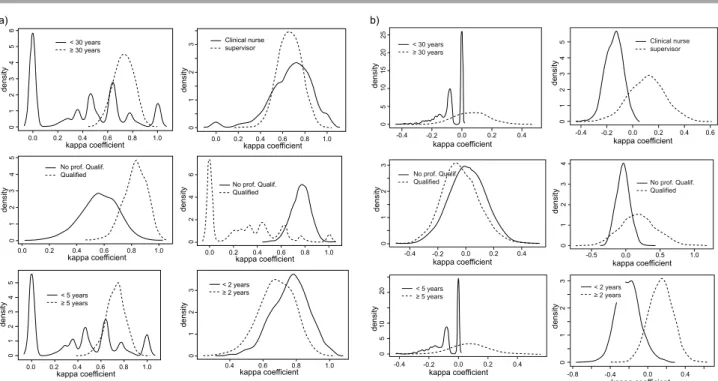
Figure 2 – Degree of agreement among evaluators and the PCI to the variables of age, years of professional experience in the unit, professional and academic qualiication and function: a) internal (IE) and b) external (EE) - Sao Jose do Rio Preto, 2011
It was observed that assessments made by nurses placed in the ICU showed greater agreement 0.80 (0.11) obtained by applying PCI than those conducted by nurses from other hospital units 0.66 (0.10).
dIScUSSIon
Agreements and disagreements between care categories
A total of 315 evaluaions were made being 105 with applicaion of instrument (for nursing unit) and 210 with-out the use of the PCI (for nursing of paient unit - IE and by nurse from another unit - EE).
The indings of this study showed that the internal evaluator (IE) showed very good level of agreement with the instrument (Kw 0.87 - CI 0.74 - 1.00). This can be jus-iied by the knowledge of the clinical status of paients by establishing paient/family bond(2) and the acive
par-icipaion from the planning to the implementaion of the care process. The availability of access to informaion by the internal evaluator enables higher data processing, making the evaluaion process more eicient. It also be-came clear, as a previous study(12), the extreme categories
of care (minimum and intensive) were more consistent for paients presening demand of nursing care and easily ideniiable by nurses.
There was prevalence of disagreement in one de-gree and a tendency to overesimate the category of care(18-19). The view of the nurse on the paient without
the use of PCI, concentrated in the areas of Invesigaion/
Monitoring, Locomoion/Acivity, Therapeuics and Per-sonal Hygiene and Eliminaions, regardless of the type of care. Personal Hygiene had already been ideniied as the most signiicant area of care in determining the complex-ity of care(12). Study(20) evaluaing the care areas mostly
addressed in the nursing paient discharge guidelines showed signiicant increase of 71.3% in idenifying care needs when PCI is applied.
Although the external evaluator (EE) noted greater number of jusiicaions corresponding to the areas of care of the PCI, they were less asserive about the cate-gories of paient care in relaion to the internal evaluator (IE). However, the evaluators did not cover all of the areas ideniied by the instrument.
Associaion between the agreement and the proile of evaluators
The professional and personal features that had inlu-ence on the agreement between the evaluaions were age ≥ 30 years, ime of professional pracice ≥ 5 years, profes-sional qualiicaion and being placed in the ICU. The vari-able funcion, that is, being a supervisor or a clinical nurse, showed no evidence of diference in degree of agreement for the internal and external evaluators. In the insituion invesigated, nursing supervisors oten take care of clinical care aciviies due to the quanitaive insuiciency of this professional in the team. Thus, this closeness with the as-sistance may have inluenced the results.
assessment takes place and the culture of nursing care in the unit can inluence clinical reasoning(2), as well as the
paient’s knowledge.
A model built related to diferent levels of acquiring skills in nursing pracice(21); described ive posiions
rang-ing from beginner (novice), with limited recogniion of evidence and analyical thinking, to the specialist (expert) with comprehensive understanding and intuiion. Thus, the model rests on concepts of experience, knowledge and skills. A more recent study(22) comparing types of
nurses selected by experts and novices in the process of decision making in the ICU found that specialist nurses are more proacive in collecing relevant evidence and anici-paing problems than novice nurses.
However, not always the most experienced and most qualiied nurses achieved more efecive assessments. A Briish study(23) comparing results of applying risk scales
of pressure ulcer with assessments by clinical reasoning carried out by 236 nurses found no staisical associaion between the two evaluaion approaches and socio-demo-graphic variables. It was also considered that the pressure exerted by ime, reduces the ability of nurses to detect pa-ients’ needs and perform intervenions, even when the professional has clinical experience(24).
One limitaion of this study was the number of paients assessed by nurses, which made it diicult to obtain more
conclusive results. We found diiculies in moving nurses from their original units and to perform three types of evaluaions (instrument, internal and external evaluator) simultaneously. The concern with the ime spent out of the unit to perform the evaluaions may have been an in-luenial factor in the results. Thus, its replicaion in other seings with larger samples is recommended, using the same variables and the same criteria to enable compari-son of indings.
concLUSIon
In professional pracice, it is important to select as-sessment strategies that address the real needs of pa-ients to guide decisions of nurses in care planning and care efeciveness.
The degree of agreement found in evaluaions shows that the studied PCI is aligned with the percepion of nurses about the demand for nursing care of the paient, facilitaing their reliability and use as a guide to decision making in the management of care. It also shows that the evaluaions conducted by using instrument contemplated more areas of care in relaion to when the instrument was not applied. Therefore, the use of this instrument is rec-ommended in order to more efecively idenify the care needs of paients.
REFEREncES
1. Bitencourt GKGD, Crossei MGO. Criical thinking skills in the nursing diagnosis process. Rev Esc Enferm USP [Internet]. 2013 [cited 2014 Feb 10];47(2):341-7. Available from: htp:// www.scielo.br/pdf/reeusp/v47n2/en_10.pdf
2. Tanner CA. Thinking like a nurse: a research-based model of clinical judgment in nursing. J Nurs Educ. 2006;45(6):204-11.
3. Harvey N. Studying judgment: general issues. Think Reason [Internet]. 2001 [cited 2013 Nov 10];7(1):103-18. Available from: htp://www.tandfonline.com/doi/pdf/10.1080/135467 80042000064#preview
4. Dowding D, Thompson C. Using judgment to improve accuracy in decision-making. Nurs Times. 2004;100(22):42-4.
5. Lunney M. Criical need to address accuracy of nurses’ diagnoses. Online J Issues Nurs [internet]. 2008 [cited 2012
Dec 8];13:(1). Available from: htp://nursingworld.org/
MainMenuCategories/ANAMarketplace/ANAPeriodicals/ OJIN/TableofContents/vol132008/No1Jan08/
AriclePreviousTopic/AccuracyofNursesDiagnoses.html
6. Simmons B. Clinical reasoning: concept analysis. J Adv Nurs. 2010;66(5):1151-8.
7. Cerullo JASB, Cruz DALM. Clinical reasoning and criical thinking. Rev Laino Am Enfermagem. 2010;18(1):124-9.
8. Lunney M. Uso do pensamento críico para o alcance de resultados posiivos de saúde. In: Lunney M. Pensamento críico para o alcance de resultados posiivos em saúde: análise e estudos de caso em enfermagem. Porto Alegre: Artmed; 2011. p. 25-55.
9. Perroca MG. Development and content validity of the new
version of a paient classiicaion instrument. Rev Laino Am Enfermagem. 2011;19(1):56-66.
10. De Groot HA. Paient classiicaion system evaluaion: Part 2, system selecion and implementaion. J Nurs Adm. 1989;19(7):24-30.
11. Van Slyck A. Paient Classiicaion Systems: not a proxy for nurse ‘busyness’. Nurs Admin Q. 2000;24(4):60-5.
13. Perroca MG. The new version of a paient classiicaion instrument: assessment of psychometric properies. J Adv Nurs. 2013;69(8):1862-8.
14. Fagerström L, Eriksson K, Engberg IB. The paients’s perceived caring needs: measuring the unmeasurable. Int J Nurs Pract. 1999;5(4):199-208.
15. Altman DG. Pracical staisics for medical research. London: CRC; 2013.
16. Lucena AF, Barros ALBL. Mapeamento cruzado: uma alternaiva para à análise de dados em enfermagem. Acta Paul Enferm. 2005;18(1):82-8.
17. Perera R, Heneghan C, Badench D. Ferramentas estaísicas no contexto clínico. Porto Alegre: Artmed; 2010.
18. Farrel GA. How accurately do nurses perceive paients’ needs? A comparison of general and psychiatric seings. J Adv Nurs. 1991;16(9):1062-70.
19. Lauri S, Lepistö M, Käppeli S. Paients’ needs in hospital: nurses’ and paients’ views. J Adv Nurs. 1997;25(2):339-46.
20. Pagliarini FC, Perroca MG. Uso de instrumento de classiicação de pacientes como norteador do planejamento de alta de enfermagem. Acta Paul Enferm. 2008;21(3): 393-7.
21. Benner P, Tanner C, Chesla C. From beginner to expert: gaining a difereniated clinical world in criical care nursing. ANS Adv Nurs Sci. 1992;14(3):13-28.
22. Hofman KA, Aitken LM, Duield C. A comparison of novice and expert nurses’ cue collecion during clinical decision-making: verbal protocol analysis. Int J Nurs Stud. 2009;46(10):1335-44.
23. Gould D, Goldstone L, Gammon J, Kelly D, Gammon J. Examining the validity of pressure ulcer risk assessment scales: a replicaion study. Int J Nurs Stud. 2004;41(3): 331-9.