INTRODUCTION
Article/Artigo
1. Departamento de Microbiologia, Centro de Ciências Biológicas, Universidade Estadual de Londrina, Londrina, PR. 2. Centro de Ciências da Saúde, Universidade Estadual de Londrina, Londrina, PR. 3. Departamento de Ensino, Universidade Tecnológica Federal do Paraná, Londrina, PR.
Address to: Dra. Márcia Cristina Furlaneto. Depto Microbiologia/CCB/UEL. Caixa Postal 6.001, 86051-990 Londrina, PR, Brasil.
Phone: 55 43 3371-5736 email: [email protected] Received in 23/02/2011 Accepted in 11/05/2011
Species distribution and
in vitro
luconazole susceptibility of clinical
Candida
isolates in a Brazilian tertiary-care hospital over a 3-year period
Distribuição de espécies e suscetibilidade
in vitro
ao luconazol de isolados clínicos de
Candida
em um hospital terciário brasileiro num período de três anos
Márcia Cristina Furlaneto
1, Juliana Frasnelli Rota
1, Regina Mariuza Borsato Quesada
2, Luciana Furlaneto-Maia
3,
Renne Rodrigues
2, Silas Oda
2, Marcelo Tempesta de Oliveira
1, Rosana Serpa
1and Emanuele Júlio Galvão de França
1ABSTACT
Introduction: In this study, we aimed at identifying Candida isolates obtained from blood, urine, tracheal secretion, and nail/skin lesions from cases atended at the Hospital Universitário de Londrina over a 3-year period and at evaluating luconazole susceptibilities of the isolates.
Methods: Candida isolates were identiied by polymerase chain reaction (PCR) using species-speciic forward primers. he in vitro luconazole susceptibility test was performed according to EUCAST-AFST reference procedure. Results: Isolates were obtained from urine (53.4%), blood cultures (19.2%), tracheal secretion (17.8%), and nail/skin lesions (9.6%). When urine samples were considered, prevalence was similar in women (45.5%) and in men (54.5%) and was high in the age group ≥61 years than that in younger ones. For blood samples, prevalence was high in neonates (35%) and advanced ages (22.5%). For nail and skin samples, prevalence was higher in women (71.4%) than in men (28.6%). Candida albicans was the most frequently isolated in the hospital, but Candida species other than C. albicans accounted for 64% of isolates, including predominantly Candida tropicalis (33.2%) and Candida parapsilosis (19.2%). he trend for non-albicansCandida as the predominant species was noted from all clinical specimens, except from urine samples. All Candida isolates were considered susceptible in vitro to luconazole with the exception of isolates belonging to the intrinsically less-susceptible species C. glabrata. Conclusions: Non-albicansCandida species were more frequently isolated in the hospital. Fluconazole resistance was a rare inding in our study.
Keywords: Candidiasis. Candida spp. Anatomic sites.
RESUMO
Introdução: Neste estudo objetivamos a identiicação de isolados de Candida obtidos de sangue, urina, secreção traqueal e de lesões de unha/pele, de casos atendidos no Hospital Universitário de Londrina num período de três anos. Avaliamos também a suscetibilidade dos isolados ao luconazol. Métodos: Os isolados de Candida foram identiicados pela reação em cadeia da polimerase (RCP) usando oligonucleotídeos iniciadores espécie-especíicos. O teste de suscetibilidade in vitro ao luconazol foi realizado segundo o procedimento de referência EUCAST-AFST. Resultados: Isolados foram obtidos de urina (53,4%), sangue (19,2%), secreção traqueal (17,8%) e lesões de unha/pele (9,6%). Considerando as amostras de urina, a prevalência foi similar em mulheres (45,5%) e em homens (54,5%) e foi alta no grupo de idade ≥ 61 anos do que em grupos mais jovens. Para amostras de sangue a prevalência foi alta em neonatos (35%) e idades avançadas (22,5%). Para amostras de unha e pele a prevalência foi maior em mulheres (71,4%) do que em homens (28,6%). Candida albicans foi a mais frequentemente isolada no hospital, mas outras espécies de Candida corresponderam a 64% dos isolados, incluindo predominantemente Candida tropicalis (33,2%) e Candida parapsilosis (19,2%). A tendência de
Candida não-albicans como espécie predominante foi observada para todas as amostras clínicas, exceto para amostras de urina. Todos isolados de Candida foram considerados suscetíveis, in vitro, ao luconazol com exceção dos isolados pertencentes às espécies intrinsecamente menos suscetíveis C. glabrata. Conclusões: Espécies de Candida não-albicans foram mais frequentemente isoladas no hospital. Resistência ao luconazol foi rara no nosso estudo.
Palavras-chaves: Candidiasis. Candida spp. Sítios anatômicos.
Although ubiquitous in nature, Candida species can cause various infections primarily in hospitalized patients. With the evolution of intensive care medicine, it has become increasingly evident that critically ill patients represent a patient population susceptible to candidal infections. he increased susceptibility of these patients is largely due to the use of invasive devices, impaired immune mechanisms due to severe underlying illness, and widespread use of antibiotics1, 2.
In Brazil, studies regarding the epidemiology of Candida infections in tertiary-care hospitals are still limited to few regions, with the majority being related to bloodstream infection1, 3-13.
Although Candida albicans remains the main individual etiologic agent of candidemia, an increase in the number of cases caused by non-albicans
species has been reported, including in Brazilian medical centers1, 3-4, 7, 9-10. he most common
non-albicansCandida species causing bloodstream infections are Candida parapsilosis and Candida tropicalis14.
Fluconazole is a systemic antifungal drug effective against most of the Candida species, although diferent degrees of susceptibility among species have been described; for example, Candida krusei has intrinsic resistance, and Candida glabrata
shows less susceptibility than other Candida
species15. Furthermore, the emergence of luconazole
resistance has been reported in C. albicans,
C. tropicalis, and C. parapsilosis16-20, including that
observed in a Brazilian tertiary-care hospital13, 21-22
that justiies the correct species identiication and evaluation of their susceptibilities.
In this study, we analyzed for the irst time the species distribution and luconazole susceptibility of Candida isolates in the Hospital Universitário de Londrina, Parana State, Brazil.
METHODS
RESULTS Furlaneto MC et al - Candida species distribution and luconazole susceptibility
Candida isolates and cultures
We evaluated Candida sp. isolates obtained from patients admited at the Hospital Universitário de Londrina (HU), a general tertiary-care hospital with 333 beds, including 43 intensive care unit (ICU) beds, in the southern Brazil from January 2005 to December 2007. he following data were recorded: sex, age, and patient location at the time of Candida detection.
Surveillance fungal cultures were obtained from several specimens during the trial. Cultures included in this study were those of the urine, blood, tracheal secretion, and supericial mycoses (nail/skin). For the urine specimens, Candida isolates were selected from signiicant candiduria (≥104 CFU/mL). he tracheal secretion
isolates were colonization. The specimens were cultured using standard mycological procedures. Samples were inoculated on Sabouraud Dextrose Agar supplemented with chloramphenicol (100µg/ml). he plates were incubated at 28°C for 48 h. All the collected isolates were stored in yeast peptone dextrose (YPD) medium with 25% glycerol at -70°C and were deposited at the
Candida culture collection of the Fungal Genetics Laboratory, Universidade Estadual de Londrina-Brazil.
Species identiication
CHROMagar® Candida plates (CHROMagar Candida; CHROMagar®, France) were used for presumptive identiication of Candida species. Deinitive identiication of all clinical isolates assayed in this work belonging to the genus Candida was performed by using a PCR-based method. PCR identification was carried out using species-specific forward primers (ITS1 and ITS2) corresponding to intergenic spacer regions and ITS4 as universal reverse primer located at the 26S rDNA as follows: CA (Candida albicans, 5´-TCA ACT TGT CAC ACC AGA TTA TT-3´), CT (Candida tropicalis, 5´-AAG AAT TA ACG TGG AAA CT A-3´), CGL (Candida glabrata, 5´-CAC GAC TCG ACA CT TCT AAT T-3´), CP (Candida parapsilosis, 5´-GGC GGA GTA TAA ACT AAT GGA TAG-3´), and CK (Candida krusei, 5´-GAT TA GTA CTA CAC TGC GTG A-3´)23. ITS4 (5´-TCC TCC GCT TAT TGA
TAT GC-3´) was used as described previously24. he identity of C.
parapsilosis isolates was conirmed by the employment of primers for
UA3 gene (orotidine-5´-phosphate decarboxylase) as described previously25.
PCR was carried out using genomic DNA obtained as described by Furlaneto-Maia et al.26. For the optimum PCR conditions,
a reaction volume of 20µL contained 0.8µL (2.5µM) of each deoxynucleoside triphosphate, 0.6µL (50mM) magnesium chloride, 0.5µL (20pmol/µL) of each primer, 10x Taq buffer and 1U of Taq polymerase (Invitrogen), and 2 l (5ng/µL) DNA template. Negative controls were performed with sterile deionised water in place of the template DNA. Reaction mixtures were subjected to an initial denaturing cycle of 5min at 96°C, followed by 34 cycles of 94°C for 1 min (denaturation), 60°C for 1 min (annealing), and 72°C for 1 min (elongation). he sizes of ampliied DNA fragments were identiied by comparison with molecular size marker DNA (100 bp DNA ladder). he identiication of C. dubliniensis was based on phenotypic characteristics27.
In vitro antifungal susceptibility testing
A total of 201 samples of Candida spp. were tested. The in vitro antifungal susceptibility test was performed according to the EUCAST-AFST reference procedure (EDef 7.1)28, using luconazole
(Sigma-Aldrich) as antifungal drug. Fluconazole powder was dissolved in sterile distilled water, in a stock solution at 6400ug/mL, and stored at -20°C overnight.
he yeast isolates were grown on Sabouraud dextrose agar for 24 h at 37°C. Suspensions were prepared in sterile saline (0.9%), adjusted to 1-5×10⁵ cells/mL.
Serial dilutions of luconazole were performed in RPMI-1640 medium, supplemented with glucose 2% (w/v) and bufered with 0.165M morpholinepropanesulfonic acid (MOPS-Sigma-Aldrich). he inal ranges of the drug dilutions tested were 0.125 to 64 mg/L.
Flat-botom microdilution plates containing 100uL of the two-fold serial dilutions of luconazole were inoculated with 100uL of the inocula. he inal concentration of cells was 0.5 to 2.5×10⁵cells/mL. he
microdilution plates were incubated at 37°C for 24h. Each sample was tested in triplicate. Minimal inhibitory concentration (MIC) endpoints were determined spectrophotometrically at 590 nm. MIC90 was deined as the concentration capable of reducing the growth of 90% of the total population. C. parapsilosis ATCC 22019 and C. krusei
ATCC 6258 standard strains were used as quality controls of the tests28.
Interpretative breakpoints proposed by EUCAST for luconazole (susceptible ≤2 mg/L and resistant ≥8 mg/L) were used28.
Ethical considerations
his study was approved by the Ethics Commitee of Hospital Universitário da Universidade Estadual de Londrina-PR.
Isolates identiication
In this study, a total of 208 Candida isolates were obtained from individual patients, including: C. albicans (n=75), C. tropicalis (n=69),
C. krusei (n=4), and Candida sp. (n=59) in CHROMagar® Candida -yeast diferential medium. In our experiments, C. albicans colonies appeared green, C. krusei appeared dry and light pink with a whitish border, and C. tropicalis appeared dark blue to metallic blue. Further identiication carried out using PCR method revealed high accuracy in speciicity. he PCR ampliication of rDNAs from the three Candida
species, C. albicans, C. tropicalis, and C. krusei, resulted in ampliication of a single DNA fragment of the expected size (data not shown).
he employment of species-speciic primer corresponding to the intergenic spacer region (ITS) sequence from C. parapsilosis (CP) e
C. glabrata (CGL) allowed the identiication of C. parapsilosis complex (n=40) and C. glabrata (n=17) isolates incompletely identiied by CHROMagar®Candida characteristics. Two isolates remained not identiied at the species level. he identity of C. parapsilosis (formerly
C. parapsilosis group I) isolates was conirmed by the employment of primers corresponding to UA3 gene as previously described25. None
of the isolates were C. orthopsilosis (formerly C. parapsilosis group II) or C. metapsilosis (formerly C. parapsilosis group III).
In this study, we have employed the tobacco agar medium for the diferentiation of C. dubliniensis from C. albicans27. On this medium
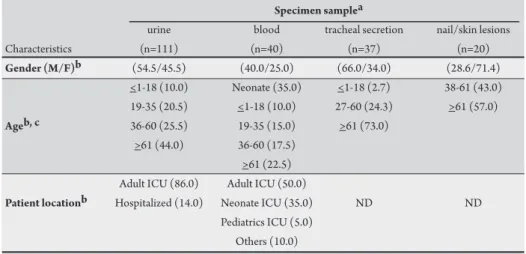
TABLE 1 - Characteristics of patients with candidiasis according to specimen type of yeast isolation. Specimen samplea
urine blood tracheal secretion nail/skin lesions
Characteristics (n=111) (n=40) (n=37) (n=20)
Gender (M/F)b (54.5/45.5) (40.0/25.0) (66.0/34.0) (28.6/71.4)
<1-18 (10.0) Neonate (35.0) <1-18 (2.7) 38-61 (43.0) 19-35 (20.5) <1-18 (10.0) 27-60 (24.3) >61 (57.0)
Ageb, c 36-60 (25.5) 19-35 (15.0) >61 (73.0)
>61 (44.0) 36-60 (17.5) >61 (22.5) Adult ICU (86.0) Adult ICU (50.0)
Patient locationb Hospitalized (14.0) Neonate ICU (35.0) ND ND
Pediatrics ICU (5.0) Others (10.0)
M: male, F: female, ICU: intensive care unit, ND: not determined, anumber of isolates according to specimen sample, bvalues in parentheses are percentages, cages are given in years.
TABLE 2 - Distribution of Candida species and the clinical samples. Candida speciesa
Specimentype albicans tropicalis parapsilosis glabrata krusei dubliniensis Candida sp. Total
Urine 50 (45.0) 40 (36.1) 4 (3.6) 14 (12.6) 2 (1.8) 1 (0.9) - 111
Blood 10 (25.0) 14 (35.0) 10 (25.0) 2 (5.0) 2 (5.0) - 2 (5.0) 40
Tracheal secretion 12 (32.4) 8 (21.6) 17 (46.0) - - - - 37
Nail/skin lesions 3 (15.0) 7 (35.0) 9 (45.0) 1 (5.0) - - - 20
Total 75 (36.0) 69 (33.2) 40 (19.2) 17 (8.2) 4 (1.9) 1 (0.5) 2 (1.0) 208
aValues are given in n (%).
Sex- and age-speciic distribution of Candida isolates
As shown in Table 1, the majority (86%) of isolates from urine specimen were obtained from patients at ICU. Prevalence was similar in women (45.5%) and in men (54.5%). When urine samples were considered, prevalence was high in the age group ≥61 years than that in younger ones.
Considering bloodstream infection, 90% of the patients were from intensive care units. For blood samples, prevalence was high in neonates (35%) followed by advanced ages (22.5%).
Isolates from tracheal secretion and supericial (nail and skin) lesions represented 17.8% and 9.6% of the isolates obtained in this 3-year survey, respectively. Concerning sex, for tracheal secretion samples, prevalence was higher in men (66%). On the other hand for nail and skin samples, it was higher in women (71.4%) than in men (28.6%). For both body-site samples, prevalence was signiicantly higher in the age group ≥61 years than that in younger ones (Table 1).
Species distribution
In a total of 208 Candida cultures, C. albicans represented 36%, while non-albicansCandida accounted for the majority (64%) of these isolates obtained from distinct clinical samples. Table 2
shows the species distribution of Candida isolates with regard to clinical samples. Urine was the most common source of the Candida, accounting for 53.4% of the total isolates, with the following colony
counting: 104 CFU/mL (20.7%), 105-106 CFU/mL (37.7%), and 107
CFU/mL (20.7%). Most C. albicans strains were isolated from urine samples (45%). Distribution of identiied non-albicans species from urine was: C. tropicalis — 36.1%; C. glabrata — 12.6%; C. parapsilosis
— 3.6%; C. krusei — 1.8%; and C. dubliniensis — 0.9%, as shown in
Table 2. In this study, we found a low rate of C. dubliniensis isolates among a total of 75 isolates previously identiied as C. albicans. Of the isolates obtained from blood cultures, 75% were non-albicans
Candida species, the most common being C. tropicalis, followed by C. parapsilosis(Table 2). Prevalence of non-albicansCandida
species was also observed from nail/skin infection specimens, the most common being C. parapsilosis (45%) and C. tropicalis (35%). Most C. parapsilosis strains were isolated from tracheal secretion samples (46%).
Susceptibility tests
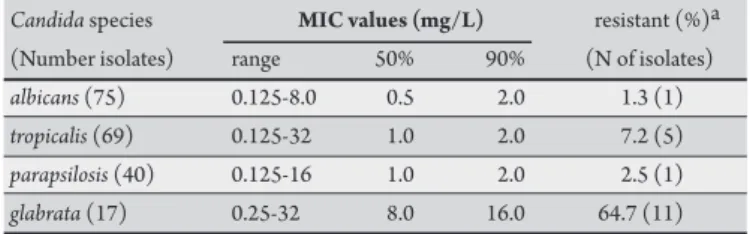
Susceptibility tests for fluconazole were performed on 205 isolates of Candida species. Table 3 shows the MICs at which 50% (MIC50) and 90% (MIC90) of the isolates tested were inhibited for luconazole. he majority of Candida isolates were considered susceptible to luconazole (MIC of ≤2 mg/L), with the exception of
C. glabrata isolates that are intrinsically less susceptible to luconazole
he authors declare that there is no conlict of interest. CONFLICT OF INTEREST
FINANCIAL SUPPORT
REFERENCES TABLE 3 - In vitro susceptibilities to luconazole of Candida species isolates
Candida species MIC values (mg/L) resistant (%)a (Number isolates) range 50% 90% (N of isolates)
albicans (75) 0.125-8.0 0.5 2.0 1.3 (1)
tropicalis (69) 0.125-32 1.0 2.0 7.2 (5)
parapsilosis (40) 0.125-16 1.0 2.0 2.5 (1)
glabrata (17) 0.25-32 8.0 16.0 64.7 (11) aresistance breakpoints MIC of ³8 mg/L, MIC: minimal inhibitory concentration.
DISCUSSION
Infection represents a frequent complication among patients admitted to tertiary hospitals. In particular, the incidence of candidiasis has been increasing during the past years. he largest multicentric study conducted in Latin America reveals a large burden of candidemia in Brazilian tertiary-care hospitals1.
In this study, the isolate identification in species level by CHROMagar® Candida medium was in agreement to what was found in molecular identification. The PCR approach for species identiication that was employed in this study is a reliable and sensitive method for the diagnosis of the most commonly encountered clinical-relevant Candida species. Furthermore, the employment of phenotypic method based on diferential growth on tobacco agar27 allowed the identiication of one C. dubliniensis
isolate (from urine sample). Candida dubliniensis is a newly emerging opportunistic pathogen that shares many phenotypic similarities with
C. albicans. hese similarities pose problems in the identiication of isolates and have previously led to misidentiication of these species29.
he frequency of non-albicans species from distinct clinical specimens observed here was greater than C. albicans, which is consistent with the results of previous studies in Brazilian tertiary hospitals21, 30. C. tropicalis was the most frequent species isolated from
candidemia (35%), which frequency was higher than that observed in the Brazilian multicenter study (16% to 29%)1. he second-most
frequent species were C. albicans and C. parapsilosis. hese data conirm the increasing importance of non-albicans species as agents of fungemia in Brazil. Besides, the low frequency of C. glabrata and
C. krusei is in agreement with a previous report that consolidates the concept that candidemia due to these species is rare in Brazil1.
An increase of candiduria among hospitalized patients has been reported31-34. Although the signiicance of Candida isolated from
urine of patients is still unclear (reviewed in Kaufman35), the overall
mortality associated with ICU candiduria can reach 50%35. In this
study, identiication of yeasts obtained from urine revealed C. albicans
to be the most common species, followed by C. tropicalis and much less commonly by other species. Studies conducted in Brazilian medical centers have also shown increased rates of isolation of
C. tropicalis from urine30, 34, 37-38.
Candida parapsilosis was the species most oten isolated from supericial mycoses (nail and skin), followed by C. tropicalis. his is in agreement with other studies that identiied C. parapsilosis
as the prevalent species in the processes of onychomycosis39-40.
C. parapsilosis is a common inhabitant of normal skin, and this presumably serves as a reservoir of infection for the nails. Recently, we showed the capability of C. parapsilosis cells to adhere and grow as bioilm on human nail surfaces41.
Candida parapsilosis was also prevalent in tracheal secretion specimens, followed by C. albicans. In a multicenter study of immunocompetent patients receiving mechanical ventilation performed in France, Azoulay found that C. albicans was the most common species and that the Candida colonization of the respiratory tract may predispose to bacterial ventilator-associated pneumonia42.
In the present study, most of the isolates were susceptible to luconazole. As expected, high resistance rate (64.7%) was observed in C. glabrata, which is an intrinsically less susceptible species. his resistance rate was similar to that observed by Bruder-Nascimento et al.21 who also evaluated the resistance of Candida isolates obtained
from distinct clinical specimens in a Brazilian tertiary hospital. Although much has been reported regarding the epidemiology of Candida infections, the present work is the irst report about the distribution of Candida species in invasive and non-invasive candidiasis in our hospital. These data suggest the need for continuous surveillance of candidiasis and antifungal susceptibility trends to adopt treatment strategies applicable to particular healthcare institutions.
Pró-Reitoria de Pesquisa e Pós-GraduaçãoofUniversidade Estadual de Londrina. Departamento de Ciência e TecnologiaofSecretaria de Ciência e Tecnologia e Insumos Estratégicos ofMinistério da Saúde. RS and MTO are fellowship holders ofCoordenação de Aperfeiçoamento de Pessoal de Nível Superior(CAPES).EJGF is fellowship holder ofConselho Nacional de Desenvolvimento Científico e Tecnológico
(CNPq). MCF is fellowship holder ofFundação Araucária SETI,
Paraná Governament, Brazil.
1. Colombo AL, Nucci M, Park BJ, Nouér SA, Arthington-Skaggs B, Mata DA, et al. Epidemiology of candidemia in Brazil: a nationwide sentinel surveillance of candidemia in eleven medical centres. J Clin Microbiol 2006; 44:2816-2823. 2. Magill SS, Swoboda SM, Johnson EA, Merz WG, Pelz RK, Lipset PA, et al. he association between anatomic site of candida colonization, invasive candidiasis, and mortality in critically ill surgical patients. Diag Microbiol Infect Dis 2006; 55: 293-301.
3. Antunes AGV, Pasqualoto AC, Diaz MC, dAzevedo PA, Severo LC. Candidemia in a Brazilian tertiary care hospital: species distribution and antifungal susceptibility. Rev Inst Med Trop São Paulo 2004; 46: 239-241.
4. Aquino VR, Lunardi LW, Goldani LZ, Barth AL. Prevalence, susceptibility proile for luconazole and risk factors for candidemia in a tertiary care hospital in southern Brazil. Braz J Infect Dis 2005; 9: 411-418.
5. Medrano DJA, Brilhante RSN, Cordeiro A, Rocha MFG, Rabenhorst SHB, Sidrim JJC. Candidemia in a Brazilian hospital: the importance of Candida parapsilosis. Rev Inst Med Trop São Paulo 2006; 48: 17-20.
6. Mata DA, Almeida LP, Machado AM, Azevedo AC, Kusano EJU, Travassos NF, et al. Antifungal susceptibility of 1000 Candida bloodstream isolates to 5 antifungal drugs: results of a multicenter study conducted in São Paulo, Brazil, 1995-2003. Dig Microbiol Infect Dis 2007; 57: 399-404.
7. Colombo AL, Guimarães T, Silva LRBF, Monfardini LPA, Cunha AKB, Rady P, et al. Prospective observational study of candidemia in São Paulo, Brazil: incidence rate, epidemiology, and predictors of mortality. Infect Control Hosp Epidemiol 2007; 28: 570-576.
8. Passos XS, Costa CR, Araújo CR, Nascimento ES, Souza LKH, Fernandes OFL, et al. Species distribution and antifungal susceptibility paterns of Candida spp. Bloodstream isolates from a Brazilian tertiary care hospital. Mycopathologia 2007; 163: 145-151.
9. Chang MR, Correia FP, Costa LC, Xavier PCN, Palhares DB, Taira DL, et al.
Candida bloodstream infection: data from a teaching hospital in Mato Grosso do Sul, Brazil. Rev Inst Med Trop 2008; 50: 265-268.
10. França JCB, Ribeiro CEL, Queiroz-Telles F. Candidemia in a Brazilian tertiary care hospital: incidence, frequency of diferent species, risk factors and antifungal susceptibility. Rev Soc Bras Med Trop 2008; 41: 23-28.
11. Hinrichsen SL, Falcão E, Vilella TAS, Colombo AL, Nucci M, Moura L, et al. Candidemia in a tertiary hospital in northeastern Brazil. Rev Soc Bras Med Trop 2008; 41: 394-398.
12. Parahym AMRD, De Mello LRB, De Morais VLL, Neves RP. Candidiasis in pediatric patients with cancer interned in a university hospital. Braz J Microbiol 2009; 40: 321-324.
13. Pereira GH, Mulles PR, Szeszs MW, Levin AS, Melhem MSC. Five-year evaluation of bloodstream yeast infections in a tertiary hospital: the predominance of non-C. albicansCandida species. Med Mycol 2010; 48: 839-842.
14. Nucci M, Queiroz-Telles F, Tobon AM, Restrep A, Colombo AL. Epidemiology of opportunistic fungal infections in Latin America. Clin Infect Dis 2010; 51: 561-570.
15. Pfaller MA, Diekema DJ, Rinaldi MG, Barnes R, Hu B, Veselov AV, et al. Results from the ARTEMIS DISK Global Antifungal Surveillance Study: a 6.5 year analysis of susceptibilities of Candida and other yeast species to luconazole and voriconazole by standardized disk difusion testing. J Clin Microbiol 2005; 43: 5848-5859.
16. Yang YL, Ho YA, Cheng HH, Ho M, Lo HJ. Susceptibilities of Candida species to amphotericin B and luconazole: the emergence of luconazole resístanse in
Candida tropicalis. Infect Control Hosp Epidemiol 2004; 25: 60-64.
17. Hajjeh A, Sofair AN, Harrison LH, Lyon GM, Arthington-Skaggs BA, Mirza SA, et al. Incidence of bloodstream infections due to Candida species and in vitro
susceptibilities of isolates collected from 1998 to 2000 in a population-based active surveillance program. J Clin Microbiol 2004; 42: 1519-1527.
18. Lyon GM, Karatela S, Sunay S, Adiri Y. Antifungal susceptibility testing of Candida
isolates from the Candida surveillance study. J Clin Microbiol 2010; 48: 1270-1275.
19. Oxman DA, Chow JK, Frendl G, Hadley S, Hershkovitz S, Ireland P, et al. Candidaemia associated with decreased in vitro luconazole susceptibility: is
Candida speciation predictive of the susceptibility patern? J Antimicrobial Chem 2010; 65: 1460-1465.
20. Arendrup MC, Bruun B, Chritensen JJ, Fuursted K, Johansen HK, Kjaeldgaard P, et al. National Surveillance of Fungemia in Denmark (2004 to 2009). J Clin Microbiol 2011; 49: 325-334.
21. Bruder-Nascimento A, Camargo CH, Sugizaki MF, Sadatsune T, Montelli AC, Mondelli AL, et al. Species distribution and susceptibility proile of Candida
species in a Brazilian public tertiary hospital. BCM Res Notes 2010; 3: 1-5. 22. Favalessa OC, Martins MA, Hahn RC. Mycological aspects and susceptibility
in vitro the yeast of the genus Candida from HIV-positive patients in the State of Mato Grosso. Rev Soc Bras Med Trop 2010; 43: 673-677.
23. Li YL, Leaw SN, Chen J H, Chang HC, Chang TC. Rapid identiication of yeasts commonly found in positive blood cultures by amplification of the internal transcribed spacer regions 1 and 2. Eur J Clin Microbiol Infet Dis 2003; 22: 693-696. 24. Williams JGK, Kubelik AR , Livak KJ, Rafalski JA, Tingey AV. DNA polymorphisms ampliied by arbitrary primers are useful as genetic markers. Nucleic Acids Res 1990; 18: 6531-6535
25. Tavanti A, Davidson AD, Gow NAR, Maiden MCJ, Odds FC. Candida orthopsilosis and Candida metapsilosis spp. nov. to replace Candida parapsilosis
groups II and III. J Clin Microbiol 2005; 43: 284-292.
26. Furlaneto-Maia L, Specian AF, Bizerra FC, Oliveira MT, Furlaneto MC. In vitro
evaluation of putative virulence atributes of oral isolates of Candida spp. obtained from elderly healthy individuals. Mycopathologia 2008; 166: 209-217. 27. Khan ZU, Ahmad S, Mokaddas E, Chandy R. Tobacco Agar, a New Medium
for Diferentiating Candida dubliniensis from Candida albicans. J Clin Microbiol 2004; 42: 4796-4798.
28. The European Committee on Antimicrobial Susceptibility Testing – Subcommitee on Antifungal Susceptibility Testing (EUCAST-AFST). EUCAST Technical Note on luconazole. Clin Microbiol Infect 2008; 14: 193-195. 29. Ells R, Kock JLF, Pohl CH. Candida albicans or Candida dubliniensis? Mycoses
2009; 54: 1-16.
30. Hinrichsen SL, Falcão E, Vilella TAS, Rego L, Lira C, Almeida L, et al.
Candida isolates in tertiary hospitals in northeastern Brazil. Braz J Microbiol 2009; 40: 325-328.
31. Bouza E, SanJaun R, Munoz P, Voss A, Kluytmans J. A European perspective on nosocomial urinary tract infections. I. Report on the microbiology workload, etiology and antimicrobial susceptibility (ESGNI-003 study). Clin Microbiol Infect 2001; 7: 523-531.
32. Shay AC, Miller LG An estimate of the incidence of candiduria among hospitilized patients in the United States. Infect Control Hosp Epidemiol 2004; 25: 894-895. 33. Passos XS, Sales WS, Maciel PJ, Costa CR, Miranda KC, Lemos JA, et al. Candida
colonization in intensive care unit patients´urine. Mem Inst Oswaldo Cruz 2005; 100: 925-928.
34. Silva EH, Ruiz LS, Matsumoto FE, Auler ME, Giudice MC, Moreira D, et al. Candiduria in a public hospital of São Paulo (1999-2004): characteristics of the yeast isolates. Rev Inst Med Trop São Paulo 2007; 49: 349-353.
35. Kaufman CA. Candiduria. Clin Infect Dis 2005; 41: S371-376.
36. Alvarez-Lerma F, Nolla-Salas J, Leon C, Palomas M, Jorda R, Carrasco N, et al. Candiduria in critically ill patients admitted to intensive care medical units. Intensive Care Med 2003; 29: 1069-1076.
37. Kobayashi CCBA, Fernandes OFL, Miranda KC, Sousa ED, Silva MRR. Candiduria in hospital patients: a study prospective. Mycopathologia 2004; 158: 49-52.
38. Binelli CA, Moreti ML, Assis RS, Sauaia N, Menezes PR, Ribeiro E, et al. Investigation of the possible association betweeen nosocomial candiduria and candidemia. Clin Microbiol Infect 2006; 12: 538-543.
39. Figueiredo VT, Santos DA, Resende MA, Hamdan JS. Identiication and in vitro
antifungal susceptibility testing of 200 clinical isolates of Candida spp. responsible for ingernail infections. Mycopathologia 2007; 164:27-33.
40. Martins EA, Guerrer LV, Cunha KC, Soares MMCN, Almeida MTG. Onychomycosis: clinical, epidemiological and mycological study in the municipality of São José do Rio Preto. Rev Soc Bras Med Trop 2007; 40: 596-598. 41. Oliveira MT, Specian AFL, Andrade CGTJ, França EJG, Furlaneto-Maia L, Furlaneto MC. Interaction of Candida parapsilosis isolates with human hair and nail surfaces revealed by scanning electron microscopy analysis. Micron 2010; 41: 604-608.
42. Azoulay E, Timsit JF, Talet M, de Lassence A, Darmon M, Zahar JR, et al.
Candida colonization of the respiratory tract and subsequent Pseudomonas