INTRODUCTION
Article/Artigo
1. Departamento de Produtos Farmacêuticos, Faculdade de Farmácia, Laboratório de Controle de Qualidade de Produtos Farmacêuticos e Cosméticos, Universidade Federal de Minas Gerais, Belo Horizonte, MG. 2.Centro de Ciências Biológicas e da Saúde, Laboratório de Parasitologia, Universidade Federal de Sergipe, São Cristóvão, SE.
Address to: Dr. Fernando Henrique Andrade Nogueira. Depto Produtos Farmacêuticos/FaFar/UFMG.
Av. Presidente Antônio Carlos 6627, Campus Universitário, Faculdade de Farmácia, Bloco 2/Sala 4029, 31270-901 Belo Horizonte, MG, Brasil.
Phone: 55 31 3409-6982; Fax: 55 31 3409-6976 e-mail: [email protected]
Received in 21/02/2011 Accepted in 15/04/2011
Quality of essential drugs in tropical countries: evaluation of
antimalarial drugs in the Brazilian Health System
Qualidade de medicamentos essenciais em países tropicais: avaliação de medicamentos
antimaláricos no Sistema de Saúde do Brasil
Fernando Henrique Andrade Nogueira
1, Lígia Maria Moreira-Campos
1, Roseli La Corte dos Santos
2and Gerson Antônio Pianeti
1ABSTACT
Introduction: he emergence of drug resistance is one of the main problems concerning malaria treatment. he use of counterfeit and/or substandard antimalarial drugs can contribute to the development of parasite resistance. hus, the aim of this study was to evaluate the quality of antimalarial drugs distributed in Brazil. Methods: Samples containing chloroquine phosphate, meloquine hydrochloride, primaquine phosphate, and quinine sulfate tablets were delivered to the Rio de Janeiro central storeroom (CENADI), state storerooms (SS), and Basic Health Units (BHUs) in the north region of Brazil — a total of 10 sample sets. Ater 5 months of storage, the samples were collected, and in vitro quality control analyses according to oicial and published methods were performed. Results: Inadequate drug storage conditions were found in two SS and in all BHUs evaluated. here were no quality deviations found in the chloroquine samples. he quinine samples exhibited weight variation above the allowed limits. he primaquine samples were found to have packaging deiciency. he release of meloquine in samples from some regions showed a statistically signiicant diference when compared with the CENADI samples. Conclusions: It is important to periodically evaluate the quality and storage conditions of essential drugs. he quality deviations found with the primaquine and quinine samples are not related to storage conditions and must be addressed urgently. he decreased meloquine release from tablets is related to formulation problems or inluenced by inadequate storage conditions, prompting further investigation. Even with the mentioned problems, the samples would probably not contribute to resistant parasite selection. Keywords: Malaria. Antimalarial drugs. Brazilian Amazon. Drug storage. Drug stability. Quality control.
RESUMO
Introdução: O aparecimento de resistência aos medicamentos é um dos maiores problemas do tratamento da malária. O uso de medicamentos falsos e/ou de má qualidade pode contribuir para o desenvolvimento de resistência no parasita. Este estudo tem por objetivo avaliar a qualidade dos medicamentos antimaláricos distribuídos no Brasil. Métodos: Amostras contendo comprimidos de difosfato de cloroquina, cloridrato de meloquina, difosfato de primaquina e sulfato de quinina foram enviadas ao almoxarifado central na Cidade do Rio de Janeiro (CENADI), almoxarifados estaduais (SS) e Unidades Básicas de Saúde (UBS) nos estados da região norte do Brasil, totalizando dez amostras. Após cinco meses de armazenamento, as amostras foram coletadas e analisadas segundo métodos oiciais e da literatura. Resultados: Foram encontradas condições inadequadas de armazenamento de medicamentos em duas SS e em todas as UBS avaliadas. Não foram encontrados problemas de qualidade com as amostras de cloroquina. As amostras de quinina apresentaram variação de peso acima dos limites permitidos. Amostras de primaquina foram encontradas com problemas na embalagem. A cedência de meloquina de comprimidos, em algumas regiões, apresentou diferença estatisticamente signiicativa quando comparada com a amostra do CENADI. Conclusões: É importante avaliar, periodicamente, a qualidade e as condições de armazenamento de medicamentos essenciais. Desvios de qualidade encontrados com as amostras de primaquina e quinina não estão relacionados às condições de armazenamento e devem ser corrigidos urgentemente. O decréscimo na cedência de meloquina dos comprimidos está relacionado com a formulação ou foi inluenciada por condições de armazenamento inadequadas, necessitando de uma investigação posterior. Apesar dos problemas mencionados, as amostras provavelmente não contribuiriam para a seleção de parasitas resistentes. Palavras-chaves: Malária. Medicamentos antimaláricos. Amazônia Brasileira. Armazenamento de medicamentos. Estabilidade de medicamentos. Controle de qualidade.
The emergence of drug resistance is one of the main problems concerning malaria treatment. The irst case of chloroquine-resistant falciparum malaria in Africa and South America was reported almost 50 years ago1, and since then, the worldwide emergence of drug
resistance has focused its atention on antimalarial drug quality. Mainly in Africa and Southeast Asia, several studies have been conducted to evaluate the presence of substandard and/or counterfeit essential drugs, including antimalarials2-5. Treatment failure can be improperly
atributed to drug resistance when the product does not meet the qualitative and quantitative requirements6.
he use of counterfeit and/or substandard anti-infective drugs can cause increased morbidity and mortality, adverse efects due to an excessive dose or the presence of potentially toxic active ingredients or pathogenic contaminants, increased health costs, loss of conidence in the health care system and in the drug regulatory authorities, and inally, the selection of resistant parasites with subtherapeutic amounts of active ingredient7.
In addition to drug quality, the stability of drugs is another issue that should be considered. As malaria is present mainly in tropical regions, antimalarials must be able to remain stable in environments of high temperature and humidity. Studies in Tanzania and Rwanda revealed decreased drug release from chloroquine and quinine tablets after 3 months of storage in simulated tropical conditions: 75% relative humidity and 40oC8-9.
Submitted to real storage conditions in Burkina Faso, chloroquine tablets exhibited decreased drug content ater 450 days10. Brazil is classiied
under region IV of the international climatic zones, which is characterized by high temperature and high humidity11, hence the need to evaluate not
METHODS
stored in the Central de Armazenagem e Distribuição de Insumos Estratégicos (CENADI) in Rio de Janeiro. From there, the drugs are distributed to state storerooms (SS), then to municipalities, and then again to the approximately 3,000 Basic Health Units (BHUs) spread all over the Amazonian region. he BHUs are responsible for thick blood smear microscopic exams and appropriate treatment of patients. he irst-choice therapy for Plasmodium vivax infection in Brazil consists of chloroquine and primaquine. Until 2006, quinine, doxycycline, and primaquine were used in the treatment of Plasmodium falciparum infections, and meloquine and primaquine were preferred for mixed infections12. he
guideline for the treatment of P. falciparum and mixed infections was changed to a combination of artemether and lumefantrine in 2007.
The aim of this study was, thus, to evaluate the quality of antimalarials in the central storeroom (CENADI), in the state storerooms in three Brazilian Amazon states, and additionally, in two locations in each of these same states. Moreover, several parameters of antimalarial drug storage conditions were evaluated to enhance the discussion and to reinforce its importance when evaluating drug quality.
Study design
Ten sample sets, each containing 100 tablet units of each antimalarial studied, were delivered to 10 diferent locations, one in the southeast and nine in the north region of Brazil. he packages were labeled, sealed, and placed along with the other antimalarials stored inside the facility. Ater the 5-month storage period, from June to October 2005, the sample sets were collected, coded, and brought to our laboratory for physical-chemical analysis.
he storage rooms were selected on three levels: the main level in the CENADI, the central storeroom (A), in the southeast region (non-endemic area); the three state storerooms in the north region named BSS, CSS, and DSS; and the two BHUs of each state (B1, B2, C1, C2, D1, and D2, respectively). he participating states and locations were omited to keep their identities conidential. hree parameters were considered in selecting the BHUs: the annual parasitic index (API), the cure veriication slides (CVS), and the absence of air-conditioning. he API is the number of malaria cases per 1,000 inhabitants, and it is used to measure the risk of contracting malaria. CVS is the microscopic examination carried out ater the end of antimalarial treatment; it is meant to ensure the success of the treatment by conirming the absence of the parasite. he BHUs were selected in areas of middle (API between 10 and 50 positive slides/1,000 inhabitants) or high (API >50 positive slides/1,000 inhabitants) risk for malaria transmission13. All the selected BHUs
were located in areas where the percentage of CVS was above the state average. Extra packages of antimalarials were let in the BHUs to avoid the utilization of the study samples in case of extreme necessity.
he antimalarials were selected on the basis of their inclusion in the Brazilian National Malaria Control Program at the time of study, their inclusion in the Brazilian National Essential Medicines List, and their common usage. Except for the quinine sulfate tablets, all antimalarials used in this study were from the same batch. he drug samples were (drug, strength, batch number, manufacturing date, expiry date): chloroquine phosphate tablets, 150mg (as chloroquine), 05030650, Mar/2005, Mar/2007; mefloquine hydrochloride tablets, 250mg (as meloquine), 0503023, Mar/2005, Mar/2008; primaquine phosphate tablets, 15mg (as primaquine), 04071297, Jul/2004, Jul/2006; quinine sulfate tablets, 500mg, 05001022,
Jan/2005; Jan2008; and quinine sulfate tablets, 500mg, 05004103, Apr/2005, Apr/2008. The quinine sulfate tablets from batch
05001022 were stored in regions A, BSS, B1, B2, DSS, D1, and D2, and
those from batch 05004103 were stored in regions A, CSS, C1, and C2.
All the tablets used were produced by government manufacturers. he dissolution test results of the samples stored in CENADI (A) were compared to those of the samples stored in the Amazonian region (state storerooms and BHUs) using ANOVA followed by Tukey´s multiple comparison test. Statistical signiicance was set at
p<0.05. he meteorological data for this period were obtained from
the Brazilian Instituto Nacional de Meteorologia (INMET) for Rio de
Janeiro and the state capitals.
Reference standards
Chloroquine phosphate, meloquine hydrochloride, primaquine phosphate, quinine sulfate, quininone, and sulfanilamide reference standards were purchased from the United States Pharmacopeia (Rockville, MD, USA).
Reagents
he reagents used in HPLC assays were of chromatographic grade, while the others were of analytical grade. Ultra-pure water was obtained from a Milli-Q Plus system (Millipore Corporation, Billerica, MA, USA). Chloroform, hydrochloric acid, 1-pentanesulfonate sodium, silver nitrate, sodium nitrite, and sulfuric acid were purchased from Merck (Darmstadt, Germany). Ammonium hydroxide was obtained from Vetec (Duque de Caxias, Brazil). Ethanol, glacial acetic acid, and methanol were purchased from Tedia (Fairield, OH, USA). Cinchonidine, dihydroquinine, and methanesulfonic acid were purchased from Sigma Aldrich (Milwaukee, WI, USA). Diethylamine was purchased from Spectrum (Gardena, CA, USA).
Equipment
he HPLC assays were carried out using the Agilent Technologies 1200 series (Palo Alto, CA, USA) equipped with quaternary pump, automatic injector, column oven, and diode array detector. Spectrophotometric analyses were run on a UV 160A spectrophotometer (Shimadzu Corporation, Kyoto, Japan). A DL53 titrator from Metler Toledo (Greifensee, Switzerland) was used for potentiometric titrations. An Erweka DT 80 dissolution tester (Heusenstamm, Germany) was used in the dissolution tests. A ZT3 disintegration tester, a TB24 hardness tester, and TA3R friability tester from Erweka were used in disintegration, hardness, and friability tests, respectively.
Physical-chemical analysis
he quality of chloroquine phosphate and quinine sulfate tablets was investigated following their individual monographs in the United
States Pharmacopeia 28th edition, USP28-NF2311. he primaquine
phosphate tablets were also examined according to the USP28-NF23 individual monograph, except for the uniformity of content, which was adapted from the HPLC method described for the dissolution test.
here is no compendial monograph for meloquine hydrochloride tablets, and therefore, identiication was conducted by comparison of the standard and the sample UV spectra. he identiication of chloride was veriied by reaction with silver nitrate as described in
the Brazilian Pharmacopeia14. he dissolution test conditions were
obtained from the Pan American Health Organization (PAHO/ OPS). he assay was a modiication of the method described by Rao
and Murthy in 200215. he precision, accuracy, and linearity of the
method were conirmed before analysis.
All antimalarial samples were submited to physical tests of uniformity of weight, hardness, friability, and disintegration as
RESULTS
TABLE 1 - Summary of antimalarial storage conditions in the CENADI (A), and the BSS, CSS, and DSS state storerooms.
Description A BSS CSS DSS
Air-conditioning + + + +
Drugs protected from direct sunlight + + + +
Stock control system + + + +
Access to drugs allowed to authorized personnel only + - + +
Drugs stored in pallets, distant from loor and walls + - + +
Periodic temperature records + - + +
Record of the places where the antimalarials are distributed + - + +
Presence of a pharmacist - - + +
Antimalarial drug quality control certiicates + - +
-Standard operational procedures + - +
-Availability of a distribution control and tracking system for antimalarials + - +
-Periodic relative humidity records + - -
-+: presence, -: absence, CENADI (A): Rio de Janeiro central storeroom A, BSS:State B storeroom, CSS: State C storeroom, DSS: State D storeroom.
Storage conditions
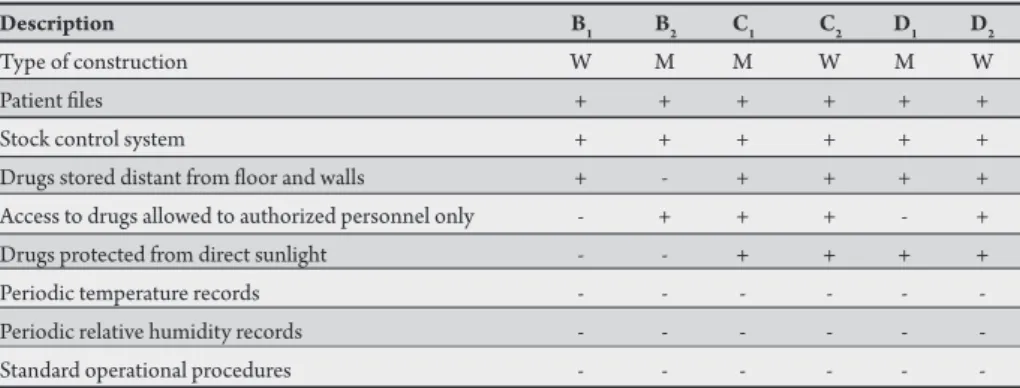
he aim of this study was to evaluate the physical-chemical quality of antimalarial drugs; however, a brief comparison of the state storerooms, CENADI storerooms (Table 1), and BHUs (Table 2) is given as an overview of the storage conditions, which can inluence drug quality. Several parameters, such as temperature and humidity records, were evaluated in order to assess storage quality.
State C storeroom (CSS) was the only location that did not keep the sample set during the entire period necessary, allowing the tablets, although segregated, to be distributed as regular medicines. Consequently, physical-chemical analysis was not conducted on this set, and the results presented below refer to only nine locations: CENADI (A), two state storerooms (BSS and DSS), and six BHUs (B1, B2, C1, C2, D1, and D2). A statistically signiicant diference was observed when the high temperatures in the capitals of states B, C, and D were compared with those in Rio de Janeiro (A) (Table 3). he low temperatures in the capitals of states C and D were also higher than those in region A. he relative humidity measured in the capital of state C was higher than that in region A.
Drug samples
Chloroquine phosphate tablets are packed in paper-polyethylene strips containing 10 tablets each. When the samples were collected,
some paper strips were found to be humid, but the inside plastic ilm kept the tablets intact. he sample from region D1 was stained with a blue liquid, which is probably the Giemsa coloring agent used in blood microscopic exams. Nevertheless, the tablets inside were found to be of normal color and shape. he low relative standard deviation (RSD) obtained with the average of the assay values indicated drug content homogeneity between the samples from the storage rooms in all regions. hese assay values are within the acceptance range of 93% to 107% of the labeled amount stated by USP28-NF23. When subjected to a dissolution test, all tablets released more than 75% of chloroquine phosphate in 45 min, in agreement with USP28-NF23 requirements. Six tablets of each sample were tested. he Tukey´s comparison test done ater ANOVA showed no diference (p<0.05) in average drug release rate between sample A and the other samples.
The mefloquine sample from region D1 was also blue-stained externally; however, the blister package protected the tablets from contamination. The assay method described in the literature for mefloquine hydrochloride in tablets exhibited adequate linearity, accuracy, and precision. All assay values were within the proposed acceptance range, from 90% to 110% of the labeled amount. he samples from all regions dissolved more than 75% of meloquine hydrochloride. Twelve units from each region were tested. he comparison of averages using Tukey´s test after ANOVA showed statistically significant diferences between sample A and samples B1, C1, C2, and D1 (p<0.05).
he primaquine samples from all regions had the aluminum foil of their blister packages detached. his also occurred in the CENADI sample (A). However, the tablets were found to be unchanged.
TABLE 2 - Summary of antimalarial storage conditions in state B, C, and D BHUs.
Description B1 B2 C1 C2 D1 D2
Type of construction W M M W M W
Patient iles + + + + + +
Stock control system + + + + + +
Drugs stored distant from loor and walls + - + + + +
Access to drugs allowed to authorized personnel only - + + + - +
Drugs protected from direct sunlight - - + + + +
Periodic temperature records - - -
-Periodic relative humidity records - - -
-Standard operational procedures - - -
TABLE 3 - Meteorological data for Rio de Janeiro (A) and the three state capitals (B, C, and D) during the study period (value ± standard deviation). High temperature (oC) Low temperature (oC) Relative humidity (%)
Month A B* C* D* A B C* D* A B C* D
June 29.3±2.2 N/A 33.0±1.4 33.0±0.7 20.1±1.4 20.8±0.5 24.0±0.7 23.5±0.5 72.3±6.8 78.0±4.3 82.5±6.0 80.3±3.5 July 27.0±3.9 33.0±2.5 32.9±1.3 33.4±0.6 18.7±1.8 18.7±1.7 23.5±0.7 22.7±0.4 75.1±7.6 72.1±6.9 83.2±5.3 79.9±3.5 August 30.9±3.5 34.7±2.3 34.9±1.2 34.0±0.7 20.9±1.7 19.8±2.6 24.0±0.8 22.9±0.6 68.7±9.0 66.8±8.5 82.8±4.1 77.1±4.4 September 26.8±3.9 33.8±3.8 35.0±2.3 33.8±0.6 19.9±1.7 20.8±2.2 24.1±1.1 22.5±0.5 76.8±8.9 71.3±6.8 84.3±6.2 77.2±4.2 October 31.2±4.0 35.1±1.9 35.2±1.8 33.7±0.7 22.9±2.0 22.6±0.9 24.5±1.1 22.7±0.6 72.9±7.8 78.2±6.3 83.0±5.5 76.8±6.0 N/A: data not available, *statistically signiicant diference of averages compared with Rio de Janeiro.
TABLE 4 - Summary of the analytical results.
Dissolution (%) Assay (% of labeled amount) lower higher Uniformity lower higher
Visual Uniformity Physical tests value value of dosage value value Final
Product inspection ID of weight hardness friability disintegration (sample) (sample) units (sample) (sample) Average RSD Result
Chloroquine + + + + + + 96.0 (D2) 99.2 (B2) + 98.3 (C2) 102.6 (B1) 99.9 1.35 pass
Meloquine - + + + + + 76.2 (C1) 81.4 (A) + 93.6 (DSS) 96.3 (B2) 94.8 0.98 fail
Primaquine - + + + + + 90.0 (DSS) 95.4 (C2) + 93.9 (C2) 97.7 (A) 95.7 1.16 fail
Quinine Batch 1022 + + - + + + 85.4 (DSS) 93.2 (A) + 92.3 (BSS) 94.4 (A) 93.3 0.70 fail
Quinine Batch 4103 + + - + + + 90.6 (A) 91.8 (C1) + 93.4 (C2) 94.2 (A) 93.9 0.47 fail
ID: identiication test, +: complies with speciications, -: does not comply with speciications, RSD: relative standard deviation. USP28-NF23 specifies that the primaquine phosphate content
should be 93% to 107% of the declared amount, and all samples met this criterion. Dissolution tests were performed on six tablets from each region. he drug release rate was in agreement with USP28-NF23 requirements, more than 80% of primaquine phosphate in 60 min. No statistically signiicant diference (p<0.05) in drug release between sample A and the other samples was observed.
In the test of uniformity of weight for quinine samples, the sample batch 05001022 stored in region A showed one tablet with more than twofold the allowed deviation. hree tablets (maximum two tablets) from sample batch 05004103 stored in region C2 were above the allowed deviation. he samples from the other regions complied with the standards on this test. he USP28-NF23 requirements for
the quinine sulfate content in tablets are from 90% to 110% of the labeled amount, expressed as the sum of quinine sulfate and dihydroquinine sulfate. his speciication was met by all samples. he samples from all regions also complied with USP28-NF23 requirements on the dissolution test: more than 75% of quinine sulfate dissolved in 45 min. Six tablets were needed to comply with the test requirements for samples A, BSS, B1, B2, C1, and C2, and 12 tablets for samples DSS, D1, and D2. No statistically signiicant diference (p<0.05) was observed when the average drug release of the samples from all regions was compared with that of sample A for each batch.
A summary of the analytical results obtained with all samples is presented in Table 4.
DISCUSSION
In reference to the WHO guidelines for the appropriate storage of medicines16, adequate drug storage conditions were found in
the CENADI and in the state storeroom CSS. Meanwhile, the state storerooms BSS and DSS need to improve their storage conditions, with BSS having a greater need for improvements.
For the state storerooms (Table 1), the relative humidity was not recorded because of the presence of air-conditioning, which is essential for adequate drug storage and to detect any equipment malfunction. Besides, the high temperatures and relative humidity observed in the north region state capitals B, C, and D (Table 3) reinforce the need to adequately control these parameters in their storerooms. A tracking system is necessary as well to withdraw drugs from the ield and dispatch them to the health authorities in case of reported quality problems, avoiding their use by the population. he use of standard operational procedures must be encouraged in the state storerooms to equalize their practices on drug handling and proper storage. Finally, the access to drugs should be restricted to authorized personnel only, avoiding robbery and subsequent misemployment.
he storage conditions observed in the BHUs were inappropriate for antimalarials (Table 2). To provide instant treatment to infected patients, the BHUs keep an amount of drugs stored in cabinets or drawers, where they are not protected from the region´s high temperature and humidity. However, the weekly drug delivery currently observed in the BHUs shortens the time in which antimalarials are kept in those places. Nevertheless, in areas with diicult access, such delivery might take within 6 months, occurring ater the rainy season, thus exposing the drugs to excessive heat and humidity.
he study period was selected to mimic the local reality. he samples were delivered in June, before the beginning of the winter season, which is hoter and drier than the spring and summer seasons, which in turn are more humid and less warm. he ease and/or possibility of geting to all the regions selected to participate in this study was also considered. In the Brazilian Amazon, the rivers may not be navigable, and the wet dirt roads may not be adequate to drive on throughout the year.
ACKNOWLEDGMENTS
he authors declare that there is no conlict of interest. CONFLICT OF INTEREST
FINANCIAL SUPPORT
REFERENCES
he authors would like to thank all the staf at the Secretaria de Vigilância em Saúde (Health Surveillance Secretary) of the Brazilian Ministry of Health for contributing to this study, and the state and municipal health secretaries for their readiness and support during the sample storage period. We also thank Prof. Cristina Duarte Vianna Soares for the English revision, critical analysis, and suggestions for improving this manuscript.
his study was inancially supported by the Pan American Health Organization (PAHO/OPS — AVREDA/AMI), the United States Agency for International Development (USAID), the Brazilian Ministry of Health, the Brazilian Pharmacopeia, and the Brazilian National Council for Scientiic and Technological Development (CNPq).
1. Wongsrichanalai C, Pickard AL, Wernsdorfer WH, Meshnick SR. Epidemiology of drug resistant malaria. Lancet Infect Dis 2002; 2:209-218.
2. Minzi OMS, Moshi MJ, Hipolite D, Massele AY, Tomson G, Ericsson Ö, et al. Evaluation of the quality of amodiaquine and sulphadoxine/pyrimethamine tablets sold by private wholesale pharmacies in Dar Es Salaam Tanzania. J Clin Pharm her. 2003; 28:117-122.
3. Shakoor O, Taylor RB, Behrens RH. Assessment of the incidence of substandard drugs in developing countries. Trop Med Int Health 1997; 2:839-845. 4. Syhakhang L, Lundburg CS, Lindgren B, Tomson G. he quality of drugs in
private pharmacies in Lao PDR: a repeat study in 1997 and 1999. Pharm World Sci 2004; 26:333-338.
5. Taylor RB, Shakoor O, Behrens RH, Everard M, Low AS, Wangboonskul J, et al. Pharmacopoeial quality of drugs supplied by Nigerian pharmacies. Lancet 2001; 357:1933-1936.
6. Petralanda I. Quality of antimalarial drugs and resistance to Plasmodium vivax in the Amazonian region. Lancet 1995; 345:1433.
7. Newton PN, Green MD, Fernández FM, Day NPJ, White NJ. Counterfeit anti-infective drugs. Lancet Infect Dis 2006; 6:602-613.
8. Kayumba PC, Risha PG, Shewiyo D, Msami A, Masuki G, Ameye D, et al. he quality of essential antimicrobial and antimalarial drugs marketed in Rwanda and Tanzania: inluence of tropical storage contidions on in vitro dissolution. J Clin Pharm her 2004; 29:331-338.
9. Risha PG, Shewiyo D, Msami A, Masuki G, Vergote G, Vervaet C, et al. In vitro
evaluation of the quality of essential drugs on the Tanzanian market. Trop Med Int Health 2002; 7:701-707.
10. Ballereau F, Prazuck T, Schrive I, Laleuriel MT, Rozec D, Fisch A, et al. Stability of essential drugs in the ield: results of a study conducted over a two-year period in Burkina Faso. Am J Trop Med Hyg 1997; 57:31-36.
11. he United States Pharmacopeial Convention. United States Pharmacopeia. 28th ed. Rockville (MD, USA): he United States Pharmacopeial Convention
2004.
12. Ministry of Health. Malaria herapeutics Manual. Brasília (BR): National Health Foundation. Brazilian Ministry of Health; 2001.
13. Ministry of Health. National Malaria Control Program. Brasília (BR): Health Surveillance Secretary. Brazilian Ministry of Health; 2004.
14. Brazilian Pharmacopoeia Comission. Brazilian Pharmacopeia. 4th ed. Part I.
São Paulo (BR): CPRFB; 1988.
15. Rao AB, Murthy RSR. A rapid spectrophotometric method for the determination of meloquine hydrochloride. J Pharm Biomed Anal 2002; 27:959-965. 16. Snow J. Guidelines for the storage of essential medicines and other health
commodities [Internet]. World Health Organization; 2003. [cited 2011 March]. 114 p. Available from: htp://www.who.int/entity/3by5/en/storage_ pocketguide.pdf.
presented by samples of primaquine phosphate and quinine sulfate tablets (detached aluminum foil from the blister pack and tablet weight variations above the allowed limits, respectively) were atributed to packaging and manufacturing problems, and not to storage conditions as they also occurred in the samples stored in region A. hese tablet samples were found to be in good condition, as conirmed visually and by the physical-chemical analysis. he fact that they were manufactured recently, not long before their use in this study, might have contributed to their good quality.
The statistically significant difference in drug release found in meloquine hydrochloride tablets may indicate a formulation problem or may be the result of inadequate storage conditions, as the region B1,C1, C2, and D1 BHUs have quite diferent storage conditions than the CENADI (region A). As mentioned, the simulated tropical conditions (high temperature and humidity) were capable of decreasing the drug release of tablets containing chloroquine and quinine in 3 months8-9. Similarly, decreased drug release was observed
in meloquine tablets under real tropical storage conditions, although to a lesser extent. We believe that this drug release reduction would not impair the expected therapeutic activity, as the rate did not fall below the allowed limits (70% meloquine hydrochloride release). his inding prompts further investigation of the inluence of storage conditions on meloquine hydrochloride drug release from tablets.
It is important to periodically evaluate the quality of essential drugs, mainly anti-infective ones, which, if substandard or counterfeit, pose a threat to patients and the public health, including the risk of selection of resistant parasites. he access to safe, efective, and good quality medicines is also a human rights issue. Along with quality, the storage conditions must be constantly evaluated and, if necessary, improved in order to allow the drugs to remain useful for their entire shelf life and avoid losses due to inadequate storage conditions.
he samples analyzed in our study, if made available to patients, would probably not contribute to resistant parasite selection, as all the dissolution and assay values were in agreement with speciications. he packaging deiciency in the primaquine samples is a serious problem that has to be addressed urgently to avoid tablet loss by the patients and to protect the drug from the environment´s high humidity. he weight variation in the quinine samples is considered a minor problem; nevertheless, in a total quality management era, it is unacceptable to have nonatendances like these.