INTRODUCTION
Article/Artigo
High prevalence of methicillin-resistant
Staphylococcus aureus
with
SCC
mec
type III in cystic ibrosis patients in southern, Brazil
Alta prevalência de
Staphylococcus aureus
resistente à meticilina com SCC
mec
tipo III
em pacientes com ibrose cística no Sul do Brasil
Keli Cristine Reiter
1, Alice Beatriz Mombach Pinheiro Machado
2, Ana Lúcia Peixoto de Freitas
3and
Afonso Luís Barth
1,21. Medical Sciences Post-graduate Program, Medicine School, Universidade Federal do Rio grande do Sul, Porto Alegre, RS, Brazil. 2. Microbiology and Molecular Biology Unit, Hospital de Clínicas de Porto Alegre, Porto Alegre, RS, Brazil. 3. Pharmacy School, Universidade Federal do Rio grande do Sul, Porto Alegre, RS, Brazil.
Address to: Dra. Keli Cristine Reiter. Laboratório de Pós-graduação em Patologia/UFSCPA. Rua Sarmento Leite 245, 90050-170 Porto Alegre, RS, Brasil.
Fax: 55 51 2101-8607 e-mail: [email protected] Received in 23/04/2010 Accepted in 14/05/2010
ABSTACT
Introduction: Bacterial colonization of the lungs is the main cause of morbidity in cystic ibrosis (CF). Pathogens such as Staphylococcus aureus are very well adapted to the pulmonary environment and may persist for years in the same patient. genetic determinants of these bacteria, such as the presence of SCCmec have recently emerged as a problem in this population of patients. Methods: Staphylococcus aureus isolates obtained from diferent clinical materials coming from CF and non-CF patients atended at a cystic ibrosis reference hospital were compared according to SCCmec type and antibiotic susceptibility proile. Results: hree hundred and sixty-four single-patient Staphylococcus aureus isolates were collected, of which 164 (45%) were from CF patients. Among the later, 57/164 (44.5%) were MRSA, and among the non-CF patients, 89/200 (35%) were MRSA. Associated pathogens were found in 38 CF patients. All 57 MRSA from CF patients harbored the multiresistant cassete type III. In contrast, 31/89 MRSA from non-CF patients harbored SCCmec type I (35%) and 44/89 harbored type III (49%). he antibiotic susceptibility patern was similar between CF and non-CF patients.
Conclusions: he high prevalence of multiresistant SCCmec type III among CF patients compared with non-CF patients in our institution may make it diicult to control disease progression through antibiotic therapy for promoting the survival of this kind of patient.
Key-words: Cystic ibrosis. SCCmec. MRSA. Multiresistance
RESUMO
Introdução: Colonização pulmonar bacteriana é a principal causa de morbidade em ibrose cística (FC). Patógenos como Staphylococcus aureus são muito bem adaptados ao ambiente pulmonar e podem persistir por anos no mesmo paciente. Determinantes genéticos desta bactéria, como presença de SCCmec emergiram recentemente como um problema nesta população de pacientes. Métodos: Foram comparados isolados de Staphylococcus aureus
obtidos de diferentes materiais clínicos, de pacientes com e sem FC atendidos em um hospital de referência em tratamento de ibrocísticos de acordo com o tipo de SCCmec e o peril de susceptibilidade aos antimicrobianos. Resultados: Foram coletados 364 Staphylococcus aureus, um isolado por paciente, sendo 164 (45%) de pacientes com FC. Entre estes pacientes, 57/164 (44,5%) eram MRSA, e entre pacientes não ibrocísticos, MRSA compreendiam 89/200 (35%). Foram encontrados outros patógenos, associados ao Staphylococcus aureus, em 38 pacientes com FC. Todos 57 MRSA de pacientes com FC possuíam o cassete de multiresistência tipo III. Por outro lado, 31/89 MRSA de pacientes não ibrocísticos possuíam SCCmec tipo I (35%) e 44/89 possuíam tipo III (49%). O peril de susceptibilidade aos antimicrobianos foi similar entre pacientes com e sem FC. Conclusões: A alta prevalência do SCCmec de multiresistência tipo III entre pacientes com FC comparado com pacientes sem FC em nossa instituição pode diicultar o controle da progressão da doença, feito através da antibioticoterapia, e que promove a sobrevivência deste tipo de paciente.
Palavras-chaves: Fibrose cística. SCCmec. MRSA. Multirresistência
Chronic pathogenic colonization of the lungs with Pseudomonas aeruginosa and Staphylococcus aureus is the main cause of morbidity in cystic fibrosis (CF)1. Recently, increased incidence of
methicillin-resistant Staphylococcus aureus (MRSA) infection in CF cases has been demonstrated, but the impact of MRSA detection on clinical outcomes is unclear2,3. Nevertheless, MRSA may be the cause
of patients’ rejection of pulmonary transplants and studies have suggested that patient-to-patient transmission of the diferent pathogens, including MRSA, may occur4,5.
Cystic ibrosis pathogens are well adapted to the CF pulmonary environment and are diicult to eradicate, and Staphylococcus aureus may persist for years in the same patient6. In addition to resistance
to methicillin, Staphylococcus aureus may also present other genetic determinants that contribute to pathogenicity and virulence, such as hypermutator populations and bioilm production, which make it more diicult to eradicate these pathogens7,8. hese
and other features, such as presence of the pvl gene and SCCmec distribution, have not been well studied in CF patients but have recently been detected as an emerging problem in this population9.
The aim of this study was to determine the presence of SCCmec types and the antibiotic susceptibility proile in a MRSA population recovered from CF patients at our institution.
METHODS
Seting
RESULTS Cystic ibrosis patients are atended at any time when an acute
exacerbation occurs, or routinely every three months. Patients may elect to be admited to hospital annually, but hospitalization occurs mainly when there is an exacerbation.
Bacterial isolates
Staphylococcus aureus isolates from CF and non-CF patients in all clinical setings (hospitalized patients, emergency departments and outpatient care) were compared. All the isolates from CF patients were obtained from the respiratory tract (sputum and oropharyngeal swab). he isolates from non-CF patients were obtained from a variety of clinical specimens, but most of them were also obtained from sputum. he antibiotic susceptibility proile of each isolate was determined using the following antibiotics: gentamicin, doxycycline, levoloxacin, erythromycin, cefoxitin, rifampicin, sulfamethoxazole-trimethoprim, clindamycin and chloramphenicol. All the assays were performed in accordance with the CLSI10. Isolates with intermediate
test results were considered to be resistant.
Molecular typing of MRSA isolates
he presence of the mecA gene was assessed for all Staphylococcus aureus isolates, and the SCCmec type of all positive mecA strains was determined from the molecular architecture of the ccr and mec complexes using PCR, as previously described11.
Patient information
For each MRSA patient-isolate, the medical records were reviewed to determine the demographic information, the date of specimen procurement, the anatomical site of the culture, the clinical indication for the culture and the antibiotic susceptibility.
Deinitions of CA-MRSA and HA-MRSA
Patient-isolates were designated as community-acquired (CA) or hospital-acquired (HA) MRSA, based on the SCCmec type. SCCmec type IV isolates were considered to be CA-MRSA, and SCCmec types I, II or III were considered to be HA-MRSA12.
Study population
A total of 364 single-patient Staphylococcus aureus isolates were selected for the present study. One hundred and four (45%) isolates were from CF patients, and 57 (44.5%) of them were MRSA. Among the isolates from non-CF patients, 89/200 (35%) were MRSA. he majority of the CF patients went to hospital for routine care ater an exacerbation had occurred, and 172/200 non-CF patients had an infection during hospitalization for other reasons.
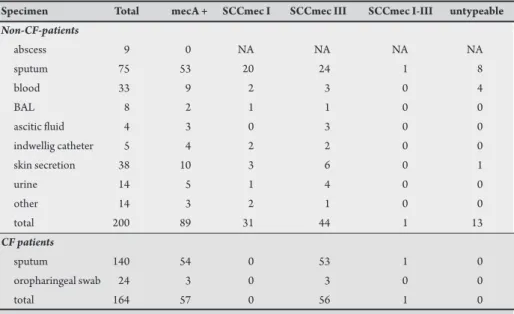
he vast majority of the isolates were from the respiratory tract (239 (65.5%) isolates, including patients with and without CF). he specimens from CF patients included only sputum or oropharyngeal swabs, while the specimens from non-CF patients also included several other clinical specimens: blood (16.5%), ascitic luid (2%), indwelling catheter (2.5%), urine (7%), abscesses and skin secretions (4.5% and 19%, respectively), among others (7%) (Table 1).
For 19 CF patients (33%) with a MRSA isolate, the specimen was recovered in a pure culture. Associated pathogens in the other 38 patients were P. aeruginosa (n = 26; Achromobacter xylosoxidans (n = 6); Stenotrophomonas maltophilia (n = 4); Burkholderia cepacea complex (n = 4); Klebsiella pneumoniae (n = 2); Haemophilus influenzae,Klebsiella oxytoca, methicillin-susceptible S. aureus (MSSA),Serratia sp. and Pseudomonas luorescens (one each); and other non-fermenting bacilli (n = 3). Some patients presented more than one associated pathogen.
Molecular typing of MRSA isolates
All of the 57 MRSA isolates from CF patients harbored SCCmec type III, but one isolate harbored SCCmec type I simultaneously with type III. In contrast, 31/89 MRSA isolates from non-CF patients harbored SCCmec type I (35%) and 44/89 harbored type III (49%) (Figure 1). Also, only one isolate harbored type I and III simultaneously.
TABLE 1 - Clinical specimens and the distribution of SCCmec types between CF and non-CF patients. Specimen Total mecA + SCCmec I SCCmec III SCCmec I-III untypeable
Non-CF-patients
abscess 9 0 NA NA NA NA
sputum 75 53 20 24 1 8
blood 33 9 2 3 0 4
BAL 8 2 1 1 0 0
ascitic luid 4 3 0 3 0 0
indwellig catheter 5 4 2 2 0 0
skin secretion 38 10 3 6 0 1
urine 14 5 1 4 0 0
other 14 3 2 1 0 0
total 200 89 31 44 1 13
CF patients
sputum 140 54 0 53 1 0
oropharingeal swab 24 3 0 3 0 0
total 164 57 0 56 1 0
31
44
1
13 0
56
1 0
0 10 20 30 40 50 60 70 80 90
type I (n=31)
type III (n=100)
types I-III (n=2)
NT (n=13)
Non-CF patients (n=200) CF patients (n=57)
FIgURE 1 - Distribution of SCCmec types between CF and non-CF patients.
hirteen (15%) MRSA isolates harbored an untypable SCCmec element, which could not be identiied by means of the PCR method used. All of these were obtained from non-CF patients.
It was possible to compare the results regarding SCCmec cassetes accordingto the clinical specimens from CF versus non-CF patients (i.e. sputum, which was the most prevalent type of specimen). We observed that that the distributions of SCCmec elements I and III were similar, regardless of the clinical specimen (Table 1).
Antimicrobial susceptibility
All the MRSA isolates underwent antimicrobial susceptibility testing (Table 2). Also, the antibiotic susceptibility of MRSA isolates was compared between those harboring SCCmec type I and those harboring type III (Table 3).
TABLE 2 - Cystic ibrosis and non-CF MRSA isolates: antibiotic resistance proile and SCCmec typea.
Variables Total SCCmec I SCCmec III SCCmec I-III Untypable
CF patients (n = 57)b
erythomycin 57/57 (100) - 56/56 (100) 1/1 (100)
-clindamycin 57/57 (100) - 56/56 (100) 1/1 (100)
-levoloxacin 47/57 (82) - 47/56 (84) 1/1 (100)
-gentamicin 54/57 (95) - 53/56 (95) 1/1 (100)
-sulfa-trimethoprim 56/57 (98) - 55/56 (98) 1/1 (100)
-rifampicin 40/57 (70) - 39/56 (70) 1/1 (100)
-doxyciclin 50/57 (88) - 49/56 (87.5) 1/1 (100)
-chloramphenicol 22/57 (39) - 22/56 (39) 0/1 (0)
-Non-CF patients (n = 89)c
erythomycin 88/89 (99) 30/31 (97) 44/44 (100) 1/1 (100) 13/13 (100) clindamycin 84/89 (94) 30/31 (97) 40/44 (91) 1/1 (100) 13/13 (100) levoloxacin 79/89 (89) 26/31 (84) 40/44 (91) 1/1 (100) 12/13 (92) gentamicin 88/89 (99) 31/31 (100) 44/44 (100) 1/1 (100) 12/13 (92) sulfa-trimethoprim 53/89 (60) 0/31 (0) 43/44 (98) 1/1 (100) 9/13 (69) rifampicin 37/89 (42) 0/31 (0) 32/44 (73) 0/1 (0) 5/13 (39) doxyciclin 36/89 (40) 0/31 (0) 30/44 (68) 0/1 (0) 6/13 (46) chloramphenicol 27/89 (30) 9/31 (29) 14/44 (32) 1/1 (100) 3/13 (23) aValues are given as n/total n of patients (%), unless otherwise indicated. NS: not signiicant.
bSCCmec type III, n=56; SCCmec type I-III, n=1; SCCmec type I, n=0, untypable SCCmec, n=0. cSCCmec type III, n=44; SCCmec type I, n=31; untypable SCCmec, n=13; SCCmec type I-III, n=1.
TABLE 3 - Comparison between SCCmec type I and III according to non-β-lactam antibiotic resistance in all patientsa.
Antibiotic SCCmec Ib SCCmec IIIb p valuec
clindamycin 30 (96.7) 96 (96) NS
chloramphenicol 9 (29) 36 (36) NS
doxycycline 0 (0) 79 (79) < 0.001
erythromycin 30 (96.7) 100 (100) NS
gentamicin 31 (100) 97 (97) NS
levoloxacin 26 (83.8) 86 (86) NS
rifampicin 0 (0) 71 (71) < 0.001
sulfa-trimethoprim 0 (0) 98 (98) < 0.001 aValues are given as n isolates (%).
FINANCIAL SUPPORT CONFLICT OF INTEREST
he authors declare that there is no conlict of interest.
REFERENCES DISCUSSION
MRSA isolates are increasingly populating the respiratory tract of CF patients. Hypermutational phenotypes, the ability to form bioilms and high antimicrobial resistance rates have been demonstrated in CF pathogens, and these may be the result from an adaptive process under their special habitat conditions5. Millar et
al demonstrated that colonization with Pseudomonas aeruginosa or Staphylococcus aureus between 1985 and 2005 remained stable (77 to 82%), but that MRSA colonization increased (1 to 6%)13. Data from
the Cystic Fibrosis Foundation Patient Registry in the United States also showed that the prevalence of MRSA increased, from 0.1% in 1995 to 17.2% in 200514.
his study only characterized Staphylococcus aureus isolates, but it also found the presence of a second or third pathogen in the same patient, in many cases. For 38 CF patients, other pathogens were also identiied: Pseudomonas aeruginosa was the most frequent, recovered from 26 CF patients, while Burkholderia cepacea was only recovered in four patients. his low recovery of Burkholderia cepacea may be a relection of increasing use of single rooms for inpatients who had previously been colonized by this pathogen, in accordance with clinical segregation policies. hese procedures have controlled the spread of Burkholderia cepacea among all CF patients atending our hospital.
In our study, there were pathogens that could not be identiied, despite recent improvements in microbiological identiication techniques; these were classiied as non-fermenting bacilli
(n = 3)13. In addition, we found signiicantly low prevalence
of Haemophilus inluenzae (n=1), which is a very common
respiratory pathogen. This was perhaps a result of widespread use of antibiotics such as imipenem and meropenem, which
are used to treat Pseudomonas aeruginosa but have concurrent
activity against Haemophilus inluenzae.
We found remarkable diferences between our CF patients and patients with diseases other than CF. All the MRSA isolates from CF patients that we typed were the so-called HA-MRSA strains. hese isolates harbored SCCmec type III, which was much more prevalent than in isolates from non-CF patients (100% vs 49%, respectively). Conversely, other studies have shown predominance of SCCmec type I (97%) or type II (89%) in CF patients, and also the presence of lower rates of type IV5,15. In order to minimize study bias, we also
compared the distribution of SCCmec considering only respiratory specimens. From this, we found that the distribution of SCCmec types was similar, regardless of the origin of the Staphylococcus aureus. his result conirms the high prevalence of SCCmec type III among CF patients in our institution.
he antibiotic susceptibility proile was similar between CF and non-CF patients, as shown in Table 2. All the isolates harboring SCCmec type III demonstrated high rate of resistance to the antibiotics used in this study, except chloramphenicol. Comparing the MRSA isolates from all the patients, it was found that isolates harboring type III were more resistant to non-β-lactam antibiotics then were isolates harboring type I. his diference was statistically signiicant for three antibiotics: trimethoprim/sulfamethoxazole, doxycycline and rifampicin (p < 0.001) (Table 3). In fact, molecular studies have shown that the presence of resistance genes in type III is higher than in type I, although both types of SCCmec are found mostly in hospital-acquired isolates11,12,16.
Patients with MRSA have been found to present larger numbers of respiratory exacerbations than do patients with MSSA17. Whereas some pathogens detected in CF respiratory cultures are usually
transient events, a previous study found that MRSA infection tended to be persistent and conirmed the hypothesis that MRSA is a marker of more severe lung disease2. he high prevalence
of multiresistant SCCmec type III among the CF patients in our institution, compared with other institutions, may suggest that serious risks exist in relation to treatment of lung colonization and control over disease progression. Until now, antibiotic use has been
one of many therapies that have contributed towards improved lung function and ultimately the survival of CF patients. Further studies are necessary to evaluate the possible genetic relatedness between these MRSA isolates.
he present study was supported by Fundação de Incentivo à Pesquisa
1. Mainz Jg, Naehrlich L, Schien M, Kading M, Schiller I, Mayr S, et al. Concordant genotype of upper and lower airways P. aeruginosa and S. aureus isolates in cystic ibrosis. horax 2009; 64:535-540.
2. Vergison A, Denis O, Deplano A, Casimir g, Claeys g DeBaets F, et al. National survey of molecular epidemiology of Staphylococcus aureus colonization in Belgian cystic ibrosis patients. J Antimicrob Chemother 2007; 59:893-899.
3. Sawicki gS, Rasouliyan L, Pasta DJ, Regelmann WE, Wagener JS, Waltz DA, et al. he impact of incident methicillin-resistant Staphylococcus aureus detection on pulmonary function in cystic ibrosis. Pediatr Pulmonol 2008; 43:1117-1123. 4. Saiman L, Siegel J. Infection control in cystic fibrosis. Clin Microbiol Rev
2004; 17: 57-71.
5. Molina A, Del Campo R, Máiz L, Morosini MI, Lamas A, Baquero F, et al. High prevalence in cystic ibrosis patients of multiresistant hospital-acquired methicillin-resistant Staphylococcus aureus ST228-SCCmecI capable of bioilm formation. J Antimicrob Chemother 2008; 62:961-967.
6. Kahl BC, Duebbers A, Lubritz g, Haeberle J, Koch Hg, Ritzerfeld B, et al. Population dynamics of persistent Staphylococcus aureus isolated from the airways of cystic ibrosis patients during a 6-year prospective study. J Clin Microbiol 2003; 41:4424-4427. 7. Prunier AL, Malbruny B, Laurans M, Brouard J, Duhamel JF, Leclercq R. High
rate of macrolide resistance in Staphylococcus aureus strains from patients with cystic ibrosis reveals high proportions of hypermutable strains. J Infect Dis 2003; 187:1709-1716.
8. garcýa-Castillo M, Morosini MI, Valverde A, Almaraz F, Baquero F, Cantón R, et al. Diferences in bioilm development and antibiotic susceptibility among Streptococcus pneumoniae isolates from cystic ibrosis samples and blood cultures. J Antimicrob Chemother 2007; 59:301-304.
9. Elizur A, Orscheln RC, Ferkol TW, Atkinson JJ, Dunne WM, Buller RS, et al. Panton–Valentine Leukocidin-positive methicillin-resistant Staphylococcus aureus lung infection in patients with cystic ibrosis. Chest 2007; 131:1718-1725. 10. Wayne PA. Performance standards for antimicrobial susceptibility testing.
In: Informational Supplement M100-S16. Clinical and Laboratory Standards Institute; 2008.
12. Deurenberg RH, Stobberingh EE. he evolution of Staphylococcus aureus. Infect gen Evol2008; 8:747-763.
13. Millar FA, Simmonds NJ, Hodson ME. Trends in pathogens colonising the respiratory tract of adult patients with cystic fibrosis, 1985-2005. J Cyst Fibros 2009; 8:386-391.
14. Razvi S, Quitell L, Sewall A, Quinton H, Marshall B, Saiman L. Respiratory microbiology of patients with cystic ibrosis in the United States, 1995 to 2005. Chest 2009; 136:1554-1560.
15. goodrich JS, Suton-Shields TN, Kerr A, Wedd JP, Miller MB, gilligan PH. Prevalence of community-associated methicillin-resistant Staphylococcus aureus in patients with cystic ibrosis. J Clin Microbiol 2009; 47:1231-1233. 16. Ito T, Okuma K, Ma XX, Yuzawa H, Hiramatsu K. Insights on antibiotic resistance
of Staphylococcus aureus from its whole genome: genomic island SCC. Drug Resist Updat2003; 6:41-52.