RESUMEN
Objeivo: Ideniicar la frecuencia e intensi
-dad del sufrimiento moral experimentado por enfermeros, técnicos y auxiliares de enfermería que trabajan en los hospitales del sur del estado de Rio Grande do Sul.
Método: Se realizó una invesigación en
-cuesta con 334 trabajadores de enferme
-ría, pertenecientes a tres insituciones, a través de la aplicación del cuesionario de sufrimiento moral. Por medio del análisis factorial y el Alfa de Cronbach, se valida
-ron los constructos: falta de competencia en el equipo de trabajo, falta de respeto a la autonomía del paciente, condiciones de
trabajo insuicientes y obsinación terapéu
-ica. Resultados: A través de la estadísica descripiva y el análisis de la varianza, se constató que los enfermeros y auxiliares de enfermería poseen una mayor percepción del sufrimiento moral comparados a los técnicos de enfermería. Los aspectos orga
-nizacionales y las formas de comunicación inluyen en la menor percepción del sufri
-miento moral. Conclusión: Se recomienda la implementación de acciones que favo
-rezcan los enfrentamientos, las tomas de decisiones y el ejercicio de la autonomía de esos trabajadores.
DESCRIPTORES Éica en enfermería Grupo de enfermería Autonomía profesional Agotamiento profesional Relaciones interprofesionales RESUMO
Objeivo: Ideniicar a frequência e intensi
-dade de sofrimento moral vivenciadas por enfermeiros, técnicos e auxiliares de en
-fermagem que atuam em hospitais no Sul do Rio Grande do Sul. Método: Realizou-se uma pesquisa survey com 334 trabalhado
-res de enfermagem, atuantes em três insi
-tuições, por meio da aplicação do quesio
-nário de sofrimento moral. Mediante análi
-se fatorial e alfa de Cronbach, validaram-se
os constructos: falta de competência na equipe de trabalho, desrespeito à auto-nomia do paciente, condições de trabalho
insuicientes e obsinação terapêuica.
Resultados: Com a estaísica descriiva e análise de variância, constatou-se que enfermeiros e auxiliares de enfermagem possuem maior percepção de sofrimento moral quando comparados aos técnicos de enfermagem. Questões organizacionais e formas de comunicação inluenciam na menor percepção de sofrimento moral.
Conclusão: Recomenda-se a implementa
-ção de ações que favoreçam enfrentamen
-tos, tomadas de decisão e exercício da au
-tonomia desses trabalhadores.
DESCRITORES Éica em enfermagem Equipe de enfermagem Autonomia proissional Esgotamento proissional Relações interproissionais ABSTRACT
Objecive: To idenify the frequency and intensity of moral distress experienced by nurses, technicians and nursing assis
-tants who worked in hospitals in the Sou
-th of Rio Grande do Sul State. Method: A survey research was conducted with 334 nursing workers from three insituions, through a quesionnaire of moral distress. Constructs were validated through facto
-rial analysis and Cronbach’s alpha: lack of competence of the working team,
disres-pect to the paient’s autonomy, insuicient working condiions and therapeuic obsi
-nacy. Results: With descripive staisics and analysis of variance, it was found that nurses and nursing assistants have higher percepion of moral distress when compa
-red to nursing technicians. Organizaional quesions and ways of communicaion in
-luence lower percepion of moral distress.
Conclusion: Implementaion of acions to favor coping, decision making and auto
-nomy exercise from those workers.
DESCRIPTORS Ethics, nursing Nursing, team Professional autonomy Burnout, professional Interprofessional relaions
Nurses, nursing technicians and assistants:
who experiences more moral distress?
*O
riginal
a
rticle
Graziele de Lima Dalmolin1, Valéria Lerch Lunardi2, Guilherme Lerch Lunardi3, Edison Luiz
Devos Barlem4, Rosemary Silva da Silveira5
ENFERMEIROS, TÉCNICOS E AUXILIARES DE ENFERMAGEM: QUEM VIVENCIA MAIOR SOFRIMENTO MORAL?
ENFERMEROS, TÉCNICOS Y AUXILIARES DE ENFERMERÍA: ¿QUIÉN EXPERIMENTA EL MAYOR SUFRIMIENTO MORAL?
*Extracted from the thesis “Sofrimento moral e síndrome de Burnout: relações nas vivências proissionais de trabalhadores de enfermagem”, Nursing
Graduate Program, Universidade Federal do Rio Grande, 2012. 1 Doctor in Nursing. Professor of the Nursing Department, Universidade Federal de Santa
Maria, Santa Maria, RS, Brazil. [email protected] 2 Doctor in Nursing. Professor of the Nursing Department, Universidade Federal do Rio Grande,
Rio Grande, RS, Brazil. 3 Doctor in Administration. Professor of the Administration Course and of Nursing Graduate Program, Universidade Federal do Rio
Grande, Rio Grande, RS, Brazil. 4 Doctor in Nursing. Professor of the Nursing Graduate Program, Universidade Federal do Rio Grande, Rio Grande, RS,
INTRODUCTION
With the recent and coninuous scieniic and techno
-logical advances, many values have been let to a second plan, consituing new challenges daily in the ethics ield which can be characterized by conlicts and dilemmas that with its pariculariies make the exercise of some profes
-sions more complex, as nursing(1).
Those conlicts are linked to the occurrence of ethical and moral problems, moral dilemmas and moral distress. Moral problems involve conlict situaions between one or more moral values and uncertainty about the correct course of acion in the individual, interpersonal, organiza
-ional and social levels. Moral dilemmas are perceived in situaions where there are two or more possible course of acions and reasons equally imperial, in which the choice of one acion can implicate renounce of others. Yet, moral distress happen in situaions where professionals know or believe to know the correct acion to be taken, but for many reasons, as fear or circumstances that surpass its competence, they cannot follow this course of acion to avoid paricular harms, and they can have their values and moral agent ideniies compromised(2).
The occurrence of moral distress is associated with the work organizaion, involving the insuicient material and human resources, interpersonal relaions, lack of in
-situional support for the autonomy exercise of nurses, disrespect to the paients’ rights and death cause by negli
-gence, that is, deaths known as avoidable(3-4).
The development of moral distress in nursing is also associated to aspects related to organizaional poliics and its impacts on the worker ability to advocate for pa
-ients, with the denial of this defense role. Those workers also present an apparent incapacity/diiculty to inluence medical decisions regarding the pain and sufering of pa
-ients, which also is related to their role to advocate for paients’ rights and to the hierarchical structure of power of many hospitals, making it diicult to recognize their knowledge as well as its implementaion(5-6).
The occurrence of moral distress present implicaions to their lives, in the personal dimension, as emoional and physical signals, as well as in the professional dimension, related to the saisfacion at work and career abandon
-ment. These manifestaions seems to be strongly related to the diiculty to exercise power in decision making, which make them act many imes against their beliefs and values, denying their knowledge(7).
In this case, power as strength relaions, in the acing spaces of nursing professionals, developed through ights and incessant coping in its contexts, consituing ways of conducts that transform and modify power. The instabil
-ity characterisic of strength correlaions, due to inequal
-ity, coninually leads to power states, always localized and modiiable; that is, the power is exercised from innumer
-ous points and within inequitable and mobile relaions, not being able to exist if not in funcion of a muliplicity of resistance points, present in all network of power(8).
Thus, it is noted that nursing professionals can experi
-ence moral distress by diiculies to exercise power, with possibility to have their personal and professional integri
-ty and authenici-ty compromised. This diicul-ty is mainly related to common everyday nursing working factors, as decision making referred to the treatment and care of pa
-ients, low autonomy, ime and resources restricions and high levels of responsibility(6).
These factors can be associated to the diiculty to resist and realize coping. The resistance as reacion fo
-cuses provoking modiicaions about everyday facts. In this sense, it can be said that the apparent lack of ights from nursing workers can be conigured in the non-use of their personal freedom, which can lead them to their own moriicaion, based on the obedience, resignaion and submission(9).
This quesion can also be related to the disciplinary power, by the apparent subjecing forces, in some dilem
-ma and coping situaions, leaving a relaionship of docile-uility to the nursing workers. The discipline in power re
-laions have the formaion of obedient and useful corps, that is, while submissive people are formed, it increases their strength in economic uility level and decrease in po
-liical, resistance and ight terms(10).
Considering the diverse aspects linked to the occur
-rence of moral distress and the possibiliies to intensify it inside nursing environments, bringing consequences to workers and compromising the nursing care; the objecive of the study was to idenify the frequency and intensity of moral distress experienced by nurses, nursing technicians and assistants from hospitals in the South of Rio Grande do Sul State/Brazil.
METHOD
This is a quanitaive approach study, exploratory and descripive, consituing a survey research.
This survey was conducted with nursing profession
-als from three hospital institutions (H1, H2 e H3) from the South of Rio Grande do Sul State, located in two different municipalities (M1 e M2). In accordance with available data from the Brazilian National Health Fa
-cilities from the Informatics Department of SUS (CNES/ DATASUS) and available data from official electronic ad
-dresses of the participating institutions, the H1 institu
-tion is characterized as a federal public hospital, with 186 beds and 59 nurses, 52 nursing technicians and 203 nursing assistants. In its majority, they are public em
-ployees formally hired, with a weekly schedule of 30 hours. The H2 institution is characterized as a philan
technicians and 54 nursing assistants, hired and regu
-lated by the Consolidation of Labor Laws (CLT), with a weekly schedule varying from 36 to 40 hours. At last, the H3 institution is a philanthropic school hospital of public utility, with 291 beds, 60 nurses, 382 nursing technicians and nursing assistants also regulated by the CLT with a 36 hours weekly schedule.
The instrument for data collecion was an adapta
-ion from the Moral Distress Scale (MDS) adjusted to the
present research context(5). This instrument was originally
developed in a North-American context(11), submited to
a back-translaion, cultural adaptaion and validaion pro
-cess(4), when it was found that in some situaions ideni -ied in our reality as sources of moral distress, it was not fully contemplated. The quesionnaire applied was com
-posed by 39 quesions, using a Likert scale of seven points to analyze the intensity and the frequency of moral dis
-tress, along with components of subject´s characterisics. As subjects for the present study, we considered nursing professionals from the H1, H2 and H3, including nurses, technicians and assistants who work in those in
-situions, which means 1,213 individuals, composing a non-probabilisic convenient sample. A formula was used to select the sample size(12), esimaing a minimum of 295
subjects for staisical analysis. The inclusion criteria re
-ferred to the availability and interest in responding the instrument at the data collecion moment.
The data collecion was performed from October 2010 to July 2011. Five hundred quesionnaires were given to workers, from those, 387 were returned. We adopted as exclusion criteria for analysis procedures, those quesion
-naires which the respondents used only two points of the scale, not considering the interval scale adopted; those who marked as not having moral distress in 20 quesions or more, and those who let more than 10 items in blank. Thus, with the exclusion of 53 instruments, 334 subjects composed the inal sample for data analysis.
Ater the data collecion, two staisical tests were conducted to guarantee the instrument validity: a facto
-rial analysis and the Cronbach’s alpha. The factorial analy
-sis aimed to reduce and summarize data, deining groups of latent dimensions, denominated factors(13). From the 39 proposed quesions, iniially, 20 were validated and pooled in four dimensions - lack of competence of the
working team, disrespect to the paient’s autonomy, in
-suicient working condiions and therapeuic obsinacy – while 19 were excluded from the instrument because they presented low factorial loads (inferior to 0.40). More el
-evated factorial loads (superior to 0.40) in more than one factor did not present conceptual coherence with the pro
-posed block or formed isolated blocks with only one ques
-ion. The four proposed dimensions explained 67.68% of the variaion in the original quesions, represening an ad
-equate level of data synthesis, facilitaing its management and interpretaion.
The Cronbach’s alpha assess internal consistency be
-tween variables of muliple scales(13). Suggested values range between 0.60 and 0.80 for exploratory studies, guaranteeing the reliability of the used scales. The Cron-bach’s alpha for the instrument presented 0.93 value
while the coeicients from the four dimensions were be
-tween 0.75 and 0.94, proving its reliability.
The presented constructs were already ideniied by other studies about moral distress, irstly with nurses(4) and ater with other nursing professionals(5). The referred
constructs can be understood in accordance with the fol
-lowing deiniions.
Lack of competence of the working team is related to
nursing professionals’ insecurity about acing with other professionals of the nursing and health teams and, also, with support services, that does not inspire trust.
Disre-spect to the paient’s autonomy refers to the infracion of the autonomy ethic principle, that sipulates individual freedom to each person to determine their acions in ac
-cordance with their own choices, values and convicions(1).
Insuicient working condiions is related to the work or
-ganizaion, associated with lack of material resources and also, to work overload caused by insuicient human resources(3). Therapeuic obsinacy consitutes the imple -mentaion of therapeuic measures recognized by nursing professionals as fuile and responsible for the prolonged sufering of terminally ill paients(14).
At last, the data analysis to obtain the results was per
-formed with descripive staisics and analysis of variance (ANOVA), idenifying possible signiicant diferences be
-tween respondent groups. The sotware Staisical Pack -age for Social Sciences (SPSS) version 13.0 was used.
All ethical precepts of research involving human be
-ings were respected, and the project was submited for evaluaion at the local Ethics in Research Commitee, with a favorable answer (Protocol nº 70/2010).
RESULTS
In relaion to general characterisics of the study par
-icipants, we highlight a sample consituted by 334 nurs
-ing professionals; from those 71 (21.3%) were nurses, 234 (70%) were nursing technicians and 29 (8.7%) were nursing assistants; 289 (86.5%) were female and 39 (11.7%) were male. Their age varied from 19 to 64 years, the mean value was 33.6 years, and 184 (55%) subjects had the same or lower age in comparison to the mean and 150 (45%) sub
-jects had superior age. Regarding the work place, 60 profes
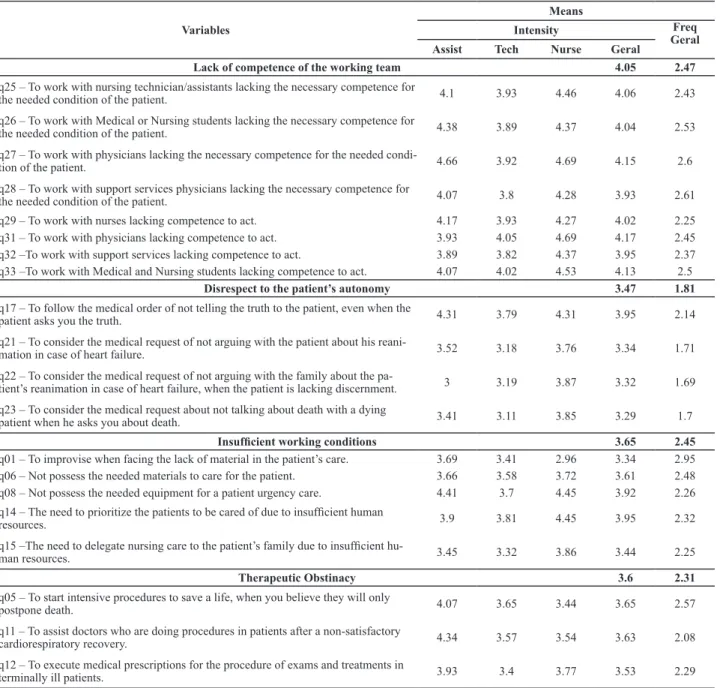
Descriptive analysis allowed the identification of their perception about the moral distress experienced. The four identified constructs were operationalized by
numerical values corresponding to arithmetic means from individual questions composing each construct (Table 1).
Table 1 - Means of intensity and frequency of moral distress experienced by different nursing professionals in accordance with situa-tions represented in quessitua-tions of a validated instrument – Rio Grande, RS, 2012
Variables
Means
Intensity Freq
Geral
Assist Tech Nurse Geral
Lack of competence of the working team 4.05 2.47
q25 – To work with nursing technician/assistants lacking the necessary competence for
the needed condition of the patient. 4.1 3.93 4.46 4.06 2.43
q26 – To work with Medical or Nursing students lacking the necessary competence for
the needed condition of the patient. 4.38 3.89 4.37 4.04 2.53
q27 – To work with physicians lacking the necessary competence for the needed
condi-tion of the patient. 4.66 3.92 4.69 4.15 2.6
q28 – To work with support services physicians lacking the necessary competence for
the needed condition of the patient. 4.07 3.8 4.28 3.93 2.61
q29 – To work with nurses lacking competence to act. 4.17 3.93 4.27 4.02 2.25 q31 – To work with physicians lacking competence to act. 3.93 4.05 4.69 4.17 2.45 q32 –To work with support services lacking competence to act. 3.89 3.82 4.37 3.95 2.37 q33 –To work with Medical and Nursing students lacking competence to act. 4.07 4.02 4.53 4.13 2.5
Disrespect to the patient’s autonomy 3.47 1.81
q17 – To follow the medical order of not telling the truth to the patient, even when the
patient asks you the truth. 4.31 3.79 4.31 3.95 2.14
q21 – To consider the medical request of not arguing with the patient about his
reani-mation in case of heart failure. 3.52 3.18 3.76 3.34 1.71
q22 – To consider the medical request of not arguing with the family about the
pa-tient’s reanimation in case of heart failure, when the patient is lacking discernment. 3 3.19 3.87 3.32 1.69
q23 – To consider the medical request about not talking about death with a dying
patient when he asks you about death. 3.41 3.11 3.85 3.29 1.7
Insuficient working conditions 3.65 2.45
q01 – To improvise when facing the lack of material in the patient’s care. 3.69 3.41 2.96 3.34 2.95 q06 – Not possess the needed materials to care for the patient. 3.66 3.58 3.72 3.61 2.48 q08 – Not possess the needed equipment for a patient urgency care. 4.41 3.7 4.45 3.92 2.26
q14 – The need to prioritize the patients to be cared of due to insuficient human
resources. 3.9 3.81 4.45 3.95 2.32
q15 –The need to delegate nursing care to the patient’s family due to insuficient hu
-man resources. 3.45 3.32 3.86 3.44 2.25
Therapeutic Obstinacy 3.6 2.31
q05 – To start intensive procedures to save a life, when you believe they will only
postpone death. 4.07 3.65 3.44 3.65 2.57
q11 – To assist doctors who are doing procedures in patients after a non-satisfactory
cardiorespiratory recovery. 4.34 3.57 3.54 3.63 2.08
q12 – To execute medical prescriptions for the procedure of exams and treatments in
terminally ill patients. 3.93 3.4 3.77 3.53 2.29
When analyzing individual means of the composing quesions of each one of the four constructs, we observed that the following quesions presented the higher means: in the construct lack of competence of the working team,
the quesion q31 – To work with physicians lacking com -petence to act (4.17); in disrespect to the paient’s auton
-omy, the quesion q17– to follow the medical order of not telling the truth to the paient, even when the paient asks you the truth (3.95); in insuicient working condiions, the quesion q14 – the need to prioriize the paients to be cared of due to insuicient human resources (3.95); and,
in therapeuic obsinacy, the quesion q05 – To start
inten-sive procedures to save a life, when you believe they will only postpone death (3.65).
On the other hand, regarding the frequency in which the nursing professionals experienced moral distress, we observed the means of situaions that causes it vary
-il (2.95) in the quesion q01 –To improvise when facing the lack of material in the paient’s care, as the most fre
-quent. We also noted that in relaion to the constructs, the higher frequency mean was in lack of competence in the working team (2.47), followed by insuicient work
-ing condiions (2.45).
Through descripive analysis, it was possible to verify total means of each construct in accordance with diferent categories of nursing professionals. We also conducted an analysis of the total moral distress, in accordance with
the three professionals’ categories, considering the con
-structs formed in the factorial analysis (Table 2).
Table 3 - Relationship between the perception of moral distress in nursing professionals in accordance with identiied constructs, cha -racteristics of subjects and work – Rio Grande, RS, 2012
Lack of competence of the working team
Disrespect to the patient’s autonomy
Insuficient working
conditions Therapeutic obstinacy Total moral distress
Variables N M P M P M P M P M P
Institution
H1 60 4.85 0.000* 3.88 0.000* 4.37 0.000* 4.02 0.000* 4.28 0.000*
H2 183 3.96 3.71 3.69 3.74 3.78
H3 91 3.71 2.72 3.1 3.02 3.14
Time to inish education
≥ 5 years 108 4.31 0.018* 3.52 0.534 3.95 0.002* 3.77 0.118 3.89 0.025*
< 5 years 211 3.92 3.4 3.48 3.47 3.57
Permanent education
Yes 181 3.96 0.063 3.44 0.096 3.59 0.372 3.61 0.065 3.65 0.049*
No 54 4.46 3.87 3.88 3.96 4.04
I don’t know 97 3.98 3.27 3.64 3.34 3.56
Meetings
Yes 146 4.06 0.978 3.42 0.608 3.52 0.106 3.39 0.032* 3.6 0.192
No 187 4.05 3.51 3.76 3.77 3.77
Table 2 - Total mean of moral distress experienced by nursing assistants, technicians and nurses in accordance with four proposed constructs in the factorial analysis – Rio Grande, RS, 2012
Variables Total
n=334
Category
P Assistant
n=29
Technician n=234
Nurse n=71
Lack of competence of the working team 4.05 4.16 3.92 4.45 0.02
Disrespect to the patient’s autonomy 3.47 3.56 3.31 3.93 0.02
Insuficient working conditions 3.65 3.82 3.56 3.89 0.16
Therapeutic obstinacy 3.6 4.11 3.54 3.58 0.17
Total moral distress 3.69 3.91 3.58 3.96 0.04
Regarding the four analyzed constructs, two present
-ed signiicant staisical diference (at a 5% level): lack of competence of the working team (P= 0.02) and disrespect
to the paient’s autonomy (P= 0.02). From this data, we
perceived that nurses presented higher means of moral distress in lack of competence of the working team (4.45)
and disrespect to the paient’s autonomy (3.93). We also noted more elevated means for the nursing assistants in all constructs in comparison with the means presented by the nursing technicians.
For the constructs insuicient working condiions and therapeuic obsinacy, it was not possible to ind sig
-niicant staisical diference (at a 5% level) between the analyzed groups. However, nurses also presented higher means in insuicient working condiions (3.89), but in
therapeuic obsinacy they presented a 3.58 mean, while the nursing assistants, 4.11. This diference can be associ
-ated to the nursing assistance everyday presence with the paient to perform direct care, seeing their pain and suf
-fering closer in situaions without possible cure.
Regarding the analysis of total moral distress, we also
found signiicant staisical diference (P= 0.04), making it possible to airm that nurses and nursing assistants have a higher percepion of experienced moral distress than nursing technicians.
Sill, aiming to analyze the existence of possible mean dif
-ferences for the four constructs in relaion to moral distress, diferent variance analysis (ANOVA) were conducted, consid
-ering subject’s pariculariies, as presented in Table 3.
In the relaionship between the constructs, the person
-al and labor characterisics from nursing profession-als, we ideniied few items with a signiicant staisical diference at a 5% level that inluences the percepion of moral dis
-tress. Within them, the insituion where they work, that is, workers from H1 presented higher percepion of moral distress, with a 4.28 mean of total moral distress, followed
by workers from H2 with a 3.78 mean and H3, with 3.14. Regarding the ime to conclude their educaion in Nursing, we noted that workers with more ime ater graduaion, that is, more than ive years, presented higher percepion of experience of moral distress in the con
-structs lack of competence of the working team (4.31),
insuicient working condiions (3.95) and the analysis of
total moral distress (3.89).
About acions towards permanent educaion in the in
-situion, workers that airmed to not have this type of acivity in their workplace presented higher percepion in of total moral distress (4.04).
The workers who airmed to not have meeings within the working team presented higher percepion of moral distress associated to therapeuic obsinacy (3.77). Lastly, we found nursing workers who perceived as not having dialogue with the insituion and managers presening higher moral distress related to insuicient working condi
-ions, with means of (3.86) and (3.97), respecively.
DISCUSSION
From the data analysis, four constructs were deined and those are related to experiences of moral distress from nursing professionals, within them: lack of compe-tence of the working team (4.05); disrespect to the
pa-ient’s autonomy (3.47); insuicient working condiions (3.65); and therapeuic obsinacy (3.60). Lastly, a total moral distress analysis calculated from the four deined
constructs means presented a 3.69 value.
Ideniied constructs in this case were also estab
-lished in other studies about percepion of moral distress in nursing. In a sample of 124 nurses in the South of Rio
Grande do Sul, the following dimensions were ideniied: lack of competence of the working team, therapeuic ob
-sinacy, disrespect to the paient’s autonomy, with 4.55, 3.60 and 3.57 means respecively(4). In another sample of 247 nursing professionals, including diferent nursing pro
-fessional categories, they also ideniied the dimensions lack of competence of the working team, disrespect to the paient’s autonomy and insuicient working condiions; again, the irst with the highest mean, that is, 4.36(5). Thus,
in those samples, other diferent constructs were seen, within them: denial of the nurse/nursing role as advocate of the paient(4-5) and denial of the nursing as advocate of the terminally ill paient(5).
Considering the quesions presening higher means in each construct, as shown in Table 1, we perceive the experience of moral sufering in the four constructs ideni
-ied in this research to be ariculated with the diiculty of nursing professionals to exercise power, to cope and facing who represents power in the working environment micro spaces, that is, diiculty to establish points of resis
-tance in power relaions, which can, as referred, compro
-mise their moral integrity(15).
This quesion can be inluenced by disciplinary forma
-ion, which increases in strength of the body in economi
-cal and uility terms, but diminishes in polii-cal terms by obedience and passivity(10), inducing to its own moriica
-ion by the produc-ion of individuals with diminished ca
-paciies to revolt, resist and ight, making them become poliically docile(15), besides more involved quesions. This
way, it is necessary for muliple relaions of power in the working environment to consider it in a manner to favor personal freedom and a moral posture in agreement with the pracice to be performed(15).
Considering all other presented results, we infer that nurses presents higher percepion of total moral dis-tress that can be associated in its diferent educaion/
formaion, regarding the number of hours spent during undergraduate nursing educaion. Comparing to other categories of nursing, they seem to receive more empha
-sis during its construcion as workers who privilege a ho
-lisic humanitarian model, contextualized in caring, with Lack of competence of the
working team
Disrespect to the patient’s autonomy
Insuficient working
conditions Therapeutic obstinacy Total moral distress
Variables N M P M P M P M P M P
Institution dialogue
Yes 122 3.96 0.157 3.39 0.6 3.35 0.007* 3.41 0.221 3.53 0.161
No 72 3.87 3.63 3.86 3.77 3.78
Sometimes 140 4.23 3.46 3.81 3.67 3.79
Management dialogue
Yes 192 4.04 0.975 3.48 0.382 3.5 0.047* 3.48 0.111 3.63 0.266
No 42 4.08 3.75 3.97 4.03 3.96
Sometimes 100 4.07 3.33 3.81 3.64 3.71
development of criical, relexive, creaive and ethical abiliies for professional pracice(16), which possibly con
-tribute to idenify moral problems; in contradicion, but seems to present diiculies to perform confroning that they can recognize as needed to assure coherent acions with their moral values. Thus, the major moral distress be
-tween nurses can also be associated to their conscience of not corresponding to what could be their roles in front of the other nursing workers, as they have a coordinaing posture in the nursing team, what implicates a leadership role and a possible model/reference to their team.
Regarding the ime ater their educaion conclusion in the nursing ield, the graduated workers of ive years or more presented higher percepion of total moral dis-tress, and related to lack of competence of the working team and insuicient working condiions. More ime ater
conclusion of the course associated with a higher percep
-ion of moral distress experience can be related to more maturity and professional experience that allows to prob
-lemaize and analyze more criically the experiences in the working context, idenifying the most correct acions, but without being able to implement those, possibly due to the diiculies regarding the confrontaions that would be needed, which intensiies their percepion of compromise of their moral agency.
Regarding the aciviies of permanent educaion, those can be considered as an essenial strategy to form and develop health professionals, acing in the perspec
-ive to qualify the ofered services(17). This way, profession
-als aware of permanent educaion acions in their insitu
-ions and, probably paricipaing in those, present lower percepion of moral distress due to the higher probability of relecion, sharing and discussing conlicing quesions and dilemmas with their work colleagues.
Some ways of communicaion experienced in working environments were also assessed, as meeings within the team and the percepion of dialogue with the insituion, managers and team. It was found that workers who re
-port to not atend to meeings, experience higher moral distress related to therapeuic obsinacy, as well as those who do not have the possibility of dialogue with managers and insituions that also experience higher moral distress related to insuicient working condiions.
Thus, to maintain an adequate and capable environ
-ment for a nursing care with quality, it is needed the existence of relaionships and spaces that allow the problemaizaion and the manifestaion of experienced diiculies, preferably a permanent dialogue with manag
-ers and administraions, especially those referred to hu
-man resources and needed materials.
Considering those results, in a sense of diminish the moral distress experienced by nursing professionals, iden
-iied strategies in the literature can be cited, regarding ethical educaion through formaion and strengthening of ethic commissions and permanent educaion programs;
improvements in communicaion, and improvement in or
-ganizaional quesions, with more paricipaion of nursing professionals in the creaion of insituional policies, as in a beter distribuion of human resources and materials(18-19).
In relaion to communicaion strategies, those appear as an opion to decrease moral distress, the opportuniies that nursing professionals have to consult their colleagues and debate about situaions that cause anguish. In a daily pracice, the moral quesions are not suiciently contem
-plated and discussed many imes, but it is emphasized that workers and insituions should ind ways to create this moral debate, in favor of their professional self-esteem(20).
Other sources of support and coping moral distress, besides the work in team and sharing anguish with their peers, it is related to the insituional management strengthening, which can favor dialogue, autonomy and decision making, establishing an ethic commitee to defend the quality of care and workers, and class organizaions assising the pre
-venion of moral distress through the advocacy for beter work condiions, respect to the worker’s rights and oppor
-tuniies for professional growth(21).
At last, with these strategies, the favor of the nursing worker’s conduct can exist as the defenders of the pa
-ients’ rights(22), because prepared and strong, they can
promote discussions and possibiliies to cope with conlict situaions in the daily pracice of nursing, contribuing, consequently, for the decrease of moral distress(18-19,21).
CONCLUSION
This study aimed to explore the percepion of moral distress experienced by nursing professionals in diferent insituions. Firstly, we ideniied as source of moral dis
-tress, the following formed constructs: lack of competence
of the working team, disrespect to the paient’s autonomy, insuicient working condiions and therapeuic obsinacy. In the same way, we tried to look for the relaionships of those items with their work environment characterisics.
Resuling from the analysis of means from the ques
-ions composing each construct, we considered that constructs and quesions with more elevated means for moral distress seem to be related to their diiculies to ex
-ercise power and resistance in their working environment, contribuing for its moriicaion and denial of themselves when facing the apparent acceptance of condiions, even inadequate ones, in which they act.
We noiced that within professional categories, nurses are those with higher moral distress, followed by nursing assistants and, ater, by the nursing technicians. Regarding the personal and the work environmental characterisics, we found moral distress seem to be more manifested in situaions and environments in which meeings are not done within the working team, and there are few possi
permanent educaion. Thus, the experience of moral dis
-tress, especially, in the working environment organizaion, which does not propiiate spaces for discussions, prob
-lemaizaion, relecion and appreciaion of experiences in everyday situaions of work that can demand coping from the workers coninually.
Thus, we recommend the implementaion of acions to enhance working condiions and communicaion in en
-vironments with nursing acion, prioriizing coping, deci
-sion making, the autonomy exercise and especially, the quality of nursing care and the process of health/saisfac
-ion of their profess-ionals.
Support
Financial support from the Brazilian Naional Council of Scieniic and Technological Development (CNPq), process nº 475366/2008-5.
REFERENCES
1. Oguisso T, Schmidt MJ. O exercício da enfermagem: uma aborda
-gem éico-legal. 3ª ed. Rio de Janeiro: Guanabara Koogan; 2010.
2. Canadian Nurses Associaion (CNA). Code of ethics for regis
-tered nurses. Otawa, Canada: Centennial; 2008.
3. Dalmolin GL, Lunardi VL, Lunardi Filho WD. O sofrimento mor
-al dos proissionais de enfermagem no exercício da proissão. Rev Enferm UERJ. 2009;17(1):35-40.
4. Barlem ELD, Lunardi VL, Lunardi GL, Dalmolin GL, Tomas
-chewski JG. The experience of moral distress in nursing: the
nurses’ percepion. Rev Esc Enferm USP [Internet]. 2012 [cit
-ed 2013 Feb 22];46(3):681-8. Available from: htp://www.sci
-elo.br/pdf/reeusp/v46n3/en_21.pdf
5. Barlem ELD, Lunardi VL, Lunardi GL, Tomaschewski-Bar
-lem JG, Silveira RS. Moral distress in everyday nursing: hid
-den traces of power and resistance. Rev Laino Am Enferm. 2013;21(1):293-9.
6. Hufman DM, Ritenmeyer L. How professional nurses working
in hospital environments experience moral distress: a system
-aic review. Crit Care Nurs Clin North Am. 2012;24(1):91-100.
7. Dalmolin GL, Lunardi VL, Barlem ELD, Silveira RS. Implicações
do sofrimento moral para os(as) enfermeiros(as) e aproxima
-ções com o burnout. Texto Contexto Enferm. 2012;21(1):200-8.
8. Foucault M. História da sexualidade I: a vontade de saber. 19ª ed. Rio de Janeiro: Graal; 1988.
9. Foucault M. História da sexualidade II: o uso dos prazeres. São Paulo: Graal; 1984
10. Foucault M. Vigiar e punir: nascimento da prisão. 36ª ed. Petrópolis: Vozes; 2009.
11. Corley MC, Elswick RK, Gorman M, Clor T. Develop
-ment and evaluaion of moral distress scale. J Adv Nurs. 2001;33(2):250-6.
12. Hill MM, Hill A. Invesigação por quesionário. Lisboa: Sí
-lado; 2002.
13. Hair JF, Anderson RE, Tatham RL, Black WC. Análise muli
-variada de dados. Porto Alegre: Artmed; 2005.
14. Carvalho KK, Lunardi VL. Obsinação terapêuica como questão éica: enfermeiras de unidade de terapia intensiva. Rev Laino Am Enferm [Internet]. 2009 [citado 2013 fev. 15];17(3). Disponível em: htp://www.scielo.br/pdf/rlae/ v17n3/pt_05.pdf
15. Foucault M. Microísica do poder. 26ª ed. Rio de Janeiro: Graal; 2008.
16. Brasil. Conselho Nacional de Educação. Câmara de Educa
-ção Superior. Resolu-ção CNE/CES n. 3, de 7 de novembro de 2001. Insitui Diretrizes Curriculares Nacionais do curso de graduação em enfermagem [Internet]. Brasília; 2001 [citado 2012 nov. 20]. Disponível em: htp://portal.mec.gov.br/cne/ arquivos/pdf/CES03.pdf
17. Duarte MLC, Oliveira AI. Compreensão dos coordenadores de serviços de saúde sobre educação permanente. Cogitare Enferm. 2012;17(3):506-12.
18. Pijl-Zieber E, Hagen B, Armstrong-Esther C, Hall B, Akins L, Singl M. Moral distress: an emerging problem for nurses in long-term care? Qual Ageing. 2008;9(2):39-48.
19. Rice EM, Rady MY, Hamrick A, Verheijde JL, Pendergast DK. Determinants of moral distress in medical and surgical nurses an adult acute teriary care hospital. J Nurs Manag. 2008;16(3):360-73.
20. Veer AJE, Francke AL, Struijs A, Willems DL. Determinants
of moral distress in daily nursing pracice: a cross sec
-ional correla-ional quesionnaire survey. Int J Nurs Stud. 2013;50(1):100-8.
21. Maluwa VM, Andre J, Ndebele P, Chilemba E. Moral distress in nursing pracice in Malawi. Nurs Ethics. 2012;19(2):196-207.