1 Universidade Federal de Alagoas, Programa de Pós-Graduação em Psicologia, Maceió, AL, Brazil.
2 Universidade Federal de Alagoas, Escola de Enfermagem e Farmácia, Curso de Graduação em Enfermagem, Maceió, AL, Brazil.
3 Universidade Federal de Alagoas, Faculdade de Medicina, Maceió, AL, Brazil.
4 Universidade Federal de Alagoas, Escola de Enfermagem e Farmácia, Programa de Pós-Graduação em Enfermagem, Maceió, AL, Brazil.
ABSTRACT
Objective: Discussing the factors associated with major depression and suicide risk among nursing professionals. Method: An integrative review in PubMed/MEDLINE, LILACS, SciELO and BDENF databases, between 2003 and 2015. Results: 20 published articles were selected, mostly from between 2012 and 2014, with signiicant production in Brazil. Nursing professionals are vulnerable to depression when young, married, performing night work and having several jobs, and when they have a high level of education, low family income, work overload, high stress, insuicient autonomy and a sense of professional insecurity and conlict in the family and work relationship. Suicide risk was correlated with the presence of symptoms of depression, high levels of emotional exhaustion, depersonalization and low personal accomplishment; characteristics of Burnout Syndrome. Conclusion: Suicide risk among nursing professionals is associated with symptoms of depression and correlated with Burnout Syndrome, which can afect work performance.
DESCRIPTORS
Nursing; Stress, Psychological; Depression; Suicide; Review.
Depression and suicide risk among Nursing
professionals: an integrative review
Depressão e risco de suicídio entre profissionais de Enfermagem: revisão integrativa Depresión y riesgo de suicidio entre profesionales de Enfermería: revisión integradora
Darlan dos Santos Damásio Silva1, Natália Vieira da Silva Tavares2, Alícia Regina Gomes Alexandre2,Daniel Antunes Freitas3, Mércia Zeviani Brêda4, Maria Cícera dos Santos de Albuquerque4, ValfridoLeão de Melo Neto3
Received: 11/14/2014 Approved: 09/15/2015
REVIEW ARTICLE DOI: 10.1590/S0080-623420150000600020
Corresponding author: Darlan dos Santos Damásio Silva Universidade Federal de Alagoas, Escola de Enfermagem e Farmácia, Setor de Saúde Mental
Depression and suicide risk among Nursing professionals: an integrative review
INTRODUCTION
Depression and suicide are complex phenomena that cause intense sufering in the lives of the people afected, their families, friends and community. hese two phenom-ena coexist and inluence one another(1), and both are
con-sidered signiicant public health problems(2).
he World Health Organization (WHO)(2) estimates
that depression accounts for 4.3% of the global burden of disease and is among the largest causes of disability in the world, particularly for women(3). It also notes that suicide
is a universal phenomenon, being the main cause of death among adolescents 15-19 years. In 2012 alone there were 804,000 suicides worldwide, representing a rate of 11.4 per 100,000 (15.0 for men and 8.0 for women)(2). Both
depression and suicide result from the interaction of bio-logical, genetic, psychobio-logical, sociobio-logical, cultural and environmental factors, while being an important indica-tor of people’s quality of life(4).
Depression is characterized by a prolongation of depres-sion symptoms and mood swings(5-6). he person afected by
this disorder has the ability to see the world as an altered reality. Brazil has one of the highest rates of depression; 18.4% of the population has had at least one episode of de-pression during their lifetime, behind only France (21.0%) and the US (19.2%)(7).
Brazil also ranked as the fourth country in Latin Amer-ica to present the highest growth in the number of suicides between 2000 and 2012, with the overall rate of 4.3 per 100,000 inhabitants, but some of its states have signiicantly higher rates(4). here was an increase in suicide rates among
women of 17.8% in 12 years(2).
In the world, the number of suicides is higher than deaths from global conlicts every year, with an increase of 60% in their rates over the last 50 years(8). In
acknowledg-ing the relationship between suicide and mental illness, most individuals who ended their lives in this manner had depression(9).
WHO deines suicide as the act of killing oneself in-tentionally. For suicidal behavior, a variety of behaviors are considered such as suicidal thoughts, regarded as suicidal ideation, planned suicide, attempted suicide and committing suicide itself. Also, the presence of social, psychological, cultural, relational, individual factors are considered as risks for suicide that can lead a person to suicidal behavior(2).
Understanding depression and risk for suicide, as well as the factors involved, is extremely important for stud-ies related to the health of workers(9). It is noteworthy
that the prevalence of depression symptoms and suicide, which corresponds to the process and that the causes of death are caused by the victims themselves, is high among health professionals(1). It should also be noted
that the prevalence is inluenced by environmental stress and work process, signiicantly interfering in the work-ing lives of these professionals with an impact on their quality of life(1).
Slowness in activities, disinterest, reduced energy, apa-thy, diiculty concentrating, recurrent negative thoughts, loss of capacity in planning and altering the perception of truth are evidence of human sufering that signal depression and possible suicide risk(6,9).
Among health workers, nurses are the group most prone to mental health problems, with depression and suicide risk among them, because they deal with human sufering, pain, joy, sadness and they need to ofer help to those who need their care(1,9). Other commonly found factors such as the
diicult working conditions and lack of professional recog-nition can also be highlighted(5).
Depression is one of the three most occurring condi-tions mentioned by nursing staf(6), therefore, those
re-sponsible for health services should identify this prob-lem early on, promote health at work, avoid sad and fatal outcomes, as well as the decrease or loss of care quality(1,5,10).
he high rates of depression and risk for suicide are in contrast with the work performed by nursing professionals who are generally expected to provide care(5), but also on the
other hand, may need to be cared for.
So the question that guides this study is: What factors contribute to depression and suicide risk among nursing
profes-sionals? With the objective to discuss the factors associated
with depression and risk of suicide among nursing profes-sionals.
METHOD
his is an integrative review of the scientiic litera-ture(11), which brought together research indings obtained
from articles of online databases, developed in ive stages: formulation of the problem, data collection, data evalu-ation, data analysis and interpretevalu-ation, and presentation of results(12).
he integrative review analyzes research that provides information for decision making and improvement of clini-cal practice, and also makes it possible to synthesize knowl-edge on a given subject as well as point out possible gaps in the studied literature(11).
For the search of articles, the databases used were: Lat-in American and Caribbean Health Sciences (LILACS), the Nursing Database (BDENF - Base de Dados de
Enfer-magem), National Library of Medicine, USA (PubMed),
Medical Literature Analysis and Retrieval System on-line (MEDLINE) and Scientiic Electronic Library Online (SciELO), a broad online index of both national and in-ternational journals in health platforms, representing the majority of those articles which have an important impact in scientiic literature.
stages: initially, only the descriptors “nurses” AND “sui-cide” were used; followed by “Nursing” AND “depression” descriptors; and inally, “Nursing” AND “suicide” AND “depression”. For Figure 1, the English terms were used as a reference to facilitate the search in international da-tabases.
Articles available electronically from January 2003 to August 2015 were included, as it is an updated and at the same time comprehensive time frame on the subject.
he selection by reading the titles was carried out irst, then later by reading the abstracts and full articles, as shown in Figure 1. 32 articles were chosen, of these, 20 were related to the objective of the study, by answering the guiding ques-tion and meeting the inclusion criteria. he ive publicaques-tions repeated in more than one database were only analyzed once. he literature search was conducted in Portuguese, Spanish and English.
he studies selected were then organized by a compila-tion of reviews/annotacompila-tions, allowing for better organiza-tion of notes, and thereby establishing a very useful tool for later reference. Next, the articles were reread in full, in order to perform an interpretative analysis based on the guiding question and stated objectives. To facilitate data analysis, a summary chart (Chart 1) containing the variables was used. Topics of interest were: article title, year and country of publication, the type of study design, the sample containing the number of nurses surveyed or the number of articles, and the outcomes.
RESULTS
he publication countries of the studies read in full (ex-cluding the repeated ones) that comprised the sample (n=20) were: Brazil, with eleven studies; Spain and Taiwan, two studies each; Australia, Canada, South Korea, the United States and Turkey, with one study each. Studies published in Brazil were all published in Portuguese; of these ive, were also in English and two in Spanish. For those published in Spain, one was only in Spanish and one in English and Spanish, while those from Australia, Canada, South Korea, the United States and Turkey were only in English.
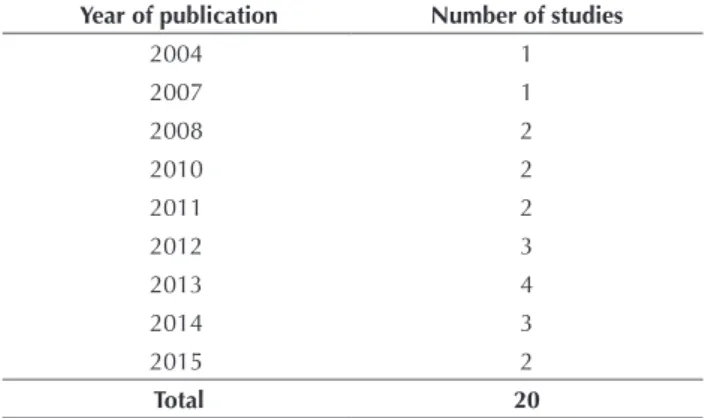
From the selected studies, sample characterization ac-cording to the year of publication with the corresponding quantitative studies is presented in Table 1.
Table 1 – Sample distribution by year of publication – Maceió, AL, Brazil, 2015.
Year of publication Number of studies
2004 1 2007 1 2008 2 2010 2 2011 2 2012 3 2013 4 2014 3 2015 2 Total 20 nursing AND suicide Lilacs/SciELO Lilacs/SciELO Bdenf Pubmed Medline Lilacs/SciELO Lilacs/SciELO Bdenf Pubmed Medline Lilacs/SciELO Lilacs/SciELO Bdenf Pubmed Medline nursing AND depression nursing AND suicide AND depression
64 articles 18 articles included afterreading the title 7 articles included afterreading the abstract 1 article included after full reading
1 article included after full reading
1 article included after full reading
2 articles included after full reading
11 articles included after full reading
6 articles included after full reading
3 articles included after full reading
4 articles included after full reading
2 articles included after full reading 0 article included
after full reading
0 article included after full reading 1 article included
after full reading 5 articles included after
reading the abstract
28 articles included after reading the abstract
18 articles included after reading the abstract
10 articles included after reading the abstract
48 articles included after reading the abstract
6 articles included after reading the abstract 0 article included after
reading the abstract
0 article included after reading the abstract 1 article included after
reading the abstract 1 article included after
reading the abstract
1 article included after reading the abstract 7 articles included after
reading the title
74 articles included after reading the title
253 articles included after reading the title
36 articles included after reading the title
36 articles included after reading the title
51 articles included after reading the title
315 articles included after reading the title
7 articles included after reading the title
27 articles included after reading the title
242 articles included after reading the title 0 article included after
reading the title 24 articles 1073 articles 1527 articles 358 articles 152 articles 3391 articles 5486 articles 8 articles 23 articles 345 articles 1393 articles
Depression and suicide risk among Nursing professionals: an integrative review
Table 1 shows the studies that comprise this integra-tive review in ascending order of year, country, title, and an outline of study type, sample and outcomes. As a result,
we found: nine cross-sectional studies; seven quantitative studies; two literature revisions; one critical review; one qualitative study.
Chart 1 –Summary of studies and their outcomes – Maceió, AL, Brazil, 2015.
Year Country Title Study design/Sample Factors
2004 Brazil Stress and psychosomatic repercussions in nursing workers from a university hospital(13).
Quantitative study, 300 nursing professionals.
Conlicting relations in personal and family responsibilities; Overload; dificulty with
suffering; death; lack of autonomy, and recognition; depression.
2007 Brazil Aspects associated to work-related
depression on nursing staff(14). Literature review, 10 articles.
Graveyard shifts; interpersonal relationship; service overload; lack of autonomy; insecurity;
conlict of interest and family income.
2008 Brazil
Cognitive and emotional effects of occupational stress in nursing professionals(15).
Quantitative study, 66
nursing professionals. Conditions and work organization.
2008 Turkey
Effects of Perceived Job Insecurity on Perceived Anxiety and Depression in Nurses(16).
Cross-sectional study,
462 nurses. Life events, job insecurity.
2010 Spain Síndrome de Burnout y riesgo suicida en enfermeras de atención primaria(17).
Cross-sectional study, 146 nursing professionals.
Burnout Syndrome, risk of suicide, depersonalization, low personal accomplishment.
2010 Brazil
Evaluation of Quality of Life and Depression in Nursing Technicians and Nursing Assistants(5).
Cross-sectional study, 266 nursing professionals.
Health problems and overnight shifts.
2011 Brazil Anxiety and Depression among Nursing Professionals who work in Surgical Units(9).
Cross-sectional study, 211 nursing professionals.
Higher educational level, young adult, female, multiple jobs.
2011 Brazil
Depression prevalence in Intensive Care Unit nursing workers: a study at hospitals in a northwestern city of São Paulo State(10).
Cross-sectional study, 67 nursing professionals.
Graveyard/overnight shifts, double shifts and marital status.
2012 Brazil Depressive symptoms and suicidal ideation in nurses and physicians care hospital(1). Quantitative study, 100 doctors and nurses. Work climate, ambiguous roles and the lack of clarity in relation to the tasks and expectations.
2012 Taiwan
Stress, depression, and intention to leave among nurses in different medical units: Implications for healthcare management/ nursing practice(18).
Cross-sectional study,
314 nurses. Marital status and complexity of care.
2012 USA Symptoms of Posttraumatic Stress Disorder
Among Pediatric Acute Care Nurses(19). Quantitative study, 173 nurses.
Higher rates of nightmares, severe anxiety, shortness of breath, severe pain, anxiety, depression and Burnout Syndrome.
2013 KoreaSouth
Perceived Stress and self-esteem Mediate the Effects of Work-related Stress on Depression(20).
Quantitative study, 284
nurses. High levels of stress, decreased self-esteem.
2013 Brazil
Illness and the use of psychoactive drugs among nursing workers at intensive care units(6).
Quantitative study, 49
nursing professionals. Lack of recognition, excessive workload and graveyard shifts.
2013 Brazil Depression, anxiety and social support in
nursing professionals(21). Quantitative study, 400 nursing professionals. Limitations and every day challenges.
2013 Brazil Mental illness of workers in intensive care units(22).
Qualitative study, eight nursing professionals.
Lack of recognition and support at work, overload, graveyard shift, interpersonal relationship at work, clash of ethical values, lack
of autonomy and dificulty in dealing with death.
2014 Taiwan The Relationships Among Work Stress, Resourcefulness, and Depression Level in Psychiatric Nurses(23).
Cross-sectional study, 154 psychiatric nurses.
Marital status, complexity of care, insecurity in developing activities and high levels of stress.
2014 Canada Critical Review on Suicide Among Nurses(24).
Critical review, nine
articles. High levels of stress and anxiety.
2014 Spain Marco actual del suicidio e ideas suicidas
en personal sanitario(25). Literature review, 20 articles. Work problems, marital status, family life, gender, age, alcohol and other drugs, stress.
2015 Australia
The mental health of nurses in acute teaching hospital settings: a cross-sectional survey(26).
Cross-sectional study,
1,215 nurses. Graveyard shift and alcohol consumption.
2015 Brazil
Symptoms of depression and intervening factors among nurses of emergency hospital services(27).
Cross-sectional study, 23 nurses.
Interpersonal conlict in the workplace, low pay,
DISCUSSION
By identifying the studies that referred to the factors which contribute to the onset of depression and risk of suicide among nursing professionals, it became evident in this integrative review that most (10 - 50%) were published between the years 2012 and 2014, and the country with the largest amount of publication was Brazil with 11 (55%), followed by Spain with two (10%), Taiwan with two (10%), and Australia, Canada, South Korea, the United States and Turkey with one (5%) each. his suggests that researchers in Brazil have begun to show interest in understanding the implications of these two phenomena in the work context of nursing professionals.
Nursing is a profession that is susceptible to mental disorders, because nurses deal with life, pain and death of people under their care on a daily basis, and also the family’s expectations(1,5,10,13,16,18,21,28). Depression is one of
the illnesses that most afects these professionals, causing damage to their work capacity and personal lives(1,5-6,10,13-14).
Because the state of depression is a predictor for increased risk of suicide(17,22), nursing professionals exhibit higher risk
for suicide(5).
Table 2 summarizes the content in alphabetical order that has emerged from the analysis of the data found about the factors that contribute to Depression and inluence Suicide Risk.
Table 2 – Content that has arisen.
Depression Suicide Risk
Work environment
Family conlicts
Interpersonal conlict in the workplace
Marital status Stress
Lack of professional autonomy Insecurity in developing activities
Young adults Higher educational level
Graveyard/Night shifts Family Income Work overload
Depression Burnout Syndrome
Low personal fulilment
Factorscontributingtodepression
Workenvironment
he daily exposure of nurses to external physical and mental stimuli related to the complexity of the work, the absence of ideal conditions taking precautions when dealing with people with serious illnesses and the risk of death leads them to develop depression more easily(5,17,20,23). Unhealthy
working environments with poor conditions, coupled with the presence of internal conlicts and the pressure of the in-stitution and patients’ families maximize these professionals’ risk for depression and suicide(5,10,17,25,27).
FamilyconFlicts
Factors involving relationships were also identiied as inluential for symptoms of depression, particularly those associated with imbalances in the family lives of nursing
professionals(1). It has also been conirmed that family loss,
absence of family and marital support increase the odds for suicide risk(2,10).
It is worth mentioning that the operating mode of nurs-ing professionals diminishes family contact, and the lack of this contact can lead to depression(10). Tiredness and
over-work compromise the dialogue of these professionals within the family(29), as well as conlicts between having to meet the
demands of nursing and reconciling with family responsi-bilities contribute to relationship wear(13), along with having
night and weekend shifts often taking the place of quality time spent with family(10).
A study revealed that nursing professionals exhibit high-er depression than medical professionals/doctors, and that a person with depression afects their social life and family(6).
Although there are still no studies linking family conlicts in nursing and risk for suicide, a study(30) conirmed that
fam-ily and marital conlicts are the third cause that appears on psychological autopsies of elderly who committed suicide.
interpersonalconFlictsintheWorkplace
Interpersonal conlicts in the workplace are common and appeared as factors that lead to depression(22). Nurses
have mentioned the precariousness of interpersonal relation-ships, since health work is inluenced and controlled by the relationships between people, which requires cohesion and collaborative participation(27,29). Due to the relational aspects
of nursing work, they can cause irritability, generate conlicts and interpersonal diiculties with the other team members, but also with managers, users and extend to their families(15,31).
One of the measures to improve interpersonal relation-ships in the nursing work environment is access to relational technologies(29). hese can be promoted through dialogue,
listening, bonding and acceptance, with the view that they raise the understanding of sufering, valuing experience and attention to the needs of the diferent people involved in the work process(32).
maritalstatus
Marital status and the position held by nursing pro-fessionals appeared as signiicant for the development of depression and stress(18). his profession is made up mostly
of women, and married women who deal with the work-ing world in their daily lives, meet the demands of their children, their partner and their house, which increases the development of a stress framework that can culminate with depression(1,18). Nurses working in medical clinics,
espe-cially those who are married, are susceptible to developing depression and quitting their job(18), on top of damaging
marital relations or delaying marriage.
stress
One study(23) revealed stress as a predictor of
Depression and suicide risk among Nursing professionals: an integrative review
correlate with high levels of depression, for example nurses who work in psychiatric nursing, intensive care units and operating rooms(6,9,23).
Work conditions have transformed the stress into some-thing familiar and often normal, with implications on the health of nursing professionals, highlighting the need for the use of internal and external strategies to minimize stress through coping strategies to control, tolerate and reduce the efects of adverse stimuli(20,29,31,33-34).
lackoFproFessionalautonomy
Another contributing factor to mental illness concerns the lack of professional nursing autonomy(5). he necessity
to abide by the standards established by the hospital makes the nurse decrease the autonomy of the nursing team, since the control and power of the sector is not within their responsibility, thus afecting their activities and causing mental illnesses(13). A study found that nurses restrict the
autonomy of their subordinates because of the role they need to perform(13).
insecurityindevelopingactivities
A study showed that depression in nurses was also as-sociated with insecurity in developing their work activities, which are characterized by high expectation standards, es-pecially when they are highly complex or involve the pos-sibility of patient death(14,22).
At times, psychological distress has contributed to cop-ing with professional demands through the desire to escape from responsibilities with passivity and pessimism, common in depression(14).
youngadults
A study(9) showed that depression afects younger
groups of nursing professionals on a larger scale than those at an older age. he vulnerability of the irst group could be linked to lack of experience in dealing with everyday situations in the workplace. his led to infer that maturity (cognitive, emotional and physical) generates security in the professional for resolving problems and facing adversities.
highereducationallevel
Nurses with higher education levels, such as a special-ization, a master’s or doctoral degree, are more afected by depression(9), even though nurses are encouraged to expand
their training constantly and acquiring new titular status will enable a salary increase and professional growth. hese result in more requirements for job performance and con-sequently the acquisition of new responsibilities, generating overload and more chance for mental illness(10).
graveyard/nightshiFts
Working the night shift brings damage and risk to worker’s health because it is exhausting and tiring(10,26),
which can worsen when the environment has critical work-ing conditions, such as in the Intensive Care Unit, increas-ing the efects on the mental health of these workers(10).
Night shifts, speciically, represent a risk factor for devel-oping major depression(1). A study(5) demonstrated that
night shift workers have higher depression scores. Another study(6) stated that the night shift had the highest quantity
of nursing professionals with psychiatric illness and that the more frequent and prolonged the night work was in the life of the nursing professional, the more labor compromise would be displayed.
Family income
Depression can also occur more frequently in nursing professionals with low family income. he lower the pay, the higher the prevalence of depression(6,14). he
associa-tion between family income and the increase in the level of depression was also observed in nursing students(14). In
contrast, another study(10) showed that the more the income
increases, the more the number of employment relation-ships increases, which can be exhausting, causing impacts on the mental health of these workers. However, a study(9)
showed high depression rates in professionals who have only one job, which may be related to low-income.
Workoverload
Work overload is considered a contributing factor to increased emotional and physical stress, which can trigger several illnesses(6,10,13). It also leads to mental illness and
is considered a triggering factor of depression(1,9,27).
Stud-ies(6,10,19) revealed that work overload produced physical and
psychological wear and tear on the nursing staf in the ICU, and among the main triggering factors found were night-mares, depression, severe anxiety and panic, thereby leading to Burnout Syndrome. Another study stated that overload and low wages generate excessive work hours and physical and emotional exhaustion among nurses(27).
Studies(14,22,27) also point out that work overload arises
from a lack of professionals, especially on holidays; co-workers who do not complete all tasks and cause exces-sive burden for the following shift; conlicts of scale/shifts, resulting in dissatisfaction and the intention to abandon employment; and larger amounts of hospitalized patients.
It is worth noting that the work environment, fam-ily and interpersonal conlicts in the workplace, as well as marital status, lack of professional autonomy, insecurity in developing activities, age, higher education level, night shift, family income and work overload appeared as factors with signiicant inluence for changes in mental health causing depression disorders.
Factorscontributingtosuiciderisk
Studies(1,17,22,24-25,29-30,35-38) revealed that nurses have a
high risk for suicide. Records indicate that in some coun-tries, the risk of suicide among nurses is higher than in the general population; for example, in Denmark, Australia, and New Zealand, while Norway has a higher prevalence of suicide among nurses than other health professionals(25).
depression
he risk of suicide was positively and signiicantly cor-related with depression(17,25). Studies(1,25) showed that the
prevalence of depression symptoms is more pronounced among nursing professionals. Using the known diagnos-tic reconstruction technique (psychological autopsy), it was noted that psychiatric disorder is one of the biggest risk factors for suicide, and suicidal behavior is quite common among most groups of people with psychiatric diagnoses, and major depression disorder is most prevalent among sui-cide victims(1,30,35-36).
loWpersonalFulFilment
Studies(1,17) revealed that there is a correlation between
risk of suicide and self-fulillment. he less nurses succeed in the exercise of their profession, the more they appear to have negative responses to themselves and their work; symptoms such as low self-esteem, irritability, decreased interest in sexual activity, lack of appetite, interpersonal re-lationship avoidance with colleagues, self-punitive feelings, low productivity, lack of interest in work and depression are very likely to increase the risk of suicide(1,17,35-36). In contrast,
there was a signiicant negative correlation between risk for suicide with high self-esteem and personal fulillment(17).
Burnout syndrome
Another predictor for the risk of suicide is emotional exhaustion, which is characterized by loss of energy, wear, exhaustion and fatigue; an emotional state closely related to components of depression, consistent with the principle component of Burnout implicated by suicide(17,25,29). Among
the many common symptoms of this illness, harmful acts or suicide appeared as one of the most alarming(22). In the case
of nurses, in general, only one study(17) showed relatively low
levels of Burnout and suicide risk among these profession-als compared to other studies. However, it should be noted that in the same study there was a high level of emotional exhaustion, high depersonalization, and low personal fulil-ment, features that may lead to Burnout Syndrome symp-toms and consequently risk of suicide(17).
Also, factors such as a lack of knowledge and motivation for career development are related to Burnout Syndrome(29).
Professionals expect recognition from those who are close to them in their daily practice, but it does not always hap-pen, possibly leading to feelings of incompetence, failure, despair, helplessness and suicidal tendencies(22,25).
his research revealed that the risk of suicide among nurses is associated with the presence of factors such as de-pression, low self-accomplishment and Burnout Syndrome. Other studies(37-38) report that it is diicult to prevent
sui-cide, given the complexity of discovering the imminent risk of suicidal behavior; however, they may contribute to its prevention and risk evaluation, for the identiication of risk factors through the use of strategies which include: restric-tion on highly lethal means, use of tracking methods and identiication of those at risk, suicide risk management, ed-ucation of the general population, coverage by responsible
media, diagnosis and efective treatments, continuing edu-cation of health teams for intervening in a multimodal and interdisciplinary manner(38).
CONCLUSION
his integrative review showed that studies on depres-sion and suicide risk among nursing profesdepres-sionals have been published mostly between the years 2012 and 2014, with signiicant production in Brazil.
Risk factors for depression among nursing professionals concerning work, human relationships and personal charac-teristics, and the risk of suicide associated with the presence of mental disorders and the professional environment have been identiied. It has been found that depression of these professionals is inluenced by factors such as the work envi-ronment, family and interpersonal conlicts among workers, marital status, stress, lack of professional autonomy, inse-curity in developing activities, age, educational level, night shifts, family income, and work overload. his study also demonstrated that depression, Burnout Syndrome and low personal accomplishment contribute to suicide risk in this category of professionals.
herefore, it was identiied that nursing professionals who perform activities in unhealthy environments with conlicting interpersonal and/or family relationships and in the workplace, married, with high levels of stress, a lack of professional autonomy, with insecurity to develop their work activities, younger, better educated, working on night shifts, with low family income, several employment relationships and work overload are more vulnerable to developing de-pression. Also, there is a risk for suicide in those who already have symptoms of depression and high levels of emotional exhaustion, high depersonalization and low personal accom-plishment; characteristics of Burnout Syndrome.
It is worth mentioning that all the factors directly re-lated to depression may also be indirectly rere-lated to the risk of suicide, because depression is considered a predictor of it. All of these factors alone or combined can inluence the health care services provided.
It is important to consider health and quality of life of nursing professionals given that their professional practice occurs in complex realities, with the most diverse human relationships, having to routinely deal with diferent re-quirements, being faced with factors that can produce risk for depression and suicide, and that contribute to the illness and compromise the delivery of care.
Nursing professionals must be understood not only as a health worker, but they should also be seen as a person who may sufer harm to their own health. hus, the aim of this study was to draw attention to the seriousness of the risks involved, both in their work and in their personal lives for de-veloping mental disorders, which is often overlooked, even by the professionals themselves. Evidence reinforces the need to identify early risk factors for depression and suicide in work-ers in this occupational category, as well as elements so that nurses can recognize them and evaluate them in their team.
Depression and suicide risk among Nursing professionals: an integrative review
diagnosing and intervening on these factors and with this speciic audience in order to prevent progression to severe depression conditions, and subsequently to a high risk of suicide.
herefore, this study may have implications for the pre-vention, early detection, treatment and psychosocial reha-bilitation of nursing professionals, who face factors related to depression and risk for suicide in their daily work.
RESUMO
Objetivo: Discutir sobre os fatores associados à depressão maior e risco de suicídio entre proissionais de enfermagem. Método: Revisão integrativa em bases de dados PubMed/MEDLINE, LILACS, SciELOe BDENF, entre 2003 e 2015. Resultados: Selecionaram-se 20 artigos publicados, a maioria entre 2012 e 2014, com signiicativa produção no Brasil. Os proissionais de enfermagem são vulneráveis à depressão quando jovens, casados, realizam trabalho noturno e possuem vários empregos, e quando apresentam alto nível educacional, baixa renda familiar, sobrecarga de trabalho, estresse elevado, insuiciente autonomia e sentimento de insegurança proissional, conlitos no relacionamento familiar e no trabalho. Risco de suicídio foi correlacionado com a presença de sintomas de depressão, alto nível de exaustão emocional, despersonalização e baixa realização pessoal; características da Síndrome de Burnout. Conclusão: Risco de suicídio entre os proissionais de enfermagem está associado a sintomas depressivos e os correlacionados com a Síndrome de Burnout, prejudicando o desempenho proissional.
DESCRITORES
Enfermagem; Estresse Psicológico; Depressão; Suicídio; Revisão.
RESUMEN
Objetivo: Discutir sobre los factores asociados con la depresión mayor y el riesgo de suicidio entre profesionales de enfermería. Método: Revisión integradora en las bases de datos PubMed/MEDLINE, LILACS, SciELO y BDENF, entre el año 2003 y el 2015. Resultados: Se seleccionaron 20 artículos publicados, la mayoría entre el 2012 y el 2014, con signiicativa producción en Brasil. Los profesionales de enfermería son vulnerables a la depresión cuando jóvenes, casados, realizan trabajo nocturno y tienen varios empleos, y cuando presentan alto nivel educativo, bajos ingresos familiares, sobrecarga de trabajo, estrés elevado, insuiciente autonomía y sentimiento de inseguridad profesional, conlictos en la relación familiar y laboral. El riesgo de suicidio fue correlacionado con la presencia de síntomas de depresión, alto nivel de agotamiento emocional, despersonalización y baja realización personal; características del Síndrome de Burnout. Conclusión: El riesgo de suicidio entre los profesionales de enfermería está asociado con los síntomas depresivos y los correlacionados con el Síndrome de Burnout, perjudicando el desempeño profesional.
DESCRIPTORES
Enfermería; Estrés Psicológico; Depresión; Suicidio; Revisión.
REFERENCES
1. Barbosa KKS, Vieira KFL, Alves ERP, Virgínio NA. Sintomas depressivos e ideação suicida em enfermeiros e médicos da assistência hospitalar. RevEnferm UFSM [Internet]. 2012 [citado 2014 out. 14]; 2(3):515-522. Disponível em: http://cascavel.ufsm.br/revistas/ojs-2.2.2/ index.php/reufsm/article/view/5910
2. World Health Organization. Preventing suicide: a global imperative. Geneva: WHO: 2014
3. World Health Organization. Comprehensive mental health action plan 2013-2020. Geneva: WHO; 2013.
4. Heck RM, Kantorski LP, Borges AM, Lopes CV, Santos MC, Pinho LB. Ação dos proissionais de um centro de atenção psicossocial diante
de usuários com tentativa e risco de suicídio. Texto Contexto Enferm [Internet]. 2012 [citado 2014 out. 24]; 21(1):26-33. Disponível em: http://www.scielo.br/pdf/tce/v21n1/a03v21n1
5. Rios KA, Barbosa DA, Belasco AGS. Evaluation of quality of life and depression in nursing technicians and nursing assistants. Rev Latino Am Enfermagem [Internet]. 2010 [cited 2014 Oct 12];18(3):413-20. Available from: http://www.scielo.br/pdf/rlae/v18n3/17.pdf
6. Vieira TG, Beck CLC, Dissen CM, Camponogara S, Gobatto M, Coelho APF. Adoecimento e uso de medicamentos psicoativos entre trabalhadores de enfermagem de unidades de terapia intensiva. RevEnferm UFSM [Internet]. 2013 [citado 2014 out. 14];3(2):205-14. Disponível em: http://cascavel.ufsm.br/revistas/ojs-2.2.2/index.php/reufsm/article/view/7538
7. Bromet E, Andrade LH, Hwang I, Sampson NA, Alonso J, Girolamo G,et al. Cross-national epidemiology of DSM-IV major depressive episode. BMC Med [Internet]. 2011 [cited 2014 Oct 25];9:90. Available from: http://www.ncbi.nlm.nih.gov/pmc/articles/PMC3163615/
8. Organização Mundial de Saúde. Saúde pública ação para prevenção de suicídio. Genebra: OMS; 2012.
9. Schmidt DRC, Dantas RAS, Marziale MHP. Anxiety and depression among nursing professionals who work in surgical units. Rev Esc Enferm USP [Internet]. 2011 [cited 2014 Oct 12];45(2):487-93. Available from: http://www.scielo.br/pdf/reeusp/v45n2/en_v45n2a25.pdf
10. Vargas D, Dias APV. Depression prevalence in Intensive Care Unit nursing workers a study at hospitals in a northwestern city of São Paulo State. Rev Latino Am Enfermagem[Internet]. 2011[cited 2014 Oct 12]; 19(5):1114-21. Available from: http://www.scielo.br/pdf/ rlae/v19n5/08.pdf
11. Mendes KDS, Silveira RCCP, Galvão CM. Revisão integrativa: método de pesquisa para a incorporação de evidências na saúde e na enfermagem. Texto Contexto Enferm. 2008;17(4):758-64.
13. Belancieri MF, Bianco MHBC. Estresse e repercussões psicossomáticas em trabalhadores da área da enfermagem de um hospital universitário. Texto Contexto Enferm. 2004;13(1):124-31.
14. Manetti ML, Marziale MHP. Fatores associados à depressão relacionada ao trabalho de enfermagem. Estud Psicol (Natal) [Internet]. 2007 [citado em 2014 out 12];12(1):79-85. Disponível em: http://www.scielo.br/pdf/epsic/v12n1/a10v12n1.pdf
15. Paschoalini B, Oliveira MM, Frigério MC, Dias ALRP, Santos FH. Efeitos cognitivos e emocionais do estresse ocupacional em proissionais
de enfermagem. Acta Paul Enferm [Internet]. 2008 [citado 2014 out. 12];21(3):487-92. Disponível em: http://www.scielo.br/pdf/ape/ v21n3/pt_17.pdf
16. Boya FO, Demiral Y, Ergor A, Akvardar Y, De Witte H. Effects of perceived job insecurity on perceived anxiety and depression in nurses. Ind Health. 2008;46(6):613-9.
17. Tomás-Sábado J, Maynegre-Santaulària M, Pérez-Bartolomé M. Síndrome de burnout y riesgo suicida en enfermeras de atención primaria. EnfermClín. 2010;20(3):173-178.
18. Chiang YM, Chang Y. Stress, depression, and intention to leave among nurses in different medical units: Implications for healthcare management/nursing practice. Health Policy. 2012;108(2-3):149-57.
19. Czaja AS, Moss M, Mealer M. Symptoms of posttraumatic stress disorder among pediatric acute care nurses. J PediatrNurs. 2012;27(4):357-65.
20. Lee JS, Joo EJ, Choi KS. Perceived stress and self-esteem mediate the effects of work-related stress on depression. Stress Health. 2013;29(1):75-81.
21. Gomes RK, Oliveira VB. Depressão, ansiedade e suporte social em proissionais de enfermagem. Bol Psicol. 2013;63(138):23-33.
22. Monteiro JK, Oliveira ALL, Ribeiro CS, Grisa GH, Agostini N. Adoecimento psíquico de trabalhadores de Unidade de Terapia Intensiva. PsicolCiêncProf [Internet]. 2013 [citado 2014 out. 15];33(2). Disponível em: http://www.scielo.br/pdf/pcp/v33n2/v33n2a09.pdf
23. Wang SM, Lai CY, Chang YY, Huang CY, Zauszniewski JA, Yu CY. The relationships among work stress, resourcefulness, and depression level in psychiatric nurses. Arch PsychiatrNurs. 2015;29(1):64-70.
24. Alderson M, Parent-Rocheleau X, Mishara B. Critical review on suicide among nurses. Crisis. 2015 Feb 23. [Epub ahead of print]
25. Cano-Langreo M, Cicirello-Salas S, López-López A, Aguilar-Vela M. Marco actual del suicidio e ideas suicidas en personal sanitario. Med Segur Trab. 2015;60(234):198-218.
26. Perry L, Lamont S, Brunero S, Gallagher R, Dufield C. The mental health of nurses in acute teaching hospital settings: a cross-sectional
survey. BMC Nurs [Internet].2015 [cited 2015 Apr 13];14:15. Available from: http://www.ncbi.nlm.nih.gov/pmc/articles/PMC4405850/
27. Oliveira FP, Mazzaia MC, Marcolan JF. Symptoms of depression and intervening factors among nurses of emergency hospital services. Acta Paul Enferm [Internet].2015 [cited 2015 July 12];28(3):209-15. Available from: http://www.scielo.br/pdf/ape/v28n3/en_1982-0194-ape-28-03-0209.pdf
28. Ávila LI, Silveira RS, Lunardi VL, Machado GFF, Mancia JR, Silveira JT. Implicações da visibilidade da enfermagem no exercício proissional.
Rev Gaúcha Enferm [Internet]. 2013 [citado 2014 out. 25];34(3):102-19. Disponível em: http://seer.ufrgs.br/RevistaGauchadeEnfermagem/ article/view/37874
29. Oliveira JDS, Alchiere JC, Pessoa Júnior JM, Miranda FAN, Almeida MG. Nurses’ social representations of work-related stress in an emergency room.Rev Esc Enferm USP [Internet]. 2013 [cited 2015 Jan 30];47 (4):984-9. Available from: http://www.scielo.br/pdf/reeusp/ v47n4/en_0080-6234-reeusp-47-4-0984.pdf
30. Cavalcante FG, Minayo MCS. Autópsias psicológicas e psicossociais de idosos que morreram por suicídio no Brasil. Ciênc Saúde Coletiva. 2012;17(8):1943-54.
31. Urbanetto JS, Magalhães MC, Maciel VO, Sant’Anna VM, Gustavo AS, Poli-de-Figueiredo CE, et al. Work-related stress according to the demand-control model and minor psychic disorders in nursing workers. Rev Esc Enferm USP [Internet]. 2013 [cited 2015 Feb 02];47(5):1186-93. Available from: http://www.scielo.br/pdf/reeusp/v47n5/0080-6234-reeusp-47-05-1180.pd
32. Maynart WHC, Albuquerque MCDS, Brêda MZ, Jorge JS. Qualiied listening and embracement in psychosocial care. Acta Paul Enferm
[Internet]. 2014 [cited 2015 Feb 01];27(4):300-3. Available from: http://www.scielo.br/pdf/ape/v27n4/en_1982-0194-ape-027-004-0300.pdf
33. Umann J, Guido LA, Silva RM. Stress, coping and presenteeism in nurses assisting critical and potentially critical patients. RevEsc Enferm USP [Internet]. 2014 [cited 2015 Feb 02];48(5):891-8. Available from: http://www.scielo.br/pdf/reeusp/v48n5/pt_0080-6234-reeusp-48-05-891.pdf
34. Guido LA, Linch GFC, Pitthan LO, Umann J. Stress, coping and health conditions of hospital nurses. Rev Esc Enferm USP [Internet]. 2011 [cited 2013 Dec 05];45(6):1434-9. Available from: http://www.scielo.br/pdf/reeusp/v45n6/en_v45n6a22.pdf
35. Overholser JC, Braden A, Dieter L. Understanding suicide risk: identiication of high risk groups during high risk times. J Clin Psychol.
2012;68(3):349-361.
36. DeJong TM, Overholser JC, Stockmeier CA. Apples to oranges? A direct comparison between suicide attempters and suicide completers. J Affect Disord. 2010;124(1-2):90-7.
37. Bertolote JM, Mello-Santos C, Botega NJ. Detecção do risco de suicídio nos serviços de emergência psiquiátrica. RevBras Psiquiatr. 2010;32 Supl. 2:S87-S95.