Resumo
Um ambiente computacional mudará a natureza da atividade interacionista se contemplar as mudanças que estão ocorrendo nos métodos de comunicação, pois deve favorecer o trabalho cooperativo. Para de-senvolver ferramentas que viabilizem a construção do conhecimento por meio da interação é preciso conhecer os aspectos biopsicossociais e entender o potencial libertador dos processos comunicativos que se estabelecem quando os sujeitos interagem mediados pela tecnologia. Partindo de uma concep-ção sócio-histórica de interaconcep-ção social, procuramos preencher um espaço de pesquisa em relação à ação comunicativa e à significação das representações so-ciais sobre as tecnologias de comunicação e informa-ção. Analisamos a tríade comunicação, tecnologia e envelhecimento, objetos de natureza distinta que advêm quando se ponderam questões que envolvem pessoas idosas num contexto biopsicossocial. Bus-camos conhecer as representações simbólicas em relação às tecnologias e analisar os sentimentos desencadeados e o significado das experiências vividas com o uso desses dispositivos. Analisamos os processos de apropriação e significação das tec-nologias com um grupo de idosos matriculados em oficias de informática do município de Passo Fundo – RS. A pesquisa é um estudo transversal de cunho analítico e populacional. Para analisar os dados utilizamos análise de variância, teste qui-quadrado, análise fatorial e análise de conglomerado em um nível de significância de 5% (p ≤ 0,05). Os resultados revelam que os idosos participam das oficinas com a finalidade de maximizar os processos de convívio,
Adriano Pasqualotti
Doctor in Computer Science in Education. Master in Computer Science. Assistant Professor of the Institute of Exact Sciences and Geosciences - Department and Statistics - from the University of Passo Fundo (Brazil). Coordinator of the Human Ageing Graduate Studies Program at the University of Passo Fundo. Member of Research Group Vivencer/CNPq.
Address: Adriano Pasqualotti, University of Passo Fundo, Campus I, Post Box 611, Zip code 99001-970, Passo Fundo, RS, Brazil. E-mail: [email protected]
Dante Augusto Couto Barone
Postdoctoral researcher in Computation. Doctor in Informatics. Master in Electrical Engineering. Associate Professor of the In-formatics Institute - Department of Applied InIn-formatics - from Federal University of Rio Grande do Sul (Brazil).
E-mail: [email protected]
Johannes Doll
Doctor in Education. Master in Education. Associate Professor of the School of Education - Department of Teaching and Curriculum - Federal University of Rio Grande do Sul (Brazil).
E-mail: [email protected]
1 Funding Source: This study was developed in the Informatics Graduate Studies Program at the Federal University of Rio Grande do Sul (Brazil) and sponsored by Research Group Vivencer/CNPq from the University of Passo Fundo (Brazil).
Communication, Technology and Ageing:
elderly, senior citizen groups and interaction
process in the information age
1
Comunicação, Tecnologia e Envelhecimento: idosos,
resultado que ratifica a importância dos programas de educação permanentes oferecidos pelas univer-sidades abertas.
Palavras-chave: Aprendizagem de adultos; Projetos interdisciplinares; Comunicação mediada por com-putador; Ambientes interativos de aprendizagem; Navegação.
Abstract
A computational environment will only change the nature of interactionist activity if the changes that are occurring in methods of communication are looked at, as this should favor cooperative work. In order to develop tools that provide opportunity for building knowledge by means of interaction, it is necessary to be aware of biopsychosocial as-pects and understand the liberating potential of the communicative processes that are established when individuals interact while mediated throu-gh technology. Beginning with a sociohistorical conception of social interaction, we seek to fill a research space in terms of communicative action and the meaning of social representations regarding communication and information technologies. We analyze the triad of communication, technology and ageing, questions are examined that involve elderly people in a biopsychosocial context. We seek to identify symbolic representations in relation to the technologies and analyze the triggered feelings and the meanings of these experiences encountered with the use of these mechanisms. The processes of appropriation are analyzed along with the meaning of technologies with a group of elderly citizens from the city of Passo Fundo – RS, enrolled in informatics workshops. The research is made up of a cross sec-tional study descriptive nature and population. To analyze relations among the researched variables, applied analysis of variance, chi squared test, fac-torial analysis and conglomerate analysis. The data was analyzed on a significance level of 5% (p ≤ 0.05). The results indicate that the elderly participate in the workshops especially with the purpose of maxi-mizing the processes of coexistence.
Introduction
According to Rodrigues (2000, p. 29) “people ate not together because they do the same things together, but rather: they are together because they do diffe-rent things and, therefore, to live they depend on others, who do things they do not want or are no lon-ger able to do”. Thus, both life and history are each a “network” built within the group (Werneck, 1997). In relation to the elderly, these individuals would seek an idea of collectivity when joining senior citizen community groups, which is, according to Peixoto (1998, p. 76), a denomination created in France in the early 1960s, as a result of a policy that aimed to transform the image of the elderly. The term sug-gests active and independent ageing and represents the stage of the life cycle between retirement and old age. In the author’s opinion, “senior citizenship is turned into a new stage of life, in which idleness symbolizes the practice of new activities, under the label of dynamism”. For Costa (2007, p. 36-37), the “participation in social life, that is, the individual’s integration in the elderly community”, occurs throu-gh the possibilities offered by society itself. Among the alternatives offered to the elderly, Senior Citizen Groups (SCGs) are highlighted, as, according to the author, they are “important intervention alterna-tives aimed at the well-being of mature people”. In the dynamic of social movements, the SCGs are maintained as centers of demand for the exercise of active citizenship, as well as for the expression of feelings. Thus, according to Portella (2004, p. 24), the ageing process is very personal, as “what is happening with men and women is a discovery that participating in a SCG reduces problems common in this stage of life”.
Within this context, there is a multiplication of programs for health promotion and prevention for the elderly population, linked especially to public authorities, the Catholic Church and open univer-sities. The notion of public centers characterizes SCGs as places of emancipation and the promotion of active citizenship (Rocha et al., 2002). According to Sant’Anna (2000, p. 60), SCGs organized by governmental agencies and through private initia-tives follow a basic principle, through the cultural and leisure proposals on offer, of occupying time
in old age as a way of preventing diseases typical to this life cycle stage. In the mind of the author, “it is starting with this principle that everything is organized within these groups: outings, parties, course for updating knowledge, gymnastics, etc.” On the other hand, a group can be defined as a poli-tically organized community in which there exists a form of political sociability that allows for the establishment of real relationships (Arendt, 1958). Thus, if the groups become public centers for the construction of reality, one could theorize the birth of a social movement that may be able to alter the process of ageing that is outlined (Telles, 1990). To Scherer-Warren (1999, p. 15), the movement takes shape in the dimensions of contention, solidarity and intention, however, there is currently a greater emphasis on solidarity actions. In the author’s opinion, the notion of the social individual is funda-mental, as it aims at the establishment of the idea of the individual in the world, that is, “it speaks of the construction of individuals, as this is constituted in the social relationships that include autonomy or self-creativity and alterity”. Thus, according to Portella (2004, p. 23), in these groups, “solidarity results from the support found when faced with problems that, quite often, arise from ageing itself, though their causes, in the understanding of some authors, differ in terms of sex”. For Rocha et al. (2002, p. 1034), a greater presence in these centers of women has allowed for “a new condition of auto-nomy and respect within the home”. According to them, women “when attaining rights, on a private sphere, acquire passports to a broader practice, on a collective sphere”.
friendships to be created and managed. Carvalho et al. (1998, p. 115), in turn, states that “the acquisition of space for expressing potential and experiences is necessary, as human beings are sources of new discoveries when considering their roots”.
Materials and Methods
The research is made up of a cross sectional study with a quantitative and qualitative approach and descriptive nature. The processes of appropriation are analyzed along with the meaning of information and communication technologies (ICTs) with a group of elderly citizens from the city of Passo Fundo en-rolled in informatics workshops. In order to develop interventions suitable to the social and cultural cha-racteristics, one has to be aware of the social aspects of the elderly, as well as analyze which processes are established when this population group interacts through technology, that is, clarify the weight of these aspects in technological interactions. In rela-tion to the overall objective we evaluate the meaning of interaction in the information age. In terms of specific objectives, we seek to uncover the universe of imagetic-symbolic representations of the elderly in relation to ICTs, as well as analyze the meaning of lived experiences and the feelings triggered with the use of these technological devices.
The research was carried out with a group of se-nior citizens linked to the groups Centro Regional de Estudos e Atividades para a Terceira Idade - Creati (Regional Center of Studies and Activities for Senior Citizens) and Divisão de Atenção ao Idoso - Dati (Division of Attention to the Elderly) and enrolled in informatics workshops. For the definition of an el-derly person, we used chronological criteria defined at the World Assembly on Ageing, that is, individuals 60 years old or older (WHO, 1984; Paschoal, 2005). The informatics workshops were developed in the Central Informatics Laboratory (LCI) at the Univer-sidade de Passo Fundo - UPF (University of Passo Fundo). Of the five groups involved in informatics activities, four were from Creati and one from Dati. There was no population randomization, that is, all the people present on the day the instrument was applied participated in the research. Of the more than one hundred elderly enrolled in this workshop, 93 responded to the survey. However, only those
indi-viduals who turned 60 were considered for analysis. Thus, of the 93 subjects who answered the survey, only 49 attended to inclusion criteria.
Data was collected by applying the survey, developed with the objective of gathering informa-tion about the processes of communicainforma-tion and interaction, the use of ICTs and the communicative centers. Due to the density of the object of study, three guidelines were defined for the analysis of the communication and interaction problem: i) the meaning of ICTs; ii) initial experiences using ICTs; iii) perception of the feelings and relationships considering the use of ICTs.
The database was defined, constructed and mani-pulated through phpMyAdmin 2.10.3 DBMS - a tool written in PHP to control the management of MySQL data on the web. Parametric and non-parametric tests were employed to analyze relations of depen-dence, independence and interdependence among the researched variables. Among the varied tests applied, highlights include the analysis of variance, chi squared test of adherence, factorial analysis and conglomerate analysis. Data were analyzed on a significance level of 5% (p = 0.005). Data of a qualitative nature were systemized in different analysis categories. In order to reach the meaning of the statements, which would allow the inference of knowledge relative to the communicative processes, the content analysis proposed by Bardin (1977) was used. The study, in compliance with the guidelines of resolution 196/96 of the Ministry of Health’s Na-tional Board of Health, as well as directive 251/97, is in line with the guidelines in terms of consent, confidentiality and anonymity, benefits and intel-lectual property.
Results and Discussion
Figure 1 - Age position measurements
The age statistics with outliers presented M = 66.2 and DP = 4.2 (IC = [65.0; 67.4]); while without the outlying values this variable obtained M = 65.4 and DP = 3.0 (IC = [64.5; 66.3]). As these measures occur
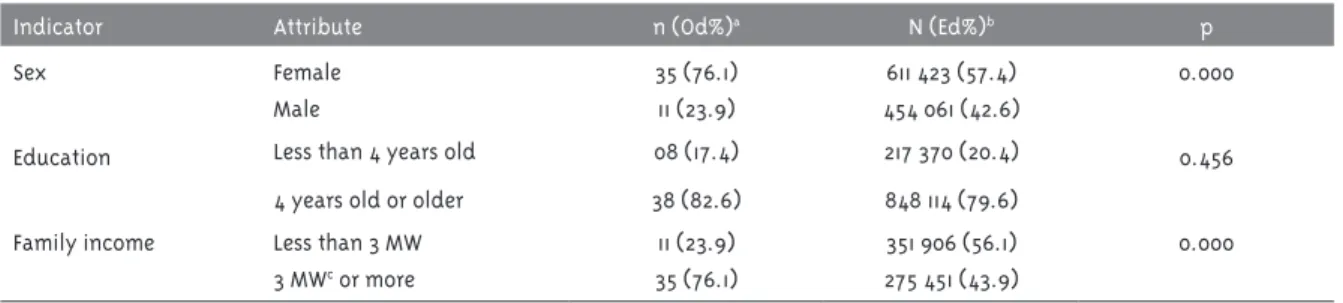
in the two intervals, there was no need to exclude other outliers. However, the Shapiro-Wilk normality test revealed that the age distribution (W = 0.964; p = 0.317) only remain normal if the extreme values are excluded. Thus, for us to use this statistic as a representative of the center of distribution and the standard deviation as measures of dispersion, the outliers were effectively excluded from the set. Thus, the size of the sample we took as a reference to analyze the other data remained with 46 observation units, with 32 elderly individuals associated with Creati and 14 with Dati. Table 1 presents a compari-son between demographic indicator statistics. These were used to characterize the research sample with the results found in the 2000 census in relation to people 60 years old or older head of the family, in urban and rural districts in Rio Grande do Sul (IBGE, 2003). The results show significant differences (p ≤ 0.05) for two indicators.
Table 1 - Demographic indicators of elderly people associated to the Creati and Dati groups.
Indicator Attribute n (Od%)a N (Ed%)b p
Sex Female 35 (76.1) 611 423 (57.4) 0.000
Male 11 (23.9) 454 061 (42.6)
Education Less than 4 years old 08 (17.4) 217 370 (20.4) 0.456
4 years old or older 38 (82.6) 848 114 (79.6)
Family income Less than 3 MW 11 (23.9) 351 906 (56.1) 0.000
3 MWc or more 35 (76.1) 275 451 (43.9)
a = Observed data; b = Expected data; c = Minimum wage.
One of the focuses of the research on the use of ICTs by elderly people looks at the process of active ageing, a fact tied, on the one hand, to the dynamic relationship between temporal changes of society and technological development and, on the other hand, human ageing itself. In the United States, in 2005, just 26% of the elderly used a computer and the Internet. The social-demographic data showed that this age group was composed of white people that lived in families and who had a monthly inco-me and an elevated education level compared to the populational average in general (Czaja and Lee, 2001). According to Czaja and Lee (2007, p. 342), “not having access to new technology or not being
able to use them in full, places elderly people at an increasingly greater disadvantage in terms of condi-tions for living in an independent manner”. We are able to verify whether ICTs are helping the elderly to improve life quality in two ways: firstly, the projected products and services must ensure that the abso-lute majority will be benefitted by this technology; secondly, the use potential for triggering the social interaction process must compensate the possible functional impairment, allowing the user to enjoy an independent life.
such as landline telephone, open TV and radio”. According to Czaja and Lee (2001, p. 114), “in the not too distant future, TV, the telephone and other me-ans of communication will become integrated with informatics [...] Those who do not interact through information technology will be at disadvantage”. Bronswijk et al. (2007, p. 130) point out that “the increase in computer processing capacity is incre-asingly linked to the significant reduction in size of components such as keyboards and the mouse, factors which may exclude users whose dexterity and/or vision are somewhat impaired”.
In relation to access to technological devices for communication and interaction process, all the elderly individuals stated that they have a TV and telephone; 98% have a radio; 78% have a computer. In relation to free time used to participate in some sort of leisure activity, 98% watch TV; 78% listen to the radio; 65% confirmed that they access the Internet; 57% use a computer as a pass time and 35% use one for writing or doing calculations. In terms of
the meaning of technology, all of them think it is a means of communication and acquiring knowledge; for 94% it is a way of participating in the world; for 92% it is a way of staying updated with others; on the other hand, for 98% it is something to learn, for 94% it is a challenge; for 88% it is a tool to be dominated; lastly, for 80% it is something different.
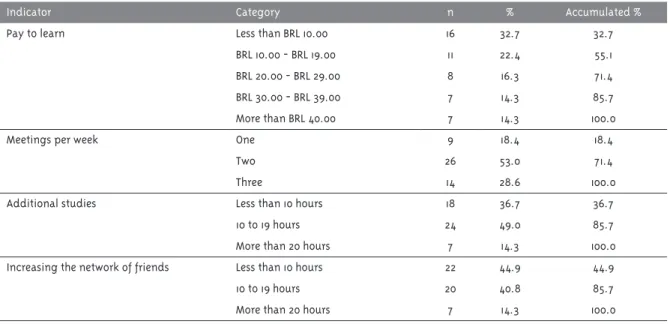
In relation to informatics workshops, Table 2 presents a series of indicators that outline the inte-rest of the group of elderly people in relation to their participation in these meetings. We evaluated how willing the individuals would be to pay a monthly fee to participate in the informatics workshops; we verified how many meetings they would like to have per week in order to learn about informatics; and lastly, we analyzed how many hours per week they would be willing to dedicate by themselves in order to consolidate the knowledge acquired during the in-formatics workshops, as well as in order to increase their network of friends, using a computer as a tool of interaction, information and communication.
Table 2 - The elderly evaluating participation in informatics workshops
Indicator Category n % Accumulated %
Pay to learn Less than BRL 10.00 16 32.7 32.7
BRL 10.00 - BRL 19.00 11 22.4 55.1
BRL 20.00 - BRL 29.00 8 16.3 71.4
BRL 30.00 - BRL 39.00 7 14.3 85.7
More than BRL 40.00 7 14.3 100.0
Meetings per week One 9 18.4 18.4
Two 26 53.0 71.4
Three 14 28.6 100.0
Additional studies Less than 10 hours 18 36.7 36.7
10 to 19 hours 24 49.0 85.7
More than 20 hours 7 14.3 100.0
Increasing the network of friends Less than 10 hours 22 44.9 44.9
10 to 19 hours 20 40.8 85.7
More than 20 hours 7 14.3 100.0
In relation to self-evaluation as a student in the informatics workshop, 78% are interested in carrying out additional studies related to informa-tics and 92% are satisfied with the performance achieved in attending the workshop; in terms of
attention and also how they express the content in language that allows adequate understanding. When evaluating aspects regarding the informatics workshop, we used an orientation matrix to gather indicators in reference to the academic aspects on which the elderly people emitted a value judgment and which, in their set, express the totality of the in-formatics workshop evaluation. In other words, the matrix was developed with indicators that charac-terize the activities worked on with the teachers, as well as describing the educational process of the me-etings. Threee constituting dimensions of indicator grouping are: proposed content, developed activity and process of interaction and communication.
Using Cronbach’s alfa (α) coefficient (Freitas et al., 2000; Pestana and Gageiro, 1998; Oliveira Neto and Riccio, 2001) we verified the congruency of the items that make up the tool that evaluated the activities developed by the teachers . Cronbach’s α before the transformation of the gross scores into standardized scores was equal to 0.835 (the standar-dized α coefficient was equal to 0.871); it thus serves as a consistency indicator of the tool, as this degree of covariance of the items among themselves can be considered acceptable (Pasquali, 2003). In order to verify the internal structure (validity of the cons-truct) of the tool, separate analyses were carried out for each of the questions. The intercorrelation ma-trixes recommend factorization, that is, it presented sufficient covariance to allow for factor searches. Furthermore, the Kaiser-Meyer-Olkin (KMO) coe-fficient, which indicates the said event, was 0.713, a value considered average to be used in the com-parison of the correlations between variables (Reis, 1997). Table 3 presents the correlation matrix of the dimensions, namely of the evaluation indicators of the activities developed in the informatics workshop after grouping. All dimensions presented significant positive correlation among themselves, however the largest indication occurred between dimensions 2 and 3 - developed activity and the process of interac-tion and communicainterac-tion. This shows that the elderly participate in these meetings with the purpose of learning strategies to maximize their processes of coexistence, dialogue and conversation with other people of the same age or another generation.
Table 3 - Correlation matrix of dimensions
Dimensions D1a D2b D3c
D1 1.000 0.611 0.594
D2 0.611 1.000 0.730
D3 0.594 0.730 1.000
a = Proposed content; b = Developed activity; c = Process of interaction and communication.
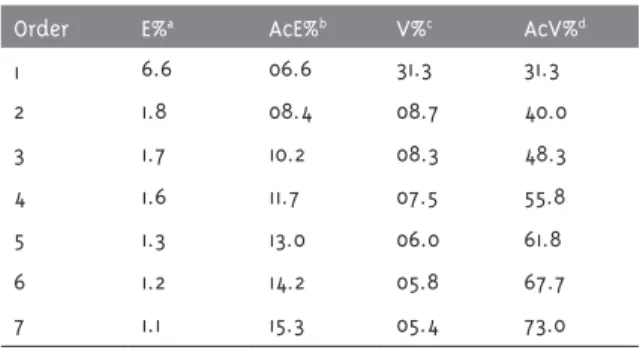
A behavior representation model cannot usually be generated using manifest variables, that is, me-asurement directly observed, however their effects can be measured by means of latent variables, non-measurable measurements calculated through manifest variables (Sellitto and Ribeiro, 2004). For this reason, we used factorial analysis to investigate dependence, independence and interdependence of the set of manifest variables (Reis, 1997; Johnson and Wichern, 1998). We found seven components to explain the original data set; this number of factors is enough, as they include more than 70% of the variance of the 21 variables analyzed. Table 4 presents results of the PCA, as well as Eigenvalues greater than one.
Table 4 - Result of an analysis of the principle com-ponents
Order E%a AcE%b V%c AcV%d
1 6.6 06.6 31.3 31.3
2 1.8 08.4 08.7 40.0
3 1.7 10.2 08.3 48.3
4 1.6 11.7 07.5 55.8
5 1.3 13.0 06.0 61.8
6 1.2 14.2 05.8 67.7
7 1.1 15.3 05.4 73.0
a = Eigenvalue; b = Accumulated eigenvalue; c = Variance; d = Accumulated variance.
example, text editing, as long as they consider the collective necessities of the group. They would like to have complete control of the machine so as to develop the proposed activity. The contents should consider active citizenship exercises, triggering feelings of appreciation and allow communication with family members. The second group shows that activities such as editing small films, computer games and the creation of works of art should be developed collaboratively. The challenges should be tied to the reality experienced by these individuals, that is, create opportunity for the socialization of experiences and allow the development of process of interaction, communication and conversation in real time. Furthermore, all the activities developed must be evaluated in relation to improvement (formative evaluation) and judgment (summative evaluation) of the process. Finally, the third group indicates that the elderly are not interested in electronic commerce or in developing activities in an individual manner. Furthermore, they indicated that learning should not be independent, that is, they do not need to be developed without the help of the teacher.
Figure 2 - Two-dimensional representation of factors in relation to original data
I01 = Collaboration; I02 = Individual; I03 = Experienced reality; I04 = Variety; I05 = Collective necessities; I06 = Exercise of active citizenship; I07 = Editing of small films; I08 = Independent learning; I09 = Evaluation; I10 = Interaction and communication; I11 = Editing of text; I12 = Control of the machine; I13 = Socialization of experiences; I14 = Computer games; I15 = Communication with family members; I16 = Meet friends; I17 = Real time conversation; I18 = Creation of works of art; I19 = Trigger feelings; I20 = Electronic commerce; I21 = Feelings of appreciation.
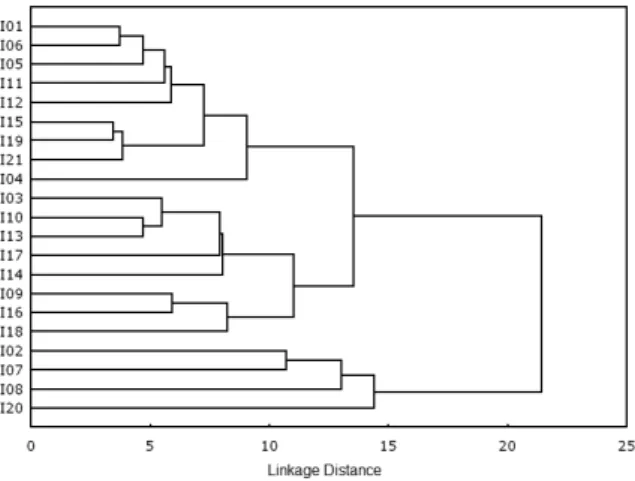
To classify the tendencies of meanings the elder-ly attribute to activities developed in the informatics workshop, we used the hierarchical conglomerate analysis (Malhotra, 1993). To generate the dendo-gram, we applied the agglomeration algorithm defined through the Ward method and for the deter-mination of distances we used the Euclidean method (Ward, 1963). Figure 3 presents the dendogram of evaluation indicators of activities developed in the informatics workshop. We noted the demarcation of three subgroups formed with indicators different to those we initially defined for the three dimensions, although very similar to those determined through factorial analysis.
Figure 3 - Evaluation indicators of activities developed in the workshop
Note: I01 = Collaboration; I02 = Individual; I03 = Experienced reality; I04 = Variety; I05 = Collective necessities; I06 = Exercise of active citizenship; I07 = Editing of small films; I08 = Independent learning; I09 = Evaluation; I10 = Interaction and communication; I11 = Editing of text; I12 = Control of the machine; I13 = Socialization of experiences; I14 = Computer games; I15 = Communication with family members; I16 = Meet friends; I17 = Real time conversation; I18 = Creation of works of art; I19 = Trigger feelings; I20 = Electronic commerce; I21 = Feelings of appreciation.
pre-fers these to reality. According to Turkle (1984, p. 19), “there is a risk of establishing a relationship with the computer that prevents opportunities for personal development. While for some children the computer intensifies personal development, for others it becomes a ‘quagmire’”.
Turkle states, however, that he does not consider it obtuse for an individual to want to dominate the technique of a computer game. When users interact with a program, they instruct themselves in relation to what the machine carries out, assimilating infor-mation surrounding the structures and strategies used by the application, as for example, to display a graph on the computer screen. In accordance with Peixoto and Clavairolle (2005, p. 83), “the sociali-zation of a technical object depends, in fact, both on the possibility of integration in the way of life of each person and their capacity to adopt it”. Ac-cording to Shelley et al. (2006, p. 38), “the Internet encourages the civic and political participation of elderly people, as it permits the development of both on-line and off-line communication, as well as reinforcing equal participation of these people in the community”. According to Turkle (1995, p. 261), “when we cross the screen to penetrate virtual communities, we reconstruct our identity from the other side of the mirror”.
The power of using ICTs associated with cybers-pace resides in the fact that these technologies are not only made up of means of carrying out tasks, but also a way of reflecting the personal concerns. According to Turkle, the use of technologies such as computers allows for the search for answers to questions regarding the nature of self, such as, for example, in relation to life and intentionality. In individual interaction with a computer, individuals tend to center themselves on identity characteristics that orbit around power and grasp; while in the so-cial mean provided by computerized networks, the ICTs serve as a stage for exploring social contexts. According to Lima (2005, p. 172), “a merely phenome-nological perspective of interaction [...] would only be satisfactory in the face of phenomena arising from the initial experiences of these interactions”. On the other hand, according to the author “a systemic perspective does not even permit us to satisfactorily grasp the new emerging subjectivities, which the
digital treatment of reality strengthens”. Lima fur-ther states that “digital interactions, starting with integration between culture and interface, allow [...] A deterritorialized expansion of oneself/oneselves and the reality in a network with others”.
According to Casalegno (1999, p. 122), to Turkle, what strengthens the cohesion between members of a community “is the supposition that people are there not to respond... The on-line community appropriates the quality of the so-called reaction in the face to face intimacy of the ‘real’ world”. To Morrell et al. (2004, p. 72), “the computer can be an instrument to establish and increase the social con-nections of elderly people, especially the Internet, as it is a source of information and an invaluable communication mechanism”. In turn, Carpenter and Buday (2007, p. 3020) confirm that “computer users interact in broader social networks and are usually more satisfied with their social circumstances”.
Conclusions
In terms of the evaluation of informatics workshops, data show that the elderly associated to SCGs would be willing to participate in more than one meeting per week and dedicate more hours in order to esta-blish the acquired knowledge on their own, as long as these workshops continue being offered by the university at no cost. In relation to self evaluation, data reveals that the elderly are satisfied with their participation in these meetings and that the educa-tional process adopted by the teacher is adequate. These results show that the objectives outlined by Creat and Dati in reference to digital inclusion are being achieved. Furthermore, in relation to the academic aspects, statistics indicate that the elderly participate in the workshops, especially with the purpose of maximizing the processes of coexistence, a result that ratifies the importance of the permanent education programs offered by open universities.
Acknowledgements
References
ARENDT, H. The human condition. Chicago: University of Chicago Press, 1958.
BARDIN, I. L’analyse de contenu. Paris: Universitaires de France, 1977.
BRONSWIJK, J. E. M. H.; KEARNS, W. D.; NORMIE, L. R. ICT infrastructures in the aging society. Gerontechnology, Eindhoven, v. 6, n. 3, p. 129-134, 2007.
CARPENTER, B. D.; BUDAY, S. Computer use among older adults in a naturally occurring retirement community. Computers in Human Behavior, Maryland Heights, v. 23, n. 6, p. 3012-3024, 2007.
CARSTENSEN, L. L. Motivação para contato social ao longo do curso de vida: uma teoria de seletividade socioemocional. In: NERI, A. L. (Eds.), Psicologia do envelhecimento: temas selecionados na perspectiva de curso de vida. Campinas: Papirus, 1995, p. 111-114.
CARVALHO, A. L. et al. O idoso e a cidadania. Sensu: Pós-Graduação em Revista, Caxias do Sul, v. 1, n. 1, p. 108-144, 1998.
CASALEGNO, F. Sherry Turkle: fronteiras do real e do virtual. Revista Famecos, Porto Alegre, v, 11, p. 117-123, 1999.
COSTA, R. C. A terceira idade hoje sob a ótica do serviço social. Canoas: Universidade Luterana do Brasil, 2007.
CZAJA, S. J.; LEE, C. C. The impact of the on older adults. In: N. Charness and K. W. Schaie (Eds.), Impact of technology on successful aging. New York: Springer, 2001, p. 113-133.
CZAJA, S. J.; LEE, C. C. The impact of aging on access to technology. Universal Access in the Information Society, Berlin, v. 5, n. 4, p. 341-349, 2007.
FREITAS, H. et al. O método de pesquisa Survey. Revista de Administração, São Paulo, v. 35, n. 3, p. 105-112, 2000.
IBGE. Instituto Brasileiro de Geografia e Estatística. Estatísticas do século XX. 2003. Available at: <http://www.ibge.gov.br/Estatisticas_ secxx/tabelas_selecionadas.xls>. Accessed at: 26 Sept. 2009.
JOHNSON, R. A.; WICHERN, D. W. Applied multivariate statistical analysis. New Jersey: Pretice Hall, 1998.
LIMA, G. As redes têm centros: uma estratégia para migração da cultura pré-digital para a simbiose de redes sociais integradas em centros de atividades sociológicas e informacionais. Liinc em Revista, Rio de Janeiro, v. 1, n. 2, p. 148-176, 2005.
MALHOTRA, N. K. Marketing research: an applied orientation. New Jersey: Prentice Hall, 1993. MORRELL, R. W.; MAYHORN, C. B.; ECHT, K. V. Why older adults use or do not use the internet. In: D. C. Burdick and S. Kwon (Eds.), Gerotechnology: research and practice in technology and aging. New York: Springer, 2004, p. 71-85.
MOTTA, E. M. Reflexos da aposentadoria sobre a questão social do idoso. Caderno da Terceira Idade, Rio de Janeiro, v. 7, p. 7-16, 1981.
OLIVEIRA NETO, J. D.; RICCIO, E. L. Desenvolvimento de um instrumento para mensurar a satisfação do usuário de sistemas de informações através do método survey. 2001. Available at: <www.tecsi.fea.usp.br/riccio/tac/pdf/ art-menssurvey.pdf>. Accessed at: 25 Aug. 2009. PASCHOAL, S. M. P. Epidemiologia do
envelhecimento. In: PAPALÉO NETTO, M. (Eds.), Gerontologia: avelhice e o envelhecimento em visão globalizada. São Paulo: Atheneu, 2005, p. 26-43.
PEIXOTO, C. E.; CLAVAIROLLE, F. Envelhecimento, políticas sociais e novas tecnologias. Rio de janeiro: Fundação Getúlio Vargas, 2005.
PESTANA, M. H.; GAGEIRO, J. N. Análise de dados para ciências sociais: a complementaridade do SPSS. Lisboa: Sílabo, 1998.
PORTELLA, M. R. Grupos de terceira idade: a construção da utopia do envelhecer saudável. Passo Fundo: Universidade de Passo Fundo, 2004. REIS, E. Estatística multivariada aplicada. Lisboa: Sílabo, 1997.
ROCHA, S. M.; GOMES, M. G. C. A.; LIMA FILHO, J. B. O protagonismo social da pessoa idosa: emancipação e subjetividade no envelhecimento. In: FREITAS, E. V. at al. (Eds.), Tratado de geriatria e gerontologia. Rio de Janeiro: Guanabara Koogan, 2002, p. 1030-1036.
RODRIGUES, A. T. Sociologia da educação,Rio de Janeiro: DP&A, 2000.
SANT’ANNA, M. R. O velho no espelho: um cidadão que envelheceu. Florianópolis: Universidade Federal de Santa Catarina, 2000.
SCHERER-WARREN, I. Cidadania sem fronteiras: ações coletivas na era da globalização. São Paulo: HUCITEC, 1999.
SELLITTO, M. A.; RIBEIRO, J. L. D. An approach for measurement of intangible values in production systems. Gestão & Produção, São Carlos, v. 11, n. 1, p. 75-90, 2004.
SELWYN, N. et al. Older adults’ use of information and communications technology in everyday life. Ageing & Society, New York, v. 23, n. 5, p. 561-582, 2003.
SHELLEY, M. C.; THRANE, L. E.; SHULMAN, S. W. Generational differences in information technology use and political involvement. International Journal of Electronic Government Research, Hershey, v. 2, n. 1, p. 36-53, 2006. TELLES, V. S. Espaço público e espaço privado na constituição do social: notas sobre o pensamento de Hannah Arendt. Tempo Social, São Paulo, v. 2, n. 1, p. 23-48, 1990.
TURKLE, S. The second self: computers and the human spirit. New York: Touchstone, 1984. TURKLE, S. Life on the screen: identity in the age of the internet. Michigan: Simon & Schuster, 1995. WARD, J. H. Hierarchical grouping to optimize an objective function. Journal of the American Statistical Association, Alexandria, v. 58, n. 301, p. 236-244, 1963.
WERNECK, C. Ninguém mais vai ser bonzinho na sociedade inclusiva. Rio de Janeiro: WVA, 1997. WHO. World Health Organization. The uses of epidemiology in the study of the elderly. Technical Report Series, 706. Geneva: WHO, 1984.
ZONABEND, F. Le club de loisirs du troisieme age: un rite de passage et une nouvelle forme d’echange entre generations. Dialogue, Paris, v. 104, n. 0, p. 94-103, 1989.