UNDERGRADUATE STUDENTS’ KNOWLEDGE
OF COPYRIGHT INFRINGEMENT
Adeyinka Tella (1), Francis Oyeyemi (2)
(1) Department of Library and Information Science, University of Ilorin, Nigeria. [email protected] (2) Graduate
Student, Department of Library and Information Science, University of Ilorin, Nigeria. [email protected]
Abstract
This study examined undergraduate students’ knowledge of copyright infringement at the University of Ilorin, Nigeria. A descriptive survey design was adopted. Three hundred and seventy-two (372) undergraduate students randomly selected from twelve universities constituted the sample for the study. Four research questions were developed and answered and data was collected through a self-designed questionnaire. The findings demonstrate that the majority of the respondents are aware of copyright infringement and have strong percep-tion that copyright infringement is a form of intellectual dis-honesty. In addition, the results indicate that downloading content from the internet without permission from the owner is the major way through which undergraduates mostly in-fringed on the copyright. The findings also show that high cost of textbook is a contributing factor that leads students to infringe on copyright law, followed by scarcity of materials, fear of scoring poor marks, lack of awareness and overarch-ing curricula while the desire to defy authority had the least
influence. The increasing awareness of copyright law and possible punishment for violating the law was rated as the most fundamental way of reducing copyright infringement. The only hypothesis tested in the study revealed a significant difference in the perception of undergraduate students on copyright infringement based on their academic level with (Chi Cal. = 740.85, df=16, chi table= 26.30 at 0.05 level of significant difference). Upon these findings, the study rec-ommends that author and publishers should try to reduce the cost of their textbooks. In addition, libraries in higher institu-tions should be well equipped with enough and relevant printed/literary resources. These should be readily available and accessible to the students when needed, in order to help reducing the rate of piracy and photocopying in higher insti-tutions.
Keywords: Copyright law, Copyright infringement, Viola-tion of law, Knowledge, Undergraduate students, University of Ilorin, Nigeria.
1 Introduction
Copyright is a type of intellectual property right that protects certain original works. Copyright laws work to provide authors with exclusive rights to their works. In other words, any unauthorized use could amount to copyright infringement. Copyright infringement is a federal, civil cause of action. It occurs when a copy-righted works is reproduced, distributed, performed, publicly displayed, or made into a derivative work without the permission of the copyright owner. In-fringement in this context includes piracy, plagiarism of text, using photocopying machines to produce sev-eral copies of copyrighted material, duplication of web pages, etc.
There is increasing concern on the copyright infringe-ment among undergraduate students in tertiary institu-tion. For instance, (Aboyade, Aboyade and Ajala, 2015; Williams, 2005) postulated that copyright in-fringement is not a new phenomenon in the academic environment. This issue of copyright infringement usu-ally affects the economy of the copyright owner. It is on this note that according to Moahi (2004) and Isiak-pona, 2012), an understanding of copyright is particu-larly important in an academic, schoparticu-larly and artistic
In order to reduce the violation of copyright law, a convention was setup as an international treaty and it was called the Berne Convention, which was first adopted in Bern (Berne), Switzerland, in 1886. This Copyright law protects the rights of authors and crea-tors and their creative works. In fact, one of the basic principles of copyright law is that it only protects the expression of ideas, not ideas themselves. Berne Con-vention makes it easy for an author to obtain copyright protection in many nations and allows authors to enjoy the full benefits of creative works for a limited period and the creators to enjoy economic value. In this con-vention, the issue of copyright infringement was seri-ously approached and the author was granted exclusive right, in which an author and other creative artists could authorize the use of their works in any way. When setting up this law, there is also a limitation that allows what is called “fair use” and “first sales doc-trine”. Under the doctrine of fair use, students or users may make short quotations for purposes of criticism, comment, news reporting, teaching, or scholarship, without first obtaining permission of the copyright owner of the quoted work. However, every quotation and contents that are not the idea of the author must be clearly identified with the source. The reason for this is that in the literature, authors like Aina (2004) have emphasized that it is unethical to lift the work of an-other person verbatim without permission and claiming ownership of the work. On the other hand, the first sale doctrine, codified at 17 U.S.C. § 109, provides that an individual who knowingly purchases a copy of a copy-righted work from the copyright holder receives the right to sell, display or otherwise dispose of that partic-ular copy, notwithstanding the interests of the copy-right owner.
In Nigeria, the Nigerian legislation on copyright in-fringement Act Cap 28 Laws of the Federation of Nige-ria, 2004, part I on copyright section 15 stipulates that: Copyright is infringed by any person who, without the license or authorization of the owner of the copyright, does or causes any other person to do an act, which is controlled by copyright; imports or causes to be im-ported into Nigeria any copy of a work which, if had been made in Nigeria, would be an infringing copy under this section of this Act; exhibits in public any article in respect of which copyright is infringed under paragraph (a) of this subsection; distributes by way of trade, offers for sale, hire or otherwise or for any pur-pose prejudicial to the owner of the copyright, any arti-cle in respect of which copyright is infringed under paragraph (a) of this subsection; makes or has in his possession, plates, master tapes, machines, equipment or contrivances used for the purpose of making in-fringed copies of the work; permits a public
entertain-ment or a business place to be used for a performance in the public work, where the performance constitutes an infringement of the copyright in the work, unless the person permitting the place to be so used was not aware and had no reasonable ground for suspecting that the performance would be an infringement of the copyright; performs or causes to be performed for the purposes of trade or business or as supporting facility to a trade or business, any work in which copyright subsists. Notwithstanding subsection (1) of this sec-tion, or any other provision of this Act, where any work in which copyright subsists or a reproduction of any such works is comprised inthe archives stored in the National Archives established under the Public Ar-chives Act; or the public records of a State, being rec-ords for the storage or custody of which provision is made by law, the copyright in the work is not infringed by making or supplying to any person, any reproduc-tion of the work in pursuance of that Act or law. Section 16 no 2 and 3, which is the action for fringement, stated that (2) Where an action for in-fringement of copyright brought by the copyright own-er or an exclusive licensee related to an infringement in respect of which they have concurrent rights of action, the copyright owner or the exclusive licensee may not, without the leave of court, proceed with the action un-less the other is either joined as a plaintiff or added as a defendant; and (3) Where in an action for infringement of copyright, it is proved or admitted that an ment was committed, but at the time of the infringe-ment, the defendant was not aware and had no reasona-ble grounds for suspecting that copyright subsisted in the work to which the action relates, the plaintiff shall not be entitled under this section to any damages against the defendant in respect of the infringement, but shall be entitled to an account of profits in respect of the infringement, whether or not any other relief is granted under this section.
2 Objectives and Research Questions
The broad objective of the study is to examine under-graduate students’ knowledge of copyright infringe-ment. The study examines specially the level of aware-ness on copyright infringement by undergraduate stu-dents; determines how undergraduate students per-ceived copyright infringement; examines the major ways in which copyright laws are being infringed by undergraduate students; finds out the major factors that lead to infringement of copyright and determines ways of reducing infringement of copyright law by under-graduate students. To achieve the objectives of this study, the following research questions were answered. 1. What is the extent of undergraduate students’ aware-ness of the copyright infringement?
2. What is the undergraduate students’ perception of the copyright infringement?
3. In what ways are copyright laws being infringed by undergraduate students?
4. What are the factors that lead to infringement of copyright law?
5. What are the various ways through which copyright law infringement can be reduced among undergraduate students?
The research assumed that as undergraduates proceed from one level, i.e. a year of study to the other, the knowledge of copyright infringement should be in-creasing. It is on this note that the only hypothesis on the study is formulated, i.e.: there is no significant dif-ference in the perception of undergraduate students in the University of Ilorin about copyright infringement based on their academic level.
3 Literature Review
Copyright can be defined as a set of exclusive rights granted by government for a limited time to protect the particular form, way or manner in which an idea or information is expressed. Copyright may subsist in a wide range of creative or artistic form or “works” in-cluding literary works, movies, musical works, sound recordings, paintings, photographs, software and indus-trial designs (Intellectual Property Office, 2011). In other words, copyright is essentially a private right by which the owners decide how to exploit the copyright work and how to enforce the copyright. The owners can decide if there will be any use of the copyright work falling within the scope of the economic rights. Okwilagwe (2001) pointed out that the concept of cop-yright was devised for two main purposes: to serve as a positive force for creative people to produce works of culture, and to provide incentives for the effective
dis-semination of these works. This author points out that copyright law protects the rights of authors and crea-tors and their creative ideas. From these perspectives, it is understood that creative ideas are under the absolute control of a creator or author. From another perspective (Fabunmi, 2007) emphasized that copyright can be described as a property that may be sold, assigned or licensed for use by any other person who has interest in such work. This simply means that the whole essence of copyright laws is to avoid intellectual theft by vari-ous information users. Ekpo (1992) asserted that copy-right allows authors to enjoy the full benefits of crea-tive works for a limited period. In Nigeria, the legal framework that protects created works is the protection decree of 1970 by the Nigerian Copyright Council for literary, dramatic, musical, and artistic works. This legal framework was amended by the Federal Govern-ment of Nigeria, when the Nigerian Copyright Com-mission was inaugurated in August 1989.
Eisenschitz (1993) observes that the easy access of information online has led to the growth of a large number of criminal activities, which have brought bar-riers to access and communicate in their wake. Okwilagwe (2001), while citing the Copyright Act, Chapter 68 laws of the Federal Government of Nigeria (1990), identified works that will have copyright pro-tection in section 1 of the act. They include literary works, musical works, artistic works, cinematography films, sound recordings and broadcast. The Copyright Act of 1976 only gives the copyright owners the exclu-sive rights to: reproduce or make copies of the work; prepare adaptations of the work such as preparing a translation of a book originally written in English or preparing a movie screenplay based on a novel; dis-tribute copies of the work to the public; perform the work in public; and display the work in public.
name of the copyright owner and the date of first pub-lication. This symbol (©) was established by the Uni-versal Copyright Convention in 1952 meaning that the work is copyright protected. For sound recordings, the symbol ℗ is used instead of the symbol ©. Under the 1909 act, publication of a work without a proper copy-right notice resulted in a complete loss of copycopy-right protection.
Copyright protects authors of original works of author-ship, including literary, dramatic, musical, artistic, and other intellectual works, regardless of whether the work is published or unpublished. The Copyright Act gives the copyright owner the right to: reproduce the work in copies; prepare derivative works based upon the work; distribute copies to the public by sale or oth-er transfoth-er of ownoth-ership, or by rental, lease, or lending; perform the work publicly; display the work publicly; perform the work publicly by means of a digital audio transmission in the case of sound recordings (United State Copyright Office, 2012).
In Nigeria, an organization known as the Nigeria Copy-right Council was established to oversee to the admin-istration of Copyright. The Council is responsible for the following:
1. All matters affecting copyright in Nigeria as pro-vided for in this Act
2. Monitor and supervise Nigeria’s position in relation to international convention and advise Government thereon
3. Advise and regulate conditions for the conclusion of bilateral and multilateral agreements between Nige-ria and any other country
4. Enlighten and inform the public on matters relating to copyright
5. Maintain an effective data bank on authors and their works
6. Responsible for such other matters as related to copyright in Nigeria as the Minister may, from time to time, direct Copyright Amendment Decree, 1999. By looking at the various instances of copyright in-fringement as reported by Bretag and Mahmud (2009), there is a clear thread to suggest that copyright in-fringement is committed with clear intent and there are those who are committed with no clear intent. Madray’s (2007) contention of accidental copyright infringement seems highly subjective. She claimed it as being the result of common misunderstanding about copyright infringement within the academic. She ar-gued that students unintentionally infringed on copy-right when they do not know how to paraphrase, sum-marize or quote correctly. Howard (1995 cited in
Suth-erland-Smith, 2008), on the other hand, maintains that the key difference in copyright infringement is in the intention. She warns, however, that discriminating be-tween unintentional and intentional infringement may not be clear. This fact prompted her to suggest investi-gation to find out if the copyright infringement was committed with a clear knowledge of the academic requirements or if it was a consequence of the students’ ignorance of academic conventions.
Nevertheless, another literature on copyright infringe-ment among the undergraduate students also grouped forms of infringement into four main categories (Wi-hoit, 1994; Brandt, 2002; Howard, 2002 mentioned in Parks, 2003, p.475). These categories are the follow-ing: stealing material from another source and pasting it off as their own, e.g. buying a paper from a research service, essay bank or term paper mill (either pre-written or specially pre-written; copying a whole paper from a source text without proper acknowledgement, submitting another student’s work, with or without that student’s knowledge by copying a computer disk), submitting a paper written by someone else (e.g. a peer or relative) and passing it off as their own; copying sections of material from one or more source texts, supplying proper documentation (including the full reference) but leaving out quotation marks, thus giving the impression that the material has been paraphrased rather than directly quoted, and paraphrasing material from one or more source texts without supplying ap-propriate documentation.
one required to make proper use of the copyrighted works of other parties, or to appropriately protect and diffuse one's own intellectual creations deriving from activity as a university student. Rodriguez, Greer, and Shipman (2014) discussed the importance of develop-ing copyright education for students as part of an over-all information literacy curriculum by describing the development of a relevant, active learning online course targeting students' competencies as both users of and creators of creative content.
Tang, Liang, Chen (2013) examined the copyright statements attached to electronic resources provided by college libraries to determine how often they are pre-sent, and analyzed the content of those statements for common themes. The data will tell us how well librar-ies are meeting their obligations in this realm. After that, it will explore common copyright-related prob-lems that arise when end users use digital library re-sources. A total of one hundred and fifteen libraries websites of universities sponsored by 211 Projects in the People’s Republic of China were examined. Partic-ular attention was paid to whether the libraries are meeting their obligation to educate users about their rights by including information about fair use and problematic copyright-infringement behaviors. There-fore, notices published on libraries websites about stu-dents’ behaviors towards copyright-infringement were documented, and three librarians in charge of the elec-tronic resources were interviewed regarding the most often student-users’ problematic behaviors towards copyright-infringement. Seventy-seven libraries (66%) out of one hundred and fifteen libraries surveyed have copyright statements, and most of them relates to li-censed electronic resources. There are, indeed, com-mon elements acom-mong statements. They can be grouped, roughly, into five common themes: purpose or basis of copyright statement, authorized users, fair use, copy-right-infringement behaviors, remedy measures and disclaimer. Only about seventeen percent of the state-ments explained the two terms “fair use” and “author-ized users” in detail. Some of these statements were frequently vague or misleading, about sixty-six percent of the respondents did not explain what is systematic downloading. From the seventy-seven libraries that provide statements, thirty-one libraries published no-tices about users’ behaviors towards copyright-infringement. Combined with the results from librarian interview, we found that end users’ problematic behav-iors included systematic downloading, distribution to unauthorized users, and other behaviors going beyond fair use. Librarians and libraries should take some measures to solve these problems. For example, copy-right statements on digitalized collections should be improved, the content of copyright statements needs to be more clear, precise and should avoid ambiguity,
copyright education should be delivered along with or embedded in the general library-use education or in-formation-literacy programs, and copyright librarians should be established to handle the library copyright issues.
D'Onofrio, Bowes, and Nieves (2013) investigated the ability of baccalaureate undergraduate teacher educa-tion candidates to understand copyright and fair use guidelines and how these guidelines apply to them. Teacher education candidates were instructed to use simulated examples of situations where teachers would need to know how to apply the guidelines. The Turning Point audience response system was used to collect evidence generated through interactive responses ses-sions during which teacher education candidates re-sponded to scenarios pertaining to copyright and fair use. The study found some statistically credible evi-dence that the candidates were more knowledgeable about video guidelines than the other areas.
Huan-Chueh, Chou, Ke, and Wang (2010) explored common copyright-related problems that arise when librarians promote the use of digital library resources; and investigated college students’ misconceptions of copyright laws that arise when the students use these resources. Four librarians in charge of the management of digital library resources were interviewed regarding student-users’ problematic behaviors towards copy-right-infringement that these librarians often encoun-tered when they promoted the use of digital library resources. In addition, a semi-structured questionnaire with nine questions about copyright-related behaviors was developed and distributed to college students. Stu-dents needed not only to identify whether the behavior was acceptable, but also to explain the reasons for their identification. A total of 109 valid sets of data were collected from 18 universities or colleges. The sets comprised responses from 48 undergraduates, 56 post-graduates, and 5 doctoral students. The librarian inter-view results indicate that students’ problematic behav-iors included systematic downloading, distribution to unauthorized users, and other behaviors going beyond the purpose and character of academic use. The student survey results indicate that students had four major areas of misunderstanding about copyright laws when using digital library resources: the digital resources should be shared; the downloaded digital resources are all legitimately authorized and permitted; all educa-tional use is fair use; and any downloading is permitted as long as students are paying tuition.
the copyright of the author. Batane (2010) found out in her study that out of 272 students that took part in her study, only 6.7% of them attributed lack of skills as a reason for plagiarism. Isiakpona (2012) carried a study on undergraduate students' perception of copyright infringement, a case study of the University of Ibadan, Oyo State, Nigeria. The study reported that the level of awareness of copyright laws by undergraduate students is considerably high (about 85%) but the knowledge on the provisions of the copyright laws on the use of printed/literary materials is low. The study also re-vealed that the majority of undergraduate students in-fringe on copyright laws mostly through photocopying and the major reason given is high cost of purchasing. From extant literature, it is observed that limited stud-ies are available especially on the knowledge and per-ception of copyright by the undergraduates particularly in the Nigeria university context. In the light of this, study such as the one herein is needed nearly in all the Nigerian universities in order to further educate Nigeria undergraduates on the issue of copyright law and its infringement.
4 Methodology – Research design
The research design used in this study is a survey that sought to examine the undergraduate students’ knowledge on copyright infringement among the un-dergraduate students in University of Ilorin. According to Orodho (2003), study concerned with obtaining in-formation by interviewing or administering a question-naire to a sample of respondents is a descriptive sur-vey. The survey design was considered appropriate in this study as it allows the use of questionnaire as a data collection instrument.
4.1 Population of the Study
The target population of the study consists of under-graduate students of University of Ilorin. According to the 2012/2013 annual report of the university, the total number of undergraduate students stands at 22,624. This number cuts across the entire twelve (12) faculties that made up the university. These are as follows: 1. Faculty of Agriculture
2. Faculty of Arts
3. Faculty of Basic Medical Sciences 4. Faculty of Business and Social Sciences 5. Faculty of Clinical Sciences
6. Faculty of Communication and Information Sciences 7. Faculty of Education
8. Faculty of Engineering
9. Faculty of Law
10. Faculty of Pharmaceutical Sciences 11. Faculty of Sciences
12. Faculty of Veterinary Medicine. 4.2 Sample and Sampling Technique
The Stratified Random Sampling Technique was adopted in carrying out this study. This sampling tech-nique was adopted because the population is divided into homogeneous groups known as strata. Each stra-tum is represented by a faculty in the university, bring-ing it to a total of 12 strata. Samples are drawn from each stratum by using the purposive sampling tech-nique. This sampling technique was used to select thir-ty-one (31) respondents from each of the twelve facul-ties in the university making a total of three hundred and seventy-two (372) respondents, which represent the sample for the study.
4.3 Data Collection Instruments
The questionnaire was administered to the respondents by the researcher in their various faculties during a core course. This was performed when the students were in session because that was the only time they could be easily reached and at the same time get the assistance of colleagues in the different faculty of the university. To ensure maximum response, the respondents, after seeking for their informed consent, were asked to fill and return the questionnaire immediately. A total of three hundred and seventy-two (372) copies of ques-tionnaires were administered (i.e. 31 copies per faculty) out of which three hundred and sixty-two (362) copies representing (97%) were returned.
4.5 Data Analysis and Results
Data collected from the field was analyzed using de-scriptive statistics comprising of simple percentage and frequency count. The data was coded using SPSS Ver-sion 16.0. The results obtained are presented as fol-lows:
4.6 Results
Demographics Frequency Percentage %
Gender
Male 183 50.6
Female 179 49.4
Total 362 100
Age
15-20 132 36.5
21-25 197 54.4
26-30 33 9.1
31-35 - -
Total 362 100
Level/year of
study
100/First year 94 26.0
200/Second year 96 26.5
300/third year 71 19.6
400/fourth year 101 27.9
500/fifth year - -
Total 362 100
Faculties
Agric. Science 30 8.3
Arts 31 8.6
Basic Medical Science
31 8.6
Business & Social Science
31 8.6
Clinical Sciences 31 8.6
Communication & Information Sciences
31 8.6
Education 31 8.6
Engineering 31 8.6
Law 31 8.6
Pharmaceutical Sciences
25 6.9
Science 31 8.6
Veterinary Medi-cine
28 7.7
Total 362 100.0 Table 1. Demographic Information of Students
The table above shows that 183 respondents (50.6%) are male while 179 (49.4%) are female. This simply means more male participated in the study than female. On the age distribution of the respondents, the results indicate 197 (54.4%) respondents fall between 21- 25 years old. This is followed by 132 respondents (36.5%) 15-20 years old. Next to this, there are 33 respondents (9.1%) 26-30 years old while respondents in the age group 31-35 amounted to (0%) which shows partici-pants from this age group were not represented in the study. The results in the table above also reveal that respondents in 400 levels (year four) were the majority with 101 (27.9%). This is followed by respondents in 200 level (year two) with 96 (26.5%). Next to this, there are the respondents in 100 level (year one) with 94(26.0%) while respondents in 300 level (year three) were 71 (19.6%), and the respondents in 500 level (year five) were not represented in the study. Further-more, the results also show that the highest number of respondents was from the faculty of Art, Basic Medical Science, Business and Social Sciences, Clinical Sci-ences, Communication and Information SciSci-ences, Edu-cation, Engineering, Law and Sciences with 31(8.3%) each. Next to these, there is the faculty of Agricultural Science with 30 (8.3%). A total of 28 respondents rep-resenting (7.7%) were from faculty of Veterinary Med-icine while faculty of Pharmaceutical Sciences has the lowest percentage with 25 respondents (6.9%).
Copyright law Awareness Frequency Percent
Yes 333 92.0
No 29 8.0
Total 362 100.0
Copyright Infringement
Awareness
Yes 288 79.6
No 74 20.4
Total 362 100.0
Extent of Awareness of Cop-yright infringement
Copyright law Awareness Frequency Percent
Yes 333 92.0
No 29 8.0
Some extent 171 47.2
Little extent 74 20.4
No extent 65 18.0
Total 362 100.0
Table 2. Undergraduates’ level of awareness of copyright infringement
Table 2 reveals that out of the 362 undergraduate stu-dents that were sampled, 333 (92.0%) were aware of the existence of copyright law while 29 (8.0%) were unaware of it. This shows that the majority of the un-dergraduate students are aware of copyright laws. The result also shows that 288 (79.6%) were aware of the existence of copyright infringement while 74 (20.4%) were not. This simply means that the majority of the undergraduate students are aware that undergraduates do infringe copyright law. The result also reveals the extent of undergraduates’ awareness of copyright in-fringement. The result shows that 171 (47.2%) of the undergraduate students are aware to some extent while 74 (20.4%) stated that they are aware with little extent, while 65 (18.0%) of the respondents stated that they are aware of copyright infringement to no extent. How-ever, 52 (14.4%) of the respondents stated that they are aware of copyright infringement to a great extent. This simply means that the majority of the undergraduate students in the University of Ilorin are aware of copy-right infringement to some extent.
Table 3 (Appendix) confirms that out of 362 respond-ents, 312 (86.2%) agree that copyright infringement is a form of intellectual dishonesty, 36 (9.9%) were unde-cided while 14 (3.8%) disagree that copyright in-fringement is a form of intellectual dishonesty. A total of 118 respondents (32.6%) agree that using copyright-ed material for academic purpose does not necopyright-ed author acknowledgment, 67 (18.5%) of the respondents were undecided while 177 (48.9%) of the respondents disa-gree. This simply means that the majority of the re-spondent have positive perception about copyright in-fringement except that their perception of using the copyrighted materials for academic purpose without the need to acknowledge the author is considered as rationalization. Furthermore, the results reveal that 197 (54.4%) of the respondents agree that paraphrasing of text does not mean they infringe on copyright law, 83 (22.9%) were undecided while 80 (22.7%) disagree. This suggests that majority of the respondents agree that paraphrasing of text does not mean infringement of copyright law.
The result also confirms that 55 (15.2%) of the re-spondents agree that submitting another person’s as-signment as their own does not mean infringement on copyright law, 42 (11.6%) of the respondents were undecided while 265 (73.2%) of the respondents disa-gree. This simply means that the majority of the re-spondents disagree that submitting another person’s assignment as their own does not mean that they have infringed on the copyright law. It was also revealed that 89 (24.6%) of the respondents agree that not doing academic referencing does not mean that they have infringed on the copyright law, 44 (12.2%) of the re-spondents were undecided while 229 (63.3%) of the respondents disagree thereby indicating that not providing reference list on academic work does not mean that they have infringed on the copyright law.
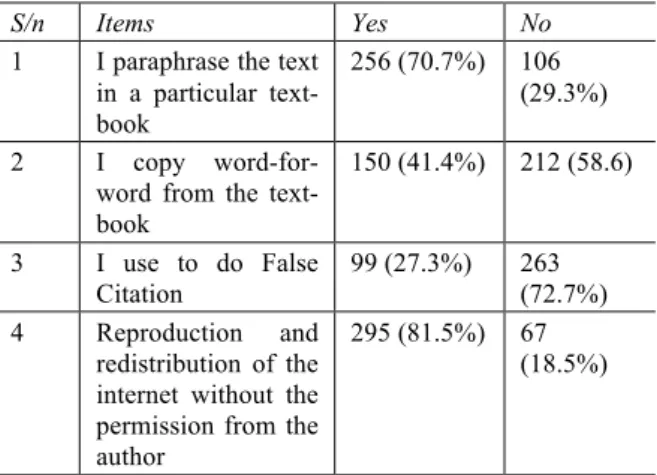
S/n Items Yes No
1 I paraphrase the text in a particular text-book
256 (70.7%) 106 (29.3%)
2 I copy word-for-word from the text-book
150 (41.4%) 212 (58.6)
3 I use to do False Citation
99 (27.3%) 263 (72.7%) 4 Reproduction and
redistribution of the internet without the permission from the author
295 (81.5%) 67 (18.5%)
Table 4. Ways by which undergraduate students infringed on copyright law
The results in table 4 show that out of 362 respondents 256 (70.7%) of them paraphrase the text in a textbook while 106 (29.3%) of them do not. On the other hand, the result also shows that 150 respondents (41.4%) usually copy word for word from the textbook while 212 (58.6%) of them do not. It was also shown that 99 respondents (27.3%) engaged in false citations while 263 (72.7%) of the respondent stated that they do not do false citation. In addition, 295 respondents (81.5%) indicated they usually reproduce and redistribute the internet without the permission from the author while 67 (18.5%) stated that they do received permission before they download from the internet. The results here imply that major ways by which undergraduate students infringed on copyright law are through down-loading from the internet and paraphrasing of text in the textbook.
CDs) to cassette for playing in the car or at parties, to medium and large-scale commercial piracy and serious organized crime. Other examples highlighted are Copy-ing purchased content for personal private use e.g. copying a cassette to make up a car or party tape or copying a purchased audio book CD to an iPod, down-loading for private use, downdown-loading copies of works already purchased in another format, downloading cop-ies of works not purchased, uploading / making availa-ble; unwitting uploading e.g. while downloading with BitTorrent, Knowingly uploading in quantity e.g. P2P and making available in quantity with no revenue e.g. via a free website with advertising, etc.
The results in table 5 (Appendix) reveal the various factors that lead the undergraduate students to copyright infringement. It shows that out of 362 respondents 315 (87%) agree that high cost of textbooks make them infringe on copyright laws; (6.9%) were undecided while 22 (6.1%) disagree. The result also shows that 214 (59.1%) of the respondents agree that overcrowded curricula lead them to infringe on copyright law; 68 (18.8%) were undecided with the statement while 80 (22.1%) disagree. A total of 226 (62.5%) respondents agree that lack of awareness leads them to infringe on copyright; 32 (8.8%) of the respondents were undecided while 104 (28.7%) of the respondents disagree. A total of 281 respondents (77.6%) agree that fear of getting poor marks lead them to infringed on copyright law; 26 (7.2%) were undecided with the statement while 55 respondents (15.2%) disagree. Furthermore, the results also indicate that 306 (84.5%) of the respondent agree that scarcity of reading materials lead them to infringed on copyright law; 17 (4.7%) of the respondents were undecided with the statement while 39 (10.8%) totally disagree. In summary, the major factors that lead the undergraduate students to infringe on copyright law as reflected from the results above are high cost of books, scarcity of information materials, fear of getting poor marks, lack of awareness, and overcrowded curricula. Table 6 (Appendix) shows that out of the 362 respond-ents 362 (100%) agree that studrespond-ents should be aware of copyright law; 187 (51.7%) agree that students that involved in copyright infringement should be fined. Respondents totaling 116 (32%) disagree that students involved in the copyright infringement should be fined. From the table, it is also clear that 349 (96.4%) agreed that there should be reduction in the price of textbooks. The result also shows that 233 (64.3%) of the respond-ents agree that school should reduce the overcrowded curricula. The results here imply that the majority of the respondents agree that students should be aware of copyright law, and that there should be reduction in the price of textbooks and a reduction in the overcrowded
curricula and besides, students involved in copyright infringement should be fined.
5. Testing of Hypothesis
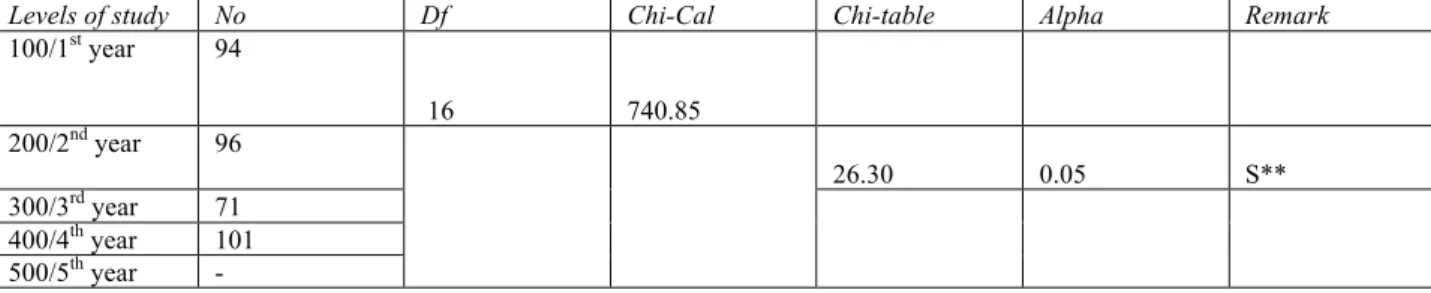
The results in Table 7 (Appendix) reveal that the chi-calculated, which is 740.87, is greater than the chi-table value, which is 26.30 at 16 degree of freedom and 0.05 alpha. This means that the hypothesis which states that “there is no significant difference in the perception of University of Ilorin undergraduate students about copy-right infringement based on their academic level” is rejected (S**), thereby concluding that there is a signif-icant difference in the perception of University of Ilorin undergraduate students on copyright infringement based on academic level.
6. Discussion of Findings
The main objective of the study was to examine the undergraduate students’ knowledge about copyright infringement among the undergraduate students in the University of Ilorin, Nigeria. The specific objectives are to examine the level of awareness on copyright infringement by the undergraduate students, determine undergraduate students perception about copyright in-fringement, examine ways in which copyright law are being infringed by the undergraduate students, find out factors that lead to infringement of copyright law and determine ways of reducing copyright infringement law.
The first findings in the study show the level of awareness of the undergraduate students about copyright law and copyright infringement. It indicates that students are aware of both copyright law and copyright infringement to some extent. This is supported by Isiakpona (2012) who report-ed that out of 200 respondents in his study, (85.0%) were aware of the existence of copyright law while (15.0%) were unaware of it. The majority of undergraduates’ awareness of copyright law and infringement in this study to some extent is therefore not unexpected. This study demonstrates a strong perception of undergraduates that copyright infringement is a form of intellectual dishonesty. This is in agreement with Palmquist (2003) who reported that copyright infringement is “a form of intellectual dis-honesty which involves unintentionally using someone else’s work without properly acknowledging where the ideas come from (this is the most common form of copy-right infringement) or intentionally copying someone else’s work and passing it as one’s own” (p.134).
wake. Zhu, (2002) agrees that "there are several possi-ble legal mechanisms for conventional database protec-tion, such as trade secrets, contract law, and copyright. However, on the Internet, the public can have free ac-cess to many databases, eliminating the possibility of trade secret protection. Although some database own-ers have managed to negotiate licensing agreements with their users, it is costly and sometimes impossible to enforce those contracts. However, Isiakpona (2012) contradicts this finding pointing out that the majority of undergraduate students engages in photocopying mate-rials without permission; and he considers it a copy-right infringement act.
This study summarised factors that lead undergraduate students to infringe on copyright law. High cost of textbooks was indicated as the major factor. This is supported by Isiakpona (2012), who reported the major reason for infringement by undergraduates in his study as due to the high cost of purchasing. It was also ob-served that the majority of undergraduate students in-fringe on copyright law as a result of the non-availability of printed learning resources. This finding is in consonance with the study carried out by Ogun-rombi and Bello (1999), which revealed that the major-ity of undergraduate students infringe on copyright because of scarcity of these printed resources. Ogun-ronbi and Bello (1999) have shown that only 5% of students in higher institutions can afford to purchase textbooks necessary for learning and researching. They end up engaging in the act of photocopying without permission, thereby infringing on the copyright of the author.
On ways of reducing copyright infringement among undergraduates, the results reveal that respondents should increase awareness of copyright laws among undergraduates. Onatola and Dina (2005/2006), who reported that librarians need to recognize that most users of copyrighted materials are not aware of their dependence on balanced law and policy for accessing information and gaining knowledge, support this. Stu-dents need to be more aware and have a better under-standing of the copyright laws and “fair use”. White (1993), Rosnow and Rosnow (1995) report that stu-dents’ lack of awareness and understanding about what constitutes plagiarism is said to be one main contrib-uting factor for students to commit plagiarism. Find-ings by (Carroll, 2003; Park, 2003; McCabe, 2005), which states that students are not aware that copying and lifting information from the internet and other sources are considered as cheating, as “students are ignorant of the plagiarism concept, or negligent in their writing, and that they plagiarize without intent to de-ceive”, lend a good credence to the finding in this study. Similarly, this finding is supported by
Suther-land-Smith. (2008) who reported a Malaysian universi-ty study where students committed plagiarism because they do not understand what plagiarism is and they do not realize that it is wrong. However, Yeo’s (2007) data from a case study on 190 first-year science and engineering students at Curtin University of Technolo-gy, Australia, suggests that students do have an under-standing of the concept of plagiarism and it contradicts this report. Other ways of reducing copyright according to respondents is that there should be reduction in the price of textbooks, in overcrowded curricula and the students involved in copyright infringement should be fined. These are all good solutions, which, if properly implemented, can reduce copyright infringement among undergraduates.
The only educational guess in the study, which stated that “there is no significant difference in the perception of University of Ilorin undergraduate students based on their academic level or year of study”, was rejected, thereby indicating that there is a significant difference in the perception of university of Ilorin undergraduate students based on their academic level/year of study”. This is not unexpected because as students grow aca-demically or transit from one level of study to the oth-er, their understanding of copyright law is assumed to be increased. Therefore, the likelihood that this under-standing will reduce infringement on copyright as stu-dents transit from one level to the next higher level might be the reason for the significant difference in the perception of their copyright law and infringement.
7. Conclusion
This study reported high cost of textbooks as the major factor that leads students to infringe on the copyright law, followed by scarcity of book materials. On this note, authors and publishers are recommended to try to reduce the price of their textbooks. In addition, librar-ies in higher institutions should be well equipped with enough and relevant printed/literary resources that will be readily available and accessible to the students when needed. This will help to reduce the rate of piracy and photocopying in higher institutions.
It is essential that copyright law is enforced for the benefit of both creator and user. The owner of copy-righted works has the right to prevent their works from being copied or sold. However, many users of infor-mation resources in Nigeria cannot do without copying or reproducing, because of problems of poverty, which characterized most developing countries. Nigeria Li-brary Association (NLA) in conjunction with Nigeria Copyright Commission (NCC) should come together in order to ensure proper implementation and enforcement of decree No 47 1988 Act revised in 2004 that deals with the issue of copyright law and infringement. Results also demonstrated some level of awareness about copyright laws, which thereby lead some stu-dents to infringe on copyright law. It is recommended that libraries, librarians and lecturers should help in-crease the level of awareness of copyright laws among students by organizing orientation programs/user edu-cation to raise students’ awareness of copyright laws and motivate compliance. Education on copyright laws could also be included in the curriculum; this will make students more aware of the consequences of infringing on these laws.
Notes
(1) Despite covering a large number of respondents, this study has some shortcomings. These include limited number of students. This study was conducted when stu-dents were receiving lecture and getting prepared for the examination. This led to reluctance in filling the ques-tionnaire, resulting in limited number of respondents. Moreover, the study was limited only to the undergradu-ate students at the University of Ilorin, Nigeria. The time constraints and tight schedule of the researcher deprived them the opportunity of extending the study to other uni-versities in the state.
References
Aboyade, W.A. Aboyade, M.A. & Ajala, B.A. (2015). Copyright infringement and photocopy services among University students and teachers in Nigeria. International Journal of Arts & Sciences, 8:1 (2015) 463-473.
Aina, L.O. (2004). Library and information science text for Africa. Ibadan: Third World Information Services Limited, 2004.
Batane, T. (2010). Turning to Turnitin to Fight Plagiarism among University Students. // Educational Technology & Society 13: 2, (2010) 1–12.
Brandt, D.S. (2002). Copyright not so little cousin plagiarize? // Computers in Libraries 22: 5 (2002) 39-42.
Bretag, T.; Mahmud, S. (2009). Self-plagiarism or appropriate tex-tual re-use. Journal of Academic Ethics 7: (2009) 193-205. Carroll, J.(2003). Six things I did not know four years ago about
dealing with plagiarism. // Paper Presented at the Asian-Pacific Educational integrity Conference: Plagiarism and other Perplexi-ties. University of South Australia, Adelaide, November, 2003. 21 -22.
Clifford, I.B.; Oghenenyerhovwome, O.F. (2014). A violation of copyright law through photocopying in tertiary institution in Delta State: Case study of Delta State University Abraka. // Journal of Education and Practice 5: 3 (2014) 17-25.
D'Onofrio, A., Bowes, K.; Nieves, A. (2013). Student Understanding of Copyright and “Fair-Use” Guidelines and How They Apply Them: A Study of 94 Pre-service Teacher Education Candidates. // R. McBride & M. Searson (Eds.) Proceedings of Society for Information Technology & Teacher Education International Conference 2013 Chesapeake, VA: Association for the Advan-cement of Computing in Education (AACE), 2013. (5027-5033). https://www.learntechlib.org/p/48929 (2017-01-25)
Eisenschitz, S.T. (1993). Information transfer policy: issues of con-trol and access. London: Library Association Publishing. 1993. Ekpo, M.F. (1992). Copyright perspective in Nigeri. // Okwilagwe,
O.A. (Ed.) Nigerian perspective on copyright. IbadanL Stirling-Horden Publishers. 1992.
Fabunmi, B.A. (2007). The Roles of Librarians in Copyright Protec-tion in Nigeria. // InternaProtec-tional Journal of African & African American Studies 4:1 (2007) 85 -93.
Howard, R.M. (2002). Do police plagiarize- just teach. // Education Digest 67:5 (2002) 46-50.
Howard, R.M. (1995). Plagiarisms, authorship and academic death penalty. College English 57:7 (1995) 788-806.
Huan-Chueh W, Chou, C, Ke, H. & Wang, M.H. (2010). College students’ misunderstandings about copyright laws for digital li-brary resources. // The Electronic Lili-brary 28:2 (2010) 197-209. Intellectual Property Office (2011). Copyright: essential reading.
Intellectual Property office, UK Gov. Press, 2011
Isiakpona, C.D. (2011). Undergraduate students' perception of copy-right infringement a case study of the University of Ibadan, Oyo State, Nigeria. // Library Philosophy and Practice, 2011. http://www.webpages.uidaho.edu/~mbolin/isiakpona.htm (2013-08-26)
Madry, A. 2007. Developing students’ awareness of plagiarism: crisis and opportunities. // Library Philosophy and Practice, 2007. http://webpages.uidaho.edu/mbolin/madray.htm (2013-08-26)
McCabe, D.L. (2005). It takes a village: Academic dishonessty and educational opportunity. // Liberal Education 91: 3 (2005) 26-31. McInnis, J.; Devlin,M. (2002). Assessing learning in Australian Universities. University of Melbourne, Center for Study in Higher Education. 2002.
Muriel-Torrado, E.; Fernández-Molina, J. (2015). Creation and use of intellectual works in the academic environment: Students' knowledge about copyright and copyleft. // The Journal of Aca-demic Librarianship 41: (2015) 441–448.
Ogunrombi, S.A. and Bello, M.A. (1999). Photocopying and the Awareness of Copyright in Tertiary Institutions in Bauchi State, Nigeria. // African Journal of Library, Archival and Information Science, 1 (1999) 1-10.
Okwilagwe, A.O. (2001). Book publishing in Nigeria. Ibadan. Ster-ling Horden, 2001. 153-158
Omoba, O.R. 2009. Copyright Law: Influence on the Use of Informa-tion Resources in Nigeria. // Library Philosophy and Practice, http://www.webpages.uidaho.edu/~mbolin/omoba.htm (2013-08-12)
Onatola, A.; Dina, T. (2005/06). Nigerian libraries and protest of authors’ rights. Nigerian Libraries 39: 1 (2005) 49-64.
Orodho, A.J. (2003). Essentials of Educational and Social Science Research Methods. Nairobi: Mazola Publishers. 2003.
Palmquist, M. 2003. The Bedford researcher. http://www.bedfordresearcher.com/links/writing_resources.cfm? (2013-08-26)
Parck, C. (2003). In other peoples’ words: Plagiarism by university students: literature and lesson. // Assessment and Evaluation in Higher Education 28: 5 (2003) 472-498.
Rodriguez, J.E. Greer, K. & Shipman., B (2014). Copyright and You: Copyright instruction for college students in the digital age. // The Journal of Academic Librarianshi, 40 (2014) 486–491. Rosnow, R.L.& Rosnow, M. (1995). Writing papers in psychology.
Belmont, C.A: Wadsworth. 1995.
Smith, S.W. (2008). Plagiarism the internet and student learning: improving academic integrity. New York: Rutledge. 2008. Tang, Q., Liang, T. & Chen, X. (2013). A Survey of Copyright
Sta-tements on Electronic Resources of College Libraries: Whether They Can Play a Role in Avoiding Copyright-infringement Behaviours? // The 5th International Conference on Information Capital, Property and Ethics. Thsunumi University. 2013. United State Copyright Office. (2012). Copyright Basics, 2012.
http://www.copyright.gov/circs/circ01.pdf 2013. (2013-08-26)
US Copyright Office 2000. Copyright basics (circular): Espanola, Sept, 2000. http://www.copyright.gov/circs/circ1.html#wci/ (2013-08-26)
White, E.M. (1993). Too many campuses want to sweep student plagiarism under the rug. // Chronicle of Higher Education 39: 25 (1993) 44.
Wihoit, S. (1994). Helping students avoid plagiarism. // College Teaching 42: 4 (1994) 161-164.
Williams, J.B. (2005). Playgiarism: deterrence prevention and
detec-tion, 2005.
http://www.economicsnetwork.ac.uk/handbook/printable/playgia rism.pdf (2013-08-26).
Yeo, S. (2007). First year university science and engineering stu-dents’ understanding of plagiarism. // Higher Education Re-search and Development 26 (2007) 199-216.
Zhu, Hongwei (Harry); Madnick, Stuart; Siege, Michael. (2002). The interplay of web aggregation and regulations. Cambridge, Mas-sachusetts: MIT Sloan School of Management. 2002
Copyright: © 2017. Tella, Oyeyemi. This is an open-access article distributed under the terms of the Crea-tive Commons CC Attribution-ShareAlike (CC BY-SA), which permits use, distribution, and reproduction in any medium, under the identical terms, and provided the original author and source are credited.
Appendix
Table 03
S/n Items Sa A U D Sd
1 I see copyright in-fringement as a form of intellectual dishonesty
210 (58%) 102(28.2%) 36
(9.9%)
7 (1.9%)
7 (1.9%)
2 Since I’m using it for academic purpose I don’t need to
acknowledge any author 55 (15.2%)
63 (17.4%)
67 (18.5%)
98 (27.1%)
79 (21.8)
3 Paraphrasing of text does not mean that I’m infringing copyright law
54 (14.9%)
14 3(39.5%)
83 (22.9%)
52 (14.4%)
30 (8.3%)
4 Submitting another per-son’s assignment as my own, does not mean that I infringed on copyright
21 5.8%)
34 (9.4%)
42 (11.6%)
114 (31.5%)
151 (41.7%)
5 Not doing academic referencing does not mean that I have in-fringed on copyright law
30 (8.3%)
59 (16.3%)
44 (12.2%)
118 (32.6%)
111 (30.7%)
Table 3. Undergraduate students’ perception about copyright infringement
Note: Strongly Agree + Agree = Agree and Disagree + Strongly Agree = Disagree
Table 05
S/n Items Sa A U d sd
1 High cost of
books
224 (61.9%) 91 (25.1%) 25(6.9%) 10 (2.8%) 12 (3.3%)
2 Over full
cur-ricula
104 (28.7%) 110(30.4) 68(18.8%) 58 (16.0%) 22 (6.1%)
3 Lack of
aware-ness
98 (27.1%) 128(35.4%) 32(8.8%) 66(18.2%) 38 (10.5%)
4 Fear of poor
mark
130(35.9%) 151(41.7%) 26 (7.2%) 23(6.4%) 32 (8.8%)
5 Scarcity of
material
189(52.2%) 117(32.3%) 17(4.7%) 16 (4.4%) 23 (6.4%)
Table 5. Factors that lead undergraduate students to infringe on copyright
Appendix
Table 06
S/n Items Sa A U D Sd
1 Students should
be aware of copyright law
278 (76.8%) 84(23.2%) - -
-2 Students
in-volved in copy-right infringe-ment should be fine
93 (25.7%) 94 (26.0%) 59
(16.3%)
84 (23.2%)
32 (8.8%)
3 There should
be reduction in the price of textbook
218 (60.2%)
131 (36.2%)
6 (1.7%)
7 (1.9%)
-4 School should
reduce curricu-la
108 (29.8%)
125 (34.5%)
61 (16.9%)
47 (13.0%)
21 (5.8%)
Table 6. Ways of reducing copyright infringement
Note: Strongly Agree + Agree = Agree and Disagree + Strongly Agree = Disagree.
Table 07
Levels of study No Df Chi-Cal Chi-table Alpha Remark
100/1st year 94
16 740.85
200/2nd year 96
26.30 0.05 S**
300/3rd year 71 400/4th year 101 500/5th year
Appendix
QUESTIONNAIRE ON UNDERGRADUATE STUDENTS’ KNWOLEDGE OF COPYRIGHT INFRINGE-MENT
Dear respondent,
This questionnaire is intended to gather data for research on the undergraduate students’ knowledge about copyright infringement in University of Ilorin, Nigeria. The information provided in this questionnaire will be held confidential and used for research purpose only.
In the section A, B, C, D, and E you are required to tick the option as apply to you Section A
Bio-data of Respondents
Gender: (a) Male (b) Female
Age: 15-20 21-25 26-30 31-35
Level of study: 100 200 300 400 500
Faculty………
OBJECTIVE OF THE STUDY
Section B: Level of awareness among the undergraduate students i. Are you aware of copyright law? A) Yes B) No
ii. Are you aware of copyright Infringement? A) Yes B) No
iii. To what extent do you aware of it? a) Great extent b) Some extent c) Little extent d) No extent
Section C: Undergraduate Students Perception of Copyright Infringement S/
N
ITEMS SA A U D SD
1 I see copyright infringement as a form of intellectual dishonesty 2 Since I’m using it for academic purpose I don’t need to
acknowledge any author
3 Paraphrasing of text does not means that I’m infringing copyright law
4 Submitting another person’s assignment as my own, did not means that I infringed on copyright
5 Not doing academic referencing does not means that I have in-fringe on copyright law
Respond to the items in the section C by ticking from the OPTIONS Strongly Agree=SA; Agree=A; Undecided=U; Disagree=D; and Strongly Disagree=SD
Section D: Ways in which Copyright Laws being infringed
Section E: Factors that lead undergraduate students to copyright infringement Please kindly tick the following factors as applicable to you
S/N ITEMS SA A U D SD
1 High cost of textbook
2 Over full curricular
S/N ITEMS YES NO
1 I paraphrased the text in a particular textbook 2 I copy word-for-word from the textbook 3 I used to do false citation
4 Reproduction and redistribution of the internet without the permission from the author
3 Lack of awareness of copyright law 4 Fear of poor mark
5 Scarcity of information materials in the library
6 Desire to defy authority
Section F: Ways of reducing Copyright Infringement Please tick the following options as applicable to you
S/N ITEMS SA A U D SD
1 Student should be more aware of copyright law
2 Students involved in copyright infringement should be fine
3 There should be reduction in the price of textbook 4 School authority should reduce curricula