\Ab Initio" Studies of Hydrogen-Enhanced
Oxygen Diusion in Silicon
R. B. Capaz
1, L. V. C. Assali
2, L. C. Kimerling
3, K. Cho
4, and J. D. Joannopoulos
5 1Instituto de Fsica, Universidade Federal do Rio de Janeiro, Caixa Postal 68528, Rio de Janeiro, RJ 21945-970, Brazil
2Instituto de Fsica, Universidade de S~ao Paulo,
Caixa Postal 66318, 05315-970, S~ao Paulo, SP, Brazil
3Department of Materials Science and Engineering,
Massachusetts Institute of Technology, Cambridge, Massachusetts 02139
4
Mechanical Engineering Department, Stanford University, Stanford, California 94305-3030
5
Department of Physics, Massachusetts Institute of Technology, Cambridge, Massachusetts 02139
Received February 8, 1999
A novel microscopic mechanism for hydrogen-enhanced oxygen diusion in p-doped silicon is pro-posed. A path for joint diusion of O and H is obtained from an ab-initiomolecular dynamics "kick" simulation. The migration pathway consists of a two-step mechanism, with a maximum energy of 1.46 eV. This path represents a 0.54 eV reduction in the static barrier when compared with the diusion of isolated O in Si, in excellent agreement with experiments.
Being the predominant impurity in Czochralski-grown silicon, oxygen has been extensively studied since the early years of semiconductor research[1]. In particu-lar, the diusion of oxygen in silicon is extremely impor-tant from a technological point-of-view, since it governs both the formation of electric-active oxygen complexes (\thermal donors")[2, 3] and the precipitation of SiO2 in silicon [1].
The ground-state conguration of a single oxygen in silicon is a bent bond-center (BC) interstitial (O
i). Diusion of Oi in silicon occurs by jumps between neighboring BC sites with a measured migration en-ergy of 2.53-2.56 eV [4]. Theoretical calculations [6, 7] have been performed within the framework of transi-tion state theory (TST) [5], in which the migratransi-tion en-ergy is expressed as the enen-ergy dierence between two static congurations: the ground-state and the saddle-point. For the case of Oi, the saddle-point is the well-known "ylid" conguration, with a three-fold coordi-nated oxygen. These ab-initiopseudopotential, local-density-functional, supercell calculations give migration energies in the range of 1.8-2.2 eV. Several mechanisms have been proposed to explain this discrepancy with
respect to experimental results [6, 7, 8].
Si-O-612 R.B.Capazet al.
Si unit to be the ground-state for H in the presence of O (as opposed to the BC site). They propose a mech-anism for migration on which the Si-H backbond be-comes stronger as the O jumps from one BC position to another, therefore lowering the saddle-point energy to 1.4 eV. Recently, Ramamoorthy and Pantelides [16] have investigated the relative stability of several O+H congurations in silicon at dierent charge states. They nd the BC conguration to be stable for the positive and neutral charge states, while the AB is stable for the negative conguration. A joint migration pathway is proposed for the neutralBC structure on which the oxygen and hydrogen jump together to adjacent BC congurations, with an activation energy of 1.2 eV.
In this work, we performab initiototal-energy cal-culations and molecular dynamics (MD) simulations to investigate the mechanism for H-enhanced O diusion in Si. Our calculations are based on the pseudopo-tential, local-density functional and supercell approx-imations. We use the Rappe et al. optimized pseu-dopotentials [17], which allow converged calculations for oxygen-containing systems with a plane-wave cut-o cut-of cut-only 40 Ry. A cubic supercell with 64 Si, 1 O and 1 H is adopted, allowing atomic relaxation of up to 3rd-nearest-neighbors of both O and H. ,-point is used for k-point sampling in most of the calcula-tions. Electronic minimizationsare performed using the conjugate-gradients technique [18]. We focus our cal-culations on the H+charge state, for it is the dominant state for isolated hydrogen in p-doped silicon [19, 20].
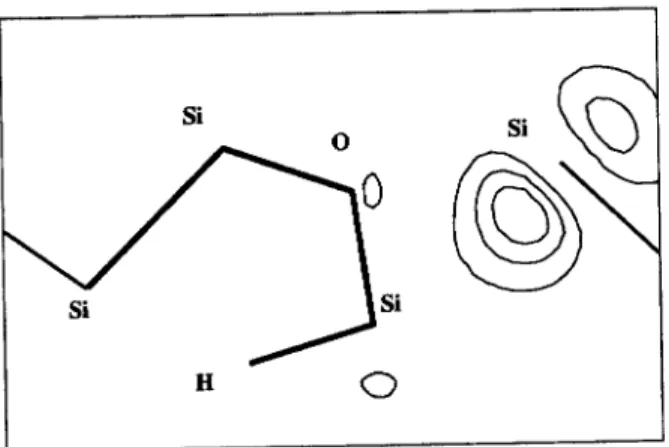
Initially we search for the ground state of the O+H system in silicon. We nd the conguration with both atoms at adjacentBCsites to be lower in energy by 0.22 eV when compared with the metastableAB congura-tion. In Fig. 1(a) we show our calculated ground-state geometry and electronic density, and in Table I some calculated bond lengths and bond angles are presented. We then proceed to investigate the migration path-way. We seek for a pathway which represents a joint dif-fusion of the O+H complex, i.e., on which the nal guration is equivalent to the initial ground-state con-guration, except by a translation of both atoms in the jump direction. A rigorous calculation of the saddle-point for the joint migration is a formidable task, due to the many degrees of freedom involved in the problem.
Therefore, we try a dynamical approach: The O atom is \kicked" in a direction perpendicular to the Si-(O)-Si axis (indicated by the arrow in Fig. 1(a)) with a 2.0 eV kinetic energy and then we let the system evolve in a MD simulation. We dene our calculated energy barrier as the energy of a "saddle-point" given by the congura-tion ofmaximum potential energyalong the trajectory. If our guess to this initial kick is good enough so that it mimics the actual movement of the O atom just be-fore a migration jump, the other atoms will respond to it in a way to generate a pathway similar to the low-est energy path. It is important to emphasize that the energy barrier calculated by this procedure will be an upper bound to the true minimum barrier for diusion [21].
Figure 1. Geometries and electronic densities of four congurations of the O+H pair in silicon, on the (110) plane which contains both impurities. Atomic positions are represented by the vertices formed the thick lines. Contours run from 0.25 to 6.25 electrons/A3. (a) Initial ground-state conguration, with
BCO and H. The arrow indicates the direction of the initial
\kick" on the oxygen. (b) \Saddle-point" conguration, dened as the conguration with maximum potential energy (1.46 eV above the ground state) during the MD simulation. (c) Metastable state with 0.30 eV, with H-saturated Si-Si broken bond. (d) Final \ground-state" conguration, withBCO and H. A true ground-state can be obtained by rotations of H and
O along the Si-Si axes.
Table I. Some bond lengths and bond angles of the ground- and metastable state congurations of O+H in Si, shown in Fig. 1(a) and 1(c), respectively. Sic denotes the central Si atom, which is initially bonded to both O and H.
Ground state Metastable state
Si-O 1.629 A Si-O 1.669 A
Sic-O 1.582 A Sic-O 1.630 A
Sic-H 1.586 A Sic-H 1.567 A
Si-H 1.645 A Si-O-Sic 142.7
Si-O-Si
c 117.4
O-Sic-H 100.6
O-Si
c-H 98.0
Sic-H-Si 132.2
614 R.B.Capazet al.
Figure 2. Electronic density for the empty gap state at the metastable conguration. Contours run from 0.02 to 0.10 electrons/A3.
In order to complete the joint diusion jump, the Si-H bond has to be broken so that the H goes to the BC position and the Si-Si bond reforms. We calcu-late the activation energy for this process by perform-ing constrained total-energy calculations on which the Si-H distance is kept xed at several values between two extreme limits: a initial situation where the Si-H distance is small and there is a bond between the two atoms and a nal situation where the distance is large and the bond is broken. As a result of these calcula-tions, we nd an extra activation energy of just 0.16 eV (0.46 eV above the ground state) to bring the system to a nal conguration with H and O at adjacent BC sites, shown in Fig. 1(d). This conguration is not ex-actly equivalent to the ground state (in fact, it has an energy of 0.25 eV above it), but the true ground state can be trivially obtained by rotations of the O and H atoms by 180around their respective Si-Si axes, which are expected to cost very little energy.
Therefore we conclude that H-enhanced O diusion in p-doped silicon occurs in a very interesting two-step mechanism. The initial step consists of a jump of the O atom between two adjacent BC congurations and the simultaneous formation of an intermediate metastable state corresponding to a H-saturated Si-Si broken-bond defect. In the second step, this defect is annealed and the H jumps to the stable BC conguration. It should be interesting to try an experimental detection of this metastable state, but this should be a dicult task due to its small annealing energy barrier. An overall en-ergy barrier of at most 1.46 eV for the combined pro-cess is obtained. This is somewhat smaller than the experimental values of 1.6-2.0 eV. This discrepancy is similar to the case of isolated oxygen. Therefore, our
barrier should be compared to the total energy of the "ylid" conguration. We calculate this energy to be 2.0 eV above its respective BCground state, consistent w! ith previousab initiocalculations [6, 7]. Therefore, the presence of hydrogen is responsible for at least a 0.54 eV reduction in the saddle-point energy, in excellent agree-ment with experiagree-ments. It is now clear the fundaagree-mental role played by H during the diusion process: it serves both to "open up" a Si-Si bond on which the O atom will jump into and, more importantly, to decrease the energy of an important intermediate state during the diusion jump by saturating a Si broken bond. This behavior is quite typical of hydrogen in semiconductors, therefore we believe that hydrogen may behave in simi-lar ways in assisting diusion jumps of other impurities in semiconductors.
Acknowledgments
This work is partially supported by Brazilian agen-cies Conselho Nacional de Desenvolvimento Cientco e Tecnologico (CNPq), Programa de Apoio a Nucleos de Excel^encia (PRONEX-MCT), Fundac~ao de Amparo a Pesquisa do Estado do Rio de Janeiro (FAPERJ) e Fundac~ao de Amparo a Pesquisa do Estado de S~ao Paulo (FAPESP).
References
[1] OxygeninSilicon, edited by F. Shimura,
Semiconduc-tors and Semimetals Vol. 42 (Academic Press, New York, 1994).
[2] U. Gosele and T. Y. Tan, Appl. Phys. A28, 79 (1982).
[3] J. W. Corbett, P. Deak, and R. Wu, Mater. Sci. Forum
38-41, 579 (1989).
[4] P. D. Southgate, Proc. Phys. Soc. (London) 36, 385
(1960); C. Haas, J. Phys. Chem. Solids15, 108 (1960);
G. D. Watkins, J. W. Corbett, and R. S. McDonald, J. Appl. Phys.53, 7097 (1982); S.-T. Lee and D. Nichols,
Appl. Phys. Lett.47, 1001 (1985); J. C. Mikkelsen, Jr.,
Mat. Res. Soc. Symp. Proc.59, 19 (1986).
[5] G. H. Vineyard, J. Phys. Chem. Solids 3, 121 (1957).
[6] M. Needels, J. D. Joannopoulos, Y. Bar-Yam, S. T. Pantelides, and R. H. Wolfe, in Defects in Materi-als, edited by P. D. Bristowe, J. E. Epperson, J. E.
Grith, and Z. Liliental-Weber, MRS Symposia Pro-ceedings 209 (Materials Research Society, Pittsburgh, 1991), p.103.
[7] M. Ramamoorthy and S. T. Pantelides, Phys. Rev. Lett.76, 267 (1996).
[8] Z. Jiang and R. A. Brown, Phys. Rev. Lett. 74, 2046
(1995).
[10] S. A. McQuaid, R. C. Newman, J. H. Tucker, E. C. Lightowlers, A. Kubiak, and M. Goulding, Appl. Phys. Lett.58, 2933 (1991).
[11] H. J. Stein and S. Hahn, J. Appl. Phys.75, 3477 (1994).
[12] S. K. Estreicher, Phys. Rev. B41, 9886 (1990).
[13] F. Buda, G. L. Chiarotti, R. Car, and M. Parrinello, Phys. Rev. Lett.63, 294 (1989).
[14] G. Panzarini and L. Colombo, Phys. Rev. Lett. 73,
1636 (1994).
[15] R. Jones, S. Oberg, and A. Umerski, Materials Science Forum83-87, 551 (1992).
[16] M. Ramamoorthy and S. T. Pantelides, Solid State Comm.106, 243 (1998).
[17] A. M. Rappe, K. M. Rabe, E. Kaxiras, and J. D. Joannopoulos, Phys. Rev. B41, 1227 (1990).
[18] M. C. Payne, M. P. Teter, D. C. Allan, T. A. Arias, and J. D. Joannopoulos, Rev. Mod. Phys.64, 1045 (1992).
[19] C. H. Seager and R. A. Anderson, Appl. Phys. Lett.
53, 1181 (1988).
[20] C. G. Van de Walle, Y. Bar-Yam, and S. T. Pantelides, Phys. Rev. Lett.60, 2761 (1988).
[21] In fact, a trajectory generated by this molecular dy-namics would approach the minimum energy trajectory if the diusing atom had a mass much greater than the mass of the host atoms, so that the latter would re-spond almost instantaneously to the movement of the diuser.