Arq Neuropsiquiatr 2006;64(1):146-148
1MD, PhD, Department of Neurology, School of Medicine, University of São Paulo, São Paulo SP, Brazil (FMUSP); 2MD, Department
of Neurology FMUSP.
Received 19 May 2005, received in final form 3 August 2005. Accepted 27 September 2005.
Dr. Eduardo G. Mutarelli - Rua Pedralva 250 - 05467-020 São Paulo SP - Brasil. E-mail: [email protected]
HYPERSEXUALITY FOLLOWING
BILATERAL THALAMIC INFARCTION
Case report
Eduardo G. Mutarelli
1, Antonio M.P. Omuro
2, Tarso Adoni
2ABSTRACT - Hypersexuality is a rare but well recognized condition following brain injury. It has been described secondarily to dysfunction in the hypothalamus, the temporal and frontal lobes. We re p o rt a 63 y e a r-old man that developed neuropsychological disturbances with hypersexuality as a prominent feature , disinhibition and moderate memory loss, hypersomnia and irritability after a bilateral paramedian thala-mic infarction. A SPECT showed frontal hypoperfusion. We believe that these findings are expression of f ro n t a l - s u b c o rtical circuits dysfunction, particularly the orbitofrontal circuit, secondary to dorso medial thalamic infarction which probably plays a role in the determination of human sexual behavior. This case favors a thalamic modulation of frontal function.
KEY WORDS: hypersexuality, disinhibition, behavior, paramedian thalamic infarction, fro n t a l - s u b c o rt i c a l circuits.
Hiperssexualidade após infarto talâmico bilateral: relato de caso
RESUMO - Hiperssexualidade é uma condição rara mas bem reconhecida após lesão do sistema nerv o s o central. A literatura medica registra casos secundários a disfunção do hipotálamo, do lobo temporal e do lobo frontal. Relatamos o caso de um homem de 63 anos de idade que desenvolveu alterações neuropsi-cológicas com hiperssexualidade como característica mais proeminente, desinibição, moderada perda de memória, hipersonia e irritabilidade após infarto talâmico paramediano bilateral. O SPECT evidenciou hipoperfusão frontal. Nós acreditamos que esses achados sejam expressão da disfunção de circuitos córti-co-subcorticais frontais, particularmente do circuito órbito-frontal, secundária ao infarto dorsomedial do tálamo, que provavelmente desempenha papel relevante na determinação do comportamento sexual humano. Este caso favorece uma possível função moduladora do tálamo sobre os circuitos córt i c o - s u b c o r-ticais frontais.
PA L AV R A S - C H AVE: hipersexualidade, desinibição, comportamento, infarto talâmico paramediano, circ u i t o s córtico-subcorticais.
Hypersexuality and alteration of sexual pre f e r-ence have been recognized as rare consequr-ences of brain injury1. Their occurrence provides import a n t
clues for understanding the anatomy and physiolo-gy of human sexual behavior. Lesions in the stru c t u-res such as the amygdala, the hypothalamus, the tem-poral and frontal lobes have been described in asso-ciation to these symptoms1. Lesion in the frontal lobe
has been re f e rred as an anatomical site that pro d u c e s t rue hypersexuality while the other stru c t u res are m o re related to changes of sexual pre f e re n c e1 , 2. Fro
n-t a l - s u b c o rn-tical circuin-ts are implican-ted in n-the den-term
i-nation of many aspects of human behavior3thus
rais-ing the question wether sexuality could be one of them. Such circuits involve several stru c t u res such as striatum, globus pallidus, substance nigra and thal-amus. Evidence that fro n t a l - s u b c o rtical circuits medi-ate a given behavior is provided by the observation that lesions in circuit related stru c t u res alter such be-havior3.
Arq Neuropsiquiatr 2006;64(1) 147
CASE
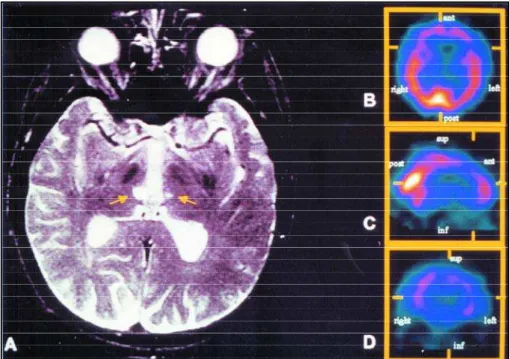
A 63-year-old right handed man presented with a sud-den loss of consciousness. His previous history was re m a r k-able for arterial hypertension, myocardial infar ction and the placement of a coro n a ry art e ry bypass graft. His behav-ior was unremarkable, he was circumspect. Upon examina-tion in the same day he was drowsy and a mild left hemi-p a resis was noted. Magnetic resonance imaging (MRI) revealed infarction in the terr i t o ryof paramedian thalam-ic art e ry (Fig 1A). In the following weeks he re c o v e red slow-ly and a behavior disorder became evident, characterized by hypersexuality, desinhibition and anterograde amnesia. He requested intercourse with his wife many times a day and started propositioning other women thus embarrass-ing his family. No change in sexual pre f e rence was pre s e n t . A b n o rmal irritability and hypersomnia were also noted. A n e u ropsychologic testing revealed a moderate memory loss, mainly for recent events (Wechsler memory scale was 52 -delay recall 52, visual 73, verbal 61)4. There were no
distur-bances in language, executive functions, motor pro g r a m-ming or constructional abilities (normal Wisconsin Card Sor-ting Test, Benton Test, Benton and Ham sher Multilingual Aphasia Examination and Raven's Coloured Pro g ressive Ma-t r i c e s )4. A single-photon emission computed tomography
(SPECT) showed bilateral frontal hypoperfusion (Fig 1B, C and D). The hypersexuality did not respond to neuro l e p t i c d rugs or carbamazepine. We have never tried testostero n e inhibitors because the risk of trh rombosis. The patient be-havior remained unmodified for the following 9 years, but his memory improved.
DISCUSSION
H e rein we present a case of a bilateral thalamic i n f a rction. The corresponding ischemic area compris-es the paramedian terr i t o ry (re t ro m a m i l l a ryor
thal-a m o - p e rforthal-ate pedicle)5. This area usually includes
the paramedian part of upper midbrain and thala-mus, including most of the dorsalmedial nucleus, intralaminar nuclear group, mamillothalamic tract and the superior part of red nucleus6. In some cases
one single unilateral pedicle on one side may supply the paramedian territory on both sides and the cor-responding infarct may be bilateral, as observed in our case. The typical form of presentations a sudden loss of consciousness, confusion, vertical gaze disor-ders, sometimes associated to blepharospasm, hemi-p a resis and hemiataxia. Variable neuro hemi-p s y c h o l o g i c a l disturbances can be found such as memory impair-ment, dysphasia, hemineglect, visuospatial pro c e s s-ing disturbances and behavioral disord e r s5 - 7. The
lat-ter consists of a mixture of aggressiveness with apa-t h y, buapa-t disinhibiapa-tion and mania may also be found8 , 9.
Utilization behavior, usually seen in frontal lobe le-sions, was also described10. Gentilini et al.9reported
eight cases of paramedian infarction. Among them, four patients presented with bulimia. One of them showed a behavioral disturbance described as inap-p roinap-priate, alternating “inap-periods of fretfulness with periods of silly cheerfulness, when she ostentatious-ly kissed and hugged her husband in the presence of other people and indulged in coarse and inappro p r i-ate jokes about the physicians”. This finding could be interpreted as a sign of hypersexual behavior. Ne-v e rtheless, to the present date, no case of hypersex-uality as a prominent feature has been reported.
The frontal hypoperfusion observed in our case
148 Arq Neuropsiquiatr 2006;64(1)
is similar to several cases of paramedian infarcts des-c r i b e d8 , 1 1 , 1 2, and support the frontal dysfunction
for-w a rdby thalamic lesion. More o v e r, some of the neu-ropsychological disturbances were similar to those present in frontal syndromes. These findings contri-buted to support current theories about the functio-ning of fro n t a l - s u b c o rtical circ u i t s3 , 1 3 - 1 7. It raises the
question about whether the hypersexuality in our patient could or not correspond to a dysfunction in one of these circuits.
C u m m i n g s3p roposed that fro n t a l - s u b c o rtical
cir-cuits are implicated in mediating behavioral alter-ations when (1) lesions in several circ u i t - related stru c-t u res produce a similar behavioral disord e r, (2) c-the behavioral syndrome is not commonly seen with sions in other brain regions and (3) simultaneous le-sions in several circuit stru c t u res produce analogous rather than additive eff e c t s1 8. Indeed, improper
sex-ual remarks or gestures and other antisocial acts may be part of an orbitofrontal syndrome, although overt sexual aggression is rare1 3 - 1 5. Cases of hypersexuality
have been described as a consequence of medial ba-sal frontal stru c t u re s1. However, hypersexuality has
been found in other than frontal lesions1, mainly in
the temporal lobe1 6and other limbic stru c t u res such
as the hypothalamus. It is well known that the medi-aldorsal nucleus has large connections with limbic s t ru c t u resparallel to frontal connections. The thala-mus is poised at the interface of the medial-tempo-ral circuit and frontal- subcortical circuits, causing dif-ficulties in establishing which of the circuits is aff e c t-ed in a given thalamic lesion1 4. The frontal hypoperf
u-sion present in our patient could be only an unre l a t-ed finding, not necessarily indicating association bet-ween fro n t a l - s u b c o rtical dysfunction and hypersex-uality.
H o w e v e r, some evidences in the literature lead us to conclude that, in our case, frontal-subcortical cir-cuits are more likely to be implicated in the patho-genesis of hypersexuality: (1) PET studies1have
de-monstrated that medial thalamic infarctions show occipital and frontal hypometabolism (as in this case) while temporal hypometabolism is seen in posterior thalamic infarcts (absent here). (2) There are descrip-tions of sexual disturbances in patients with Parkin-s o n ’Parkin-s diParkin-seaParkin-se who Parkin-start receiving levodopa therapy1 , 1 7
suggesting a participation of striatal connections in these symptoms. Other diseases related to cort i c a l -s u b c o rtical dy-sfunction may al-so -show hyper-sexual behavior such as Huntington’s disease and Gilles de La To u rette syndro m e1. A case of capsulo-lenticular
hematoma with hypersexuality was also described1 8.
(3) Limbic stru c t u res have been described associated to alterations of sexual pre f e rences (homosexuality, pedophilia, fetishism) rather than to the true hyper-sexuality found in frontal lesions1 , 1 9 , 2 0. All these facts,
in addition to the evidences present in our case sug-gests that the thalamus plays an important role in the control of human sexual behavior mediated by frontal-subcortical circuits.
Acknowledgement– We thank C. Buchpiguel, MD,
A. Osawa, MD and C.R. Ono, MD for the help in pro c e s s-ing the images.
REFERENCES
1. G r a ff - R a d f o rd NR, Damasio H, Yamada T, Eslinger PJ, Damsio A R . Nonhaemorragic thalamic infarction: clinical, neuropsychological and e l e c t rophysiological findings in four anatomical groups defined by computerized tomography. Brain 1985;108:485-516.
2. Eslinger PJ, Warner GC, Grattan LM, Easton JD. “Frontal lobe” utiliza-tion behavior associated with paramedian thalamic infarc t i o n . Neurology 1991;41:450-452.
3. Castaigne P, Lhermitte F, Buge A, Escourolle R, Hauw JJ, Ly o n - C a e n O. Paramedian thalamic and midbrain infarcts: clinical and neuro p a t h o-logical study. Ann Neurol 1981;10:127-148.
4. Lesak MD. Neuropsychological assessment, 3rd ed. New York: Oxford University Press, 1995.
5. Bogousslavsky J, Ferrazzini M, Regli F, Assal G, Tanabe H, Delaloye-Bischof A. Manic delirium and frontal-like syndrome with paramedi-an infarction of the right thalamus. J Neurol Neuro s u rg Psychiatry 1988;51:116-119
6. Bogousslavsky J, Regli F, Uske A. Thalamic infarcts: clinical syndro m e s , etiology and prognosis. Neurology 1988;38:837-848.
7. Gentilini M, Renzi E, Crisi G. Bilateral paramedian thalamic artery in-f a rcts: report oin-f eight cases. J Neurol Neuro s u rg Psychiatry 1987; 50: 900-909.
8. Blumer D, Benson DF. Personality changes with frontal and temporal lobe lesions. In Benson DF, Blumer D (eds). Psychiatric aspects of neu-rologic disease. New York: Grume and Stratton, 1975:151-169. 9. G a u t i e r-Smith PC. Cerebral dysfunction and disorders of sexual
behav-ior. Rev Neurol (Paris) 1980;136:311-319.
10. Donnet A, Schmitt A, Poncet M, Graziani N, Grisoli F. Hallucinations of supernumerary limbs, left hemineglect and hypersexuality in a case of right capsulo-lenticular hematoma. Rev Neurol (Paris) 1999;153: 587-90.
11. Reitman F. Orbital cortex syndrome following leucotomy. Am J Psy-chiatry 1946;103: 238-241.
12. Sandson TA, Daffner KR, Carvalho PA, Mesulan MM. Frontal lobe dys-function following infarction of the left-sided medial thalamus. A rc h Neurol 1991;48:1300-1303.
13. B l a k e m o re SJ, Rees G, Frith CD. How do we predict the consequences of our actions? A functional imaging study. Neuropsychologia 1998; 36:521-529.
14. Monga TN, Monga M, Raina MS, Hardjasudarma M. Hypersexuality in stroke. Am J Phys Med Rehabil 1986;67:415-417
15. Murad A. Orbitofrontal syndrome in psychiatry. Encephale 1999;25: 634-637.
16. Miller BL, Cummings JL, McIntyre H, Ebers G, Grode M. Hyperse-xuality or altered sexual pre f e rence following brain injury. J Neuro l Neurosurg Psychiatry 1986;49:867-873.
17. Szelies B, Herholz K, Pawlik G, Karbe H, Hebold I, Heiss W. Wi d e s-p read functional effects of discrete thalamic infarction. A rch Neuro l 1191;48:178-182.
18. Cummings JL. Frontal-subcortical circuits and human behavior. Arch Neurol 1993;50:873-880.
19. Uitti RJ, Tanner CM, Rajput AH, Goetz CG, Klawans HL, Thiessen B. Hypersexuality with antiparkinsonian therapy. Clin Neuro p h a r m a c o l 1989;12:375-383.