ARTIGO
DOI: http://dx.doi.org/10.1590/0102-4698171043 https://creativecommons.org/licenses/by/4.0/
DISCOURSE ANALYSIS OF STUDENTS-WORKERS ON SCHOOL TRUANCY: A SPECIFIC CASE IN THE MATH COURSE
Luciano Ferreira*
Universidade Estadual do Paraná (UNESPAR), Campo Mourão - PR, Brasil
Rui Marcos de Oliveira Barros**
Universidade Estadual de Maringá (UEM), Maringá - PR, Brasil
ABSTRACT: School absenteeism of ex-students in the Math course of the State University of Maringá, Maringá PR Brazil, and the need to work are related from the point of view of Foucault´s theory, through their own
statements. By collecting oficial data of the university on truancy in the Math course between 2003 and 2013, we sought and analyzed scientiic
papers that address the evasion object and applied an interview with 26
escapees. The objective of the research, scientiic papers and correlated
documents were harvested on school truancy. Besides verifying the representations that truants have of their activities and their need to work, this paper instigates a critical discussion on representations involved in truancy. In fact, representations reveal their subjectivity. This research intends to describe the truants and in which discourse they are inserted so that the excluded subjects may have their own voice and opinion. “Truants” are made up by their own discourse.
Keywords: truancy. work. discourse. Math course. Foucault.
UMA ANÁLISE DO DISCURSO DO ALUNO TRABALHADOR ACERCA DE SUA EVASÃO: CASO ESPECÍFICO DO CURSO DE MATEMÁTICA DA UEM
RESUMO: Objetivamos, neste artigo, relacionar a evasão do ex-aluno do curso de matemática da Universidade Estadual de Maringá (UEM) e sua necessidade de trabalhar, à luz da teoria de Michel Foucault, utilizando-nos de enunciados proferidos pelos próprios aluutilizando-nos evadidos. Para tanto, levantamos os dados oficiais da UEM acerca da evasão no curso de Matemática entre os anos de 2003 a 2013, buscamos e analisamos trabalhos
cientíicos que tratam do objeto evasão e aplicamos uma entrevista com 26
*PhD in Education and Mathematics, Universidade Estadual de Maringá (UEM), Brazil. Associate Professor
from Universidade Estadual do Paraná (UNESPAR), Brazil. Researcher from Grupo de Estudos Foucaultianos (GEF) and Grupo de Estudos e Pesquisas em Educação Matemática, Campo Mourão (GEPEMCaM), Brazil. E-mail:<[email protected]>.
**PhD in Mathematics, Instituto de Ciências Matemáticas, São Carlos (USP), Brazil. Professor from
evadidos. O objetivo da pesquisa, além da veriicação das representações
que os evadidos têm da sua evasão e sua necessidade de trabalhar, é incitar uma discussão crítica das representações do maior envolvido com a evasão, uma vez que as representações mostram sua subjetividade. Pretendemos descrever quais são os sujeitos evadidos e em que discurso estão inseridos. Almejamos dar voz aos sujeitos excluídos. Podemos airmar que “sujeito
evadido” se constitui em seu próprio discurso.
Palavras-chave: Evasão. Trabalho. Discurso. Curso de Matemática. Foucault.
INTRODUCTION
In this article, we will approach a subject, the student on truancy situation from the Mathematics course of the Universidade Estadual de Maringá (UEM), Brazil. We will verify their relationship with the started course that was not completed. In addition, we will show the close relationship between the need to work and their truancy, through statements of the students themselves. In order to achieve such, it will be used the theory of discourse analysis, based on Foucault (1985, 1995, 2001, 2004, 2008, 2013) and its commentators.
The object of research in this article is truancy. There are several concepts for truancy and different theoretical and methodological models for the study of this phenomenon. However, in this research, it will be considered as an object of study. We shall
consider, therefore, its general deinition, which is related to when students start but do not inish their course.
Our aim is to understand the constitution of the truant
from the mathematics course of the Universidade Estadual de Maringá and the oscillation of the subjectivity and the objectivity of these students, from discursive practices about their truancy and their need to work, represented in their statements. In other words, we longed to describe the history that is not told by documents, but rather told by truants from the mathematics course of UEM.
Therefore, we ask the following question: What is the relation
of the “truant” with the mathematics course from Universidade Estadual de Maringá? How does he/she, the “truant”, see the relation of his/her truancy to his work? In what discursive practice does the
“subject in truancy situation” could it in?
In addition to the aforementioned questions and aims, we
1. THEORETICAL FRAMEWORK
In this research, we use part of the philosophical thinking from Michel Foucault (1926 to 1984), because we agree with Fischer (2001) and believe that such theory may contribute to researches in education, the circumstance of this investigation. When discussing the topic truancy of the mathematics course from UEM we intend to collaborate with education, especially the Mathematics Education.
According to Fischer (2001, p.197) there is a “[...] contribution of this foucaultian referential, both theoretical and methodological, for researches in education, in which one intends to analyze discourses.”1 Thus, this reference will support this research in two
aspects: theoretical, when using concepts of Foucault’s theory for
interpretation of data; methodological, to seek regularities and dispersions in the statements uttered in an archaeological excavation of the problem of truancy of the mathematics course from UEM.
The term “discourse” is one of the central themes of Foucault’s
work. The idea of discourse in the classical episteme and the opposition between being the discourse and the human being are concerns cited by Foucault in his work “Archeology of Knowledge”. However, in
this article, we consider, irst, the broader deinition that discourse
“consists of a limited number of statements (instructions) to which
you can deine a set of conditions” (Foucault, 2008, pp. 132-133).2 We took into account the conditions of the student in truancy situation, the paths in which the former student through his statements was inserted in a discourse and without which he/she may incur situations that no longer will legitimize him/her to be the subject of this discourse. In this article, the students in truancy situation from the mathematics course of Universidade Estadual de Maringá (UEM) will be subjects of their own history, through their own words.
To refer and explain the discourse theory it is necessary to
answer the following question: what is a statement?
For Foucault (2008), a statement is not a constructive unit of discourse, and it is not a word, a phrase, a logical proposition, a speech or something of the kind. A statement, for Foucault, is a function of the existence of signs (written, spoken, and gestural) and it may be the object of interest in the search for meaning in what is registered by the
signs. In his work Archeology of the Knowledge, one inds:
Paradoxically, deining a set of statements in what he has as an individual would be
to describe the dispersion of these objects, to grasp all the interstices that separate them, to measure the distances between them - in other words, to formulate their
We noticed this in our research corpus. An example is the dispersion of the statement “the course of mathematics is not for the student worker,” this statement starts to describe the truant by means of this dispersion.
The statement always needs a sensitive support so that it exists, it also needs a materiality (auditory, textual, gestural support), that is, the statement will always be in a set of signs. Nevertheless, it is not the set of signs, nor is it constituted by lexicographic or purely thematic grouping as described in the four hypotheses raised by Foucault (2008). For such possibility, it is necessary that we pay
attention to some basic attributes of the statement:
[...] a referential (which is not exactly a fact, a state of things, not even an object,
but a principle of differentiation); a subject (not the speaking consciousness,
not the author of the formulation, but a position that can be occupied, under
certain conditions, by indifferent individuals); an associated ield (which is not
the actual context of the formulation, the situation in which it was articulated,
but a domain of coexistence for other statements); a materiality (which is not
only the substance or the support of the joint, but a status, rules of transcription,
possibilities of use or reuse) (FOUCAULT, 2008, p.130, emphasis added).4
The series of statements obtained in the interviews has a relation with some discourses present in the university and that are
“concerns” of researchers in the education ield. There is a discourse
that the university, professors and students, standardize evasion in the mathematics course and in the area of Mathematical and Engineering Sciences as a whole, accepting truancy as something natural.
We intend, with this research, to describe the enunciative function from what the former students say about their truancy, and then to specify what position these students occupy.
Describing a statement, therefore, [...] is to apprehend it as an event, as something that breaks out in a certain time, in a certain place. What will allow to situate a tangle of statements in a certain organization is precisely the fact that they belong
to a certain discursive formation (FISCHER, 2001, p.202).5
When we return to the main purpose of this research, which is to describe the discourse of the truant of the mathematics course of UEM and the relation between his/her truancy and his/her work, we deem it necessary to clarify that in the Discourse Analysis here
used. This, states: “the subject is produced within discourses and their identity is the result of the subject’s positions and practices in
the discourses”. (FERNANDES, ALVES JÚNIOR, 2009, p.113).6
from the mathematics course of UEM) is understood as a legitimate subject of a certain type of knowledge, or rather, as the subject perceives himself in the relation subject/object, student/former student. The
objectiication processes, in turn, concern how the subject may become
an object for knowledge, as this subject sees his/her evasion not by himself/herself, but by others (teachers, family, institution, course, etc.)
The truancy will be understood as a manifestation of subjectivity, in its antagonism with the university, resulting in the subject leaving the university course before graduating. In fact, there is a clash
of desires (feelings): the will versus the impossibility of graduating. At that moment, we deine truancy and, consequently, there is a reason
why the student decides to leave his/her course and/or university. Fernandes (2011) explains subjectivation as the constitutive process of the subjects, he also stresses that the process of production of subjectivity allows, in the Foucaultian sense, to objectify. “Considering that the modes of subjectivation produce singular subjects, one must try to show, through the analysis of the discourses, the procedures mobilized for the production of subjectivity and,
consequently, of the subjects”,7 Fernandes (2011, p.15).
The alumni are inserted in some discursive practices and they
are objectiied in the discourses of others, for example, in the discourses
from the university documents, which they discuss truancy. We intend to
analyze some modes of objectiication of the alumni and how they take
it for themselves, being subjectivated by discourses external to them. By objectivation we mean the game (discursive) between object (truancy) and the individual (the alumni). This discursive practice appears when the object and the subject are related. It characterizes an identity, and sometimes the truant believes he/she has the object predicates, that is, to be the truant that the “others” talk about.
We make it clear that when we discuss about the former student as a “truant” we consider a certain individual who has entered into a certain discourse. The alumni are not the subject of speech yet, but they may be.
2. PATHWAYS OF RESEARCH
The adoption of a qualitative research allows the detection
and apprehension of necessary elements to describe the “truant”. We intend to study the relationship between truancy and the employability of the former student, through his/her statements. This approach
The methodological procedures were:
A. documentary analysis - with the collaboration of UEM’s administration, we obtained speciic information about
enrolled students and the dropouts in the mathematics course during the period covered by the research (2003-2013). In possession of these reports, we evaluated the number of truants (719); the number of enrolled students; the number of graduated students; the subjects covered by the truants; the years in which there was truancy; the course curriculum etc.
B. bibliographic research - parallel to the documentary analysis,
we made a cut in scientiic research that dealt with evasion,
then, we set up a “small” archive in search of regularities that permeate the theme and that served as support for the
elaboration of the questions for the interview. This archive
also contributed, in part, to our analysis.
C. contact and interview with the target population - after obtaining the number of truants (719) in the period from 2003 to 2013, we contacted 50 of them, of which 26 were willing to collaborate with the research, signing the
Termo de Consentimentos Livres e Esclarecidos;8
D. transcript - the interviews were transcribed, and we tried not to left out any pertinent information that could serve to reveal the problem of truancy. We maintained,
therefore, the idelity to the speech of the truants; E. Foucault’s discourse analysis - of all the utterances said
by students on truancy situation and supported in the Foucaultian literature, we weaved considerations to clarify the relations between the need to work and truancy.
Consequently, there was an approach to the analysis of
discourse with the Mathematical Education.
The research environment is the mathematics course of UEM, created in 1970 and implemented in 1971. At present time
(2016), the course is composed of a bachelor’s degree, with 3419
hours of instruction and a degree in Mathematics for teaching, with 3045 hours / class. Courses may be full time or at night.
order to carry out this archaeological excavation, we searched for the “truant”, through written and oral reports (by interviews) about his/ her experience. These reports compose the corpus of the analyzed research in this article.
2.1. DOCUMENTARY ANALYSIS
Since we decided to research truancy in the mathematics course
of the UEM, we sought help from the university’s administration
and we obtained several documents from the course, records and telephone numbers of the truants, transcript of records from the course, syllabus and political-pedagogical projects of the course.
2.2. A PROFILE OF A SCIENTIFIC RESEARCH: SYNTHESIS OF DOCUMENTS
We know of the impossibility of tracing the whole archive,9 but we understand this phase as the search for regularities about the truant.
The criterion for grouping the documents of the archive was:
works found in public domain and the catalog of theses and dissertations of Capes, with the keywords “school dropout” published in Brazil in the last 30 years. We emphasize that we did not deal with everything that has been said or written about truancy, since we are aware that this is not possible. We only consider regular work on truancy in college
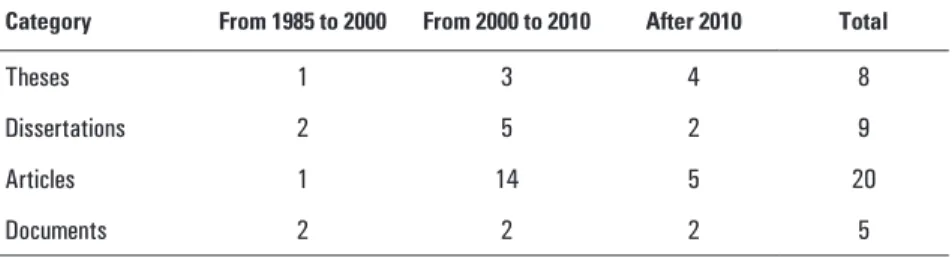
education. The selected documents are listed in Table 1, below:
TABLE 1. Amount of researched works
Category From 1985 to 2000 From 2000 to 2010 After 2010 Total
Theses 1 3 4 8
Dissertations 2 5 2 9
Articles 1 14 5 20
Documents 2 2 2 5
2.3. DESCRIPTIONS OF THE SUBJECTS
We were cautious when choosing the interviewees. For example, from the 719 truants in the eleven researched years, the majority dropped
out in the irst year of the course. Thus, from the 26 interviews used in
this research, 15 were made with students who had dropped out in the
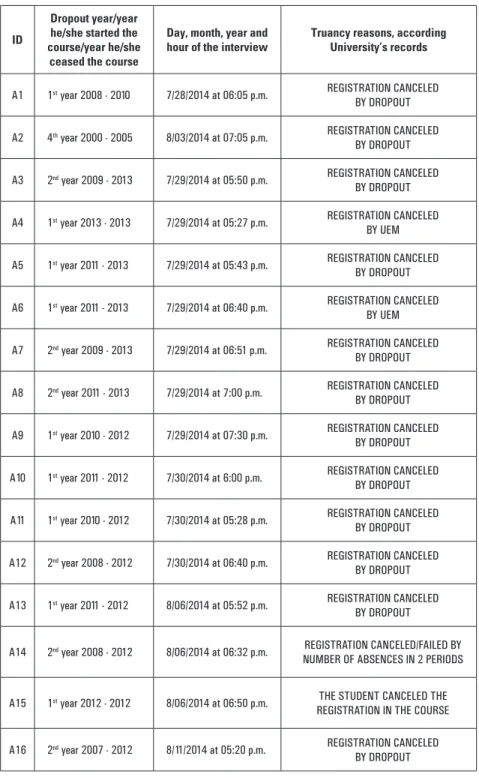
irst year of the course. Table 2 identiies students by enrollment year and years in which they started and inished the course, dates and times
TABLE 2. Student’s identification, dates of interviews and reasons, according UEM
ID
Dropout year/year he/she started the course/year he/she
ceased the course
Day, month, year and hour of the interview
Truancy reasons, according University’s records
A1 1st year 2008 - 2010 7/28/2014 at 06:05 p.m. REGISTRATION CANCELED BY DROPOUT
A2 4th year 2000 - 2005 8/03/2014 at 07:05 p.m. REGISTRATION CANCELED BY DROPOUT
A3 2nd year 2009 - 2013 7/29/2014 at 05:50 p.m. REGISTRATION CANCELED BY DROPOUT
A4 1st year 2013 - 2013 7/29/2014 at 05:27 p.m. REGISTRATION CANCELED BY UEM
A5 1st year 2011 - 2013 7/29/2014 at 05:43 p.m. REGISTRATION CANCELED BY DROPOUT
A6 1st year 2011 - 2013 7/29/2014 at 06:40 p.m. REGISTRATION CANCELED BY UEM
A7 2nd year 2009 - 2013 7/29/2014 at 06:51 p.m. REGISTRATION CANCELED BY DROPOUT
A8 2nd year 2011 - 2013 7/29/2014 at 7:00 p.m. REGISTRATION CANCELED BY DROPOUT
A9 1st year 2010 - 2012 7/29/2014 at 07:30 p.m. REGISTRATION CANCELED BY DROPOUT
A10 1st year 2011 - 2012 7/30/2014 at 6:00 p.m. REGISTRATION CANCELED BY DROPOUT
A11 1st year 2010 - 2012 7/30/2014 at 05:28 p.m. REGISTRATION CANCELED BY DROPOUT
A12 2nd year 2008 - 2012 7/30/2014 at 06:40 p.m. REGISTRATION CANCELED BY DROPOUT
A13 1st year 2011 - 2012 8/06/2014 at 05:52 p.m. REGISTRATION CANCELED BY DROPOUT
A14 2nd year 2008 - 2012 8/06/2014 at 06:32 p.m. REGISTRATION CANCELED/FAILED BY NUMBER OF ABSENCES IN 2 PERIODS
A15 1st year 2012 - 2012 8/06/2014 at 06:50 p.m. THE STUDENT CANCELED THE REGISTRATION IN THE COURSE
A17 2nd year 2008 - 2012 8/11/2014 at 05:30 p.m. REGISTRATION CANCELED/FAILED BY NUMBER OF ABSENCES IN 2 PERIODS
A18 1st year 2008 - 2012 8/11/2014 at 05:40 p.m. REGISTRATION CANCELED/FAILED BY NUMBER OF ABSENCES IN 2 PERIODS
A19 4th year 2006 - 2012 8/11/2014 at 06 p.m. THE STUDENT CANCELED THE REGISTRATION IN THE COURSE
A20 1st year 2010 - 2012 8/11/2014 at 06:20 p.m. THE STUDENT CANCELED THE REGISTRATION IN THE COURSE
A21 1st year 2011 - 2012 8/11/2014 at 06:30 p.m. THE STUDENT CANCELED THE REGISTRATION IN THE COURSE
A22 1st year 2011 - 2012 8/11/2014 at 06:50 p.m. THE STUDENT CANCELED THE REGISTRATION IN THE COURSE
A23 1st year 2011 - 2012 8/11/2014 at 07:10 p.m. REGISTRATION CANCELED BY DROPOUT
A24 3rd year 2001 - 2003 8/13/2014 at 05:15 p.m. THE STUDENT CANCELED THE REGISTRATION IN THE COURSE
A25 2nd year 2001 - 2003 8/13/2014 at 05:40 p.m. REGISTRATION CANCELED BY DROPOUT
A26 1st year 2002 - 2004 8/13/2014 at 06:30 p.m. THE STUDENT CANCELED THE REGISTRATION IN THE COURSE
2.4. THE INTERVIEW
The interview was elaborated in the semi-structured modality.
It contained closed or structured questions in order to direct the
interview, that is, we had the former student speak of his/her passage
in the course. On the other hand, with the open-ended questions, we
gave interviewees a free discourse about the subject.
A characteristic of this research was the devoted record of what was said by the interviewees. According to Minayo (2007, p.
69), “reliable and, if possible, ‘literal’ recording of interviews and
other forms of data collection whose raw material is speech becomes crucial to a good understanding of the internal logic of the group or of the collectivity studied.”10 The recording of the interview, according to the author, is one of the instruments that guarantee reliability. Our interviews were all made by telephone11 and recorded. We adopted the strategies of Minayo (2007), transcribing them fully, without altering or omitting any data.
attributes that allow the symbolization A1, A2, A3... A26, as shown in Table 2. Thus, we were able to constitute the corpus of the research. We emphasize the importance of describing and interpreting the facts of
discourses, since there are points of convergence between qualitative
research and the historical analysis that we propose to write.
For the analysis of the interviews, we separated the questions
into two groups.
For questions 1, 2 and 3, which are open-ended questions,
we did a collective analysis of the statements. We analyzed all the
interviewees (26 former students), we identiied discursive regularities,
which pointed to the discursive practices of the former students in their regular manifestations of subjectivities, and we verify in which discourses these interviewees are inserted.
For question 4, we did an individual analysis; we looked specifically at the answers from question 4, student per student. In this question, we only analyzed subjects A1 to A9. The themes addressed in question 4 were extracted from other researches that dealt with truancy and other themes were inluenced by the authors’ professional experience. Therefore, our interview was as follows:
Question 1) Do you remember the reasons that led you to take the entrance exam for the math course?
Question 2) Could you talk about that prevented you from continuing the math course?
Question 3) Would you like to return to math, today or in the near
future? (Yes or no)
a. If so: Could you tell me if this would bring you any beneit? b. If not: Could you tell me reasons not to want to continue the math
course?
Question 4) I will discuss some topics or issues and I would like you to comment on whether they have any bearing on your inability to
graduate in the math course. You can tell me if they were determinants
or if there was no relation to the fact of the interruption of your course. All right?
a. Regarding work, was there any relationship?
b. Regarding the time devoted to the study of the disciplines. c. What about the time devoted to weekly classes?
e. What about the time to inish the course? Did you have predictions? f. Were there any inancial problems?
g. Regarding personal encouragement, did you have had any encouragement? Was there lack of encouragement?
h. Regarding the theoretical prerequisites of the subjects you did,
what could you tell me about it?
i. About the motivation to inish the math course, could you tell me
if there was any relation to the interruption?
j. Were there family problems that made it dificult to continue with
the course?
k. Regarding transportation to UEM, what can you tell me?
l. Regarding the communication with the professors of the course that you met, do you have something to tell me?
m. What about the structural arrangement (buildings, furniture and
equipment), were they related to the impossibility of continuing your
study in the course?
n. Was there an attempt to begin another course?
o. Is there any other reason that you remembered and that we did not mention here?
3. A PROFILE OF THE ARCHIVE IN SEARCH OF REGULARITIES
We noticed that the discourses produced on the truants presented a certain regularity, that is visible in academic papers and
oficial documents, which try to trace the identity of these subjects.
We aim to carry out a different investigation from existing ones. In order to do so, in this section we will organize memories from many discursive formations, drawn from experiences as a student and teacher, and from researches already carried out about truancy, as a surface of emergence and as a convergence of discourses that operate
a kind of classiication of the involved subjects in this phenomenon.
Initially, 7 theses, 9 dissertations, 20 papers and 8 documents
were searched, but for this article we have brought proiles from 4 theses,
5 dissertations, 5 articles and 1 document, since these are inserted in the
discourse that the working student has more dificulties to graduate.
In the thesis Evasão do ensino superior de Física, segundo
Junior (2013) investigates a structural analysis, and he identiies that students that belong to the popular class or ruling class are equally likely to dropout or inish a course. For Lima, the structural analysis
allowed to conclude that students from the dominant class are more predisposed to dropout the course and go towards most prestigious careers, whereas students from the popular class tend to dropout by failure. In his research records, students asked why they cannot have scholarships and work at the same time.
In the thesis Evasão discente no ensino superior: estudo de caso de um curso de licenciatura em matemática, Santos (2012) shows seven reasons that caused students to dropout mathematics of a public college institute located in the State of Minas Gerais, Brazil, in the period from 2000 to 2009. Two of these reasons are,
according to the author, external to the course: inancial dificulties, with consequent need to work and devaluation of the teaching profession. The other reasons are internal to the course: curricular
organization; teaching methodology adopted by the professors; the adopted evaluation criteria; building and structural arrangement and
the fact students do not learn the mathematical contents; inally, the
lack of integration between university and basic education.
In the thesis Dificuldades de alunos ingressantes na
universidade pública: indicadores para relexões sobre a docência
universitária, Belletati (2011) has as main purpose the investigation of the elitization of public universities. The author points out as
demands on professors the need for relections on the social function
of the university and on the low socio-economic conditions, especially in “more privileged” courses.
Biazus (2004), in the research Sistema de Fatores que
Inluenciam o aluno a evadir-se dos cursos de graduação na UFSM e na UFSC: um estudo no curso de ciências contábeis, the author, after creating and testing the statistical mechanism to identify factors of truancy, faces statements that contain examples of internal factors
and external factors, such as unfavorable student inancial conditions. Truancy connected to inancial conditions is closely related to the need to work, which makes it impossible to inish a graduation course.
In the thesis Evasão e evadidos: o discurso dos ex-alunos
sobre evasão escolar nos cursos de licenciatura, Gomes (1998)
inds out that one of the reasons for dropping out is the relation
between work and university. The author also highlights that history has shown how elitist the Brazilian university can be, both in
These considerations lead me to defend the thesis that graduate students from teaching courses are not students who dropped out or failed, because they are hardworking, critical, courageous students that seek new options before the end of courses, as opposed to so many who graduate and go to work in different activities, with sorrow, often because they did not change their decisions
previously.12 (GOMES, 1998, p. 154).
In the dissertation Evasão escolar no Ensino Superior: um
estudo nos cursos de licenciatura da Universidade Estadual do Oeste do Paraná – UNIOESTE – Campus Cascavel, Castro (2013) did a study in the undergraduate courses of Unioeste - Campus of Cascavel and emphasized the regularity that truancy is related to the working student.
In the dissertation Evasão e avaliação institucional: uma
discussão bibliográfica, Baggi (2010) analyzes the theoretical production that approaches truancy and its relation with evaluation in the college education, between the end of 1990 until 2009. The
regularity found by Baggi was that social inequality appears directly or
indirectly in all studies, from elementary to college education as the main cause of truancy.
In the dissertation Evasão nos cursos superiores de
tecnologias: a percepção dos estudantes e seus determinantes,
Scali (2009) has as objectives: to identify and to analyze the reasons
of dropouts from superior courses of technology, from the dropout
student’s perception and to analyze the academic course of the student
after dropping out. According to the author, her data indicated that the
main reasons for dropouts were: deinition of admission course (50.0%), location of the institution (36.4%), the training and the professional performance of the technologist (25.0%), conditions related to work (18.2%) and financial conditions (18.2%). Regarding the academic course of the student after dropping out, 77.2% of the interviewees
had already graduated or started in another course / institution.
In the dissertation Do encontro ao desencontro: fatores
relacionados à procura de cursos de EaD em psicologia e à posterior evasão, Ramminger (2006), pointed out that the lack of discipline to study and autonomy is one of the causes of truancy; another cause is the time to study; demotivation also appears as the a
cause for truancy; the dificulties with the contents, materials and papers for the disciplines; the technical dificulties and the communication dificulties with the group are also important causes. Although the
we may review later in this article as “a não adequação no tempo de estudo” subjectiication of the subject in justifying his/her truancy.
In the dissertation A evasão no ensino superior: o caso
do curso de pedagogia da Universidade Estadual de Maringá (1992-1996), Kira (1998) concluded that there are several causes for dropping out the course of pedagogy from UEM. The author cited
as main causes: the course and the teaching practice; the emphasis on the question of work and that most of the dropouts had no identiication with the course.
In the article Evasão na educação superior: uma temática
em discussão, Cunha and Morosini (2013) relate causes that we call
general, which are: accumulated deiciencies in basic education that
lead to low results and repeated failure in subjects; difficulties in continuing the course; the choice for other courses; demotivation; lower self-esteem; economic reasons (conditions related to work and
inancial conditions).
In the article Panorama da evasão no ensino superior brasileiro: aspectos gerais das causas e soluções, Lobo (2012) comments about the detected causes: misadaptation of the student to the style of college education and lack of maturity; poor basic training; inancial dificulty; annoyance at the precariousness of the services offered by the college institutions; disappointment with professors’ lack of motivation and attention; dificulties with transportation, alimentation
and the atmosphere in the college institution; change of course and change of residence.
In the article Desigualdades sociais e acesso seletivo ao ensino superior no Brasil no período, Mello (2007) considered that the students who worked had less possibilities of entry at university. Among those
who do not work, only a few more than a quarter do not advance to
college education. Among those who worked, sought work or began to work in the course of the research, less than a third continued to study. The article is part of the discourse that says “University is not for working students”, this discourse circulates and resists, although the academic environment does not accept it as theirs.
In the article Reprovação, avanço e evasão escolar no Brasil, De Leon e Menezes-Filho (2002) present a descriptive analysis of the indicators and determinants of failure. In the descriptive analysis, the authors verify that, throughout the years, there is a selective process between the economic bands, lower income greater dropout. To
progress in university, the opposite is true: the difference between income brackets increases signiicantly after high school, just when
Perfil socioeconômico dos alunos, repetência e evasão no curso de química da UFMG. In this article, Braga, Miranda-Pinto e
Cardeal (1997) bring results that, according to them, de-authorize the usual simplistic interpretations that truancy is basically due to the lack of preparation and / or lack of interest of the student. To Braga et. al, even though these factors may account for part of the dropouts,
the available information indicates that the university’s share of fault is at least equal to that normally attributed to secondary education or
to the labor market.
The work document “A evasão do terceiro grau em Curitiba”
is the summary of the master’s dissertation of Alberto Sanchéz Paredes. Alberto Sanchéz Paredes (1994) indicates 12 main causes, declared as responsible for the dropout of almost 95% of the interviewees, among which the following stand out: the impossibility
of working and studying (UFPR); little involvement with the public
course (UFPR); high cost of the course - inancial dificulty
(PUC-PR) and disappointment with the course - criticism (PUC-(PUC-PR). For Fischer (2001, p.204) it is important “to constitute units from this dispersion, to show how certain statements appear and how
they are distributed within a certain set, knowing, irst, that unity is
not given by the object of analysis”.13
In this sense, this profile shows us some discursive
heterogeneity in the scientiic works that treat about truancy, which corroborates with the results of Niquini, (2015, p.374) who observes
[...]among working students, especially among those in less favorable conditions, less motivation to study, more limited training, impairment in learning and the
normal progression of the course, and even dropout.14
We perceive that the unifying element is not truancy, but the conditions that cause it, whether internal or external to the institution.
The statement that the student’s work is the decisive factor of his/her
truancy permeates all the works listed here. That is, there is a discourse
that working and studying is very dificult, sometimes impossible.
4. DISCOURSE ANALYSIS: ANALYZING THE STATEMENTS OF THE TRUANTS
In order to comprehend the constitution of the “truant” we
ask: What is the relation between the “truant” with the mathematics
course from UEM? How he/she perceives his/her truancy and his/ her work? In which discursive practice the “truant” is inserted?
For the questions asked in the interview, we based on the theoretical
elements pointed out by Foucault, and on the readings in part of the archive dealing with the subject of truancy, and we present them as a language of a person not initiated in theory.
Regarding the interview questions, we can relate them to our research questions, for example, in question 1) we try to understand:
Why did the individual want to start the math course? What were his/ her initial desires? At the moment of choosing the math course, was he/she subjectivated by some discourse?
In question 2) we wanted to notice: How did the individual
see his/her dropout when reporting reasons that led him/her to evade? At which point does he/she become a subject of discourse?
In question 3) is it sought to see, both in item ‘a’ and in item ‘b’, in which discourse the individual inserts himself/herself? In which discursive practice he/she is inserted, when questioning the
possibility of returning to the course? Does the answer given in this
question explain his/her view of the course?
In question 4) the following elements were presented (reasons, causes, consequences, etc.) from the discourses that deal with truancy,
with which we tried to awaken some knowledge about the truancy situation of the interviewees.
When we analyze the answers, we relect on the subject in
relation to himself/herself, that is, how the process of subjectivation takes place and how the representation of the other by what we call the “truant”. This was the path fallowed to get the story told by the truants from the mathematics course from UEM.
In the first phase of our analysis, we returned to Barbosa (2004, p.50)
To describe, then, the enunciative function from the subject is to describe, to specify the position that the individual can and must occupy to exercise the function of
subject of the utterance. This position, as Foucault exempliies, may be identical to
that of the author of the wording, in the case of a phrase that, prefacing a work, explains why, why and what circumstances justify the study undertaken, or may be
a position of neutrality, if it appears in a proposition of the type ‘two quantities equal to a third are equal to each other’ (BARBOSA, 2004, p.50).15
Before describing the enunciative function, in an initial reading
of the answers of each question, we made a description of the
elements of the enunciative function (referential, subject, materiality
and an associated ield). This procedure allowed us to understand
how students who have dropped out become at the same time the
order to understand their uniqueness, which allows us to understand how the subjectivity of the “truant” is constituted discursively.
The subjects’ position, in all cases, is of a student who is outside the math course. For these analyzes, we associate the ield of scientiic research (which includes statements of teachers and
students) about the object truancy, the object that is a reference and we used the materiality of the transcribed interviews.
In this article, we analyzed only question 2 and question 4. In the irst statements from the answers of question 2, we
noticed how the subjects are subjectivated by a discourse of lack of time to study and the need to work. Such arguments appear in the
statements of truants quite clearly. Some do not report explicitly the need for inancial aid, but in the dispersion of the given statements by these truants, this regularity can be veriied.
A1: Time!
A3: Boy, the lack of time to study, right?
A8: [...] I think that, take a mathematics course you have to dedicate your time only for that. [...] you have to dedicate exclusively.
A9: Well, like... You must have available time to strengthen mathematical concepts, you have to dedicate to it.
A18: Time to devote myself more to it.
A22: The amount of time the subjects of the mathematics course demands from students is too much, right? Not just during classes, but outside the classroom too.16
In the following statements, other students talk explicitly about the need to work, providing reasons for their truancy because of that.
A3: To work and [...] when we juggle study and work we end up not doing both. A5: Yes, in 2011 I got married, and in 2012 I go into the police academy, then, I couldn’t continue, [...].
A6: Yeah... because of my work.
A12: Work, and the thing about how dificult the course can be.
A22: The mathematics course was pretty hard, and I already worked at the time, and I chose to study at night, right? [...]we saw that the students who got good grades were the ones that didn’t work.17
as Ramminger (2006), Gomes (1998), Cunha and Morosini (2013), Santos (2012), Scali (2009) and Biazus (2004).
Relying on the argument that you have to dropout the course because of the necessity to work is a clear example of subjectivation
in which, according to Revel (2005: 82), is “a process by which
one obtains the constitution of a subject, or, more precisely, of a subjectivity.”18 In these statements, former students use a mode of
objectiication to become the subject of the discourse, that is, the
“truant,” justifying their truancy.
Another perception that we noticed was that the statements belong to the same discursive formation, being “characterized not by principles of construction, but by a dispersion of fact”19 (Foucault, 2008, 132).
We recall that subjectivation is different from affirming, since subjectivation is the discursive process that sums up a series of statements. This subjectivation may coincide with what discourses about it bring or refute these other discourses.
If we can understand that the discursive practices that appear in the interviews come from the various relations that allow certain things to be uttered and also from the effects of power that permeate the utterances, we will conclude that the statements described above are considered singular, if apprehended in the relation of knowledge with the power, that is, for interests that support its constitution and its formulation. The former student of the mathematics course is an object and at the same time subject of this discourse.
The statements in question 4 are inserted in some “discourses”,
understood as practices which allow us to historicize them. We prioritize what each truant reported about evasion. In our view, such discourses constitute the knowledges of each period and they are the representation that they have about their dropouts, so, our interpretations are historizicized and supported in our references. It is
important to remember that the analysis of this question will be done
for seven truants.
A1 is a student who went through the math course between 2008 to 2010, and failed to get to the second year, according to the
answers provided to question 4 - the work was directly related to the
truancy, as A1 is not an entrepreneur and was not able to conciliate work and study. A1 only studied at dawn and was usually tired. For
A1, the mathematics course was “pretty hard”: “A1: Well, I inished just the irst year, but it was pretty hard, I think it was too many things to study for
A2 is a student that stayed in the course for six years, and when the last year came, she could not graduate. She says, like A1,
that working and studying was dificult: “A2: Well, I worked, too, it
was very dificult, it was pretty hard, I worked the whole day at school and then went straight to UEM, it was very dificult.”21It is also subjectivated by a
discourse of the lack of theoretical prerequisites that the mathematics
course demands, the famous “basic mathematics”.
According to Fernandes (2011, p. 3) “Foucault refers to the
objectiication of the subject as an effect of subjectivation, by the
knowledge and by the powers that surround it.”22 This is clear in A2, because she attributes her truancy with the short time she devoted to the disciplines. This means that teachers, other students, point out that to study mathematics at UEM, one should devote more time to the study, a very common discourse in the mathematics course.
The student A2 attributes her truancy to personal problems and, despite nine years of her truancy, the student did not try to start another course. She was a dropout of the the system, with the idealization of
returning to take the course that was so close to be inished. It is clear
that the student stresses that her dropout was due to causes external to the course, and even after 6 years, she still wants to graduate.
The former student who we called as A3 began in 2009 and dropped out in 2013, enrolled in the second year, with still some
subjects from the irst year to inish. The current discourse in the
institution about this “type” of a student is that he “is not able to understand the subjects”, that he is “not so good in math”, etc. We realized that this type of discourse applies to A3, but he does not accept it. A3, when discussing his truancy, reported that his lack of time to study was one of the reasons for his dropout; his work is the greater cause of his evasion. A3, when he was asked about “incentive”, he starts to talk about the lack of time again “A3 Not like that, I had self-esteem, I just didn’t have the time to study, man”.23
A5 is a student who stayed in the course for three years and did not reach the second year. He considers that the lack of time to study, due to having been married in the period of the course and starting in a position in the public service, were the reasons for
his dropout. And when he says, he puts the lack of prerequisites of
mathematics as an obstacle to continue the course. The constitution
of the “truant” is this process which A5 states, as Revel describes:
The term ‘subjectivation’ designates, for Foucault, a process by which one obtains
the constitution of a subject, or, more precisely, of a subjectivity. The ‘modes of
actually, to two types of analysis: on the one hand, the modes of objectiication
that transform human beings into subjects - which means that there are only
objectiied subjects and that modes of subjectivation are, in this sense, practices of objectiication; on the other hand, the way in which the relation with oneself, by means of a certain number of techniques, allows the constitution as subject of
its own existence (REVEL, 2005, p. 82).24
A5 is keen to take the course but he says he is unable to attend
mathematics at UEM and work at the same time. Thus, he states:
“A5: I’d like to do the course! But I don’t know if a public university would be a good idea, I would skip classes at least two times a week, right? To organize myself. Yeah, I’m waiting for distance learning, you know”.25
The former student A5 continues not attending another university, that is, this student has dropped out the system. He is subjectivated by the discourse that working and studying mathematics at UEM is impossible, becoming himself the subject of his discourse, “truant” of the mathematics course, inserted in the discursive practice that the course is not for a working student.
The former student, whom we call A6, attended the course for three years and did not advanced to the second year. When
questioned about her truancy, she reports her work as the main
reason for dropping out, being subjugated by a discourse that lack of time for study kept her from continuing the course.
A6 is also in the discourse that working students cannot study mathematics. We realized that the subjectivation process of this “truant” appears discursively in the statements inserted in the discourse of the impossibility of graduating if one is a working student. The practice of “blaming” work is also common when justifying the lack of time for dedication in studies.
In these analyzed statements, we ind the indications that:
The objectification of subjects, whether in regard to self-care (the subject is
objectiied as a subject of identity), or as regarding the determinations of another
(the subject is interdicted, segregated, etc.), presents itself as an effect of a subjectivity produced by externality, which implies inscriptions of the subjects in the discourses.
These discourses, as well as subjectivity, are not ixed, are always in production and
transformation, marked by discontinuity (FENANDES, 2011, p. 17).26
A8 attended the course for three years, but when she dropped out, she was enrolled in the second year, with two subjects from the
irst year to inish. For the student, the work and the time dedicated
The former student A9 stayed in the course for three years
and inished only the subjects about education. However, he was not able to go to the second year. In the irst statement from question 4,
he is inserted in the discourse that working and studying mathematics is almost impossible.
A9: Yes, very important. Like, this has a lot of inluence, like, it’s not the kind of course you
can work and study at the same time. Well, there are people that can do it, but... Yeah, I guess that’s it, because we listen to people saying something like ‘this person has something special’.27
When asked about the time devoted to the subjects, A9 retakes the statement of the need for “exclusive dedication” and goes back to talk about his lack of time, becoming a subject of the discourse we call
the “truant”. In the later question, when asked about the arrangement
of the classes, he again states that the time he had was not enough. Interesting is the analysis that we can infer of student A9,
because when answering other items of question 4, the student is
inserted in the discourse about the problem study-work.
Even when asked for other reasons, A9 returned to the talk
about work:
A9: So, I did some research, right? I knew that, for example, there’s a moment you cannot fail anymore. As I knew that my conditions were little, and not ideal, I could go through another path, I wasn’t going to lose everything, I was going to learn stuff, but I was going
to go through a very long path, and it would be a terrible ight. Then, I thought and I said
‘no, you must have conditions to face it.’28
At that moment, the former student decides to dropout and begins to become subject of his/her speech, inserting himself/ herself in the discourse that it is impossible to study and work, because to study mathematics it is necessary a lot of dedication or a
prolonged permanence. For all items in question 4, A9 returns to the statement about work. When asked about inancial problems during the course, answers:
A9: No doubt! If I was the kind of person that didn’t need to work, I’d have all the time to study, then, I mean, it was that thing I told you, I was going to study, study, study, and
then rest to recover my energies and after come back and ight again. Now, the thing that
you must work, then, I mean, also take care of your health, you can’t, for example... I had a friend from mathematics, he was always up all night and stuff, and that’s not very healthy, right? You must know your limits.29
this subject, that is, to describe who the former student is, the student of the mathematics course that did not succeed or did not want to graduate, his constitution as subject.
For Foucault,
It is quite general in that the subject of the utterance is a given function, but not
necessarily the same from one utterance to another; inasmuch as it is an empty function, and can be exercised by individuals to some extent indifferent, when they come to formulate the statement; and to the extent that one and the same individual can alternately occupy a number of utterances, different positions, and
assume the role of different subjects (FOUCAULT, 2008, p. 105).30
Thinking about the quotation above and this analysis, we ask:
what is the position that every individual can and should occupy to be a “truant” of the statements from our interviews?
Recalling Foucault (2008, p. 107), “the position that can and should be occupied by an individual is a particular place.” 31 It is only
from the moment in which the subject’s position can be pointed
out that a sentence, a proposition or even an act of speech can be
considered a statement. Therefore, we ind in the statements analyzed
here that these former students sometimes occupy the position of “truant”, sometimes, do not.
The dropout, according to the UEM’s administration, is only
data. When discussed by teachers and students, it becomes an object on which knowledge is built up in the social imaginary. It may be
thought that people dropout due to inancial and work problems
primarily, but when they are given voice, their discourse about themselves and their experience shows up. They become subjects, they report as they see themselves (they are subjectivated by external discourses) and they say which process led them to this condition.
To be a “truant” of the institution’s discourse, it was necessary to it into certain practices (hypotheses), and to be the subject of one’s
discourse it is necessary to show the experience they lived.
The former student that has not yet inished his/her course
can only represent the “truant subject” from his/her position of subject, at the moment he/she talks about his/her truancy, since until then he/she had not been heard. Therefore, after listening to the truants, we begun to understand these subjects.
We agree with Miranda (2012, p. 137) that the “existence of an associated domain means to admit that the statement to be so, in
Foucault (2008, p. 110), “a statement always has margins33 populated with other utterances”.34 This is fully perceptible in this analysis,
when statements embedded in scientiic discourses or even in the
speeches from professors and students from the mathematics course. Our analyzes dialoged with a memory about the truant, so that in the beginning, the interview was based on these supposed practices to investigate if the reasons presented by the subjects would be the same that circulate in the discourse of the institution. In the second part, using motifs and causes already reported in other researches, which dealt with the truant object, we believe we have reached the constitution of the “truant subject”.
We can say that there is a repetition of statements in this analysis, from so many other statements written and told about truancy in the mathematics course, in so many other moments, even though some
common sense and other documents are in the same associated ield.
SOME FINAL CONSIDERATIONS
In order to reach the main objective of this research, which was to understand the constitution of the truant subject from the mathematics course from State University of Maringá (UEM) and the oscillation of subjectivity and objectivity, in relation to truancy and the need to work, from the discursive practices, we took some paths.
We begin to describe the truant from the mathematics course
from UEM as a subject, inluenced by the subjectivities and objectivities
of the course. A subject resistant to the power over him/her exercised, able to complete other higher courses or even the course of which he/she dropped out, in another institution or modality,35 ceasing to be data on paper and becoming a subject of a discourse.
The “truant” of the mathematics course sees his evasion from
two perspectives: by talking about his/her lack of time to devote himself/herself to the studies of the course’s subjects, due to his/
her work, and to be subjectivated by a discourse that is impossible to finish the course and work at the same time. That is, he/she constitutes himself/herself as the subject of his/her own discourse. According to Fernandes (2011, p. 2) “Considering that the modes of subjectivation produce singular subjects, one must try to show, through the analysis of discourses, the procedures mobilized for the
production of subjectivity and, consequently, of subjects”.36
research we perceive that the “truant” of the mathematics course inserts himself/herself in a discursive practice in which the working student cannot finish the course of mathematics in the time determined by the institution. This statement is regular in several
works and ields, as it has been repeated over time.
Even outside of the math course, these alumni highlight their success in other courses or professional area. The truant who says he/she gave up is the one who has not advanced in his/her career, so he/she assumes more strongly the negative point of view that the institution disseminates about him/her.
Our main objective in this article, besides the verification of the effects of the representations that the truants have from the mathematics course from UEM, was and still is to incite a critical discussion about the representations from the biggest part of those involved with truancy (truant subject), since we noticed that representations not only integrate and constitute subjectivity, but they also may create another from itself.
BIBLIOGRAPHY
BAGGI, C. A. S. Evasão e avaliação institucional: uma discussão bibliográica. 2010.
80 f. Dissertação (Mestrado em Educação)–Pontifícia Universidade Católica de Campinas,
Campinas, 2010.
BARBOSA, P. L. N. Navegar foi preciso? O discurso do jornalismo impresso sobre
os 500 anos do Brasil. 2004. 347 f. Tese (Doutorado em Linguística e Língua Portuguesa)–
Universidade Estadual Paulista, Araraquara, 2004.
BELLETATI, V. C. F. Diiculdades de alunos ingressantes na universidade pública:
indicadores para relexões sobre a docência universitária. 2011. 237 f. Tese (Doutorado em Educação)–Faculdade de Educação, Universidade de São Paulo, São Paulo, 2011.
BIAZUS, C. A. Sistema de fatores que inluenciam o aluno a evadir-se dos cursos de
graduação na UFSM e na UFSC: um estudo no Curso de Ciências Contábeis. 2004. 203
f. Tese (Doutorado em Engenharia de Produção)–Universidade Federal de Santa Catarina,
Florianópolis, 2004.
BRAGA, M. M.; MIRANDA-PINTO, C. O. B.; CARDEAL, Z. L. Peril socioeconômico dos alunos, repetência e evasão no curso de química da UFMG. Química Nova, São Paulo, v. 20, n. 4, p. 438-444, 1997.
CASTRO, L. P. V. Evasão escolar no ensino superior: um estudo nos cursos de
licenciatura da Universidade Estadual do Oeste do Paraná – UNIOESTE – Campus Cascavel. 2013. 161 f. Dissertação (Mestrado em Educação)–Universidade Estadual do
Oeste do Paraná, Cascavel, 2013.
CUNHA, E. R.; MOROSINI, M. C. Evasão na educação superior: uma temática em
discussão. Revista Cocar, Belém, v. 7, n. 14, p.82-89, ago./dez.2013.
DE LEON, F. L. L.; MENEZES-FILHO, N. A. Reprovação, avanço e evasão escolar no
FERNANDES, C. A. Discur so e produção de subjetividade em Michel Foucault. 2011. Disponível em: <http://documents.scribd.com.s3.amazonaws.com/
docs/183hgx8fuo123zud.pdf>.
FERNANDES, C. A.; ALVES JÚNIOR, J. A. Mutações da noção-conceito de sujeito na análise do discurso. In: SANTOS, J. B.C. (Org.). Sujeito e subjetividade: discursividades contemporâneas. Uberlândia: Edufu, 2009. p. 103-149.
FISCHER, R. M. B. Foucault e a Análise do Discurso em Educação. Cadernos de Pesquisa, São Paulo, n. 114, p. 197-223, nov.2001.
FOUCAULT, M. O sujeito e o poder. In: RABINOV, P.; DREYFUS, H. Michel Foucault, uma trajetória ilosóica: para além do estruturalismo e da hermenêutica. Trad. Vera Porto Carrero. Rio de Janeiro: Forense Universitária, 1995.p. 231-249.
FOUCAULT, M. A ordem do discurso. Trad. Laura Fraga de Almeida Sampaio. São Paulo:
Loyola, 1996.
FOUCAULT, M. A arqueologia do saber. Trad. Luiz Felipe Baeta Neves. 7. ed. Rio de
Janeiro: Forense Universitária, 2008.
FOUCAULT, M. Microfísica do poder. Organização, introdução e revisão técnica de
Roberto Machado. São Paulo: Graal, 2013.
GOMES, A. A. Evasão e Evadidos: o discurso dos ex-alunos sobre evasão escolar nos
cursos de licenciatura. 1998. 203 f. Tese (Doutorado em Educação)–Universidade Estadual
Paulista, Marília, 1998.
KIRA, L. F. A evasão no ensino superior: o caso do curso de pedagogia da Universidade
Estadual de Maringá (1992-1996). 1998. 106 f. Dissertação (Mestrado em Educação)–Programa de Pós-graduação em Educação, Universidade Metodista de Piracicaba, Piracicaba, 1998.
LIMA JUNIOR, P. R. M. Evasão do ensino superior de Física segundo a tradição
disposicionalista em sociologia da educação. 2013. 258f. Tese (Doutorado em Ensino de Física)–Universidade Federal do Rio Grande do Sul, Porto Alegre, 2013.
LOBO, M. B. C. M. Panorama da evasão no ensino superior brasileiro: aspectos gerais das causas e soluções. In: HORTA, C. E. R. (Org.). Evasão no ensino superior brasileiro.
Brasília, DF: Associação Brasileira de Mantenedoras de Ensino Superior, 2012. 82 p.
(Cadernos ABMES, 25).
MELLO, J. Desigualdades sociais e acesso seletivo ao ensino superior no Brasil no
período1994-2001. Revista Electrónica Iberoamericana sobre Calidad, Eicacia y Cambio
em Educación, Madrid, v. 5, n. 2, p. 69-83, 2007.
MINAYO, M. C. S. Pesquisa Social: teoria, método e criatividade. Petrópolis: Ed. Vozes, 2001.
MINAYO, M. C. S. Trabalho de campo: contexto de observação, interação e descoberta. In: DESLANDES, S. F.; GOMES, R.; MINAYO, M. C. S. (Orgs.). Pesquisa social: teoria,
método e criatividade. 25. ed. rev. e atual. Petrópolis: Vozes, 2007.p. 61-77.
MIRANDA, A. Z. Heterotopia e subjetivação: a representação nacional francesa
nos discursos do sujeito da educação. 2012. 240 f. Dissertação (Mestrado em Letras)–
Universidade Estadual de Maringá, Maringá, 2012.
NIQUINI, Roberta Pereira et al. “CARACTERÍSTICAS DO TRABALHO DE ESTUDANTES UNIVERSITÁRIOS ASSOCIADAS AO SEU DESEMPENHO
ACADÊMICO.” Educação em Revista, v. 31, n. 1, p. 359-382, 2015.
PAREDES, A. S. A evasão do terceiro grau em Curitiba. São Paulo: Núcleo de Pesquisas
RAMMINGER, S. Do encontro ao desencontro: fatores relacionados à procura de
cursos de EAD em psicologia e à posterior evasão. 2006. 150 f. Dissertação (Mestrado em Educação)–Faculdade de Educação, Pontifícia Universidade Católica do Rio Grande do Sul,
Porto Alegre, 2006.
REVEL, Judith. Michel Foucault: conceitos essenciais. Trad. Maria do Rosário Gregolin, Nilton Milanez e Carlo Piovesani. São Carlos: Claraluz, 2005.
SANTOS, F. A. Evasão discente no ensino superior: estudo de caso de um curso de licenciatura em matemática. 2012. 246 f. Tese (Doutorado em Educação)–Faculdade de Ciências Humanas, Universidade Metodista de Piracicaba, Piracicaba, 2012.
SCALI, D. F. Evasão nos cursos Superiores de Tecnologia: a percepção dos estudantes
sobre seus determinantes. 2009. 150 f. Dissertação (Mestrado em Educação)–Universidade
Estadual de Campinas, Campinas, 2009.
NOTAS
1 Free translation from the original: “[...] contribuição desse referencial foucaultiano, tanto
teórico como metodológico, para as pesquisas em educação, nas quais que se pretende
analisar discursos”. (FISHER, 2001, p.197)
2 Free translation from the original: “é composto por um número limitado de enunciados
(instruções) para as quais você pode deinir um conjunto de condições”. (FOUCAULT,
2008, p. 132-133)
3 Free translation from the original: “De modo paradoxal, deinir um conjunto de enunciados
no que ele tem de individual consistiria em descrever a dispersão desses objetos, apreender todos os interstícios que os separam, medir as distâncias que reinam entre eles - em outras palavras, formular sua lei de repartição”. (FOUCAULT, 2008, p. 37)
4 Free translation from the original: “[...] um referencial (que não é exatamente um fato, um
estado de coisas, nem mesmo um objeto, mas um princípio de diferenciação); um sujeito (não a consciência que fala, não o autor da formulação, mas uma posição que pode ser ocupada, sob certas condições, por indivíduos indiferentes); um campo associado (que não é o contexto real da formulação, a situação na qual foi articulada, mas um domínio de coexistência para outros enunciados); uma materialidade (que não é apenas a substância ou o suporte da articulação, mas um status, regras de transcrição, possibilidades de uso ou de reutilização)”. (FOUCAULT, 2008, p.130, grifo nosso)
5 Free translation from the original: “Descrever um enunciado, portanto, [...] é apreendê-lo
como acontecimento, como algo que irrompe num certo tempo, num certo lugar. O que permitirá situar um emaranhado de enunciados numa certa organização é justamente o fato de eles pertencerem a uma certa formação discursiva”. (FISCHER, 2001, p. 202).
6 Free translation from the original: “o sujeito é produzido no interior dos discursos e sua
identidade é resultante das posições e das práticas do sujeito nos discursos”. (FERNANDES;
ALVES JÚNIOR, 2009, p. 113).
7 Free translation from the original: “Considerando que os modos de subjetivação produzem
sujeitos singulares, devem-se procurar mostrar, por meio da análise dos discursos, os
procedimentos mobilizados para a produção da subjetividade e, consequentemente, dos
sujeitos”, Fernandes (2011, p. 15).
9 “I shall call archives not all the texts that have been preserved by a civilization, nor the
set of traits that could be saved from its disaster, but the set of rules that, in a culture, determine the appearance and disappearance of statements, permanence and its erasure, its
paradoxical existence of events and things” (Foucault, 2008: 95). Free translation from the original: “Denominarei de arquivo não a totalidade de textos que foram conservados por uma civilização, nem o conjunto de traços que puderam ser salvos de seu desastre, mas o jogo das regras que, em uma cultura, determinam o aparecimento e o desaparecimento de enunciados, sua permanência e seu apagamento, sua existência paradoxal de acontecimentos
e de coisas” (FOUCAULT, 2008, p. 95).
10 Free translation from the original: “o registro idedigno, e se possível ‘ao pé da letra’, das
entrevistas e outras modalidades de coleta de dados cuja matéria-prima é a fala, torna-se
crucial para uma boa compreensão da lógica interna do grupo ou da coletividade estudada”.
(MINAYO, 2007, p. 69)
11 We decided to do the interview by telephone, after applying a pilot interview strategy by
telephone and in person, we realized that in addition to the lower cost for the research, telephone interviews suggest more elements than face-to-face interviews.
12 Free translation from the original: “Tais considerações me levam a defender a tese de que
ex-alunos das licenciaturas não são evadidos nem fracassados, pois são trabalhadores, são
críticos, são corajosos ao buscarem novas opções antes do término dos cursos, ao contrário de tantos que se formam e vão trabalhar em atividades diferentes, lamentando-se, muitas vezes por não terem alterado suas decisões anteriormente”. (GOMES, 1998, p. 154)
13 Free translation from the original: “constituir unidades a partir dessa dispersão, mostrar
como determinados enunciados aparecem e como se distribuem no interior de certo
conjunto, sabendo, em primeiro lugar, que a unidade não é dada pelo objeto de análise”.
(FISHER, 2001, p.204)
14 Free translation from the original: “[...] entre os estudantes trabalhadores, sobretudo entre
aqueles em condições menos favoráveis, menor motivação com os estudos, formação mais limitada, prejuízo no aprendizado e na progressão normal do curso e até no abandono da graduação.” (NIQUINI, 2015, p.374)
15 Free translation from the original: Descrever, pois, a função enunciativa a partir do sujeito
é descrever, especiicar a posição que o indivíduo pode e deve ocupar para exercer a função de sujeito do enunciado. Essa posição, conforme exempliica Foucault, pode ser idêntica à do autor da formulação, no caso de uma frase que, prefaciando uma obra, explica o porquê, o para que e as circunstâncias que justiicam o estudo empreendido, ou pode ser uma posição de neutralidade, se aparecer numa proposição do tipo ‘duas quantidades iguais a uma terceira são iguais entre si’ (BARBOSA, 2004, p.50).
16 Free translation from the original:
A1: Tempo!
A3: Rapaz, a falta de tempo para estudar mesmo né.
A8: [...] eu acho que assim, para fazer matemática tem que se dedicar somente a isso. [...] você tem que ter uma dedicação exclusiva.
A9: Assim, bom! Tem que ter muito tempo disponível para poder reforçar os conceitos matemáticos, precisa de muita dedicação.
A18: Tempo para me dedicar mais.