Optimal bladder diary duration for patients with suprapontine
neurogenic lower urinary tract dysfunction
_______________________________________________
Charalampos Konstantinidis
1, Zisis Kratiras
2, Michael Samarinas
3, Konstantinos Skriapas
21 Urology & Neuro-urology Unit, National Rehabilitation Center, Athens, Greece; 2 Department of Urology, General Hospital of Larissa “Koutlibanio”, Larissa, Greece; 3 Department of Urology, University of Thessaly, Larissa, Greece
ABSTRACT
ARTICLE
INFO
______________________________________________________________ ______________________
Purpose: To identify the minimum bladder diary’s length required to furnish reliable documentation of LUTS in a specific cohort of patients suffering from neurogenic uri-nary dysfunction secondary to suprapontine pathology.
Materials and Methods: From January 2008 to January 2014, patients suffering from suprapontine pathology and LUTS were requested to prospectively complete a blad-der diary form for 7 consecutive days. Micturitions per day, excreta per micturition, urgency and incontinence episodes and voided volume per day were evaluated from the completed diaries.
We compared the averaged records of consecutive days (2-6 days) to the total 7 days records for each patient’s diary, seeking the minimum diary’s length that could provide records comparable to the 7 days average, the reference point in terms of reliability. Results: From 285 subjects, 94 male and 69 female patients enrolled in the study. The records of day 1 were significantly different from the average of the 7 days records in every parameter, showing relatively small correlation and providing insufficient documentation. Correlations gradually increased along the increase in diary’s duration. According to our results a 3-day duration bladder diary is efficient and can provide results comparable to a 7 day length for four of our evaluated parameters. Regarding incontinence episodes, 3 days seems inadequate to furnish comparable results, show-ing a borderline difference.
Conclusions: A 3-day diary can be used, as its reliability is efficient regarding number of micturition per day, excreta per micturition, episodes of urgency and voided volume per day.
Keywords:
Urinary Bladder; Pathology; Neurogenic Bowel; Lower Urinary Tract Symptoms
Int Braz J Urol. 2016; 42: 766-72
_____________________
Submitted for publication: May 31, 2015
_____________________
Accepted after revision: October 12, 2015
INTRODUCTION
Lower Urinary Tract Symptoms (LUTS) se-condary to neurological disorders appear to be a major health problem affecting patients worldwide (1). Voiding dysfunction has a remarkably nega-tive impact on the quality of life and may lead to significant and life threatening complications (2), increasing simultaneously the economic burden
have been defined (3): Micturition Chart, Fre-quency Volume Chart and Bladder Diary (BD).
Nevertheless, a validated standardized bladder diary in terms of diary format, dura-tion and evaluated parameters, has not yet been established (4). As a result, a BD with an opti-mum duration, which may ensure reliable re-sults having simultaneously an acceptable level of patient’s compliance, remains a dispute.
Recent and former literature has studied mostly non-neurogenic populations, having only rare references focusing on neurogenic lower urinary tract dysfunction in patients su-ffering from suprapontine pathology. So, the aim of our study was to determine the optimal length of a BD in terms of test reliability in this special cohort of patients. Analyzing the data derived from a 7-day bladder diary we evalua-ted five parameters seeking the optimal length for each one, assuming that the 7-day duration urinary diary is the reference point in the asses-sment of LUTS (5, 6).
MATERIALS AND METHODS
Type of the study
Prospective, quantitative survey from January 2008 to January 2014, involving 285 consecutive patients.
Inclusion/exclusion criteria
Inclusion criteria were treatment-naive patients of both genders, older than 20 years, suffering from suprapontine pathology caused either by traumatic brain injury or by cere-brovascular accident (CVA). Patients should be mentally fit with the ability to understand and communicate and the appearance of their LUTS should prelude at least 2 weeks before the inte-gration on this study. For the mental evaluation of our subjects, Mini Mental State Examination was used (7). Exclusion criteria were multiple sclerosis, confused state, depression, dementia, bladder cancer, pregnancy, bladder stones, bla-dder outlet obstruction, diabetes, and urinary tract infection. Furthermore, subjects with a previous history of stress incontinence were also excluded from this study, in order to avoid
the real cause of present LUTS to be confused and mixed. Additionally, male individuals over 50 years of age were excluded, considering that the co-existing benign prostate hyperplasia mi-ght interfere and distort our results. Moreover, after a proper vaginal examination, female pa-tients suffering from any kind of vaginal pro-lapse were also excluded from the study, since vaginal prolapse might cause bladder outlet obstruction distorting our results.
Process
All patients at the initial visit were cli-nically evaluated with physical examination, history report, urine analysis and urine culture, abdominal ultrasound and post-void residual volume evaluation. Patients received a bladder diary form and were requested to complete it for 7 consecutive days beginning with the first morning void. Patients were advised to record the precise time and volume of each void. The beginning of every day was defined at 08.00a.m. and the end at 07.59a.m. next morning (8).
Additionally, the episodes of urgency and incontinence have also been recorded. The evaluated parameters of our study were: mictu-ritions per day (voiding frequency), excreta per micturition (mL per void), episodes of urgency and incontinence and voided volume per day.
Statistical analysis
At the second visit, we analyzed the dia-ries and averaged the records over 2 to 7 days. The records of each subject were considered as dependent scale parameters and the total avera-ge of the 7 days records as the reference point of our comparisons in terms of test reliability.
RESULTS
From the total of 285 patients, 122 (42%) patients were excluded while 163 subjects (58%) met the inclusion criteria and were prospective-ly enrolled in the study. Among the 122 patients, 12 (9%), 31 (25%) and 30 (24%) were excluded from the study due to urinary infection, diabetes and mental instability respectively. In addition, 40 (32%) male patients over 50 years old were also excluded. The 94 male and 69 female patients en-rolled in our study ranged in age from 23 to 68 years, with a mean age of 43.6 years.
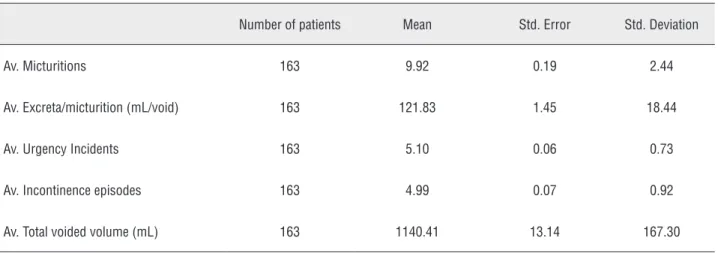
The data retrieved from the diaries were summarized, averaged and the descriptive statistics along with the general characteristics of our cohort are provided in Tables 1a and 1b. Correlations gra-dually increased along the increase in the diary’s du-ration reaching the maximum on the day 6. Table-2 summarizes the correlations of the different diary’s duration records with the 7 days average.
According to our test results, a 1-day and 2-day length bladder diary could not provide re-sults comparable to a 7-day diary in any parame-ter, since the differences that arose using the pai-red t-test between these durations were statistically significant. Thus, regarding micturitions per day, excreta per micturition, urgency episodes and total voided volume the 3-day records were not signifi-cantly different than the 7 days records (p>0.05). This absence of statistical significance was inter-preted as a failure to establish a true difference be-tween the 3-day length and the 7-day length recor-ds for 4 of the 5 evaluated parameters. As a result, the 3-day diary could provide data comparable to the 7-days in terms of these parameters. As for the incontinence episodes the 3-days length was bor-derline significantly different from the 7-day leng-th (p=0.044), becoming statistically non significant from day 4 and on. Table-3 summarizes the results of the comparisons between the different diary’s lengths. Comparisons between 1-day to 7-day and
Table 1a - Descriptive statistics of the cohort. Average data derived from the completed diaries.
Number of patients Mean Std. Error Std. Deviation
Av. Micturitions 163 9.92 0.19 2.44
Av. Excreta/micturition (mL/void) 163 121.83 1.45 18.44
Av. Urgency Incidents 163 5.10 0.06 0.73
Av. Incontinence episodes 163 4.99 0.07 0.92
Av. Total voided volume (mL) 163 1140.41 13.14 167.30
Table 1b - Patient’s general characteristics
Male Female Total
Patients (n) 94 69 163
Mean age (yrs) 30.3 61.7 43.6
Brain trauma (n) 59 26 85
Table 2 - Correlations of different diary’s length with the 7-day duration diary for the evaluated parameters (r values).
Day 1 Day 2 Day 3 Day 4 Day 5 Day 6
Micturitions 0,832 0,800 0,929 0,974 0,972 0,947
Excreta/micturition 0,745 0,866 0,891 0,839 0,970 0,990
Urgency episodes 0,609 0,669 0,822 0,922 0,961 0,979
Incontinence episodes 0,664 0,707 0,798 0,906 0,968 0,969
Total Urine 0,823 0,955 0,956 0,902 0,973 0,980
Table 3-Results of the comparisons between different diary’s length (comparison day1 versus day 7 and day 6 versus day 7 were omitted from the Table). Mean difference, 95% confidence intervals and P value of each comparison are provided.
Day 2 vs. Day 7 Day 3 vs. Day 7 Day 4 vs. Day 7 Day 5 vs. Day 7
Micturitions
Mean diff. -0.29 0.13 -0.012 0.049
95% Cl (-0.522, -0.056) (-0.014, 0.274) (-0.1, 0.075) (-0.041, 0.138)
P value 0.016 0.077 0.776 0.282
Excreta per micturition (mL/void)
Mean diff. 2.50 -1.75 -0.27 0.07
95% Cl (0.252, 4.757) (-3.551, 0.035) (-1.956, 1.413) (-0.619, 0.778)
P value 0.03 0.055 0.75 0.822
Urgency episodes
Mean diff. 0.12 0.06 -0.03 0.01
95% Cl (0.013, 0.237) (-0.005, 0.126) (-0.084, 0.022) (-0.021, 0.045)
P value 0.028 0.071 0.254 0.489
Incontinence episodes
Mean diff. 0.16 -0.11 -0.06 0.027
95% Cl (0.019, 0.306) (-0.207, -0.031) (-0.126, 0.003) (-0.009, 0.065)
P value 0.027 0.044 0.061 0.141
Voided volume (mL)
Mean diff. -12.15 -9.32 -8.65 4.30
95% Cl (-22.628, -1.633) (-17.062, 0.473) (-21.402, 4.092) (-0.701, 10.304)
6-day to 7-day duration were omitted from the Table in order to become less complicated. Mean differences along with 95% confidence intervals and P values of each comparison, between dura-tions, are presented in the Table.
DISCUSSION
BD’s are widespread used by clinicians in the assessment of voiding dysfunction, provid-ing real-time documentation of LUTS and voidprovid-ing habits in the patient’s environment during every-day life. BD’s reduce the recall bias (9-11) that af-fects questionnaires like history-taking, providing simultaneously objective evidence for the evalua-tion of several therapeutic intervenevalua-tions. Urody-namic studies (UDS) have been considered as the mainstay in the diagnostic approach of patients suffering from LUTS and cannot be replaced by a diary. Nevertheless, voiding diaries are a useful tool in the initial management of LUTS providing information of daily bladder function, contribut-ing to a more integrated interpretation of the UDS’ results, particularly in terms of the functional bladder capacity (12).
No consensus has been reached yet for the optimal duration of BD since no sufficient data could be found in the literature. In several pub-lished reports, diaries’ duration varies from 24 hours to 14 days. Wyman et al. (9) was the first who recommended that 7-day duration was suffi-cient to provide reliable documentation of urinary frequency and incontinence episodes in women. The most commonly recommended duration in lit-erature is the 7-day diary (5, 6, 9, 13-15), covering both leisure and working activities. Nevertheless, several studies reported that a diary with less du-ration than 7 days could furnish comparably reli-able results (16).
Nygaard and Holcomb (17) have suggested that a 3-day length is appropriate for trials evalu-ating stress incontinence, while Brown et al. (18) reported that, in patients suffering from urgency urinary incontinence, a 3-day duration diary could furnish reliable results in terms of daytime fre-quency, nocturia, urgency and incontinence epi-sodes. In 2005, Dmochowski et al. (19) analyzed, reviewed and compared two large-scale
random-ized phase III clinical trials with patients suffering from overactive bladder, treated with transdermal oxybutynin. In both trials patient’s symptoms were evaluated through voiding diaries with dif-ferent durations. In trial A 520 patients docu-mented their symptoms with a 7-day diary, while in trial B 361 patients documented their symptoms with a 3-day diary. Comparing the different du-rations, they concluded that 3-day diary appears to be equally effective to the 7-day, increasing potentially patient’s compliance in clinical trials. Our results appear to be in accordance to the con-clusion of the previously mentioned studies. Al-though the design and the cohort of our study was totally different, our results indicate that a 3-day diary length is adequate, effective and comparable to 7-day, providing credible results in patients suffering from suprapontine pathology in terms of the majority of the evaluated parameters.
Despite protracting the duration of the charts leads to an enhancement of the test reli-ability, prolonged studies might increase patient’s burden leading to decreased compliance, a term de-scribed as “diary fatigue” (6, 20). Tincello et al. (21) announced that 90.7% of the patients completed a 3-day diary compared to only 50% who completed a 7-day diary, respectively. Shick et al. (16) reported that patient’s compliance in BDs follows a logarith-mic curve, in contrast to the reliability of the results which follows a bell-shaped curve. The intersection of these two curves represents the minimum dura-tion of a diary which simultaneously provides ac-ceptable reliability of the results.
In 2004, Ku et al. (22) prospectively en-rolled 193 patients with incontinence and LUTS in a trial targeting to determine the appropriate duration of a diary assessing patient’s compliance and burden. According to their results patient compliance was not compromised by the 7-day diary while patient’s burden increases along the increase in the duration of the chart. Although pa-tient’s burden was not an evaluated parameter in the design of our study, we should mention the fact that the majority of our patients complained at the second visit about the duration of the BD, claiming that was rather inconvenient.
suffering from LUTS caused by several different conditions (diabetes, benign prostate hyperplasia, overactive bladder). In contrast to them, our study population was totally homogenous, since all sub-jects suffered from neurogenic urinary dysfunc-tion secondary to suprapontine pathology. Thus, the data provided in the literature for this specific population are deficient and sparse. To the best of our knowledge, this is one of the first attempts en-rolling such a pure cohort. In such cohort, the neu-rologic condition of patients is mainly responsible for their urinary dysfunction. As a result, patients’ storage and voiding function are less influenced from social, behavioural or environmental factors. The clinical assessment of such patients could be very strenuous due to their neurological pathology and their consequent mobility problems. The ma-jority of patients might be hospitalized for a long time; making their evaluation with the “classic” diary pattern, which includes leisure and working activities, unsuitable. According to our results a 3-day duration bladder diary is efficient and can provide results comparable to a 7-day length for 4 of our evaluated parameters. Only regarding in-continence episodes, 3 days seems inadequate to furnish comparable results, showing a borderline difference. In conclusion, 3-day bladder diary ap-pears to be a quite useful and valuable tool in the evaluation of LUTS in this specific group of pa-tients.
Nevertheless, our study has some limita-tions. Although it was prospective, we had not de-signed a second completion of the diaries by the same subjects, as a retest. This could have added concurrent validity to our results (23). Total fluid intake and patient’s burden were not evaluated in the study. Moreover, we have to mention that our patients were not evaluated by UDS and that our study was based on the use of a self-recorded di-ary (20). Finally, we have to point out that the results of the current study cannot be applied to other voiding dysfunctions as only suprapontine neurogenic disorders were included.
CONCLUSIONS
Three-day duration for bladder diary is as effective and sufficient as the 7-day, in at least
4 out of 5 evaluated parameters, in patients su-ffering from neurogenic urinary dysfunction due to suprapontine pathology. Thus, a 4-day length BD can provide comparable results in all parame-ters. In conclusion, the reliability of results was not compromised by the reduction in the number of days, clearly suggesting that the 7-day diary is unnecessarily protracted. Nevertheless, since LUTS derived from several different clinical conditions, it seems necessary that a validated standardized bladder diary in terms of diary format, duration and evaluated parameters needs to be developed in the future.
CONFLICT OF INTEREST
None declared.
REFERENCES
1. Manack A, Motsko SP, Haag-Molkenteller C, Dmochowski RR, Goehring EL Jr, et al. Epidemiology and healthcare utilization of neurogenic bladder patients in a Us claims database. urourol Urodyn. 2011;30:395-401.
2. Gormley EA. Urologic complications of the neurogenic bladder. Urol Clin North Am. 2010;37:601-7.
3. Abrams P, Cardozo L, Fall M, Griffiths D, Rosier P, Ulmsten U, et al. The standardisation of terminology of lower urinary tract function: report from the Standardisation Sub-committee of the International Continence Society. Neurourol Urodyn. 2002;21:167-78.
4. Bright E, Drake MJ, Abrams P. Urinary diaries: evidence for the development and validation of diary content, format, and duration. Neurourol Urodyn. 2011;30:348-52.
5. Abrams P, Klevmark B. Frequency volume charts: an indispensable part of lower urinary tract assessment. Scand J Urol Nephrol Suppl. 1996;179:47-53.
6. Homma Y, Ando T, Yoshida M, Kageyama S, Takei M, Kimoto K, et al. Voiding and incontinence frequencies: variability of diary data and required diary length. Neurourol Urodyn. 2002;21:204-9.
7. Fountoulakis KN, Tsolaki M, Chantzi H, Kazis A. Mini Mental State Examination (MMSE): A validation study in Greece. Am J Alzheimers Dis Other Demen. 2000;15:342-345.
8. Mazurick CA, Landis JR. Evaluation of repeat daily voiding measures in the National Interstitial Cystitis Data Base Study. J Urol. 2000;163:1208-11.
10. Blanker MH, Bohnen AM, Groeneveld FP, Bernsen RM, Prins A, Ruud Bosch JL. Normal voiding patterns and determinants of increased diurnal and nocturnal voiding frequency in elderly men. J Urol. 2000;164:1201-5.
11. Yap TL, Cromwell DA, Brown C, van der Meulen J, Emberton M. The relationship between objective frequency-volume chart data and the I-PSS in men with lower urinary tract symptoms. Eur Urol. 2007;52:811-8.
12. De Wachter S, Wyndaele JJ. Frequency-volume charts: a tool to evaluate bladder sensation. Neurourol Urodyn. 2003;22:638-42.
13. Robinson D, McClish DK, Wyman JF, Bump RC, Fanti JA. Comparison between urinary diaries completed with and without intensive patient instructions. Neurourol Urodyn. 1996;15:143-8.
14. Jaffe JS, Ginsberg PC, Silverberg DM, Harkaway RC. The need for voiding diaries in the evaluation of men with nocturia. J Am Osteopath Assoc. 2002;102:261-5.
15. Locher JL, Goode PS, Roth DL, Worrell RL, Burgio KL. Reliability assessment of the bladder diary for urinary incontinence in older women. J Gerontol A Biol Sci Med Sci. 2001;56:M32-5.
16. Schick E, Jolivet-Tremblay M, Dupont C, Bertrand PE, Tessier J. Frequency-volume chart: the minimum number of days required to obtain reliable results. Neurourol Urodyn. 2003;22:92-6.
17. Nygaard I, Holcomb R. Reproducibility of the seven-day voiding diary in women with stress urinary incontinence. Int Urogynecol J Pelvic Floor Dysfunct. 2000;11:15-7
18. Brown JS, McNaughton KS, Wyman JF, Burgio KL, Harkaway R, Bergner D, et al. Measurement characteristics of a voiding diary for use by men and women with overactive bladder. Urology. 2003;61:802-9.
19. Dmochowski RR, Sanders SW, Appell RA, Nitti VW, Davila GW. Bladder-health diaries: an assessment of 3-day vs 7-day entries. BJU Int. 2005;96:1049-54.
20. Groutz A, Blaivas JG, Chaikin DC, Resnick NM, Engleman K, Anzalone D, et al. Noninvasive outcome measures of urinary incontinence and lower urinary tract symptoms: a multicenter study of micturition diary and pad tests. J Urol. 2000;164:698-701.
21. Tincello DG, Williams KS, Joshi M, Assassa RP, Abrams KR. Urinary diaries: a comparison of data collected for three days versus seven days. Obstet Gynecol. 2007;109:277-80. 22. Ku JH, Jeong IG, Lim DJ, Byun SS, Paick JS, Oh SJ. Voiding
diary for the evaluation of urinary incontinence and lower urinary tract symptoms: prospective assessment of patient compliance and burden. Neurourol Urodyn. 2004;23:331-5. 23. Jimenez-Cidre MA, Lopez-Fando L, Esteban-Fuertes M,
Prieto-Chaparro L, Llorens-Martinez FJ, Salinas-Casado J, et al. The 3-day bladder diary is a feasible, reliable and valid tool to evaluate the lower urinary tract symptoms in women. Neurourol Urodyn. 2015;34:128-32.
_______________________ Correspondence address: