ABSTRACT
BACKGROUND AND OBJECTIVES:Postoperative pain af-ter total hip arthroplasty is moderate to severe and requires ef-fective analgesic techniques. his study aimed at comparing con-tinuous lumbar plexus block and epidural analgesia in patients submitted to hip arthroplasty.
METHODS: his is a prospective, observational and analyti-cal study of patients submitted to hip arthroplasty in a two-year period, under postoperative analgesia with continuous lumbar plexus block and epidural analgesia. Patients were divided ac-cording to the analgesic technique chosen by the anesthesiolo-gist. he protocol consists in continuous perfusion of 0.2% ropi-vacaine (5mL/h) via continuous lumbar plexus block catheter or 0.1% ropivacaine and fentanyl (3µg/mL) (5mL/h) via epidural catheter. Using Acute Pain Unit records, three postoperative days were compared between continuous lumbar plexus block and epidural analgesia with regard to pain intensity, rescue analgesia, complications and hospital stay.
RESULTS:Participated in the study 162 patients. Most patients of both groups had no pain in the irst postoperative day (77.6% continuous lumbar plexus block versus 79.2% epidural). Both groups were not diferent with regard to pain intensity and need for rescue analgesia (23.5% continuous lumbar plexus block versus 22.1% epidural). Continuous lumbar plexus block group had fewer complications (4.7% versus 23.4%), namely motor block, nausea, vomiting and itching. he low number of compli-cations does not allow the detection of signiicant diferences be-tween techniques. Most patients of both groups were discharged in the third postoperative day.
Postoperative analgesia for hip arthroplasty: comparison of continuous
lumbar plexus block and epidural analgesia
Analgesia pós-operatória da artroplastia do quadril: comparação do bloqueio de plexo lombar
contínuo com a analgesia peridural
Gabriela Maria Pereira da Silva e Costa1, Inês Martins Carvalho2, Ana Isabel Rodrigues Castro3, Neusa Cristina Ribeiro Lages4, Carlos
Manuel Machado Correia4
1. Centro Hospitalar do Tâmega e Sousa, Penaiel, Portugal.
2. Centro Hospitalar de Lisboa Ocidental, Departamento de Anestesiologia, Lisboa, Portugal. 3. Faculdade de Ciências da Universidade do Porto, Departamento de Ciências de Com-putadores, Porto, Portugal.
4. Centro Hospitalar do Alto Ave, Departamento de Anestesiologia, Guimarães, Portugal.
Submitted in October 04, 2015.
Accepted for publication in January 20, 2016. Conlict of interests: none – Sponsoring sources: none.
Correspondence to:
Gabriela Maria Pereira da Silva e Costa Avenida Cidade de Guimarães, 64 4480-660 Vila do Conde, Portugal. E-mail: [email protected]
© Sociedade Brasileira para o Estudo da Dor
CONCLUSION: As compared to epidural analgesia, continu-ous lumbar plexus block has provided similar analgesia with fewer complications.
Keywords:Epidural analgesia, Hip arthroplasty, Lumbar plexus block, Postoperative pain.
RESUMO
JUSTIFICATICA E OBJETIVOS: A dor pós-operatória da ar-troplastia total do quadril tem intensidade moderada a intensa, exigindo a realização de técnicas analgésicas eicazes. O objetivo deste estudo foi comparar o bloqueio do plexo lombar contínuo com a analgesia peridural em pacientes submetidos à artroplastia de quadril.
MÉTODOS: Estudo retrospectivo, observacional e analítico dos pacientes submetidos à artroplastia de quadril durante dois anos, sob analgesia pós-operatória por bloqueios do plexo lom-bar contínuo e peridural. Os pacientes foram divididos de acor-do com a técnica analgésica escolhida pelo anestesiologista. O protocolo consiste em infusão contínua de ropivacaína a 0,2% (5mL/h) via cateter de bloqueio do plexo lombar contínuo ou em ropivacaína a 0,1% e fentanil 3µg/mL (5mL/h) via cateter peridural. Recorrendo aos registos da Unidade de Dor Aguda, foram comparados os três dias pós-operatórios dos grupos blo-queio do plexo lombar contínuo e peridural em relação à in-tensidade da dor, analgesia de resgate, complicações e tempo de internação hospitalar.
RESULTADOS: Foram incluídos 162 pacientes. A maioria de ambos os grupos não apresentou queixas de dor no primeiro dia pós-operatório (77,6% bloqueio do plexo lombar contínuo
versus 79,2% peridural). Ambos os grupos não diferiram em
re-lação à intensidade de dor nem à incidência de necessidade de analgesia de resgate (23,5% bloqueio do plexo lombar contínuo versus 22,1% peridural). O grupo bloqueio do plexo lombar contínuo registrou menos complicações (4,7% versus 23,4%), nomeadamente bloqueio motor, náuseas, vômitos e prurido. A rara ocorrência de complicações não permite detectar diferenças signiicativas entre as técnicas. A maioria dos pacientes de ambos os grupos obteve alta hospitalar no 3º dia pós-operatório. CONCLUSÃO: Em relação à analgesia peridural, o bloqueio do plexo lombar contínuo proporcionou analgesia semelhante com menos complicações.
Descritores: Analgesia peridural, Artroplastia de quadril, Blo-queio do plexo lombar, Dor pós-operatória.
INTRODUCTION
Due to population aging and the high prevalence of hip os-teoarthritis among the elderly, total hip arthroplasty (THA) is an increasingly frequent procedure. Older age and multi-ple associated comorbidities may be an anesthetic and anal-gesic challenge. THA postoperative pain (POP) is moderate to severe and worsens with mobilization, being especially severe during the first 24 postoperative hours. Patients’ recovery requires effective analgesia to assure comfort and satisfaction necessary for early mobilization and functional rehabilitation. So, adequate THA analgesia speeds recovery and minimizes postoperative morbility-mortality1-3.
Different analgesic techniques to provide post-THA pain relief were studied, such as intravenous patient-controlled analgesia (PCA) with opioids, epidural analgesia, peripheral nerves block and lumbar plexus block (LPB). The technique with better analgesic efficacy, safety and postoperative re-covery has not yet been determined2.
Therapeutic intravenous PCA regimens offer poor pain re-lief during movement and have secondary opioid effects and several technical problems. Most common postoperative THA analgesia is the epidural block, although presenting known adverse effects, such as hypotension, nausea, vomit-ing, pruritus, urinary retention, motor block and respiratory depression. Peripheral nerves block provides excellent anal-gesia with little motor and sympathetic blocks, preventing adverse effects of local anesthetics and opioids administered to the neuraxis3. Recently, LPB started to receive more
at-tention as THA analgesic technique1-3.
Lumbar plexus is responsible for skin sensitivity in the side of the thigh and originates some branches to the hip4. So,
posterior LPB is able to promote effective unilateral anal-gesia, to decrease consumption of other analgesics and to contribute to patients’ rehabilitation and satisfaction after THA2. Single shot LPB analgesia is limited to the first 8
postoperative hours, but may be prolonged by the introduc-tion of a continuous infusion catheter5.
he scarcity of clinical studies comparing the analgesic ei-cacy and the safety proile of continuous lumbar plexus block (cLPB) versus epidural analgesia in patients submitted to THA has called our attention, so we considered important to investigate whether cLPB may replace epidural analgesia to decrease the incidence of adverse efects and to speed recov-ery, functional rehabilitation and hospitalization time. This study aimed at carrying out a prospective analysis of the postoperative period of patients submitted to THA to compare analgesic efficacy, safety and hospitalization time of cLPB and epidural block.
METHODS
This was a retrospective study carried out in the Centro Hospitalar Alto Ave (Guimarães, Portugal) from January 1, 2011 to December 31, 2012, including all patients submit-ted to cLPB and epidural block for postoperative THA
an-algesia or THA review. Exclusion criteria were the need to change analgesic protocol due to failed block or insufficient analgesia.
Anesthetic and analgesic techniques were chosen by an-esthesiologists according to their preference and patients condition. Catheters for cLPB or epidural analgesia were installed before anesthetic induction. Anesthetic technique was balanced general anesthesia (BGA) or spinal block (SB) with 0.5% isobaric bupivacaine or 0.5% isobaric levobupi-vacaine.
Approach and catheter introduction technique for cLPB was that described by Capdevila et al.4 with dual guidance
(electric stimulation and ultrasound6). After catheter
inser-tion, 20mL of 0.5% ropivacaine were administered. After surgery, in the postoperative care unit, patients with cLPB started continuous perfusion of 0.2% ropivacaine (5mL/h, via elastomer).
Epidural catheter was inserted in L3-L4 or L4-L5 spaces with cephalic introduction of 3 to 5cm of 20G multibore cath-eter, followed by the administration of ropivacaine and fen-tanyl in doses chosen by the anesthesiologist. After surgery, patients with epidural catheter started 0.1% ropivacaine and 3µg/mL fentanyl (5mL/h, via elastomer).
Postoperative adjuvant analgesia for both groups was paracetamol (1000mg every 6h) with or without the asso-ciation of non-steroid anti-inflammatory drugs (15 – 30mg ketorolac or 20 – 40mg parecoxib every 12 hours), accord-ing to comorbidities of each patient.
Statistical analysis
Program SPSS version 17.0 (SPSS Inc., Chicago, IL, USA) was used to compare patients under epidural analgesia or cLPB. Demographic data were compared between groups, as well as the incidence of pain or complications in the postoperative period (t, Chi-square and
Wilcoxon-Mann-Whitney tests). For all tests, p<0.05 was considered statis-tically significant.
his study was approved by the Anesthesiology Ethics Com-mittee, Centro Hospitalar Alto Ave, process 23/2012.
RESULTS
During the study period, a universe of 165 patients was evalu-ated. hree patients were excluded for not establishing block-ade or for insuicient analgesia (1 from the epidural group and 2 from the cLPB group). Table 1 shows characterization of sample and of groups. Sample is made up of 162 patients with mean age of 67.22±11.57 years [32;91]; 50.6% were males; 58.6% ASA II; 70.4% submitted to THA; 84.0% un-der SB. he epidural group has 77 patients with mean age of 65.44±4.95 years [37;84]; 55.8% were females; 63.6% sub-mitted to THA; 85.7% under SB. he cLPB group has 85 patients with mean age of 68.62±12.29 years [32;91]; 56.5% were males; 72.9% submitted to THA; 82.4% under BGA. Groups are similar and do not have signiicant diferences with regard to age (t test), gender, ASA and type of procedure
(Chi-square test).
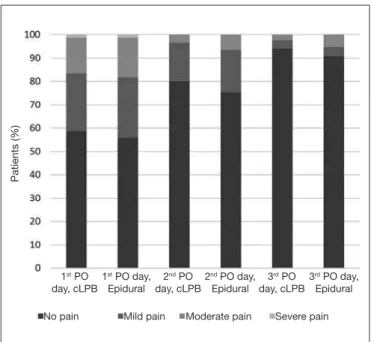
Most patients of both groups had no pain at rest during the irst postoperative day (77.6% cLPB versus 79.2% epidural). Approximately 22.4% of patients (n=19) of the cLPB group had pain complaints, corresponding to mild pain in 15.3% of cases (n=13). hese values are not signiicantly diferent from the epidural group, which had pain in 20.8% of cases (n=16), classiied as mild pain by 14.3% of patients (n=11) (Figure 1). With regard to pain at movement during the irst POD, 58.8% of cLPB group (n=50) and 55.8% of the epi-dural group (n=43) had no pain and most of remaining pa-tients had mild pain (24.7% cLPB versus 26.0% epidural) (Figure 2). In both groups, POP at rest and at movement has decreased along the second and third postoperative days (Fig-ures 1 and 2). Groups were not diferent with regard to pain at rest and at movement during the three postoperative days. Group cLPB sensory block was signiicantly better as
com-Table 1. Distribution and characterization of evaluated patients and groups
Groups Age Gender ASA Surgery Anesthetic techique
Male Female I II III ? THA THA Review SB BGA
Epidural (n=77)
65.44±4.95 34 43 5 43 14 15 55 22 66 11
cLPB (n=85)
68.62±12.29 48 37 3 52 17 13 59 26 70 15
Total (n=162)
67.22±11.57 82 80 8 95 31 28 114 48 136 26
ASA = American Society of Anesthesiologists; ASA? = unknown; THA = total hip arthroplasty; CLPB = continuous lumbar plexus block; SB = spinal block; BGA = balanced general anesthesia.
Figure 1. Comparison of pain intensity at rest along the three days for both groups
Figure 2. Comparison of pain intensity at movement along the three days for both groups
1st PO
day, cLPB
1st PO day,
Epidural
Patients (%)
No pain Mild pain Moderate pain Severe pain 2nd PO
day, cLPB
2nd PO day,
Epidural
3rd PO
day, cLPB
3rd PO day,
Epidural
1st PO
day, cLPB
1st PO day,
Epidural
Patients (%)
No pain Mild pain Moderate pain Severe pain
2nd PO
day, cLPB
2nd PO day,
Epidural
3rd PO
day, cLPB
3rd PO day,
pared to the epidural group. cLPB group had unilateral sen-sory block, classiied as grade 2 in 87.1% of patients (n=74). In the epidural group, blockade was bilateral being classiied as grade 2 in 75.3% of patients (n=58).
Rescue analgesic dose (5mL of 0.2% ropivacaine) was need-ed for 23.5% of patients (n=20) of the cLPB group and for 22.1% of patients (n=17) of the epidural group. he inci-dence of patients needing at least one rescue dose was not signiicantly diferent between groups. Rescue doses were pri-marily administered in the irst postoperative day for 22.4% of cLPB group (n=19) and 22.1% of epidural group (n=17), most cases needing just one dose (15.3% of cLPB versus 18.2% epidural). he need for rescue doses has signiicantly decreased in both groups in the second (2.4% cLPB versus 2.6% epidural) and third postoperative days (1.2% cLPB ver-sus 1.3% epidural) (Figure 3).
Most patients were discharged in the third postoperative day, namely 68.2% of cLPB (n=58) and 72.7% of epidural block patients (n=56). Among remaining patients, 20% of cLPB group (n=17) and 22.1% of epidural group (n=17) were discharged in the fourth postoperative day; 10.6% of cLPB (n=9) and 5.2% of epidural (n=4) were discharged in the ifth postoperative day; 1.2% of cLPB (n=1) was discharged in the sixth postoperative day.
DISCUSSION
his study has shown that cLPB has provided analgesic ei-cacy equivalent to epidural block, with the advantage of pre-senting a better safety proile. Mean hospitalization time was also similar for both techniques.
his shows the clinical practice reality of the studied institu-tion. However, it is necessary to take into account limitations inherent to a retrospective design, such as administration of diferent ropivacaine doses for the cLPB group (0.2% ropiva-caine) and the epidural group (0.1% ropivaropiva-caine), the associa-tion of fentanyl only in the epidural group and random load dose administered in the perioperative period for epidural anal-gesia. Another limitation of this study was the low incidence of complications, which does not allow determining the existence of statistically signiicant diferences between groups.
As to the evaluation of analgesic eicacy, epidural and cLPB groups were not diferent in pain intensity or the incidence of rescue doses, but the incidence of complete sensory block was higher in the cLPB group. During the irst postoperative day, cLPB group had 92.9% of patients with no pain or mild pain at rest, not difering from the epidural analgesia group with 93.5% of patients in the same conditions. With regard to pain at move-ment during the irst postoperative day, most patients had no pain and from remaining patients most reported mild pain. Rescue doses are primarily administered in the irst postop-erative day, stressing that a similar number of patients of both groups have not needed rescue analgesia (77.6% cLPB versus 77.9% epidural). In both groups, POP at rest and at move-ment, as well as the need for rescue doses, have considerably decreased in the second and third postoperative days. he in-cidence of complete sensory block is lower in the epidural group, with the presence of bilateral block in case of epidural block and unilateral block for cLPB. Results also suggest that adopted analgesia regimens are adequate for the postoperative period of patients submitted to hip arthroplasty. Scarce litera-ture data report that LPB provides excellent intra and post-operative analgesia, decreases opioid consumption, speeds recovery and has few adverse efects5,7,8.
Türker et al.8 have compared LPB and epidural analgesia and
have not found statistically signiicant diferences in pain in-tensity and postoperative rescue analgesia consumption. Il-feld et al.9 have concluded that most patients submitted to
THA under analgesia with cLPB by Patient Controlled Re-gional Analgesia could walk 30 meters and be discharged in the irst postoperative day. However, these results also difer from other studies. Duarte et al.3 have reported that patient Table 2. Comparison of complications for both groups
Groups Motor
block
Nausea & vomiting
Pruritus Total
cLPB (n=85) 1(1.2%) 3(3.5%) 0 4(4.7%)
Epidural (n=77) 3(3.9%) 8(10.4%) 7(9.1%) 18(23.4%)
Total (n=162) 4(2.5%) 11(6.8%) 7(4.3%) 22(13.6%)
cLPB = continuous lumbar plexus block.
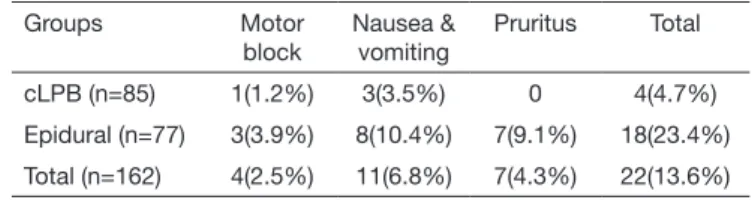
he incidence of complications for both groups is shown in table 2. cLPB group had a total number of complications signiicantly lower as compared to the epidural group (4.7% cLPB versus 23.4% epidural). However, the scarce incidence of each compli-cation does not allow establishing statistically signiicant difer-ences between groups. With regard to motor block degree, there has been blockade degree 1 in 1.2% of patients (n=1) with cLPB analgesia and in 3.9% of patients (n=3) with epidural analgesia. Pruritus was reported only by the epidural group, with incidence of 9.1% (n=7). he incidence of nausea and vomiting was higher in the epidural group (3.5% cLPB versus 10.4% epidural). here was one patient of each group in whom the catheter was exterior-ized and in both cases APU discharge was determined for con-sidering that patients no longer needed analgesic intervention.
Figure 3. Comparison of the number of rescue doses during the three postoperative days for both groups
1st PO
day, cLPB
1st PO day,
Epidural
Patients (%)
0 dose 1 dose 2 doses 3 doses 4 doses
2nd PO
day, cLPB
2nd PO day,
Epidural
3rd PO
day, cLPB
3rd PO day,
controlled epidural analgesia with 0.2% ropivacaine and 3µg/ mL fentanyl promotes more efective pain relief at rest and during mobilization as compared to cLPB with 0.2% ropiva-caine and that both techniques are equivalent for functional rehabilitation. he incidence of rescue analgesia for the cLPB group was 23.5%, being much higher than 6.5% reported by Capdevilla et al.4. his diference is probably due to diferent
perfusion techniques, since that study has used mechanical infusion pump, while the protocol of this study has used per-fusion with elastomer with its inherent low luctuations4.
Few adverse efects were observed in our study, which is in line with other studies4. he cLPB group had lower incidence
of complications as compared to the epidural group. he in-cidence of motor block and nausea and vomiting was lower in the cLPB group, although the diference was not statisti-cally signiicant. he higher incidence of nausea and vomiting in the epidural group may be explained by the association of fentanyl in this group. No cLPB group patient has com-plained of pruritus, diferently from 9.1% of patients with the epidural catheter who presented this complaint. Unfortu-nately, the low incidence of secondary efects and complica-tions in the sample does not allow inferring the existence of signiicant diferences between cLPB and epidural techniques. cLPB seldom has severe complications being known intoxica-tion by local anesthetics following inadvertent intravascular injections, spinal administration, intraperitoneal puncture, subcapsular renal hematoma by renal perforation and retro-peritoneal hematoma1,3,5.
Drug dispersion to the epidural space was considered by other authors as the most frequent LPB complication, with inci-dence of 5%4,5,10. Chosen approach for the blockade has not
inluenced bilateral local anesthetic epidural difusion, being most probable causes the injection of large volumes10 and the
injection pressure, especially pressures above 20 psi11. he
lack of severe complications in our study may be associated to the safety provided by the dual guidance technique, which combines electric stimulation and ultrasound to conirm cor-rect needle location12.
Although not recommended as routine in case of low analge-sic eicacy, blood traces in the catheter or negative catheter aspiration, catheter position was conirmed in our study by means of X-rays with contrast injection. he best way to avoid intravascular injection is still aspiration previous to injection, negative test dose and fractioned and slow administration of drugs, although there might be false negative results10. LPB
is a very deep block which should not be induced in patients with altered coagulation test or platelet dysfunction and it is recommended to be induced by experienced professionals1,3,5.
In our institution, the same anticoagulation standards used for placement and removal of epidural catheters were used for cLPB.
here are no diferences between cLPB and epidural groups with regard to hospitalization time. Most patients of both groups were discharged in the third postoperative day and almost all patients of the sample were discharged before the fourth postoperative day. Our results are diferent from
stud-ies suggesting that cLPB speeds postoperative recovery8,13,
suggesting that recovery times are similar for both groups. Reports of severe complications and familiarity with other techniques may explain the reluctance of anesthesiologists in choosing LPB. However, epidural analgesia has known sec-ondary efects14. Our study conirms scarce studies results
which conclude that cLPB may provide similar or better an-algesia as compared to epidural block, with the advantages of decreasing the incidence of adverse efects8,13. he Prospect
Group recommends cLPB for postoperative analgesia of THA in situations where general anesthesia is the choice15. We hope
that this study contributes to the demystiication of postop-erative analgesia with cLPB and calls the attention of anesthe-siologists to the advantages of this technique.
CONCLUSION
Our study suggests that cLPB is a safer technique with anal-gesic eicacy equivalent to epidural block for hip arthroplasty. Based on our results and on existing literature, it seems that cLPB could be a valid alternative to epidural block. In spite of relecting the clinical practice of our institution and of the inherent limitations of the method, we believe that our re-sults might condition a change in hip arthroplasty postop-erative analgesia paradigm, contributing to a safer analgesic practice. We stress the need for multicenter, prospective and randomized studies, with larger samples to determine the role of cLPB in hip arthroplasty postoperative analgesia, as well as its hemodynamic efects.
ACKNOWLEDGEMENTS
he authors acknowledge the cooperation of the APU nursing group of the Centro Hospitalar Alto Ave, Guimarães, Portugal.
REFERENCES
1. YaDeau JT, Tedore T, Goytizolo EA, Kim DH, Green DS, Westrick A. et al. Lumbar plexus blockade reduces pain after hip arthroscopy: a prospective randomized control-led trial. Anesth Analg. 2012;115(4):968-72.
2. Duarte LT, Paes FC, Fernandes Mdo C, Saraiva RA. Posterior lumbar plexus blo-ck in postoperative analgesia for total hip arthroplasty: a comparative study betwe-en 0.5% bupivacaine with epinephrine and 0.5% ropivacaine. Rev Bras Anestesiol. 2009;59(3):273-85. English, Portuguese.
3. Duarte LT, Beraldo PS, Saraiva RA. Efects of epidural analgesia and continuous lum-bar plexus block on functional rehabilitation after total hip arthroplasty. Rev Bras Anestesiol. 2009;59(5):531-44. Portuguese.
4. Capdevila X, Macaire P, Dadure C, Choquet O, Biboulet P, Ryckwaert Y, et al. Con-tinuous psoas compartment block for postoperative analgesia after total hip arthro-plasty: new landmarks, technical guidelines, and clinical evaluation. Anesth Analg. 2002;94(6):1606-13.
5. Touray ST, de Leeuw MA, Zuurmond WW, Perez RS. Psoas compartment block for lower extremity surgery: a meta-analysis. Br J Anaesth. 2008;101(6):750-60. 6. Karmakar MK, Ho AM, Li X, Kwok WH, Tsang K, Ngan Kee WD.
Ultrasound-gui-ded lumbar plexus block through acoustic window of the lumbar ultrasound trident. Br J Anaesth. 2008;100(4):533-7.
7. Freitas HF, Flores F, Lima LC, Couceiro TC, Neves M, Lira C. et al. Avaliação da anal-gesia pós-operatória em artroplastias de quadril com morina por via subaracnoidea asso-ciada ao bloqueio “3 em 1”: estudo aleatório e encoberto. Rev Dor. 2012;13(2):137-40. 8. Türker G, Uçkunkaya N, Yavascaoglu B, Yilmazlar A, Ozçelik S. Comparison of the
catheter-technique psoas compartment block and the peridural block for analgesia in partial hip replacement surgery. Acta Anaesthesiol Scand. 2003;47(1):30-6. 9. Ilfeld BM, Gearen PF, Enneking FK, Berry LF, Spadoni EH, George SZ, et al. Total
pso-as compartment nerve block: a prospective fepso-asibility study. Reg Anesth Pain Med. 2006;31(2):113-8.
10. Mannion S. Psoas compartment block. Continuing education in anaesthesia. Crit Care Pain. 2007;7(5):162-6.
11. Gadsden JC, Lindenmuth DM, Hadzic A, Xu D, Somasundarum L, Flisinski KA. Lumbar plexus block using high-pressure injections leads to contralateral and epidural spread. Anesthesiology. 2008;109(4):683-8.
12. Carvalho I, Costa G, Lages N, Correia C. Cirurgia da anca e bloqueio do plexo lom-bar. Rev Soc Port Anestesiol. 2015;24(1):6-11.
13. Biboulet P, Morau D, Aubas P, Bringuier-Branchereau S, Capdevila X. Postoperative analgesia after total-hip arthroplasty: comparison of intravenous patient-controlled analgesia with morphine and single injection of femoral nerve or psoas compart-ment block: a prospective, randomized, double-blind study. Reg Anesth Pain Med, 2004;29(2):102-9.
14. de Leeuw MA, Zuurmond WW, Perez RS. he psoas compartment block for hip surgery: the past, present, and future. Anesthesiol Res Pract. 2011;2011:159541. 15. postoppain.org. PROSPECT working group – procedure speciic postoperative pain