Original Article
Comparison of spirometric changes in the response to bronchodilators
of patients with asthma or chronic obstructive pulmonary disease*
Comparação da variação de resposta ao broncodilatador através da espirometria em portadores de asma ou doença pulmonar obstrutiva crônica
Isabella Correia Silvestri1, Carlos Alberto de Castro Pereira2, Sílvia Carla Sousa Rodrigues3
Abstract
Objective: Making the differential diagnosis between asthma and chronic obstructive pulmonary disease (COPD) based on the response to inhaled bronchodilators by means of spirometry is controversial.The objective of this study was to identify the most useful spirometric variables in order to distinguish between asthma and COPD. Methods: Retrospective study conducted from April of 2004 to January of 2006, comparing the spirometric parameters of 103 nonsmoking patients with asthma to those of 108 patients with COPD who were smokers for more than 10 pack-years. All of the patients included in the study were older than 40 and presented stable disease at the time of the test.
Results: Initial forced expiratory volume in one second (FEV1) was the same in the two groups (pre-bronchodilator FEV1 = 51%). However,
patients with COPD were older (66 ± 9 years vs. 59 ± 11 years, p < 0.001) and more frequently male (73% vs. 27%, p < 0,001).After the use of the bronchodilator, the median absolute difference in FEV1 was 0.25 L (range, −0.09 to 1.13 L) in patients with asthma and 0.09 L (range, −0.1 to 0.73 L) in those with COPD (p < 0.001).The highest sensitivity (55%), specificity (91%) and likelihood ratio (6.1) for asthma
diagnosis was obtained when the percentage increase in postbronchodilator FEV1 in relation to the predicted FEV1 (∆%predFEV1) was equal
to or greater than 10%.Isolated significant increases in forced vital capacity were more common in patients with COPD. Conclusions: In patients over the age of 40 and presenting obstructive lung disease, a ∆%predFEV1≥ 10% is the best spirometric parameter to distinguish
asthma from COPD.
Keywords: Spirometry; Respiratory function tests; Lung diseases, obstructive.
Resumo
Objetivo: O diagnóstico diferencial entre asma e doença pulmonar obstrutiva crônica (DPOC) através da resposta aos broncodilatadores inalatórios na espirometria ainda é controverso. O objetivo deste estudo foi detectar quais variáveis espirométricas melhor diferenciam asma de DPOC. Métodos: Estudo retrospectivo realizado entre abril de 2004 e janeiro de 2006, comparando-se os parâmetros espirométricos de 103 pacientes asmáticos, não fumantes, com os de 108 pacientes portadores de DPOC, fumantes de mais de 10 anos-maço. Todos os pacientes tinham mais de 40 anos e apresentavam doença estável no momento do exame. Resultados: O volume expiratório forçado no primeiro segundo (VEF1) pré-broncodilatador foi igual nos dois grupos (VEF1 = 51%), mas os portadores de DPOC eram mais velhos (66 ± 9 anos vs. 59 ± 11 anos, p < 0,001) e, na sua maioria, do sexo masculino (73% vs. 27%, p < 0,001). A mediana da variação absoluta do VEF1 pós-broncodilatador foi de 0,25 L (intervalo, −0,09 a 1,13 L) nos pacientes com asma e de 0,09 L (intervalo, −0,1 a 0,73 L) nos com
DPOC (p < 0,001). A melhor combinação de sensibilidade (55%), especificidade (91%) e razão de verossimilhança (6,1) para o diagnóstico de asma foi obtida quando a percentagem de incremento do VEF1 pós-broncodilatador em relação ao VEF1 previsto foi igual ou maior que
10% (p < 0,001). Variações significativas isoladas da capacidade vital forçada foram mais comuns nos pacientes com DPOC. Conclusões: Em portadores de doenças pulmonares obstrutivas com mais de 40 anos, a ∆%prevVEF1≥ 10% constitui o melhor parâmetro espirométrico para diferenciar asma de DPOC.
Descritores: Espirometria; Testes de função respiratória; Pneumopatias obstrutivas.
* Study conducted at the Hospital do Servidor Público Estadual de São Paulo – HSPE/SP, São Paulo Hospital for State Civil Servants – São Paulo, Brazil. 1. Masters Student in Pulmonology. Hospital do Servidor Público Estadual de São Paulo – HSPE/SP, São Paulo Hospital for State Civil Servants – São Paulo, Brazil.
2. Head of the Respiratory Diseases Department. Hospital do Servidor Público Estadual de São Paulo – HSPE/SP, São Paulo Hospital for State Civil Servants – São Paulo, Brazil.
3. Head of the Pulmonary Function Laboratory. Hospital do Servidor Público Estadual de São Paulo – HSPE/SP, São Paulo Hospital for State Civil Servants – São Paulo, Brazil.
Correspondence to: Isabella Correia Silvestri. Rua Pedro de Toledo, 1800, Bloco F, 3º andar, Laboratório de Função Pulmonar, CEP 04029-000, São Paulo, SP, Brasil.
Financial support: None.
Methods
This was a retrospective analysis of spirometric patterns in patients with asthma or COPD under regular outpatient treatment at the Pulmonology Clinic of the São Paulo Hospital for State Civil Servants. The study design received the uncon-ditional approval of the Ethics Committee of the Hospital.
The spirometric tests met all of the accept-ability and reproducibility criteria established by the Brazilian Thoracic Association (BTA).(7) The tests
were conducted using two different spirometers (SensorMedics, Yorba Linda, CA, USA; MultiSpiro Inc., Irvine, CA, USA) and in two phases: preb-ronchodilator; and postbronchodilator (15 min after the administration of 400 µg of albuterol via a metered-dose inhaler with a spacer. Reference ranges were calculated based on equations recently formulated for the Brazilian population.(13) Only the
tests in which there was airway obstruction (with or without a reduction in FVC), defined as a FEV1/ FVC ratio below the lower limit of normality, were considered.
The diagnosis of asthma or COPD was made by attending pulmonologists, during routine treat-ment, based on the clinical criteria established by the BTA.(14,15) A total of 1,061 spirometric tests,
all conducted between April of 2004 and January of 2006, were evaluated: 620 were indicative of a diagnosis of asthma, and 441 were indicative of a diagnosis of COPD. From among those indicative of asthma, 284 were selected based on the following criteria: patient over 40 years of age; stable disease at the time of the test; and no history of smoking. From among those indicative of COPD, 346 were selected based on the following criteria: patient over 40 years of age; stable disease at the time of the test; and current or former smoker with a smoking history of at least 10 pack-years. After this initial selection, the patient charts were reviewed in order to confirm the diagnoses, as well as to exclude patients with other, concomitant lung diseases or with pulmonary manifestations of systemic diseases. Cases in which the chart indicated a change in the diagnosis were also excluded. The final sample consisted of 211 spirometry tests: 103 from patients diagnosed with asthma; and 108 from patients diagnosed with COPD.
Introduction
It remains controversial whether the differential diagnosis between asthma and chronic obstruc-tive pulmonary disease (COPD) can be made on the basis of the response to inhaled bronchodila-tors, as determined through spirometry. The COPD consensus established by the American Thoracic Society (ATS) and European Respiratory Society (ERS) states that, although some degree of bron-chodilation can be seen in patients with COPD, a pronounced postbronchodilator increase in forced expiratory volume in one second (FEV1) is indicative of a diagnosis of asthma.(1) The most recent version
of the Global Initiative for Chronic Obstructive Lung Disease (GOLD) recommends that the degree to which airflow is reversible should not be used as a criterion in making the differential diagnosis between asthma and COPD.(2)
Bronchodilator response is typically determined based on differences between prebronchodilator and postbronchodilator FEV1, as well as on prebron-chodilator/postbronchodilator differences in forced vital capacity (FVC). Currently, FEV1 is considered
the functional parameter that best characterizes bronchodilator response. However, some patients, especially those with severe obstruction, can present isolated increases in FVC, which should be taken into consideration, since FVC correlates better with dyspnea and exercise performance.(3-5)
Bronchodilator response can be expressed in a number of ways.(6-8) Various cut-off points have
been proposed in order to define what constitutes a significant bronchodilator response in individuals with obstructive disorders.(7,8) In addition,
bron-chodilator response can vary longitudinally.(9)
Divergences among the findings of previous studies in which attempts were made to differentiate between asthma and COPD based on bronchodilator response can be explained by a number of factors: small sample size; the inclusion of smokers among the asthma patients; use of low doses of inhaled albuterol; inclusion of younger patients with asthma; and greater degree of obstruction among the patients with COPD.(10-12)
qualitative patterns of bronchodilator response were calculated using asthma as a reference. The various expressions of bronchodilator response were correlated with baseline FEV1 and with age using
Spearman’s correlation coefficient (rs). An analysis of covariance was performed in order to correlate bronchodilator response, expressed as ∆absFEV1, with clinical diagnosis and with gender. Values of p ≤ 0.05 were considered statistically significant.
Results
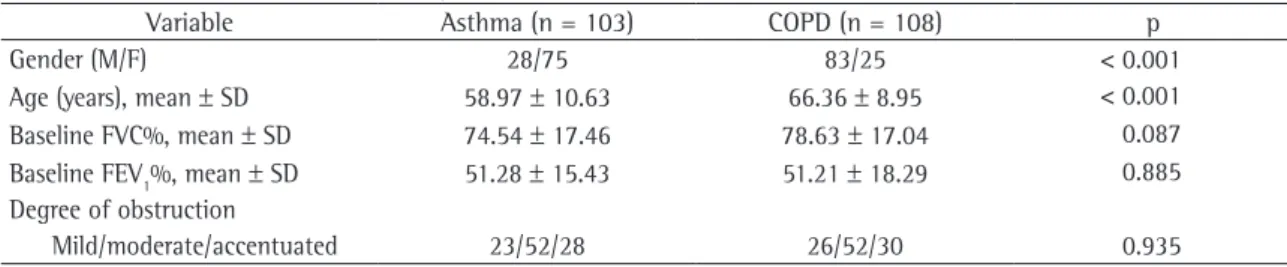
Of the 211 patients evaluated in this study, 103 (49%) had received a diagnosis of asthma, and 108 had received a diagnosis of COPD. Despite the fact that patients below the age of 40 were excluded from the analysis, mean age was higher in the COPD group Among the patients with COPD, the median smoking history was 50 pack-years (range, 15-234 pack-years). The baseline percentage FEV1 values were statistically similar in the two groups evaluated (Table 1).
Comparing prebronchodilator and postbron-chodilator values, the mean increase in FVC was from 2.39 L to 2.68 L among the patients with asthma (p < 0.001) and from 2.91 L to 3.09 L among the patients with COPD (p < 0.001). The mean increase in FEV1 was from 1.32 L to 1.59 L
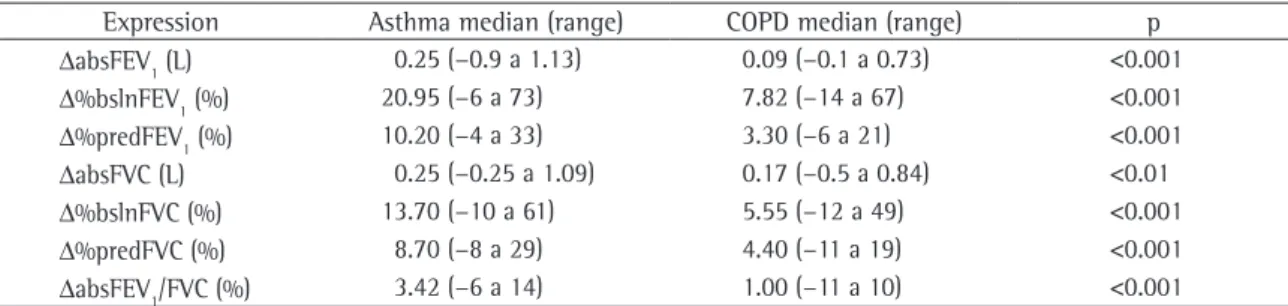
among the patients with asthma (p < 0.001) and from 1.49 L to 1.61 L among the patients with COPD (p < 0.001). The remaining parameters also presented statistically significant variations in the median values obtained for both groups (Table 2).
When the spirometric values were evaluated separately in accordance with the variations in FEV1, FVC or both, we found that 86% of the isolated FEV1 responses occurred in asthma patients, whereas 83% of the isolated FVC responses occurred in asthma The bronchodilator response was evaluated in
four different ways: 1) postbronchodilator percentage increase in FEV1 over baseline (∆%bslnFEV1); 2) postbronchodilator percentage increase in FEV1 in relation to the predicted value (∆%predFEV1); 3) absolute difference between baseline and post-bronchodilator FEV1 (∆absFEV1); and 4) absolute difference between baseline and postbronchodilator FVC (∆absFVC).
Sensitivity, specificity, predictive values and like-lihood ratios were calculated for the various response expressions.(6,7) In a recent spirometry study, FEV
1
and FVC were evaluated before and after bron-chodilator use in individuals without lung disease.(16)
The authors found that, in individuals over the age of 40, FEV1 can increase after bronchodilator use by as much as 0.30 L in men and 0.20 L in women. This response expression was also evaluated in the present study.
Bronchodilator responses were classified as follows: 1) absent - no significant increase in FEV1 or FVC; 2) FEV1 response in isolation - isolated FEV1 response ≥ 0.30 L in men or ≥ 0.20 L in women; 3) FVC response in isolation - isolated FVC response ≥ 0.35 L; and 4) FEV1 and FVC response - significant increase in both parameters.
The statistical analysis was conducted using the Statistical Package for the Social Sciences, version 10 for Windows 95 (SPSS Inc., Chicago, IL, USA). Values are expressed as mean ± standard deviation or as median and range. Variations in bronchodi-lator responses within groups were compared using paired t-tests. Variations in bronchodilator responses between groups were compared using t-tests for independent samples, Mann-Whitney tests for independent samples or chi-square (χ2)
tests. Sensitivity, specificity, positive predictive value and negative predictive value for the various
Table 1 - General characteristics of the patients.
Variable Asthma (n = 103) COPD (n = 108) p
Gender (M/F) 28/75 83/25 < 0.001
Age (years), mean ± SD 58.97 ± 10.63 66.36 ± 8.95 < 0.001
Baseline FVC%, mean ± SD 74.54 ± 17.46 78.63 ± 17.04 0.087
Baseline FEV1%, mean ± SD 51.28 ± 15.43 51.21 ± 18.29 0.885
Degree of obstruction
Mild/moderate/accentuated 23/52/28 26/52/30 0.935
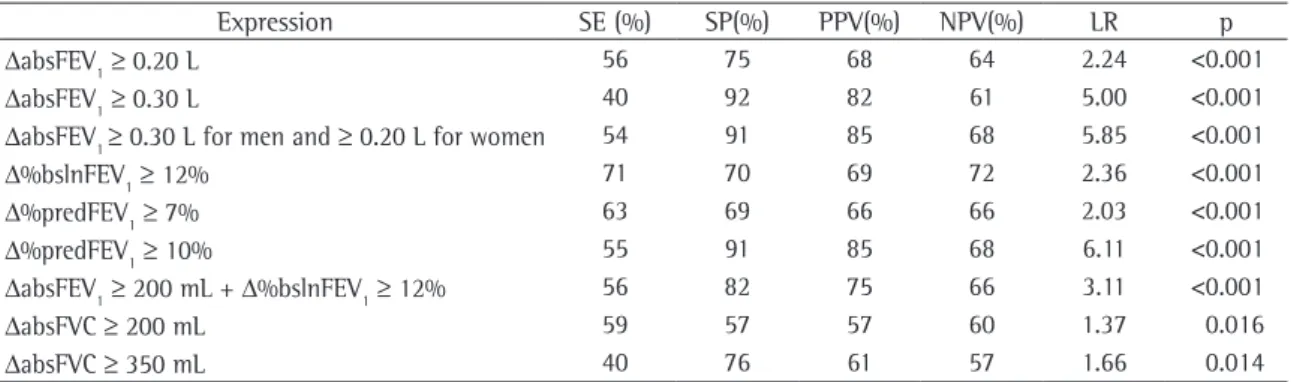
In Table 4, the sensitivity, specificity, predic-tive values and likelihood ratios are shown for the various expressions of bronchodilator response, using asthma as a reference.
The ideal expression of bronchodilator response should not vary more than the magnitude of the baseline FEV1 value. In the sample as a whole, there was no dependence in relation to baseline FEV1:
∆absFEV1 (rs = 0.096; p = 0.167) and ∆%predVEF1 (rs = 0.080; p = 0.246). The ∆%bslnFEV1 proved to be dependent on the baseline VEF1 (rs = −0.200; p = 0.004). In both groups, the absolute variation in postbronchodilator FEV1 presented an inverse
corre-lation with age: rs = −0.31 (p = 0.001) for asthma; and rs = −0.296 (p = 0.002) for COPD. In the analysis of covariance, clinical diagnosis and gender were found to influence bronchodilator response, as expressed by the absolute variation in FEV1.
Discussion
Our findings show that it is possible to differ-entiate between asthma and COPD based on the spirometric response to the use of a bronchodilator. A greater than 10% increase in FEV1 in relation to the predicted value presented the greatest discrimi-natory power in distinguishing asthma from COPD.
Asthma and COPD both result from the inter-action of genetic and environmental factors. The Dutch hypothesis proposes that asthma, chronic bronchitis and emphysema should be considered different expressions of the same disease. Common risk factors for the development of asthma or patients (Table 3). When both responses were
present, 84% of such responses occurred in asthma patients, and the difference was statistically signifi-cant (χ2 = 52.41, p < 0.001). Patients presenting isolated FVC responses had lower baseline percentage values of FEV1 than did those presenting other types of responses (39% vs. mean values > 50% in the remaining patients, F = 5.07, p = 0.002). There was a weak, yet significant, inverse correlation between prebronchodilator FVC and ∆absFVC (rs = −0.23, p = 0.001). Among the patients with COPD, there were three cases in which the absolute variation in FEV1 was greater than 400 mL (440, 640 and 730 mL). In those three cases, the patient charts revealed emphysema on a tomography scan of the chest and a lack of clinical-spirometric improvement after treatment with inhaled corticosteroids.
Table 2 - Functional variations after bronchodilator use in individuals with asthma or chronic obstructive pulmonary disease.
Expression Asthma median (range) COPD median (range) p
∆absFEV1 (L) 0.25 (−0.9 a 1.13) 0.09 (−0.1 a 0.73) <0.001
∆%bslnFEV1 (%) 20.95 (−6 a 73) 7.82 (−14 a 67) <0.001
∆%predFEV1 (%) 10.20 (−4 a 33) 3.30 (−6 a 21) <0.001
∆absFVC (L) 0.25 (−0.25 a 1.09) 0.17 (−0.5 a 0.84) <0.01
∆%bslnFVC (%) 13.70 (−10 a 61) 5.55 (−12 a 49) <0.001
∆%predFVC (%) 8.70 (−8 a 29) 4.40 (−11 a 19) <0.001
∆absFEV1/FVC (%) 3.42 (−6 a 14) 1.00 (−11 a 10) <0.001
COPD: chronic obstructive pulmonary disease; FVC: forced vital capacity; FEV1: forced expiratory volume in one second; ∆abs: absolute difference between baseline and postbronchodilator FEV1, FVC or FEV1/FVC; ∆%bsln: postbronchodilator percentage increase in FEV1 or FVC over baseline; and ∆%pred: postbronchodilator percentage increase in FEV1 or FVC in relation to the predicted value.
Table 3 - Responses of forced expiratory volume in one second and forced vital capacity in individuals with asthma or chronic obstructive pulmonary disease.
Type of response Asthma COPD Total
None 43 79 122
Isolated FEV1a 19 3 22
Isolated FVCb 4 19 23
FEV1 and FVC 37 7 44
Total 103 108 211*
COPD: chronic obstructive pulmonary disease; FVC: forced vital capacity; and FEV1: forced expiratory volume in one second.
aIncrease in FEV
Two types of studies have been used to derive cut-off points intended to characterize a signifi-cant bronchodilator response. Postbronchodilator variations can be considered significant if they exceed those observed in individuals without lung disease, or if they exceed the spontaneous varia-tion/variation observed after the use of a placebo, in patients with airflow limitation. In three different studies involving individuals without lung disease, the upper limits of the postbronchodilator response were observed (8, 9 and 10%, respectively).(7) In a
recent study, it was demonstrated that, in individ-uals without lung disease, the response is reduced with age, but that, in general, variations of > 0.20 L in men and > 0.30 L in women constitute the limits of the response in individuals over the age of 40.(16)
In the present study, a 10% increase in FEV1 over
the predicted value presented the best discrimi-natory power for distinguishing between asthma and COPD, underscoring the fact that, in individ-uals with asthma, bronchial tone is truly elevated. Responses > 0.20 L in women and > 0.30 L in men were slightly less definitive. In two other studies,(8,24)
the best differentiation between asthma and COPD was also obtained through the use of a ≥ 10% post-bronchodilator increase in FEV1 over the predicted value. In a study involving 660 patients with COPD, a postbronchodilator increase in FEV1 of 9% over predicted was observed in 23%, although this value varied in subsequent tests.(25)
COPD include bronchial hyperresponsiveness and β2-adrenergic receptor polymorphisms.
(17,18) Variable
airway obstruction has been proposed as an asth-ma-defining characteristic. However, that does not always differentiate between asthma and COPD, especially in older individuals with long-standing disease. There are critical differences between asthma and COPD that influence their management and prognosis.(19,20)
To distinguish between asthma and COPD, various resources are available. The most relevant lung function parameters are the diffusing capacity of the lung for carbon monoxide and the bron-chodilator response.(21,22) However, there is as yet no
consensus as to which index best expresses bron-chodilator response, or even as to what cut-off value would indicate a positive bronchodilator response.
In the present study, the groups were similar in terms of the initial degree of obstruction but dissimilar in terms of age and gender, both of which influenced the bronchodilator response. Asthma with persistent airway obstruction is most common in older women, which increases the difficulty in making the differential diagnosis with COPD.(23) In our sample, the asthma group consisted
of only nonsmokers, and the COPD consisted of only smokers, thereby reducing the chance of incor-rect classification. However, these restrictions also reduced the external validity of the study.
Various expressions of bronchodilator response, with different cut-off points, have been described.
Table 4 - The different bronchodilator response expression/cut-off point combinations and their diagnostic capacity for asthma.
Expression SE (%) SP(%) PPV(%) NPV(%) LR p
∆absFEV1≥ 0.20 L 56 75 68 64 2.24 <0.001
∆absFEV1≥ 0.30 L 40 92 82 61 5.00 <0.001
∆absFEV1 ≥ 0.30 L for men and ≥ 0.20 L for women 54 91 85 68 5.85 <0.001
∆%bslnFEV1≥ 12% 71 70 69 72 2.36 <0.001
∆%predFEV1≥ 7% 63 69 66 66 2.03 <0.001
∆%predFEV1≥ 10% 55 91 85 68 6.11 <0.001
∆absFEV1≥ 200 mL + ∆%bslnFEV1≥ 12% 56 82 75 66 3.11 <0.001
∆absFVC ≥ 200 mL 59 57 57 60 1.37 0.016
∆absFVC ≥ 350 mL 40 76 61 57 1.66 0.014
responsive patients also presented low numbers of alveolar attachments in the external walls of the airways. Patients with emphysema could have pronounced bronchodilator responses, due to the potential amplification of these mechanisms. In another study, we evaluated a patient with extensive emphysema who presented sharp variations in post-bronchodilator FEV1.(27) That patient was submitted
to lung volume reduction surgery, after which the bronchodilator response disappeared, which might be explained by the increase in the radial traction of the airways after the procedure.
Patients with COPD, especially those with pronounced obstruction, can, after the use of a bron-chodilator, present an isolated increase in FVC, which has been correlated with a reduction in dyspnea and with an increase in exercise capacity.(3,4)Variations in
FVC ≥ 0.35 L are above the 95th percentile of random
variation.(7) Variations in FVC of 12% and 0.20 L,
similar to the values proposed for FEV1, continue to
be erroneously considered significant.(28) It is
there-fore understandable that this cut-off point has little discriminatory power for differentiating between asthma and COPD.(12)
In the present study, significant, isolated vari-ations in FVC were more common in patients with COPD, and such variations were associated with a greater degree of obstruction. Isolated volume responses to bronchodilator use in patients with COPD are known to be associated with accentuated emphysema and probably result from an altera-tion in the effect that lung inflaaltera-tion has on airway diameter.(29) Patients with asthma can also present
isolated postbronchodilator FVC responses. In those patients, there is probably an increase in the residual volume caused by the closing down of the small airways, which reopen after bronchodilator use.
Bronchodilator responses can be categorized as flow responses or volume responses.(30) When
post-bronchodilator variations in FEV1 are proportional to the postbronchodilator variations in FVC and are accompanied by a normal or reduced postbron-chodilator FEV1/FVC ratio, they can simply reflect
lung volume recruitment and should be consid-ered volume responses.(3) Although FEV
1 and FVC
are both volume measures, postbronchodilator variations in these measures can reflect increased expiratory flows. When there is an isolated postbron-chodilator variation in FEV1, it is likely that there is
bronchial dilation primarily of the central airways, Certain functional variables, whose values
exceed those observed after the use of a placebo, present variations greater than those occurring spontaneously. Such variables include FEV1 above
0.20 L, FEV1 above baseline and the combination of the two, as well as FEV1 > 7% above the predicted value.(7) Although such responses are more often
observed in individuals with asthma, they are also common in individuals with COPD. Therefore, it is not surprising that these expressions of postbron-chodilator response present greater sensitivity and lower specificity for the diagnosis of asthma.(9-12)
The author of one study suggested that a ∆absFEV1 ≥ 200 mL is the expression that is most efficient in differentiating between asthma and COPD but found that the likelihood ratio was greater for vari-ations in FEV1 > 9% of the predicted value.(12)
Among the forms used in order to express bron-chodilator response, the ∆%bslnFEV1 presents greater apparent responses when FEV1 is lower, thereby
overestimating the response.(25) In the present study,
we were concerned with matching the severity of airway obstruction in the two groups, in order to minimize the influence that baseline FEV1 had on the rate of bronchodilator response. We found that neither ∆%predFEV1 nor ∆absFEV1 correlated with
baseline FEV1. The combined use of absolute and percentage variations, expressed as a simultaneous increases in FEV1 of > 12% of the baseline value and 0.20 L, partially negates the influence that the base-line value has on the response. In the present study, this response expression presented sensitivity similar to that of a > 10% increase in FEV1 over predicted, albeit with less sensitivity and a lower likelihood ratio. Variations greater than 0.20 L in women are indicative of abnormal bronchial tone.(16)
In the present study, three COPD patients presented absolute postbronchodilator variations in FEV1 of more than 400 mL. In those three cases, tomography scans of the chest revealed extensive emphysema, and no improvement was seen after treatment with inhaled corticosteroids. In one study, bronchial hyperresponsiveness was found to correlate with structural changes in patients diag-nosed with COPD who were referred for resection of pulmonary nodules.(26) The provocative
concentra-tion causing a 20% fall in FEV1, after correction for the baseline value of FEV1, was found to correlate
9. Calverley PM, Burge PS, Spencer S, Anderson JA, Jones PW. Bronchodilator reversibility testing in chronic obstructive pulmonary disease. Thorax. 2003;58(8):659-64.
10. Kesten S, Rebuck AS. Is the short-term response to inhaled beta-adrenergic agonist sensitive or specific for distinguishing between asthma and COPD? Chest. 1994;105(4):1042-5. 11. Quadrelli SA, Roncoroni AJ, Montiel GC. Evaluation of
bronchodilator response in patients with airway obstruction. Respir Med. 1999;93(9):630-6.
12. Chhabra SK. Acute bronchodilator response has limited value in differentiating bronchial asthma from COPD. J Asthma. 2005;42(5):367-72.
13. Sociedade Brasileira de Pneumologia e Tisiologia. III Consenso Brasileiro no Manejo da Asma. J Pneumol 2002;28(Supl.1):S6-S51.
14. Sociedade Brasileira de Pneumologia e Tisiologia. II Consenso Brasileiro sobre Doença Pulmonar Obstrutiva Crônica. J Pneumol. 2004; 30(Supl.5): S1-S52.
15. Pereira CA, Sato T, Rodrigues SC. New reference values for forced spirometry in white adults in Brazil. J Bras Pneumol. 2007;33(4):397-406.
16. Johannessen A, Lehmann S, Omenaas ER, Eide GE, Bakke PS, Gulsvik A. Post-bronchodilator spirometry reference values in adults and implications for disease management. Am J Respir Crit Care Med. 2006;173(12):1316-25. 17. Matheson MC, Ellis JA, Raven J, Johns DP, Walters EH,
Abramson MJ. Beta2-adrenergic receptor polymorphisms are associated with asthma and COPD in adults. J Hum Genet. 2006;51(11):943-51.
18. Brutsche MH, Downs SH, Schindler C, Gerbase MW, Schwartz J, Frey M, et al. Bronchial hyperresponsiveness and the development of asthma and COPD in asymptomatic individuals: SAPALDIA cohort study. Thorax. 2006;61(8):671-7.
19. Jenkins CR, Thompson PJ, Gibson PG, Wood-Baker R. Distinguishing asthma and chronic obstructive pulmonary disease: why, why not and how? Med J Aust. 2005;183(1 Suppl):S35-S7.
20. Hargreave FE, Parameswaran K. Asthma, COPD and bronchitis are just components of airway disease. Eur Respir J. 2006;28(2):264-7.
21. Boulet LP, Turcotte H, Hudon C, Carrier G, Maltais F. Clinical, physiological and radiological features of asthma with incomplete reversibility of airflow obstruction compared with those of COPD. Can Respir J. 1998;5(4):270-7. 22. Goedhart DM, Zanen P, Lammers JW. Relevant and redundant
lung function parameters in discriminating asthma from COPD. COPD. 2006;3(1):33-9.
23. The ENFUMOSA cross-sectional European multicentre study of the clinical phenotype of chronic severe asthma. European Network for Understanding Mechanisms of Severe Asthma. Eur Respir J. 2003;22(3):470-7.
24. Meslier N, Racineux JL, Six P, Lockhart A. Diagnostic value of reversibility of chronic airway obstruction to separate asthma from chronic bronchitis: a statistical approach. Eur Respir J. 1989;2(6):497-505.
25. Weir DC, Sherwood Burge P. Measures of reversibility in response to bronchodilators in chronic airflow obstruction: relation to airway calibre. Thorax. 1991;46(1):43-5. 26. Riess A, Wiggs B, Verburgt L, Wright JL, Hogg JC, Paré PD.
Morphologic determinants of airway responsiveness in chronic smokers. Am J Respir Crit Care Med. 1996;154(5):1444-9.
whereas an isolated postbronchodilator variation in FVC is indicative of bronchial dilation primarily of the peripheral airways. Therefore, both also reflect increased flow, albeit in different segments of the tracheobronchial tree. Therefore, it seems more appropriate to designate these responses simply FEV1 responses, FVC responses or FEV1-FVC
combi-nation responses, rather than refer to them as flow responses or volume responses.
We can conclude that, in individuals over the age of 40 with obstructive lung disease, it is possible to differentiate between asthma and COPD based on the spirometric response to bronchodilator use. A ≥ 10% increase in FEV1 over the predicted value proved to have the greatest discriminatory power in discriminating between asthma and COPD. Alternatively, the expression ∆absFEV1 (≥ 0.30 L for
men and ≥ 0.20 L for women) can be employed. Further studies involving age- and gender-matched samples of individuals with asthma and individuals with COPD are needed in order to obtain more specific results.
References
1. Celli BR, MacNee W; ATS/ERS Task Force. Standards for the diagnosis and treatment of patients with COPD: a summary of the ATS/ERS position paper. Eur Respir J. 2004;23(6):932-46. Erratum in: Eur Respir J. 2006;27(1):242.
2. GOLD - Global strategy for the diagnosis, management, and prevention of chronic obstructive pulmonary disease [homepage on the Internet]. Global Strategy for the Diagnosis, Management and Prevention of COPD 2006. [cited 2007 Oct 22]. Available from: http://www.goldcopd. org.
3. O’Donnell DE, Forkert L, Webb KA. Evaluation of bronchodilator responses in patients with “irreversible” emphysema. Eur Respir J. 2001;18(6):914-20.
4. Rodrigues Jr. R, Pereira CAC. Resposta a broncodilatador na espirometria: que parâmetros e valores são clinicamente relevantes em doenças obstrutivas? J Pneumol 2001;27(1):35-47.
5. Ramsdell JW, Tisi GM. Determination of bronchodilation in the clinical pulmonary function laboratory. Role of changes in static lung volumes. Chest. 1979;76(6):622-8.
6. Dompeling E, van Schayck CP, Molema J, Akkermans R, Folgering H, van Grunsven PM, et al. A comparison of six different ways of expressing the bronchodilating response in asthma and COPD; reproducibility and dependence of prebronchodilator FEV1. Eur Respir J. 1992;5(8):975-81. 7. Pereira CA. Espirometria. J Pneumol. 2002;28(supl
3):S1-S82.
29. Cerveri I, Pellegrino R, Dore R, Corsico A, Fulgoni P, van de Woestijne KP, et al. Mechanisms for isolated volume response to a bronchodilator in patients with COPD. J Appl Physiol. 2000;88(6):1989-95.
30. Paré PD, Lawson LM, Brooks LA. Patterns of response to inhaled bronchodilators in asthmatics. Am Rev Respir Dis. 1983;127(6):680-5.
27. Gelb AF, Brenner M, McKenna RJ Jr, Fischel R, Zamel N, Schein MJ. Serial lung function and elastic recoil 2 years after lung volume reduction surgery for emphysema. Chest. 1998;113(6):1497-506.