Licenciado sob uma Licença Creative Commons DO): http://dx.doi.org/ . / - . . .AO
[T]
Prevalence of postural deviations and associated factors
in children and adolescents: a cross-sectional study
[)]
Prevalência de variações posturais e fatores associados
em crianças e adolescentes: um estudo transversal
[A]
Mariana Vieira Batistão, Roberta de Fátima Carreira Moreira, Helenice Jane Cote Gil Coury, Luis Ernesto Bueno Salasar, Tatiana de Oliveira Sato*
Universidade Federal de São Carlos, UFSCar , São Carlos, SP, Brazil
[R]
Abstract
Introduction: Postural deviations are frequent in childhood and may cause pain and functional impairment.
Previously, only a few studies have examined the association between body posture and intrinsic and extrinsic factors. Objective: To assess the prevalence of postural changes in school children, and to determine, using
multi-ple logistic regression analysis, whether factors such as age, gender, BM), handedness and physical activity might explain these deviations. Methods: The posture of students was assessed by observation. Subjects were aged
between and years, . % n = of which were female. The mean age was . ± . years. Mean body weight was . ± . kg and mean height was . ± . m. A digital scale, a tapeline, a plumb line and standar-dized forms were used to collect data. The data were analyzed descriptively using the chi-square test and logistic regression analysis signi icance level of % . Results: We found the following deviations to be prevalent among
schoolchildren: forward head posture, . %, shoulder elevation, . %, asymmetry of the iliac crests, . %, valgus knees, . %, thoracic hyperkyphosis, . %, lumbar hyperlordosis, . % and winged shoulder blades, . %. The associated factors were age, gender, BM) and physical activity. Discussion: There was a high prevalence
of postural deviations and the intrinsic and extrinsic factors partially explain the postural deviations. Conclusion:
These indings contribute to the understanding of how and why these deviations develop, and to the implementa-tion of preventive and rehabilitaimplementa-tion programs, given that some of the associated factors are modi iable.
Keywords: Disease Prevention. Low Back Pain. Posture.
*MVB: Doctoral student, e-mail: [email protected] RFCM: PhD, e-mail: [email protected]
Resumo
Introdução: Variações posturais são frequentes na infância e podem causar dor e prejuízo funcional. Embora a prevalência de variações posturais em crianças já tenha sido avaliada, poucos autores inves-tigaram a associação entre a postura e fatores intrínsecos e extrínsecos. Objetivo: Avaliar a prevalência de variações posturais em crianças e adolescentes e identificar fatores explicativos para estas variações, dentre eles: idade, gênero, dominância manual, índice de massa corporal (IMC) e atividade física, por meio da análise de regressão logística múltipla. Métodos: A postura de 288 estudantes foi avaliada de forma observacional. Os sujeitos tinham idades entre 6 a 15 anos, sendo 171 (59,4%) do sexo feminino. A idade média foi de 10,6 (2,4) anos, massa corporal de 38,6 (12,7) kg e altura de 1,5 (0,1) m. Utilizou-se balança digital, fita métrica, fio de prumo e formulários padronizados. Os dados foram analisados des-critivamente, com o teste de Qui-quadrado e regressão logística (nível de significância - 5%). Resultados: A prevalência de anteriorização da cabeça foi de 53,5%; elevação do ombro 74,3%; assimetria entre as cristas ilíacas 51,7%; joelhos valgos 43,1%; hipercifose torácica 30,2%; hiperlordose lombar 37,2% e 66,3% de escápulas aladas. Os fatores associados foram idade, sexo, IMC e não realização de atividade fí-sica. Discussão: A prevalência de variações posturais foi alta. Os fatores escolhidos explicam parcialmen-te as variações posturais. Conclusão: Esses achados contribuem para a compreensão do desenvolvimento destas variações e para a proposição de programas preventivos e de reabilitação, considerando que entre os fatores analisados, alguns são modificáveis.
Palavras-chave: Prevenção de Doenças. Dor Lombar. Postura.
Introduction
Good posture is a state of equilibrium of body segments, in a position of least effort and maximum support , . )n children, whole body posture is influenced by physical development, which de-pends on nutritional, congenital and environmental factors .
Many postural deviations originate in childhood and adolescence . Some of them are common in children of the same age group and are considered to be a response of the body to the demands of gravity , . They are usually corrected sponta-neously with the development of muscle strength
, , . (owever, if they persist, they will lead to joint overload, causing discomfort and functional impairment .
According to several studies, common postural deviations found in at least % of healthy children include poor formation of the longitudinal arch of the foot; knee hyperextension and valgus; medial rotation of the hip; pelvic anteversion; pelvic tilt; abdominal protrusion; lumbar hyperlordosis; winged shoulder blades; protruding shoulders; thoracic hyperkypho-sis; and shoulder elevation , , , , , , .
)t is important to diagnose postural deviations in children, because their skeletal system is still sus-ceptible to changes and poor posture is more easily corrected at this stage of development , . Thus, postural assessment should become a common prac-tice in schools, in order to early detect and treat pos-tural deviations in students . Besides this, schools have the potential to develop children´s knowledge and skills and to help them learn how to live a healthy life , .
Postural assessment is a complex procedure, be-cause it takes into account many intrinsic and extrin-sic factors that can in luence an individual´s posture, such as the environment, his/her social, cultural and emotional status, physical activity, obesity, physio-logical developmental disorders, sexual maturation, gender and heredity .
Detsch et al. have studied the association between the postural deviations and type of school public or private , parental education, age, body mass index BM) and body postures adopted in everyday situ-ations. Penha et al. have studied the association between age and postural deviations. (owever, the aforementioned studies have only used association tests. Multiple logistic regression analysis, which al-lows the simultaneous assessment of multiple factors and can help understand the in luence of these fac-tors upon postural deviations, has not been reported. Thus, the objectives of this study were to deter-mine the prevalence of postural deviations in school-children aged - years, and to identify, using mul-tiple logistic regression analysis, whether factors such as age, gender, BM), hand dominance and physical activity are associated with these deviations.
Methods
Subjects and study site
All st to th graders from a public school in São Carlos, SP, Brazil, were invited to participate in the study. The selection criteria were: . formal consent from a parent or legal guardian; . being in good health at the time of the investigation; and . no detected or reported neuromuscular, rheumatic or metabolic disorders.
Three hundred and four . % of a total of students enrolled at the school returned a signed con-sent form and were then assessed. Of these, were excluded because they did not complete the assessment procedures. Thus, the inal sample consisted of stu-dents whose characteristics are depicted in Table .
Table 1 - Participants' Anthropometric Data (mean ± standard deviation)
Gender Female (n = 171)
Male (n = 117)
Total (N = 288)
Age (years) 10.6 ± 2.4 10.5 ± 2.6 10.6 ± 2.4
Body mass
(kg) 39.1 ± 12.3 38.0 ± 13.2 38.6 ± 12.7
Height (m) 1.5 ± 0.1 1.5 ± 0.2 1.5 ± 0.1
Body mass index (kg/
m2)
18.2 ± 3.5 17.5 ± 3.0 17.9 ± 3.3
This study met the criteria established by Resolution / of the National (ealth Council and was ap-proved by the Research Ethics Committee of the Federal University of São Carlos CAAE . . . - ,
opinion / .
Equipments
The following equipments were used in this study: plumb line, rotating platform, tapeline with an ac-curacy of mm and digital scale G Life®, maximum
kg with an accuracy of ± gram .
Procedures
The researchers completed a questionnaire with personal information such as age, gender, handed-ness and physical activity, based on the students' self-reports. After the interview, the children were asked to change into bathing suits, so that the weight of their clothes was not added to their weight and we could get a better visualization of their body seg-ments. Students' weight and height measurements were then collected. Body mass was measured us-ing a digital anthropometric scale, while height was measured to the nearest mm with a tapeline.
For the postural assessment, the children were asked to step onto a rotating platform in front of one of the researchers. Their feet should be about hip-width apart and pointing straight ahead. Students were instructed to stand still in a relaxed posture, looking forward. A researcher rotated the platform in order to prevent changes in position due to move-ment by the subjects. Figure shows a subject stand-ing on the platform.
Note: Source: authors.
hemi-parts must be exactly symmetrical and, hypo-thetically offset one another. )n the side view, the plumb line projection represents the gravity line in the frontal plane. The plumb line ends slightly in front of the lateral malleolus and also passes through most of the bodies of the cervical and lumbar vertebrae and the shoulder joint and slightly posterior to the frontal transverse axis of the hip joint. The presence of postural deviations was determined according to the positioning of the aforementioned structures in relation to the plumb line.
Data Analysis
The data were analyzed descriptively by calculat-ing the proportion of individuals who had postural deviations according to age, gender, body mass index
BM) , handedness and physical activity.
BM) data were categorized as underweight U , eu-trophic E , overweight O and obese Ob , according to the BM) curves by age provided by the North American Center for Disease Control and Prevention .
Students were divided into three age groups. The choice of these age groups was based on the litera-ture, so that the irst group - years was the pre-puberty age group; the second group - was the female puberty age group and the third group - was the male puberty age group , . The statistical analysis was performed using the Statistical Package for Social Sciences software SPSS . Multivariate analysis of variance was pre-ceded by univariate analyses to identify signi icant associations P < . between the response variable and the factors. Univariate analysis was performed using the chi-square association test χ .
The response variables used in the logistic regres-sion analysis were all the postural deviations listed above and explanatory variables were age, gender, BM), handedness and physical activity. We used a logistic regression model with logit link function for each postural deviation response variable . For the selection of important variables, we used the step-wise selection method.All tests were two-tailed with the level of signi icance set at %.
The sample size calculation was based on data on the prevalence of postural variations, considering a signi icance level of % and power of %. The ob-tained sample was big enough for all postural devia-tions analyzed, except elevation of the shoulders, for which the calculation indicated a sample size of Postural Assessment
When assessing posture, direct quantitative measurements are comparatively more accurate than subjective qualitative measurements . Direct measurement methods include radiography and software-based measuments such as the ones us-ing the Postural Assessment Software [PAS/SAPO] . (owever, these types of assessments are more com-plex, more time consuming, and restricted to certain body parts PAS/SAPO and expose the subject to radiation radiography , .
Qualitative assessment is more widely used in clinical settings and more feasible for assessments in larger sample sizes because it is more affordable, less complex and requires less preparation of the study site . For these reasons, qualitative assessment was the method of choice for this study.
Two physical therapists and two senior Physical Therapy students conducted the postural assess-ments. Thus, all evaluators had the required train-ing to perform the tasks of the assessments. )n addi-tion, a speci ic eight-hour training was held for the evaluators, in order to ensure the standardization of data collection. The training consisted of discussing the assessment form, de ining the postural devia-tions that would be analyzed and carrying out joint assessments. Divergences during the assessments were solved by consensus. )ntra-evaluator reliability was previously tested in subjects and the results showed an % agreement among measures.
The assessment was conducted by observation, and the data for each subject were recorded on stan-dardized assessment forms. Posture assessment was performed in the anterior, posterior and lateral right and left views. We identi ied the main postural de-viations in each view. )n anterior view, we assessed elevation of the shoulders, elevation of the iliac crests and valgus knees. )n the side view, we assessed for-ward head posture, thoracic hyperkyphosis and lum-bar hyperlordosis. Finally, in the posterior view, we assessed the presence of winged shoulder blades.
subjects. As the literature states with reference to the adequacy of the sample size that at least individu-als should be included for each predictor variable, the required sample size for multiple logistic regression analysis was met .
Results
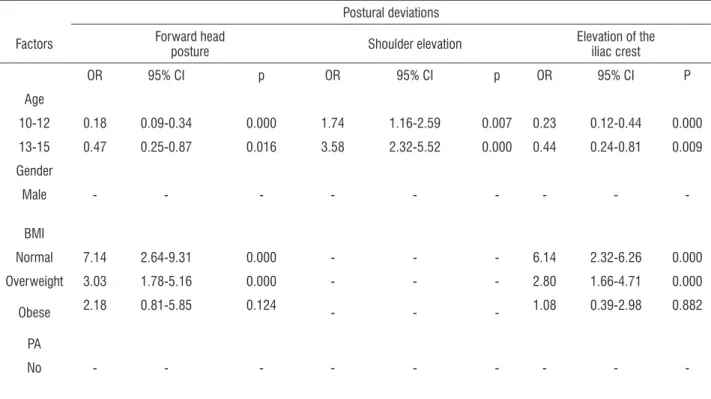
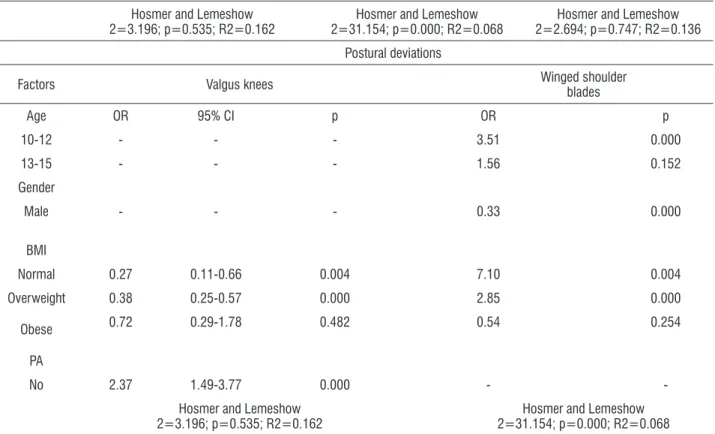
Tables and , respectively, show the prevalence of postural deviations according to the factors analyzed and the logistic regression results for signi icant associations.
Table 2 - Prevalence of postural deviations [n (%)] according to age, gender, body mass index and physical activity. Values in bold indicate a significant association (in the chi-square test [2]
) between the response variable (postural devia-tion) and the factor
Forward head posture
Shoulder elevation Elevation of the iliac
crest Valgus
knees
Winged shoulder
blades
Factors (n) R L R L
Age (years)
6 - 9 104 37 (35.6) 32 (30.8) 34 (32.7) 25 (24.0) 15 (14.4) 47 (45.2) 83 (79.8) 10 - 12 119 69 (58.0) 49 (41.2) 44 (37.0) 48 (40.3) 16 (13.4) 54 (45.4) 78 (65.5) 13 - 15 65 48 (73.8) 17 (26.2) 38 (58.5) 25 (38.5) 20 (30.8) 23 (35.4) 30 (46.2) Gender
Female 171 94 (55.0) 36 (30.8) 47 (40.2) 39 (33.3) 22 (18.8) 79 (46.2) 102 (59.6) Male 117 60 (51.3) 62 (36.3) 69 (40.4) 59 (34.5) 29 (17.0) 45 (38.5) 89 (76.1)
BMI
UW 27 18 (66.7) 11 (40.7) 9 (33.3) 11 (40.7) 7 (25.9) 9 (33.3) 24 (88.9) Normal weight 217 120 (55.3) 73 (33.6) 89 (41.0) 78 (35.9) 41 (18.9) 86 (39.6) 153 (70.5)
Overweight 22 10 (45.5) 8 (36.4) 10 (45.5) 6 (27.3) 1 (4.5) 12 (54.5) 8 (36.4) Obese 22 6 (27.3) 6 (27.3) 8 (36.4) 3 (13.6) 2 (9.1) 17 (77.3) 6 (27.3)
PA
Yes 103 61 (59.2) 27 (26.2) 46 (44.7) 42 (40.8) 16 (15.5) 31 (30.1) 75 (72.8) No 185 93 (50.3) 71 (38.4) 70 (37.8) 56 (30.3) 35 (18.9) 93 (50.3) 116 (62.7) Note: BMI: Body mass index; UW: underweight; PA: physical activity.
Table 3 - Multiple logistic regression results of postural deviations in relation to the factors associated with them in the univariate analysis
Postural deviations
Factors Forward head
posture Shoulder elevation
Elevation of the iliac crest
OR 95% CI p OR 95% CI p OR 95% CI P
Age
10-12 0.18 0.09-0.34 0.000 1.74 1.16-2.59 0.007 0.23 0.12-0.44 0.000
13-15 0.47 0.25-0.87 0.016 3.58 2.32-5.52 0.000 0.44 0.24-0.81 0.009
Gender
Male - - -
-BMI
Normal 7.14 2.64-9.31 0.000 - - - 6.14 2.32-6.26 0.000
Overweight 3.03 1.78-5.16 0.000 - - - 2.80 1.66-4.71 0.000
Obese 2.18 0.81-5.85 0.124 - - - 1.08 0.39-2.98 0.882
PA
-There was a high prevalence of postural deviations in the sample studied. . % of the subjects had forward head posture; . % had shoulder elevation; . % had iliac crest elevation; . % had valgus knees; . % had thoracic hyperkyphosis; . % had lumbar hyperlordosis; and . % had winged shoulder blades. The prevalence of thoracic hyperkyphosis and lumbar hyperlordosis were not associated with any of the analyzed factors. For this reason, they are not shown in Table . The same is true for handedness, which was not signi icantly associated with any of the postural deviations recorded.
The prevalence of winged shoulder blades was found to decrease with age
OR = . , while the prevalence of forward head posture OR = . , shoulder elevation OR = . and iliac crests elevation OR = . were found to be higher in the age group - years.
With regard to gender, we found a signi icant as-sociation only between gender and winged shoulder blades OR = . . Male students had a higher preva-lence of this postural deviation.
BM) was also associated with postural deviations. The forward head posture, elevation of the iliac crests, valgus
knees and winged shoulder blades were associated with lower BM), while the prevalence of valgus knee was asso-ciated with higher BM). Physical activity was signi icantly associated with lower prevalence of valgus knees.
Regression analysis showed that winged shoul-der blades were associated with factors such as age, gender and BM), with R = . . The other postural deviations were less prevalent in the sample, ranging from - %.
Discussion
This study aimed to assess the prevalence of postural deviations in children and adolescents, and to identify, using multiple logistic regression analysis, whether factors such as age, gender, BM), hand dominance and physical activity are associated with these deviations. The results indicated a high prevalence of postural de-viations among schoolchildren, especially forward head posture . % , shoulder elevation . % , iliac crest elevation . % , valgus knees . % , thoracic hy-perkyphosis . % , lumbar hyperlordosis . % , and winged shoulder blades . % .
Table 3 - Multiple logistic regression results of postural deviations in relation to the factors associated with them in the univariate analysis
Hosmer and Lemeshow 2=3.196; p=0.535; R2=0.162
Hosmer and Lemeshow 2=31.154; p=0.000; R2=0.068
Hosmer and Lemeshow 2=2.694; p=0.747; R2=0.136
Postural deviations
Factors Valgus knees Winged shoulderblades
Age OR 95% CI p OR p
10-12 - - - 3.51 0.000
13-15 - - - 1.56 0.152
Gender
Male - - - 0.33 0.000
BMI
Normal 0.27 0.11-0.66 0.004 7.10 0.004
Overweight 0.38 0.25-0.57 0.000 2.85 0.000
Obese 0.72 0.29-1.78 0.482 0.54 0.254
PA
No 2.37 1.49-3.77 0.000 -
-Hosmer and Lemeshow 2=3.196; p=0.535; R2=0.162
Hosmer and Lemeshow 2=31.154; p=0.000; R2=0.068
Postural deviations usually occur in children of the same age group and most often do not require treat-ment , . Such deviations come in response to different balance requirements and different growth rates of body segments , . When the body reaches maturity, the balance of forces and the proportional growth of body structures generally lead to regres-sion of postural deviations .
)n this study, we found an association among age, BM) and forward head posture. The literature has reported that younger children have greater degrees of forward head posture . From a musculoskel-etal standpoint, more mature children compensate in other regions of the spine and hip, minimizing ab-normalities in the alignment of the head in relation to the trunk. (owever, in this study, the prevalence of forward head posture was higher in the age group of to years. )t can be assumed that this change has been in luenced by environmental factors. A previous study has assessed the posture of elementary schoolchildren during classes and its relation to the inadequacy of the school furniture. The results have shown that % of the tables and % of the seats were too low for older students th graders . Thus, these children had to maintain a head and trunk lex-ion posture most of the time. Furthermore, the same study has shown that at least % of the time the lexion postures adopted were close to degrees, posing risks to the children's health. Since children generally spend % of their awake time at school, the development of postural deviations may be as-sociated with positions adopted in the classroom.
Shoulder elevation was associated with increased age. This indicates that this postural change arises during the growth phase, possibly due to the differ-ent growth rates of body segmdiffer-ents. This asymmetry can also be associated with differences in overload between body sides, which is caused by external fac-tors such as improper carrying of school supplies and asymmetrical sitting posture , . (owever, this postural change was not associated with handedness, although it was expected that the handedness might be associated with an elevation of the contralateral shoulder .
This study found that a high BM) and lack of physi-cal activity were associated with higher prevalence of valgus knee, which is in line with the literature , . Also, according to these authors, these two factors may be interrelated. Most of the study par-ticipants who regularly performed physical activity
did not have valgus knees. Since the most frequent physical activity is soccer, it can be assumed that the practice of this sport, which predominantly involves striking the ball with the medial aspect of the foot, might contribute to reduce of knee valgus loading. Resende et al. have assessed - -year-old boys who played and who did not played soccer. The authors have found that those boys who played soccer regularly had a prevalence of varus knees as high as . % and a prevalence of valgus knees as high as . %. School boys who did not play soccer regularly had a prevalence of varus knees and valgus knees as high as . % and . %, respectively.
On the other hand, physical activity might also be associated with lower body mass, which, in turn, is also associated with a lower prevalence of valgus knees. Silva et al. have compared obese and nonobese - -year-old children and found a preva-lence of knee deviations of . % among obese chil-dren and of . % among nonobese chilchil-dren.
According to the literature, valgus knees physi-ologically occur at age two years and reach peak in-cidence at age three years. The emergence of these deviations is associated with the search for a greater support base and for a greater balance when a child practices new movement strategies to improve his walking ability. From six to eight years of age this postural change tends to regress as a result of internal tibial torsion, longitudinal growth of the femur and disappearance of the inner tigh fat pad .
Obesity causes overload because of the overweight on the lower limbs, and leads to increased pelvic ante-version causing internal rotation of the hips. Especially in childhood, these factors, associated with the accu-mulation of fat in the inner thighs and the search for a greater support base, cause the malleoli to move apart. This, in turn, results in the opening of the medial com-partment and increased pressure in the lateral knee compartment. With time and development, uneven growth occurs between the two compartments, lead-ing to the emergence of a permanent valgus deformity of the knee , . )n this study, we found an associa-tion between obesity and valgus knees, which indicates the need for preventive measures.
rehabilitation programs should take these aspects into account, in order to avoid adult structural problems that can be prevented in childhood and adolescence.
References
. Kendall FP, Mccreary EK, Provance PG. Músculos – provas e funções. Barueri Brazil : Manole; . . Levangie P, Norkin C. Joint structure and function:
a comprehensive analysis. Philadelphia: F. A. Davis Company; .
. Detsch C, Luz M(, Candotti CT, Oliveira DS, Lazaron F, Guimarães LK, et al. Prevalência de alterações posturais em escolares do ensino médio em uma cidade no Sul do Brasil. Rev Panam Salud Publica.
; : - .
. Detsch C, Candotti CT. A incidência de desvios post-urais em meninas de a anos da cidade de Novo (amburgo. Rev. Mov. ; : - .
. Asher C. Variações da postura na criança. São Paulo: Manole; .
. Lueder R, Rice V. Ergonomics for children: Designing products and places for toddlers to teens. Londres: Taylor & Francis; .
. Juskeliene V, Magnus P, Bakketeig LS, Dailidiene N, Jurkuvenas V. Prevalence and risk factors for asym-metric posture in preschool children aged - years. )nt J Epidemiol. ; : - .
. Penha PJ, João SMA, Casarotto RA, Amino CJ, Penteado DC. Postural assessment of girls between and years of age. Clinics. ; : - .
. Penha PJ, Casarotto RA, Sacco )CN, Marques AP, João SMA. Qualitative postural analysis among boys and girls of seven to ten years of age. Braz J Phys Ther.
; : - .
. Silva LR, Rodacki ALF, Brandalize M, Lopes MFA, Bento CB, Leite N. Alterações posturais em crianças e adoles-centes obesos e não-obesos. Rev Bras Cineantropom Desempenho (um. ; : - .
. Penha PJ, Baldini M, João SMA. Spinal postural align-ment variance according to sex and age in - and
-year-old children. J Manipulative Physiol Ther.
; : - .
% of girls aged years. Cil et al. have found an increase in the prevalence of thoracic hyperkyphosis among children up to years of age, a decrease in its prevalence at ages - years, and a new increase at ages - years. (owever, in this latest study, the tho-racic curvature has been quantitatively assessed and parameter of normality used has not been described, which makes data comparison dif icult. Several au-thors have associated increased thoracic hyperkypho-sis with the period of rapid growth in childhood and adolescence , , specially for females, who tend to hide their developing breasts by increasing kyphosis and forward protrusion of the shoulders .
The prevalence of winged shoulder blades de-creased with increasing age, possibly due to muscle development, which leads to better attachment of the scapula to the thorax , . Penha et al. have qualitatively assessed the posture of seven- to ten-year-old children and found that % of the boys at age years, % at age years and . % at age years had winged shoulder blades. As in this study, the girls in the aforementioned study had lower prevalence rates, namely . % at age years, % at age years and . % at age years. According to Asher , girls reach their maximum muscle force earlier than boys because in girls the sexual matura-tion process begins earlier than in boys.
Although this study has shown signi icant associa-tions, it has some important limitations such as its cross-sectional design. )t would be relevant to conduct a longi-tudinal follow-up of these children to assess the progress of these deviations throughout the children's develop-ment. (owever, despite the study design, the fact that the number of children per age group was relatively homo-geneous allows us to assume that the age groups used provide a relatively consistent notion of development.
Conclusion
. Mac-thiong JM, Berthounnaud E, Dimar JR, Betz RR, Labelle (. Sagittal alignment of the spine and pelvis during growth. Spine. ; : - .
. Lafond D, Descarreaux M, Normand MC, (arrison DE. Postural development in school children: a cross-sec-tional study. Chiropr Osteopat. ; : .
. Batistão MV, Sentanin AC, Moriguchi SC, (ansson GA, Coury (JCG, Sato TO. Furniture dimensions and pos-tural overload for schoolchildren’s head, upper back and upper limbs. Work. ; : - .
. Trevelyan F, Legg S. Back pain in school children - where to from here? Appl Ergon. ; : - . . Resende LFM, Santos M, Araújo TL, Matsudo
VKR. A prática do futebol acentua os graus de geno varo? Rev Bras Med Esporte. ; : - . . Brandalize M, Leite N. Alterações ortopédicas
em crianças e adolescentes obesos. Fisioter Mov.
; : - .
. Cil A, Yazici M, Uzumcugil A, Kandemir U, Alanay A, Alanay Y, et al. The Evolution of Sagittal Segmental Alignment of the Spine During Childhood. Spine.
; : - .
Received in / /
Recebido em 19/01/2015
Approved in / /
Aprovado em 03/12/2015
. Zaina F, Atanasio S, Ferraro C, Fusco C, Negrini A, Ro-mano M, et al. Review of rehabilitation and orthope-dic conservative approach to sagittal plane diseases during growth: hyperkyphosis, junctional kyphosis, and Scheuermann disease. Eur J Phys Rehabil Med.
; : - .
. Johnson J, Deshpande C. (ealth education and physi-cal education: disciplines preparing students as pro-ductive, healthy citizens for the challenges of the st centrury. J Sch (ealth. ; : - .
. Noll M, Candotti CT, Vieira A. Escola postural: revisão sistemática dos programas desenvolvidos para esco-lares no Brasil. Rev Mov. ; : - . . Guimarães MMB, Sacco )CN, João SMA. Caracterização
postural da jovem praticante de ginástica olímpica. Braz J Phys Ther. ; : - .
. Arruda MF. Análise postural computadorizada de alterações musculoesqueléticas decorrentes do so-brepeso em escolares. Motriz. ; : - . . Juul-kristensen B, Fallentin N, Ekdahl C. Criteria
for classi ication of posture in repetitive work by observation methods: A review. )nt J )nd Ergon.
; : - .
. Batistão MV, Carnaz L, Barbosa LF, Motta GC, Sato TO. Posture and musculoskeletal pain in eutrophic, over-weighed, and obese students. A cross-sectional study. Motriz. ; : - .
. Teixeira FA, Carvalho GA. Con iabilidade e validade das medidas da cifose torácica através do método
lexicurva. Braz J Phys Ther. ; : - . . Centers for Disease Control and Prevention CDC .
About BM) for Children and Teens. [cited Sep ]. Available from: http://tinyurl.com/yewbvqf. . Rodrigues S, Montebelo )L, Teodori RM. Distribuição
da força plantar e oscilação do centro de pressão em relação ao peso e posicionamento do material escolar. Braz J Phys Ther. ; : - .
. Rogol A, Roemmich J, Clark P. Growth at puberty. J Ado-lesc (ealth. ; : - .