___________________________
Corresponding author:Rajesh Kumar Patel, Sandor Animal Biogenics Pvt. Ltd., Road No. 3, Banjara Hills, Hyderabad, India, [email protected]
UDC 575 DOI: 10.2298/GENSR1402515K
Original scientific paper
IDENTIFICATION OF CITRULLINAEMIA CARRIER AND DETECTION OF A NEW SILENT MUTATION AT 240bp POSITION IN ASS1 GENE OF NORMAL HOLSTEIN
CATTLE
Rosaiah KOTIKALAPUDI1,Rajesh Kumar PATEL2*, Richa Singh KUSHWAH1 and Phani Sri Satish SUNKARA1
1
Sandor Lifesciences Pvt. Ltd., Banjara Hills, Hyderabad-500 034, India
2
Sandor Animal Biogenics Pvt. Ltd., Banjara Hills, Hyderabad, India
Kotikalapudi R., R. Kumar Patel, R. Singh Kushwah and P. Sri Satish Sunkara (2014): Identification of citrullinaemia carrier and detection of a new silent mutation at 240bp position in ass1 gene of normal holstein cattle. -.Genetika, Vol 46, No. 2,515 -520.
The autosomal recessive genetic disorders are regularly investigated especially in Indian Holstein and Holstein Crossbred bulls before they entered in semen collection so that a defective gene should not be transmitted to future generations. Bovine citrullinaemia first reported in Australia is a metabolic disorder as one of the enzymes, Argininosuccinate synthetase (ASS) involved in urea cycle is impaired in function. The mutation responsible for citrullinemia has been characterized as a single-base substitution at 256bp (C>T) in coding exon 3 of argininosuccinate synthetase 1 (ASS1) gene, which converts the CGA (arginine) at 86 codon to TGA (stop codon). A Holstein bull during routine molecular screening was found to be carrier for Citrullinaemia that was confirmed by sequencing. This is a fresh case of Citrullinaemia carrier in addition to three cases reported earlier in India. Partial sequencing of coding exon 3 of a normal Holstein revealed a new silent polymorphism at 240bp position that does not change amino acid (Sarine AGC>AGT) at 80 codon within exon 3 of ASS1 gene. The sequence of exon 3 of ASS1 gene in a normal Holstein exhibiting a new polymorphism was submitted to NCBI with accession No. KF933365. The presence of citrullinaemia carriers in Indian Holstein, though in very low frequency, emphasizing to continue the investigation of mutant gene in cattle population.
Key words: ASS1 gene, carrier, Citrullinaemia, Holstein, PCR, RFLP.silent mutation
INTRODUCTION
Greyview Crisscross, the semen of whose son Linmack Kriss King (LMKK) was used extensively in Australia (HEALYet al., 1991). About 8% of bulls considered for AI in Australia have proven to be heterozygous for the defective gene. The urea cycle involves a series of biochemical steps in which nitrogen, a waste product of protein metabolism, is removed from the blood and converted to urea. It has been established that bovine Citrullinaemia is a consequence of a deficiency of Argininosuccinate synthetase (ASS), one of the enzymes involved in urea cycle, which converts citrulline to argininosuccinate. As a result the concentrations of citrulline become greatly elevated in tissues and body fluids (HEALYet al., 1990). The deficiency of ASS occurs when a calf inherits a copy of the mutant gene encoding for ASS from each parent. The mutation responsible for citrullinemia has been characterized as a single-base substitution at 256bp (C>T) in coding exon 3 of argininosuccinate synthetase 1 (ASS1) gene, which converts the CGA (arginine) to TGA (stop codon) at 86 codon. This conversion results in a truncated peptide product (85 amino acids instead of 412), which do not participate in urea cycle (DENNISet al., 1989). A second C> T transition at 525bp position represents a silent polymorphism in proline (CCC > CCT) at 175 codon (DENNISet al., 1989). The gene is located on chromosome No.11 (BTA11). Clinical symptoms exhibit when both genes are defective in animals. Affected calves are born apparently normal but they develop head pressing, blindness and death usually by first week of age.
The occurrence of bovine Citrullinaemia was found high in Australia where this mutation is reportedly wide spread. (HEALY et al., 1991) reported that 50% of Australian national Holstein herds and 30% of breeding bulls in AI centres were descendants of Linmack Kriss King (LMKK), which was carrier for Citrullinaemia. In other countries like USA and Germany, the incidence of the Citrullinaemia is very low (ROBINSON et al., 1993; GRUPEet al., 1996). Many cases of bovine citrullinaemia heterozygous were reported in Hungary (FESUS et al., 1999), Taiwan (LINet al., 2001), China (MEI et al., 2009; LIet al., 2011) etc. However, other countries; Czech Republic (CITEKet al., 2006), Turkey (ONERet al., 2010), Iran (EYDIVANDIet al., 2012) etc. investigated Citrullinaemia but observed no heterozygous in their Holstein populations. The reason for not observing any incidents could be because of small population screened or descendants of LMKK bull could not be used for artificial inseminations. A few cases of Citrullinaemia were also observed in Indian Holstein (PADEERIet al., 1999; GAURet al., 2012). A fresh case of citrullinaemia carrier and a new silent polymorphism in an ASS1 gene in a normal Holstein are described in the present study.
MATERIALS AND METHODS
Blood samples were collected in to the EDTA blood collecting tubes from two Holstein bulls as a part of routine screening for various autosomal recessive genetic diseases. The DNA was extracted by phenol-chloroform standard protocol with little modification in the procedure. The quality and quantity of DNA were determined using agarose gel electrophoresis and nano-spectrophotometry. For detection of mutation in a gene coding for Argininosuccinate Synthase, as described by GRUPE et al. (1996), the 185 bp DNA fragment was amplified by PCR, which was set by adding sense primer (5’ GGC CAG GGA CCG TGT TCA TTG AGG ACA TC 3’) and antisense primer (5’ TTC CTG GGA CCC CGT GAG ACA CAT ACT TG 3’). The PCR mix containing 1X PCR buffer, 10 mM dNTPs, 5 pM each of sense and antisense primer, 1.5mM MgCl2, 0.5 Unit Taq DNA Polymerase, 50 ng genomic DNA and finally added with sterilized
Predenaturation for 5 minutes at 95oC followed by 35 cycles of 60 seconds at 95oC, 60 seconds at 60oC, and one minute 30 seconds at 72oC and final extension for 10 minutes at 72oC for utilization of extra dNTPs in mixture.
The PCR product of 185 bp was seen on 1.5% agarose gel. The amplified or Polymerase Chain Reaction (PCR) products was digested by using Ava II (Restriction enzyme) and 1X reaction buffer at 37oC for overnight. The digested product was visualized on 3% agarose gel. The PCR products of both bulls were also sequenced. As described by BELL (2008), a simple method to treat PCR products prior to sequencing using ExoSAP-IT was performed. After purification step of PCR product, it was sequenced by Applied Bio systems 3130XL Automated Sequencer using the ABI Big Dye Ver 3.1. Sequence analysis comparison was performed using the Codon Code Aligner 4.0.4 Software.
RESULTS AND DISCUSSION
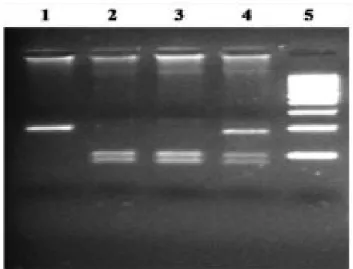
The amplified 185bp product upon digestion by Ava II, yielded two bands of 103 bp and 82 bp respectively in a bull, whereas three bands of 185 bp, 103 bp and 82 bp yielded in an another Holstein bull, indicating polymorphism in a gene coding for Argininosuccinate synthase (fig-1).
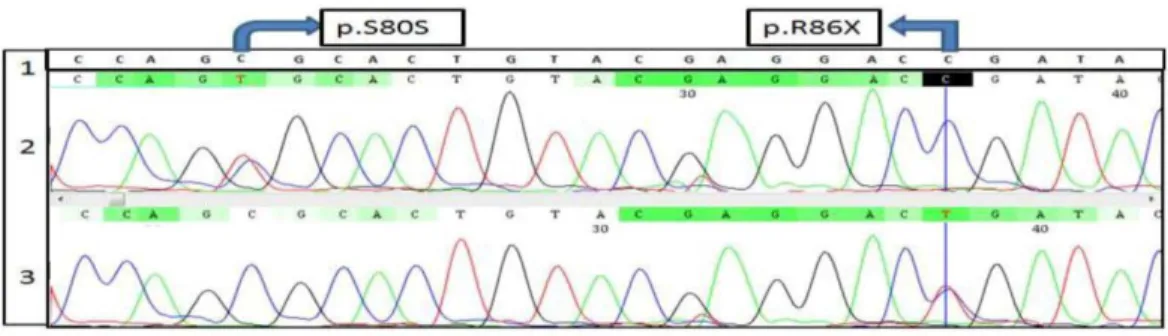
Results indicate that a bull was showing two Restriction Fragment Length Polymorphism (RFLP) patterns, was normal and another bull showing three RFLP patterns was carrier for Citrullinaemia. The observations were also confirmed by sequence of coding exon 3 of ASS1 gene (fig 2).
However, the sequence of a normal Holstein exhibited a new polymorphism at 240bp position. The new polymorphism at 240 bp position was found to be silent as it does not change amino acid (Serine AGC>AGT) within exon 3 of ASS1 gene. The sequence of exon 3 of ASS1 gene in a normal Holstein exhibiting a new polymorphism was submitted to NCBI with accession No.KF933365. In India, first carrier bull for citrullinaemia was observed by PADEERI et al., (1999) when they screened a group of various breeds of Bos Taurus (n=200), Bos indicus
(n=80), Bos taurus x Bos indicus crossbreds (n=50) and Bubalus bubalis (n= 135). The Holstein bull identified as carrier was imported from Australia where this mutation was reportedly wide spread. Although no proper pedigree was available for tracing the origin of mutation in the carrier animal, but they presumed that the animal could be a 3rd or 4th generation descendant of LMKK. After the identification of carrier, an extensive screening of Holstein (n=337) and Holstein crossbreds (n=305) specially breeding bulls stationed in various frozen semen banks throughout the country was conducted (PATEL et al., 2006), which indicated the absence of heterozygous or carrier animal in Holstein and Holstein crossbred bull population. It was then realized that Indian Holsteins might have no polymorphism for ASS1 gene. However, GAURet al., (2012) once again detected two Indian Holstein bulls heterozygous for ASS1 gene out of 120 (1.67%) examined during a year. Identification of two carriers during 2012 and one carrier in present investigation, suggests breeders to continue screening of Holstein and Holstein Crossbred bulls for Citrullinaemia. To best of our knowledge, a new silent polymorphism at 240bp position within exon 3 of ASS1 gene was never reported earlier. Such silent polymorphism must be monitored for their association with other traits.
ACKNOWLEDGEMENT
Authors are thankful to Mr Rajeev Sindhi, Managing Director of Sandor for his constant encouragement & support, and providing facilities to conduct such scientific works in the laboratory.
Received March19th
2014 Accepted July 22th
, 2014
REFERENCES
BELL, J.R. (2008): A simple way to treat PCR products prior to sequencing using ExoSAP-IT.Bio Techniques., 44,
834-834.
CITEK, J., V. REHOUT, J. HAJKOVA, J.PAVKOVA (2006): Monitoring of the genetic health of cattle in the Czech Republic. Vet Med., 51, 333-339.
DENNIS, J.A., P.J. HEALLY, A.L. BEADUET, W.F. O’BRIEN (1989): Molecular definition of Bovine Argininosuccinate synthetase deficiency. Proceeding of Natl Acad Sci., 86, 7947-7951.
EYDIVANDI, C., C AMIRINIA, N.E. JOMEH-KASHAN, M, CHAMANI, J. FAYAZI, H.R. SEYEDABADI (2012): Study of citrullinaemia disorder in Khuzestan Holstein cattle population of Iran. African J Biotech., 11, 2587-2590. FESUS, L., I. ANTON, A. ZSOLNAI (1999): Marker assisted selection in livestock. DUMPS, Weaver-diseases and
Citrullinaemia in cattle population. Allatt-es-Takarm., 48, 193-203.
GAUR, U., T.G. SATHE, A. ROY, P.S.S. SUNKARA, R.K. PATEL, P.SRI VENKATESH (2012): Polymorphism in Arginosuccinate synthase gene in Indian Holstein. Inter J Vet Sci.,1, 115-117.
GRUPE, S., G. DIETLE, M.SCHWERIN(1996): Population survey of Citrullinaemia on German Holsteins. Livest Prod Sci., 45, 35-38.
HARPER, PAW., P.J. HEALY, J.A. DENNIS, J.J. O'BRIEN, D.H. RAYWARD (1986): Citrullinaemia as a cause of neurological disease in neonatal Friesian calves. Australian Vet J., 6,378-379.
HEALY, P.J., J.A. DENNIS, L.M. CAMILLERI, J.L. ROBINSON, A.L. STELL, R.D. SHANKS (1991): Bovine Citrullinaemia traced to the sire of Linmack Kriss King. Australian Vet J., 68,155.
HEALY, P.J., PAW. HARPER, J.A. DENNIA (1990): Bovine citrullinaemia: A clinical. pathological, biochemical and genetic study. Australian Vet J., 67, 255-258.
LI, J., H. WANG, Y. ZHANG, M., HOU, J. ZHONG, Y.ZHANG (2011): Identification of BLAD and citrullinemia carriers in Chinese Holstein cattle. Anim Sci Papers and Reports., 29, 37-42.
LIN, D., Y. HUANG, J. CHEN, T. YANG, T. SHIAO, H.CHANG (2001): Investigation of Citrullinaemia of dairy cattle in Taiwan. J Taiwan Livestock Res., 34, 279-284.
MEI, W.H., L.J. BIN, H.M. HAI, Z.X, HONG, L.W. HAO, N.J. FENG (2009): Development and application of PCR-RFLP for detecting bovine Citrullinaemia and deficiency of uridine monophosphate synthase. Chinese J Vet Sci., 29, 661-664.
ONER, Y., A., C. KESKIN, ELMASI (2010): Identification of BLAD, DUMPS, Citrullinaemia and FXI deficiency in Holstein cattle in Turkey. Asian J Anim Vet Advan., 5, 60-65.
PADEERI, M,, V,K. KHODA, S, GRUPE, P.N. MUKHOPADHYA, S. MANFRED, H.H. MEHTA (1999): Incidence of hereditary citrullinaemia and bovine leukocyte adhesion deficiency syndrome in Indain dairy cattle (Bos Taurus, Bos indicus) and buffalo (Bubalus bubalis) population. Arch. Tierz. Dummerstorf., 42, 347-352.
PATEL, R.K., K.M. SINGH, K.J. SONI, J.B. CHAUHAN, SAMBASIVA, K.R.S. RAO (2006): Lack of carriers of Citrullinaemia and DUMPS in Indian Holstein cattle. J Applied Genet., 47,239-242.
IDENTIFIKACIJA NOSIOCA Bovine citrulinemiae I DETEKCIJA NOVE MUTACIJE
VELI INE 240BP U ASS1 GENU KOD NORMALNE HOLŠTAJNSKE RASE
GOVE ETA
Rosaiah KOTIKALAPUDI1,Rajesh Kumar PATEL2*, Richa Singh KUSHWAH1, Phani Sri Satish SUNKARA1
1
Sandor Lifesciences Pvt. Ltd, Hyderabad-500 034, India
2
Sandor Animal Biogenics Pvt. Ltd., Hyderabad, India
Izvod
Pre uvo enja Holštajnske rase i mužjaka dobijenih ukrštanjem u kolekciju posebno u Indiji redovno se vrši ispitivanje autosomalnih geneti kih poreme aja da se izbegne prenos na slede e generacije. Bovine citrullinaemia je prvi put identifikovana u Australiji kao metaboli ki poreme a funkcije enzima Argininosuccinate synthetase (ASS) uklju enog u ciklus metabolizma uree. Mutacija odgovorna za ovaj poreme aj je zamena jedne baze (C u T) u kodiraju em egzonu 3 ASS1 gena, koja vrši konverzju kodona za arginin (CGA) u kodiraju i region 83 u TGA ( stop kodon).
Molekularnim skriningom je utvr eno da je nosioc ove mutacije mužjak, a to je potvr eno i sekvencioniranjem. Ovo je novi slu aj uz prethodno dva ve identifikovana u Indiji. Parcijalnim sekvencioniranjem kodona 3 normalne Holštajn rase utvr en je novi polimorfizam u poziciji od 240bp koji ne menja aminokiselinu (Sarine AGC>AGT) u kodonu 80 unutar egzona 3 ASS1 gena. Ova sekvenca egzona 3 ASS1 gena je uklju ena u bazu NCBI pod brojem No. KF933365. Mada je veoma mala u estalost ovog poreme aja Holštajn rase u Indiji, od zna aja je nastavak istraživanja mutacija gena u populaciji goveda.
Primljeno 19. III 2014.