Environmental Stochasticity on the Epidemiology and
Evolution of Vector-Borne Diseases: The Example of
Chagas’ Disease
Perrine Pelosse1,2,3*, Christopher M. Kribs-Zaleta2, Marine Ginoux1, Jorge E. Rabinovich6, Se´bastien Gourbie`re4,5, Fre´de´ric Menu1
1Laboratoire de Biome´trie et Biologie Evolutive UMR 5558, Centre National de la Recherche Scientifique, Universite´ Lyon 1, Villeurbanne, France,2Mathematics Department, University of Texas at Arlington, Arlington, Texas, United States of America,3Public Health England, London, United Kingdom,4Ecologie et Evolution des Interactions UMR 5244, Centre National de la Recherche Scientifique, Universite´ de Perpignan Via Domitia, Perpignan, France,5Centre for the Study of Evolution, School of Life Sciences, University of Sussex, Brighton, United Kingdom,6Centro de Estudios Parasitolo´gicos y de Vectores, Universidad Nacional de La Plata, La Plata, Provincia de Buenos Aires, Argentina
Abstract
Insects are known to display strategies that spread the risk of encountering unfavorable conditions, thereby decreasing the extinction probability of genetic lineages in unpredictable environments. To what extent these strategies influence the epidemiology and evolution of vector-borne diseases in stochastic environments is largely unknown. In triatomines, the vectors of the parasite Trypanosoma cruzi, the etiological agent of Chagas’ disease, juvenile development time varies between individuals and such variation most likely decreases the extinction risk of vector populations in stochastic environments. We developed a simplified multi-stage vector-borne SI epidemiological model to investigate how vector risk-spreading strategies and environmental stochasticity influence the prevalence and evolution of a parasite. This model is based on available knowledge on triatomine biodemography, but its conceptual outcomes apply, to a certain extent, to other vector-borne diseases. Model comparisons between deterministic and stochastic settings led to the conclusion that environmental stochasticity, vector risk-spreading strategies (in particular an increase in the length and variability of development time) and their interaction have drastic consequences on vector population dynamics, disease prevalence, and the relative short-term evolution of parasite virulence. Our work shows that stochastic environments and associated risk-spreading strategies can increase the prevalence of vector-borne diseases and favor the invasion of more virulent parasite strains on relatively short evolutionary timescales. This study raises new questions and challenges in a context of increasingly unpredictable environmental variations as a result of global climate change and human interventions such as habitat destruction or vector control.
Citation:Pelosse P, Kribs-Zaleta CM, Ginoux M, Rabinovich JE, Gourbie`re S, et al. (2013) Influence of Vectors’ Risk-Spreading Strategies and Environmental Stochasticity on the Epidemiology and Evolution of Vector-Borne Diseases: The Example of Chagas’ Disease. PLoS ONE 8(8): e70830. doi:10.1371/ journal.pone.0070830
Editor:Herbert B. Tanowitz, Albert Einstein College of Medicine, United States of America
ReceivedMarch 18, 2013;AcceptedJune 23, 2013;PublishedAugust 8, 2013
Copyright:ß2013 Pelosse et al. This is an open-access article distributed under the terms of the Creative Commons Attribution License, which permits unrestricted use, distribution, and reproduction in any medium, provided the original author and source are credited.
Funding:This work has been supported by the French National Research Agency (grant reference ‘‘ANR-08-MIE-007’’), by the National Science Foundation (grant reference ‘‘DMS-1020880’’), and by the Agencia Nacional de Promocio´n Cientı´fica y Tecnolo´gica of Argentina (grant reference PICT2008-0035). The funders had no role in study design, data collection and analysis, decision to publish, or preparation of the manuscript.
Competing Interests:The authors have declared that no competing interests exist. * E-mail: [email protected]
Introduction
Environmental stochasticity is a major factor responsible for fluctuations in the density of populations, and possibly their extinction, and on an evolutionary timescale it strongly influences organisms’ life histories [1,2]. Environmental stochasticity typically affects all individuals of a same cohort, developmental stage or population the same way, contrary to demographic stochasticity which may affect each individual differently [3]. Insects are particularly sensitive to variations in environmental factors such as temperature, which impacts their development rate [4,5], rainfall, which determines the availability of larval habitats in mosquitoes [6], predation or habitat destruction. Unpredictable environmen-tal variations are likely to increase as a result of global climate
change [7] and other human interventions such as deforestations or pest and vector control. It is thus a fundamental question to what extent environmental stochasticity affects the distribution, epidemics, virulence and evolution of vector-borne diseases, i.e., diseases transmitted between hosts by blood-sucking arthropods, which are a major health threat in tropical and subtropical areas [8].
vector-borne diseases [11]. Climate-based transmission models that integrate explicit relationships between climatic factors and insect life-history traits such as development time have been developed to investigate the effect of climatic variations on the population dynamics of vectors and, in turn, on the epidemiology of vector-borne diseases [12–15]. However, to our knowledge, the possible impacts of environmental stochasticity on the evolution of vector-borne diseases have never been investigated.
Insects are well known to display specific behavioral and life-history strategies to face environmental uncertainty [16–18]. Life-history theory in stochastic environments predicts that strategies which spread the risk of encountering unfavorable conditions over time or space should be selected for in unpredictable environments [1,2,19,20]. Density-dependent factors have also been shown to favor the evolution of risk-spreading (i.e., diversified bet-hedging) strategies [21], because they amplify population size variation and, in turn, the effects of environmental stochasticity. Iteroparity, which consists in reproducing multiple times over an organism’s lifetime, and inter-individual variability of juvenile development times due to dormancy variation are usual risk-spreading strategies reducing the probability of lineage extinction [22–24]. Such risk-spreading strategies exhibited by vector insects in stochastic environments could potentially affect the epidemiology, evolution and control of insect-borne diseases. This has been largely overlooked, except in a recent study suggesting that several species of triatomines, the vectors ofTrypanosoma cruzi, the etiological agent of Chagas’ disease, exhibit, even under the same environmental conditions, an inter-individual variability of juvenile development times, and that such variability could have been selected as a response to environmental stochasticity [25]. The consequences of the variability in tick diapause duration on the epidemiology of tick-borne diseases have also been questioned [14]. However, the influence of such vector strategies on the prevalence and evolution of pathogen virulence has not been studied yet.
The epidemiology and evolution of parasites are affected by their hosts’ physiology, life-history traits, population biology and environment. In the case of vector-borne diseases, the availability of both hosts and vectors is likely to affect disease epidemiology and evolution [26–28]. Understanding how the interaction of these multiple factors affects parasite evolution, in particular their virulence, could permit the prediction of their impact on both humans and animals and help set up effective control strategies [29]. Theoretical and empirical works suggest that pathogens should evolve toward intermediate levels of virulence to their hosts, on the grounds that increasing replication rate within the host is beneficial in terms of increasing transmission probability, but also costly as it increases the level of damage to the host and therefore shortens the infectious period [29–38]. This compromise is referred to as the trade-off hypothesis between virulence and transmission [33,34].
To what extent and how classical vector life-history traits such as developmental time, fecundity or survival could affect the evolution of parasite virulence to hosts is still not completely clear. Vector life-history traits do not seem to affect the long-term evolution of parasite virulence to hosts in a deterministic setting [39]. However, under stochastic settings, more complex host and vector population dynamics and extinctions might create ecolog-ical conditions favoring different parasite virulence strategies. In the case of a directly-transmitted disease submitted to demo-graphic stochasticity, large host populations have been suggested to favor more virulent parasites as it seems less costly to harm one’s hosts when available hosts are numerous [40]. Environmental stochasticity associated to vector risk-spreading strategies could lead to similar results among vector-borne diseases.
Our work uses a theoretical modeling framework to test whether environmental stochasticity in interaction with vector life-history traits, in particular risk-spreading strategies, influences the epidemiology and evolution of vector-borne diseases. Our objective is to provide a general framework including only key demographic and transmission processes which could potentially apply to several vector-borne diseases [41]. We nevertheless have based our model on the specific example of triatomine biodemo-graphy, in particular the variability they display in the duration of their juvenile stage [25,42–45]. Chagas’ disease is a chronic infection caused by the parasiteTrypanosoma cruziand transmitted to humans and other vertebrate hosts by blood-sucking triatomine insects [46]. This disease is a complex zoonosis covering a huge geographical area, submitted to diverse ecological and climatic conditions, and involving numerous host and vector species. Whereas it has long been restricted to rural Latin America areas where it is responsible for thousands of deaths each year, it is now a worldwide health threat because of increasing migratory flows, blood donations, organ transplants, and potential displacements of triatomines as a result of human activities and global climatic changes [47–49].
We developed a SI (i.e., Susceptible-Infected, with no recovery) vector-borne epidemiological model which considers for simplicity a single type of vectors and hosts, both regulated by density-dependent processes. Vectors in our model are structured in two explicit stages, a juvenile and an adult stage, both able to transmit the infection (Fig. 1, Fig. S1). Following previous work on triatomines’ developmental delay, we considered that vectors could display variable development times and that the juvenile stage was more resistant to environmental stress than the adult stage [25]. To create conditions under which displaying variable development times could lower vector population extinction probability, only adult vectors were subjected to environmental stochasticity. This generated risk-spreading strategies in vectors and we tested their influence on parasite epidemiology and evolution. Numerical simulations were carried out to compare the predictions of the model in a deterministic and a stochastic setting, in order to infer the role of environment stochasticity, as well as to be able to compare our results with other results obtained with deterministic models.
Results
The Influence of Vector Life-history Traits and Environmental Stochasticity on Vector Density and Parasite Prevalence
As expected, vector life-history traits affect vector population density and, in turn, influence prevalence among vectors and hosts. Sensitivity analyses suggested that such effects were very similar whatever the level of parasite virulence to hostsa(results not shown). The virulence of the parasite introduced in the susceptible host - vector population was therefore set toar= 0.008
in the entire epidemiological analysis. This value was selected as it corresponds to the typical level of virulence toward which the system converges after a long evolutionary time (see section ‘‘Virulence evolution’’ below). Among all possible combinations of vector life-history traits, we chose a sample of scenarios (Fig. 2) which accurately captures the diversity of the results observed in the whole study.
How do vector life-history traits affect vector density?. In the deterministic case, increasing the proportion Pjof juvenile vectors prolonging the juvenile stagePjdecreased of
stochasticity was relatively low (in this case, epidemiological patterns were, in general, very similar to the deterministic case, results not shown), or that vector life-history traits such as adult survival and fecundity were high enough to allow a high persistence of vector populations (Fig. 2d, black lines). Fewer juveniles molting into adults most likely lessens adult vector density and therefore the production of juveniles, which decreases total vector density. A decrease in other vector life-history traits (i.e., juvenile and adult survival and adult fecundity) led to a similar decrease in total vector density.
How does vector density affect parasite
prevalence?. When vectors were relatively abundant, i.e., mostly in deterministic environments, and in stochastic environ-ments when adult survival and fecundity were high (and as a consequence vector population persistence always high irrespec-tive ofPj), any decrease in vector density according toPjresulted in
an increase of parasite prevalence in vectors but no (or limited) increase of prevalence in hosts (Fig. 2a, red lines,Svjhigh,Pjlow;
Figs. 2b and 2d, red lines; Fig. 2c, red lines,Svjintermediate to
high; Fig. 2d, black lines,Svjhigh, orSvjlow but only forPjlow).
This unusual result can be explained by the fact that our model incorporates density-dependent mechanisms regulating vector population density. As vectors rely on blood meals and therefore
compete for host access, decreasing vector density lessens the intensity of competitive interactions between vectors. This enhances the per-vector biting rate and seems to increase parasite prevalence among vectors. Conversely, at relatively low vector densities, decreasing vector density can reduce parasite prevalence among vectors and hosts (Fig. 2a, red lines, except forSvj= 0.95).
Parasite prevalence among hosts obviously collapses when vector density approaches zero, even if parasite prevalence among the few remaining vectors could be relatively high (Fig. 2c, red lines, whenPjhigher than 0.6 andSvjlower than 0.95; Fig. 2d, black
lines,Svj= 0.6 andPj= 0.9).
In stochastic cases, wherePjdrastically affects vector population
persistence probability, the relationships between vector density and prevalence among vectors and hosts according toPjare more
complex as no monotone patterns can be observed (Figs. 2b and 2c, black lines). These patterns are described in detail in the next section but we can already notice that great changes in vector or host prevalence can occur without major changes in vector density according toPj.
Risk-spreading strategies enhance parasite prevalence in stochastic environments. Risk-spreading strategies are de-fined as life histories maximizing the probability of persistence in unpredictable environments. Such risk-spreading strategies were observed in stochastic environments for combinations of vector life-history trait values depicted in black lines, in Figs. 2b and 2c. Under these conditions, we observed classical patterns of insect populations’ persistence according to risk spreading strategy [e.g. 1,2,24] (Figs. 2b and 2c, grey lines in graphs showing vector densities). This confirms that variable development times (i.e., Pj?0 andPj?1) decrease the extinction risk when environmental
stochasticity affects vector adult survival. Vector risk-spreading arose clearly for intermediate to highPjvalues, when eitherSvawas
relatively high andwvrelatively low (Fig. 2b, dashed and solid grey
lines) orSvarelatively low andwvrelatively high (Fig. 2c, dashed
and solid grey lines). Under these conditions, lowPjvalues always
resulted in vector population extinction. For intermediateSvj, very
highPjvalues also led to vector population extinction, as vector
density became very low and eventually null (Figs. 2b and 2c, dashed grey lines). When Sva, Svj and wv were too low, vector
populations did not persist at anyPj values (Fig. 2a, grey lines:
vector persistence probability always null whateverSvj, and Figs. 2b
and 2c, grey dotted lines: vector persistence probability always null whenSvj= 0.6).
Vector risk-spreading strategies observed for intermediate to high Pj values resulted in an increase in parasite transmission.
Indeed, the prevalence according toPjfollowed the same patterns
as vector population persistence probability: prevalence among hosts is maximal for intermediate or high values ofPj(Figs. 2b and
2c, dashed and solid black lines). Note that when vector risk-spreading occurs, patterns of prevalence among hosts are very different than those among vectors. As a consequence, the latter cannot be used as a predictor of parasite prevalence among hosts.
Environmental stochasticity can enhance parasite
prevalence as compared to deterministic
contexts. Parasite prevalence among vectors was generally always slightly higher in the stochastic compared to the deterministic case (provided that vector persistence probability was not too low which resulted in very low to null prevalence). This can be explained by the fact that environmental stochasticity decreases vector density, and that when vector density is too high, this decrease results in higher parasite transmission. This result held for parasite prevalence among hosts in a few cases only. When vectors displayed no risk-spreading strategy, prevalence among hosts was always null or very low in the stochastic case, and
therefore substantially inferior to the deterministic case (Figs. 2a, 2b and 2c). When vectors adopted risk-spreading strategies, prevalence among hosts remained lower in the stochastic case at intermediatePjvalues (Figs. 2b and 2c, dashed and solid lines), but
reached values similar to the deterministic case when bothPjand
Svjwere high (Figs. 2b and 2c, solid lines). When bothSvaandwv
were high, prevalence among hosts was the same whatever the kind of environment (deterministic or stochastic) at lowPjvalues,
and at higherPjvalues was then slightly superior in the stochastic
than in the deterministic case (Fig. 2d). In the same context, but with less stochasticity, prevalence among hosts was always slightly superior in the stochastic compared to the deterministic case independently ofPj(results not shown).
The Influence of Vector Risk-spreading Strategies on the Evolution of Parasite Virulence
Neither the proportion of juvenile vectors prolonging the juvenile stagePj, nor the other vector life-history traits and their
interactions markedly influenced the value of the Continuously Stable Strategy (CSS) toward which parasite virulence converged over long evolutionary times. Furthermore, the CSS reached under the stochastic and deterministic settings were nearly the same. Nevertheless, the invasion speed of the mutant was affected by the interaction between the environment (i.e., stochastic or deterministic) andPj, which suggests that risk-spreading strategies
in stochastic environments can affect the evolution of parasite virulence on shorter evolutionary timescales.
Effect of vector life-history traits and environmental stochasticity on the long-term evolution of parasite virulence. Simulations of the competition of resident and mutant parasites were carried out for all the demographic and epidemiological scenarios presented in the result section ‘‘ Epide-miology’’. Three types of environments were studied: deterministic,
stochastic with relatively low stochasticity (eS= 0.3) and stochastic
with relatively high stochasticity (eS= 0.1). In each environment,
we considered all combinations ofPjand other vector life-history
trait values leading to a vector population persistence probability strictly superior to 5% (see Fig. 2), and a large range ofar/am
virulence couples (see the ‘‘Model’’ section). In all the tested cases, virulence always converged to an asymptotic CSS value of approximatelya= 0.008 (result illustrated for a specific example in Appendix S2 in File S1 and Fig. S2). Therefore, vector life-history traits and vector risk-spreading strategies in stochastic environments do not influence the long-term evolution of parasite virulence. The virulence value obtained (a= 0.008) corresponds to an average life expectancy of 1 year and 5 months for infected hosts as compared to healthy hosts, which live an average of 3 years.
However, the time needed to reach mutant fixation appeared to vary between the cases studied (see Appendix S2 in File S1 and Fig. S2). As a consequence, we analyzed in more detail how the transient dynamics of mutant invasion was affected by vector risk-spreading strategies (see below).
Vector risk-spreading strategies affect the transient dynamics of mutant invasion. We analyzed the transient dynamics of mutant invasion for two cases for which vector risk-spreading strategies were previously identified: one corresponding to a relatively efficientPj(i.e., enhancing very significantly vector
population persistence probability in stochastic environments) and the other one corresponding to a less efficientPj(see Figs. 2b and
2c, dashed and solid grey lines), in the stochastic versus deterministic case. We set mutant virulence am to the CSS
strategy of 0.008, so that the mutant is always expected to invade the resident in the long term, and we slightly variedararound the
mutant CSS strategy. We observed that environmental stochas-Table 1.Definition and values of the parameters used in the model.
Parameter Definition Value (or range of values) used in the model
Shs Proportion of hosts surviving at each time step. 0.994
vh Maximal number of offspring per host per time step. 0.05
g Density dependence factor for hosts: number of hosts at which host fecundity is reduced by two.
100
Sva Proportion of adult vectors surviving at each time step (parameter submitted to stochastic variations).
variable (from 0.6 to 0.95)
Svj Proportion of juvenile vectors surviving at each time step. variable (from 0.6 to 0.95) Pj Proportion of juvenile vectors prolonging the juvenile stage at each time step. variable (from 0 to 0.9)
vv Maximal number of eggs per vector per time step. variable (1; 2.5) [58,59]
q Density dependence factor for vectors: V/H ratio at which vector fecundity and biting rate is divided by two.
50
bmax Maximal (preferred) biting rate of vectors (in bites per vector per time step). 1 [62]
ak Probability of the host to die as a result of an infection by the parasite straink (virulence).
0.008 in the epidemiological approach; variable according to parasite strain in the evolutionary approach
bh Stercorarian* transmission probability (host infection probability) (in infected hosts per bite).
0.005
c Shape of the function linking virulence and transmission rate. 0.01
eS(t) Quantity by which vector adult survival is multiplied (eS= 1 during ‘‘good’’ periods and0#es#1during ‘‘bad’’ periods), or intensity of stochasticity.
variable (0.1; 0.3)
pB Probability that a bad period occurs. 0.2
r Autocorrelation coefficient among good and bad periods. 0.5
ticity and the level of efficiency of risk-spreading strategies can affect the transient dynamics of mutant invasion.
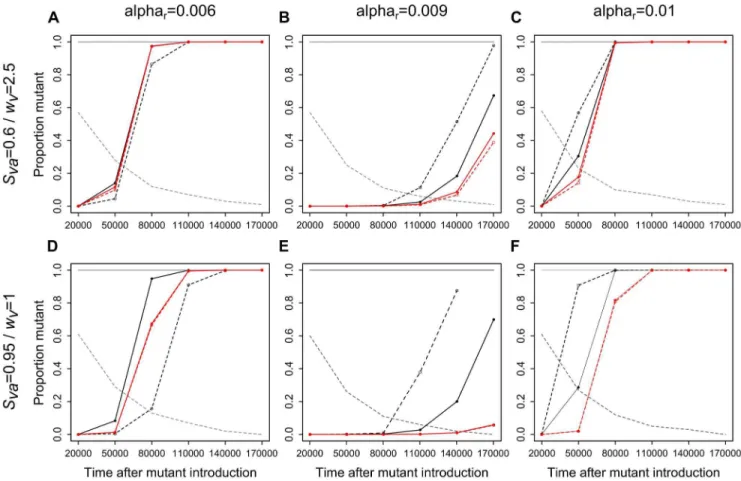
When ar.am, the proportion of infections by the mutant
parasite among all infected hosts during the transient phase of mutant invasion, or in other words, mutant invasion speed, was always higher in the stochastic (black lines) compared to the deterministic (red lines) case whatever the efficiency of vector risk-spreading strategy (Figs. 3b, 3c, 3e and 3f). Under stochastic environments, mutant invasion speed was also higher when vectors played a less efficient risk-spreading strategy (dashed black lines) as compared to a more efficient one (solid black lines, Figs. 3b, 3c, 3e and 3f).
Conversely, whenar,am, mutant invasion was always slower in
stochastic contexts in which vectors played a less efficient risk-spreading strategy (dashed black lines) compared to other contexts (Figs. 3a and 3d). Then, the invasion of the mutant in stochastic contexts in which vectors played a more efficient risk-spreading strategy (solid black lines) was either faster (Fig. 3d) or similar (Fig. 3a) than in deterministic environments (red lines). The difference in the results between Fig. 3a and Fig. 3d can be explained as follows: in theSva= 0.6/wv= 2.5 context (i.e., Fig. 3a),
vector density at the time of mutant introduction when vectors adopted the efficient risk-spreading strategy (i.e., Pj= 0.8) is
approximately one half in the stochastic as compared to the
Figure 2. Influence of vector life-history traits on vector population dynamics and parasite prevalence.In each panel, the upper, middle and lower graphs display, respectively: total vector density, parasite prevalence in vectors, and parasite prevalence in hosts, according to the proportion of juvenile vectors prolonging the juvenile stagePj. Red and black lines correspond, respectively, to simulation results in the deterministic (shown att= 150,000 weeks) and stochastic (shown att= 10,000 weeks as median values over the 100 simulations, plotted only if the number of simulations without extinction is$5) case; dotted lines (open circles), dashed lines (closed circles) and solid lines (triangles) to a relatively low (Svj= 0.6), intermediate (Svj= 0.8) and high (Svj= 0.95) juvenile survival. Left and right panels correspond, respectively, to a relatively low (Sva= 0.6; panels a, c) and relatively high (Sva= 0.95; panels b, d) adult survival; upper and lower panels to a relatively low (wv= 1; panels a, b) and relatively high (wv= 2.5; panels c, d) fecundity. The persistence probability of vector populations (proportion of simulations for which vector density does not collapse before the end of the simulation), is given in grey in the upper graphs showing vector density. For prevalence among hosts, all simulations (including those for which vector populations collapse) are taken into account. For vectors (density and prevalence), only simulations for which vector population persisted until the end of the simulation are considered. Other parameters values are:ar= 0.008,b= 0.005,c= 0.01,Shs= 0.994,wh= 0.05, g= 100,q= 50,bmax= 1,r= 0.5,pb= 0.2,eS= 0.1.
doi:10.1371/journal.pone.0070830.g002
deterministic environment (see epidemiological results on Fig. 2c), while in the Sva= 0.95/wv= 1 context (i.e., Fig. 3d), it is
approximately one tenth, which most likely boosted mutant invasion speed.
These results show that a mutant parasite less virulent than the resident invades faster under ecological contexts leading to a relatively high extinction probability of vector populations (i.e., in stochastic compared to deterministic environments, and with a less efficient compared to more efficient risk-spreading strategy). Conversely, a mutant parasite more virulent than the resident invades faster under ecological contexts leading to a relatively good persistence of vector populations (i.e., in deterministic environments and in stochastic environments with efficient risk-spreading strategies). This suggests that over relatively short evolutionary times, efficient risk-spreading strategies can favor more virulent parasites by enhancing vector population persistence probability.
Discussion
Insects are sensitive to variations in environmental factors such as temperature, rainfall, predation, vector control, habitat change (e.g., pollution) or destruction. Climate variability and the frequency of extreme climatic events are most likely increasing with global climate change (e.g. [6,7]). We therefore expect that insect risk-spreading strategies, that is, strategies able to reduce extinction risk in stochastic environments, will become more widespread in the future. Our work investigates theoretically, for the first time, the influence of environmental stochasticity and vector risk-spreading strategies, on both the epidemiology and evolution of vector-borne diseases. We showed that vector risk-spreading strategy in stochastic environments, defined here as an increase in the inter-individual variability in vector development time, can enhance parasite prevalence among both vectors and hosts (these changes being influenced by other vector life-history traits), but does not affect the long-term evolution of parasite virulence. On shorter timescales, they nevertheless affect the invasion speed of the mutant, less virulent parasites invading faster when the extinction risk of vector populations is high (i.e., in stochastic environments when vectors do not adopt efficient risk-spreading strategies), and more virulent parasites invading faster when vector population extinction risk is low (i.e., in deterministic environments, or when vectors adopt efficient risk-spreading strategies in stochastic environments). Our work therefore shows that environmental stochasticity and vector risk-spreading strate-gies are major factors that must be considered to understand both the epidemiology and short-term evolution of vector-borne diseases. It also strengthens the idea that vector biodemography in general has drastic consequences on the epidemiology of vector-borne diseases [41].
Vector Risk-spreading Strategies in Stochastic Environments can Enhance Parasite Prevalence
Risk-spreading strategies are common and well described among insects (e.g. [22–24]) and seem to be displayed by triatomines, the vectors of the parasite Trypanosoma cruzi respon-sible for Chagas’ disease [25]. Our study shows that intermediate to high values of the vector development time parameter Pj
increase vector population persistence in stochastic environments, as they spread the risk that vectors reach the adult stage when a bad environmental event occurs. We showed that such risk-spreading strategies increase parasite prevalence among hosts compared to non risk-spreading strategies. More generally in our study, prevalence was either smaller or higher in stochastic
compared to deterministic environments, depending on the values of vector life-history traits. Therefore, neglecting vector risk-spreading life histories may result in underestimating the epidemiological risk in stochastic environments, and deterministic models in general could lead to both over- and under-estimations of this risk.
Efficient risk-spreading strategies could be achieved in our model because only adult vectors were subjected to environmental stochasticity. Several lines of evidence suggest that triatomines’ juvenile stage, in particular the 5thinstar, could be more resistant than the adult stage to environmental stress such as starvation or insecticide exposure [see 25]. Smaller juveniles could also easily hide in small cracks in walls or in the ground and thus better resist stochastic events such as insecticide spraying, physical removal of vectors from human habitats, or predation. Such risk-spreading strategies and their epidemiological consequences may not be specific to triatomine vectors and Chagas’ disease. Indeed, variability in diapause duration, described in ticks and having a strong effect on tick population dynamics [14] could also possibly influence tick-borne disease transmission. Overall, our results suggest that vector temporal dispersion strategies and environ-mental stochasticity may play a role in the global increase of vector-borne disease epidemics and reemergence, such as the ones described in malaria [6].
Risk-spreading Strategies Increase the Invasion Speed of more Virulent Parasites
Over a long evolutionary time, the vector life-history traits considered in our study do not influence the evolution of parasite virulence to hosts in either the deterministic or the stochastic settings. In this regard, our study is consistent with a previous modeling study conducted on dengue in a deterministic setting which showed that vector life-history traits do not influence the long-term evolution of virulence to hosts [39]. Our work extends this result to the stochastic context, includes juvenile variable development time, and considers a density-frequency-dependent evolutionary process, which is different from this existing study that has used a ‘‘R0optimization approach’’ (see [29]). In
vector-borne diseases, in the same manner as in directly-transmitted disease systems, the only life-history trait which seems to influence the long-term evolution of virulence to hosts is host background mortality, long-lived hosts giving rise to long-lasting infections and selecting for less virulent pathogens, and short-lived hosts selecting for more virulent pathogens [39,71–73]. We reached the same conclusion with our model: an increase in host survival decreased the value of the evolutionary stable virulence (results not shown). Further work, which falls beyond the scope of the present study, should look in more detail at the determinants ofT. cruzivirulence, in particular under the influence of host biodemography.
improve vector persistence probability. A similar conclusion could be reached with a directly-transmitted disease model including demographic stochasticity: dense host populations that provide less restrictive conditions for pathogen invasion selected for increased virulence [40].
Pathogen extinction rates in vector-borne systems, for which vectors are more severely subjected to environmental stochasticity than hosts, is probably lower than in directly-transmitted disease systems, because hosts might provide reservoirs for the pathogen [74]. Lastly, vector metapopulation dynamics, in particular their immigration and/or recolonization of treated areas can have drastic consequences on vector persistence [75–79] and pathogen transmission [40,80,81], and might also be used as a strategy to decrease vector extinction risk. Similarly, vector immigration might select for more virulent pathogens, as it decreases the local risk of extinction [82].
Decreasing Vector Abundance Usually Increases Parasite Transmission, via a Decrease in Vectors’ Competition for Host Access
The inclusion in our model of a density-dependent mechanism for regulating vector populations revealed novel aspects of the effects of vector demography on parasite prevalence. Most previous epidemiological models assume that transmission rate is an increasing function of host density. Vector-borne models traditionally assume that the vector per host ratio affects transmission rates, but that hosts are numerous and therefore do not constitute a limiting resource for vectors which can feed at their preferred rate (e.g. [26,27]). However, in Chagas’ disease, as probably in other vector-borne diseases, vectors are known to compete for host access, and this most likely regulates vector populations [53–56]. The vector per host ratio and processes of saturation in contacts between hosts and vectors have a strong influence on the transmission dynamics [28,60,61] and the evolution of the parasite (at least in the specific case of the evolution of transmission modes, see [83]).
Here we showed that as a result of vector competition for host access, decreasing vector density can increase parasite prevalence in vectors and hosts (unless vector density is too low). Conse-quently, because environmental stochasticity results in a decrease in vector density, prevalence among vectors is often higher in the stochastic version of our model compared to the deterministic one, and there are a few cases for which prevalence among hosts is also slightly higher. This contrasts with previous models including demographic stochasticity that usually lead to lower prevalence compared to deterministic models (e.g. [9]). Few comparisons between the predictions of stochastic versus deterministic epide-miological models have been carried out, especially among models with an evolutionary component (but see [10]), and our work is original in this respect.
Our model assumes that vector biting rate increases when vector density relative to hosts decreases and that the quantity of blood ingested is constant. As an alternative, we could have considered that when vectors are too numerous relative to hosts, host defensive behaviors interrupt blood meals and therefore reduce their size. This would reduce the infectivity of the bites because parasite transmission requires that feces are deposited in the vicinity of the bite. This alternative should therefore lead to similar predictions because infection probability would increase when the competition between vectors decreases.
Conclusion
Our work is the first to investigate the epidemiological and evolutionary consequences of the interaction between vector risk-spreading strategies and environmental stochasticity. Our results show they must be taken into account in epidemiological and evolutionary studies on vector-borne diseases and strengthen the idea that vector-borne diseases are strongly affected by vector biodemography [41]. Our model bears properties specific to the Chagas’ disease system, the main one being that both juvenile and adult stages are able to transmit the parasite. This applies also to tick-borne diseases as all ticks’ developmental stages are infective. We believe that a global approach, taking into account adaptive biodemographic responses of vectors to environmental stochasti-city when trying to understand the epidemiology and evolution of vector-borne diseases, should be considered and applied more widely to other systems.
Methods
We built a discrete-time SI model describing triatomines’ life-cycle (juvenile and adult stage) and vector-borne transmission ofT. cruzito a single host species. To investigate the epidemiological dynamics of the model, and in particular the influence of vector life-history traits on disease prevalence in hosts and vectors, a one-parasite-strain model was used. This model has a total of 6 classes (Fig. 1). To investigate the evolutionary dynamics of parasite virulence, we used a two-parasite-strain version of the model considering that a residentr and a mutant mcompete for host access (no co-infection was considered). This model has a total of 9 classes. The equations of the two-parasite-strain model are given in Appendix S1 in File S1. We first describe the deterministic form of the model, and then explain how environmental stochasticity was applied.
We used a time step of 1 week as triatomines feed once about every five-ten days under optimal, laboratory conditions (see [50] and below). At each time step, a certain proportion of hosts and vectors first survive, then produce newborns (host and vector newborn mortality is incorporated in the fecundity), and then eventually become infected by one of the two parasite strains (see schematic sequence of events of the one-parasite-strain version of the model in Fig. S1). Vectors are divided into a juvenile and an adult stage and, at each time step, a proportion Pj of juvenile
vectors remain in the juvenile stage. Both triatomine larvae and adults are haematophagous, and consequently both are able to contract and transmit the infection. For simplicity, we assume that there is no difference in the two stages’ infectivity and susceptibility to infection. Hosts and vectors produce susceptible offspring even if infected. Even if vertical transmission has been reported in a few host species (e.g. in mice [51]; in humans [52]), we consider its role in the transmission of Chagas’ disease to be negligible. For simplicity, we also assume that hosts and vectors turn infective immediately after becoming infected and that their infectivity remains unchanged whatever the time since infection.
Host Biodemography
T. cruziinfects numerous vertebrate hosts (sylvatic and domestic) that show contrasted life-history trait values (e.g. life expectancy, fecundity). Taking into account multiple host populations was technically difficult and our work focuses on the biodemography of vectors. We therefore considered a single ‘‘hypothetical’’ host for whichT. cruziis pathogenic,i.e.the parasite generates a mortality cost. The proportion of susceptible hosts surviving at each time step is assumed to beShs= 0.994 (which corresponds, in terms of
weeks or 3.1 years) (see Table 1 for all parameter values used in the model). The survival probability of infected hosts is the probability that they survive from ‘‘natural causes’’, Shs, and the probability
that they survive from the infection. We define virulenceaas the probability to die as a result of the infection. By extension, and because in our model, virulence is assumed to vary according to the parasite strain (resident or mutant), the proportion of infected hosts surviving at each time step is considered to be:
Shi(ak)~Shsð1{akÞ
withkreferring to the resident or mutant strain. In our model, and as is commonly assumed in models of pathogen virulence, virulence is therefore defined as an additive mortality cost.
Susceptible and infected hosts are assumed to display the same density-dependent fecundity,Fh(t):
Fh(t)~
vh
1zHTg(t)
wherevhis the maximum number of offspring produced per host
and per time step,gthe density of hosts at which host fecundity is divided by two, andHT(t) the total host density, i.e., the sum of
susceptible and infected (whatever the parasite strain) host density. We assume that each female host produces a maximum of 5 newborns per year (approximately 0.1 per week). Both males and females are considered in our model, and assuming a 0.5 sex-ratio,
vh= 0.05.
Vector Biodemography
Contrary to hosts, vectors do not usually suffer a mortality cost when infected byT. cruzi(see [46] for a review). The proportion of adult and juvenile vectors surviving at each time step areSvaand
Svj, respectively, and the proportion of juvenile vectors prolonging
the juvenile stage is Pj (see Table 1 for the range of parameter
values used). A value for Pj strictly between 0 and 1 creates a
temporal variability in the time at which juveniles reach the adult stage. Increasing Pjincreases both the average and variability of
the juvenile stage duration. To survive (and for adult vectors, to reproduce as well), vectors need to ingest blood from hosts (these host-vector contacts may result in parasite transmission when one of two partners is susceptible and the other one infected, see below). Hosts cannot tolerate an unlimited amount of bites: they are known to become irritable and defend themselves against vectors when they receive too many bites [53–56]. Increasing the vector per host ratioQ(t) =VT(t)/HT(t) (VT(t) being the total vector
density including all infection status and developmental stages) could therefore result either in blood meals being interrupted by host defensive behaviors, which would lessen the average quantity of blood ingested, or in a global reduction in the average vector biting rate if access to hosts is made difficult. Because triatomines cannot produce eggs without ingesting blood meals but can undergo long starving periods, we assume, following [57], that the vector per host ratioQ(t) affects vector fecundity but not survival. Triatomines’ fecundity is therefore assumed to be a decreasing function ofQ(t) and is expressed as:
Fv(t)~
vv
1zQq(t),
withvvbeing the maximum number of eggs produced per vector
and per week and q the Q ratio for which vector fecundity is divided by two. Under laboratory conditions, fecundity estimates
from triatomines of the genus Triatoma vary between 2 and 6 female eggs per female per week (e.g. [58,59]). To take into account the sex-ratio and egg mortality, we setvvto either 1 or 2.5
in our analysis (see Table 1 for the parameter values used in the model).
Infection Dynamics
Vector-borne models, and in particular models of Chagas’ disease transmission (e.g. [27]) usually follow the assumption developed by Ross [26] on malaria that hosts are always numerous and vectors feed at their preferred rate. As reported above, hosts can however constitute a limited resource when the number of vectors per host is large. We assumed for simplicity that the quantity of blood ingested was unaffected by the vector per host ratio and that the per-vector biting rate (in number of bites per vector per time step) saturates for low Q values and decreases gradually asQincreases [28,60,61], which leads to the following expression:
b(t)~ bmax 1zQq(t),
withbmax being the maximum (preferred) vector biting rate (in
number of bites per vector per time step). Data on triatomine spontaneous drive for food in the field are lacking and are likely to be highly variable among triatomine species. In the laboratory, when triatomines are offered a host daily, the preferred feeding frequency averages one blood meal every 5–10 days for species of the triatomine genusRhodnius[62]. For simplicity, and because in the laboratory feeding conditions are optimal for the insects, we set bmax= 1, i.e., vectors feed at a maximum rate of one time per week.
New infections in hosts require a contact between a susceptible host and an infected vector. The number of new hosts infected by a parasite strain k at each time step is thus calculated as the product of the total number of blood meals per time step, b(Q(t))VT(t), the proportion of contacts involving a susceptible host
Hs(t)/HT(t), the proportion of contacts involving a vector (either
adult or juvenile) infected by the strain k, Vik(t)/VT(t), and the
probabilitybhthat such a contact gives rise to an infection in the
host (in infected hosts per bite) [28]:
Lhk(t)Hs(t)~b Qð (t)ÞVT(t) Hs(t) HT(t)
Vik(t) VT(t)
bh
~b Qð (t)ÞbhVik(t)
HT(t) Hs(t),
Lhk(t) being the rate of new host infections by the parasite straink.
The total probability for a host to become infected by one of the two strains (residentrand mutantm) is therefore:
wh(t)~1{e
{ðLhr(t)zLhm(t)ÞT
whk(t)~
Lhk(t)
Lhr(t)zLhm(t)
1{e{ðLhr(t)zLhm(t)ÞT
:
In a similar way, new infections in vectors require contacts between susceptible vectors and infected hosts. If we setbvas the
probability that such a contact gives rise to an infection in the vector (in infected vectors per bite), the number of new vectors infected by a parasite strainkper time step is:
Lvk(t)Vs(t)~b Qð (t)ÞVT(t) Vs(t) VT(t)
Hik(t) HT(t)
bv~b Qð (t)ÞbvHik(t)
HT(t) Vs(t):
This leads to the following expression for the probability for a vector to become infected by straink:
wvk(t)~
Lvk(t)
Lvr(t)zLvm(t)
1{e{ðLvr(t)zLvm(t)ÞT
:
Resident and mutant parasites are assumed to differ in the intensity of the harm they induce to their host, i.e. virulence a
(defined in our model as an additive mortality cost to natural mortality). It is well accepted in the literature that virulence is correlated to the growth rate of the parasite inside the host,i.e.to the total number of pathogen particles present in the host. Increasing virulence therefore typically leads to an increase of pathogen transmission probability from infected hosts to vectors
bv, up to a certain threshold [30–32]. In our model, we therefore
expressedbvas a simple increasing function ofawith decreasing
benefits, as has been traditionally done in the literature (e.g. [29,33]):
bv~
a azc,
cbeing the shape parameter of this function.
Environmental Stochasticity
Our main objective is to study the combined influence of vector risk-spreading strategies and environmental stochasticity on the epidemiology and evolution of the disease. Because risk-spreading strategies most likely occur at the juvenile stage in triatomines [25], and in order to create conditions under which variability in the juvenile stage duration decreases extinction risk under unpredict-able environmental conditions, only adult vectors are subjected to environmental stochasticity in our model. We chose to expose adult vector survival rather than fecundity to stochasticity. Indeed, as triatomines are iteroparous (i.e. they have several reproductive periods during their lifetime), subjecting their reproduction to stochasticity has only a limited impact on vector population densities.
In the stochastic version of our model, a stochastic sequence of ‘‘good’’ and ‘‘bad’’ periods was considered, ‘‘bad’’ periods occurring with probabilitypB. Because the time step of one week
chosen here is relatively small, and switching from a ‘‘good’’ to a ‘‘bad’’ period every week might be unrealistic, we define a parameter r, between 0 and 1, controlling the intensity of the autocorrelation between periods. The probability to switch from a ‘‘good’’ to a ‘‘bad’’ period is set topB.(1-r)and from a ‘‘bad’’ to a
‘‘good’’ period to (1-pB).(1-r) [63]. The greater r is, the more
difficult it is to switch from one type of period to another. At each time step of the simulation process, a number was sampled from a uniform distribution (0,1), and switching occurred when it was strictly less than the corresponding switching probability (as given above). r and pB have been set to the values 0.5 and 0.2,
respectively, as calibrations showed that the sequence of ‘‘good’’ and ‘‘bad’’ periods under these parameter values corresponds roughly to seasonal variations. At each time step, the proportion Svaof adult vectors surviving is multiplied byeS(t), which is set to 1
during ‘‘good’’ periods and to a value 0#eS,1 during ‘‘bad’’
periods.eS therefore controls the intensity of the environmental
stochasticity (with eS= 0 leading to the death of adults when a
‘‘bad’’ period occurs, see Table 1 for the parameter values used in the model).
Analysis of the Influence of Vector Life-history Traits on Parasite Epidemiology
To assess how vector life-history traits influence infection dynamics (and in a second step the parasite’s evolutionary dynamics, see below), numerical simulations were performed in both deterministic and stochastic settings. For the epidemiological analysis, a single individual infected by a resident parasite was introduced in a susceptible host – vector population. Juvenile vectors were always chosen as the class in which parasites arise (both resident and mutant), as simulations showed that the system converged toward the same prevalence and evolutionary strategy regardless of the class in which the mutation was introduced (results not shown). Susceptible host, adult and juvenile vector initial densities (i.e., numbers per unit area) have been set to 100, 100 and 200, respectively, for all simulations. The spatial unit used is on the order of 1 km2. The output variables of the epidemiological analysis are the prevalence of the parasite (among vectors and hosts) and the population densities att=tm= 10,000
time-steps in the stochastic andt=tm= 150,000 time-steps in the
deterministic case (tm being the time at which the mutant is
introduced, see below). Preliminary work not shown here determined that these time frames were long enough in the stochastic case for the disease to spread in the population and short enough to avoid all vector populations collapsing (host populations never collapse as they are not exposed to stochasticity), and long enough for the equilibrium state to be reached in the deterministic case. For each parameter combination tested, 100 simulations were performed in the stochastic case. During all simulations in our study (for both epidemiological and evolutionary steps), we avoided unrealistic situations in which extremely small population densities (e.g. on the order of 10210) persisted over very long times by replacing by 0 all densities falling below an arbitrary value of 1025
. Furthermore, at the end of the simulation times, we considered populations were extinct if their density was less than 1023
.
Analysis of the Influence of Vector Life-history Traits on Parasite Evolution
To assess whether vector life-history traits influence the evolutionary dynamics of parasite virulence, we followed the Adaptive Dynamics framework [29,64–66], and introduced a mutant at timetm, in the host – vector population already infected
mutant virulence strategies (arandamwere varied from 0 to 0.016
with a 0.002 step, a range corresponding to the same average life expectancy to a life expectancy divided by almost 4, for infected hosts compared to healthy hosts). An Evolutionarily Stable Strategy (ESS) is defined as a strategy that cannot be invaded by any other strategy [67], and a convergent-stable strategy as a strategy attainable throughout the course of evolution via small mutational steps [68]. A strategy verifying both properties is a Continuously Stable Strategy (CSS, [69]; see [70] for further details). Compared to a ‘‘R0optimization approach’’ in which the
evolutionary stable strategy is sought as the strategy which maximizes the basic reproduction numberR0, or parasite fitness,
this approach considers that the adaptive value of a strategy depends on the strategies played by other individuals (here, parasites), and the frequency of these strategies (see [29] for further details). Because during the first (epidemiological) step involving the resident only, some vector populations collapsed among the 100 initial simulations, we increased, when necessary, the number of initial simulations in order to have always 100 simulations at the time of introduction of the mutanttm. In our analysis of the
long-term evolution of virulence (see section ‘‘Results’’), the outcomes of the competition between mutant and resident parasite strains for all ar/am virulence couples were captured at t=tm+20,000,
t=tm+50,000, t=tm+80,000 and t=tm+170,000 weeks in the
stochastic case (in order to find the best balance between stochastic extinctions and parasite strain fixations), and at t=tm+170,000
weeks in the deterministic case. In our analysis of the dynamics of mutant invasion on a relatively shorter term (see section ‘‘Results’’),
outcomes of the competition between mutant and resident parasites were captured, in both the deterministic and stochastic cases, at times varying fromt=tm+20,000 tot=tm+170,000, using
steps of 30,000 weeks.
Supporting Information
Figure S1 Sequence of events between timetandt+1in
the one-parasite-strain model. (PDF)
Figure S2 Pairwise Invasibility Plots. (PDF)
File S1 Appendix S1, Equations of the two-parasite-strain system.Appendix S2,Long-term evolution of parasite virulence. (DOC)
Acknowledgments
We are very grateful to Dimitrios Kosmopoulos for his assistance with the simulations, to Sergio Rinaldi, Claudio R. Lazzari and an anonymous reviewer, for helpful comments on the manuscript.
Author Contributions
Conceived and designed the experiments: PP FM. Performed the experiments: PP. Analyzed the data: PP. Contributed reagents/materi-als/analysis tools: CKZ MG JR SG. Wrote the paper: PP SG FM.
References
1. Tuljapurkar SD, Orzack SH (1980) Population dynamics in variable environments. I. Long-run growth rates and extinction. Theor Popul Biol 18: 314–342.
2. Yoshimura J, Clark CW (1993) Adaptation in stochastic environments. Berlin: Springer. 193 p.
3. Lande R (1988) Genetics and demography in biological conservation. Science 241: 1455–1460.
4. Tauber MJ, Tauber CA, Masaki S (1986) Seasonal adaptations of insects. New York: Oxford University Press.
5. Danks HV (1987) Insect dormancy: an ecological perspective. Ottawa: The biological survey of Canada (terrestrial arthropods).
6. Zhou G, Minakawa N, Githeko AK, Yan G (2004) Association between climate variability and malaria epidemics in the East African highlands. PNAS 101: 2375–2380.
7. Solomon S, Qin D, Manning M, Chen Z, Marquis M, et al. (2008) Climate Change 2007: The physical science basis. IPCC Fourth assessment report. Cambridge: Cambridge University Press. 996 p.
8. Luckhart S, Lindsay SW, James AA, Scott TW (2010) Reframing critical needs in vector biology and management of vector-borne disease. PLoS Negl Trop Dis 4(2): e566.
9. Lloyd AL, Zhang J, Root AM (2007) Stochasticity and heterogeneity in host-vector models. J R Soc Interface 4: 851–863.
10. Read JM, Keeling MJ (2007) Stochasticity generates an evolutionary instability for infectious disease. Ecol Lett 10: 818–827.
11. Magori K, Legros M, Puente ME, Focks DA, Scott TW, et al. (2009) Skeeter Buster: a stochastic, spatially explicit modeling tool for studyingAedes aegypti population replacement and population suppression strategies. PloS Negl Trop Dis 3: e508.
12. Parham PE, Michael E (2010) Modeling the effects of weather and climate change on malaria transmission. Environ Health Persp 118: 620–626. 13. Alonso D, Bouma MJ, Pascual M (2011) Epidemic malaria and warmer
temperatures in recent decades in an East African highland. Proc R Soc Lond B 278: 1661–1669.
14. Hancock PA, Brackley R, Palmer SCF (2011) Modelling the effect of temperature variation on the seasonal dynamics ofIxodes ricinustick populations. Int J Parasitol 41: 513–522.
15. Lambrechts L, Paaijmans KP, Fansiri T, Carrington LB, Kramer LD, et al. (2011) Impact of daily temperature fluctuations on dengue virus transmission by Aedes aegypti. Proc Natl Acad Sci USA 108: 7460–7465.
16. Livdahl TP (1979) Environmental uncertainty and selection for life-cycle delays in opportunistic species. Am Nat. 113: 835–842.
17. Real LA (1980) Fitness, uncertainty, and the role of diversification in evolution and behavior. Am Nat 115: 623–638.
18. Clark JS (2003) Uncertainty and variability in demography and population growth: a hierarchical approach. Ecology 84: 1370–1381.
19. Seger J, Brockmann HJ (1987) What is bet-hedging? Oxf Surv Evol Biol 4: 182– 211.
20. Gourbie`re S, Menu F (2009) Adaptive dynamics of dormancy duration variability: evolutionary trade-off and priority effect lead to suboptimal adaptation. Evolution 63: 1879–1892.
21. Rajon E, Venner S, Menu F (2009) Spatially heterogeneous stochasticity and the adaptive diversification of dormancy. J Evol Biol 22: 2094–2103.
22. Goodman D (1984) Risk spreading as an adaptive strategy in iteroparous life histories. Theor Popul Biol 25: 1–20.
23. Hanski I (1988) Four kinds of extra long diapause in insects: a review of theory and observations. Ann Zool Fennici 25: 37–53.
24. Menu F, Roebuck JP, Viala M (2000) Bet-hedging diapause strategies in stochastic environments. Am Nat 155: 724–734.
25. Menu F, Ginoux M, Rajon E, Lazzari CR, Rabinovich JE (2010) Adaptive developmental delay in Chagas disease vectors: an evolutionary ecology approach. PLoS Negl Trop Dis 4: e691.
26. Ross R (1911) The prevention of malaria. London: John Murray.
27. Velasco-Herna´ndez JX (1994) A model for Chagas disease involving transmission by vectors and blood transfusion. Theor Popul Biol 46: 1–31. 28. Kribs-Zaleta CM (2010) Estimating contact process saturation in sylvatic
transmission ofTrypanosoma cruziin the United States. PLoS Negl Trop Dis 4: e656.
29. Dieckmann U (2002) Adaptive dynamics of pathogen-host interactions. In: Dieckmann U, Metz JAJ, Sabelis MW, Sigmund K, editors. Adaptive Dynamics of Infectious Diseases: In Pursuit of Virulence Management. Cambridge: Cambridge University Press. 39–59.
30. Anderson RM, May RM (1982) Coevolution of hosts and parasites. Parasitology 85: 411–426.
31. Frank SA (1996) Models of parasite virulence. Quart Rev Biol 71: 37–78. 32. Levin BR (1996) The evolution and maintenance of virulence in microparasites.
Emerg Infect Dis 2: 93–102.
33. Anderson RM, May RM (1991) Infectious diseases of humans: dynamics and control. Oxford and New York: Oxford University Press.
34. van Baalen M, Sabelis MW (1995) The dynamics of multiple infection and the evolution of virulence. Am Nat 146: 881–910.
35. Mackinnon MJ, Read AF (2004) Virulence in malaria: an evolutionary viewpoint. Phil Trans R Soc Lond B 359: 965–986.
37. Cooper VS, Reiskind MH, Miller JA, Shelton KA, Walther BA, et al. (2002) Timing of transmission and the evolution of virulence of an insect virus. Proc R Soc Lond B 269: 1161–1165.
38. Jensen KH, Little TJ, Skorping A, Ebert D (2006) Empirical support for optimal virulence in a castrating parasite. PloS Biol 4: e197.
39. Medlock J, Luz PM, Struchiner CJ, Galvani AP (2009) The impact of transgenic mosquitoes on Dengue virulence to humans and mosquitoes. Am Nat 174: 565– 577.
40. Andre´ J-B, Hochberg ME (2005) Virulence evolution in emerging infectious diseases. Evolution 59: 1406–1412.
41. Rascalou G, Pontier D, Menu F, Gourbie`re S (2012) Emergence and prevalence of human vector-borne diseases in sink vector populations. PLoS ONE 7: e36858.
42. Carcavallo RU, Martı´nez R (1972) Life cycles of some species of Triatoma (Hemiptera: Reduviidae). Can. Entomol. 104: 699–704.
43. Heitzmann-Fontenelle TJ (1984) Bionomia comparativa de Triatomı´neos. V. Triatoma lenti, Scherlock & Serafim, 1967 (Hemiptera, Reduviidae). Memo´rias do Instituto Butantan 47/48: 165–174.
44. Garcia da Silva I, Garcia da Silva HH (1989) Estudo comparado do ciclo evolutivo de Triatomineos a duas temperaturas. Memo´rias do Instituto Oswaldo Cruz 84 (suppl. IV): 499–500.
45. Guarneri AA, Pereira MH, Diotaiuti L (2000) Influence of the blood meal source on the development ofTriatoma infestans,Triatoma brasiliensis,Triatoma sordida, and Triatoma pseudomaculata(Heteroptera, Reduviidae). J Med Entomol 37: 373–379. 46. Gourbie`re S, Dorn P, Tripet F, Dumonteil E (2012) Genetics and evolution of
triatomines: from phylogeny to vector control. Heredity 108: 190–202. 47. Click Lambert R, Kolivras KN, Resler LM, Brewster CC, Paulson SL (2008)
The potential for emergence of Chagas disease in the United States. Geospat Health 2: 227–239.
48. Sarkar S, Strutz SE, Frank DM, Rivaldi C-L, Sissel B, Sa´nchez-Cordero V (2010) Chagas disease risk in Texas. PLoS Negl Trop Dis 4: e836.
49. Tanowitz HB, Weiss LM, Montgomery SP (2011) Chagas disease has now gone global. PLoS Negl Trop Dis 5: e1136.
50. Devillers H, Lobry JR, Menu F (2008) An agent-based model for predicting the prevalence ofTrypanosoma cruziI and II in their host and vector populations. J Theor Biol 255: 307–315.
51. Hall CA, Pierce EM, Wimsatt AN, Hobby-Dolbeer T, Bradley Meers J (2010) Virulence and vertical transmission of two genotypically and geographically diverse isolates ofTrypanosoma cruziin mice. J Parasitol 96: 371–376. 52. Sa´nchez Negrete O, Mora MC, Basombrı´o MA (2005) High prevalence of
congenitalTrypanosoma cruziinfection and family clustering in Salta, Argentina. Pediatrics 115: e668–e672.
53. Schofield CJ (1982) The role of blood intake in density regulation of populations ofTriatoma infestans(Klug) (Hemiptera: Reduviidae). Bull Entomol Res 72: 617– 629.
54. Gorla DE, Schofield CJ (1985) Analysis of egg mortality in experimental populations ofTriatoma infestansunder natural climatic conditions in Argentina. Bull Soc Vector Ecologist 10: 107–117.
55. Rabinovich JE, Himschoot P (1990) A population-dynamics simulation model of the main vectors of Chagas’ disease transmission. Ecol Model 52: 249–266. 56. Castanera MB, Aparicio JP, Gu¨rtler RE (2003) A stage-structured stochastic
model of the population dynamics ofTriatoma infestans, the main vector of Chagas disease. Ecol Model 162: 33–53.
57. Schofield CJ (1980) Density regulation of domestic populations of Triatoma infestansin Brazil. Trans R Soc Trop Med Hyg 74: 761–769.
58. Rabinovich JE (1972) Vital statistics of Triatominae (Hemiptera: Reduviidae) under laboratory conditions. I.Triatoma infestansKlug. J Med Entomol 9: 351– 370.
59. Perlowagora-Szumlewicz A (1976) Laboratory colonies of Triatominae, biology, and population dynamics. In: New approaches in American trypanosomiasis research. Proceedings of an International Symposium, Belo Horizonte, Minas Gerais, Brazil, 18–21 March 1975. Pan American Health Organization. Scientific Publications N 318. 63–82.
60. Kribs-Zaleta CM (2004) To switch or taper off: the dynamics of saturation. Math Biosci 192: 137–152.
61. Kribs-Zaleta CM (2006) Vector consumption and contact process saturation in sylvatic transmission ofT. cruzi. Math Popul Stud 13: 135–152.
62. Lent H, Valderrama A (1977) Observac¸o˜es, em laborato´rio, sobre o ciclo evolutivo deRhodnius prolixusStal, 1859,R. pictipesStal, 1872 eR. neivaiLent, 1953. Rev Brasil Biol 37: 325–344.
63. Caswell H (2001) Matrix population models: construction, analysis, and interpretation. 2ndEdition. Sunderland, Sinauer Associates. 722p.
64. Metz JAJ, Geritz SAH, Mesze´na G, Jacobs FJA, van Heerwaarden JS (1996) Adaptive dynamics: A geometrical study of the consequences of nearly faithful reproduction. In: van Strien SJ, Verduyn Lunel SM, editors. Stochastic and spatial structures of dynamical systems. North-Holland: Elsevier.
65. Geritz SAH, Metz JAJ, Kisdi E´ , Mesze´na G (1997) The dynamics of adaptation and evolutionary branching. Phys Rev Lett 78: 2024–2027.
66. Geritz SAH, Kisdi E´ , Mesze´na G, Metz JAJ (1998) Evolutionarily singular strategies and the adaptive growth and branching of the evolutionary tree. Evol Ecol 12: 35–57.
67. Maynard Smith J (1982) Evolution and the theory of games. Cambridge: Cambridge University Press.
68. Christiansen FB (1991) On conditions for evolutionary stability for a continuously varying character. Am Nat 138: 37–50.
69. Eshel I, Motro U (1981) Kin selection and strong evolutionary stability of mutual help. Theor Popul Biol 19: 420–433.
70. Guilhem R, Simkova´ A, Morand S, Gourbie`re S (2012) Within-host competition and diversification of macro-parasites. J R Soc Interface 9: 2936–2946. 71. May RM, Anderson RM (1983) Epidemiology and genetics in the coevolution of
parasites and hosts. Proc R Soc Lond B 219: 281–313.
72. Kakehashi M, Yoshinoga F (1992) Evolution of airborne infectious diseases according to changes in characteristics of the host population. Ecol Res 7, 235– 243.
73. Lenski RE, May RM (1994) The evolution of virulence in parasites and pathogens: reconciliation between two competing hypotheses. J Theor Biol 169: 253–265.
74. Reisen WK (2010) Landscape epidemiology of vector-borne diseases. Annu Rev Entomol 55: 461–483.
75. Barbu C, Dumonteil E, Gourbie`re S (2010) Characterization of the dispersal of non-domiciliatedTriatoma dimidiatathrough the selection of spatially explicit models. PLoS Negl Trop Dis 4: e777.
76. Barbu C, Dumonteil E, Gourbie`re S (2011) Evaluation of spatially targeted strategies to control non-domiciliatedTriatoma dimidiatavector of Chagas disease. PLoS Negl Trop Dis 5: e1045.
77. Ramirez-Sierra MJ, Herrera-Aguilar M, Gourbie`re S, Dumonteil E (2010) Patterns of house infestation dynamics by non-domiciliatedTriatoma dimidiata reveal a spatial gradient of infestation and potential insect manipulation by Trypanosoma cruzi. Trop Med Int Health 15: 77–86.
78. Dumonteil E, Gourbie`re S, Barrera-Pe´rez M, Rodriguez-Fe´lix E, Ruiz-Pin˜a H, et al. (2002) Geographic distribution of Triatoma dimidiataand transmission dynamics ofTrypanosoma cruziin the Yucatan Peninsula of Mexico. Am J Trop Med Hyg 67: 176–183.
79. Dumonteil E, Ruiz-Pin˜a H, Rodriguez-Fe´lix E, Barrera-Pe´rez M, Ramirez-Sierra MJ, et al. (2004) Re-infestation of houses byTriatoma dimidiataafter intra-domicile insecticide application in the Yucata´n Peninsula, Mexico. Mem Inst Oswaldo Cruz, Rio de Janeiro 99: 253–256.
80. Nouvellet P, Dumonteil E, Gourbie`re S (2011) Effects of genetic factors and infection status on wing morphology ofTriatoma dimidiataspecies complex in the Yucatan peninsula, Mexico. Inf Genet Evol 11: 1243–1249.
81. Pacheco-Tucuch FS, Ramirez-Sierra MJ, Gourbie`re S, Dumonteil E (2012) Public street lights increase house infestation byTriatoma dimidiata, vector of Chagas disease in the Yucatan peninsula. PLoS ONE 7: e36207.