Financial Performance Analysis Of Financial
Service Cooperative
Eyo Asro Sasmita
Abstract: This research is aimed to test and identify empirical evidence regarding the effect of capital structure and loan to financial performance of cooperative, where the relationship between loan and financial performance is moderated by non-performing loan.The population of this research is 257 Financial Service Cooperative (hereinafter referred to as “KJK”, as the abbreviation for Koperasi Jasa Keuangan) of Urban Village Community Economic Empowerment (hereinafter referred to as “PEMK”, as the abbreviation for Pemberdayaan Ekonomi Masyarakat Kelurahan) in Jakarta, 2011 to 2013. Sample is determined by using purposive sampling method. The data is secondary data which is obtained from the Revolving Fund Management Unit (hereinafter referred to as “UPDB”, as the abbreviation for Unit Pengelola Dana Bergulir) Jakarta. Hypothesis is tested by using multiple linear regression analysis with SPSS 20.00. The number of sample used in this research is 120. Research findings explain that (1) Capital Structure (hereinafter referred to as “SM”, as the abbreviation for Struktur Modal) has positive and significant impact on financial performance (hereinafter referred to as “KIN” as the abbreviation for Kinerja Keuangan), because the probability value of 0,000 is smaller than α 0.05. Calculation shows that if the capital structure rises 1%, assuming that the loan and non-performing loan variables remain the same, then the financial performance will increase 0.017%. (2) Loans (hereinafter referred to as "PIN", as the abbreviation for Pinjaman) given has positive and significant impact on KIN, because the probability value of 0,001 is smaller than α 0.05. If the loan rises 1%, assuming that the capital structure and non-performing loan variables remain the same, then the KIN will increase 0.013%. (3) Non-performing loan has negative and significant effect on KIN, because the probability value of 0,000 is smaller than α 0.05. PBR varible increase 1%, assuming that the loan and capital structure variables remain the same, KIN would fall 0.001%. It can be concluded that the level of KIN in KJK PEMK Jakarta is determined by the relationship or interaction between the capital structure, loan, and non-performing loans.
Index Terms: Capital Structure, Loans, Financial Performance, Non-Performing Loan.
————————————————————
1 Introduction
Cooperative is part of the Micro Finance Institutions (hereinafter referred to as "LKM", as the abbreviation for Lembaga Keuangan Mikro) that offer success in finance and give positive social impact by improving living standard of people. In this case, profit is not the only goal of the cooperatives establishment (Eva Orburch, 2011). KJK, as Micro financial institutions, has an important role in improving the accessibility of small loans to poor households that are difficult to access bank (Agarwal, 2007), and in financing Small and medium enterprises (hereinafter referred to as "UMKM", as the abbreviation for Usaha Mikro, usaha Kecil dan usaha Menengah). Cooperative is able to carry out the functions and roles required by UMKM, because financial institutions which give loans, especially banks, have not dared to give loan to UMKM. Financial Service Cooperative PEMK has important roles in the community. It:
(1) Is able to adjust the rhythm and character attached to UMKM.
(2) Is able to give assistance to UMKM.
(3) May contribute in reducing poverty by assisting the poor who own a business.
(4) Is able to provide loan in accordance with the purposes of the feasibility of the business.
For UMKM, access to LKM such as KJK is one of the major needs, for either the provision of the working capital or investment. Without LKM, then the ability of every UMKM to develop will be very limited (Purnomo, 2012).
Cooperative is instrumental in granting loan to UMKM. Ucu Nurwati (2012) suggested that independently, UMKM can hardly access facilities of banks, state-owned and private enterprises. Through cooperative, these problems can be solved. Compared with State-Owned Enterprises and the Private Owned Enterprises, cooperative is a business entity with lower financial performance, so it can not serve UMKM optimally. Nevertheless, the role and benefits of KJK is perceived by the society (Sugiyanto, 2012). Development of KIN for 40 KJK for three years (2011-2013), especially KJK PEMK in Jakarta, can be seen in Table 1
Table 1
40 KJK PEMK in Special Capital Region of Jakarta (million Rp)
Year Equity Loan SHU % KIN
2011 2.826 32.600 896 31,73 2012 4.199 34.213 1.026 24,44 2013 5.176 28.404 687 13,28 Source: UPDB Financial Report 2015 (processed)
From Table 1, it can be noted that the Equity and Loan given by KJK increase, but Business Profits (hereinafter referred to
as “SHU”, as the abbreviation for Sisa Hasil Usaha) of KJK tend to decrease. KIN KJK PEMK phenomena in Jakarta has become an interesting thing to be investigated, considering other supporting indicators rise sharply, including the existing market share, see Table 2.
Table 2
Number of UMKM and Big Enterprise Tahun 2011-2013
Year Micro Enterprise
Small Enterprise
Medium
Enterprise Big Enterprise 2010 53,207,500 573,601 42,631 4,838
2011 54,559,969 602,195 44,280 4,952
2012 55,856,176 629,418 48,997 4,968
Source: Report of Ministry of Cooperatives and SMEs 2014 (processed) ___________________
Eyo Asro Sasmita is student of Doctoral Degree from
Faculty of Management Science Universitas Padjadjaran and he is now as lecturer from. He interest for Financial
51 Table 2 shows large numbers of business units of micro and
small enterprises in the last three years, they reach 55.16 million units, or 99.9% of all business units that exist. The remaining 0.1% is business unit of medium and large enterprises. While loan absorbed reaches Rp. 19 trillion, or 0.57%, and the remaining Rp. 3.290 trillion, or 99.43% is absorbed by the business units of medium and large enterprises of the entire financing provided by financial institutions (Ahmad Subagyo, 2012). Cooperative, as an economic and social organization, is extremely vulnerable to the risk of loss. The vulnerability can be from internal and ekternal elements. Internal elements such as human character; fraudulent, ambitious, lazy, careless, selfish, accessary, and many more. While the external element is the parties who do not like the business activities of cooperatives, because of competition or other factors that wants to prioritize its interests by exploiting weaknesses of cooperative management (Tulus Tambunan, 2008). Due to the lack of cooperative KIN, the service to UMKM is not optimal. Various development of financial services cooperative is continued to be made by the government. UMKM as a strategic force in accelerating the development has an important position not only in employment and social welfare, but also in maintaining social stability. Therefore, Jakarta government put UMKM as the main target of development. Under the Act. No. 34 of 2002 on Regional Government, local autonomy in particular, the development of cooperative is a matter that is handed over by central government to local governments. Here, the role of local government is required. As the realization of the Law No. 34, Jakarta provincial government issues a governor regulation (Governor Regulation No. 24 year 2008 and Governor Regulation No. 36 year 2012). This regulation states that in order to improve KIN KJK PEMK to increase UMKM financing, Jakarta government establish UPDB to distribute revolving funds for UMKM. In practice, UPDB is partnered with KJK PEMK in each village. The goal is for KJK PEMK to be able to improve KIN. Ariffin (2012) suggested that government support for the development of cooperative has not yet effective. However, it is generally believed that without government support, the cooperative will not survive.
2.
L
ITERATURER
EVIEWCapital is one of the obstacles for cooperative in Indonesia, because generally cooperatives are unable to make up their own capital in large numbers (Soedjono, 1997). Cooperative capital can be obtained from inside or outside the cooperative. Comparison between own capital (equity) and capital from outside (debt) is called Capital Structure (Sartono, 2001; Brigham E, F., 1988; Weston and Copeland, 1999). Hanel (1989) says that the cooperative capital resources is the same with other business entities, own capital (equity) and debt. This shows the capital contributions from owners and creditors. This understanding is based on the fact that in practice it is difficult for enterprises including cooperative to maintain the position of all equity financing, which all capital requirements are fulfilled by its own capital and to maintain all conditions of debt financing, which all funding needs are fulfilled by debt sources. Myers (1984) stated that the trade off theory is a capital structure model that assumes that the company's capital structure is a balance between the advantages of the loan use and the cost of financial distress with agency cost. From this model, it can be stated that a company tht does not use loan at all and a company that use
all loan are bad. The best decision is the moderate decision by considering both loan instruments. Trade off theory is a model based on the trade off between profits and loss of the loan use. The trade off is influenced by several variables, generally by tax benefit from loan use, risk of financial distress, and use of agency costs. Myers (1984) predicts a positive relationship between capital structure and the level of profitability or financial performance. Ariffin (2013) says that in some countries, capital contribution from members in the form of principal savings and mandatory savings is called share capital, while in Indonesia the term 'share' in cooperative tend to be avoided. Although the term principal savings, mandatory savings and share capital have the same properties, member and voice validity in all cooperatives is a value that put human dignity above capital dignity (Cooperative Act No. 25 year 1992). However, the share capital in capitalistic enterprise such as limited liability company is different from the share capital in cooperative in which the share capital cannot be offered to stock market. The above principles lead to weakness, especially on capital accumulation, as each member who has fund is not attracted to save their money in cooperative, members contribute only to the amount of capital mandated. Some basic values and principles of cooperative that affect the capital are:
1) Meeting of members is the highest authority. In here, members have equal right, regardless of the paid-up capital.
2) SHU is distributed to members in proportion to their services, not based on the amount of paid-up capital. 3) In an open and voluntary membership, there is freedom
to enter and exit from the membership. This makes the total capital of cooperative members become unstable. 4) Interest or compensation of limited capital.
insufficient operating profit to pay interest, the owner must cover the shortfall. KJK main source of income is the income received from the services of loan. The loan is the provision of funds or claims by other parties who require the borrower to repay their loan with "reward" payment after a certain period of time (Decree of Minister of Cooperative and SME No. 20 / Per / M.KUKM / XI / 2008 Chapter, Article 1). To increase revenue, cooperative should increase granting loans. Manurutng (2012) says that the cooperative business entity who wants to grow must increase granting loans. In addition to providing income, the loan is also a major cause of problems in KJK. So it is not too much to say that the KIN of cooperative is strongly influenced by the success of the manager in managing the loan.KJK which is successfully manage the loan will grow, while KJK which is always undermined non-performing loan will fail. KJK loan management failures trigger problems in financial difficulties which in turn will give impact on the failure to achieve good KIN. Performance is an indicator of the achievement of the organizational tasks. Anthony (1997: 54) defines performance measurement as "the activity of measuring the peformance of an activity or the entire value chain". Bruce (2004: 9) suggests that, "firm financial performance as the total return to shareholders (percentage change in stock price during the year of s donation plus dividends per share as a percentage of the beginning stock price)." KIN is the total of shareholder returns (percentage change in the share price during the year plus dividend per share as a percentage of the initial share price). KIN is the company achievement showed by its financial statements as a representation of the company state during a certain period (Ganguli and Agrawal, 2009). Therefore, the company's financial performance is important for the owner. Arifin (2003) suggests that KIN cooperatives should be assessed on the success of the organization in carrying out two tasks,1) improving the economics of members through the services provided, 2) developing cooperative enterprise through the participation of members. Although cooperative is not profit oriented, but to survive, cooperative needs a strong financial performance because the ability to obtain margin may cover operating costs and gain optimal profit (Dasuki, 2013). To improve KIN of KJK PEMK, the city government allocates a revolving fund, as stipulated in the Regulation of the Governor (Governor Regulation No. 24 year 2008 and Governor Regulation No. 36 year 2012).
3.
R
ESEARCHM
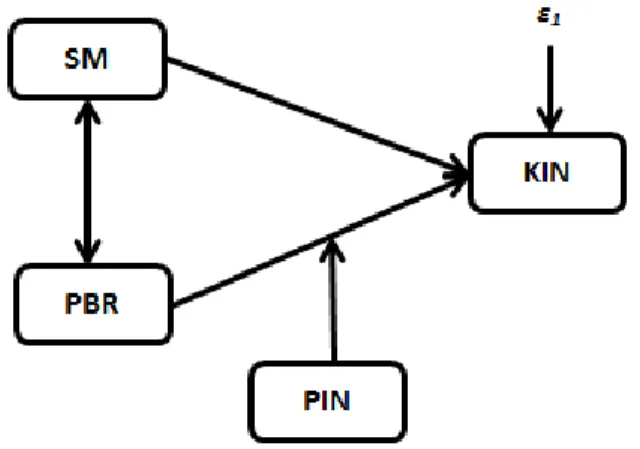
ETHODThere are four variables in this study: Capital Structure (SM), Loans (PIN), Non-performing Loan (PBR) and Financial Performance (KIN). According Suharsimi (2006), Sugiyono (2012: 63) Sekaran (2003) variable is the research object or focal point, while the place where the variable is attached to is the research subject. The study is conducted in KJK PEMK in Jakarta. Hypothesis of this study is the SM and PIN affect KIN, where PBR moderate the relationship of KIN and PIN. See Figure 1.
Figure 1. The equation of the influence of SM and PIN moderated by PBR
Annotation:
KIN = Y = Financial Performance (dependent variable) SM = X1 = Capital Structure (independent variable) PIN = X2 = Loan Given (independent variable)
PBR = X3 = Non-Performing Loan (independent variable)
The methods used are descriptive and verification. Sugiyono (2011) mentions that descriptive method is used to describe or analyze the results of the study but not used to make broader conclusions. While verification research is conducted to test hypotheses regarding the causal relationship between one or several variables with one or several other variables. By using descriptive method, information about SM, PIN, and KIN KJK PEMK in Jakarta is obtained. While the verification method is used to test the truth of the hypothesis by collecting data in the field, as in this study which is aimed to determine the effect of SM and PIN to KIN, where the influence of PIN to KIN is moderated by PBR. This research is an explanatory research with quantitative approach. This research seeks to explain the relationship between variables through hypothesis testing. While the data used is in the form of numbers which are calculated through a statistical test. This research focuses on empirical testing to build the model which is developed based on the basic theoretical model: SM and PIN affect KIN where PBR is the moderating variable of PIN to KIN.
4
C
ITATIONSSIMULTANEOUS TESTING
The hypotheses tested are as follow:
H0 = All
0
i
(SM, PIN, and RB simultaneously does not affect the KIN)H1 = All or one of
0
i
(SM, PIN, and PBR simultaneously affect KIN)Significance level used is α=0, 05
Statistics Test obtained on the output (see Table 3)
Test Criteria:
Reject H0 if p-value < α, accept others
53 H0 is rejected because p-value < α (0,000<0,05) therefore, it
can be said SM, PIN, and PBR simultaneously significantly affect KIN because probability value 0,00 is smaller than α 0,05. This indicates that the level KIN is determined by the relationship or interaction between SM, PIN, and PBR. The value of R2 from the regression model is 0,482 which means the ability of SM and PIN variables moderated by PBR in explaining the cooperative KIN variation is 48,2%, and 51,8 % of it is determined by variables which are not included in the model. While the correlation value is 0,694 which shows strong relationship by being above 0,60.
Partially Test
The hypotheses tested are as follow:
H01 = β1 ≤ 0 SM does not positively affect KIN
Ha1 = β1 > 0 SM positively affect KIN
H02 = β 2 ≤ 0 PIN does not positively affect KIN
Ha2 = β2 > 0 PIN positively affect KIN
H03 = β3≥ 0 PBR does not negatively affect the
relationship between PIN and KIN
Ha3 = β3 < 0 PBR negatively affect the relationship
between PIN and KIN
Significance level used is α=0,05
Statistics Test obtained on the output (see Table 4)
The equation of the effect of SM and PIN to KIN model, where the effect of PIN to KIN moderated by PBR is explained as follow:
1) SM rises 1% with the assumption that PIN and PBR remain the same, then KIN will rise 0,017 %
2) PIN rises 1% with the assumption thatSM and PBR remain the same, then KIN will rise 0,013%
3) PBR rises 1% with the assumption that PIN and SM remain the same, then KIN will fall 0,001%.
4) Based on the findings and the statistical test on SM variable, SM positively and significantly affect KIN, because the probability value 0,000 is smaller than α 0,05, then accepting alternative hypothesis which partially means SM affect KIN.
Table 3 Summary Model
Mo del R
R Squ are
Adjus ted R Squa
re Std. Error of the Estim
ate
Change Statistics
R Square Change
F Ch ang
e
df1 df2 Sig. F Change
1 .69
4a .482 .469 8.550
92 .482 35. 999 3
11 6 .000 a. Predictors: (Constant)
Table 4 Coefficientsa
Model
Unstandardized Coefficients
Standardize d
Coefficients T Sig. B Std. Error Beta
(Constant) SM PIN PBR
9.993 2.756 3.626 .000 .017 .002 .521 7.671 .000 .013 .004 .276 3.443 .001 -.001 .000 -.447 -5.496 .000
a. Dependent Variable: KIN0
Based on the calculation, the equation is:
KIN = 9,993 +0,017 SM +0,013 PIN –0,001 PIN*PBR +є The estimation result of the parameter or the regression coefficient can be seen in figure 2
Figure 2. The Equation of the Effect of SM and PIN to KIN where the effect of PIN to KIN moderated by PBR
Annotation:
KIN = Y = KIN (dependent variable)
β0 = cosntanta
β 1, β 2 = coefficient vector
SM = X1 = SM (independent variable) PIN = X2 = PIN (independent variable) PBR = X3 = PBR (independent variable)
PBR*PIN = Moderation
5 DISCUSSION
(1) The results showed that SM positivelly affect KIN, this means that the increase of SM will increase KIN. Rising loan will be positively responded by KIN. With the increase of capital from loan, cooperative performance will increase, assuming that the additional cost of loan interest is smaller than the addition of revenue. Under these conditions, KJK PEMK activities will increase. Therefore, with good KIN, additional loan will increase revenue greater than the additional interest costs. In other words, the greater the use of loan in SM, the higher the Return on equity (ROE) of the company will increase. SM is a very important issue for any company, because the condition of SM will directly affect the financial position of the company. A company that has bad SM and big loan will burden the company. KIN of PEMK KJK increases along with the increase of loan. However, that does not mean that the capital itself does not need to be increased. Equity still have to be improved to increase investor confidence in the KJK PEMK.
(2) PIN positively affects KIN. This means that each PIN given in perfect condition will increase income, because along with the increase of PIN, interest or service gained will increase. To reach this, KJK PEMK must take security measures in distribution of funds, for PIN either for member or non-member, including:
b. Assessing the ability of debtor to repay the principal loan and services. Members are given loan in accordance with priority scale.
c. Assessment of customer (debtor) is not as practiced by banks. Customer feasibility remains the main consideration, since KJK PEMK is not a social institution, but an entity that seeks profit for long-term business continuity.
d. PBR positively affect KIN. PBR weakens the effect of PIN to KIN (as elaborated in point 2). The increase of PBR will decrease KIN of KJK PEMK. Otherwise, the decrease of PBR will increase KIN.
This argument can true if KJK does not take into account the reserved number of PBR every period. If KJK PEMK does so, when realization of deletion is lower than budget, PBR wil positively affect the relationship between PIN and KIN and the other way around. This is because the researved PBR is taken into account in determining the cost. If KJK takes into account the amount of PBR in previous years and the prospects in the following years, then PBR is included in the cost components.
6
C
ONCLUSIONKIN is positively affected by SM. Cooperative, with rising SM, tends to have better KIN. SM rises 1% with the assumption that PIN and PBR remain the same, then KIN will rise 0,017 %.
1) KIN is positively affected by PIN, where the effect of PIN to KIN is moderated by PBR. This means, if the given PIN rises, KIN will rise. PIN rise 1%, with the assumption that SM and PBR remain the same, then KIN will rise 0,013%.
2) PBR rises 1%, with the assumption that PIN and SM remain the same, then KIN will fall 0,001%.
Cooperative with higer SM tends to have better KIN. This not optimally developed capital is related to financial condition. This capital constraint occur due to the lack of capital support from inside or due to the dependence on the capital from outside. Based on the result of the hypothesis testing, it is known that research variable has significant effect on KIN. This indicates that variation of SM will cause variation of KIN, variation of PIN will cause variation of KIN. Variation of PBR will cause variation of the relationship between PIN and KIN. Regression coefficient SM with positive mark indicates that the rise of SM will increase KIN and the other way around. Regression cefficient PIN with positive mark indicates that the rise of PIN will rise KIN and the other way around. Regression coefficient PBR with negative mark indicates that the rise of PBRwill weaken the relationship between PIN and KIN and the other way around.
R
EFERENCES[1]. Agarwal, Pankaj K, dan Sinha, S.K 2007. “Financial Performance Microfinance Institutions of India a
Cross-Sectional Study”.
[2]. Agus Sartono, 2001. “Manajemen Keuangan,” Edisi 3. Universitas Gajah Mada Yogyakarta
[3]. Brigham, E.F., Gapenski L.C. dan Daves P.R., 1993, “
Intermediate Financia”l Athanasoglou, P.P., Brissmis,
S.N., and Delis, M.D. 2005. Banks-Specific, Industry-Specific, and Macroeconomic determinants of Bank Profitability Working Paper Bank of Greece, No 32026.
[4]. Donaldson, G., 1961, “ Corporate Debt Capacity: a Study of Corporate Debt Policy and The Determination
of Corporate Debt Capacity”, Boston, Dividion of Research, Harvard Graduate School of Business Administration
[5]. Dulfer E,1994. “Managerial of Economics of
Cooperative”, International Handbook of Cooperative
Organization p.587-592.
[6]. Budi Purnomo, 2012 “Disertasi Intellectual Capital, Ukuran Perusahaan, Umur Perusahaan dan Kinerja
Keuangan “, Universitas Padjadjaran Bandung
[7]. Elya Dasuki Rima, 2013. “ Integrasi kinerja keuangan dan kinerja sosial dampaknya terhadap sustainabilitas
koperasi”.
[8]. Eva Orburch, 2011. “Towards an Integration Approach to Micro finance A Case for the Integration of Financial and Non Financial Service in Microfinance Institution “, Urban Studies Stanford University, 2011.
[9]. Hanel, Alfred. 1994.” Dual or Double Nature of Cooperative. Dalam internasional Handbook of
Cooperative Organizations”. Vandenhoeck & Ruprecht.
Gottingen.
[10]. Ibnoe Soedjono, 1997. “Koperasi dan Pembangunan
Nasional”, PIP-DEKOPIN-Jakarta
[11]. Myers, S. and Majluf, 1984, “Corporate Financing and Investment Decision When Firms have information
Investors Do not Have “, Journal of Finance Economics 13, pp. 187-221.
[12]. Modigliani, F., Miller, M.H., 1958, “The Cost 0f Capital, Corporate finance and the Theory of Investement, The
American Economics review”, Vol. XIVIII. No. 3, pp. 261-297.
[13]. Ramudi Ariffin, 2012, “Menggerakan Roda Perekonomian Melalui Koperasi sebagai wadah Pemberdayaan UMKM Dalam Meningkatkan
Kesejahteraan masyarakat”, Jurnal Ilmiah manajeman
vol 3 no 2.
[14]. Ramudi Ariffin, , 2013, Koperasi sebagai perusahaan, Ikopin Press.
[15]. Sugiyanto, 2012. “Human Capital Leverage Kinerja
Koperasi”, Cetakan pertama. Penerbit Ikopin Press
Jatinangor-Sumedang.
[16]. Tulus Tambunan dan Chairulhadi M. Anik, 2008.
“Perkembangan koperasi di Indonesia: Prospek dan
tantangan di dalam era globalisasi ekonomi dan
55 [17]. Ucu Nurwati (2012), “Menggerakan roda perekonomian
melalui koperasi sebagai wadah Pemberdayaan UMKM dalam upaya meningkatkan kesejahteraan
masyarakat” Jurnal Ilmiah manajemen, Ikopin Vol. III
No. 2/November / Tahun 2012.
[18]. Weston, J. Fred, Eugene F, Brigham, 2001. Manajemen Keuangan Jilid II, Edisi Kesepuluh, Erlangga: Jakarta.
[19]. ---Undang-undang Republik Indonesia Nomor 25 Tahun 1992 tentang Perkoperasian
[20]. ---Peraturan Menteri Negara Koperasi dan
Usaha Kecil dan Menengah Nomor