GJMEDPH, Vol 1(5) September- October 2012 Page 6
Global Journal of Medicine
and Public Health
www.gjmedph.org
Hearing Loss in otitis media with effusion- Types and management- A study of hundred cases
Sriram Nathan , Minutha R A B S T R A C T
Introduction- Serous Ottis media or otitis media with effusion is a common cause of hearing loss of acute onset. The common presentation will be a block or reduced hearing possible after a travel or flight. Most of the cases present with conductive hearing loss while some may present with mixed or even pure sensory hearing loss. Background- we study hundred patients diagnosed with serous otitis media for the type of hearing loss and characterize the management strategy. Conclusion- Serous otitis media is a common cause of hearing loss which is mostly conductive and is amenable to treatment while some rare cases which may persist may require assistive hearing with amplification. Although sensorineral hearing loss is rare in otitis media, it is seen in practice along with mixed hearing loss. The pathophysiology of the neural affection of hearing loss remains a mystery although many theories exist.
Key words- serous otitis media, impedance audiometry, conductive hearing loss.
_____________________________________________________________________________________________ Corresponding Author: Sriram Nathan,
No:A14, Sterling ganges apartments Mount poonamallee Road Katupakkam,porur, Chennai, Tamil Nadu, India Email : [email protected]
Funding: None Conflict of interest: None
_____________________________________________________________________________________________ Introduction: Serous otitis media is one of the most
common causes of hearing loss following either a respiratory tract infection or travel. The travel may be to a place of higher or lower altitude or by flight. Pain is rarely seen and the block is reported as non discrimination of speach. We analyze the cause, type of hearing loss and the management strategy of around one hundred patients diagnosed with serous otitis media.
These were ramdom one hundred cases of otitis media with effusion seen and treated by the authors during their practice. Although the most common and the hall mark hearing loss of otitis media has been conductive hearing loss, we demonstrated mixed and sensorineural hearing loss albeit of lesser incidence. Materials And Methods: One hundred patients presenting to our hospital with hearing loss and diagnosed with serous otitis media with effusion were taken into consideration. The source of data were the general population who presented to our hospital with chief complaints of hearing loss and diagnosed as having otitis media with effusion. They were
GJMEDPH, Vol 1(5) September- October 2012 Page 7 or sensorineural hearing loss due to other causes such
as otosclerosis were excluded from the study. Even cases with fluid in the middle ear and showing conductive hearing loss were excluded from the study if the fluid was proven to be blood due to trauma. Results And Observations: One hundred patients were taken up for this study. This included fifty eight males and forty two females. The age group ranged from five years to eighty five years (figure 1) The youngest patient were three boys of the age of five years. The eldest was a lady of eighty five years. The mean age was around twelve years. There were a total of seventy two adults in the study and thirty eight children (described as less than twelve years) in the study.
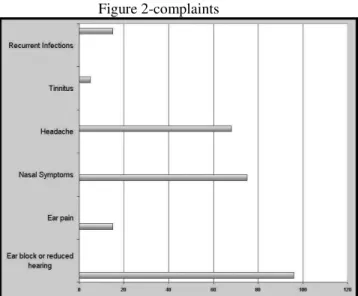
Complaints- The most common complaint was ear
block or reduced hearing either from both ears or one ear in over ninety six patients (figure 2). Ear pain was also seen, although mild in severity in around fifteen patients. Other complains included nasal stuffiness seen in around seventy five patients, headache of mentionable severity in around sixty eight patients, tinnitus in around five patients and recurrent episodes of throat infection and hospitalization seen in fifteen children with associated tonsillitis.
Figure 1- age distribution
Clinical ENT examination-The classical signs of fluid in the middle ear were elicited in a fairly large amount of cases. These included either all or one of, reduced mobility of the tympanic membrane, absent light reflex, prominent handle of malleus and frank fluid behind the drum. These were elicited and demonstrated in around eighty seven patients. Tuning fork demonstrated conductive hearing loss in around eighty two patients, mixed hearing loss was seen in around fifteen and sensorineural hearing loss was seen in around three cases. The same were confirmed by pure tone audiometry. Impedance audiometry
confirmed the presence of fluid and the diagnosis of serous otitis media. It showed a type 'b' curve in all the cases and is thus an investigation of choice for the diagnosis of this condition.Patients having non pure conductive hearing loss, around eighteen in number were investigated further with HRCT of temporal bones to rule out any other lesion causing the neural loss. They were reported as normal supplementing the presence of fluid in the middle ear.
Figure 2-complaints
Degree of loss- as pictured in figure 3, Conducive loss seen in around eighty two patients were divided into grades according to the degree of hearing loss. Around forty patients had mild conductive loss, thirty eight had moderate loss and four had moderately severe hearing loss. Mixed loss in fifteen patients were similarly divided into categories depending on the degree of hearing loss. Mild seen in around six, moderate seen in around four, moderately severe in around three and severe in around two. Sensorineural hearing loss seen in around three patients were all severe in grade. Of the thirty eight children, thirty five had conductive hearing loss and three had mixed hearing loss. The conductive hearing loss was mild in three, moderate in twenty nine and moderately severe in six. Mixed hearing loss was moderate in two and moderately severe in one. None of the children had sensorineural loss in the study.
Management -All patients were routinely given a conservative treatment of antihistamine (levocetrizine in a dose of 5 mg hs) and mucolytics (ambroxol in a dose of 60 mg hs) for a period of two weeks.
GJMEDPH, Vol 1(5) September- October 2012 Page 8 these belonged to the group which had pure
conductive hearing loss. Twenty four patients having conductive hearing loss were subjected to surgical treatment which involved either myringotomy alone in twenty patients and myringotomy with grommet in four patients. The interventions were routinely decided after a wait and watch period of minimum of three months and the decision was taken only if there was either no improvement of hearing loss or rarely (in two cases), worsening of the loss. The placement of grommet was determined on the basis of quantity and the consistence of fluid. A thicker and large quantity of fluid deemed the grommet necessary. Single placement of grommet was done and this was placed in the inferior quadrant of the tympanic membrane posteriorly. All these patients were followed up for six months during which they had recovery which was good ( good air bone closure and subjective improvement of hearing) in twenty and satisfactory in the remaining four. In the mixed hearing loss group, around five patients recovered in such way that the hearing improved with air bone closure but the hearing was not normalized. However the conversions were appreciated positively by the patient. This was interpreted as the normalisation or betterment of the conductive component of the hearing loss. In the sensorineural hearing loss category, the patients were counseled for the better upkeep of the other normal ear and were advised hearing aids if the hearing loss was of moderate to severe in nature. In all these patients however a trial of myringotomy and grommet placement was attempted to affirm the presence of fluid and also to try and improve the hearing. In all the three patients the fluid was present in minimal quantity and thus no grommet was placed. None of the patients showed any improvement although there were no further loss. With the removal of fluid, a block sensation which the patient felt were relieved. Only one patient with severe loss needed amplification for hearing for which he was provided with a digital in the canal hearing aid. The other two were counseled but did not accept the amplification; furthermore, their loss were mild to moderate and the opposite ear was normal. Discussion: Otitis media with effusion is a common clinical entity with a characteristic hallmark of conductive hearing loss with fluid in the middle ear cavity. However rarely sensorineural or mixed hearing loss can also be seen as in our study. Majority of our cases had conductive hearing loss (>80 percentage), although mixed and sensorinueral hearing loss was also seen in a select minority (15 % and 3 % respectively).
The prevalence of sensorineural hearing loss in otitis
media with effusion had been described and several theories have been put forward for the same although none have been proven till date.
Figure 3- degree of hearing and type
According to Paparella et al, biochemical alterations effecting the cochlea via round window result in SNHL associated with COM. Semipermeable structure of the membrane leads to passage of the toxic substance into cochlea. Biochemical changes occured in perilymph and endolymph, give rise to partial destruction of Corti organ. The anatomical characteristics of the round window are such as to encourage the accumulation, stagnation and absorbtion of purulent secretion into perilymph. Impairment of sound conduction in cases with COM may be associated with the occlusion of round and oval windows by granulation, cholesteatoma and inflammed mucosa or stiffening of the ossicular chain. Both air and bone conduction may be influenced by these kinds of mechanical occlusions. Histological evidence showed that the round window changes were more marked in cases with purulent otitis media than in non-purulent otitis media. These changes especially basal turn hair cell lesions in acute purulent cases, could be temporary or permanent and render the ear more vulnerable to future damage. This theory seems to explain why depressed BCT are observed in some patients but not in others, despite apparent identical etiologies.1
GJMEDPH, Vol 1(5) September- October 2012 Page 9 eustachian tube. They adopted a soft palate approach
to obstruct the orifice of the eustachian tube to establish otitis media in a rat model. Auditory evoked brainstem response and tympanometry were used as hearing function tests, hypoxia-related factors were examined by reverse transcriptase polymerase chain reaction (RT-PCR). The expression of hypoxia-related proteins was detected by Western blot and immunostaining. The model of otitis media with effusion was successfully induced by cauterizing the orifice of the eustachian tube. RT-PCR showed up-regulation of hypoxia-related factors in cauterized ears. Western blot and immunostaining showed that the expression of hypoxia-related proteins in cauterized ears was increased. Hypoxia-induced vascular proliferation and an increase in permeability may be one pathogenetic mechanism of otitis media due to dysfunction of the eustachian tube.2
Papp Z et al performed a study to determine whether chronic suppurative otitis media may cause sensorineural hearing loss. The files of 121 patients with unilateral chronic suppurative otitis media were reviewed in this retrospective study. Air conduction and bone conduction threshold averages were calculated over the speech frequencies (500 Hz, 1,000 Hz, and 2,000 Hz). Thresholds at 4 kHz were examined separately but in a similar way. Multiple linear regression models were used to clarify the relationships between sensorineural hearing loss and chronic otitis media. They concluded that chronic suppurative otitis media was seen to be associated with sensorineural hearing loss. When age and normal side were corrected for, pure-tone threshold and bone conduction threshold at either the speech frequencies or at 4 kHz increased gradually according to the duration of the chronic suppurative otitis media. The threshold shift was more accentuated as age increased. Also the sensorineural hearing loss at 4 kHz seemed to be higher than that at the speech frequencies. They also suggested that the inner ear is vulnerable against chronic suppurative otitis media. Older age increases this vulnerability. The proximity of the sensory cells to the potential source of harm (inflamed middle ear) may mean higher exposure, as reflected by the fact that sensory cells processing higher frequencies are more seriously damaged.3 Our study also confirms to this study in terms of the sensorineural and mixed hearing loss prevalance of hearing loss in otitis media with effusion.
Yamamah G et al have stated that Hearing loss among schoolchildren in developing countries is reported to be a significant health problem. Middle ear diseases and hearing impairment were assessed among 453 primary-school children aged 7-10 years
in South Sinai (906 ears). Otoscopic examination, tympanometry and pure tone audiometry (PTA) were done. Ear disease was found in 27.5% of the ears examined. The commonest cause was secretory otitis media (10.8%), followed by occluded earwax (9.5%). Mild and moderate hearing loss affected 8.5% of the sample, while sensorineural hearing loss affected 2.4%; only 0.4% had moderate and severe hearing loss. Hearing impairment affects 19.3% of this age group in South Sinai. The authors recommended that hearing and middle ear screening at schools is recommended for early detection and management of middle ear and hearing problems.4 We have also seen a rapid improvement in majority of the patients with hearing loss (Over 82 %), with some requiring the routine procedures such as medications and myringotomy and grommet insertion. Rarely though we need to use the amplification for auditory rehabilitation.
GJMEDPH, Vol 1(5) September- October 2012 Page 10 A retrospective analysis was conducted by Feng XH
et al of the data from 26 cases (43 ears) of secretory otitis media with bone conduction hearing loss collected from 2001 to 2008. Thirty-two ears were treated with mastoid surgery and myringotomy with insertion of ventilation tubes. All the patients received medications after the operation. They found that all the patients showed obvious improvement after mastoid surgery. The average pure tone of air conduction hearing threshold was about 25 dB after the surgery, with the average pure tone of bone conduction hearing threshold of about 15 dB. The patients were followed up for 1-2 years during which no significant change in hearing was recorded, and no middle ear effusion in the tympanic cavity was found after removal of the ventilation tubes. They concluded that persistent secretory otitis media can be associated with mixed hearing loss, and mastoid surgery can significantly enhance the hearing level to produce positive therapeutic effects6
In all our patients, none were subject to mastoid surgery, most of them improved with oral medications and some with minor procedures like myringotomy and grommet insertion.
Conclusion : Otitis media with effusion can affect all age group and is a common clincal entity. The most common hearing loss seen is conductive hearing loss although both mixed hearing loss and sensorineural hearing loss can also be seen. Most cases require little or no intervention with good result. Non responsive patients can be counselled for medication with or without insertion of ventilation tubes or grommet. Rarely though amplification, especially in cases of severe to profound hearing loss can be advocated.
The pathophysiology of sensorineural or mixed hearing loss in otitis media with effusion is not known although many theories have been put forward. As indicated earlier, biochemical alterations effecting
the cochlea via round window, semipermeable structure of the membrane leading to passage of the toxic substance into cochlea and biochemical changes occuring in perilymph and endolymph giving rise to partial destruction of Corti organ. Recent studies have also shown that hypoxia-induced vascular proliferation and an increase in permeability may be one pathogenetic mechanism of otitis media due to dysfunction of the eustachian tube. Inspite of the abundance of theories, the exact mechanism of sensorinueral hearing loss in otitis media with effusion remains an enigma.
References
1. Paparella MM, Morizono T, Le CT, et al. Sensorineural hearing loss in otitis media. Ann Otol Rhinol Laryngol 1984;93:623-9.
2. Huang Q, Zhang Z, Zheng Y, Zheng Q, Chen S, Xu Y, Ou Y, Qiu Z. Hypoxia-Inducible Factor and Vascular Endothelial Growth Factor Pathway for the Study of Hypoxia in a New Model of Otitis Media with Effusion. Audiol Neurootol. 2012 Aug 15;17(6):349-356.
3. Papp Z, Rezes S, Jókay I, Sziklai I. Sensorineural hearing loss in chronic otitis media. Otol Neurotol. 2003 Mar;24(2):141-4.
4. Yamamah G, Mabrouk A, Ghorab E, Ahmady M, Abdulsalam H. Middle ear and hearing disorders of schoolchildren aged 7-10 years in South Sinai, Egypt. East Mediterr Health J. 2012 Mar;18(3):255-60.
5. Al-Rowaily MA, Alfayez AI, Aljomiey MS, Albadr AM, Abolfotouh MA. Hearing impairments among Saudi preschool children. Int J Pediatr Otorhinolaryngol. 2012 Aug 23. 6. Feng XH, Long XB, Wang J, Chen YT, Guo XQ.
Nan Fang Yi Ke Da Xue Xue Bao. Mastoid surgery for secretory otitis media with mixed hearing loss 2010 Jul;30(7):1673-5.
Access This Article Online Quick Response Code:
Website: