Iranian Journal of Otorhinolaryngology Vol. 22, No.60, Summer-2010, (87-92)
Original Article
Serous Otitis Media in Pre-School Children
Keramat Mozaffarinia1,*Yeganeh Teimouri2, Afshin Sarrafinejad3
Abstract
Introduction:
In spite of the fact that acute otitis media is a systemic and symptomatic disease with sever otalgia, otitis media with effusion (OME) is an asymptomatic and silent disease. OME is the most common cause of conductive hearing loss in children and has adverse effects on speech development and cognitive skills.
Results:
Among 1001 children under study, 57 subjects (5.7%) were diagnosed with OME, more than 50% of which were asymptomatic. Periodic otalgia and turning up television volume were the most common symptoms.
Conclusion:
Regarding the improved knowledge on diagnosis and treatment of OME especially in younger children, hearing problems or cognitive and linguistic skills retardation may be avoided by promoting general information.
Keywords:
Children, Prevalence, Otitis media
Received date: 6 Jan 2010 Accepted date: 18 May 2010
1
Department of otorhinolaryngology, Kerman University of Medical Sciences, Kerman, Iran
2
Department of otorhinolaryngology, Kerman University of Medical Sciences, Kerman, Iran
3
Ph.D. student in medical informatics,Kerman University of Medical Sciences, Kerman, Iran
Corresponding author:
Department of otorhinolaryngology, Kerman University of Medical Sciences, Kerman, Iran. E-mail: [email protected]
Serous Otitis Media in Pre-School Children Mozaffarinia K, et al
Introduction
Serous otitis media (SOM) or OME describes as a collection of fluid in the middle ear; but acute otitis media (AOM) results from the acute bacterial infection of the upper respiratory system, with systemic infectious symptoms such as fever, weakness, malaise, nausea, vomiting and severe otalgia. In case of no response to medical treatment; AOM may result in eardrum rupture and discharge from the middle ear (1). Serous otitis media often caused by Eustachian tube disorder and negative pressure in the middle ear, but it does not result in eardrum rupture.
In these cases fluid accumulates in the middle ear. The fluid may be serous, mucoid or mucopurulent (2). So it's better to call OME as otitis media with effusion (3).
OME is classified in two groups:
1- Persistent effusion caused by an acute effusion
2- Secretary effusion as a result of response to sub clinical antigenic stimulant
Their clinical diagnosis is possible only before incidence of the disease.
OME in younger children is probably the unimproved stage of acute otitis media (AOM). According to the study of Teele and his colleagues, OME in 40% of children lasted more than 30 days and in 10% it lingered on up to 3 months after AOM attack (4). It is the consequent to the disorder in the cleaning mechanisms of the middle ear. The risk factors include ciliary disorder, edema and hyperplasia, secretion viscosity, pressure gradient of nasopharynx relative to the middle ear. Prolonged paralysis of the middle ear's cilia is caused by the bacteria's exotoxin. Inflammatory edema can also influence drainage of the middle ear. Ineffective cleaning of the thick secretions by the ciliary of Eustachian tube causes negative pressure in the middle ear and consequently the eardrum retraction. Negative pressure is treated by incising eardrum along with inserting tympanostomy tube. This also helps with cleaning. The most significant symptoms of OME include slight and periodic otalgia, auto-phony, ear-fullness
sensation, dizziness and imbalance, hearing sounds like bursting air bubble and crack in the middle ear.
In most cases OME is asymptomatic in primary levels. Its chronic and progressive type results in hearing loss and cognitive skills retardation. Speech and behavioral development disorder are other adverse outcome of the disease which require medical expensive treatment and have unexpected damages.
Articulation, vocabulary perception and phonologic learning are the specific aspects of speech development. All of these aspects are affected by OME.
Since OME is a silent disease and its clinical symptoms are not so obvious to be noticed by parents or even doctors; the otoscopic examination is suggested to diagnose the disease. Pneumatic otoscopy, tympanometry and acoustic reflex are also performed for confirm ation. In most cases, tympanogram showe type B; in 10%, type A and in 20- 50%, type C (3). Considering the importance of OME, it is necessary to estimate the incidence of the disease in each geographical zone. There was no exact statistical information a bout the incidence of OME in children in Kerman. Therefore in this study we basically evaluate this point.
Materials and Methods
Iranian Journal of Otorhinolaryngology Vol. 22, No.60, Summer-2010, (87-92)
kindergarten was marked in the map. The list was then selected for sampling. According to the proportion of population in each group to the total population, 3-6 years old children from the selected kindergartens were examined.
Parents had received the moral testimonial and questionnaire by kindergarten a week before the examination. Children were first examined by otoscopy and pneumatic otoscopy by an experienced otorhinolaryngology medical assistant. The suspicious cases with OME were referred to Shafa University Hospital for tympanometry and acoustic reflex evaluation to confirm the disease.
Diagnostic factors of serous otitis media during examination included retraction of eardrum; change in color, reduction in movement and increase in radial vessels on the membrane; shortening of the malleus handle and finally absence of cone of light. These factors were probably the symptoms of SOM; therefore the suspicious children were referred for tympanometry and acoustic reflex evaluation.
We know that that any pathological agent, specially liquid in the middle ear cavity causes negative acoustic reflex; so negative acoustic reflex along with tympanogram type B shows serous otitis media. In other cases negative acoustic reflex along with tympanogram type C or even A with positive clinical symptoms during examination is also serous otitis media. Patients with chronic otitis media (COM), Down syndrome, cleft palate, eardrum rupture and OME were excluded from the study.
After collecting information, all forms were numbered and registered in the computer and analyzed by SPSS version 11.5. The relation between different variables was analyzed by Chi Square and Mann Whitney U tests to specify the ratio of frequencies between different groups. Kappa agreement was analyzed in α= 0.05 to define the adjustment scale of diagnostic methods.
Results
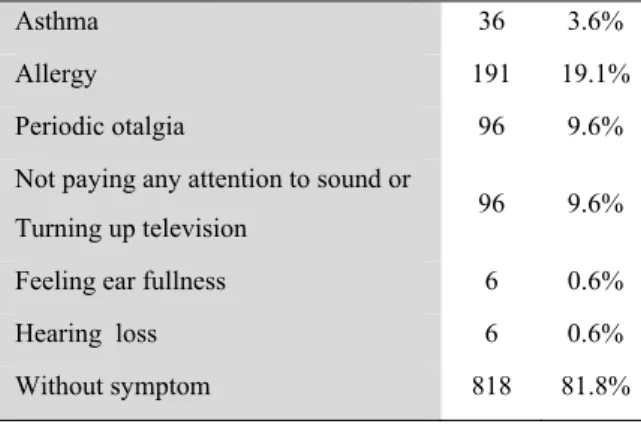
From 1001children under study, 36 subjects (3.6%) suffered from asthma and 191
(19.1%) from allergy. From those with serous otitis media, it was revealed 96 subjects (9.6%) suffered from periodic otalgia, 96 subjects (9.6%) turned up television volume or did not pay any attention to sound, 25 subjects (2.5%) felt ear fullness, 6 subjects (0.6%) heard sounds like bursting bubble, 6 subjects (0.6%) had hearing loss and 818 subjects (81.8%) showed no symptoms. (Some of the children mentioned more than one symptom) (Table 1)
Table1: Examination results of 1001 children
under study based on the questionnaire
Asthma 36 3.6%
Allergy 191 19.1%
Periodic otalgia 96 9.6%
Not paying any attention to sound or
Turning up television 96 9.6%
Feeling ear fullness 6 0.6%
Hearing loss 6 0.6%
Without symptom 818 81.8%
In the clinical exam 79 subjects with different ear problems were reported, 63 of which were suspicious to OME and referred for audiometry.
The audiometry result showed 51 subjects (80.9%) suffered from OME. 6 subjects already had Grommets. Totally 57 subjects (5.7%) were diagnosed with OME.
The frequency evaluation of OME based on the sex was as follows; 24 girls (4.9%) and 33 boys (6.5%).
There was no significant difference between two group (P>0.1) (Table 2).
Table 2: The frequency of OME based on sex
Sex + OME − Total
Female (95.1%) 464 (4.9%) 24 491
Male (93.5%) 477 (605%) 33
510 94.3% 5.7%
Serous Otitis Media in Pre-School Children Mozaffarinia K, et al
frequency between groups with different ages (Table 3).
Table 3: The frequency of OME based on age
Age + −
3-4 (6.3%) 22 (93.7%) 325
4-5 (6.8%) 23 (93.2%) 316
5-6 (3.9%) 12 (96.1%) 296
Total (5.7%) 57 (94.3%) 937
There was no significant difference in incidence of OME in four seasons, although its incidence in winter was more than other seasons. In this study no important difference between economical situation and educational level of parents and OME was revealed.
The study of relation between asthma and allergy and OME showed 16.7% of children with asthma suffered from OME, while only 5.3% children without asthma had OME. Fisher test shoed a significant difference (P=0.014), but there was no relation between Allergy and OME incidence (Table 4)
Table 4: The relation between OME and asthma/
allergy
+ −
Asthma + (16.7%) 6 (83.3%) 30
P=0.014
− (5.3%) 51 (94.7%) 910
Allergy + (7.3%) 14 (92.7%) 177
P=0.28
− (5.3%) 43 (94.7%) 763
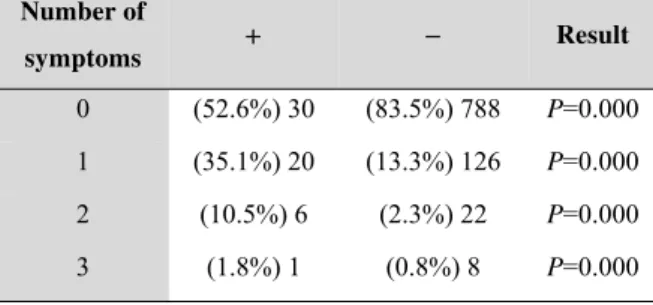
In the 57 subjects with OME, 30 (52.6%) showed no positive symptoms, 20 (35.1%) only one, 6 (10.5%) had two and 1 subject (1.9%) had three symptoms (table.5).
Table 5: The frequency of OME symptoms
Number of
symptoms + − Result
0 (52.6%) 30 (83.5%) 788 P=0.000
1 (35.1%) 20 (13.3%) 126 P=0.000
2 (10.5%) 6 (2.3%) 22 P=0.000
3 (1.8%) 1 (0.8%) 8 P=0.000
The frequency of symptoms in patients with final diagnosis of OME was also reported. The most common symptoms were periodic otalgia in 15 (26.3%), turning up television volume in 10 (17.5%), feeling full ear in 5 (8.8%), hearing sounds like bursting bubble in 4 (7%) and hearing loose in only 1 (1.8%) (Tables 6 and 7).
Table 6: The comparison of OME symptoms
between children with OME and those without OME
Symptoms
With OME N= 57
Without OME
N= 944 Result
+ − + −
Otalgia 15 42 81 863 P=0.000
Feeling bubble
bursting 4 53 2 942 P=0.000
Hearing loss 1 56 5 939 P=0.24
Feeling ear
fullness 5 52 20 924 P=0.002
Turning up
television 10 47 86 858 P=0.003
Without symptom 30 27 788 156 P=0.000
Table7: The frequency of OME clinical
symptoms
Otalgia 15 (26.3%)
Feeling bubble bursting 4 (7%)
Hearing loss 1 (1.8%)
Feeling ear fullness 5 (8.8%)
Turning up television 10 (17.5%)
Without symptom 30 (52.6%)
Among 51 patients with OME examined by otoscopy and confirmed by audiometry, 26 and 25 subjects suffered from OME in one ear and both ears respectively (totally 76 diseased ears). The tympanogram curves were as follow: type B in 54 cases (71.1%), type C in 15 cases (19.7%), type A in 5 cases (6.6%), type A in 1 case (1.3%) and Ad in 1 case (1.3%) (Table 8).
Iranian Journal of Otorhinolaryngology Vol. 22, No.60, Summer-2010, (87-92)
Table 8: Tympanometry types
A 5 (6.6%)
As 1 (1.3%)
Ad 1 (1.3%)
B 54 (71.1%)
C 15 (19.7%)
Among 63 patients with OME, 51 subjects (81%) were examined by acoustic reflex (AR) and tympanometry and OME was diagnosed. This value was equal to the informative positive value of clinical test. (Chi Square=0.88, P= 0.000)
In 63 patients with OME, 37 and 26 subjects suffered from OME in one ear and both ears respectively. Totally 89 diseased ears were referred to further analysis. According to the AR results and tympanometry 74 ears were diagnosed with OME and 15 ones were intact. So the informative value of clinical examination and its specificity were 83%. In the primary examination of the children under study, 3 cases with foreign body in ear; 1 with eardrum retraction; 4 with tympana-sclerosis; 1 with atresia of ear canal and 3 with neotympan um were reported.
Discussion
The purpose of this study was evaluation of OME incidence in Kerman kindergartens. In this study, 1001 children 3-6 years old from different geographical zones of Kerman were analyzed in four seasons. The study indicated 79 subjects suffered from various clinical problems including AOM, foreign body in ear, eardrum retraction, etc. Among them 63 cases suspicious to OME were referred to tympanometry and acoustic reflex referred to tympanometry and acoustic reflex evaluation. Result was 51 cases with OME. Six out of 79 children had Grommets. Totally 57 subjects (5.7%) were diagnosed with OME. In this study the frequency of boys was more than girls (6.5% and 4.9%). The difference was not statistically significant. The incidence of OME among different groups including 3-4, 4-5, 5-6 years old was not significant either.
The OME incidence in winter, autumn, summer and spring decreases sequentially without any statistical difference (P=0.2). According to the study of Safavi Naeini and his colleagues in Tehran in 2001, OME incidence in children under school-age and those going to school were 9.1% and 14.1% respectively. It had been revealed the incidence in children with parents smoking cigarette was higher than others (5), while in our study parent’s smoking did not have a significant influence on OME incidence. Based on the study of Karimane and his colleagues in Tehran in 2002, OME incidence was increased in winter and spring and also crowded areas, although there was no significant difference. The incidence in girls and boys was the same and it was increased in 4-6 year old group (6). In our study the seasonal influence on OME incidence was not significant either, while the number of diseased subjects was increased in winter.
Saki and his colleagues studied OME incidence on the students of the first grade primary school in Ahvaz in 1997. Accordingly 2000 students were selected and examined by otoscopy and tympanometry. The incidence was reported as 11.1%. The risk factors indicated being male and cold seasons. Ear fullness (18%) and hearing loss (8%) were reported as the most common symptoms (7). According to our study OME incidence was more common in male and except in 30 subjects without any significant signs (52.6%), the most common symptoms included periodic otalgia in 15 subjects (26.3%), turning up television volume in 10 (17.5%), fullness in 5 (8.8%), hearing sounds like bursting bubble in 4 (7%) and hearing loss in 1 (1.8%).
Serous Otitis Media in Pre-School Children Mozaffarinia K, et al
smoking and the number of family members did not have any effect on it (8). In our study no significant relation between the economical condition, educational level and smoking of parents and OME incidence was observed.
In another study by Okour and his colleagues in Turkey in 2002 on the students of primary school, 2930 subjects, 6-16 years were analyzed by pneumatic otoscopy, acoustic reflex and tympanometry. OME was observed in 189 children, linilareral in 80 subjects and bilatearal 109 subjects. The total incidence of OME was reported 6.5% and its maximum incidence was between 6-8 years old in crowded areas (9). We studied the 3-6 year old children and the maximum incidence was in the 4-5 year old group. Olli-Pekka and his colleagues in 1995 reported that day nursery, sex (male), autumn and acute OME were effective on increasing OME incidence (10).
A review article on the relation between smoking and OME incidence was presented by Neel and his colleagues in 1995 which revealed no relation between the mentioned items (11).
Conclusion
1- OME incidence in males was more than females in Kerman kindergartens.
2- Periodic otalgia, turning up television, volume ear, fullers hearing sounds like bursting air bubble and hearing loss were defined as the most common symptoms
3- The informative value and precision specificity of the clinical exanimation were ranked as high.
4- Diagnosis of the disease was based on the positive clinical examination along with negative acoustic reflex and tympanogram type B, C and A.
5- Audiometry screening with PTA to diagnose OME has some limitation.
References
1. Bluestone CH, Klein J. Definitions, terminology and classification. In: Donely S. (editor). Otitis media in infants and children. 3rd ed. Philadelphia: W.B Saunders; 2001: 1-15.
2. Ballenger. Ballenger’s otorhinolaryngology head and neck surgery. 16th ed. Hamilton BC: Decker Inc; 2003: 249-60.
3. Andrew F, Inglis GA. Acute 92 otitis media and 92 otitis media with effusion. In: Cummings CW, Flint PW, Harker LA, Haughey BH, Richardson MA, Robbins KT, et al. (editors). Cumming’s otolaryngology head and neck surgery. 4th ed. Philadelphia: Elsevier Mosby; 2005: 4445-68.
4. Teele DW, Klein JO, Rosner B. The greater Boston 92 titis media study group: Epidemiology of 92 titis media during the first seven years of life in children in greater Boston. J Infect Dis 1989; 160: 83-94.
5. Safavi Naeini A, Safavi Naeini A, Vazir Nezam M. [The effect of parents smoking and pediatric middle ear effusion prevalence]. Pediatric respiratory 2002; 1: 25-8. (Persian)
6. Karimane A, Mirarab SA. [Middle ear effusion risk factors]. Iranian journal of otorhinolaringology 2001; 13(3-4): 28-32. (Persian)
7. Saki N, Nickakhlagh S, Moddarres Dezfuli M. [Prevalence of middle ear effusion in children]. Journal of Ahvaz University of Medical Sciences 2005; 4(3): 21-5. (Persian)
8. Saim A, Saim L, Saim S, Ruszymah BH. Prevalence of otitis media with effusion among preschool children in Malasiya. Int J Pediatr Otorhinolaryngol 1997; 41(1): 21-8.
9. Okour E, Yildirim I, Akil-Kilic M, Guzesoy S. Prevalence of 92titis media with effusion among primary school children in Kahraman Maras in Turkey. Int J Pediatr Otorhinolaryngol 2004; 68(5): 557-67.
10. Olli-Pekka A, Hannv O, Matti K, Martti S. Risk factors for chronic 92titis media with effusion in infancy. Arch Otolaryngol Head Neck Surg 1995; 121(8): 839-43.