DOI: 10.1590/0004-282X20150093
ARTICLE
Migraine and tension-type headache triggers
in a Greek population
Fatores desencadeantes de enxaqueca e de cefaleia tipo tensional em uma
população grega
Vasilios Constantinides, Evangelos Anagnostou, Anastasia Bougea, George Paraskevas, Elisavet Kapaki, Ioannis Evdokimidis, Evangelia Kararizou
Migraine is a primary headache that is usually severe, uni-lateral and throbbing in nature. It is often accompanied by photo – or phonophobia, nausea and vomiting and it worsens with physical activity1. A number of external and internal
fac-tors are considered triggers for migraine. Amongst them, the most common are stress, dietary factors, environmental fac-tors, hormonal factors and sleep disorders.
Tension type headache on the other hand is the most common primary headache, and is characterized by bi-lateral location, pressing/tightening quality and of gen-erally milder intensity compared to migraine. The ac-companying symptoms of migraine (nausea, vomiting, photo- and phonophobia) are only rarely encountered in tension-type headache1.
he importance of these triggers (particularly stress and dietary factors) varies signiicantly among studies, presumably because of the diferent lifestyles and cultures of cohorts2,3,4,5.
he purpose of this article is to review the literature re -garding trigger factors of headache and to present data about the prevalence of these trigger factors in a Greek cohort of mi-graineurs and patients with tension-type headache (TTH) in a Headache Clinic of a Tertiary Hospital in Athens.
METHOD
All patients examined at the Headache Clinic of Eginition
Hospital during the period of 5/2011-5/2012 with a deinite
Eginitio Hospital, Department of Neurology, Greece.
Correspondence: Vassilios Constantinides; Eginitio Hospital, Department of Neurology; Vassilisis Soias 72-74, Athens Attica 11528, Greece; E-mail: [email protected]
Conlict of interest: There is no conlict of interest to declare.
Received 06 August 2014; Received in inal form 27 March 2015; Accepted 15 April 2015.
ABSTRACT
Migraine and tension type headache are the two most common primary headaches. The purpose of this study was to detect differences in clinical characteristics and headache triggers and in a Greek cohort of 51 migraineurs and 12 patients with tension-type headache. (TTH) Migraine patients had a signiicantly lower age at headache onset and frequency, higher mean visual analogue scale (VAS) and greater maximum duration of headache episodes compared to TTH patients. They did not differ from (TTH) patients in quality of headache, laterality of pain, way of headache installation and progression and temporal pattern of headaches. Nausea, vomiting and phonophobia were more frequent in migraine. Triggering of headaches by dietary factors was associated with migraine, whereas there was no difference between the two groups in any of the other headache triggers. Stress, both physical and psychological, were particularly common in both patient groups.
Keywords: migraine, tension type headache, precipitating factors.
RESUMO
Enxaqueca e cefaleia tipo tensional são as duas cefaleias primárias mais frequentes. O propósito deste estudo foi avaliar as diferenças e características dos fatores desencadeantes destas cefaleias numa coorte grega de 51 pacientes com enxaqueca e 12 com cefaleia tipo tensional. Pacientes com enxaqueca tinham uma idade signiicativamente menor por ocasião do início da cefaleia e maior frequência, maiores valores de (VAS) e maior duração dos episódios em comparação com os pacientes com (CTT). Não houve diferença entre os pacientes com enxaqueca e (CTT) com relação à qualidade e lateralidade da dor, na forma de instalação e progressão, e no padrão temporal das cefaleias. Náuseas, vômitos e fonofobia foram mais frequentes em enxaqueca. Fatores desencadeantes na dieta estavam associados à enxaqueca, enquanto não houve diferença entre os dois grupos para outros fatores desencadeantes. Estresse físico e psicológico foram particularmente prevalentes em ambos os grupos de pacientes.
diagnosis of migraine without aura, migraine with aura or frequent episodic tension type headache, (according to the 2nd edition of the International Classiication of Headache
Disorders) were included in the study1. he study was ap
-proved by the Ethics Committee of Eginition Hospital. All the procedures were in accordance with the ethical standards with the Helsinki Declaration of 1975, as revised in 1983 and our patients were informed about that. In order to exclude secondary headaches, all patients underwent a complete neurological examination, basic blood tests, and brain imag-ing with CT or MRI, as well as more specialized tests when it was considered appropriate.
Demographic (age, gender) and clinical data were record-ed for all the patients. Clinical data includrecord-ed age at disease onset, mean headache frequency and duration, mean and maximum headache severity (based on a visual analogue
scale), presence (or absence) of a speciic temporal pattern
(e.g. headaches in the morning, midday, afternoon or eve-ning) and of attacks that awaken the patient, way of attack installation (sudden or progressive), quality (pulsating, press-ing, stabbing or mixed) and localization of headache.
All patients were asked about any association of their
headache with the consumption of speciic dietary triggers
(alcohol, cheese, chocolate, citrus fruits, bananas), sleep disorders (insomnia and/or hypersomnolence), menstrua-tion, the presence of mental and physical stress and weath-er - tempweath-erature changes.
he treating physician reported a headache characteris -tic or trigger factor as present or absent, based on the pa-tient’s assessment during an interview. Although no formal questionnaires to quantify trigger characteristics were used, the questions were stereotyped.
All patients were furthermore asked about whether they
considered that the recent inancial crisis had afected them or not, without formal recording of the inancial status of the pa
-tients. he Hamilton Anxiety Rating Scale (HAM-A) was admin -istered, to objectively assess the anxiety levels of the patients.
Data on premonitory symptoms ( fatigue, diiculty con
-centrating, yawning, pallor, neck stifness), aura, associated
(photophobia, phonophobia, nausea, vomit, conjuctival in-jection, rhinorrhoea, eyelid edema, miosis – ptosis, facial sweating), relieving (sleep, local pressure, shower etc) and ag-grevating factors (especially headache worsening with physi-cal activity) were recorded.
Continuous data were analyzed by independent samples t-test and categorical data by x2 test.
RESULTS
Of the 207 patients examined, 63 patients met the
crite-ria for deinite migraine and tension-type headache. 39 (62%) sufered from migraine without aura, 12 (19%) from migraine with aura (19%) and 12 (19%) from tension-type headache.
Most of the remaining patients sufered from other primary
or secondary headaches. Female/male ratio was 6:1, mean patient age was 40.7 years and mean age at headache onset
was 22.8 ± 0.9 years. Patients had a mean VAS of 7.1 ± 1.9 (maximum VAS 9.6 ± 0.8), mean days of headache per month
7.3 ± 8.7 episodes/month and mean headache episode dura-tion of 25.4 ± 36.9 hours.
Migraine patients had a signiicantly lower age at head -ache onset, fewer days of head-ache per month, higher mean
visual analogue scale (VAS) and greater maximum duration of headache episodes compared to TTH patients. he two groups did not difer in their age and in mean headache du -ration (Table 1).
Migraine patients did not difer from TTH patients in
quality of headache, laterality of pain, way of headache in-stallation and progression and temporal pattern of head-aches. However, migraine presented more frequently in the retrobulbar/frontal region, whereas TTH mainly occurred in the temporal region (Table 1).
Regarding accompanying symptoms, nausea, vomiting and
phonophobia difered signiicantly between the two groups
(more frequent in migraine). Photophobia and the occurrence of vasomotor type disorders (eye redness - tearing - nasal
con-gestion) did not difer between the two groups (Table 1).
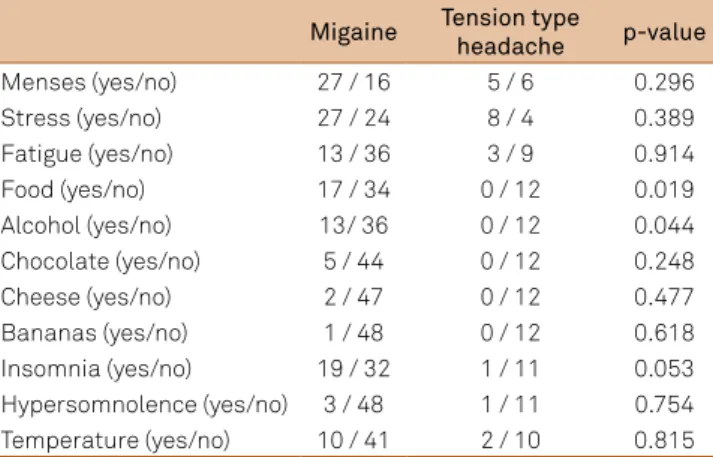
Triggering of headaches by dietary factors (when asked
as a general term) was associated with migraine (p = 0.019).
Alcohol was a more common headache trigger factor in
mi-graine patients (p = 0.044). However, the two groups did not difer when speciic food items were analyzed separately (chocolate, cheese, citrus fruits, bananas). Sleep disorders,
menstruation, changes in temperature/weather did not
dif-fer in the two groups. here were no didif-ferences between mi -graine and TTH patients in relieving and aggravating
fac-tors. Stress, both physical and psychological, was particularly
common in both patient groups (Table 2). However, the two
groups did not difer in their anxiety levels, as measured by the Hamilton Anxiety Rating Scale.
DISCUSSION
Our study revealed many of the known clinical diferenc -es of patients with migraine compared to TTH2,3,4,5,6,7.
Patients with migraine exhibited a lower age of head-ache onset, fewer days of headhead-ache per month, increased
intensity and duration of headache, diferent localization
of pain, greater frequency of nausea, vomiting and
phono-phobia. However, there was no diference in the laterality of
pain, quality of pain and presence of photophobia between migraine and TTH, three characteristics that are considered established discriminators between the two headache types.
his could be attributed to the relatively small sample size
requiring a larger sample to reach statistical signiicance. A
selection bias should also be taken into consideration, since the patients examined at a University hospital are likely to
difer from the general population, representing more atypi
-cal, complex or diicult to treat cases.
Despite not reaching statistical signiicance, migraine
patients exhibited a clear tendency towards more frequent
unilateral, throbbing headaches with accompanying photo-sensitivity compared to TTH patients, as expected.
In terms of triggers, only dietary factors (as a group) and
alcohol were associated with migraine in our study. his rela -tionship is well established in the literature2,3. No other
spe-ciic food item was a statistically signiicant trigger in our
study, although again there was a clear tendency of more fre-quent report of chocolate as trigger in migraine patients.
Most studies support the relationship between migraine and alcohol consumption, which is considered a major trig-ger factor of migraine attacks1,2,4,5,6,7,8,9,10,11,12,13,14,15,16,17,18,19,20,21.
However this relationship is complex and depends on many
factors. he type of beverage is of some importance. Most
studies consider red wine to be the most important mi-graine trigger2,9,12.Other studies however disagree5,11. he im
-portance of white wine and beer is controversial9,10,11,12,18,22.
Milde-Bush et al. report the importance of cocktails as a trig -gering factor for both migraine and TTH23. Aaamodt et al. re
-ported a decrease in migraine attacks with an increase of al-cohol consumption24.
Alcohol consumption was a trigger in 27% of the mi -graineurs in our study, in agreement with the literature, but
Table 1. Comparison of headache characteristics between the 2 groups.
Migaine Tension type headache p-value
N 51 12
Age at headache onset 21.2 ± 10.4 29.4 ± 11.5 0.019
Age 41.4 ± 12.9 37.5 ± 15.5 0.429
Sex (male/female) 8 / 43 1 / 11
Frequency of headache episodes (per month) 5.0 ± 5.4 17.1 ± 12.1 0.0001
Max episode duration (hours) 67.6 ± 65.5 19.0 ± 32.1 0.045
Mean episode duration (hours) 28.0 ± 38.4 10.4 ± 23.3 0.08
MaxVAS 9.9 ± 0.5 9.0 ± 1.3 0.114
MeanVAS 7.4 ± 1.6 5.5 ± 2.2 0.001
Quality of headache
Pulsating 13 2
Pressing 5 2
Stabbing 11 7
Pulsating + pressing 14 1 0.237
Pulsating + stabbing 2 0
Pressing + stabbing 2 0
All 3 types 2 0
Laterality (unilateral/bilateral) 27/22 3/9 0.062
Location
Retroorbital 20 1
Frontal 17 3
Parietal 1 1 0.001
Temporal 1 5
Occipital 7 2
Diffuse 5 0
Nausea (yes/no) 35/16 4/8 0.023
Vomitting (yes/no) 18/33 0/12 0.015
Photosensitivity (yes/no) 38/13 7/5 0.264
Sound sensitivity (yes/no) 38/13 4/8 0.006
Hamilton Anxiety Rating Scale 8.7 ± 7.6 11.4 ± 7.8 0.368
VAS: visual analogue scale.
Table 2. Comparison of trigger factors between the 2 groups.
Migaine Tension type
headache p-value
Menses (yes/no) 27 / 16 5 / 6 0.296
Stress (yes/no) 27 / 24 8 / 4 0.389
Fatigue (yes/no) 13 / 36 3 / 9 0.914
Food (yes/no) 17 / 34 0 / 12 0.019
Alcohol (yes/no) 13/ 36 0 / 12 0.044
Chocolate (yes/no) 5 / 44 0 / 12 0.248
Cheese (yes/no) 2 / 47 0 / 12 0.477
Bananas (yes/no) 1 / 48 0 / 12 0.618
did not relate with tension-type headache. Red wine was the commonest trigger. Beer and cocktails did not relate to mi-graine attacks.
Insomnia was a relatively common migraine trigger (19 out of 51 patients) in our study. However, only 1 of 12 patients with tension-type headache reported insomnia as a trigger.
his diference was important, but did not reach statistical signiicance (p = 0.053).
Sleep disturbances have been extensively studied and
seem to be of some importance in both migraine and TTH.
Bruni et al. reported that poor sleep quality was the common -est headache trigger (migraine or not)25. Kelman et al. also re
-ported a high frequency of sleep disturbances in migraineurs
(diiculty in sleep initiation and maintenance, reduction of
total sleep hours)26. Bruni et al. concluded that improvement
of sleep quality resulted in a reduction of migraine attack se-verity and frequency27.
Stress did not difer between migraine and TTH patients
in our study (as measured by HAM-A), despite the fact that stress is considered a traditional migraine trigger. However, 27 out of 51 patients with migraine and 8 out of 12 with ten-sion type headache considered stress to be an important
headache trigger. hese results emphasize the importance of
stress in both migraine and TTH.
he recent inancial crisis in Greece could play a part in
the elevated levels of stress in both study groups. Although
the majority of patients reported that they were afected by the inancial crisis, we did not include a formal question
-naire to assess the possible interaction between the inan -cial crisis, stress and the occurrence of headache. A
cur-rently ongoing study in our clinic is speciically designed to
answer this complex interaction.
Zivadinov et al. reported that contrary to widespread be -lief, stress was a more common trigger factor in migraineu-rs and physical activity in TTH. Other frequent precipitat-ing factors included frequent travels and changes in weather conditions. Migraine with aura (MA) correlated with frequent travelling, dietary factors and weather conditions, compared to migraine without aura (MWA)2.
Another population based study in Iraq, reached the conclu-sion that psychological upset, physical activity and changes in weather conditions were the most important precipitating fac-tors in migraine patients28. he results of a study by heeler et al.
on a mainly military population with headache were similar to the previous studies. Environmental factors, stress, dietary fac-tors and fatigue were the most common headache triggers3.
Hansen et al. reached similar conclusions in their study
of trigger factors in patients with familial hemiplegic
mi-graine. Stress, intense light, emotional turmoil and in -creased or de-creased sleeping hours were the most often reported trigger factors29.
Another cross-sectional study by Camboim et al. consid -ered stress, environmental and hormonal factors to be the
most important trigger factors for a migraine attack. he
majority of patients reported susceptibility to a multitude of trigger factors (> 5)30.
Our study is in agreement with the literature in regard to the most common migraine triggers such as dietary factors,
alcohol and sleep. We could not establish any diference be
-tween TTH and migraine patients in the frequency of speciic
food items consumption and stress, which are also consid-ered classic migraine triggers.
Some diferences between the two study groups were im
-portant but did not reach a level of statistical signiicance. his could be attributed to the relatively small sample size of our study. his is supported by the clear tendency towards
more frequent occurrence of menses and chocolate in mi-graine patients compared to TTH patients, factors that are well established migraine triggers.
All trigger factors were based on the patient’s assess-ment during an interview. We did not include quantitative data regarding the frequency and severity of the triggers. Thus it is conceivable, that although TTH and migraine patients in our study did not differ in the frequency of some triggers, they might differ in their clinical impor-tance (e.g. severity).
Our study population is not representative of the gen-eral population, because patients who refer to a
universi-ty hospital tend to have more severe, auniversi-typical or diicult to treat symptoms. hus a selection bias cannot be excluded.
However it is important to present data on the cohorts that are examined in hospital environments, to highlight the dif-ferences with population-based data.
Despite these shortcomings, data recorded system-atically in a hospital environment by trained physicians are more robust than data from cross-sectional
popula-tion studies and diagnosis accuracy is signiicantly im -proved in a clinical environment compared to data from self-administered questionnaires.
Most data on the subject derive from cross-sectional
pop-ulation or retrospective studies. Study poppop-ulations, inclusion
criteria, study design and methodology vary considerably, prohibiting safe conclusions on the subject.
Ideally, a population based study, with data collected by trained physicians would provide concrete data on the
sub-ject of triggers of primary headaches. hese data would be relevant in a clinical level, aiding diferential diagnosis of pri -mary headaches and promoting avoidance behavior as part of headache treatment. Furthermore, it would help elucidate the pathophysiological mechanisms underlying each pri-mary headache, thus promoting more targeted therapies of
References
1. The International Classiication of Headache Disorders 2nd edition. Cephalalgia. 2004;24(1 Suppl):9-160.
2. Zivadinov R, Willheim K, Sepic-Grahovac D, Jurjevic A, Bucuk M, Brnabic-Razmilic O et al. Migraine and tension-type headache in Croatia: a population-based survey of precipitating factors. Cephalalgia. 2003;23(5):336-43. http://dx.doi.org/10.1046/j.1468-2982.2003.00544.x
3. Theeler BJ, Kenney K, Prokhorenko OA, Fideli US, Campbell W, Erickson JC. Headache triggers in the US military. Headache. 2010;50(5):790-4. http://dx.doi.org/10.1111/j.1526-4610.2009.01571.x
4. Aamodt AH, Stovner LJ, Hagen K, Bråthen G, Zwart J. Headache prevalence related to smoking and alcohol use. The Head-HUNT Study. Eur J Neurol. 2006;13(11):1233-38. http://dx.doi.org/10.1111/j.1468-1331.2006.01492.x
5. Takeshima T, Ishizaki K, Fukuhara Y, Ijiri T, Kusumi M, Walutani Y et al. Population-based door-to-door survey of migraine in Japan: the Daisen study. Headache. 2004;44(1):8-19. http://dx.doi.org/10.1111/j.1526-4610.2004.04004.x
6. Henry P, Auray JP, Gaudin AF, Dartigues JF, Duru G, Lantéri-Minet M et al. Prevalence and clinical characteristics of migraine in France. Neurology. 2002;59(2):232-7. http://dx.doi.org/10.1212/WNL.59.2.232
7. Ulrich V, Olesen J, Gervil M, Russell MB. Possible risk factors and precipitants for migraine with aura in discordant twin-pairs: a population-based study. Cephalalgia. 2000;20(9):821-5. http://dx.doi.org/10.1046/j.1468-2982.2000.00135.x
8. Bánk J, Márton S. Hungarian migraine epidemiology. Headache. 2000;40(2):164-9. http://dx.doi.org/10.1046/j.1526-4610.2000.00023.x
9. Ulrich V, Russell MB, Jensen R, Olesen J. A comparison of tension-type headache in migraineurs and in non-migraineurs: a population-based study. Pain. 1996;67(2-3):501-6.
http://dx.doi.org/10.1016/0304-3959(96)03164-8
10. Rasmussen BK. Migraine and tension-type headache in a general population: precipitating factors, female hormones, sleep pattern and relation to lifestyle. Pain. 1993;53(1):65-72. http://dx.doi.org/10.1016/0304-3959(93)90057-V
11. Yadav RK, Kalita J, Misra UK. A study of triggers of migraine in India. Pain Med. 2010;11(1):44-47. http://dx.doi.org/10.1111/j.1526-4637.2009.00725.x
12. Fukui PT, Gonçalves TR, Strabelli CG, Lucchino NM, Matos FC, Santos JP et al. Trigger factors in migraine patients. Arq Neuropsiquiatr. 2008;66(3A):494-9. http://dx.doi.org/10.1590/S0004-282X2008000400011
13. Kelman L. The triggers or precipitants of the acute migraine attack. Cephalalgia. 2007;27(5):394-402. http://dx.doi.org/10.1111/j.1468-2982.2007.01303.x
14. Wöber C, Holzhammer J, Zeitlhofer J, Wessely P, Wöber-Bingöl C. Trigger factors of migraine and tension-type headache: experience and knowledge of the patients. J Headache Pain. 2006;7(4):188-95. http://dx.doi.org/10.1007/s10194-006-0305-3
15. Karli N, Zarifoglu M, Calisir N, Akgoz S. Comparison of pre-headache phases and trigger factors of migraine and
episodic tension-type headache: do they share similar clinical pathophysiology? Cephalalgia. 2005;25(6):444-51. http://dx.doi.org/10.1111/j.1468-2982.2005.00880.x
16. Ierusalimschy R, Moreira Filho PF. [Precipitating factors of migraine attacks in patients with migraine without aura]. Arq Neuropsiquiatr. 2002;60(3-A):609-13. Portuguese. http://dx.doi.org/10.1590/S0004-282X2002000400017
17. Spierings EL, Ranke AH, Honkoop PC. Precipitating and aggravating factors of migraine versus tension-type headache. Headache. 2001;41(6):554-8. http://dx.doi.org/10.1046/j.1526-4610.2001.041006554.x
18. Peatield RC. Relationships between food, wine, and beer-precipitated migrainous headaches. Headache. 1995;35(6):355-7.
http://dx.doi.org/10.1111/j.1526-4610.1995.hed3506355.x
19. Van den Bergh V, Amery WK, Waelkens J. Trigger factors in migraine: a study conducted by the Belgian Migraine Society. Headache. 1987;27(4):191-6. http://dx.doi.org/10.1111/j.1526-4610.1987.hed2704191.x
20. Wöber C, Brannath W, Schmidt K, Kapitan M, Rudel E, Wessely P et al. Prospective analysis of factors related to migraine attacks: the PAMINA study. Cephalalgia. 2007;27(4):304-14. http://dx.doi.org/10.1111/j.1468-2982.2007.01279.x
21. Littlewood JT, Gibb C, Glover V, Sandler M, Davies PT, Rose FC. Red wine as a cause of migraine. Lancet. 1988;1(8585):558-59. http://dx.doi.org/10.1016/S0140-6736(88)91353-0
22. Turner LC, Molgaard CA, Gardner CH, Rothrock JF, Stang PE. Migraine trigger factors in non-clinical Mexican-American population in San Diego county: implications for etiology. Cephalalgia. 1995;15(6):523-30. http://dx.doi.org/10.1046/j.1468-2982.1995.1506523.x
23. Milde-Busch A, Blaschek A, Borggräfe I, Heinen F, Straube A, von Kries R. Associations of diet and lifestyle with headache in high-school students: results from a cross-sectional study. Headache. 2010;50(7):1104-14. http://dx.doi.org/10.1111/j.1526-4610.2010.01706.x
24. Robbins L. Precipitating factors in migraine: a retrospective review of 494 patients. Headache. 1994;34(4):214-6. http://dx.doi.org/10.1111/j.1526-4610.1994.hed3404214.x
25. Bruni O, Russo PM, Ferri R, Novelli L, Galli F, Guidetti V. Relationships between headache and sleep in a non-clinical population
of children and adolescents. Sleep Med. 2008;9(5):542-8. http://dx.doi.org/10.1016/j.sleep.2007.08.010
26. Kelman L, Rains JC. Headache and sleep: examination of sleep patterns and complaints in a large clinical sample of migraineurs. Headache. 2005;45(7):904-10. http://dx.doi.org/10.1111/j.1526-4610.2005.05159.x
27. Bruni O, Galli F, Guidetti V. Sleep hygiene and migraine in children and adolescents. Cephalalgia. 1999;19 Suppl 25:57-9.
28. Al-Shimmery EK. Precipitating and relieving factors of migraine headache in 200 iraqi kurdish patients. Oman Med J. 2010;25(3):212-7. http://dx.doi.org/10.5001/omj.2010.59
29. Hansen JM, Hauge AW, Ashina M, Olesen J. Trigger factors for familial hemiplegic migraine. Cephalalgia. 2011;31(12):1274-81. http://dx.doi.org/10.1177/0333102411415878