Analysis of Trigger Factors in Episodic
Migraineurs Using a Smartphone Headache
Diary Applications
Jeong-Wook Park1, Min Kyung Chu2, Jae-Moon Kim3, Sang-Gue Park4, Soo-Jin Cho5*
1Department of Neurology, the Catholic University of Korea College of Medicine, Seoul, Korea,
2Department of Neurology, Sacred Heart Hospital, Hallym University College of Medicine, Anyang, Korea,
3Department of Neurology, Chungnam National University College of Medicine, Daejeon, Korea,
4Department of Applied Statistics, Chung-Ang University, Seoul, Korea,5Department of Neurology, Dongtan Sacred Heart Hospital, Hallym University College of Medicine, Hwaseong, Korea
Abstract
Background
Various stimuli can trigger migraines in susceptible individuals. We examined migraine trig-ger factors by using a smartphone headache diary application.
Method
Episodic migraineurs who agreed to participate in our study downloaded smartphone head-ache diary application, which was designed to capture the details regarding headhead-ache trig-ger factors and characteristics for 3 months. The participants were asked to access the smartphone headache diary application daily and to confirm the presence of a headache and input the types of trigger factors.
Results
Sixty-two participants kept diary entries until the end of the study. The diary data for 4,579 days were analyzed. In this data set, 1,099 headache days (336 migraines, 763 non-migraine headaches) were recorded; of these, 772 headache events had with trigger fac-tors, and 327 events did not have trigger factors. The common trigger factors that were pres-ent on headache days included stress, fatigue, sleep deprivation, hormonal changes, and weather changes. The likelihood of a headache trigger was 57.7% for stress, 55.1% for sleep deprivation, 48.5% for fatigue, and 46.5% for any trigger. The headaches with trigger factors were associated with greater pain intensity (p<0.001), headache-related disability (p<0.001), abortive medication use (p = 0.02), and the proportion of migraine (p<0.001), relative to those without trigger factors. Traveling (odd ratios [OR]: 6.4), hormonal changes (OR: 3.5), noise (OR: 2.8), alcohol (OR: 2.5), overeating (OR: 2.4), and stress (OR:1.8) were significantly associated with migraines compared to non-migraine headaches. The headaches that were associated with hormonal changes or noise were more often
OPEN ACCESS
Citation:Park J-W, Chu MK, Kim J-M, Park S-G, Cho S-J (2016) Analysis of Trigger Factors in Episodic Migraineurs Using a Smartphone Headache Diary Applications. PLoS ONE 11(2): e0149577. doi:10.1371/journal.pone.0149577
Editor:Jong-Ling Fuh, Taipei Veterans General Hospital, TAIWAN
Received:September 4, 2015
Accepted:February 1, 2016
Published:February 22, 2016
Copyright:© 2016 Park et al. This is an open access article distributed under the terms of the Creative Commons Attribution License, which permits unrestricted use, distribution, and reproduction in any medium, provided the original author and source are credited.
Data Availability Statement:All relevant data are within the paper and its Supporting Information files.
Funding:This study was supported by a grant from Korean Headache Society (http://www.headache.or. kr/) and by Hallym University Research Fund (HURF-2014-51).
migraines, regardless of the preventive medication. The headaches due to stress, over-eating, alcohol, and traveling were more often migraines without preventive medication, but it was not evident with preventive medication.
Conclusion
Smartphone headache diary application is an effective tool to assess migraine trigger fac-tors. The headaches with trigger factors had greater severity or migraine features. The type of triggers and the presence of preventive medication influenced the headache characteris-tics; hence, an investigation of trigger factors would be helpful in understanding migraine occurrences.
Introduction
Migraines are characterized by recurrent headaches and a hypersensitivity to sensory stimuli [1]. Various external and internal stimuli can lead to migraine events in susceptible individuals, which can be considered as migraine triggers or precipitants [2,3]. The reported migraine triggers include stress, sleep, fatigue, fasting, physical exercise, hormonal changes, weather, sunlight, alcohol, and various sensory stimuli [4–9]. Most studies that examined migraine trig-ger factors were based on participant reports. These trigtrig-ger factors are found in 73–80% of migraineurs [10,11].
Most migraineurs encounter their migraine triggers daily without suffering a migraine attack, and only some migraineurs experience a migraine attack provoked by a trigger factor [4]. To avoid general exposure to migraine triggers, a process to identify personal headache triggers in real life may be useful for migraine sufferers. Moreover, the estimation of the degree of each trigger factor’s contribution to a headache occurrence is meaningful. Schurks et al. recently proposed that triggering or precipitating factors were important for the characteriza-tion of migraine phenotypes, despite being excluded from the current diagnostic criteria for a headache disorder [12]. Diary studies using advanced statistical modeling techniques may be required for the reliable identification of one’s migraine trigger factors [13,14]. In a paper diary study using a Cox regression analysis, hormonal changes exerted the most prominent influence, increasing the likelihood of a headache occurrence [15].
While most patients have reported one or more triggers, the major limitation to accepting these triggers as precipitating factors resides in the reliability of the patient’s migraine trigger recall and selection [3,10]. In addition, the causal relationships between triggers and migraines are currently uncertain.
Therefore, in this study, we investigated the frequencies and impacts of triggers in episodic migraine patients using our SHD.
Methods
Participants and baseline survey
The participants who met the inclusion criteria were recruited between September 2014 and January 2015. This study was conducted at the neurology outpatient clinics of university hospitals.
The following inclusion criteria were applied: 1) age between 19 and 55 years and migraines with or without auras, as defined by the International Headache Society Criteria for Migraine (ICHD-3 beta) [24]; 2) an of 2–14 headache days per month; 3) stable headache characteristics for at least 1 year prior to study entry; and 4) the possession of a personal platform smartphone that was capable of operating the SHD.
The following exclusion criteria were applied: 1) headaches attributed to secondary causes; and 2) inability to complete questionnaires, to use our specially designed SHD, or to comply with the SHD usage requirements.
For the baseline survey, the participants were asked to choose their potential triggers on the basis of their previous experiences from a list of 18 trigger factors. Those factors were selected on the basis of the results of previous studies about migraine trigger factors, and included stress, excessive sleep, sleep deprivation, exercise, fatigue, hormonal changes, emotional changes, weather changes, sunlight, noise, odors, fasting, overeating, caffeine, smoking, alcohol, cheese/chocolate, and traveling [2,5,6,8,9]. The participants were also asked to complete the Hospital Anxiety and Depression Scale to determine their anxiety and depression levels [25]. They also completed the Korean versions of the Migraine Disability Assessment Scale
(MIDAS) and the Headache Impact Test-6 to determine the impact of their migraines on their daily functioning [26,27].
The ethical approval for the study was granted by the Dongtan Sacred Heart Hospital Insti-tutional Review Board/Ethic Committee (IRB approval number: 2014–132) and Uijeongbu St. Mary’s Hospital, the Catholic University of Korea College of Medicine Institutional Review Board/Ethic Committee (IRB approval number: UC14OIM10085). The participants received an explanation of the study’s aims and procedures and provided written informed consent.
SHD development and contents
Two registered nurses, a project coordinator, a web-support project manager, and three head-ache specialists developed the SHD together.
The SHD included systematic instructions for its use during the study. The patients’ recorded SHD data were available to them after their enrollment in the study.
A series of reports, which included each participant’s missing diary days, was automatically uploaded. These reports allowed researchers to track each participant’s status and alert the par-ticipants if increased compliance was needed. The SHD was programmed to check the partici-pants’incidence of headache and the potential triggers on a daily basis. In addition to the potential trigger factors identified at the initial assessment, the participants were able to input details concerning other headache triggers.
Data collection using the SHD
by touching the screen. They were asked to complete the SHD on a daily basis for 3 months. A short message was sent every two weeks to remind the participants to enter information.
Every day, regardless of the presence of a headache, the participants were asked to touch the SHD icon shown in their smartphone. After doing so, they could log into the SHD. The first screen asked the patient whether he/she had a headache. If the patients noted that there was no headache, then it was automatically recorded as a‘no headache day’. However, if there was any form of a headache present, he/she was asked to record the headache characteristics their head-ache (e.g., headhead-ache intensity, duration, and the presence of photophobia or phonophobia), any headache self-treatment, and headache-related functional disability (e.g., MIDAS, if any). Finally, the patients were asked to select the triggers from the list of 18 trigger factors presented during the same day. The triggers present during the 1–3 days preceding the headache were not considered or selected. In addition, the patients were asked to record those trigger factors daily, regardless of the presence of a headache.
The participants were interviewed by the researchers and received a personal summary of their daily records for the preceding 3 months at the study’s completion.
Data analysis
We analyzed the effect of trigger factor exposure on the headache occurrence using the daily records from the participants’diary entries. The frequency for each trigger factor was acquired by calculating the number of headache days with certain trigger factors divided by the total number of headache days. There were many terms for the occurrence of a headache, such as intensity or probability; we chose the likelihood of a headache [3,19]. Likelihood of a headache during the presence of each trigger factor was obtained with the following equation:
Frequency¼the number of headache days with certain trigger factors
total number of headache days 100
Likelihood ¼ the number of headache days with certain trigger factor
the number of days with presence of the same trigger factor100
Each headache was classified as a migraine or non-migraine headache, according to the diagnostic criteria B–D of item 1.1 of migraine without aura in the ICHD-3 beta.
The categorical variables were presented as percentages, and the continuous variables were summarized using descriptive statistics, such as the means and standard deviations. The clini-cal variables for the headache were compared according to the presence or absence of trigger factors, using t-tests for continuous variables, and a chi-square test or Fisher’s exact test for the frequency variables.
The trigger factor frequency was compared between the migraine and non-migraine head-aches by using a chi-square test or Fisher’s exact test. The associations of the 18 trigger factors and migraine were examined using a stepwise multiple logistic regression analysis with 153 possible combinations of trigger factors. A variable must have had a p value of less than 0.15 to be entered into the regression model. SAS statistical software (SAS version 9.3, SAS Institute, Inc., Cary, NC) was used for all analyses. The statistical significance was set at p<0.05.
Results
Demographic characteristics
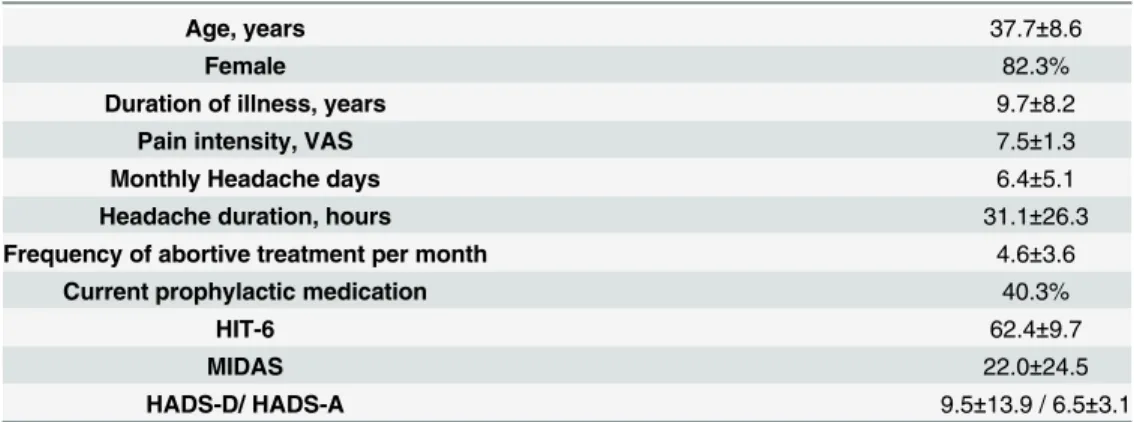
for at least 50% of the study period. We analyzed the headache diary data from 62 patients (S1 File). Sixty patients had a migraine without aura, and two had a migraine with aura. The partic-ipants’mean age was 37.7 ± 8.6 years of age, with 83% of participants being women. The mean illness duration was 9.7 ± 8.2 years (Table 1).
The required recording time per day was 2.1 ± 1.2 (1–5) minutes. All patients preferred to use the smartphone diary rather than the paper diary, as assessed by a survey after the end of the study.
Personal triggers estimated at the baseline survey and on the SHD
At the initial study session, the participants were asked to provide a retrospective estimate of the number of migraine triggers of which they were aware. Of the participants analyzed, 39 (62.9%) reported any trigger(s) and the median number of triggers was 3 (range: 0–11). The participants estimated that 64.5% of their headaches were related to triggers.
In total, 4,579 diary days were recorded from 62 patients, with an 86.3% recording rate dur-ing 85 ± 13.4 days. The median number of headaches per patient was 15 durdur-ing the period (range: 4–60). The proportion of patients who reported any trigger(s) on the SHD was higher than that found in the baseline survey (80.6% vs. 62.9%, p = 0.002). The number of possible trigger(s) for each patient was higher on the SHD [median: 7 (range 0–17)] than that in the baseline survey [median: 3 (range 0–11)].
Trigger frequencies and likelihood of headache in presence of the
triggers on the whole SHD
During the study period, 1,099 headache days were recorded (Fig 1). The median number of triggers on each recording headache day was 2 (range: 1–9); 80% of the headache diary listed 0–2 triggers (Table 2). The proportion of days with the presence of a trigger was 65.7% on the headache day and 25.6% on a day without a headache. There was no influence of the trigger number on the likelihood of a headache in the Chi-square analysis (S1 Table).
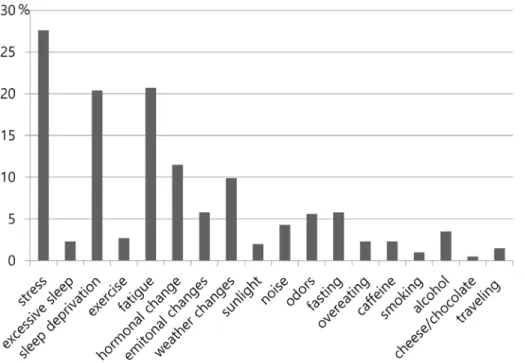
When headaches were reported in the SHD, the common triggers were stress (27.6%), fol-lowed by fatigue (20.7%), sleep deprivation (20.4%), hormonal changes (11.5%), and weather changes (9.9%) (Fig 2).
Table 1. Demographic and headache characteristics of the participants.
Age, years 37.7±8.6
Female 82.3%
Duration of illness, years 9.7±8.2
Pain intensity, VAS 7.5±1.3
Monthly Headache days 6.4±5.1
Headache duration, hours 31.1±26.3
Frequency of abortive treatment per month 4.6±3.6
Current prophylactic medication 40.3%
HIT-6 62.4±9.7
MIDAS 22.0±24.5
HADS-D/ HADS-A 9.5±13.9 / 6.5±3.1
Mean±standard deviation; VAS, visual analogue scale; HIT-6, Headache impact test-6; MIDAS, Migraine Disability Assessment Scale; HADS-D, Score of Hospital anxiety depression scale-depression part; HADS-A, Score of Hospital anxiety depression scale-anxiety part
Of the 1662 days that included a trigger, 772 day records (46.5%) were recorded as headache days. The following triggers were likely to trigger a headache: 78.6% for alcohol, 71.8% for odor, 68.8% for emotional change, 64.2% for hormonal changes, and 57.7% for stress, 55.1% for sleep deprivation, and 48.5% for fatigue.
Analysis of headache characteristics among the 1099 headache day
records on the SHD
Of the total number of headache days, 70.2% (772/1,099) were recorded as days that included triggers (Fig 1).
The headaches with triggers were related to a greater pain intensity (p<0.001), the use of
abortive treatment (p = 0.015), headache-related disability (p<0.001), and the proportion of
migraine (p<0.001) than were those without triggers (Table 3). The headache duration did
not differ between the two groups (p = 0.57).
Of the total number of headache days, 30.6% (336/1,099) of the headaches met the criteria for a migraine (Fig 1).
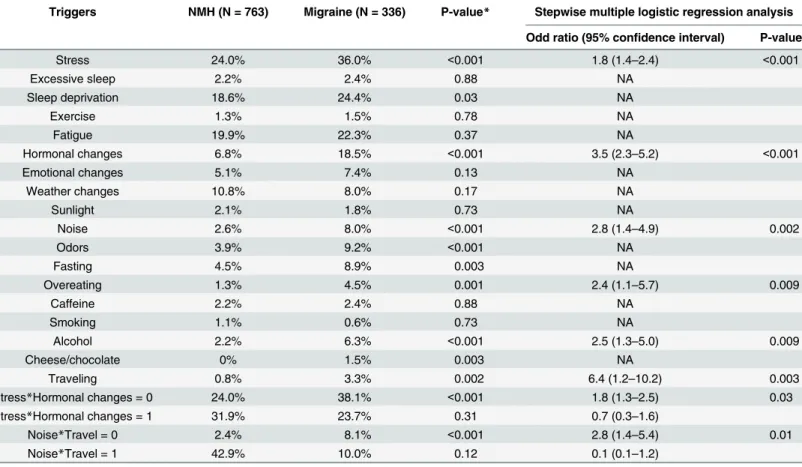
The presence of stress, sleep deprivation, hormonal changes, noise, odors, alcohol, fasting, overeating, cheese/chocolate consumption, and traveling were significantly more frequent in migraines relative to non-migraine headaches (Table 4). A stepwise multiple logistic regression analysis with the 18 trigger factors and the 153 possible combinations of the trigger factors revealed that traveling (odds ratio [OR]: 6.4, confidence interval [95% CI]::1.2–10.2), hormonal
Fig 1. Flow Chart Depicting Subject Participation and the Number of Records.There were 722 headache days with certain triggers and 357 headache days without triggers. In total, 1662 days with a trigger and 2917 days without a trigger were recorded.
doi:10.1371/journal.pone.0149577.g001
Table 2. The Number of Trigger of each Recording Day with and without Headache.
Number of triggers 0 1 2 3 4 5 6 7 8 9 Total
Headache days 327 305 247 139 56 18 3 2 1 1 1099
No headache 2587 351 267 182 76 14 1 0 1 1 3480
Total 2914 656 514 321 132 32 4 2 2 2 4579
changes (OR: 3.5, 95% CI: 2.3–5.2), noise (OR: 2.8, 95% CI:1.4–4.9), alcohol (OR: 2.5, 95% CI:1.3–5.0), overeating (OR: 2.4, 95% CI:1.1–5.7), and stress (OR: 1.8, 95% CI:1.4–2.4) were significantly associated with migraines (Table 4). Two trigger combinations were selected dur-ing the stepwise logistic analysis. In situations with stress, but without hormonal changes, the OR did not change compared to the OR of stress alone. In situations with stress and hormonal changes, the migraine risk was not significant. The associations of noise and travel were similar (Table 4).
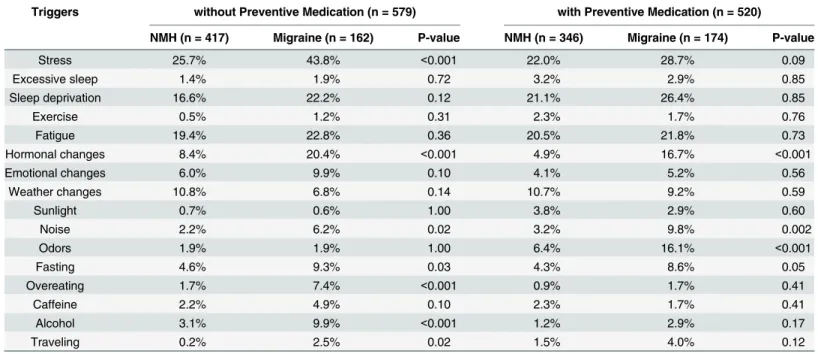
The headaches with the presence of hormonal changes or noise were more likely to be migraines, regardless of any preventive medications. The headaches with the presence of stress, overeating, alcohol, and traveling were more often migraines without the use of preventive medication, but migraines were not evident with the use of preventive medication. The head-aches with the presence of odors were more likely to be migraines only with preventive medica-tion. The influences of the other trigger factors on the headache type were not different with the use of preventive medication (Table 5).
Fig 2. Distribution of each Trigger related to Headache according to Their Frequency.
doi:10.1371/journal.pone.0149577.g002
Table 3. Comparison of the Headache Variables according to Trigger presence on a Smartphone Application-based Electronic Headache Diary.
Headache Variables Headache not associated with Trigger (N = 327) Headache associated with Trigger (N = 772) P-value
Pain intensity, VAS 3.9±2.0 4.6±2.3 <0.001
Duration of headache, hours 7.7±5.7 8.0±5.8 0.57
Usage of abortive treatment 56.9% 64.8% 0.02
Disability associated with headache 33.6% 53.6% <0.001
Proportion of migraines 17.1% 36.3% <0.001
Mean±standard deviation; VAS, visual analogue scale
Discussion
The main findings of the current study were as follows: 1) the SHD was comprehensive in detecting the trigger factors of episodic migraineurs; 2) the frequent trigger factors on headache days were stress, fatigue, and sleep deprivation; the likelihood of a headache was 57.7% for stress, 55.1% for sleep deprivation, 48.5% for fatigue, and 46.5% for any trigger; 3) the head-aches with trigger factors were more severe relative to those without trigger factors, 4) traveling, hormonal changes, noise, alcohol, overeating and stress increased the risk of migraines; and 5) hormonal changes and noise increased the risk of migraine regardless of preventive medica-tion, whereas stress, overeating, alcohol, and traveling increased the risk of migraine in situa-tions without preventive medication.
Our SHD was developed for clinical and research purposes. It has major advantages for researchers, including data entry by the participants, big data set collection, immediate and fre-quent data analysis, and no requirements for special diary equipment [22,23]. For participants, SHD was easy to use. The summary report could be obtained from the clinician and the SHD after the end of the study. The SHD facilitated the research regarding migraine trigger factors, and has a great potential to enhance the communication between the physician and their patient [22,28].
Table 4. Comparison of Triggers between Migraines and Non-migraine headaches on the Smartphone Application-based Electronic Headache Diary.
Triggers NMH (N = 763) Migraine (N = 336) P-value* Stepwise multiple logistic regression analysis
Odd ratio (95% confidence interval) P-value
Stress 24.0% 36.0% <0.001 1.8 (1.4–2.4) <0.001
Excessive sleep 2.2% 2.4% 0.88 NA
Sleep deprivation 18.6% 24.4% 0.03 NA
Exercise 1.3% 1.5% 0.78 NA
Fatigue 19.9% 22.3% 0.37 NA
Hormonal changes 6.8% 18.5% <0.001 3.5 (2.3–5.2) <0.001
Emotional changes 5.1% 7.4% 0.13 NA
Weather changes 10.8% 8.0% 0.17 NA
Sunlight 2.1% 1.8% 0.73 NA
Noise 2.6% 8.0% <0.001 2.8 (1.4–4.9) 0.002
Odors 3.9% 9.2% <0.001 NA
Fasting 4.5% 8.9% 0.003 NA
Overeating 1.3% 4.5% 0.001 2.4 (1.1–5.7) 0.009
Caffeine 2.2% 2.4% 0.88 NA
Smoking 1.1% 0.6% 0.73 NA
Alcohol 2.2% 6.3% <0.001 2.5 (1.3–5.0) 0.009
Cheese/chocolate 0% 1.5% 0.003 NA
Traveling 0.8% 3.3% 0.002 6.4 (1.2–10.2) 0.003
Stress*Hormonal changes = 0 24.0% 38.1% <0.001 1.8 (1.3
–2.5) 0.03
Stress*Hormonal changes = 1 31.9% 23.7% 0.31 0.7 (0.3–1.6)
Noise*Travel = 0 2.4% 8.1% <0.001 2.8 (1.4–5.4) 0.01
Noise*Travel = 1 42.9% 10.0% 0.12 0.1 (0.1–1.2)
*Chi-square analysis
NMH, Non-migraine Headaches; NA, not available due lack of inclusion in the stepwise multiple regression analysis
Among the 1099 headache days, 70.2% were related to trigger factors in this study. Com-pared to the baseline survey that was based on life experience, the actual frequency of each trig-ger factor was lower. The contributions of individual trigtrig-ger factors were similar, and the proportion of patients who reported any trigger(s) was higher in the SHD for 3 months. The frequent trigger factors in this analysis were in line with previous studies [2,3,10,29–30]. Sev-eral studies have suggested that stress is related to hormones, including cortisol and thyroid hormone, and may have a role in migraine pathogenesis [2,29]. Fatigue was considered to be a migraine-specific trigger and may be related to sleep quality [31]. Sleep disturbances were 3–17 times more likely to be triggers for migraines, tension-type headaches, and chronic headaches in a population-based study. It has been suggested there is an overall pain-promoting effect of sleep deprivation [32]. Sleep deprivation was a predictor for severe headaches among chronic migraine patients, but was not associated with episodic migraines in this study [33]. Stress, fatigue, and sleep deprivation may be modifiable triggers for migraines, so proper attention to psychiatric disorders, sleep hygiene, and life habits is important in learning to cope with trig-gers [33–35]
The likelihood of a headache on a day with any trigger factor was 46.5%. Alcohol, odor, and emotional changes were not frequently associated with headaches, but the likelihood of a head-ache occurrence was more than 70% when the patients were exposed to those factors. Although the avoidance of all triggers is impractical in everyday life, the avoidance or pre-emptive approach for certain triggers may be reasonable [11].
The additional effects of triggers were not seen in the logistic analysis with 153 possible combinations of two triggers, although stressmenstruation and noisetravel were selected in
the model. A previous study using natural triggers in migraine auras showed no additional effects of a flickering light and physical activity [4]. One study about odorant-triggered migraines showed the association of perfume odors within other factors, such as cleaning,
Table 5. Influence of Preventive Medication on the Headache Features with their Trigger Factors.
Triggers without Preventive Medication (n = 579) with Preventive Medication (n = 520)
NMH (n = 417) Migraine (n = 162) P-value NMH (n = 346) Migraine (n = 174) P-value
Stress 25.7% 43.8% <0.001 22.0% 28.7% 0.09
Excessive sleep 1.4% 1.9% 0.72 3.2% 2.9% 0.85
Sleep deprivation 16.6% 22.2% 0.12 21.1% 26.4% 0.85
Exercise 0.5% 1.2% 0.31 2.3% 1.7% 0.76
Fatigue 19.4% 22.8% 0.36 20.5% 21.8% 0.73
Hormonal changes 8.4% 20.4% <0.001 4.9% 16.7% <0.001
Emotional changes 6.0% 9.9% 0.10 4.1% 5.2% 0.56
Weather changes 10.8% 6.8% 0.14 10.7% 9.2% 0.59
Sunlight 0.7% 0.6% 1.00 3.8% 2.9% 0.60
Noise 2.2% 6.2% 0.02 3.2% 9.8% 0.002
Odors 1.9% 1.9% 1.00 6.4% 16.1% <0.001
Fasting 4.6% 9.3% 0.03 4.3% 8.6% 0.05
Overeating 1.7% 7.4% <0.001 0.9% 1.7% 0.41
Caffeine 2.2% 4.9% 0.10 2.3% 1.7% 0.41
Alcohol 3.1% 9.9% <0.001 1.2% 2.9% 0.17
Traveling 0.2% 2.5% 0.02 1.5% 4.0% 0.12
Smoking and cheese/chocolate were not analyzed because more than one cell was zero. NMH, Non-migraine Headaches
cooking, beauty products, and foul odors [6]. The addictive effect of triggers on headache occurrence or severity is still uncertain and worth investigating with advanced statistical modeling techniques [13,14].
One of the important methodological issues in studying trigger factors of migraines is the individual models (within-person) and population-level models (using an individual diary) [19]. The impact of trigger factors on migraines was analyzed by using population-level models based on 1099 headache diaries; 30.6% (336/1,099) of the headaches fulfilled the criteria for migraines in this study. A substantial proportion of the reported by migraine sufferers may be a manifestation of mild migraine attacks. These attacks were probable migraines or were treated before the full development of migraine symptoms [36]. There is the possibility of a ten-sion-type headache; the prevalence of tenten-sion-type headaches in migraine individuals was sim-ilar to the general population [37,38]
The headaches with triggers were more severe and related to migraines in this study. People with triggers frequently had more severe headache profiles. The menstrual migraine is a good example [3,39–41]. In a study that used paper diaries, hormonal changes demonstrated a haz-ard ratio increase of up to 96%, while the values for all other factors were less than 35% [42]. Migraineurs with allodynia were reported to have a higher number of triggers relative to those without, indicating that triggers may play a role in the exacerbation of a migraine [43].
Hormonal changes and noise increased the risk of a migraine regardless of preventive medi-cation in this study. Considering that short-term migraine prevention uses triptans for men-strual migraines, conventional preventive medication would not change the features of a headache triggered by menstruation [39]. The associations of stress, overeating, alcohol, and traveling with migraine were not evident with preventive medication. Preventive medication may change the feature of headaches [44].
The study had some limitations. First, the temporal sequence and relationships between the triggers were not evaluated. The changes from the previous levels and associations between the trigger factors may have influenced the headache onset and severity [20]. The dif-ferentiation from the premonitory symptoms with functional imaging may be promising [45], Second, we analyzed one-day diaries; the triggers that were present during the preceding 1–3 days were not considered [33,46], which limits the predictability and direct causality associa-tions between the triggers and headaches. Third, the compliance rate of this study was based on more than 50% of recording period (74.7%), which is not high. However, the recording rate of the SHD (86.3%) observed in this study was comparable to those of previous studies and reasonable for clinical settings [18,20,39]. Fourth, most triggers influenced a subgroup of migraineurs, but we did not analyze the risk of migraine by using an individual model [4,19]. Fifth, we relied on the participants’judgment for recording the triggers and cannot rule out the possibility of selection bias from the clinical setting and recall or confirmation bias by par-ticipant [3].
The merits of this study were analyzing trigger factors in regards to frequency, headache occurrence, headache features, and the influence of preventive medication by using a statistical method and patient-friendly SHD in episodic migraineurs.
Conclusion
Supporting Information
S1 File. Dataset of 62 patients, 1099 Headache Diary Records, and 4579 Diary Records. (XLS)
S1 Table. Chi-square analysis about the likelihood of Headache and the Number of Trig-gers.
(PDF)
Acknowledgments
The authors thank Sarang Shin, Kyeongok Jo, Juyeon Park for assistance in data management and M2Community Co. Ltd for the development of the smartphone application-based head-ache diary.
Author Contributions
Conceived and designed the experiments: JWP MKC SJC JMK SGP. Analyzed the data: JWP MKC SJC JMK SGP. Wrote the paper: JWP MKC SJC SGP. Designed the smartphone applica-tion used in analysis: JWP MKC SJC.
References
1. Schwedt TJ. Multisensory integration in migraine. Curr Opin Neurol 2013; 26:248–253. doi:10.1097/
WCO.0b013e328360edb1PMID:23591684
2. Peroutka SJ. What turns on a migraine? A systematic review of migraine precipitating factors. Curr Pain Headache Rep 2014; 18:454. doi:10.1007/s11916-014-0454-zPMID:25160711
3. Pavlovic JM, Buse DC, Sollars CM, Haut S, Lipton RB. Trigger factors and premonitory features of migraine attacks: summary of studies. Headache 2014; 54:1670–1679. doi:10.1111/head.12468
PMID:25399858
4. Hougaard A, Amin FM, Hauge AW, Ashina M, Olesen J. Provocation of migraine with aura using natural trigger factors. Neurology 2013; 80:428–431. doi:10.1212/WNL.0b013e31827f0f10PMID:23345632 5. Hoffmann J, Recober A. Migraine and triggers: post hoc ergo propter hoc? Curr Pain Headache Rep
2013; 17:370. doi:10.1007/s11916-013-0370-7PMID:23996725
6. Silva-Neto RP, Peres MF, Valenca MM. Odorant substances that trigger headaches in migraine patients. Cephalalgia 2014; 34:14–21. doi:10.1177/0333102413495969PMID:23832131
7. Scheidt J, Koppe C, Rill S, Reinel D, Wogenstein F, Drescher J. Influence of temperature changes on migraine occurrence in Germany. Int J Biometeorol 2013; 57:649–654. doi:
10.1007/s00484-012-0582-2PMID:22895651
8. Tekatas A, Mungen B. Migraine headache triggered specifically by sunlight: report of 16 cases. Eur Neurol 2013; 70:263–266. doi:10.1159/000354165PMID:24051692
9. Koppen H, van Veldhoven PL. Migraineurs with exercise-triggered attacks have a distinct migraine. J Headache Pain 2013; 14:99. doi:10.1186/1129-2377-14-99PMID:24359317
10. Baldacci F, Vedovello M, Ulivi M, Vergallo A, Poletti M, Borelli P, et al. How aware are migraineurs of their triggers? Headache 2013; 53:834–837. doi:10.1111/head.12083PMID:23534912
11. Wang J, Huang Q, Li N, Tan G, Chen L, Zhou J. Triggers of migraine and tension-type headache in China: a clinic-based survey. Eur J Neurol 2013; 20:689–696. doi:10.1111/ene.12039PMID:
23356519
12. Schurks M, Buring JE, Kurth T. Migraine features, associated symptoms and triggers: a principal com-ponent analysis in the Women's Health Study. Cephalalgia 2011; 31:861–869. doi:10.1177/
0333102411401635PMID:21398421
13. Houle TT, Turner DP. Natural experimentation is a challenging method for identifying headache trig-gers. Headache 2013; 53:636–643. doi:10.1111/head.12075PMID:23534852
15. Salhofer-Polanyi S, Frantal S, Brannath W, Seidel S, Wober-Bingol C, Wober C. Prospective analysis of factors related to migraine aura—the PAMINA study. Headache 2012; 52:1236–1245. doi:10.1111/j.
1526-4610.2012.02166.xPMID:22671771
16. Sorbi MJ, Mak SB, Houtveen JH, Kleiboer AM, van Doornen LJ. Mobile Web-based monitoring and coaching: feasibility in chronic migraine. J Med Internet Res 2007; 9:e38. doi:10.2196/jmir.9.5.e38 PMID:18166526
17. Goldberg J, Wolf A, Silberstein S, Gebeline-Myers C, Hopkins M, Einhorn K, et al. Evaluation of an elec-tronic diary as a diagnostic tool to study headache and premenstrual symptoms in migraineurs. Head-ache 2007; 47:384–396. PMID:17371355
18. Moloney MF, Aycock DM, Cotsonis GA, Myerburg S, Farino C, Lentz M. An Internet-based migraine headache diary: issues in Internet-based research. Headache 2007; 49:673–686.
19. Lipton RB, Pavlovic JM, Haut SR, Grosberg BM, Buse DC. Methodological issues in studying trigger factors and premonitory features of migraine. Headache 2014; 54:1661–1669. doi:10.1111/head.
12464PMID:25339181
20. Lipton RB, Buse DC, Hall CB, Tennen H, Defreitas TA, Borkowski TM, et al. Reduction in perceived stress as a migraine trigger: testing the "let-down headache" hypothesis. Neurology 2014; 82:1395–
1401. doi:10.1212/WNL.0000000000000332PMID:24670889
21. Rosser BA, Eccleston C. Smartphone applications for pain management. J Telemed Telecare 2011; 17:308–212. doi:10.1258/jtt.2011.101102PMID:21844177
22. Jacob E, Stinson J, Duran J, Gupta A, Gerla M, Ann Lewis M, et al. Usability testing of a Smartphone for accessing a web-based e-diary for self-monitoring of pain and symptoms in sickle cell disease. J Pediatr Hematol Oncol 2012; 34:326–335. doi:10.1097/MPH.0b013e318257a13cPMID:22627570 23. Hundert AS, Huguet A, McGrath PJ, Stinson JN, Wheaton M. Commercially available mobile phone
headache diary apps: a systematic review. JMIR Mhealth Uhealth 2014; 19;36.
24. Headache Classification Committee of the International Headache Society (IHS). The International Classification of Headache Disorders, 3rd edition (beta version). Cephalalgia 2013; 33:629–808. doi:
10.1177/0333102413485658PMID:23771276
25. Zigmond AS, Snaith RP. The hospital anxiety and depression scale. Acta Psychiatr Scand 1983; 67:361–370. PMID:6880820
26. Chu MK, IM HJ, Ju YS, Yu KH, Ma HI, Kim YJ, et al. Validity and reliability assessment of Korean Head-ache Impact Test-6 (HIT-6). J Korean Neurol Assoc 2009; 27:1–6.
27. Lee HS, Chung CS, Song HJ, Park HS. The reliability and validity of the MIDAS (Migraine Disability Assessment) questionnaire for Korean migraine sufferers. J Korean Neurol Assoc 2000; 18:287–291. 28. Krogh AB, Larsson B, SalvesenØ, Linde M. A comparison between prospective internet-based and
paper diary recordings of headache among adolescents in the general population. Cephalalgia.2015; pii: 0333102415591506 (In press)
29. Parashar R, Bhalla P, Rai NK, Pakhare A, Babbar R. Migraine: is it related to hormonal disturbances or stress? Int J Womens Health 2014; 6:921–925. doi:10.2147/IJWH.S62922PMID:25368535
30. Yang AC, Fuh JL, Huang NE, Shia BC, Wang SJ. Patients with migraine are right about their perception of temperature as a trigger: time series analysis of headache diary data. J Headache Pain 2015; 16:533. doi:10.1186/s10194-015-0533-5PMID:26018293
31. Haque B, Rahman KM, Hoque A, Hasan AT, Chowdhury RN, Khan SU, et al. Precipitating and relieving factors of migraine versus tension type headache. BMC Neurol. 2012; 12:82. doi: 10.1186/1471-2377-12-82PMID:22920541
32. Odegard SS, Engstrom M, Sand T, Stovner LJ, Zwart JA, Hagen K. Associations between sleep distur-bance and primary headaches: the third Nord-Trondelag Health Study. J Headache Pain 2010; 11:197–206. doi:10.1007/s10194-010-0201-8PMID:20224943
33. Houle TT, Butschek RA, Turner DP, Smitherman TA, Rains JC, Penzien DB. Stress and sleep duration predict headache severity in chronic headache sufferers Pain 2012; 153:2432–2040. doi:10.1016/j.
pain.2012.08.014PMID:23073072
34. Brennan KC, Charles A. Sleep and headache. Semin Neurol 2009; 29:406–418. doi:
10.1055/s-0029-1237113PMID:19742415
35. Noseda R, Kainz V, Borsook D, Burstein R. Neurochemical pathways that converge on thalamic trige-minovascular neurons: potential substrate for modulation of migraine by sleep, food Intake, stress and anxiety. PLOS One 2014; 9:e103929. doi:10.1371/journal.pone.0103929PMID:25090640
36. Lieba-Samal D, Wober C, Weber M, Schmidt K, Wober-Bingol C. Characteristics, impact and treatment of 6000 headache attacks: the PAMINA study. Eur J Pain.2011; 15:205–212. doi:10.1016/j.ejpain.
37. Ulrich V, Russell MB, Jensen R, Olesen J. A comparison of tension-type headache in migraineurs and in non-migraineurs: a population-based study.Pain1996; 67:501–506. PMID:8951947
38. Lipton RB, Stewart WF, Cady R, Hall C, O'Quinn S, Kuhn T, et al. 2000 Wolfe Award. Sumatriptan for the range of headaches in migraine sufferers: results of the Spectrum Study. Headache 2000; 40:783–
791 PMID:11135021
39. Silberstein S, Patel S. Menstrual migraine: an updated review on hormonal causes, prophylaxis and treatment. Expert Opin Phramacother 2014; 15:2063–2070.
40. MacGregor EA. Classification of perimenstrual headache: clinical relevance. Curr Pain Headache Rep 2012; 16:452–460. doi:10.1007/s11916-012-0282-yPMID:22653664
41. Granella F, Sances G, Allais G, Nappi RE, Tirelli A, Benedetto C, et al. Characteristics of menstrual and nonmenstrual attacks in women with menstrually related migraine referred to headache centres. Cephalalgia 2004; 24:707–716. PMID:15315526
42. Wober C, Brannath W, Schmidt K, Kapitan M, Rudel E, Wessely P, et al. Prospective analysis of factors related to migraine attacks: the PAMINA study. Cephalalgia 2007; 27:304–314. PMID:17376107 43. Baldacci F, Vedovello M, Ulivi M, Vergallo A, Poletti M, Borelli P, et al. Triggers in allodynic and
non-allodynic migraineurs. A clinic setting study. Headache 2013; 53:152–160. doi:10.1111/head.12012
PMID:23278553
44. Unalp A, Uran N, Oztürk A. Comparison of the effectiveness of topiramate and sodium valproate in pediatric migraine. J Child Neurol 2008; 23:1377–1381. doi:10.1177/0883073808318547PMID:
19073842
45. Maniyar FH, Sprenger T, Monteith T, Schankin CJ, Goadsby PJ. The premonitory phase of migraine—
what can we learn from it? Headache.2015; 55:609–620. doi:10.1111/head.12572PMID:25919990 46. Hashizume M, Yamada U, Sato A, Hayashi K, Amano Y, Makino M, et al. Stress and psychological