567
Arq Neuropsiquiatr 2013;71(8):566-567 DOI: 10.1590/0004-282X20130096
IMAGES IN NEUROLOGY
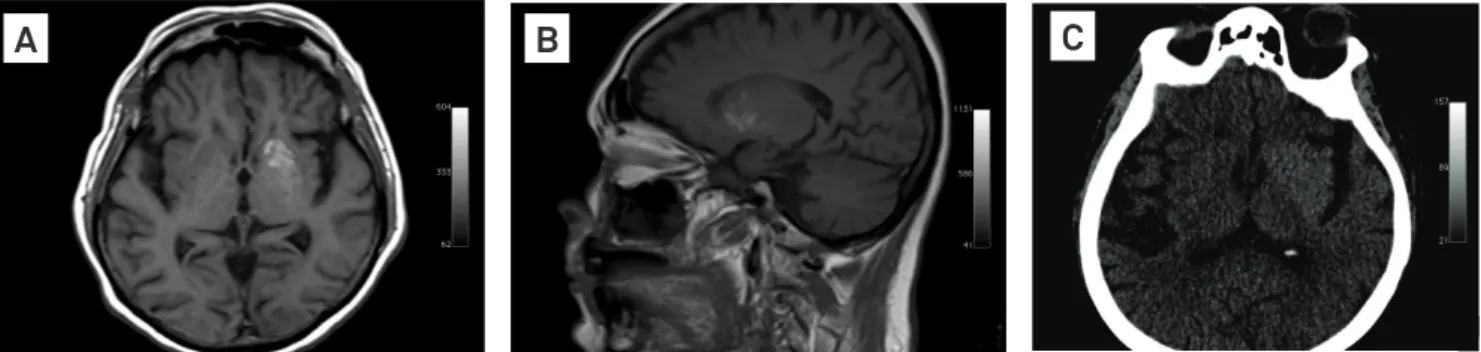
A 69-year-old woman was admitted for investigation of an acute-onset right hemichorea1. T1-weighted brain magnetic
res-onance imaging (MRI) showed hyperintensity in the left basal ganglia (Figs 1A and B). Although diabetic, she had no hyperg-lycemia. Interestingly, two weeks earlier, the patient was admit-ted due to nonketotic hyperglycemia. Brain compuadmit-ted tomog-raphy, previously reported as normal (Fig 1C), showed subtle
Delayed hemichorea syndrome
associated with nonketotic hyperglycemia
Síndrome de hemicoreia tardia associada ao estado hiperglicêmico não cetótico
Tiago Aguiar, Renata Nogueira, Rafael Vidon, Marcos Martins da Silva, Péricles Maranhão-Filho
Department of Neurology Clementino Fraga Filho Hospital from Federal University of Rio de Janeiro, Brazil.
Correspondence: Tiago Aguiar; Departamento de Neurologia, Hospital Universitário Clementino Fraga Filho/UFRJ; Avenida Brigadeiro Trompowiski s/n; 21941-590; Rio de Janeiro RJ - Brasil; E-mail: [email protected]
Conlict of interest: There is no conflict of interest to declare.
Received 8 January 2013; Received in final form 1 April 2013; Accepted 8 April 2013. 1. Postuma RB, Lang AE. Hemiballism: revisiting a classic disorder.
Lancet Neurol 2003;2:661-668.
2. Ahlskog JE, Nishino H, Evidente VG, et al. Persistent chorea triggered by hyperglycemic crisis in diabetics. Mov Disord 2001;16:890-898. References
hyperdensity in the left basal ganglia. However, there were no movement disorders. Choreic movements have been reported in patients with nonketotic hyperglycemia. Usually, dyskinesia and metabolic disturbance are concomitant. Rarely, as in this case, although pathophysiologically controversial, a delayed dys-kinesia is found, and this possibility should be considered when evaluating acute chorea in diabetic patients2.