Instituto de Cardiologia do Rio Grande do Sul/Fundação Universitária de Cardiologia.
Mailing address: Alexandre S. Quadros - Unidade de Pesquisa do IC/FUC - Av. Princesa Isabel, 395 - 90620-001 - Porto Alegre, RS, Brazil
E-mail: [email protected] English version by Stela Maris C. e Gandour
Arq Bras Cardiol, volume 80 (nº 5), 538-43, 2003
Alexandre Schaan de Quadros, Carlos A. M. Gottschall, Rogério Sarmento-Leite, Miguel Gus,
Rodrigo Wainstein, André Bussmann
Porto Alegre, RS - Brazil
Predictive Factors of Complications after Coronary Stent
Implantation
Percutaneous coronary interventions are currently the main technique for myocardial revascularization, and stents have been used in more than 70% of these procedures, redu-cing restenosis and in-hospital mortality 1-3. Based on the
last studies on coated stents and the perspective that reste-nosis should be drastically reduced 4, the occurrence or not
of complications and the clinical success of the procedure should become the major limitation of this technique. Although many randomized clinical assays have suggested the almost nonexistence of complications, data illustrating the so-called “real world” of clinical practice are not so encouraging. In the recently published dynamic NHLBI registry, the incidence of acute myocardial infarction remai-ned around 3%, of urgent surgery around 1.5%, of death around 2%, and overall success of the procedure around 92% 1.
However, few studies have analyzed the predictive fac-tors of complications after percutaneous procedures using only stents 5-12. Predictive models of complications based on
angioplasty studies may overestimate events when applied to a series of patients treated only with stents 5. Variations
in the populations studied and in the criteria of the definition of success and complications reduce the external validity of the studies available 13,14. Aiming at analyzing predictive
factors of complications in patients undergoing stent implan-tation, we carried out a consecutive cohort study with 1,018 patients undergoing 1,070 stent implantations at a referral hospital for interventional cardiology.
Methods
In the period from April 1996 to December 2000, 1,092 coronary stents were implanted in 1,030 patients. The pa-tients were prospectively included in an Access database, and clinical and angiographic characteristics were analy-zed, as were aspects related to stent implantation and in-hospital evolution. The incidence of major and minor car-diovascular complications related to the procedure was recorded, and the patients with intrastent restenosis, in
Objective – To analyze the predictive factors of com-plications after implantation of coronary stents in a con-secutive cohort study.
Methods – Clinical and angiographic characteris-tics related to the procedure were analyzed, and the inci-dence of major cardiovascular complications (myocar-dial infarction, urgent surgery, new angioplasty, death) in the in-hospital phase were recorded. Data were stored in an Access database and analyzed by using the SPSS 6.0 statistical program and a stepwise backwards multiple lo-gistic regression model.
Results – One thousand eighteen (mean age of 61±11 years, 29% females) patients underwent 1,070 stent implan-tations. The rate of angiographic success was 96.8%, the rate of clinical success was 91%, and the incidence of major cardiovascular complications was 7.9%. The variables independently associated with major cardiovascular com-plications, with their respective odds ratio (OR) were: rescue stent, OR = 5.1 (2.7-9.6); filamentary stent, OR = 4.5 (2.2-9.1); first-generation tubular stent, OR = 2.4 (1.2-4.6); multiple stents, OR = 3 (1.6-5.6); complexity of the lesion, OR = 2.4 (1.1-5.1); thrombus, OR = 2 (1.1-3.5).
Conclusion – The results stress the importance of angiographic variables and techniques in the risk of com-plications and draw attention to the influence of the stent’s design on the result of the procedure.
according to the TIMI classification 17, and the type of
ste-nosis was classified according to the American College of Cardiology modified criteria18. A thrombus was defined as
an intraluminal filling defect, an eccentric lesion when the stenosis was located in the middle of the supposed normal lumen in at least 1 projection. Vessel occlusion was defined as the appearance of total or subtotal stenosis within or in the margins of the stent with TIMI 0 or 1 flow. The use of high pressures was considered when the postdilatation of the prosthesis was performed with pressure > 14 ATM.
In regard to indication for stent implantation, it was considered elective when stent implantation was indicated before the procedure, suboptimal when patients were refer-red with nonocclusive dissections, residual lesions, or elas-tic removal, and rescue stent implantation when performed during an acute occlusion. The following stents were used: Tenax (Biotronik, Berlin, Germany), 271 implantations; Multilink (Guidant/Advanced Cardiovascular Systems, Santa Clara, California, USA), 260 implantations; Freedom (Global Therapeutics Inc, Cook Company, Broomfield CO, USA), 143 implantations; Vflex (Cook Group Inc, Broom-field, CO, USA), 105; NIR (Medinol Ltd., Tel Aviv, Israel), 77 implantations; AVE GFX (Arterial Vascular Engineering, Inc., Santa Rosa, California, USA), 73 implantations; BX Velocity (Cordis/Johnson & Johnson Interventional, Warren, New Jersey, USA), 60 implantations; Iris (Uni-Cath Inc, Saddle Brook, NJ, USA), 44 implantations; Jostent (Jomed AB, Helsinborg, Sweden), 11 implantations; Palmaz Schatz (Cordis/Johnson & Johnson Interventional, Warren, New Jersey, USA), 9 implantations; Angiostent (Angio Dy-namics, Glens Falls, NY, USA), 8 implantations; Tensum (Biotronik GmbH, Berlin, Germany), 5 implantations; Wall-stent (Schneider Europe, Lausanne, Switzerland), 1 implan-tation. In regard to the type of stent implanted, the sample was divided into 4 groups: filamentary(Freedom, angio-stent), first generation (Palmaz Schatz, Vflex, Iris, Jostent, Walstent, NIR, GFX), second generation(Multilink, BX Velocity), and coated with silicone carbonite (Tenax, Ten-sum). Aiming at assessing the influence of the institutional learning curve on the results, the sample was divided into quartiles and analyzed comparatively in relation to the presence of complications.
Categorical variables were presented as percentages, and the continuous variables were presented as mean ± standard deviation. The differences between the groups of categorical variables were analyzed with the chi-square test, and the differences between the groups of continuous variables were analyzed with the t test for independent samples. Significance levels < 0.05 were considered statisti-cally significant.
The variables related to clinical, angiographical, and procedural characteristics in the groups with and without complications were compared. The statistically significant variables were selected for inclusion in the stepwise back-wards multiple logistic regression model. The following 8 variables were included in the model 19: 1) clinical
presenta-cardiogenic shock, or not being clinically followed up were excluded. The sample analyzed comprised 1,070 stent im-plantations in 1,018 patients, of whom 46 received 2 stents and 3 received 3 stents.
The procedure of stent implantation was performed according to the recommendations in the literature 15,16. The
use of high pressures, type and number of the stents used, coronary angioplasty in another vessel, use of other devi-ces and of glycoprotein IIb/IIIa inhibitors were decided by the surgeons. Most patients were treated with platelet inhi-bition with acetylsalicylic acid and thienopyridines; in emergency cases, drugs were administered during or right after the procedure.
The following clinical findings were observed prior to the procedure: stableangina, defined as stability of the pat-tern of pain triggered in the last 2 months; unstable angina, defined as worsening of the intensity or frequency of the anginal pattern in the last 2 months prior to the procedure; angina of recent onset, defined as the presence of angina at rest or thoracic pain with enzymatic alterations with no elevation in the ST segment; acute myocardial infarction, in which case, the procedure was indicated when the patient was referred for mechanical recanalization of the artery rela-ted to the infarction in the presence of thoracic pain and elevation in the ST segment.
A successful procedure was defined as stent implan-tation in the most severe stenosis on angiography with a residual lesion < 30% and with no major cardiovascular com-plications. The following events were considered major car-diovascular complications: death, emergency myocardial revascularization surgery, acute myocardial infarction, and new angioplasty. Acute myocardial infarction as a compli-cation of the procedure was defined as the appearance of new Q waves with elevation in the ST segment or a 5-fold increase in the CPK-MB levels, or both. Myocardial revas-cularization surgery was defined as the need for urgent revascularization in patients with severe and refractory ischemia during the procedure. The deaths considered were those occurring at the hospital. New angioplasty was defi-ned as the need for new percutaneous revascularization in the vessel treated in the in-hospital phase or in the first month after the index intervention, due to subacute throm-bosis of the stent.
Uncomplicated dissections were defined as the appea-rance of a defect of linear filling < 10mm right after stent implantation with or without contrast medium retention, but with no significant impairment in coronary flow (maintenan-ce of TIMI 2 or 3 flow). Loss of branches was defined as the occlusion of branches larger than or equal to 2.0mm during or right after the procedure and the occurrence of vascular complications, such as the appearance of a hematoma > 5cm in the puncture site, the need for surgical exploration, or the appearance of a pseudoaneurysm.
tion, defined as presence or absence of acute myocardial infarction; 2) length of the lesion, in millimeters; 3) type of lesion, defined as a complex (B2/C) or simple (A/B1) lesion; 4) presence or absence of a thrombus; 5) indication of the procedure, defined as rescue stent or not; 6) type of stent: filamentary, first-generation tubular, last-generation tubu-lar, or stent coated with silicone carbonite; 7) residual steno-sis, presented as percentages; 8) use of a single stent or mul-tiple stents. The statistically significant variables are shown with their odds ratio, respective confidence interval, Wald statistics, B coefficient, and significance level.
Results
The patients’ mean age was 60 (±11) years, and 29% of them were females. Data referring to the presence of risk factors, previous acute myocardial infarction, previous percutaneous revascularization procedures, ventricular function, extension of arterial impairment, and clinical pre-sentation are shown in table I. Data referring to the angio-graphic characteristics, type of lesion treated, and characte-ristics of the lesion are shown in table II. Data referring to the procedure are shown in table III.
The rate of success and major and minor cardiovascu-lar complications are shown in table IV. The index of angio-graphic success was 96.8%, and the index of clinical suc-cess was 91%. Angiographic failure occurred in 3.2% of the cases (34 patients), and it was mainly due to residual steno-ses greater than 30% (2.2% of the casteno-ses, 24 patients); im-possibility of crossing the lesion, mal positioning, and loss of the prosthesis were less frequent (1% of the cases, 10 patients). The most frequent major cardiovascular
compli-cation was the need for a new angioplasty (4.8% of the ca-ses, 52 patients), mainly due to acute occlusion (34 patients) or subacute thrombosis (11 patients). Acute myocardial infarction occurred in 17 patients (1.6% of the cases), urgent surgery in 6 patients (0.6% of the cases), and death in 9 patients (0.8 % of the cases).
Comparison between the 2 groups in regard to their clinical characteristics is shown in table I. A statistically
Table I – Clinical characteristics of patients
All With No P
patients MCVC MCVC
Number of procedures 1070 84 986 Age (years) 60 ± 11 60 ± 11 60 ± 11 NS
Female sex (%) 29.3 34.5 28.8 NS
Arterial hypertension (%) 41.6 36.9 42 NS
Smoking (%) 26.1 22.6 26.4 NS
Familial history (%) 21.1 16.7 21.5 NS Dyslipidemia (%) 24.7 16.7 25.4 NS Diabetes mellitus (%) 26.3 32 25.8 NS
Previous MRS (%) 10.9 7.2 11.2 NS
Previous percutaneous
revascularization (%) 13.1 16.7 12.8 NS
Previous AMI (%) 15 8.3 15.5 NS
Ejection fraction (%) 65 ± 10 65 ± 10 65 ± 9 NS Number of vessels
impaired (%) NS
One 51.2 50 51.3
Two 35.3 40.5 34.9
Three 13.5 9.5 13.8
Clinical presentation (%) 0.003
Stable angina 24.7 26.2 24.6 Unstable angina 64.4 51.2 65.5
AMI 10.9 22.6 9.9
MCVC- major cardiovascular complications; MRS- myocardial revasculari-zation surgery; AMI- acute myocardial infarction; NS- non significant.
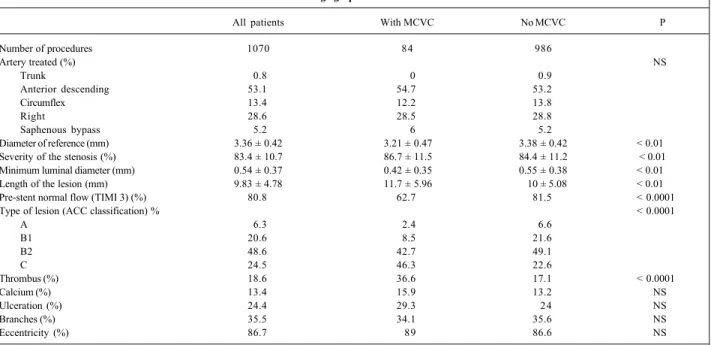
Table II - Angiographic characteristics
All patients With MCVC No MCVC P
Number of procedures 1070 84 986
Artery treated (%) NS
Trunk 0.8 0 0.9
Anterior descending 53.1 54.7 53.2
Circumflex 13.4 12.2 13.8
Right 28.6 28.5 28.8
Saphenous bypass 5.2 6 5.2
Diameter of reference (mm) 3.36 ± 0.42 3.21 ± 0.47 3.38 ± 0.42 < 0.01
Severity of the stenosis (%) 83.4 ± 10.7 86.7 ± 11.5 84.4 ± 11.2 < 0.01 Minimum luminal diameter (mm) 0.54 ± 0.37 0.42 ± 0.35 0.55 ± 0.38 < 0.01
Length of the lesion (mm) 9.83 ± 4.78 11.7 ± 5.96 10 ± 5.08 < 0.01
Pre-stent normal flow (TIMI 3) (%) 80.8 62.7 81.5 < 0.0001
Type of lesion (ACC classification) % < 0.0001
A 6.3 2.4 6.6
B1 20.6 8.5 21.6
B2 48.6 42.7 49.1
C 24.5 46.3 22.6
Thrombus (%) 18.6 36.6 17.1 < 0.0001
Calcium (%) 13.4 15.9 13.2 NS
Ulceration (%) 24.4 29.3 24 NS
Branches (%) 35.5 34.1 35.6 NS
Eccentricity (%) 86.7 89 86.6 NS
significant difference in regard to the clinical presentation of the patients was observed, mainly due to a greater number of patients treated for acute myocardial infarction in the group with major cardiovascular complications. The other variables analyzed showed no statistically significant diffe-rence between the 2 groups.
Comparison between the 2 groups in regard to the angiographic characteristics is shown in table II. The follo-wing findings were associated with the presence of major cardiovascular complications: smaller vessels, more severe stenoses, smaller luminal diameters, longer lesions, and more impaired arterial flow before the implantation. The group with major cardiovascular complications also had a significantly greater number of type C lesions and angiogra-phically evident thrombi than the group of patients with no complications.
Data in table III show that the group with major car-diovascular complications had a significantly greater num-ber of patients with acute occlusions after coronary angioplasty prior to stent implantation, while, in the group with no complications, the patients referred for elective stent implantation prevailed. In regard to the type of stent, the patients with complications were more frequently treated with filamentary or first-generation tubular stents, while those with no complications received more last-generation tubular stents or those coated with silicone carbonite. The group with major cardiovascular complica-tions received longer stents, smaller balloons, remained with greater residual stenoses and smaller final luminal dia-meter, and, in addition, in that group, the use of multiple stents was also more frequent.
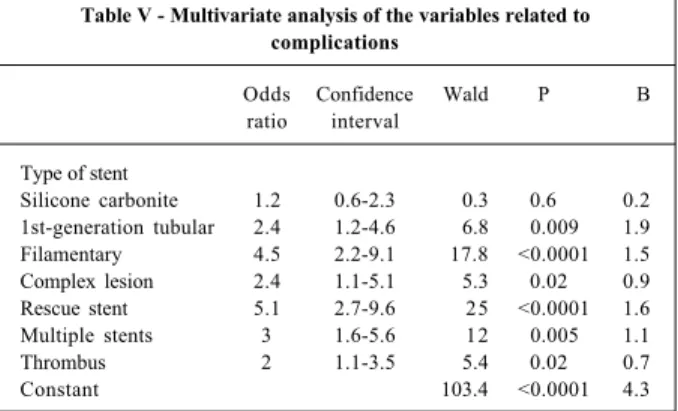
The stepwise backwards multiple logistic regression model was used in univariate analysis with the following 8 statistically significant variables: acute myocardial infarc-tion, length of the lesion, complexity of the lesion, presence of a thrombus, rescue stent, type of stent, residual stenosis, and use of multiple stents (tab. V). The variables most stron-gly associated with major cardiovascular complications were the implantation of a rescue stent and the type of stent used (filamentary or first-generation tubular stent). Implan-tation of multiple stents in the same procedure, complexity of the lesion, and the presence of a thrombus were also sta-tistically significant. The degree of residual stenosis, stent implantation in the presence of acute myocardial infarction, and the length of the stent were not independently associa-ted with major cardiovascular complications, although they were statistically significant in the univariate analysis.
Table III – Characteristics of the procedure
All patients With MCVC No MCVC P
Number of procedures 1070 84 986
Indication (%) < 0.0001
Elective 58.2 36.9 60.1
Provisional 34.6 36.9 34.5
Rescue 7.1 26.2 5.5
Type of stent (%) 0.006
Filamentary 14.1 25 13.2
First-generation tubular 22.9 29.8 22.3
Last-generation tubular 36.8 26.2 37.7
Silicone carbonite 25.8 19 26.4
Ostial lesion (%) 2.1 2.4 2 NS
Length of the stent (mm) 16.5 ± 4.81 18 ± 5.64 16.5 ± 4.82 < 0.05
Pressure used (ATM) 13.1 ± 2.81 13.1 ± 3.22 13.1 ± 2.77 NS
Diameter of the balloon (mm) 3.37 ± 0.37 3.24 ± 0.41 3.38 ± 0.37 < 0.05
Residual stenosis (%) 1.8± 15 19 ± 35 0.4 ± 11 < 0.0001
Final luminal diameter (mm) 3.3 ± 0.53 2.7 ± 1.1 3.3 ± 0.4 < 0.0001
Glycoprotein inhibitor (%) 3.2 4.2 3.1 NS
Multiple stents (%) 10.1 23.2 8.9 < 0.0001
Learning curve (%) NS
1st quartile 37.2 24.2
2nd quartile 21.7 26.6
3rd quartile 23.5 27.9
4th quartile 19.3 23.4
Angioplasty associated (%) 10.3 15.5 9.8 NS
MCVC- major cardiovascular complications; NS- nonsignificant; mm- millimeters; ATM- atmospheres.
Table IV - Results of the procedure
Failure 34 (3.2%)
Did not cross the lesion 2 (0.2%)
Mal positioning 5 (0.5%)
Loss of the prosthesis 3 (0.3%) Residual stenosis > 30% 24 (2.2%)
Major complications 84 (7.9%)
New angioplasty in the first month 52 (4.8%)
AMI 17 (1.6%)
Urgent surgery 6 (0.6%)
Death 9 (0.8%)
Minor complications 77 (7.2%)
Dissections 47 (4.4%)
Vascular complications 8 (0.7%)
Loss of the branch 22 (2.1%)
Angiographic success 96.8%
Table V - Multivariate analysis of the variables related to complications
Odds Confidence Wald P B ratio interval
Type of stent
Silicone carbonite 1.2 0.6-2.3 0.3 <0.6 0.2 1st-generation tubular 2.4 1.2-4.6 6.8 <0.009 1.9 Filamentary 4.5 2.2-9.1 17.8 <0.0001 1.5 Complex lesion 2.4 1.1-5.1 5.3 <0.02 0.9 Rescue stent 5.1 2.7-9.6 25 <0.0001 1.6 Multiple stents 3 1.6-5.6 12 <0.005 1.1 Thrombus 2 1.1-3.5 5.4 <0.02 0.7
Constant 103.4 <0.0001 4.3
with antiproliferating drugs may lead to greater flexibility in the models and designs of the prostheses.
The use of stents to rescue acute occlusions of angio-plasty was the variable associated with a greater risk of major cardiovascular complications, with an odds ratio of 5.1 (CI: 2.7-9.6) compatible with data reported in the literature 23,24.
The use of multiple stents was also associated with a greater risk, probably due to the larger metallic surface, and also to their overlapping 10,11.
The complexity of the lesion has traditionally been one of the factors most frequently associated with major cardio-vascular complications in most studies analyzing predictive factors of complications after coronary angioplasty 6,9,20;
however, its importance has been questioned when the pro-cedure involves stent placement 12. The complexity of the
lesion was one of the variables independently associated with complications in the studies by Moscucci et al 6 and by
Holmes et al 5, but not in the study by Schünlen et al 11. In our
study, the patients with complex lesions had a 2.4-times greater risk of complications (CI: 1.1-5.1).
Although the procedure performed in the presence of acute myocardial infarction was statistically significant in the univariate analysis, it was not independently associated with the occurrence of major cardiovascular complications, con-trary to findings in most previous studies 6,7,9,11. The reasons
for this finding are not clear, although the concomitance of patients with acute myocardial infarction, thrombus, and rescue conditions may have influenced the model. Residual stenosis and length of the lesion, although significant in uni-variate analysis, were not significant in the final model. Like-wise, age and left ventricular dysfunction were not also asso-ciated with complications, even in a univariate analysis.
The index of clinical success in this study is compara-ble to those in several previous studies, considering the differences in the criteria of success and major cardiovascu-lar complications used (in our study, the need for a new per-cutaneous intervention in the in-hospital phase or in the first month due to subacute thrombosis was considered a major complication) 1,5,11,25,26. Some randomized clinical
assays have reported rates of success of up to 99%, but in groups of patients at very low risk, excluding ongoing acute myocardial infarction and patients with unfavorable angio-graphic criteria 21.
Major cardiovascular complications occurred in 7.9% of our patients, with the incidence of acute myocardial infarction, urgent surgery, and death similar to those repor-ted in the literature. The high incidence of acute occlusions (3.1% of the patients) may be attributed to the high frequen-cy of acute occlusions in coronary angioplasty and the large number of patients with ongoing acute myocardial infarction. Seventy-one patients (7.1% of the total) (tab. III) were treated for acute occlusions during angioplasty, and, in that subgroup, the possibility of a patient remaining in acute occlusion was 7 times greater than the risk of an elec-tive patient presenting with that problem, a finding compa-tible with data reported in the literature 11,20.
Discussion
The patients studied comprised a representative sam-ple of a tertiary referral center exclusively dedicated to pa-tients with cardiac diseases. These data may help in asses-sing the risk of complications in patients undergoing stent implantation in conditions similar to those reported. In this study analyzing 1,070 implantations of coronary endopros-theses in 1,018 consecutive patients, the major predictors of cardiovascular complications were the type of stent used (filamentary or first generation), implantation of rescue stents, complexity of the lesion, presence of a thrombus, and use of multiple stents in the same procedure.
The type of stent implanted, the major finding in this study, was one of the major variables independently associa-ted with major cardiovascular complications, a result that had not been previously reported in studies specifically designed for the analysis of complications 5,6,11,20. Holmes et al 5,
analyzing 3,761 patients undergoing stent implantation, observed that the New York State model of risk prediction was the major predictive factor of complications; however, the types of stents used were not reported 5. Schünlen et al 11
studied 2,444 patients and identified several clinical and angiographic characteristics (mainly residual dissections and the lack of the use of ticlopidine) associated with com-plications, but not with the type of stent. Likewise, in the studies by Moscucci et al 6 and Kastrati et al 20, the type of
stent was also not associated with complications. On the other hand, results from some observational studies have shown up to 2-fold variations in the incidence of complica-tions with the use of different types of stents 21. Our data
showed a 4.5-fold risk of complication (CI: 2.2-9.1) greater with filamentary stents, and a 2.4-fold risk of complication (CI: 1.2-4.6) greater with first-generation tubular stents. These findings are in accordance with those of previous studies showing a weaker radial strength of filamentary stents and the possibility of a greater prolapse of the plate between their rods, allowing greater residual stenoses and a greater thrombogenic substrate 22. Although these models
References
1. Wiliams DO, Holubkov R, Yeh W, et al. Percutaneous coronary intervention in the current era compared with 1985-1986. The National Heart, Lung, and Blood Institute Registries. Circulation 2000;102; 2945-51.
2. Rankin JM, Spinelli JJ, Carere RG, et al. Improved clinical outcome after widespread use of coronary-artery stenting in Canada. N Engl J Med 1999; 341: 1957-65. 3. Kimmel SE, Localio AR, Krone RJ, et al. The effects of contemporary use of
coronary Stents on in-hospital mortality. Registry Committee of the Society for Cardiac Angiography and Interventions. J Am Coll Cardiol 2001; 37: 499-504. 4. Souza JE, Costa MA, Abizaid A, et al. Sustained supression of neointimal proli-feration by sirolimus-eluting Stents: one-year angiographic and intravascular ultrasound follow-up. Circulation 2001; 104: 2007-11.
5. Holmes DR, Berger PB, Garratt KN, et al. Application of the New York State PTCA mortality model in patients undergoing stent implantation. Circulation 2000; 102: 517-22.
6. Moscucci M, Kline-Rogers E, Share D, et al. Simple bedside additive tool for prediction of in-hospital mortality after percutaneous coronary interventions. Circulation 2001; 104: 262-8.
7. O´Connor GT, Malenka DJ, Quinton H, et al., for the Northern New England Car-diovascular Disease Study Group. Multivariate prediction of in-hospital morta-lity after percutaneous coronary interventions in 1994-1996. J Am Coll Cardiol 1999; 34: 681-91.
8. Ellis SG, Weintraub W, Holmes D, Shaw R, Block PC, King 3rd SB. Relation of
operator volume and experience to procedural outcome of percutaneous coronary revascularization at hospitals with high interventional volumes. Circulation 1997; 96: 2479-84.
9. Moscucci M, O´Connor GT, Ellis SG, et al. Validation of risk adjustment models for in-hospital percutaneous transluminal coronary angioplasty mortality on an independent data set. J Am Coll Cardiol 1999; 34: 692-7.
10. Ellis SG, Buetta B, Miller D, Whitlow PL, Topol EJ. Relation between lesion cha-racteristics and risk with percutaneous intervention in the stent and glycopro-tein Iib/IIIa era: an analysis of results from 10907 lesions and proposal for new classification scheme. Circulation 1999; 100: 1971-6.
11. Schünlen H, Kastrati A, Dirschinger J, et al. Intracoronary stenting and risk for ma-jor adverse cardiac events during the first month. Circulation 1998; 98: 104-11. 12. Maier W, Mini O, Antoni J, Wischnewsky MB, Meier B. ABC stenosis
morpho-logy classification and outcome of coronary angioplasty. Circulation 2001; 103: 1225-31.
13. Lindsay J, Pinnow EE, Popma JJ, Pichard AD. Obstacles to outcomes analysis in percutaneous transluminal coronary revascularization. Am J Cardiol 1995; 76: 168-72.
14. Block PC, Peterson EC, Krone R, et al. Identification of variables needed to risk adjust outcomes of coronary interventions: evidence-based guidelines for effi-cient data collection. J Am Coll Cardiol 1998; 32: 275-82.
15. Holmes DR, Hirshfield J, Faxon D, et al. ACC Expert Consensus Document on Coronary Artery Stents. Document of the American College of Cardiology. J Am Coll Cardiol 1998; 32: 1471-82.
16. Carrozza JP, Baim DS. Coronary stenting. In: Baim DS, Grossman W, eds. Gross-man´s Cardiac Catheterization, Angiography, and Intervention. 6a ed.
Philadel-phia, EUA: Lippincott Wiliams & Wilkins, 2000: 637-66.
17. The TIMI Study Group. The Thrombolysis in myocardial infarction (TIMI) trial: Phase I findings. N Engl J Med 1985; 312: 932-6.
18. Baim DS. Coronary angioplasty. In: Baim DS, Grossman W, eds. Grossman´s Cardiac Catheterization, Angiography, and Intervention. 6a ed. Philadelphia,
EUA: Lippincott Wiliams & Wilkins, 2000: 547-600.
19. Concato J, Feinstein AR, Holford TR. The risk of determining risk with multiva-riable models. Ann Intern Med 1993; 118: 201-10.
20. Kastrati A, Schömig A, Elezi S, et al. Prognostic value of the modified American College of Cardiology/American Heart Association stenosis morphology clas-sification for long-term angiographic and clinical outcome after coronary stent placement. Circulation 1999; 100: 1285-90.
21. Kastrati A, Dirschinger J, Boekstegers P, et al. Influence of stent design on 1-year outcome after coronary stent placement: a randomized comparison of five stent types in 1147 unselected patients. Catheter Cardiovasc Interv 2000; 50: 290-7. 22. Lansky A, Roubin G, O´Shaughnessy CD, et al. Randomized comparison of GR-II stent and Palmaz-Schatz stent for elective treatment of coronary stenoses. Circulation 2000; 102: 1364-8.
23. Schömig A, Kastrati A, Mudra H, et al. Four-year experience with Palmaz-Schatz stenting in coronary angioplasty complicated by dissection with threatened or present vessel closure. Circulation 1994; 90: 2716-24.
24. Sutton JM, Ellis SG, Roubin GS, et al. Major clinical events after coronary sten-ting. The multicenter registry of acute and elective Gianturco-Roubin stent pla-cement. The Gianturco- Roubin Intracoronary Stent Investigator Group. Circu-lation 1994; 89: 1126-37.
25. Mattos LA, Pinto I, Abizaid A, et al. Safety and efficacy of coronary stent implan-tation. Acute and six month outcomes of 1126 consecutive patients treated in 1996 and 1997. Arq Bras Cardiol 1999; 73: 30-6.
26. Kastrati A, Schömig A, Dirschinger J, et al. Increased risk of restenosis after placement of coated stents: results of a randomized trial compring gold-coated with ungold-coated steel stents in patients with coronary artery disease. Circu-lation 2000; 101: 2478-83.
This study was initiated in 1996, including filamentary and first-generation stents. The evolution of the techni-ques of implantation and the most frequent use of glycopro-tein IIb/IIIa inhibitors may have limited the extrapolation of the results. Although the patients were prospectively inclu-ded, the data analysis was retrospective, which could also introduce bias in assessing the study. Although the clinical characteristics played no significant role as determinants of in-hospital complications, they are well-known important predictors of a long-term prognosis.
In conclusion,the major finding of this study was that the type of stent, filamentary or first generation, contributes as one of the factors most strongly associated with the
occurrence of major cardiovascular complications after im-plantation. Other variables statistically associated with major cardiovascular complications in the multiple logistic regression model were rescue stents, use of multiple stents, complexity of the lesion, and the presence of a thrombus prior to implantation. These results emphasize the impor-tance of angiographic variables and techniques in the risk of complications and draw attention to the influence of the stent’s design on the result of the procedure.