journal homepage: www.scielo.br/ne ISSN: 1519-566X
ECOLOGY, BEHAVIOR AND BIONOMICS
Feeding Pa
Ʃ
erns of the Aqua
Ɵ
c Grasshopper
Cornops aqua
Ɵ
cum
(Bruner)
(Orthoptera: Acrididae) in the Middle Paraná River, Argen
Ɵ
na
S C
Ö½½Ê
1, ML
W
ùÝ®»®
2, M M
Ù«Ý
1,31InsƟ tuto Nacional de Limnología (INALI-CONICET-UNL), Santa Fe, ArgenƟ na
2Centro de Estudios Parasitológicos y de Vectores (CEPAVE) (CCT-La Plata- CONICET- UNLP), La Plata, ArgenƟ na 3Facultad de Humanidades y Ciencias-UNL, Santa Fe, ArgenƟ na
Keywords
Diet composiƟ on, dairy consumpƟ on rate, nutriƟ onal index
Correspondence
Sʽ CÖ½½Ê, Instituto Nacional de Limnología (INALI-CONICET-UNL), Ciudad Universitaria, 3000, Santa Fe, Argentina; [email protected]
Edited by Angelo Pallini – UFV
Received 10 December 2009 and accepted 27 August 2010
Abstract
The aquatic grasshopper Cornops aquaticum (Bruner) is native to South America and inhabits lowlands from southern Mexico to Central Argentina and Uruguay. This grasshopper is host-speci ic to aquatic plants of the genera Eichhornia and Pontederia. The objectives of this study were to analyze the feeding patterns of the aquatic grasshopper C. aquaticum in relationship to development stages and sex and to determine the food consumption rate in their host plant, Eichhornia crassipes. Samples were collected from April 2006 to May 2007 in different loodplain lakes of the Middle Parana River. The average consumption was greater in the females (0.127 g food/day ± 0.051) than in the males (0.060 g food/day ± 0.025). The feces of 361 nymphs and adults of this locust were examined and the most common tissue fragments found were of the water hyacinth (E. crassipes). In the initial nymphal stages (I, II and III), an exclusive consumption of E. crassipes was registered, while in the IV and V stages the choice included also other macrophytes. In summary, C. aquaticum presents polyphagy in the ield, feeding on six macrophytes of different classes and families.
Introducti on
The diet breadth of grasshoppers varies from strict monophagy to extreme polyphagy. Between these extremes there are species exhibiting varying degrees of selectivity of the food they eat. The essential difference among polyphagous, oligophagous and monophagous species is one of sensitivity to deterrents (Bernays & Chapman 1994). Isely (1944) showed that grasshoppers are conveniently classi ied as grass-feeders (graminivorous), forb-feeders (forbivorous), or a mix of the two (ambivorous or mixed feeders). Joern (1986) pointed out that the most oligophagous species are grass feeders, while monophagous- and polyphagous species are forb-feeders. Forbs are generally considered a higher
quality food than grasses for most herbivores because of their higher nitrogen, phosphorus and sugar contents (Randolph et al 1995).
The feeding patterns of nymphs and adults of a given species of grasshopper are similar, and vary according to seasonal changes in the availability and quality of food (Gangwere 1961), and the processes of learning (Bernays & Bright 1991). The aquatic grasshopper
Cornops aquaticum (Bruner) is native to South America
this grasshopper depends on the mandible type and it is classi ied as parenchyma-forbivorous because this acrids eats the parenchyma of plants with wide leaves.
Very little is known concerning the Orthoptera species that inhabit moist or wet environments because usually such species do not become pests. Nevertheless, C.
aquaticum could have potential use for biological control
of the water hyacinth, Eichhorniacrassipes weed, and is planned to be released in South Africa for this purpose (Oberholzer & Hill 2001). This macrophyte is considered the world’s most important aquatic weed (Center 1994, Wright & Purcell 1995) because it invades aquatic ecosystems on almost every continent, reproducing rapidly, dispersing easily, displacing indigenous loras, and causing problems in reservoirs, isheries, irrigation schemes, and transportation routes (Timmer & Weldon 1967, Mitchell & Thomas 1972, Gopal 1987, Ogwang & Molo 2004).
The objectives of this study were to analyze the feeding patterns of the aquatic grasshopper C. aquaticum in relationship to development stages and sex and to determine the food consumption rate in their host plant,
E. crassipes.
Material and Methods
Study sites
Samples were collected from April 2006 to May 2007 in different loodplain lakes of the Middle Paraná River. The selected sites differed in their degree of connectivity with the main channel, being lakes either connected permanently (31°38’ 43.77” S; 60°34’ 35.07” O), or temporarily to the Paraná River (31°40’ 14.40” S; 60°34’ 44.43” O).
The vegetation of these lakes is associated directly with the hydrological regime of the Paraná River, because the species richness varies according to the level of water (Sabattini & Lallana 2007). In spite of the differences in connectivity of the lakes, in both sites the most important macrophytes were the same: E. crassipes, Paspalum repens, Salvinia herzogii, Pistia stratiotes, Ludwigia
peploides, Echinochloa sp. and Polygonum sp.
ConsumpƟ on rate
Cornops aquaticum adult grasshoppers were collected
with entomological nets in the spring (November) of 2007. Thirty grasshoppers of each sex were transported to the laboratory to determine their consumption rate of the host plant E. crassipes. After 2h of fasting, the grasshoppers were weighed and placed individually in vials with E. crassipes leaves. After 24h, the grasshoppers, the food remaining and the feces were oven-dried (at 60ºC for 72h or constant mass) and weighed in an OHAUS
balance (accuracy of 10-5 g).
The biomass gained and the food consumed were calculated from the difference between the initial and the inal dry weights. The initial dry weight of the grasshoppers and the leaves were derived from the fresh weight and a conversion factor, which was obtained by dividing the product of the dry weight/fresh weight of 10 grasshoppers of each sex and 50 leaves of water hyacinth with the same characteristics of those used in the experiments (Pereyra 1995).
The consumption rate, growth and feeding ef iciency were calculated using the following nutritional indexes (Pereyra et al 1996): i) rate of relative consumption: ingested food/mean dry weight of individual/day, ii) rate of relative growth: biomass gained/mean dry weight of individual/day, and iii) ef iciency of ingested food conversion: (gained biomass/ingested food) x 100.
Diet composiƟ on
The diet composition of C. aquaticum was determined by microanalysis of the feces under an optical microscope (400x) according to Arriaga (1981, 1986). Individuals (152 nymphs and 209 adults) were sampled fortnightly with an entomological net from 2006-2007. Each individual collected was immediately placed in a paper tube for a period of 24h and the feces collected, clari ied with 10% potassium hydroxide (KOH) and mounted on a slide. Twenty microscope ields were randomly selected for each sample (feces of one individual) where at least one epidermic tissue piece was present (Sheldon & Roger 1978).
The anatomy of leaves of all the macrophytes recorded in the floodplain lakes was previously analyzed. The epidermal tissues were identified based on cellular characteristics (epidermal cells, stomata, trichomes or hairs, etc) and photographs were taken under the optical microscope. The vegetal tissues observed in the feces of C. aquaticum were compared with these reference collections to identify the plant species consumed.
Frequency of occurrence was calculated for each food item present based on the number of ields containing this particular food item.
StaƟ sƟ cal analysis
The data collected were grouped among four seasons (autumn, winter, spring and summer) to conduct statistical analyses. Factorial design (2k) was used to
Results
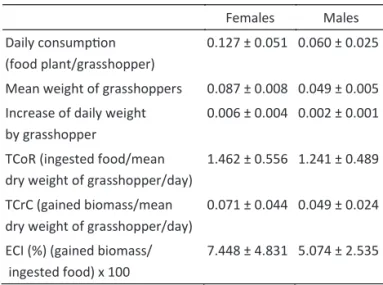
The daily consumption was higher for females (0.127 g food/day ± 0.051) than for males (0.060 g food/day ± 0.025). An average consumption of 0.093 g food/day was noted for adults of both sexes.
The female adults presented high values in all nutritional indexes in comparison with the male adults. The relative consumption rate average, relative growth rate and ingested food conversion ef iciency obtained for
C. aquaticum are shown in Table 1.
The feces of 361 grasshoppers were examined (152 nymphs and 209 adults), and plant tissues of six species were identi ied. The most common tissue fragments found in the feces were of the water hyacinth, representing 90.4% of all samples. Others plant species consumed were P. repens (3.6%), L. peploides (3.6%), Panicum sp.,
Polygonum sp. and one unidenti ied grass (2.4%). The
epidermal structures (epidermal cells, stomas, trichomes or hairs) of the three most consumed plants are shown in Fig 1.
A total of 298 individuals consumed exclusively E.
crassipes, 52 individuals, E. crassipes and other plants
and 11 non-E. crassipes host plants.
In the initial nymphal stages (I, II and III, n = 51), only
E. crassipes was consumed, while in the stages IV and V
(n = 86) other macrophytes were also consumed (mainly
L. peploides and P. repens). The proportion of non-E.
crassipes host plants in the diet was greatest in stage VI
(n = 15), reaching 40%. The adults’ diet composition was dominated by E. crassipes, reaching77.6% in the female individuals (n = 94) and 81.7% in the male individuals feces (n = 115).
The amplitude of diet of C. aquaticum is different according to the development state, being the adult females those that present greater niche breadth, consuming the six plants registered in feces (Fig 2)
There were no signi icant differences between the
botanical composition and the stages of development (P = 0.955) and sex (P = 0.251) of C. aquaticum, demonstrating that the election of the nutritional items depends neither on the stage of development nor on the sex of the grasshoppers (Table 2).
Discussion
The daily consumption by individual in C. aquaticum was greater in females than in males. Similar results available when the daily consumption of aquatic (Amorim & Adis 1994) and terrestrial grasshoppers were evaluated (Gangwere 1959, de Wysiecki 1986, Sánchez & de Wysiecki 1990, Mariottini 2009). In coincidence with Lockwood et al (1996), females consume greater amounts of food than males because they have higher protein demands for egg production.
When E. crassipes was the host plant, the relative consumption rate of C. aquaticum populations of the
Table 1 Nutritional indexes of aquatic grasshopper Cornops aquaticum. Data expressed in grams.
Females Males
Daily consump on (food plant/grasshopper)
0.127 ± 0.051 0.060 ± 0.025
Mean weight of grasshoppers 0.087 ± 0.008 0.049 ± 0.005
Increase of daily weight by grasshopper
0.006 ± 0.004 0.002 ± 0.001
TCoR (ingested food/mean dry weight of grasshopper/day)
1.462 ± 0.556 1.241 ± 0.489
TCrC (gained biomass/mean dry weight of grasshopper/day)
0.071 ± 0.044 0.049 ± 0.024
ECI (%) (gained biomass/ ingested food) x 100
7.448 ± 4.831 5.074 ± 2.535
Fig 1 The epidermal structures of the plants more consumed for Cornops aquaticum. The photographies were taken under optical microscope (400x). A: Eichhornia crassipes, B: Paspalum repens and C: Ludwigia peploides. S: stoma. EC: epidemical cell. T: trichoma.
a
S
S
S
EC EC
Central Amazonia was 0.9 g food/g individual/day, and the individual consumption per day was 0.0522 g in males and 0.0837 g in females (Adis & Junk 2003), recording slightly higher values than in our study. Amorim & Adis (1994) reported a lower relative consumption rate of adult males (0.135 g food/g individual/day) and adult females (0.229 g food/g individual/day) of the semiaquatic grasshopper Stenacris ϔissicauda ϔissicauda (Bruner) compared to that of C. aquaticum. Thus, the consumption capacityof C. aquaticum was greater when considering that the dry weight of C. aquaticum is greater than that of S.ϔissicauda ϔissicauda.
Comparing the relative consumption rate obtained, the aquatic grasshopper C. aquaticum consumes a larger amount of food than the terrestrial S.ϔissicauda ϔissicauda
and Dichroplus pratensis Bruner (Pereyra et al 1996). By
coincidence, Cyr & Pace (1993) reported that aquatic herbivores consumed greater quantities of biomass than their terrestrial counterparts.
The ef iciency of C. aquaticum to convert the ingested
food was higher in females than in males, concurring with the results obtained by Sánchez & de Wysiecki (1990) and de Wysiecki & Sánchez (1992) for D.
pratensis.
Fragments of E. crassipes tissues were observed in more than 90% of the diet composition of C. aquaticum. Coincidentally, Ferreira & Vasconcellos Neto (2001) also found that 90% of what is consumed by this grasshopper in Brazil is represented by Pontederiacea. There are several reports of the high speci icity of C. aquaticum with different genera of the family Pontederiaceae (Silveira Guido & Perkins 1975, Medeiros 1984, Vieira & dos Santos 2003, Lhano et al 2005). This relationship may be caused by three different reasons: 1) the water hyacinth is the macrophyte dominant in the Middle Paraná River (Marta 1977, Bayo et al 1981); 2) the very low amount of deterrentes substances and 3) high concentrations of nitrogen; and 4) the adequate petiole structure (abundant aerenchyimatic tissue), allowing optimal conditions for the development of eggs (endophytic oviposition) (Boeger & Adis 2007)
Early instars (I, II and III) of C. aquaticum consumed water hyacinth leaves exclusively. This inding agrees with that reported by Sword & Dopman (1999) for
Schistocerca lineate (Scudder), which represent a
more extreme situation in which the early stages are monophagous. However, the later instars and adults become polyphagous. The greater variety of mixed foregut contents in later instars might also suggest their greater mobility (Bernays & Chapman 1994). In contrast, early instars of Chorthippus parallelus (Zetterstedt) were observed to feed frequently on three or four of the grass species, suggesting that they require a wider range of grass species (Bernays & Bright 2001).
Bennett (1971, 1974) and Carbonell (1981) demonstrated that C. aquaticum could eat another variety of aquatic plant (Commelina sp.), but their life cycle is associated with Eichhornia because other vegetal species were unsuitable for their endophytic oviposition.
In an experimental study on feeding habits of C.
aquaticum, the acceptance of six aquatic macrophytes
species was detected, indicating that these plants can represent alternative resources, but are not essential for the development of the species (Vieira & dos Santos 2003). Ludwigia sp. and P. repens are the only plants found in this study, what con irms that the feeding pattern of an herbivore insect in its natural environment would differ from the laboratory conditions, as suggested elsewhere (Bernays & Lewis 1986, Bernays & Simpson 1990, Bernays & Chapman 1994).
The speci icityof C. aquaticum on E. crassipes has been determined for populations of the Pantanal wetlands in Brazil (Lhano et al 2005), but those in South Africa also feed on cultivated plants such as Canna indica and Musa
paradisiaca (Oberholzer & Hill 2001).
Fig 2 Frequency of occurrence of the different aquatic plants consumed by Cornops aquaticum in the different development stages.
Tests of the effects inter-subjects
Dependent variable: Eichhornia crassipes
Origin Sum of square
type III gl
Quadra c
mean F P
Model 11.013a 4 2.753 28.415 .000
Sex .131 1 .131 1.355 .251
Stage .000 1 .000 .003 .955
Sex * stage .160 1 .160 1.654 .206
Error 3.973 41 .097
Total 14.986 45
a. R squared = .735 (R squared corrected = .709)
Table 2 Results obtained of the factorial design (2k)
realized to Cornops aquaticum according to sex and stage
of development.
0 10 20 30 40 50 60 70 80 90 100
I II III IV V VI Female Male
Frequency of occurrence (%)
Eichhornia crassipes Ludwigia peploides Paspalum repens Panicum sp. Polygonum sp. Uniden fied grass
An important preference for monocotyledonous plants (approximately 95%) was observed in the diet composition of C. aquaticum through the whole year in contrast to that revealed by Chapman (1990) that the polyphagous herbivores consume greater proportions of dicotyledons.
In summary, C. aquaticum presents polyphagy in the ield, feeding on six different species of macrophytes of various classes and families(monocotyledonous: Pontederiaceae and Poaceae; dicotyledonous: Onagraceae and Polygonaceae). Although C. aquaticum is considered speci ic to the genus Eichhornia, this grasshopper also feeds on other plant species in the laboratory and in the ield. Its acceptance of several plant species in the absence of the preferred host plant could indicate that it is the host plant’s relative abundance in the ield that determines the
C. aquaticum diet breadth.
Acknowledgements
The authors dedicate this work in memory to Dr Joachim Adis. We thank to Language Edit by the revision of our manuscript and especially thanks to the Department of Mathematical of the Faculty of Biochemistry and Biological Science (FBCB - UNL) for help in data analysis. This study was inanced in part by a Grant of Orthopterist´s Society and CONICET.
References
Adis J, Bustorf E, Lhano MG, Amedegnato C, Nunes AL (2007) Distribution of Cornops grasshoppers (Leptysminae: Acrididae: Orthoptera) in Latin America and the Caribbean Islands Stud Neotrop Fauna Environ 42: 11-24.
Adis J, Junk WJ (2003) Feeding impact and bionomics of the grasshopper Cornops aquaticum on the water hyacinth Eichhornia crassipes in Central Amazonian loodplains. Stud Neotrop Fauna Environ 38: 245-249.
Adis J, Victoria RL (2001) C3 or C4 macrophytes: a speci ic carbon source for the development of semi-aquatic and terrestrial arthropods in Central Amazonian river- loodplains to d13C values. Iso Environ Healt S 37: 193-198.
Amorim MA, Adis J (1994) Consumo de alimento por um gafanhoto neotropical, Stenacris ϔissicauda ϔissicauda (Bruner, 1908) Orthoptera: Acrididae) da várzea Amazônica. Acta Amazonica 24: 289-302.
Arriaga MO (1981) El uso de caracteres histofoliares en el estudio de hábitos alimentarios de Acridiidae I. Physis Secc C 39: 61-74.
Arriaga MO (1986) Metodología adaptada al estudio de hábitos alimentarios en insectos herbívoros. Comunicaciones del Museo Argentino de Ciencias Naturales “Bernardino Rivadavia” Botánica 2: 103-111.
Bayo V, Lallana V, Lorenzatti E, Marta MC (1981) Evaluación cuantitativa de la vegetación acuática en islas del valle aluvial del río Paraná medio. Ecología 6: 67-72.
Bennett FD (1971) Current status of biological control of the small moth borers of sugar cane Diatraea spp. (Lep: Pyralidae). Entomophaga 16: 111-124.
Bennett FD (1974) Biological control, p.99-106. In Mitchell DS (ed) Aquatic vegetation and its use and control, Paris, Unesco, 135p. Bernays A, Chapman R (1994) Behavior: The process of host-plant
selection, p.95-205. In Bernays A, Chapman R (eds) Host-plant selection by phytophagous insects, New York, Springer, 312p. Bernays EA, Bright KL (1991) Dietary mixing in grasshoppers:
switching induced by nutritional imbalances in foods. Entomol Exp Appl 61: 247-253.
Bernays EA, Bright KL (2001) Food choice causes interrupted feeding in the generalist grasshopper Schistocerca americana: further evidence for inef icient decision-making. J Insect Physiol 47: 63-71.
Bernays EA, Lewis A C (1986) The effects of wilting of palatability of plants to Schistocerca gregaria, the desert locust. Oecologia 70: 132-135.
Bernays EA, Simpson SJ (1990) Nutrition, p.105-128. In Chapman RF, Joern A (eds) Biology of grasshoppers. New York City, John Wiley and Sons, 563p.
Boeger R, Adis J (2007) Anatomia de cinco espécies de macró itas aquáticas e sua impôrtancia para Cornops aquaticum (Orthoptera: Acrididae: Leptysminae). Amazoniana 19: 199-208.
Carbonell CS (1981) Orthoptera, p.92-99. In Hurlbert SH, Rodriguez G, Dias dos Santos N(eds) Aquatic biota of tropical South America. Part 1, Arthropoda, San Diego, San Diego State Univ., 323p. Center TD (1994) Biological control of weeds: water hyacinth and
water lettuce, p.481-521. In Rosen D, Bennett FD, Capinera JL (eds) Pest management in the tropics - a Florida perspective. Intercept, Andover, 737p.
Chapman RF (1990) Food selection, p.39-72. In Chapman RF, Joern A (eds) Biology of Grasshoppers, New York, John Wiley and Sons, 563p.
Cyr H, Pace ML (1993) Magnitude and patterns of herbivory in aquatic and terrestrial ecosystems. Nature 361: 148-150. de Wysiecki ML (1986)Estudio del daño potencial producido por
Dichroplus pratensis (Orthoptera: Acrididae) sobre comunidades de pastizal. Tesis de Posgraduación en Doctor en Ciencias Naturales. Universidad Nacional de La Plata, Facultad de Ciencias Naturales y Museo (UNLP-FCNyM). La Plata, Argentina. 147p. de Wysiecki ML, Sánchez NE (1992) Dieta y remoción de forraje
de Dichroplus pratensis Bruner (Orthoptera:Acrididae) en un pastizal natural de la provincia de La Pampa, Argentina. Ecol Austral 2: 19-28.
Gangwere SK (1959) Experiments upon the food consumption of the grasshopper Melanoplus s. scudderi Uhler. Pap Mich Acad Sci Nat 44: 93-96.
Gangwere SK (1961) A monograph on food selection in Orthoptera. Trans Am Entomol Soc (Phila) 87: 67-230.
Gangwere SK, Ronderos RA (1975) A synopsis of food selection in Argentine Acridoidea. Acrida 4: 173-194.
Gopal B (1987) Water hyacinth. Amsterdam, Elsevier, 471p. Isely FB (1944) Correlation between mandibular morphology
and food speci icity in grasshoppers. Ann Entomol Soc Am 37: 47-67.
Joern A (1986) Experimental study of avian predation on coexisting grasshopper populations (Orthoptera: Acrididae) in a sandhills grassland. Oikos 46: 243-249.
Lhano MG, Adis J, Marques MI, Battirola LD (2005) Cornops aquaticum (Orthoptera, Acrididae, Leptisminae): aceitação de plantas alimentares por ninfas vivendo em Eichhornia azurea (Pontederiaceae) no Pantanal Norte, Brasil. Amazoniana 18: 397-404.
Lockwood JA, Astruttmann JM, Miller C (1996) Temporal patterns in feeding of grasshoppers (Orthoptera: Acrididae): importance of nocturnal feeding. Environ Entomol 25: 570-581.
Mariottini Y (2009)Biología y ecología de acridios (Orthoptera: Acridoidea) del Sur de la región Pampeana. Tesis doctoral. La Plata, Facultad de Ciencias Naturales y Museo (UNLP), 203p. Marta MC (1977) Nota sobre los hidró itos de la laguna Los
Natadores. Rev Asoc Cienc Nat Litoral 8: 77-83.
Medeiros MLM (1984) Insetos associados a Eichhornia crassipes (MART.) SOLMLAUBACH, lutuação sazonal e biologia do Cornops aquaticum (BRUNER, 1906) (Orthoptera: Acrididae). Dissertação de mestrado. Curitiba, Universidade Federal do Paraná, 105p. Mitchell DS, Thomas PA (1972) Ecology of waterweeds in the
Neotropics. UNESCO Tech Papers Hydrol 12: 13-21.
Oberholzer IG, Hill MP (2001) How safe is the grasshopper Cornops aquaticum for release on water hyacinth in South Africa? In Julien MH, Hill MP, Center TD, Jianqing D (eds) Biological and integrated control of water hyacinth, Eichhornia crassipes. Canberra, ACIAR Proceedings, p.82-88.
Ogwang JA, Molo R (2004) Threat of water hyacinth resurgence after a successful biological control program. Biocontrol Sci Technol 14: 623-626.
Pereyra PC (1995) Ecología nutricional de la “oruga medidora” Rachiplusia nu (Lepidoptera: Noctuidae). Rev Soc Entomol Argent 54: 31-40.
Pereyra PC, Sánchez NE, de Wysiecki ML (1996) Efecto de la calidad del alimento en la tucura Dichroplus pratensis (Orthoptera: Acrididae). Rev Fac Agr (UNLP) 101: 169-178.
Randolph JC, Cameron GN, Wrazen JA (1995) Dietary choice of a generalist grassland herbivore, Sigmodon hispidus. J Mammal 72: 300-313.
Sabattini RF, Lallana VH (2007) Aquatic Macgrophytes, p.205-226. In Iriondo MH, Paggi JC, Parma MJ (eds) The Middle Paraná River. Berlin, Springer, 382p.
Sánchez NE, de Wysiecki ML (1990) Quantitative evaluation of feeding activity of the grasshopper Dichroplus pratensis Bruner (Orthoptera: Acrididae) in a natural grassland. Environ Entomol 19: 1392-1395.
Sheldon JK, Rogers LE (1978) Grasshopper food habits within a shrub-steppe community. Oecologia (Berl) 32: 85-92.
Silveira Guido A, Perkins BD (1975) Biological and host speci icity of Cornops aquaticum (BRUNER) (Orthoptera: Acrididae), a potential biological control agent for waterhyacinth. Environl Entomol 4: 400-404.
Sword GA, Dopman EB (1999) Developmental specialization and geographic structure of host plant use in a polyphagous grasshopper, Schistocerca emarginata (=lineata) (Orthoptera: Acrididae). Oecologia 120: 437-445.
Timmer CE, Weldon LW (1967) Evapotranspiration and pollution of water by waterhyacinth. Hyacinth Contr J 6: 34-37.
Vieira MF, do Santos AC (2003) Duracção do ciclo de vida de Cornops aquaticum (Bruner, 1906) (Orthoptera: Acrididae: Leptisminae) e aspectos de seu comportamento alimentar na Amazonia Central. Acta Amazonica 33: 711-714.