Acute cardiovascular responses to strength exercise for
biceps and quadriceps muscles in middle-aged women
Rodrigo Cunha de Mello PedreiroI, Ramila Ferreira da Silva SantosII, Sérgio MachadoIII,IV, Geraldo de Albuquerque Maranhão NetoI
DOI: 10.5935/MedicalExpress.2016.02.06
I Universidade Salgado de Oliveira, Programa de Pós-Graduação em Ciências da Atividade Física, Niterói, RJ, Brasil. II Fundação Educacional de Além Paraíba, Departamento de Educação Física, Além Paraiba, MG, Brasil.
III Universidade Federal do Rio de Janeiro, Instituto de Psiquiatria, Laboratório de Pânico e Respiração, Rio de Janeiro, RJ, Brasil.
IV Universidade Salgado de Oliveira, Laboratório de Neurociência da Atividade Física, Programa de Pós-Graduação em Ciências da Atividade Física, Niterói, RJ, Brasil.
OBJECTIVE: Strength Training is increasingly popular and is studied for its eicacy in increasing muscular power and endurance. It has been claimed that cardiovascular responses are related to the muscle mass involved during execution, but some studies do not conirm these indings. We analyzed the behavior of heart rate, systolic/diastolic blood pressure, and double product in middle-aged women while performing exercises for two muscle groups with diferent volumes: elbow lexors (small mass) and knee extensors (large mass).
METHOD: The study sample comprised eight women physically active for at least 6 months. The experimental procedure was performed in 3 sessions. In the irst session, the characterization of the sample and a 10 repetition maximum (10RM) test were conducted. In the second, participants performed a warm up and then (depending on randomization), either the elbow lexion or the knee extension exercises in 3 series of 10 repeats. In the third session, participants performed the alternate exercise, folllowing the same procedures. Systolic and diastolic pressures and heart rate were measured 5 minutes before warm up and at the end of each series.
RESULTS: No diference was observed in the acute cardiovascular responses for exercises involving the two diferent muscle mass volumes in normotensive women above age 45 years.
CONCLUSION: The cardiovascular response is not afected by the exercised muscular mass in this speciic population. Further studies should examine these variables in diferent conditions such as weather, climate and other populations.
KEYWORDS: Strength training, Blood pressure, Double product.
Pedreiro RCM, Santos RFS, Machado S, Maranhão-Neto GA. Acute cardiovascular responses to strength exercise for biceps and quadriceps muscles in middle-aged women. MedicalExpress (São Paulo, online). 2016;3(2)M160206
Received for Publication on December 30, 2015; First review on January 1, 2016; Accepted for publication on February 17,2016; Online on March 2, 2016
E-mail: [email protected]
■
INTRODUCTIONStrength training is an activity that over the years has become very popular and frequently studied for its efficacy in increasing muscular force, power and endurance as well as causing hypertrophy; this would improve the individual’s functionality. It is a recommended activity for several populations.1 In this
sense, some variables must be taken into account, such as the number of exercise sets, load of training, number
of repetitions and interval between sets so that the cardiovascular responses do not rise too much and cause risk to health.2
Characterization of the sample
The characterization of the sample was conducted with anthropometric measurements following the recom -mendations and protocols proposed by the Society for Advancement of Kinanthropometry (ISAK). The following items were recorded: total body mass and height using a stadiometer (Welmy, model W200). Skinfolds will be measured with a compass caliper (Sany) in the following folds: triceps, supra iliac and thigh. Obtained data were used to estimate variables of body composition and body mass index (BMI).6
Experimental protocol
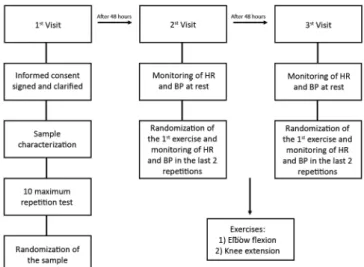
The research protocol is illustrated in Figure 1 and was conducted in three sessions at the Universidade Salgado Oliveira. During the first session an informed consent form was presented and signed; participants were characterized as shown in Table 1. A 10RM test was performed for the two exercises to which the participants were exposed in sessions 2 and 3. 10RM is the maximum load a patient can complete in 10 repetitions. It was determined in a maximum of 3 attempts, as the largest weight successfully completed.7
During the second session, participants were randomly assigned to perform either a unilateral elbow flexion (small mass muscle), or a unilateral knee extension (large mass muscle). During the third session, participants performed the alternate exercise, following the same procedures of the previous training. A 48 hour interval was allowed between each session.
We also note that it has been claimed that cardio -vascular responses may be affected as a function of the muscle mass involved in the exercise,4 but other studies
failed to confirm this claim.3,5 Understanding the influence
on cardiovascular variables of strength training of muscular groups with different volumes in middle-aged people is an essential element for the evaluation of health and quality of life. Therefore, the aim of this study was to analyze the beha -vior of heart rate, systolic and diastolic blood pressure, and double product in middle-aged women while performing two exercises for muscle groups with different sizes. The muscle groups chosen were (a) the elbow flexors as a small mass and (b) the knee extensors as a large mass muscular group.
■
MATERIAL AND METHODSParticipants
The sample of the study comprised eight women. The inclusion criteria were: women over 45 years old, physically active for at least the past six months.6 The exclusion
criteria were: individuals with cardiovascular, metabolic or osteoarticular disease that might compromise performance or expose participants to risks. In addition, individuals using substances that might alter the cardiovascular responses, such as, ergogenic products, caffeine, alcohol and smoking were excluded.
Exercise protocol
The elbow flexion exercise was performed with the individual seated on a chair, with 15° of back extension approximately; it started with an elbow angle of 180° and ended with a full elbow flexion (forearm in supination). The left arm remained stationary and was used to measure blood pressure. The left arm was slightly bent at shoulder height, leaning on a screen for measuring. The knee extension exercise was performed with the individual seated on a chair; it started from a knee angle of 90° and ended with the total knee extension. Blood pressure was measured as described for elbow flexion.
Each exercise session was preceded by a warm-up cosisting of 5-10 repetitions at 40-60% of perceived maximum. After a 5 minute interval exercise was initiated. The cadence of the movement was regulated, one second for the contraction phase and one second for the relaxation phase, totaling 2 seconds for each repetition. Participants performed 3 series of 10 repeats with 1 minute of interval between series. The order of exercises (elbow flexion or knee extension) was randomized for each participant. Tests were conducted between the 3:00 and 7:00 PM at 23°C approximately. Blood pressure and the heart rate were monitored at rest (before the warm-up) and at the end of each series. While executing the exercises, participants were advised not to perform the Valsalva maneuver.
Figure 1 - Experimental design of the study.
Blood pressure and Heart Rate monitoring
Table 1 - Sample characterization described as mean and standard deviation
Sample characterization
Situation Age Weight Height BMI Load EF Load KE (yrs) (Kg) (cm) (kg/m2) (kg) (kg)
Mean 56.1 65.1 156.5 26.6 5.3 15.6
Standard
Deviation 7.0 3.8 3.4 1.8 1.0 4.1
*BMI: Body mass index; EF: Elbow lexion; KE: Knee extension.
Statistical Analysis
After checking the normality assumption, we perfor -med a Two-Way ANOVA and applied the post hoc Tukey test. The analyzes were performed using GraphPad Prism 5 (Gra -phPad Software Inc., CA, USA) at a significance level of p ≤ 0.05.
■
RESULTSThe sample was characterized and their values are described in Table 1.
Figure 2 displays systolic and diastolic pressures at rest and exercise for the two different exercises. No significant differences were observed when comparing elbow flexion to knee extension. However, a significant increase in systolic pressure occurred for both exercises from rest to exercise execution. Diastolic pressure remained unaltered.
Figure 2 – Mean and standard deviation for systolic (hatched blocks) and diastolic (solid blocks) arterial pressure at rest and after three series of elbow lexion (EF) and knee extension (KE). * Signiicant diferences vs. the three series (p < 0,01), only for Systolic arterial pressure.
Figure 3 displays heart rate at rest and exercise for the two different exercises. No significant differences were observed when comparing elbow flexion to knee extension. However, a significant increase in heart rate occurred for both exercises from rest to exercise execution.
Figure 4 displays the double product at rest and exercise for the two different exercises. No significant differences were observed when comparing elbow flexion to knee extension. However, a significant increase in the double product occurred for both exercises from rest to exercise execution.
Figure 3 – Mean and standard deviation for heart rate at rest and after three series of elbow lexion (EF) and knee extension (KE). * Signiicant diferences vs. the three series (p < 0,01).
Figure 4 – Mean and standard deviation for the double product (mm Hg*min-1) at
rest and after three series of elbow lexion (EF) and knee extension (KE). * Signiicant diferences vs. the three series (p < 0,01).
■
DISCUSSIONCurrently, Strength Training is highly recommended for very diverse populations, from healthy individuals to patients with cardiovascular disease.5 Thus, it becomes
relevant to study variables such as the activation of muscles with different masses during strength training, and to monitor cardiovascular variables in order to further clarify and increase the safety for the prescription of this procedure.8
Studies analyzing different muscle masses have usually been performed through exercises involving muscle groups with different masses.9,10 These reports compared
mono- to multi-joint exercises, and analyzed several groups of muscles against just one. The present study concentrates on the cardiovascular responses to standardized exercise procedures performed on two specific muscle groups with very different muscular mass: the light elbow flexors and the heavy knee extensors.
As previously noted, there is no consensus in the literature on the effects of exercising muscle groups with different masses on the cardiovascular response.3-5 Our
and more specifically with D’Assunção et al.,3 who used
the same exercises in healthy young men. Polito et al.2 also
found no significant differences in cardiovascular responses, comparing the performance of unilateral and bilateral knee extension exercises, with three sets of 12RM.
The studies of MacDougall et al.11 and Seals et al.12
reported that there is an increase in peripheral vascular resistance according to the muscle mass involved, which raises blood pressure during exercise. These findings do not agree with ours, but we must take into account other relevant variables such as interval between sets and number of repetitions, which may, or may not generate influences on the cardiovascular response, all of which may explain our discrepant results.2 We observed significant differences only from rest to exercise within their own sessions in both exercises. During the execution of the elbow flexion exercise, a significant cardiovascular response was observed for all cardiovascular variables, from rest to effort, corroborating a similar study in normotensive men, which also presented a significant difference in systolic pressure for the 2nd and 3rd series. Whereas D’Assunção et al.3 reported similar significant cardiovascular responses; however, in terms of intra-series behavior, significant differences were only noted in systolic pressure responses between the 1st and 3rd series. Such differences may be explained by the previous experience of the participants, as well as by gender and age.
The American College of Sports Medicine (ACSM)
defines the double product as an excellent indicator of cardiac overload when individuals perform strength training. The double product values (see figure 4) obtained in this study average below the cutting point suggested by ACSM as a risk for angina pectoris.13
Our study has limitations. The technique used to measure blood pressure was not the gold standard for this measurement and the sample size was small. We emphasize the importance of future studies, trying to minimize these limitations, as well as others, in order to better understand the cardiovascular responses with muscle groups with different sizes in women over 45 years.
■
CONCLUSIONSWe can conclude that there is no difference in acute cardiovascular responses for exercises involving different muscle mass volumes, namely by performing elbow flexion and knee extension exercises with equivalent volume, interval and intensity, in normotensive women above 45 years. Further studies should examine these variables in different conditions such as weather, climate and other populations.
■
CONFLICT OF INTERESTThe authors state no conflict of interest.
■
AUTHOR PARTICIPATIONPedreiro RCM, Santos RFS, Machado S and Maranhão Neto A developed the project, discussed the data, wrote the
first draft of the article, and reviewed its final form; Pedreiro
RCM, Machado S and Maranhão Neto A discussed the data and reviewed the final form of the article.
RESPOSTAS CARDIOVASCULARES AGUDAS DE EXERCÍCIO DE FORÇA PARA OS MÚSCULOS BÍCEPS E QUADRÍCEPS EM MULHERES DE MEIA IDADE
OBJETIVO: O treinamento de força é cada vez mais popular e é estudado pela sua eficácia no aumento da potência muscular e resistência. Alega-se que as respostas cardiovasculares estão relacionadas com a massa muscular envolvida durante o exercício, mas alguns estudos não confirmam esses achados. Analisamos o comportamento da freqüência cardíaca, pressão arterial sistólica/diastólica e duplo produto em mulheres de meia-idade durante a execução de exercícios para dois grupos musculares com diferentes volumes: flexores do cotovelo (massa pequena) e extensores do joelho (massa grande).
MÉTODO: A amostra foi constituída por oito mulheres fisicamente ativas por pelo menos 6 meses. O procedimento experimental foi realizado em 3 sessões. Na primeira, a caracterização da amostra e um teste de 10 repetições máximas (10RM) foram realizados. Na segunda, as participantes realizaram um aquecimento e, em seguida, (dependendo da randomização), a flexão do cotovelo ou a extensão do joelho em 3 séries de 10 repetições. Na terceira sessão, os participantes realizaram o exercício alternado, respeitando os mesmos procedimentos. As pressões sistólica e diastólica e a frequência cardíaca foram verificadas 5 minutos antes do aquecimento e ao final de cada série.
RESULTADOS: Não foi observada diferença nas respostas cardiovasculares agudas de exercícios envolvendo os dois volumes diferentes de massa muscular em mulheres normotensas acima de 45 anos de idade.
CONCLUSÃO: A resposta cardiovascular não é afetada pela massa muscular exercida nessa população específica. Novos estudos devem analisar essas variáveis em diferentes condições, tais como tempo, clima e outras populações.
PALAVRAS-CHAVE: treinamento de força, pressão arterial, duplo produto.
■
REFERENCES8. Polito MD, Farinatti PTV. Respostas de freqüência cardíaca, pressão arterial e duplo produto ao exercício contra resistência: uma revisão de literatura. Rev Port Ciências Desp. 2003;3(1):79-91.
9. Oliveira BS, Pedreiro RCM, Machado S, Maranhão-Neto GA. Análise
do comportamento do duplo produto em exercícios monoarticulares
e multiarticulares em membros inferiores. Rev Bras Fisiol Exerc. 2015;14(2):76-80
10. Salles BF, Miranda F, Novaes J, Simão R. Influência de influência de
dois e cinco minutos dois e cinco minutos dois e cinco minutos de
intervalo de intervalo entre séries entre séries em exercícios mono e
multiarticulares em exercícios mono e multiarticulares para membros
inferiores. Rev Mackenzie Ed Fís Esp. 2008;7(1):35-44.
11. MacDougall JD, Tuxen D, Sale DG, Moroz JR, Sutton JR. Arterial blood
pressure response to heavy resistance exercise. J Appl Physiol. 1985;58:785-90.
12. Seals DR, Washburn RA, Hanson PG, Painter PL, Nagle FJ. Increased cardiovascular response to static contraction of larger muscle groups. J Appl Physiol. 1983;54:434-7.
13. Leite TC, Farinatti PTV. Estudo da frequência cardíaca, pressão arterial
e duplo produto em exercícios resistidos diversos para grupamentos
musculares semelhantes. Rev Bras Fisiol Exerc. 2003;2:29-49. 2. Polito MD, Rosa CC, Schardong P. Respostas cardiovasculares agudas
na extensão do joelho realizada em diferentes formas de execução. Rev Bras Med Esporte. 2004;10(3):173-6. http://dx.doi.org/10.1590/ S1517-86922004000300006.
3. D’Assunção W, Daltro M, Simão R, Polito M, Monteiro W. Respostas cardiovasculares agudas no treinamento de força conduzido em exercícios para grandes e pequenos grupamentos musculares.Rev Bras Med Esporte. 2007;13(2):118-22. http://dx.doi.org/10.1590/ S1517-86922007000200010.
4. Baum K, Rüther T, Essfeld D. Reduction of blood pressure response during strength training through Intermittent muscle relaxations. Int J Sports Med. 2003;24(6):441-5. http://dx.doi. org/10.1055/s-2003-41172
5. Fleck SJ, Dean LS. Resistance-training experience and the pressor response during resistance exercise. J Appl Physiol. 1987;63:116-20.
6. American College of Sports Medicine. ACSM’s guidelines for exercise testing and prescription. 6th edition. Baltimore: Lippincott Williams & Wilkins, 2000.