Received from Hospital Vita Batel in Curitiba, Parana, Brazil.
1. Physiotherapist in the Intensive Care Unit of Instituto de Assistência Médica ao Servidor Público Estadual (IAMSPE), M.Sc. Student, Department of Surgery, Faculdade de Ciências Médicas da Universidade Estadual de Campinas (FCM-UNICAMP)
2. Assistant Professor Ph.D., UNICAMP, PhD in Medical Sciences UNICAMP
3. Physiotherapist in the Intensive Care Unit of Hospital das Clínicas, UNICAMP, PhD De-partment of Surgery, FCM-UNICAMP
4. Physiotherapist, Ph.D., Director of Próisio Assistência Fisioterápica, Professor of the Lato Sensu Post-graduate Program in Physical Therapy in Intensive Care at the Centro de Estu-dos, Pesquisa e Extensão em Saúde Inspira, Curitiba, PR
5. Physiotherapist; Postgraduate Student at Lato Sensu Post-graduate Program in Physi-cal Therapy in Intensive Care at the Centro de Estudos, Pesquisa e Extensão em Saúde Inspira, Curitiba, PR
6. Physiotherapist at Hospital Vita Batel, Specialist in Physical Therapy in Intensive Care at Centro Universitário Campos de Andrade - Uniandrade; Specialist Cardio-Respiratory Physiotherapy at Universidade Tuiuti do Paraná
Submitted on September 11, 2009. Approved on September 9, 2010.
Correspondence to:
Dra. Paula Patelli Juliani Remístico
Faculty of Medical Sciences - Universidade Estadual de Campinas Rua Tessália Vieira de Camargo, 126
Cidade Universitária “Zeferino Vaz” 13083-887, PO Box: 6111 – Campinas, SP, Brazil E-mail: [email protected]
SCIENTIFIC ARTICLE
Impact of Alveolar Recruitment Maneuver in the Postoperative
Period of Videolaparoscopic Bariatric Surgery
Paula Patelli Juliani Remístico
1, Sebastião Araújo
2, Luciana Castilho de Figueiredo
3, Esperidião Elias Aquim
4,
Larissa Mottim Gomes
5, Morgana Lima Sombrio
5, Sabrina Donatti Ferreira Ambiel
6Summary: Remístico PPJ, Araújo S, Figueiredo LC, Aquim EE, Gomes LM, Sombrio ML, Ambiel SDF - Impact of Alveolar Recruitment Maneuver
in the Postoperative Period of Videolaparoscopic Bariatric Surgery.
Background and objectives: Pulmonary complications in bariatric surgery are common and, therefore, alveolar recruitment maneuvers (ARM)
have been used to prevent or reduce them in the postoperative period (POP). The aim of this study was to evaluate the impact of ARM performed intraoperatively in patients undergoing bariatric surgery by videolaparoscopy in the incidence of postoperative pulmonary complications.
Methods: Randomized clinical trial with 30 patients divided into control group (CG) and experimental group (EG), with analysis of spirometric, ventilatory, hemodynamic, and radiographic variables. ARM was performed in EG with positive end expiratory pressure of 30 cmH2O and
inspira-tory plateau pressure of 45 cmH2O for 2 minutes after pneumoperitoneum delation.
Results: We observed a signiicant decrease in spirometric values (p ≤ 0.001) and higher incidence of pulmonary complications on chest radio-graph (p = 0.02) in CG, as well as signiicant improvement in dyspnoea Borg scale (p ≤ 0.001) in EG.
Conclusions: We conclude that ARM is a safe and effective technique when used for prevention of pulmonary complications in patients undergo-ing bariatric surgery, resultundergo-ing in more favorable radiological and spirometric indundergo-ings in the experimental group compared to the control group in the PO.
Keywords: Positive Pressure Respiration; Postoperative Complications; Pulmonary Atelectasis; Laparoscopy; Bariatric Surgery.
[Rev Bras Anestesiol 2011;61(2): 163-176] ©Elsevier Editora Ltda.
INTRODUCTION
Bariatric surgery by videolaparoscopy has been used since 1994 with a mixed technique of Roux-en-Y gastric bypass as a less invasive procedure, thereby reducing the incidence of early and late complications compared with the conventional technique 1-3.
Morbid obesity can promote a restrictive syndrome with ac-cumulation of perithoracic and abdominal fat, aggravated after general anesthesia in the supine position, a fact that leads to
reduced lung volume and functional residual capacity (FRC), favoring the development of atelectasis and changing the re-lationship between ventilation and perfusion, and increasing the physiological pulmonary shunt 4-11.
Some ventilatory strategies have been proposed and used to improve gas exchange during anesthesia in bariatric sur-gery 12-14. Among them, the most studied today is the recruit-ment maneuver (ARM) that, which consists of pulmonary in-lations and sustained use of positive end expiratory pressure (PEEP) to prevent atelectasis or alveolar hypoventilation dur-ing surgery in operated patients 15.
Therefore, the purpose of this study was to evaluate the impact of recruitment maneuvers performed during surgery on the incidence of postoperative pulmonary complications in patients undergoing videolaparoscopic bariatric surgery.
METHOD
This was a randomized clinical trial with a cross-analytic and prospective design, with a quantitative approach developed at the Hospital Vita Batel, Curitiba-PR, in the period from Febru-ary to June 2009. The project was approved by the Research Ethics Committee of Centro de Estudos, Pesquisa e Extensão em Saúde Inspirar (Approval report nº 014/08) and a written informed consent term in writing was obtained from each par-ticipant.
are patients with serious lung diseases, congestive heart fail-ure (NYHA class III or IV), coronary artery disease, individuals who, for some reason, required intervention by laparotomy, and those who presented hemodynamic instability (MAP ≤ 60 mmHg) at the scheduled time for the ARM.
The inal population comprised 30 patients of both sexes submitted to bariatric surgery by mixed videolaparoscopy technique randomly distributed into two simple groups, the Control Group (CG) and Experimental Group (EG).
The evaluation was conducted at three speciic times: pre-operative (Pre-OP), intrapre-operative (Intra-OP) and postopera-tive (Post-OP).
At irst (pre-OP), patients underwent a pulmonary function test with Respiradyne – Plus spirometer to check the values of forced expiratory volume in one second (FEV1), forced vi-tal capacity (FVC), peak expiratory low (PEF), maximal vol-untary ventilation (MVV) and forced expiratory low 25-75% (FEF25-75%), having the best value been used for the three at-tempts performed 16-19.
In the second stage (Intra-OP), with patients already in the operating room, we initiated 100% oxygen by face mask, then proceeding to intravenous induction with sequential adminis-tration of midazolam (50-10 mg), hydrochloride of remifenta-nil (300 mg), propofol (2-3 mg.kg-1) and atracurium (50 mg). Maintenance of anesthesia was performed using propofol from 0.075 to 0.1 mg.kg-1 and remifentanil hydrochloride 0.75 to 1.0 µg.kg-1.min-1.
The EG patients underwent ARM using a PEEP of 30 cm-H2O and inspiratory plateau pressure of 15cmH2O above PEEP for two minutes immediately after abdominal dela-tion of pneumoperitoneum (PNP) using Takaoka Samurai and Dräger Medical fans, recording ventilatory parameters of tidal volume (TV) used, fraction of inspired oxygen (FiO2) and PEEP in the early induction. CG patients did not undergo ARM.
Both groups were monitored and hemodynamic and res-piratory function were recorded, such as heart rate (HR), respiratory rate (RR), mean arterial pressure (MAP), oxygen saturation (SpO2) and end tidal carbon dioxide partial pres-sure (PETCO2) at four speciic times: pre-PNP (ive minutes after tracheal intubation), post-PNP (15 minutes after instal-lation of pneumoperitoneum), immediately after ARM and ive minutes after ARM. Data were collected using the following equipment: vital sign monitor Datascope Spectrum; Dräger Vamos capnograph, and pulse oximetry by Oxipani Takaoka. Also the time of surgery was documented.
Thereafter, lung function tests were again conducted in the irst and second days Post-OP. Chest radiographs were performed in the POP and Post-OP, and analyzed by re-searchers in conjunction with the report of a radiologist. The patients underwent daily respiratory and motor physiotherapy, according to the Próisio protocol; after this procedure, the modiied BORG scale for dyspnea (BORGd) was evaluated in both groups.
For data analysis, parametric statistical tests were used as normality was noted using Levene’s test, applying the Student’s
t test and ANOVA. To check the likelihood of development
res-piratory complications in both groups, the relative risk was cal-culated to assess the effectiveness of the treatment employed in this study. The level of signiicance was 5% (p ≤ 0.05).
RESULTS
There was homogeneity in the demographic characteristics of the sampling distribution for the 30 patients in the study (15 in each group). The gender distribution of subjects in the con-trol group was composed of 10 females (67%) and 5 males (33%) as the experimental group, 11 were females (73%) and 4 males (27%).
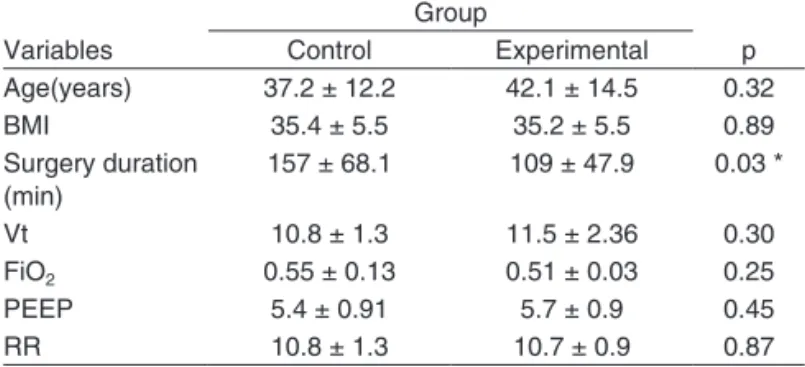
Surgical time was signiicantly higher in CG, with an av-erage of 157 minutes compared to EG, which avav-eraged 109 minutes (p = 0.03), as seen in Table I.
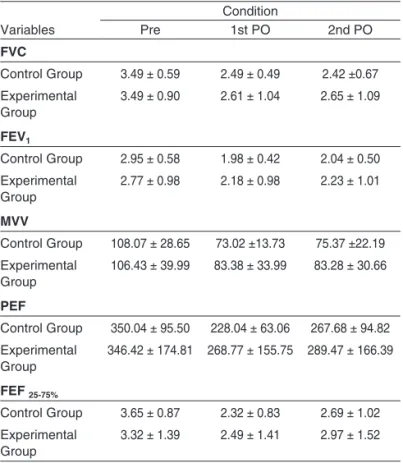
Regarding the spirometric variables, we found a decrease in CG from the Pre-OP FVC to the 1st and 2nd Post-OP (p < 0.001). As for FEV1, a reduction in the Pre-OP for the 1st and 2nd Post-OP (p < 0.001) was observed. The MVV was reduced from the Pre-OP to the 1st (p < 0.001) and to the 2nd Post-OP (p = 0.001), as were PEF values for the 1st Post-OP (p = 0.001) and the 2nd Post-OP (p = 0.031) when compared with the Pre-OP. Finally, there was also a reduction in Pre-OP FEF25-75% for the 1st Post-OP (p = 0.001) and the 2nd Post-OP (p = 0.017), as shown in Table II and Figure 1.
Analyzing the spirometric values of EG, there was a de-cline in FVC for the 1st Pre-OP (p = 0.024) and for the 2nd Post-OP (p = 0.027), as shown in Table II and Figure 1.
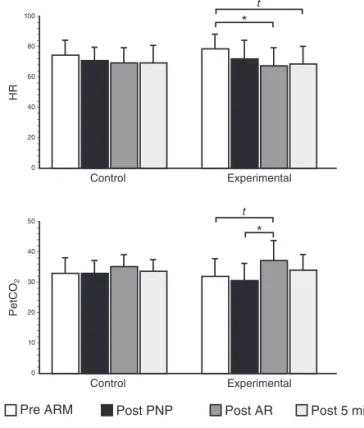
In CG, no signiicant changes in the hemodynamic parame-ters (HR, MAP, SpO2 and PETCO2) were observed, (Table III). In EG, HR was reduced in value by comparing the Pre-PNP and -Post-ARM moments (p = 0.04).
The variable PETCO2 showed an increase when compar-ing the Post-PNP with the Post-ARM moments (p = 0.02), as shown in Figure 2 and Table III.
Regarding the Borg dyspnea scale (BORGd), the CG showed a slight but not signiicant symptom improvement from the 1st to the 2nd Post-OP. On the other hand, the EG showed statistically signiicant improvement in BORGd from
Table I - Demographic Data of the Studied Population in the Preoperative Period
Variables
Group
p
Control Experimental
Age(years) 37.2 ± 12.2 42.1 ± 14.5 0.32
BMI 35.4 ± 5.5 35.2 ± 5.5 0.89
Surgery duration (min)
157 ± 68.1 109 ± 47.9 0.03 *
Vt 10.8 ± 1.3 11.5 ± 2.36 0.30
FiO2 0.55 ± 0.13 0.51 ± 0.03 0.25
PEEP 5.4 ± 0.91 5.7 ± 0.9 0.45
RR 10.8 ± 1.3 10.7 ± 0.9 0.87
Values expressed as mean ± standard deviation, BMI: body mass index; Vt:
tidal volume, FiO2: fraction of inspired oxygen, PEEP: positive end expiratory
the 1st to the 2nd Post-OP (p < 0.001), as shown in Table IV and Figure 3.
To assess the risk of patients developing respiratory com-plications, we calculated the relative risk (RR) and efficacy of treatment. Evaluation of radiographic indings of patients included in the survey did not reveal signiicant changes in any of the patients in the Pre-AP, whereas in the Post-OP, nine individuals from the control group showed changes (40% atelectasis and 20% pleural effusion), and in EG only two indi-viduals showed changes (13% pleural effusion).
Calculating the relative risk, with a conidence interval of 95% (0.06-0.86), it was shown that CG showed an increased risk of developing pulmonary complications in the post-OP (78% more than the EG; RR = 0.06-0.86, conidence interval 95%, p = 0.02).
DISCUSSION
In the present trial, it was observed that in relation to the ven-tilatory parameters evaluated (VC, FiO2, PEEP, FR) no sta-tistically signiicant differences between groups were found. This might be explained by the standardization of mechani-cal ventilation used by the staff anesthesiologists. However, the prolonged duration of surgery can cause deleterious ef-fects on lung mechanics 20, and this may be, partially one explanation for the higher number of respiratory and spiro-metric changes observed in Post-OP patients in the CG, Table II –Descriptive Data of the Spirometric Test
Variables
Condition
Pre 1st PO 2nd PO
FVC
Control Group 3.49 ± 0.59 2.49 ± 0.49 2.42 ±0.67
Experimental Group
3.49 ± 0.90 2.61 ± 1.04 2.65 ± 1.09
FEV1
Control Group 2.95 ± 0.58 1.98 ± 0.42 2.04 ± 0.50
Experimental Group
2.77 ± 0.98 2.18 ± 0.98 2.23 ± 1.01
MVV
Control Group 108.07 ± 28.65 73.02 ±13.73 75.37 ±22.19
Experimental Group
106.43 ± 39.99 83.38 ± 33.99 83.28 ± 30.66
PEF
Control Group 350.04 ± 95.50 228.04 ± 63.06 267.68 ± 94.82 Experimental
Group
346.42 ± 174.81 268.77 ± 155.75 289.47 ± 166.39
FEF 25-75%
Control Group 3.65 ± 0.87 2.32 ± 0.83 2.69 ± 1.02
Experimental Group
3.32 ± 1.39 2.49 ± 1.41 2.97 ± 1.52
Values expressed as mean ± standard deviation; FVC: forced vital capacity, FEV: forced expiratory volume, MVV: maximal voluntary ventilation; PEF: peak expiratory low, FEF: forced expiratory low.
5.0 4.0 3.0 2.0 1.0 0
Pré 1st PO 2nd PO
CVF Experimental Control 450.0 -400.0 -350.0 -300.0 -250.0 -200 -150.0 -100.0 -50.0 0
Pré 1st PO 2nd PO
PFE Experimental Control 4.0 3.0 2.0 1.0 0
Pré 1st PO 2nd PO
VEF 1 Experimental Control 5.0 4.0 3.0 2.0 1.0 0
Pré 1st PO 2nd PO
FEF 25-75%
Experimental Control
140.0 - -120.0 - -100.0 - -80.0 - -60.0 - -40.0 - --20.0 - 0
Pré 1st PO 2nd PO
VVM
Experimental Control
*: p ≤ 0.05; ***: p ≤ 0.001.
since the surgical time was signiicantly higher compared to the EG (p = 0.03).
This study demonstrated a reduction in the values planned for the assessment in both groups. In a recent study, Cardoso Filho et al. 21 demonstrated a decrease in these variables due to the surgery and the anesthetics used, leading to varying de-grees of postoperative pain and impaired respiratory muscle
function. Another group showed a decrease of 51% of FVC in obese patients as compared to subjects with normal body mass index (BMI) 22.
The intensity of postoperative pain certainly plays an im-portant role in preservation of pulmonary function after sur-gery 23-26, a fact conirmed by the decrease in spirometry val-ues in all patients.
Table IV – Descriptive Data of the Modiied Borg Scale Related to Dyspnea
Variables
Condition
1st PO 2nd PO
BORGd
Control Group 4.1 ± 2.25 2.87 ± 1.92
Experimental Group 5.6 ± 2.41 3.07 ± 2.12
Values expressed as mean ± standard deviation.
Table III – Descriptive data of the Alveolar Recruitment Maneuver
Variables
Condition
Pre ARM Post PNP Post ARM Post 5
HR
Control Group 74.0 ± 10.1 70.2 ± 9.4 69.1 ± 10.0 68.93 ± 11.2
Experimental Group 78.0 ± 10.8 71.1 ± 12.7 66.4 ± 11.8 67.8 ± 11.8
HR
Control Group 10.8 ± 13 10.9 ± 1.4 11.1 ± 1.4 11.13 ± 1.3
Experimental Group 10.8 ± 0.8 10.8 ± 0.8 10.9 ± 0.9 11.2 ± 1.2
MAP
Control Group 78.0 ±12.2 79.3 ± 19.1 77.1 ± 10.7 78.07 ± 14.1
Experimental Group 72.6 ±15.3 72.1 ± 18.8 81.1 ± 15.3 79.9 ± 16.3
SpO2
Control Group 97.7 ± 2.1 98.3 ± 2.3 98.5 ± 1.8 99.13 ± 0.8
Experimental Group 98.5 ± 2.4 98.1 ± 2.1 99.5 ± 1.1 99.5 ± 1.1
PETCO2
Control Group 32.8 ± 5.3 32.8 ± 4.3 35.0 ± 3.9 33.6 ± 3.9
Experimental Group 32.3 ± 5.4 30.9 ± 5.3 37.3 ± 6.7 34.1 ± 5.4
Values expressed as mean ± standard deviation, HR: heart rate, RR: respiratory rate, MAP: mean arterial pressure, SpO2, oxygen saturation; PETCO2: end tidal carbon
dioxide.
Pre ARM Post PNP Post AR Post 5 min
Figure 2 – Comparison of Hemodynamic and Respiratory Variables. 100
80 60 40 20 0
50 40 30 20 10 0
-HR
PetCO
2
Experimental
Experimental Control
Control
t: tendency; *: p ≤ 0.05.
1st PO 2nd PO
Figure 3 – Analysis According to the BORG Dyspnea Scale. 10
8 6 4 2 0
-BORGd
Control Experimental
Eichenberger et al. 10 demonstrated, by means of comput-ed tomography (CT), areas of atelectasis in morbidly obese patients before induction of anesthesia, after extubation and 24 hours after extubation. The authors concluded that the ar-eas of atelectasis in morbidly obese patients tend to incrar-ease and persist 24 hours after extubation compared to obese peo-ple and also to patients with normal BMI.
Other indings observed, also by means of CT, that despite the use of oxygen with 100% concentration, the application of PEEP throughout the induction period almost completely prevents atelectasis formation in morbidly obese patients. The authors also reported that when induction is performed with-out PEEP, atelectasis may develop within minutes of induc-tion, signiicantly impairing the blood oxygenation 27.
The ARM is a technique that uses sustained increase in airway pressures, with the aim of recruiting collapsed alveolar units, increasing lung area available for gas exchange and, therefore, arterial oxygenation 15. Nowadays, this procedure has been used frequently during surgery 15,28-31.
The literature shows good results when PEEP is used in patients undergoing general anesthesia, whereas areas of atelectasis develop during the anesthetic procedure, leading to impaired gas exchange, increased pulmonary shunt and worsening of oxygenation, facts that are known to be aggra-vated in morbidly obese patients 10,13,15,26, 29, 30, 32, 33.
A study showed that the alveolar recruitment with moder-ate levels of PEEP may produce beneicial effects in patients undergoing abdominal, thoracic, or laparoscopic surgery and in patients prone to developing moderate degrees of lung in-jury after surgical procedures 34. Other studies have present-ed indings more favorable to improve oxygenation and blood pressure of oxygen (PaO2) in bariatric surgery 13,15,27,35,36.
Several authors mention the difficulty of making adequate ventilation in morbidly obese patients, due to unawareness of the ideal VC for such individuals 13, while others search which mode of ventilation is the best one for them. Cadi et al. 37 compared the effects of pressure controlled ventilation
mode (PCV) to the volume controlled ventilation mode (VCV) in airway pressure, blood gases and hemodynamic variables during surgery to laparoscopic surgery. They concluded that the PCV mode improved gas exchange without increasing pressure ventilation or causing any side effects hemodynam-ics during anesthesia in laparoscopic bariatric surgery.
Thus, some studies are being used with this mode of ven-tilation in order to assess the respiratory function in the post-operative period of these patients. One proposal is to evaluate the efficacy of recruitment maneuvers in morbid obesity, since this procedure has not been fully disseminated in this popula-tion 15.
Whalen et al. 15 quantiied the effects of maneuver followed by PEEP on oxygenation, lung mechanics and hemodynam-ics during laparoscopic bariatric surgery. Two groups were studied showing an increase in PaO2/FiO2 intraoperatively and increased dynamic compliance of respiratory system. But 30 minutes after extubation, there was no signiicant differ-ence between the control and the recruitment groups. They conclude it would be reasonable to state that more studies
are needed to examine whether the use of immediate post-extubation strategy of expansion of the lung (CPAP) might improve outcomes in patients undergoing lung in bariatric sur-gery.
In a recent study, two techniques of ARM were compared in 47 patients using the response PaO2/FiO2, and the sum PaO2 and PaCO2 in BMI class III obese in open bariatric sur-gery. The authors noted that, at the time of ARM, a statisti-cally signiicant difference was observed with increase in the values of PaO2, PaO2/FiO2 ratio, sum of PaO2 and PaCO2, plateau pressure, and mean airway pressure 35.
Recently, Sprung et al. 36 observed 17 patients who un-derwent a recruitment maneuver during bariatric surgery associated with the use of deslurane. Distributed into two groups, those patients who underwent the maneuver showed an increase in dynamic compliance, decreased inspiratory resistance and improvement oxygenation conirmed by a decreased absorption of deslurane, increasing the alveolar concentration of anesthetic. It was concluded that the recruit-ment maneuver is an effective method to improve oxygena-tion during surgery. However, the decreased atelectasis in-dicated by improvement in oxygenation was not sufficient to alter the blood concentrations of deslurane during induction of anesthesia.
The use of CPAP for the reversal of atelectasis, to improve pulmonary exchange and mechanics is well known and wide-spread in the literature in cases of acute respiratory distress syndrome who resorted to the method of sustained pressure in the airways with levels ranging from 30 to 40 cmH2O for 30 to 90 seconds 31,38,39.
Early studies in obese patients demonstrated that CPAP, besides improving oxygenation, restores CRF 40,41 and reduc-es the risk of acute rreduc-espiratory distrreduc-ess syndrome after upper abdominal surgery 42.
A survey of 1,067 patients evaluated the risk of anasto-motic dehiscence on those who used CPAP or not. The au-thors concluded that this method is useful for the treatment of morbidly obese patients in the postoperative gastric bypass Roux-en-Y, which, in addition to improving blood oxygenation in those using the device, showed no relationship between the use of CPAP with anastomotic rupture 43.
Another study showed that CPAP improved blood oxy-genation in obese compared with those who received oxygen therapy with nasal catheter at 4 L.min-1 in moments as before surgery, 30 minutes after admission to the recovery room, post anesthesia , 4 hours and 8 hours after this admission 44.
In a recent study, Constantin et al. 45 used a recruiting ma-neuver with CPAP of 40 cmH20 for 30 seconds to produce an improvement in SpO2 and PaO2 during periods of 5 and 30 minutes after intubation. Such a maneuver, besides prov-ing to be effective in reducprov-ing hypoxemia durprov-ing anesthesia, was considered an attractive treatment strategy, for it would have previous and noninvasive ventilation, through the sup-port pressure ventilation in the Pre-OP period.
to ARM, which enhances the effectiveness of maneuvering among individuals in the EG, which showed improvement in lung volume and capacity, observed in spirometry and chest radiography. When evaluated separately to chest radiographs, we observed a 78% reduction in the incidence of pulmonary complications in patients of EG in the Post-OP.
Morbid obesity and pneumoperitoneum signiicantly affect respiratory mechanics, leading to retention of CO2 compared with 14 non-obese subjects, but the CRF is reduced further when the surgery is performed in Trendelenburg associated with videolaparoscopy 23. Another study analyzed the static compliance (Cst) and respiratory system compliance (sr) in three different positions: supine, Trendelenburg and reverse Trendelenburg. It was observed that Cst,sr supine was lower in morbidly obese patients, not being signiicant in other posi-tions; when compared to pneumoperitoneum, showed a sig-niicant decrease in Cst,sr 14 in all groups. Two other studies showed the same decrease in Cst, with decrease of 40% after induction of the PNP 46,47.
The systemic absorption of CO2 in laparoscopic surgery can bring adverse cardiorespiratory and ventilator effects and increase the load by increasing the transperitoneal pressure, opposing the descent of the diaphragm 23. From this prem-ise, in the present study we observed that immediately after ARM, an increase of PETCO2 was observed, justiied by the
decrease in minute volume during ARM that leads to this mo-mentary retention of CO2, values that returned to normal after ive minutes maneuver.
Research conducted with healthy patients showed hemo-dynamic changes induced by pneumoperitoneum, as for ex-ample raised intra-abdominal and intrathoracic pressures, increased heart rate (HR), blood pressure, systemic vascular resistance and pulmonary vascular resistance 14,46,48. How-ever, in this study, we found that EG had a signiicant drop in HR, a inding contrary to the authors cited, with no signiicant hemodynamic instability, keeping normal values of MAP.
By using a PEEP of 30 cmH2O in obese patients, we can see improvement in PaO2/FiO2 2 minutes after the suture of the aponeurosis 35. In another study, which used an inspira-tory pressure of 45 cmH2O in order to analyze the mechanics of ventilation, the PaO2, PaCO2 and PETCO2, it was observed that, both in the supine position and in the group Tredelen-burg, mechanical respiration after induction of the PNP
wors-ened, compared to the baseline 49.