IX
Radiol Bras. 2015 Jan/Fev;48(1):IX–XI
Alexandre Dias Mançano1, Cássia Carvalho de Siqueira2, Gustavo Gomides Macedo2
0100-3984 © Colégio Brasileiro de Radiologia e Diagnóstico por Imagem
Which is your diagnosis?
Mançano AD, Siqueira CC, Macedo GG. Which is your diagnosis? Radiol Bras. 2015 Jan/Fev;48(1):IX–XI. 1. MD, Radiologist at Radiologia Anchieta – Hospital Anchieta, Coordinator for
Medi-cal Residency at Hospital Regional de Taguatinga, Taguatinga, DF, Brazil. 2. MDs., Residents at Hospital Regional de Taguatinga, Taguatinga, DF, Brazil. Mailing Address:
A female, 59 year-old patient complaining of colic-like
abdominal pain and mild enterorrhagia for some months.
No abnormal finding was observed at physical examination
and laboratory tests. Colonoscopy demonstrated the
pres-http://dx.doi.org/10.1590/0100-3984.2015.48.1qd
ence of an expansile occlusive luminal lesion in the
ascend-ing colon. The patient was referred for radiological stagascend-ing
and submitted to contrast-enhanced abdominal computed
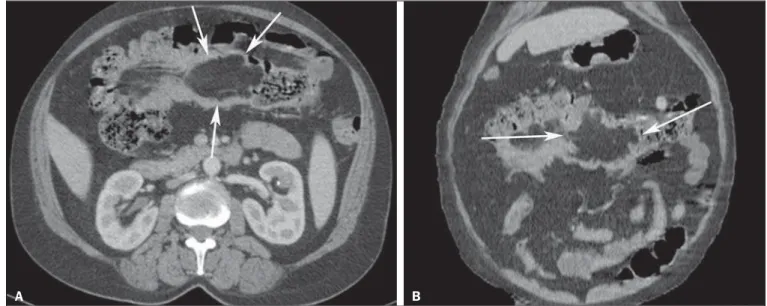
tomography (Figure 1).
Dr. Alexandre Dias Mançano. Centro Médico Hospitalar Anchieta. AE 8/10 Setor C Norte, 1º subsolo, Centro de Excelência Anchieta, lojas 12 e 13. Taguatinga, DF, Brazil, 72115-700. E-mail: [email protected].
Figure 1. Axial CT section (A) and coronal reformation (B).
X
Radiol Bras. 2015 Jan/Fev;48(1):IX–XIImage description
Figure 1.
Axial CT section (
A
) and coronal
reforma-tion (
B
) showing a predominantly lipomatous tumor with
fat density in the transverse colon (arrows), with bosselated
contour, measuring about 9 cm in its greater cross-sectional
diameter, and signs of ileocolic intussusception.
Diagnosis:
Giant colonic lipoma.
COMMENTS
The Brazilian radiological literature has recently
high-lighted the relevance of imaging methods in the
improve-ment of the diagnosis of digestive system conditions
(1–12).
Colonic lipoma is a rare benign tumor in spite of
be-ing the most common non-epithelial (mesenchymal)
neo-plasia in the gastrointestinal tract. Generally, it is located
in the submucosa and, in rare cases, in the subserous
mem-brane
(13)and may have a lobulated aspect. This tumor is
more commonly found in women (66,7%)
(14)between the
fifth and sixth decades of life, and is asymptomatic in most
cases. However, a tumor > 2–3 cm may generate normally
nonspecific and long-lasting symptoms such as abdominal
pain, blood in stools and change in bowel habits
(13). Larger
tumors may present symptoms of bowel obstruction with
colonic intussusception
(14). Spontaneous elimination of
lipomas has also been reported
(15).
Studies demonstrate that approximately 46% of bowel
lipomas are incidentally found in surgical specimens
re-moved for other conditions
(13,16), and the ascending colon
is the most common site of involvement
(13).
Imaging studies can be useful in the preoperative
di-agnosis, but generally the definitive diagnosis is made with
basis on the analysis of the surgical specimen
(13)(Figure
2). However, the finding of macroscopic fat at computed
tomography or magnetic resonance imaging narrows the
differential diagnosis in these cases
(17).
Barium enema demonstrates luminal filling failure, but
such finding is nonspecific and may be observed in other
types of colonic neoplasias
(14).
Unenhanced nodules or parietal mass with fat density
(–40 to –120 Hounsfield units), as described in the present
case, represent a useful tomographic finding in the
diag-nosis. In cases of association with intussusception, the
diagnosis may be more difficult because of the presence of
necrotic foci or infarct
(18)and, in many cases, the
differ-ential diagnosis with other lesions such as
adenocarcino-mas, lymphomas and metastases
(13,19,20)cannot be reliably
be established.
The treatment varies with the location, symptoms and
size of the lipoma. Lesions < 2 cm may be endoscopically
resected with the aid of ultrasonography in order to reduce
the risk of perforation. The great majority of authors
rec-ommend surgical treatment for lesions > 2 cm, and the
surgical options include lesion resection, partial colectomy
and hemicolectomy
(21).
Main differential diagnoses include adenoma,
adeno-carcinoma, lymphoma, neuroendocrine tumors, fibroma,
leiomyoma and hamartoma
(13,14,18,22,23).
Although rare, colonic lipomas should be considered
in the differential diagnosis of large bowel tumors. An
ac-curate diagnosis is hardly made preoperatively and many
times the lesion may be confused with adenomatous
pol-yps or carcinoma. The surgical approach is the treatment
of choice for colonic lipoma, varying with the lesion size
and location, and with the presence or not of
complica-tions
(18).
REFERENCES
1. Kierszenbaum ML, von Atzingen AC, Tiferes DA, et al. Colonogra-fia por tomograColonogra-fia computadorizada na visão do médico encaminha-dor: qual o seu valor segundo a visão de especialistas? Radiol Bras. 2014;47:135–40.
2. Francisco FAF, Araújo ALE, Oliveira Neto JA, et al. Contraste he-patobiliar: diagnóstico diferencial das lesões hepáticas focais, arma-dilhas e outras indicações. Radiol Bras. 2014;47:301–9.
3. Torres LR, Timbó LS, Ribeiro CMF, et al. Hemangioendotelioma hepático multifocal e metastático: relato de caso e revisão da litera-tura. Radiol Bras. 2014;47:194–6.
4. Terceiro MG, Faria IM, Alfenas R, et al. Hérnia de Amyand com apendicite perfurada. Radiol Bras. 2014;47(6):xi–xiii.
5. Cunha EFC, Rocha MS, Pereira FP, et al. Necrose pancreática de-limitada e outros conceitos atuais na avaliação radiológica da pan-creatite aguda. Radiol Bras. 2014;47:165–75.
6. Kadow JS, Fingerhut CJP, Fernandes VB, et al. Peritonite encapsu-lante: tomografia computadorizada e correlação cirúrgica. Radiol Bras. 2014;47:262–4.
7. Santana Júnior PJ, Aurione ACV, Dangoni R, et al. Tumor neuroen-dócrino gástrico tipo III. Radiol Bras. 2014;47(4):xi–xii.
8. Pedrassa, BC, Rocha EL, Kierszenbaum ML, et al. Tumores hepáti-cos incomuns: ensaio iconográfico – Parte 1. Radiol Bras. 2014;47: 310–6.
9. Pedrassa, BC, Rocha EL, Kierszenbaum ML, et al. Tumores hepáti-cos incomuns: ensaio iconográfico – Parte 2. Radiol Bras. 2014;47: 374–9.
10. Martins FP, Vilela EG, Ferrari MLA, et al Contribuição da medida
XI
Radiol Bras. 2015 Jan/Fev;48(1):IX–XI
do volume de fluxo da artéria mesentérica superior pelo Doppler na caracterização da atividade inflamatória em pacientes com doença de Crohn. Radiol Bras. 2013;46:279–83.
11. Teixeira ACV, Torres US, Westin CEG, et al. Tomografia compu-tadorizada com multidetectores no diagnóstico pré-operatório das complicações intestinais causadas pela ingestão de corpos estranhos da dieta sem suspeita clínica: série de casos enfatizando o uso de técnicas de renderização volumétrica. Radiol Bras. 2013;46:346– 50.
12. Costa DMC, Salvadori PS, Monjardim RF, et al. Quando a fase sem contraste intravenoso é desnecessária nos exames de tomografia computadorizada do abdome? Análise retrospectiva de 244 casos. Radiol Bras. 2013;46:197–202.
13. Ghidirim G, Mishin I, Gutsu E, et al. Giant submucosal lipoma of the cecum: report of a case and review of literature. Rom J Gastro-enterol. 2005;14:393–6.
14. Jiang L, Jiang LS, Li FY, et al. Giant submucosal lipoma located in the descending colon: a case report and review of the literature. World J Gastroenterol. 2007;13:5664–7.
15. Ryan J, Martin JE, Pollock DJ. Fatty tumours of the large intestine: a clinicopathological review of 13 cases. Br J Surg. 1989;76:793–6. 16. Taylor BA, Wolff BG. Colonic lipomas. Report of two unusual cases
and review of the Mayo Clinic experience, 1976-1985. Dis Colon Rectum. 1987;30:888–93.
17. Pereira JM, Sirlin CB, Pinto PS, et al. CT and MR imaging of extra-hepatic fatty masses of the abdomen and pelvis: techniques, diag-nosis, differential diagdiag-nosis, and pitfalls. Radiographics. 2005;25:69– 85.
18. Atmatzidis S, Chatzimavroudis G, Patsas A, et al. Pedunculated ce-cal lipoma causing colo-colonic intussusception: a rare case report. Case Rep Surg. 2012;2012:279213.
19. Michowitz M, Lazebnik N, Noy S, et al. Lipoma of the colon. A re-port of 22 cases. Am Surg. 1985;51:449–54.
20. Rogy MA, Mirza D, Berlakovich G, et al. Submucous large-bowel lipomas – presentation and management. An 18-year study. Eur J Surg. 1991;157:51–5.
21. PaÓkauskas S, Latkauskas T, Valeikait• G, et al. Colonic intussus-ception caused by colonic lipoma: a case report. Medicina (Kaunas). 2010;46:477–81.
22. Gürses B, Kabakci N, Akyuz U, et al. Imaging features of a cecal li-poma as a lead point for colo-colonic intussusception. Emerg Radiol. 2008;15:133–6.